Tag Archives: Jesus

Good News: Our Focus

Unless you’ve been living under a rock, I’m guessing you know that the world is batship crazy right now: Wars and rumours of wars (Matthew 24:6); earthquakes setting off chain-reactions of town-swallowing landslides and a cluster of volcanoes taking deep breaths to blast anytime soon; massive storms and flooding in places unprepared for such weather. And those topics are just the tips of melting icebergs.

We could focus on such things and despair; it’s no wonder that depression soars, in some places as high as 1 in 6 people globally. Positive news is elusive – not because it isn’t there, but because it doesn’t grab our emotions like negative or shocking news does; this is why it’s dominant in news reports, newspapers or YouTube thumbnails. Drama sells. But it’s also selling anti-depressants.

But I have good news: Focus is what it’s all about.

If we focus on something, that’s what we’ll begin to see everywhere. Take the example of a puzzle: When you’re working on a particular section and looking for blue, you’ll begin to see blue on pieces you hadn’t noticed before. If we focus on the negative and the bad things happening in the world, we’ll begin to see only that, and it’s no wonder we feel blue.

The Bible has a lot of wisdom, even if you don’t yet believe in God. Philippians 4:8 encourages us to focus on good things: “…whatever is true, whatever is noble, whatever is right, whatever is pure, whatever is lovely, whatever is admirable – if anything is excellent or praiseworthy – think about such things.” The message of Jesus is called the Good News for many reasons; I encourage you to explore the Bible. If you prefer to watch rather than read, I highly recommend The Chosen series – all free online, in any language! All you need to do is sign up, and you’ll have access to the series and all the extras that have already been released – five seasons so far, with two to come.

My husband and I read a devotional every evening, and one of the elements is this: “As I end this day in God’s safe keeping, I count three blessings before my sleeping.” It causes us to focus on the good things of the day; sometimes it can be as simple as, “I was able to get up without assistance, dress myself, and walk and breathe on my own.” All things that most people take for granted… until they’re gone. They are tremendous blessings and not inevitable or unimportant! It’s a good way to end the day… focusing on upsies, not downsies.

There is a lot of good news happening around the world, but as I said, it can be elusive. Thankfully, there are people out there focused on finding it for us and reporting about it! Here’s a link to the appropriately named Good News YouTube channel that brings a dose of good reports from around the world, from ecology to breakthroughs in science and medicine. Another channel worth watching is called Planet Wild, which focuses on restoration and conservation, putting people’s money to immediate use in projects focused on the environment and ecology. They show the progress and report on positive changes.

When you hear about or watch something that’s good news, please let me know in the comments below which story captures your imagination or encourages you!

Take a few minutes every day to focus on what is true, noble, right, pure, lovely, admirable, excellent and praiseworthy.

1 Comment

Filed under Articles, Humanity Highlights, Links to External Articles, YouTube Link

Merry Christmas!

Christmas Story

For me, Christmas has never been about the commercialism or the food or the decorations; we do things low-key here in Switzerland, though we do decorate and exchange gifts.  It’s about family, time together, specific gifts that the receiver wanted or needed (not just purchases to stuff the stocking or load the base of the tree).  As a Christian, the true meaning of Christmas has nothing to do with Santa or sitting around a dead tree in the living room eating candy out of socks.  It has to do with the single greatest event in the history of humanity, which was simultaneously a “non-event”… nothing like the people of the times had been expecting, and so most of them missed it altogether.  Those who have ears to hear, or eyes to see, will hear and see; those who don’t, or who choose to remain deaf and blind, will do so; it’s that simple.  So it is that many people today repeat history and miss the point of Christmas altogether.  They get bogged down in materialism, commercialism, superficiality or social pressures of one form or another, and forget about the historical and spiritual aspects of the holiday.

Personally, we will continue to celebrate Christmas with a Christmas tree, gifts, Christmas music and time together with loved ones, all the while remembering the true Reason for the Season, for the greatest demonstration of sacrificial love next to the act of Jesus’s obedience to the point of the crucifixion:  That of coming to Earth in the vulnerable form of a baby, born into a family with no status, no wealth and no social power, becoming a human in order to identify with us in every way, and to eventually pay the ultimate price on our behalf so that, if we accept what Jesus did for us on the cross, we can know him intimately – on the deepest level of connection possible to humans in our limitations of time and space:  That of the heart, the soul, the mind, and the spirit.  The more I think about it, the more mind-boggling it is; the events that we celebrate at Christmas were set in motion for you and for me.  It’s that simple.

I wish you all a Merry Christmas, and a Blessed New Year!

Chalkboard - Christmas 1

13 Comments

Filed under Articles, Musings

The History of the Nativity & Christmas

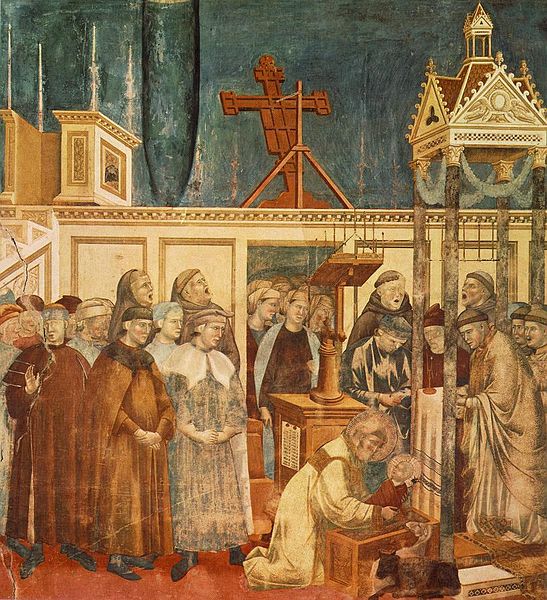
nativity - by Giotto di Bondone (1267-1337)In 1223, in Greccio, Italy, Saint Francis of Assisi is accredited with creating the first Nativity Scene.  We tend to think of commercialism and materialism as a modern disease, but in fact, Francis created that display to be a visual reminder of what Christmas was all about, and to counter what he felt was a growing emphasis on secular materialism and gift-giving.  It was to be a day of celebration and worship of thanks to God for what he had inaugurated through the birth of the prophesied Messiah, Jesus.

When we think of a modern nativity scene, we think of a few elements as standard:  Shepherds, Jesus in a wooden manger of straw, three kings, angels, and cattle and donkeys and sheep.  In fact, the stable was more likely a cave or a small hand-dug dugout, a shelter for animals in cold weather or raids, and perhaps a place to store surplus grains or foodstuffs.  The manger was a feeding trough, much like modern feeding troughs found on small farms.  The shepherds “watching the flocks by night”  tells us that it was likely in spring or summer in that region; the day we celebrate as Christmas was adopted throughout Western Europe in the fourth century.  Imagine the scenario:  Rome had called for a census of the entire region, turning everything on its head as everyone was required to travel to their ancestral homes, including businessmen like Joseph, and innkeepers as well.  Hundreds of people descended en masse onto sleepy little villages unequipped with beds or food to cope with them all.  Perhaps Joseph had tried at several places in Bethlehem; perhaps there was only one Bed & Breakfast in the entire village; turned away, they headed back to the stable to get their donkey, and uh, “Wait!  The baby’s coming!”

The kings were actually Magi, likely a caste of scientists and astronomers, from the “east” – i.e. east of Israel, which could have made them Asian, Indian, Caucasian, or even African.  There were not three, but rather three gifts:  Gold, Frankincense and Myrrh.  In reality, their number might have been more like a small army:  They would not have travelled such a distance with the quantities of gifts fit not only for a king but representing their own importance, as well as the honour they wished to bestow on this new king, without protection!  The Bible records that King Herod and all Jerusalem were disturbed by their presence and the reason for their journey (Matthew 2).  The three gifts offered by the Magi were very symbolic:  Gold was a symbol of kingship, the wealth of the earth.  It is one of the only metals that, when heated, loses none of its nature, weight or colour, but allows impurities to surface.  It is used to symbolize faith and the process of refinement.  Frankincense represents priesthood and divinity.  It was familiar to most people in the ancient world, used in religious ceremonies.  Myrrh, unlike sweet Frankincense, is bitter.  It was used as a resin in a spice mixture used to embalm the dead and was symbolic of Jesus’ purpose in coming:  His death, burial and resurrection.  It makes an appearance both at the beginning and the end of Jesus’ life on earth.  It was used medicinally as a painkiller (often dissolved in wine) which is the reason Jesus refused to drink it on the cross (Mark 15:23).  And note that the Magi did not show up at the manger in Bethlehem, but by the time they’d travelled that far and found Jesus, he was a child, and Mary and Joseph had set up house (Matthew 2:11).

ichthus

ICHTHYS

Let’s address one more historical topic:  Xmas.  Many people think it’s a modern attempt to “X” Christ from Christmas; but in fact, it is just the opposite, historically-speaking.  The X is the first letter of the Greek word Χριστός which comes into English translated as “Christ.” and such abbreviated references date back as far as the Anglo-Saxon Chronicle, 1021.  Even further back, ΙΧΘΥΣ (Ichthys) was an acronym meaning “Jesus Christ, God’s Son, Saviour” used by ancient Christians.  It is often placed within the symbol of a fish, as Jesus called his disciples to become “fishers of men.”  Ichthyology is the study of fish, reflecting the Greek connection for the use of the symbol.

Modern Nativity scenes represent a condensed version of a historical event (there is, after all, more historical evidence for Jesus’ birth, life, death and resurrection than many other events in history people accept as fact); so the next time you see one, think about the significance, the reason for its inception by St. Francis of Assisi in the first place, and the Reason for the season.

Merry Christmas!  Or, Merry Xmas!

Originally posted on History Undusted, December

4 Comments

Filed under Articles, History, History Undusted, Research