
Sometimes, my husband and I discuss history, and an odd topic here or there pops up; I’ll often delve into the history or etymology of a phrase, word, or idiom and share my findings here. So, no more fiddling about; let’s get to it.
A reduplication in English is a word or sound that’s doubled or altered the second time for effect; there are a few kinds of reduplications: Exact repeats, like bye-bye or night-night; rhyming, like okey-dokey, easy-peasy, or higgledy-piggledy; ablauts, like chit-chat, criss-cross, splish-splash, or wishy-washy; there is even a series of -shm reduplications, like fancy-shmancy, laborday-shmaborday, or work-shmerk. Some reduplications emphasise the first term to focus on the prototypical or normal form of something, e.g. ‘I just was a salad-salad (not bean salad or tuna salad)’. Many such words have become standard in English, such as flip-flops, wingdings, or zig-zag. Every language probably has such words; German has krimskrams, schnikschnak, mischmasch, larifari, Wirrwarr and more. Italian has a few that have slipped into use in other languages, such as piano piano (very slowly), Mamma mia (literally, my mother, but used as an expression of surprise, frustration, or even delight, similar to ‘Oh my goodness‘), or bric-a-brac (knick-knack).
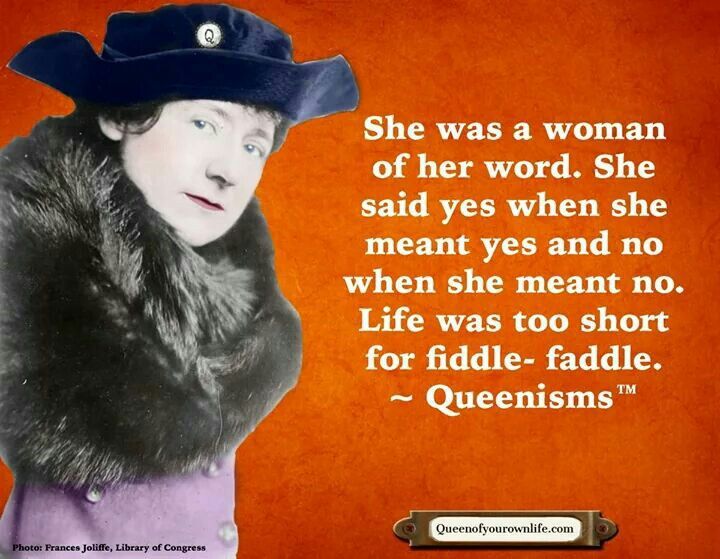
Have you ever said (or heard someone else say) Fiddle-faddle? It first appeared in English in the 1570s, meaning trifles, or to talk nonsense or speak of something not worth serious attention. Fiddle is another word for violin and is the more colloquial/casual of the two; as such, it has long been associated with less important things. Georgette Heyer uses fiddle without faddle to mean trivial or nonsense; the reduplication would merely emphasise the meaning of the first word, so she chose to drop the second.
John Milton Edwards (the pen-name of William Wallace Cook, 1867-1933) wrote, “There’s a lot of fiddle-faddle wrapped up in that word ‘inspiration.’ It is the last resort of the lazy writer, of the man who would rather sit and dream than be up and doing...”
It was also used as an adjective to describe a troublesome person, such as a nit-picky, ceremonious old woman. As a verb, to fiddle-faddle means to dally, which leads us to another reduplication: dilly-dally, which means to loiter, delay, or trifle! A fiddle-faddler is a person who trifles or dallies.
No dilly-dallying, let’s get to the point: Which reduplications have you used? Have you ever known a fiddle-faddler or a dilly-dallier? If you know of more such words, please put them in the comments below!




 Stephanie Huesler