Tag Archives: Rock

Geology Undusted: Rock vs Stone

Today’s topic is the kind of thing that flashes through my brain at 4 a.m. when I’m dropping off to sleep.

Sometimes rock and stone can be used interchangeably, depending on the context of science, society or conversation; but some phrases are intuitively either stone- or rock-rooted: We say rock road, rockslide and rock salt, but stonemason, stone wall and Stonehenge.

In geological terms, a rock is a naturally occurring mass of minerals, particularly those with a distinctive composition (e.g. granite, bedrock, igneous, or features such as Ayers Rock). Other geological terms range from clay, silt, sand, pebble, gravel, cobble, boulder or glacial erratic (material moved by geological forces from one location to another) to mountain in size.

In Archaeological terms, rock refers to a geological formation, while stone refers to any rock that has been placed or modified into a tool by humans (ergo, Stonehenge, not Rockhenge). When an archaeological dig is underway and they pull out a rock, trained eyes can spot signs of scarring, or scoring, such as on a core, which is a piece of rock that has been worked by a stone tool referred to as a hammerstone (for obvious reasons), used to shape another rock into a tool, such as in the process of flint knapping (the more refined the knapping process, the more refined the tools become, such as using antler or copper nubs to chip away finer areas of an arrowhead or hunting barb). In Kansas, where I grew up, arrowheads are still discovered occasionally; I have a small collection, along with a few obsidian arrowheads.
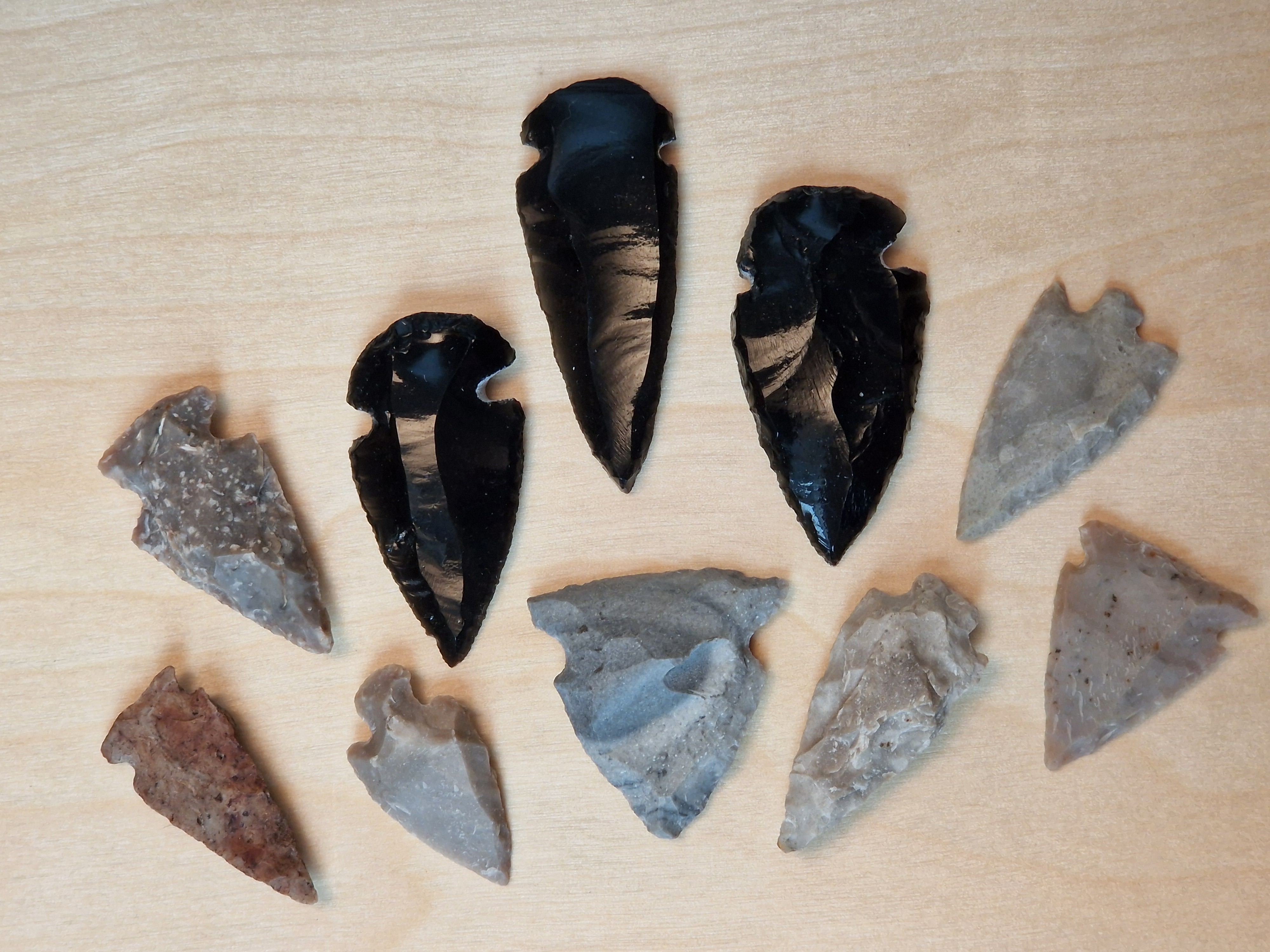
In archaeological excavations, what might appear to be a natural rock formation may turn out to be an ancient boundary wall, with stones intentionally stacked for a specific purpose. In that sense, though a rock road has intentionally been placed, it is not stone – it is placed for a purpose, yes, but its arrangement is left as it falls, so it is referred to as a rock road.

Years ago, when my husband and I were walking along a rocky riverbank in Ticino (in the Italian-speaking part of Switzerland), I picked up a stone; it had obvious signs of human activity, with smoothed sides where hands held it, and scrapes along the top and bottom, such as might be caused by sharpening a tool – whether antler or arrowhead. As it was washed down from its resting place in the rapids, it was no longer in situ and therefore would have no archaeological significance.

So which is it, stone or rock? For me, the answer is this: When it has been modified or intentionally placed or ordered by humans, it’s stone; when it’s naturally occurring, it’s rock.

I’ll leave you with a few idioms carved in stone or rock:

Set /carved in stone

Living under a rock

Leave no stone unturned

On the rocks

Heart of stone

Kill two birds with one stone

Have rocks in one’s head

Cast the first stone

As solid as a rock / As solid as the Rock of Gibraltar

Written in stone

Like getting blood from a rock

Between a rock and a hard place

A stone’s throw

Leave a comment

Filed under Etymology, History Undusted, Images, Liguistics, Linguistics, Nature, Science & Technology

Rock, Snake or Spock?

Almost everyone in the world has at one time or other played “Rock, Paper, Scissors”, or a variation of the game.  My husband and I use it to decide who goes first whenever we play a dice or card game together, which is nearly every evening.  If you scratch beneath the surface, you’ll find that there are a lot of variations; some make sense intuitively, some need to be explained to make sense, and others, you just need to accept as the way the game works.  In looking into this topic online, I came across several forums that discussed in length whether the rock sharpened the scissors, thus making them allies against paper, or why the paper wouldn’t be defeated by the rock because it holds it down; but the fact is that in this widespread variation, the rock is wrapped (defeated) by the paper, the scissors cut the paper, and the rock smashes (or dulls) the scissors.  Sometimes the game is accompanied by a preparatory chant, such as, “eeny, meeny, miny, moe”, “one, two, three” (in whichever language it’s being played in), or something like “ickety, ackerty, ock”.

Other Variations of the Game:

Rock, Scissors, Paper, Dynamite:  Dynamite (palm out, fingers spread wide like an explosion) blows up the rock and paper, but the scissors can cut the fuse.

Rock, Scissors, Paper, Fire,Water:  Fire (waving fingers, pointing upward) destroys paper and scissors but is put out by the rock and water; the water (hand held horizontally, palm down) drowns the scissors and puts out the fire but is moved by the rock and floated on by the paper.

Earwig, Elephant, Man:  The elephant is tamed by man; the man is bitten by the earwig; the earwig is stepped on by the elephant.

Hoof, Bandage, Knife:  The bandage wraps the hoof, the knife cuts the bandage, and the hoof breaks the knife (presumably by stepping on it).

In the Idaho panhandle:  Hunter, Bear, Woman:  Players stand with their backs to each other to prepare, jump and turn, landing in the stance of their choice. The hunter mimes a rifle, the bear displays claws, and the woman symbolizes breasts with cupped hands.  The hunter defeats the bear, the bear defeats the woman (unarmed), the woman defeats the hunter (putty in her hands).

rock-paper-scissor-lizard-spockRock, Paper, Scissors, Lizard, Spock:  Scissors (first and second fingers extended) cut paper (open palm) and decapitate lizard (hand held with thumb against fingers, as for finger puppet); paper covers rock (fist) and disproves Spock (Spock’s gesture of peace – palm out, fingers divided into V between middle and ring fingers); rock crushes lizard and scissors; lizard poisons Spock and eats paper; Spock smashes scissors and vaporizes rock.
Variations Around the World

Whether you call it “rock, paper, scissors”, Janken (the Japanese word for the original game), Kai bai bo (Korean), or Janjii (Thailand), the goals are the same – to win over an opponent, or to make an arbitrary decision, such as who goes first in a game.  Here are a few variations from around the world:

KoreaKai bai boKai is scissors, Bai is rock, and Bo is cloth or paper.  China has a similar version, except that it is sometimes hammer (guu) and bomb (paa).

Malaysia and parts of ThailandWan Shi Zan –Pistol, Water, Bird, Stone, Plank:  The pistol defeats everything except water, and the bird loses to everything except water. The stone defeats the bird and the plank, but loses to the pistol and the water. The plank defeats the bird and the water, but loses to the stone and the pistol. The water defeats the stone and the pistol. The bird loses to the plank.

India and Indonesia, and on Bali:  Elephant, Human Ant:  The elephant beats the human, the human beats the ant, and the ant beats (scares) the elephant.

Myanmar:  General, Soldier, Tiger:  The general defeats the soldier, the soldier (with a gun) defeats the tiger, and the tiger kills the general (unarmed).

Vietnam:  Hammer, Paper, Scissors:  The same hierarchy as Stone, Paper, Scissors.

Laos:  Hammer, Nail, Cloth:  The hammer defeats the nail; the nail pierces the cloth; the cloth wraps the hammer.

Russia:  Rock, Scissors, Paper, Well:  The rock smashes the scissors; the scissors cut the paper; the paper floats on the well and wraps the rock; the well swallows the rock and scissors.

France:  Rock, Scissors, Leaf, Well:  Same principle as the Russian variation.

ChinaGosukumi [i.e., 5 choices instead of 3]:  Idol, Chicken, Gun, Fox, Termite:  The idol is the thumb, chicken the index finger, gun the middle finger, fox the ring finger, and termite the little finger. The chicken is sacrificed to the idol; the gun introduces people to the idol (the idol wins); the termite eats the idol; both the gun and the fox defeat the chicken; the chicken defeats the termite; the gun defeats the fox. The idol and the fox are good friends, as are the gun and termite, and the fox and termite ignore each other, so these symbols tie with each other. According to these rules, the god and gun are strongest, and the chicken weakest.

Japan:  There are many variations of the game throughout Japan, where it is very popular; one is called “Mushiken” with a snake, slug and frog:  The snake (thumb) fears the slug (ring finger); the slug is eaten by the frog (index finger); the frog is eaten by the snake.

Shouyaken” is played by gestures made with the whole body. The symbols were the village-headman, musket, and fox. The village-headman sits in a dignified manner, as if in the seat of honour. The musket was mimed as if carrying a gun in both hands. The fox was indicated by holding up both fists at an angle.  The rules were that the headman beat the gun, the gun beat the fox, and the fox beat the headman.

Do you know of any other variations?  Please put it in the comments below, explaining how your version is played!

Some information gleaned from the following sites:
http://www.democraticunderground.com
https://en.wikipedia.org/wiki/Rock%E2%80%93paper%E2%80%93scissors
http://archive.ec/Rjp5v

Save

8 Comments

Filed under Articles, History, Nuts & Bolts, Research