Tag Archives: Rouen

History Undusted: Rolf Ganger, Viking Outlaw and Founder of Normandy

How does a rabble-rousing Viking end up causing a war centuries after his death (as if stirring up trouble during his lifetime wasn’t enough fun and gigs)? Read on… this is going to be a quick, deep dive into history, so buckle up!

Firstly, let’s start with Rolf Ganger, aka Rollo, Rolloun, Rollon, or Hrôlfr – depending on which language you read. On his tomb, the Latin version of his name is Rollonis (see image).

Tomb of Rollonis (Rolf) Ganger, the first ruler of Normandy, in Rouen Cathedral (He’d probably roll in his grave to find himself so simperingly portrayed…!)

The Heimskringla is a collection of ancient Norwegian sagas about Norwegian kings and rulers, written by Snorri Sturluson (great name, by the way) around AD 1230. It tells us that Rolf was the oldest legitimate son of Earl Ragnvald, best friend of King Harald Harfager (“Fair Hair” – a nickname given to him by the Earl due to Harald’s thick, fair hair), who was the first king of Norway, reigning from ca. AD 872 to 930. It tells us that Rolf was so hefty that no horse could carry his weight; thus, he had no choice but to walk everywhere, from which Ganger, his second name derives (I cannot find a direct translation of the meaning of the name, but Germanic languages have similar words: In German, “gehen” means go or walk; “gangart” means gait, or way of walking).

Harald Harfagre, First King of Norway – Statue in Haugusund, Norway

He was rowdy, even by Viking standards. Heimskringla records that he plundered most of the East Sea (likely referring to what is now the region around the Baltic Sea). Then, “One summer, as he was coming from the east on a Viking’s expedition to the coast of Viken*, he landed there and made a cattle foray. As King Harald happened, just at that time, to be in Viken, he heard of it, and was in a great rage; for he had forbid, by the greatest punishment, the plundering within the bounds of the country. The king assembled a Thing**, and had Rolf declared an outlaw over all Norway.”

*Viken was a region that lay over the modern border between Norway and Sweden.

**To assemble a Thing means to gather a council or general assembly. These still take place in some parts of Switzerland, as well as on the Isle of Man and in Scotland; the Icelandic Althing is considered the oldest active, surviving parliament in the world, dating back to the AD 900s. The first detailed description of such a Thing was made by Tacitus, a Roman historian and senator, in AD 98; the oldest reference to a Thing is inscribed on a stone near Hadrian’s Wall, dated as early as AD 43.

According to the Heimskringla, Rolf, now banished from Norway, headed toward the Hebrides, and from there to “Valland” [In Norse legend, Valland is the name of the part of Europe which is inhabited by Celtic and Romance peoples, and Snorri Sturluson mentions it several times as the Old Norse name for Gaul, which was a region of Western Europe first clearly described by the Romans, encompassing present-day France, Belgium, Luxembourg, and parts of Switzerland, the Netherlands, Germany, and Northern Italy, and covering an area of around 494,000 km2.].

Arriving in Gaul, he did what he did best – went a-Viking, plundering and pillaging and “subduing for himself a great earldom”. He populated it with his own best rabble of Norsemen, which the French called Normanz, literally “north men” which quickly led to the Anglicized term Normans (similar to the word for the people group and language, Norse).

One of the places known to have been invaded by the Vikings in AD 841 is the Jumièges Abbey, which is along the Seine River on its way to Rouen, which they also ransacked. At some point (around AD 885), Rolf also raided Bayeux, carrying off a woman, Popa (whose lineage is unverified – later historians for the duke may have sanitized her parentage to legitimize their son’s noble lineage, as she was married “more danico”). She gave birth to his heir, William Longsword. When Rolf and his gang were all done hacking their way through towns and villages along the Seine, they eventually made their way back to Rouen, where he established the Duchy of Normandy in AD 912.

So, how did Rolf cause a war centuries later? Well, his son, William Longsword, fathered a son, Richard the Fearless (who became ruler of Normandy at the age of 10 when his father died). Richard’s son was called Richard the Good, and he became the father of Robert the Magnificent and grandfather to the illegitimate William the Bastard, who became known as William the Conqueror (a sword seems to have cleared up his illegitimacy quite neatly) – from whom all the subsequent English kings descended. Now to the crux of the matter: William, descendent of Rolf Ganger, fathered English kings, who thus claimed their right to the Norman throne by connection, birth, rank… in short, any excuse for raiding was still in their blood. Rouen was one of the largest and most prosperous cities of medieval Europe, and (as mentioned in my last post) was made wealthy through textiles and trade along the Seine River and beyond. Rouen became the focal point of the Hundred Years’ War (1337-1453) because of that pesky connection. So now ya know!
5 Comments

Filed under Articles, Etymology, History, History Undusted, Links to External Articles, Quotes

History Undusted: The Great Clock of Rouen, France

Last summer, my husband and I rented a privately-owned motorhome in Caen, France, and travelled around Normandy for 10 weather-perfect days. One of the places we had on our short list to see was the city of Rouen, a region with a long and rich history. One icon of the city is a clock. Not just any clock. The Great Clock of Rouen.

Rouen was a pivotal location in the Hundred Years’ War (1337-1453 – calling it the “Hundred-and-Sixteen Years’ War” is more accurate but not as catchy, though the name is likely based on the fact that there were periods of fragile truces); the central conflict was the English claim to the French throne. In the context of this war, Joan of Arc became a victim of male chauvinism and political expediency. But that’s another story.

The mechanism of this clock was built in 1389. Let’s put that into perspective: That’s over 100 years before Columbus set out to discover a western passage to the East Indies and inadvertently discovered America; Richard II took over as king of England; it was made during the Hundred Years’ War; Joan of Arc would have seen this clock on her way to her execution (by burning at the stake). It was made more than 190 years before our modern Gregorian calendar replaced the Julian calendar, in 1582.

The mechanism deserved not only a grand position, but a grand façade: The Rouennais aldermen decided that the town needed a clock, and the construction of a tower to house the clock took 9 years; the architect was Jehan de Bayeux, though the tower was completed by his son in 1398. The original designer of the clock’s facades, Jordan Delettre, was no more (whether he died or was removed is unknown), and it was completed by Jean de Felain, who became the first “governor of the clock”, maintaining it in exchange for a home in the clock’s tower. Towers and wars came and went, and the clock survived; it was moved to its current location in 1410, now housed astride an ornately carved stone archway.

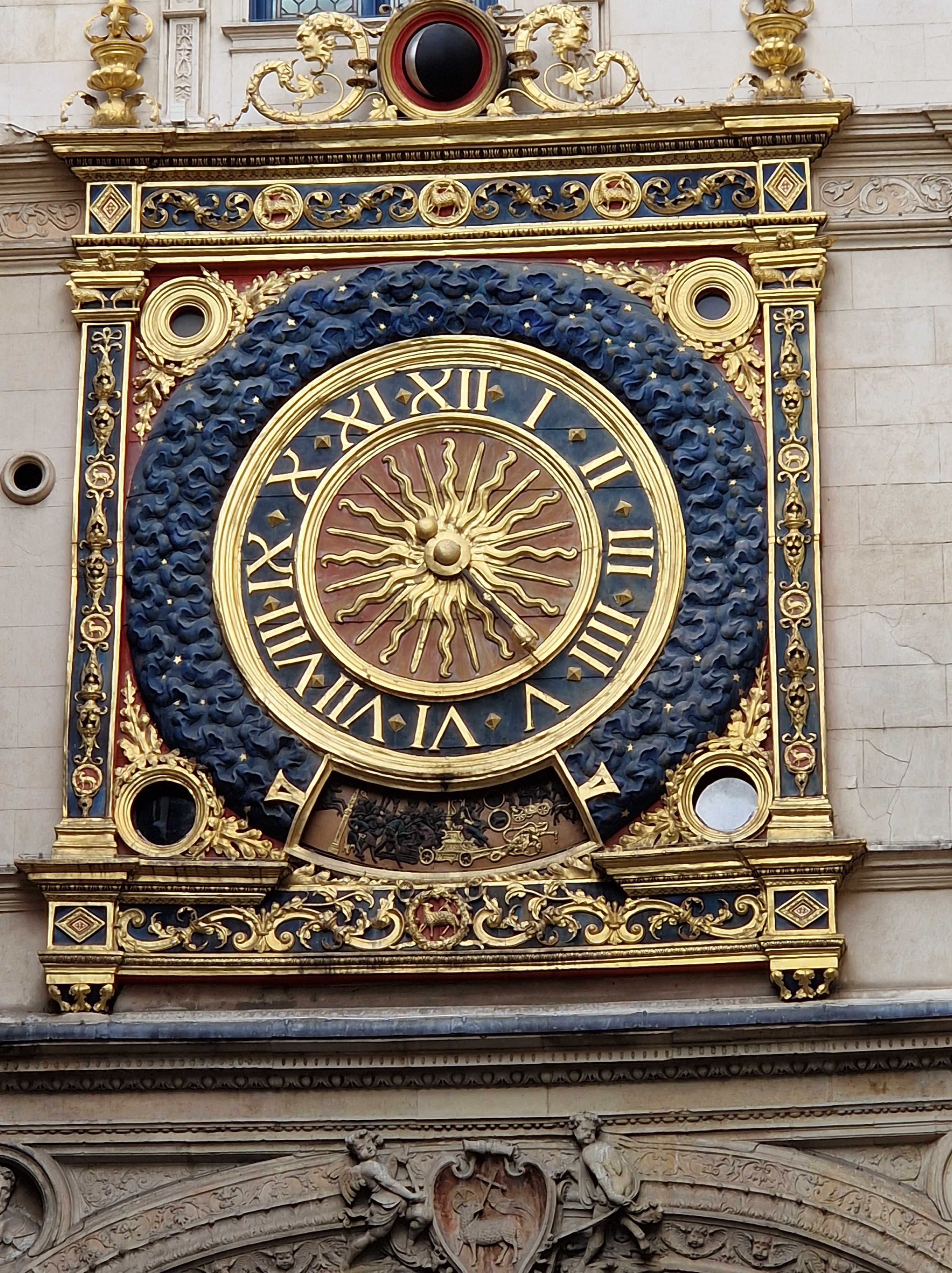
The clock faces (on both sides of a stone archway and connected to a central mechanism shared by both) are 2.5 metres (over 8 feet) in diameter, and each has only a single hand, tipped with the depiction of a lamb, which shows the hour; moon phases are indicated in the 30 cm oculus above the clock face, which makes a full rotation every 29 days. The face depicts 24 rays of the sun surrounded by a dark blue starry frame. A hand which shows the day of the week is located in an opening at the base of the dial, with each day represented by a different Greek god: Diane as the moon (Monday), Mars (Tuesday), Mercury (Wednesday), Jupiter (Thursday), Venus (Friday), Saturn (Saturday) and Apollo (Sunday).

Although the mechanism of the clock still works, it has been powered by electricity since 1928, and the tower itself was renovated in the late 1990s.

Underneath the clock in the centre of the archway, the coat of arms of Rouen can be seen: It depicts the Paschal lamb on a red background (the official colour of Rouen); it is held by two angels (if you look closely at the angel on the right, you’ll notice that its head is on wrong; it is thought to be due to disgruntled construction workers – obviously an age-old problem…). Beneath the arch are elaborate bas-reliefs of Jesus as the Good Shepherd caring for his flocks; the clock’s hand, the coat of arms and the reliefs all echo the importance of textile and wool trade to the city. One clock face alone has at least 15 sheep (zoom in on the picture of the clock and see if you can spot them all!). Next to the clock is a Gothic belfry tower built in the 14th and 15th centuries which houses the bells connected to the clock, which ring on the quarter-hour.

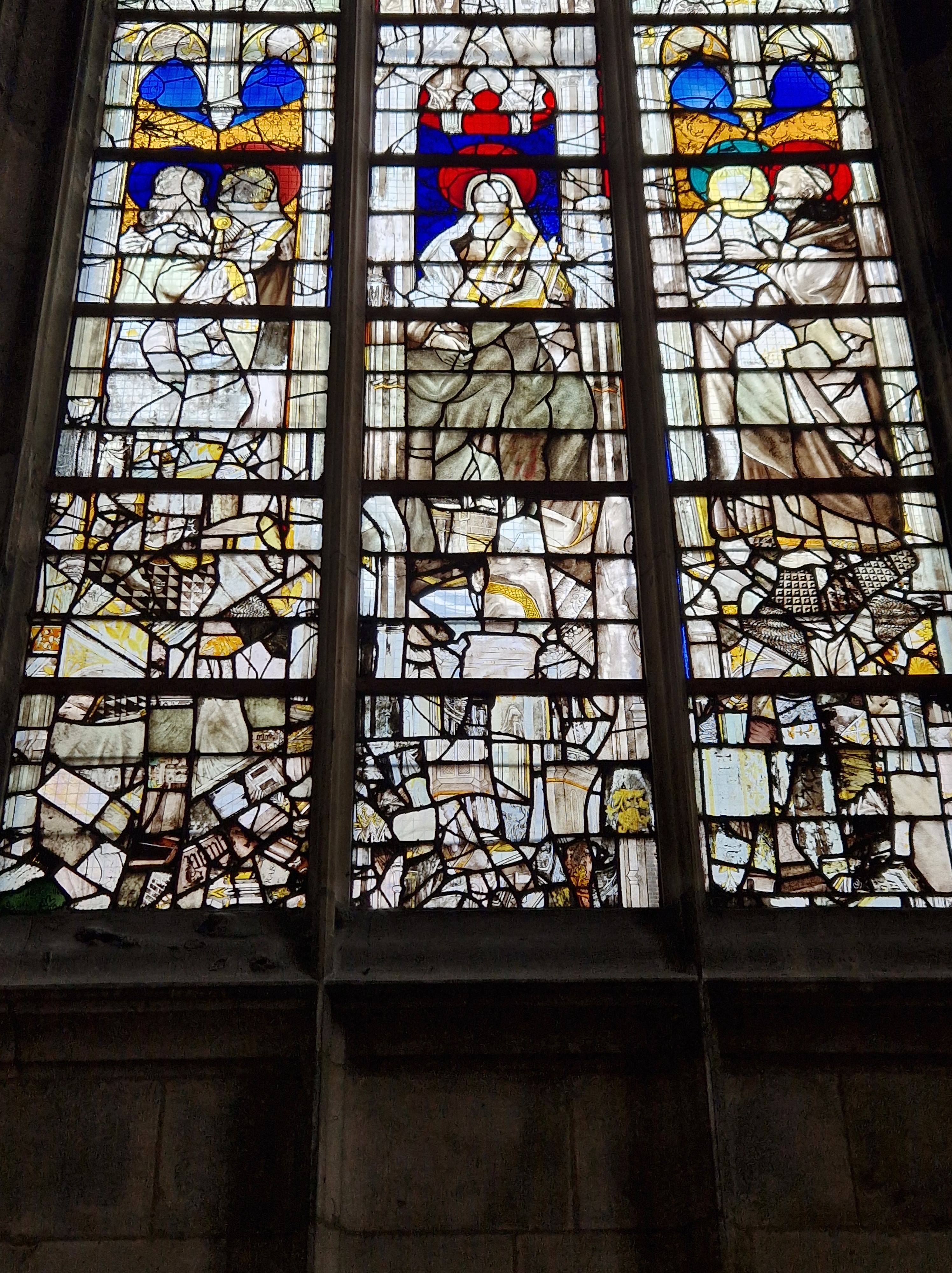
Rouen is a survivor: It has outlasted Viking raids that travelled up the Seine River, the Hundred Years’ War, the Religion Wars of the Renaissance period, the Franco-Prussian War of 1870, the French Revolution, and even World War 2; the latter damaged nearly half the city, and shrapnel and bullet scars can still be seen in façades. The cathedral’s stained-glass windows were shattered by a WW2 bomb and were subsequently reconstructed using the fragments, creating jumbled images that reflect its history and its survival.

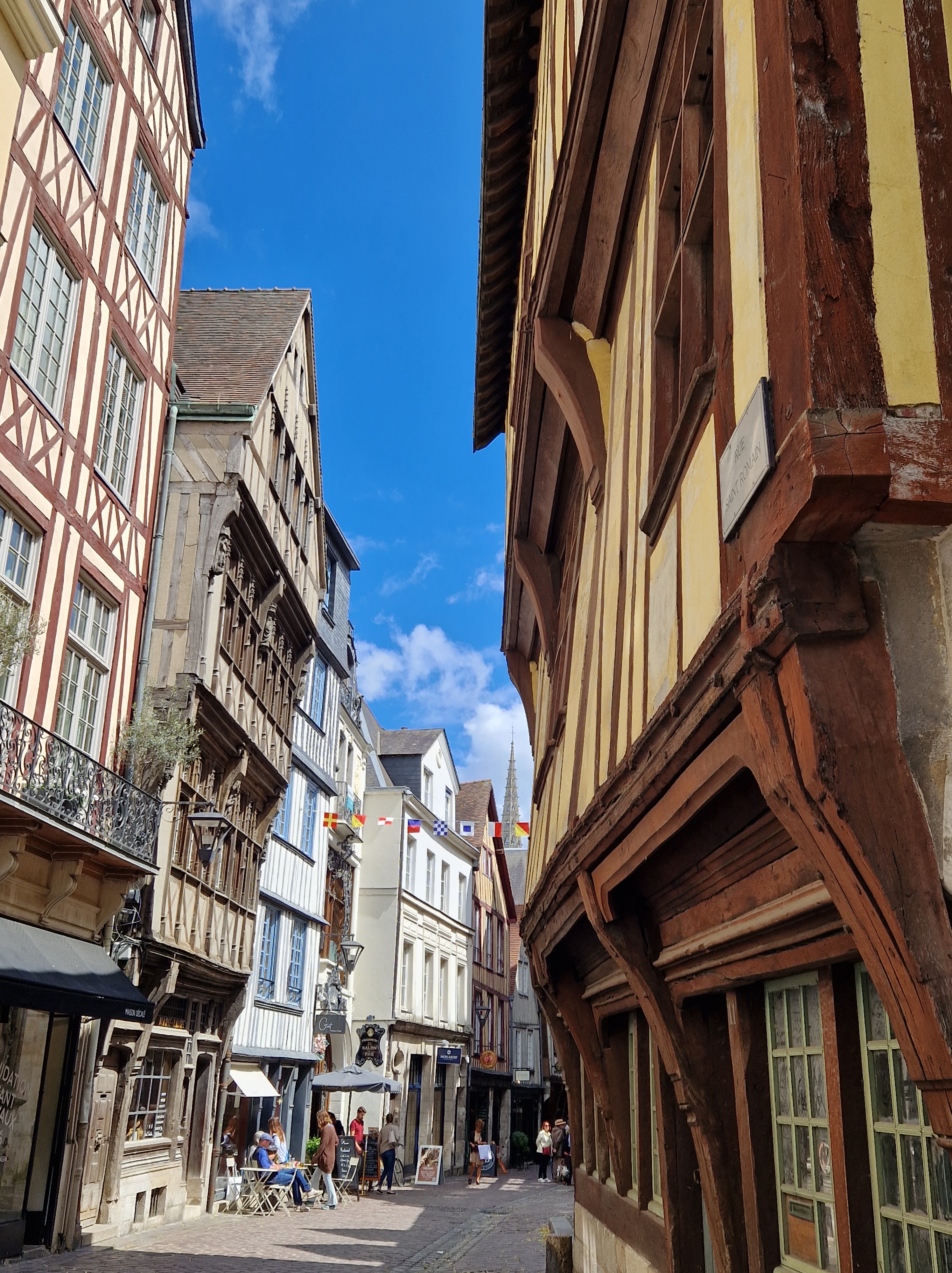
For me, the clock must really be seen within its context to truly appreciate it; it’s surrounded by wonky Medieval buildings which are three or four stories tall and built when plumb lines and uniformity were still futuristic concepts. They were built out of timber, as there is abundant forest nearby but no stone quarries.

The clock adorns the arch over the Rue du Gros-Horloge (“Street of the Great Clock”), which runs between the Gothic cathedral, made famous by Claude Monet (who painted over 30 canvases centred on the cathedral), and the old market square, where Joan of Arc was burned at the stake. Perhaps ironically in light of the latter event, the street just off of the clock’s archway is called Rue Massacre

Though I do not speak French, I know that in French, clocks today are referred to in the feminine form, la horloge; but prior to the 18th century, clocks were masculine; so, the great clock of Rouen, in French, is still Le Gros-Horloge.

Below are a few of our holiday photos: They include the cathedral’s jumbled windows and the clock from various angles, as well as a few of the wonky buildings. Enjoy!

5 Comments

Filed under History, History Undusted, Military History, Science & Technology, Snapshots in History