Tag Archives: Radium

History Undusted: Radium Girls

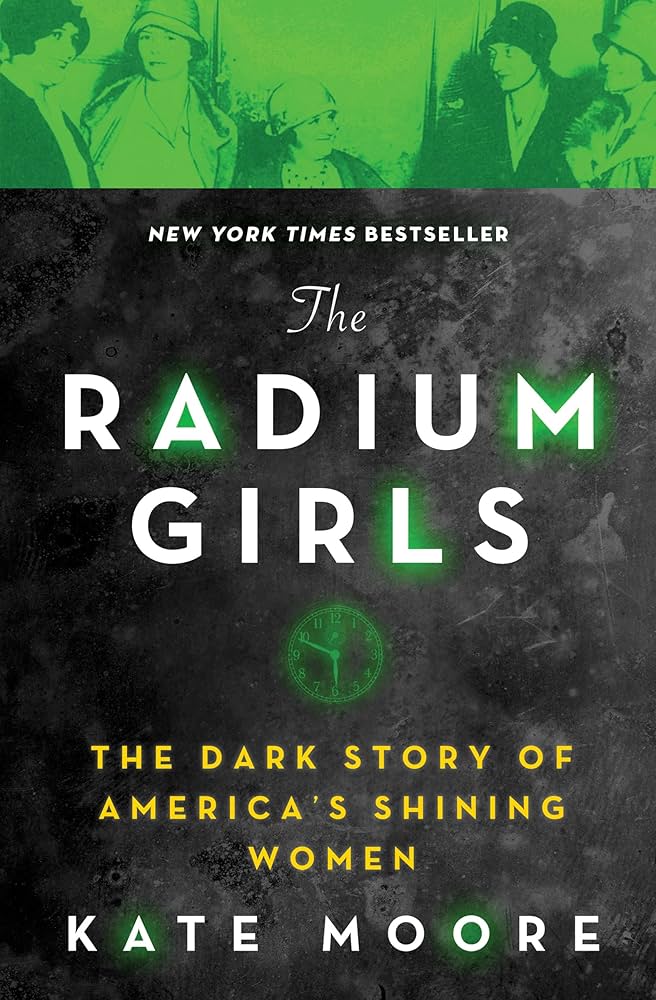
I’ve been thinking about writing on the topic of the Radium Girls for some time now. In our home library, the book by Kate Moore, The Radium Girls – The Dark Story of America’s Shining Women (2017), has been glowing at me (not literally, thank goodness!). The book is a fascinating history of the women who worked in watch-making factories across the States, and the groundbreaking battle for workers’ and women’s rights, which helped shape labour laws that would protect future generations from shameless exploitation.

Curie is the unit of measurement for radioactivity, named for both Marie Sklodowska-Curie and Pierre Curie (co-winners of her first Nobel Prize, in Physics, 1903); Marie went on to win a second in another field (Chemistry, 1911). Their oldest daughter, Irene Joilet-Curie, won the Nobel Prize (with her husband, Frédéric) in 1935, also in chemistry. Marie Curie died from the effects of exposure to radiation on 4 July 1934 (her husband would have had the same fate, but he was killed in 1906 in a road accident). Even today, her papers and even her cookbook are so radioactive that they are stored in lead boxes, and anyone examining them must be fully protected. I could do a whole history of the Sklodowska and Curie families; the women were intelligent, educated, ahead of their time and left their marks on history in several fields of science. [I don’t know if the book would be available where you live, but the youngest daughter of Marie, Eve Curie, wrote a biography about her mother, published in 1937 in several languages (I have the 1938 Swiss edition, in German). The book can be found in e-book formats as well.]
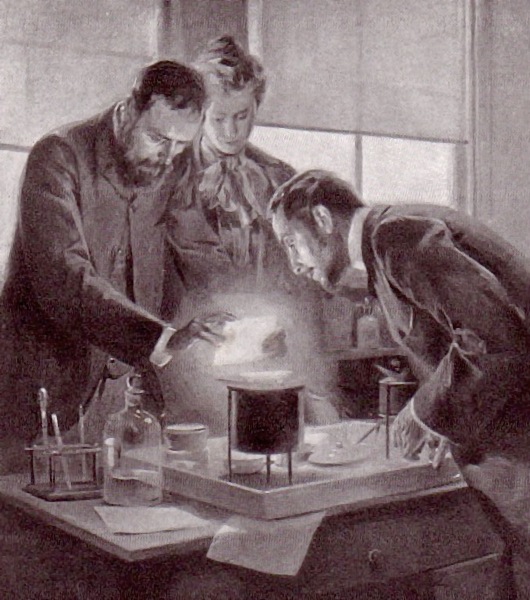
Marie and Pierre Curie experimenting with radium. Drawing by André Castaigne. Notice that they are all handling the radioactive material without protective gear…

Radium, discovered by the Curies in December 1898, caught public fascination; soon, Radium was touted as the cure-all of the new century. It was sold as healthy, as something that would make your skin glow. It was said to cure ailments and recharge your physiological batteries with pure energy. It was put into toothpastes, face creams, soaps, bath salts, makeup, and pure energy drinks. And it was painted onto the face of watches: Each painter would mix her own paints in a small crucible; they each had a camel hair paint brush and were instructed to keep their brushes pointed with their lips: Lip, dip, paint. The girls at the factories would paint their nails and faces with the paint for fun.

And then people started getting sick. Eaten from the inside out, their bodies started disintegrating, and they started dying. And at the time, workers at factories were earning a penny per watch face painted; they were too poor to quit, and too sick to work. And the company big boys denied all responsibility, medical aid or financial compensation. Eventually, though some of the Radium Girls tried to sue the United States Radium Corporation, the company dragged the case on so long that most of the women were bedridden by the time the company forced them to settle out of court. It was too late for those girls and those like them still working in the factories; their bones will glow for a thousand years. But public opinion was already on the side of the women, and it fueled a turning point in protective legislation, not only in America but in Europe as well.

For a fascinating insight into this topic, here are two links:

Radium Girls, Wikipedia

The film: Radium Girls (2020) (1:37)

Oh, and by the way: If you find an old, glow-in-the-dark watch face for sale made any time before 1971, give it a WIDE berth.


2 Comments

Filed under History, History Undusted, Humanity Highlights, Links to External Articles, Science & Technology, YouTube Link

A Blast from the Past: 1906

Living in the Cyber Age, it’s easy to forget that personal computers only came into existence for the mass market in 1981 (and even then, didn’t become common household items until the early 1990s), with the launch of the IBM Personal Computer (they coined that term, and the shortened “PC”).  We got our first personal computer in 1993, and it had the astounding RAM of 256 MB!

As far as telephones went, I grew up with several:  My grandparents’ farm had a box phone on the wall, with the separate ear piece; then they modernized to a heavy black beast of a rotary phone – the kind you could really slam down if the need arose; in fact, you had to be careful how you set it down when you weren’t upset, because it was so heavy that it might sound like a slam in the receiver!  My family had wireless land-line phones, but the signal was poor if you moved much farther away than a long cable would have allowed.   Remember the impatience of dialling a number on the rotary dial, especially if it contained nines or zeros?  And remember that curly cable that got tangled on itself from being over-stretched?  Cell phones didn’t really come into their own until the late 1990s as a mass-market item; kids today would find that hard to imagine, as they seem to think they’ll fall off the edge of the known universe and die if they leave the house without their cells.

Before Spotify, iTunes or MP3s, and even before CDs were common, cassette tapes and LP (long-play) records were all the rage.  Remember winding cassettes with a pencil?  Now that films like “Guardians of the Galaxy” have highlighted cassettes, this generation thinks they’re a novel gadget, and history begins to repeat itself with the labels of “retro” or “vintage” attached to make “old” sound “cool”!  We had an 8-track player in our car, with a cumbersome disc the size of an old Beta movie cassette case.  My father was always at the cutting edge of technology, and in the late 70s we had a laser disc player; the DVDs were the size of LP records (yet looked just like a CD or DVD of today), and we had films like “Logan’s Run” and “Heaven Can Wait”.  The technology didn’t catch on, so I’ve never known anyone else who had that contraption (an image below shows the size comparison to a modern DVD).  Another gadget we had was a set of picture frames hanging on our living room wall; they were filled with psychedelic lights that reacted to sounds, changing colours as you talked, sang, or watched television.  The topic of TVs is a whole other kettle of fish!  As the way of dinosaurs, cassettes and 8-tracks, CDs are nearly a thing of the past now, with digital clouds; even television stations will struggle to survive in the changing technology with on-demand digital providers becoming more popular.  Here are a few images to stir your nostalgia for stone-age technology:

This slideshow requires JavaScript.

With so many changes happening just within a few decades, it’s easy to imagine that a century ago, things were even more different.  I wish I had statistics for Europe, but here are a few US stats for the year 1906 – 110 years ago.  Some of these items came in the form of a chain e-mail several years ago, and I didn’t forward it; even so, I’ve made new friends, I haven’t been hit by a meteorite, and I’ve been perfectly happy, despite the threats that come from breaking such a chain…

  • 18% of households in the US had at least one full-time servant or domestic help.
  • 2 out of every 10 adults were illiterate; only 6% of all Americans had graduated from high school.
  • 90% of all doctors had NO college education; they rather attended “medical schools,” many of which were condemned by the press and the government as sub-standard.
  • A 3-minute call from Denver to New York City cost 11 dollars.
  • A competent accountant could expect to earn $2,000 per year, a dentist $2,500, a veterinarian between $1,500 and $4,000, and a mechanical engineer about $5,000 per year.
  • Alabama, Mississippi, Iowa, and Tennessee were each more heavily populated than California.
  • Canada passed a law that prohibited poor people from entering into their country for any reason.
  • Crossword puzzles, canned beer, and ice tea hadn’t been invented yet.
  • Marijuana, heroin and morphine were all available over the counter at corner drugstores; pharmacists claimed that, “Heroin clears complexion, gives buoyancy to the mind, regulates the stomach and bowels, and is, in fact, a perfect guardian of health.”
  • More than 95% of all births in the US took place at home.
  • Most women only washed their hair once a month, and used borax or egg yolks for shampoo.
  • Sugar cost 4 cents per pound; eggs were 14 cents for a dozen; coffee was 15 cents a pound.
  • The American flag had 45 stars: Arizona, Oklahoma, New Mexico, Hawaii and Alaska had not yet been admitted into the Union.
  • The population of Las Vegas, Nevada was 30.
  • The average life expectancy was 47.
  • The average US worker made between $200 and $400 per year.
  • The average wage in the US was 22 cents per hour.
  • The maximum speed limit for most cities was 10 mph.
  • The tallest structure in the world was the Eiffel Tower.
  • There was no official Mother’s Day or Father’s Day.
  • There were about 230 reported murders in the entire US.
  • There were only 8,000 cars in the US, and only 144 miles of paved roads.
  • With a mere 1.4 million people, California was only the 21st-most populous state.
  • The five leading causes of death in the US:
    1. Pneumonia and influenza
    2. Tuberculosis
    3. Diarrhea
    4. Heart Disease
    5. Stroke
  • The top news articles of the time:
    1. Roald Amundsen, Norwegian explorer, located the Magnetic North Pole.
    2. Ethiopia declared independent in a tripartite pact; the country was divided into British, French, and Italian spheres of influence.
    3. Finland was the first European country to give women the vote.
    4. President Roosevelt sailed to the Panama Canal Zone. It was the first time a U.S. president travelled outside the country while in office.
    5. Reginald Fessenden invented wireless telephony, a means for radio waves to carry signals a significant distance. On December 24, he made the first radio broadcast: a poetry reading, a violin solo, and a speech.
    6. In Economy, federal spending was $0.57 billion; unemployment was 1.7%, and the cost of a first-class stamp was 2 cents.
    7. On 18 April, a magnitude 7.8 earthquake hit San Francisco, California, killing over 3,000. Though many have heard of the famous quake, a less-publicized 8.8 magnitude earthquake hit Ecuador and Columbia earlier in the year, on 31 January, causing a tsunami.  On 16 August, a magnitude 8.2 earthquake in Valparaíso, Chile left approximately 20,000 dead, while on 18 September, a typhoon and tsunami killed an estimated 10,000 in Hong Kong.  The media all but ignored such events, making the San Fran earthquake the best-known, though it was the least of all these events in the loss of lives. [Note the warning about shooting looters, from the San Fran mayor, in the images below.]
    8. A few famous births in 1906: Dietrich Bonhoeffer (4 Feb.); Hans Asperger (18 Feb.); Lou Costello (6 March).

Below are a few ads and gadgets from 1906 (gleaned around Pinterest), for your amusement:

This slideshow requires JavaScript.

5 Comments

Filed under Articles, History, Images, Musings