Tag Archives: Radium Girls

History Undusted: Radium Girls

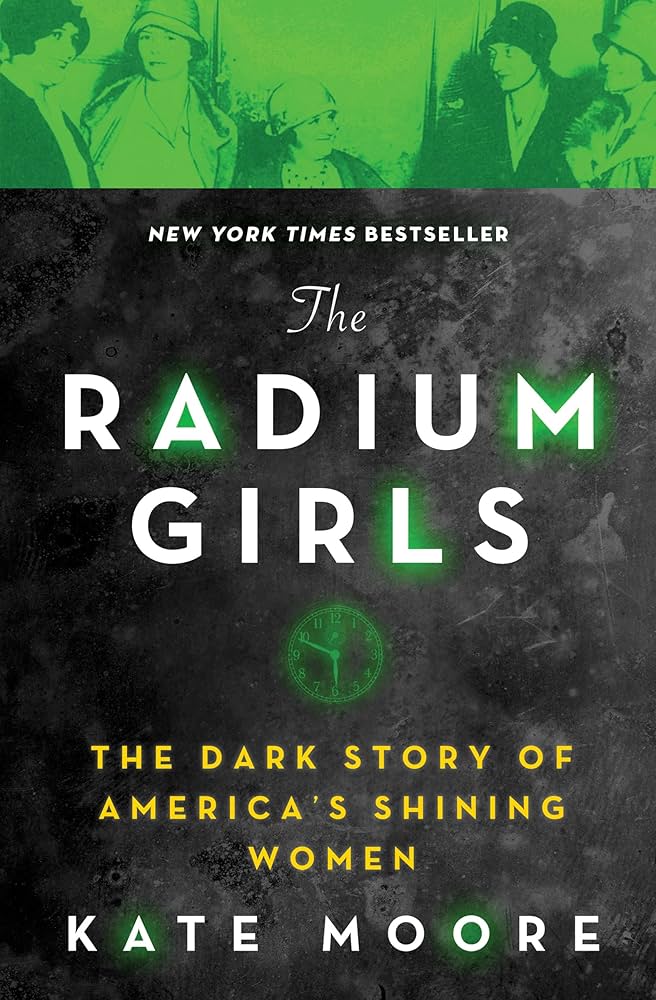
I’ve been thinking about writing on the topic of the Radium Girls for some time now. In our home library, the book by Kate Moore, The Radium Girls – The Dark Story of America’s Shining Women (2017), has been glowing at me (not literally, thank goodness!). The book is a fascinating history of the women who worked in watch-making factories across the States, and the groundbreaking battle for workers’ and women’s rights, which helped shape labour laws that would protect future generations from shameless exploitation.

Curie is the unit of measurement for radioactivity, named for both Marie Sklodowska-Curie and Pierre Curie (co-winners of her first Nobel Prize, in Physics, 1903); Marie went on to win a second in another field (Chemistry, 1911). Their oldest daughter, Irene Joilet-Curie, won the Nobel Prize (with her husband, Frédéric) in 1935, also in chemistry. Marie Curie died from the effects of exposure to radiation on 4 July 1934 (her husband would have had the same fate, but he was killed in 1906 in a road accident). Even today, her papers and even her cookbook are so radioactive that they are stored in lead boxes, and anyone examining them must be fully protected. I could do a whole history of the Sklodowska and Curie families; the women were intelligent, educated, ahead of their time and left their marks on history in several fields of science. [I don’t know if the book would be available where you live, but the youngest daughter of Marie, Eve Curie, wrote a biography about her mother, published in 1937 in several languages (I have the 1938 Swiss edition, in German). The book can be found in e-book formats as well.]
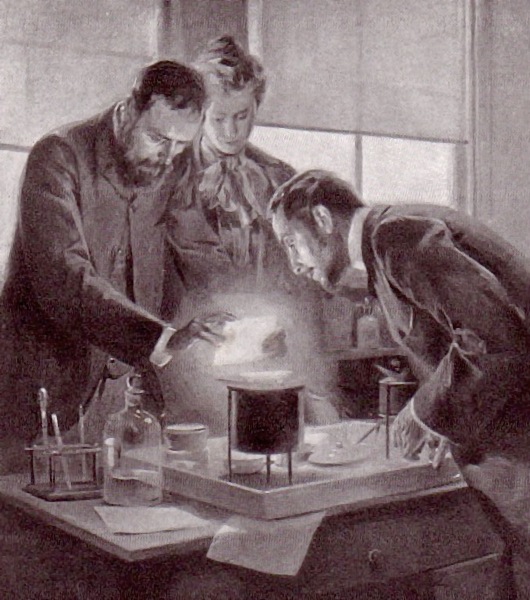
Marie and Pierre Curie experimenting with radium. Drawing by André Castaigne. Notice that they are all handling the radioactive material without protective gear…

Radium, discovered by the Curies in December 1898, caught public fascination; soon, Radium was touted as the cure-all of the new century. It was sold as healthy, as something that would make your skin glow. It was said to cure ailments and recharge your physiological batteries with pure energy. It was put into toothpastes, face creams, soaps, bath salts, makeup, and pure energy drinks. And it was painted onto the face of watches: Each painter would mix her own paints in a small crucible; they each had a camel hair paint brush and were instructed to keep their brushes pointed with their lips: Lip, dip, paint. The girls at the factories would paint their nails and faces with the paint for fun.

And then people started getting sick. Eaten from the inside out, their bodies started disintegrating, and they started dying. And at the time, workers at factories were earning a penny per watch face painted; they were too poor to quit, and too sick to work. And the company big boys denied all responsibility, medical aid or financial compensation. Eventually, though some of the Radium Girls tried to sue the United States Radium Corporation, the company dragged the case on so long that most of the women were bedridden by the time the company forced them to settle out of court. It was too late for those girls and those like them still working in the factories; their bones will glow for a thousand years. But public opinion was already on the side of the women, and it fueled a turning point in protective legislation, not only in America but in Europe as well.

For a fascinating insight into this topic, here are two links:

Radium Girls, Wikipedia

The film: Radium Girls (2020) (1:37)

Oh, and by the way: If you find an old, glow-in-the-dark watch face for sale made any time before 1971, give it a WIDE berth.
2 Comments

Filed under History, History Undusted, Humanity Highlights, Links to External Articles, Science & Technology, YouTube Link

Virtual Tours 2: Electric Ladyland Fluorescent Museum, Amsterdam

Come along with me on this next tour, as we explore the world of florescence. Today’s featured museum is the only one of its kind in the world: The Electric Ladyland Fluorescent Museum, in Amsterdam, Netherlands, is an interactive “participatory art” museum; visitors can get creatively involved in the artwork, see fluorescent minerals light up, and can have their eyes opened to just how many common objects around us fluoresce. When was the last time you looked through your vegetable drawer with a UV light? Tomatoes, lettuce, cucumbers, bell peppers, coconuts… they all emit UV light waves.

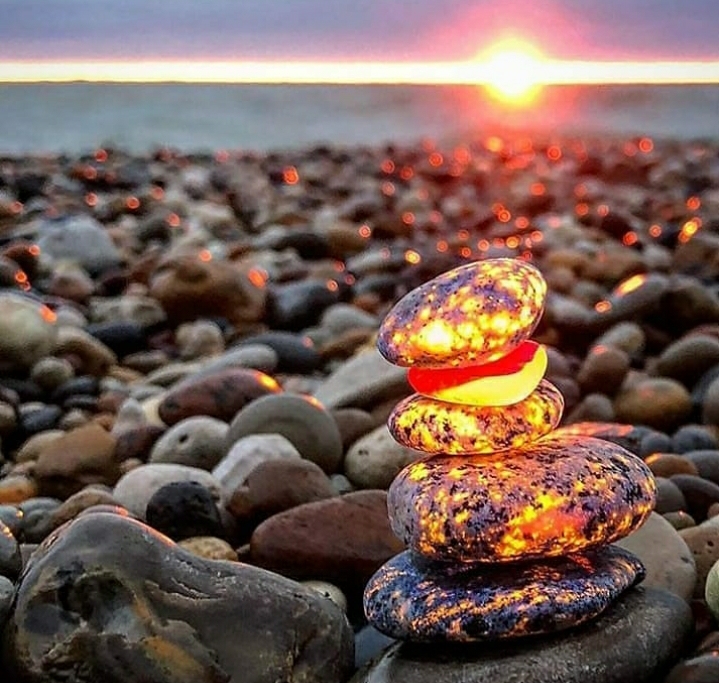
First, what is fluorescence? It is also known as “black-light” glow; in other words, it shows up under UV (ultraviolet) wavelengths. Man-made fluorescence differs from nature’s spectacles of bioluminescence in that the latter doesn’t require external light – it is generated by an internal chemical energy in the organism. There are also examples of fluorescence occurring in nature: Syenite, also known as yooperlite or sodalite-syenite, is not a common rock, but does appear all over the world in pockets; in fact, about 15% of all minerals fluoresce. Check out this link to see where syenite can be found near you. Take a UV torch (flash light), and hunt for them at night. They look like plain rocks under normal lighting conditions, but glow under UV. There are also animals that don’t have bioluminescence, but do glow under UV lights, such as scorpions. To watch a short video about hunting along Lake Michigan for yooperlites (these start at 8:00), and see a glowing spider (19:23), click here. At 18:43, you can also see an example of phosphorescence.

Yooperlite – Credit: Reddit, uRyunysus

Phosphorescence is what we also know as “glow-in-the-dark” when it comes in a paint form. The emission of visible light persists after this substance has been exposed to a light source; it fades over time, but the light “charges” the phosphorescent material, such as stars on a child’s ceiling, and glows for a time. This is the paint you also see marking airplane’s escape routes (I hope you never need them!).

Radioluminescence is, as its ominous name implies, a result of the decaying of radioactive isotopes; when mixed with a radioluminescent phosphorous chemical, the decaying radiation particles agitate the phosphor into emitting visible light. Believe it or not, Radium paint was used for over 40 years on the faces of watches, compasses, and aircraft instruments; if you are in possession of your great-grandfather’s or grandfather’s glowing watch, you might want to reconsider that. Radium emits gamma rays… think “Incredible Hulk”. Joking aside, the reality was far grimmer: The episode of history that became known as the “Radium Girls” and the impact it had on industrial safety standards deserves an article all of its own. Shockingly, radioluminescent paint may still be used in specialised applications, such as diving watches.

Radium clock. Credit: Wikimedia Commons

I hope you enjoyed this short tour through all things glowing. What do you have around your house that either glows in the dark, or emits light under a UV light? If you don’t already have a UV torch (flash light), you can buy one fairly easily online. If you’re brave enough, take a tour of your home in the dark – UV is known to show up things that have perhaps been missed in your cleaning routine; they will show you what foods you eat that fluoresce; and you’ll most likely learn a few things along the way! Have fun!

4 Comments

Filed under Links to External Articles, Nature, Science & Technology, Snapshots in History, Virtual Tours