Category Archives: Linguistics

History Undusted: Shop Signage

I’m fascinated by a few aspects of architecture in particular, such as doorways, knockers, unusual features such as sundials on the sides of buildings, mural paintings (here in Switzerland, these are sometimes hundreds of years old), and shop signage – you’ll see the latter even in the smallest town here.

This past summer, my husband and I rented a motorhome and travelled mostly in eastern Switzerland. I would say that 90% of my photos were of shop signs! I find that if you focus in on one topic, you’ll begin to see that thing everywhere.

Known as commercial signage or trade signs, such symbols of a shop’s products have been used as far back as ancient Egypt. As many people were illiterate, the pictorial shop sign not only advertised what was for sale in a shop but also distinguished the shops with similar items. By the mid-15th century, English laws even required shops that sold ale to hang a shop sign out; it made inspections of the quality of the ale easier. Some signs were temporary; for instance, if a woman made more ale or bread than her family could consume, she would put out a sign to sell the surplus and thus earn a bit of money. In the narrow streets of medieval towns, signs might be so large as to nearly touch the building on the other side of the lane, and they could become a hazard to passing horsemen or coachmen. By the mid-16th century, regulations were passed to limit the size of signage, and the securing of the sign to the building to avoid it endangering passersby. In Britain, hanging signs were eventually phased out in favour of what were are most familiar with – a flat sign denoting the store along the space above the front windows. But here in Switzerland, shop signage is everywhere – not just old, but also newer additions.

The development of the signs, including elements of guilds or heraldry symbols, led to competition between blacksmiths to create the most elaborate ironwork. The signs evolved from simple displays of ware to symbolic representations of a shop owner’s name or a heraldic connection or patronage of royalty (e.g. a crown). Examples might include shoemakers displaying a shoe or gilt boot, bakeries displaying bread, and haberdasheries displaying a needle and thread or a coat.

Here is just a fraction of the signs I photographed during our holidays, with brief explanations:
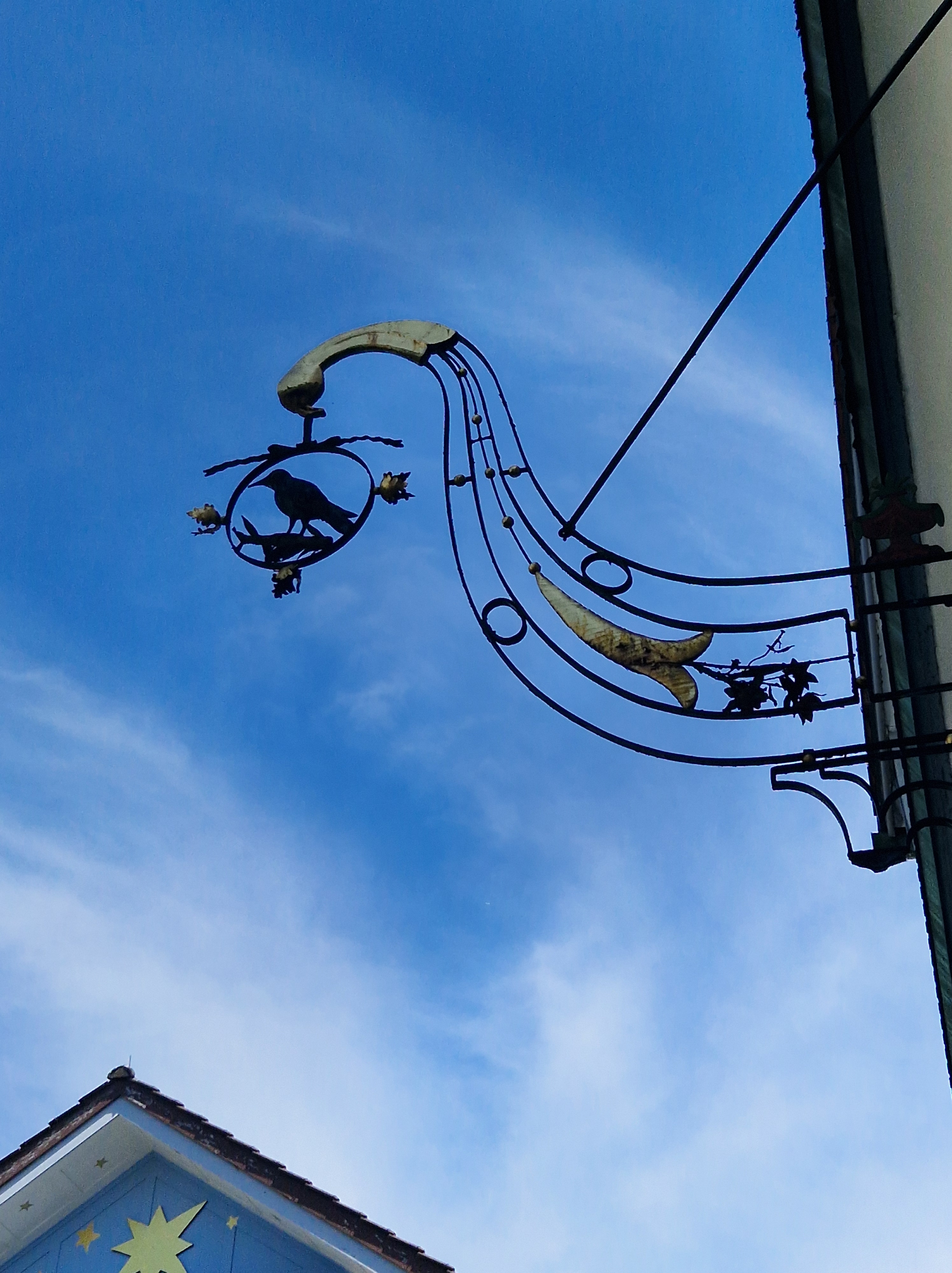
The building from which this sign hangs was built originally in 1664, and renovated to the current form in 1830. It was originally an inn/tavern on one side, and a forge (blacksmith) on the other. The Raven, as a tavern, took its symbol from the legend of St. Meinrad (797-861 AD); he was a hermit who rescued two young ravens from a sparrowhawk and raised them in his hut in the Finstern Wald (dark forest). In 861, he was murdered by two robbers; when they realized what they’d done, they fled to Zürich, but the crows followed them into a tavern and attacked them; the others present thought it unusual, so they took the men captive; they confessed, and were executed. The raven became a symbol of inns along a pilgrimage road; it was sometimes combined with a wine jug and bread.
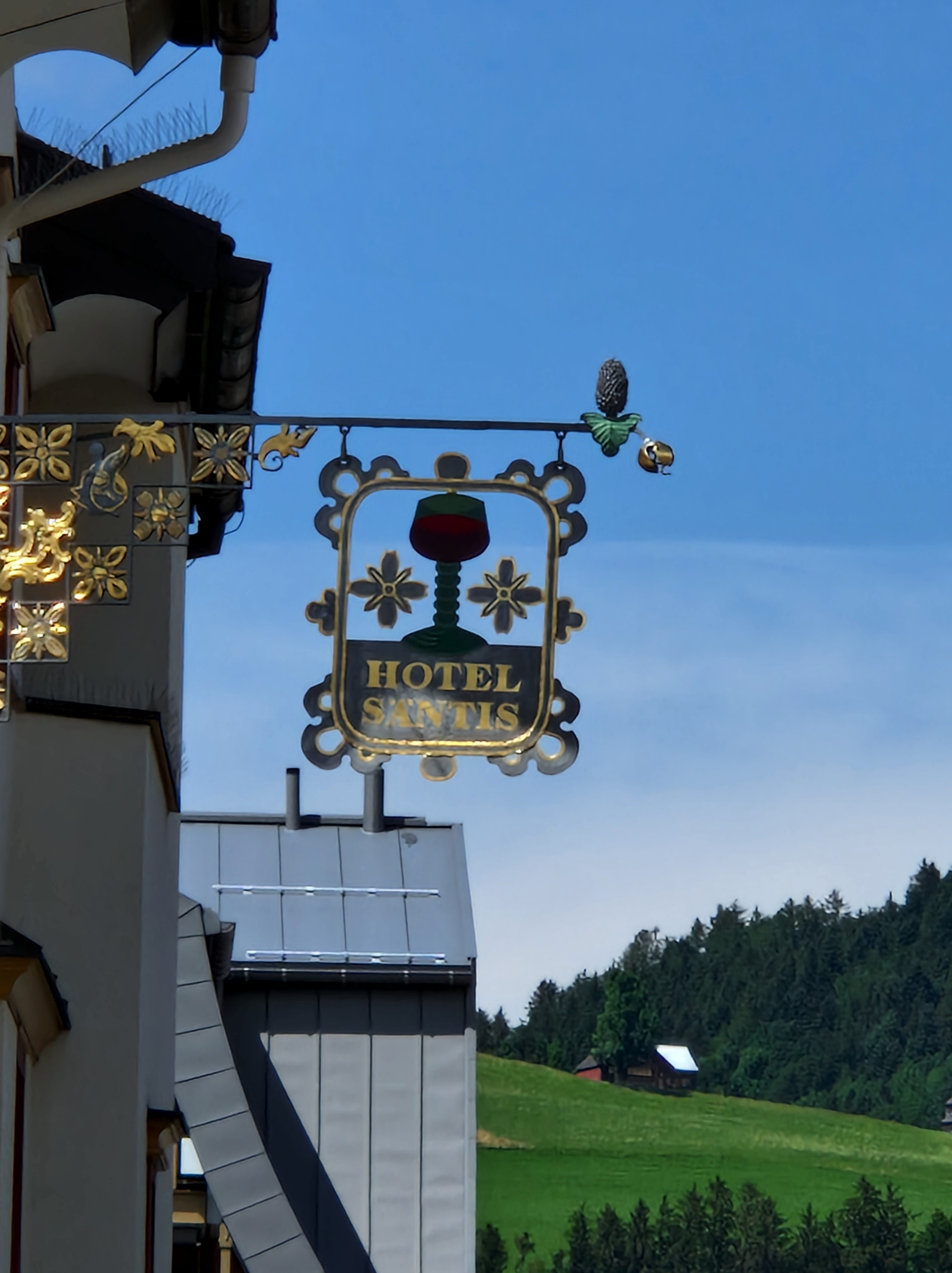
The Hotel Santis sign has a few symbols: The wine is an obvious reference to a tavern, pub or inn; the pine cone is an interesting addition: It was the symbol of the field sign of the Roman legion stationed in Rhaetia in 15 BC, and hence it is used as a heraldic charge (an emblem on a shield). It may have been included in this sign to proclaim a good place for soldiers to eat or sleep, or as an advertisement that it was protected under a legion or unit of the military at a time when such protection would have been welcome. The bell symbolized a pilgrimage or an invocation of guardian angels over a premises.
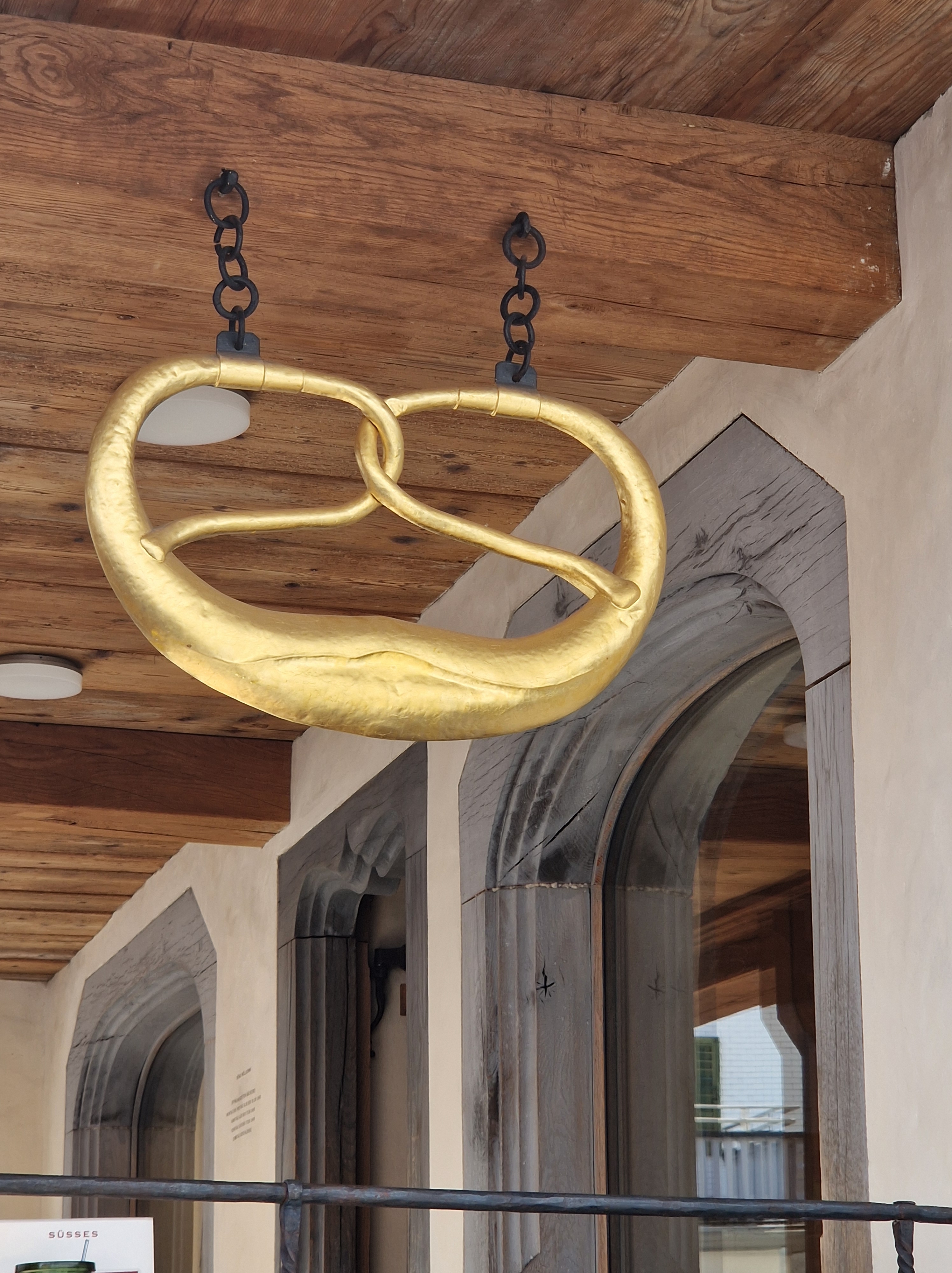
I think this is fairly clear – it’s a bakery!
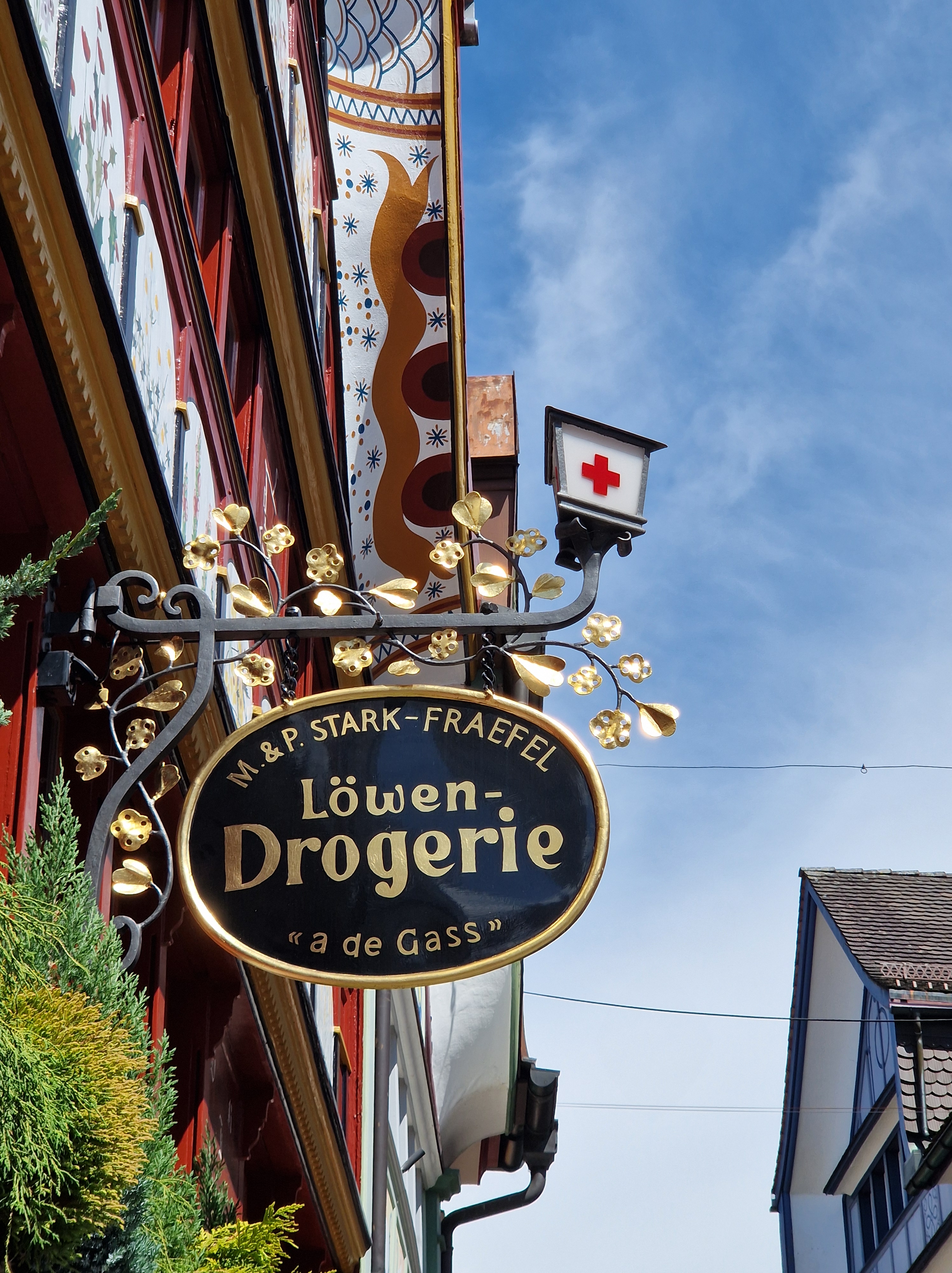
This building is a pharmacy; the front of the building is a beautiful example of the mural painting I mentioned earlier; these panels represent the herbs and flowers used medicinally. The saying painted toward the right side reads: Vielerlei Kraut gegen Leibesnot, aber kein einzigs wider den Tod (Many herbs against bodily pain, but none against death).
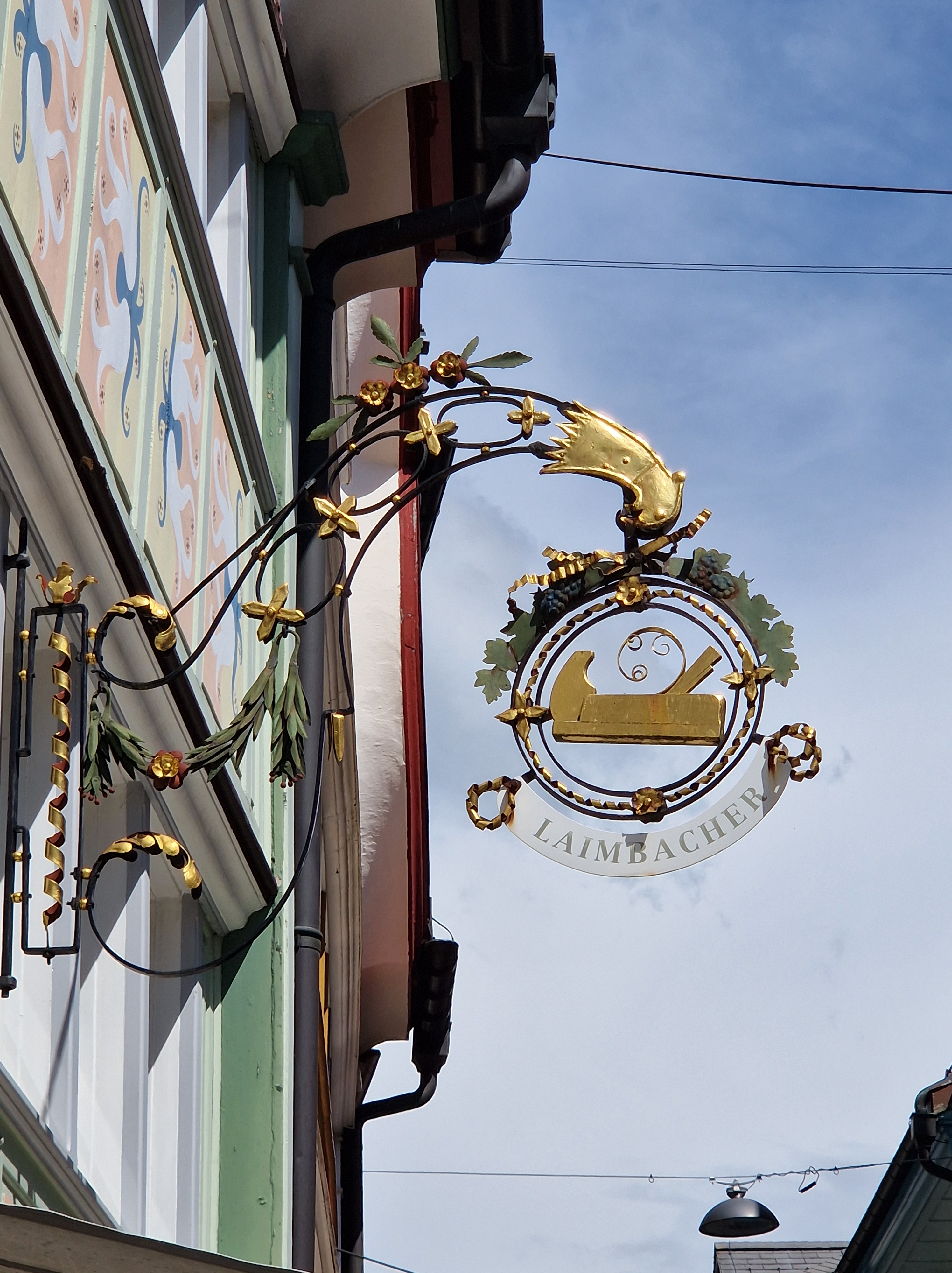
This symbol denotes a carpenter’s shop.
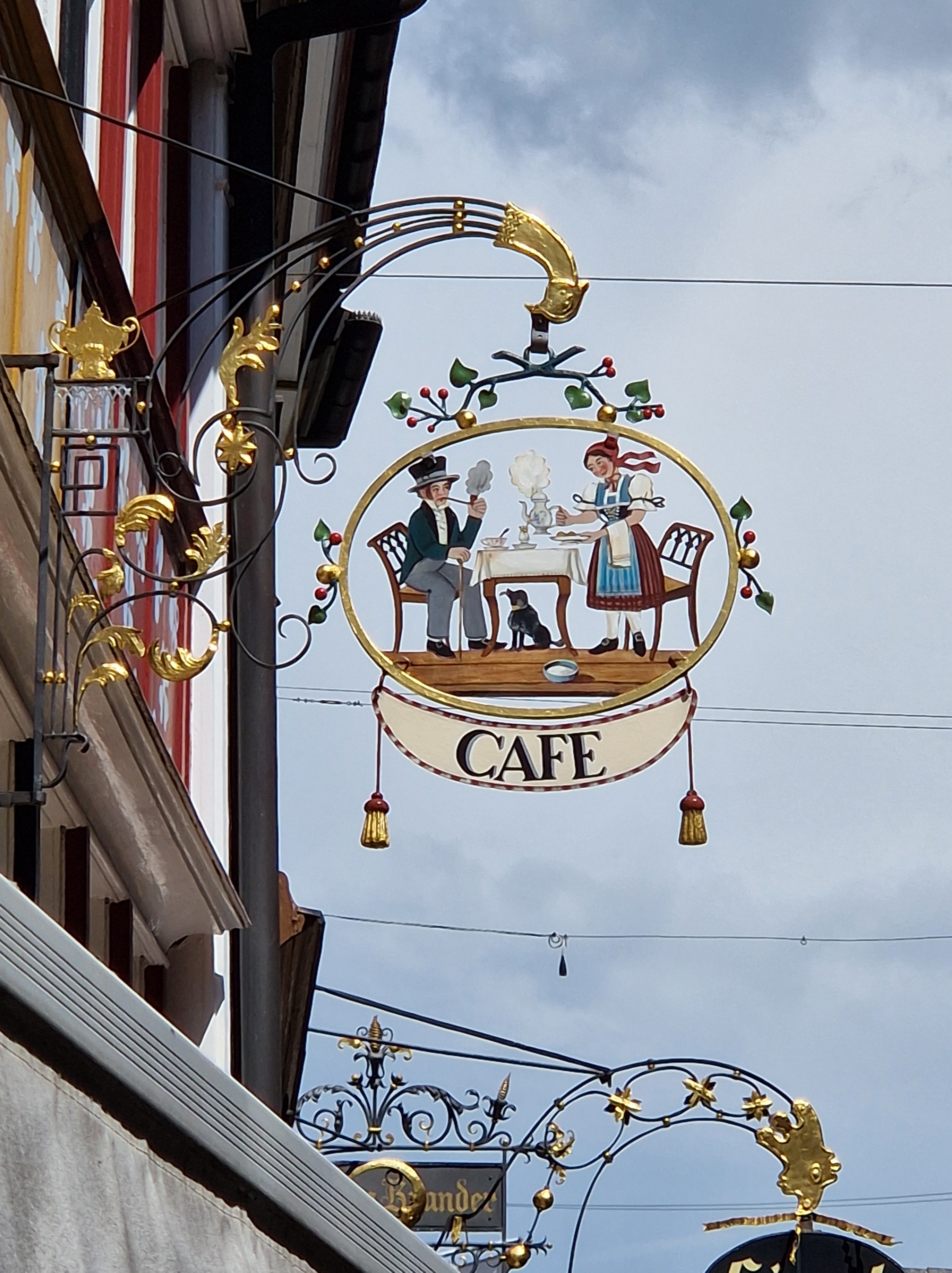
This café sign would be clear from any stagecoach stopping for a break and horse change what could be expected inside. The figures are dressed in traditional Appenzeller clothing.

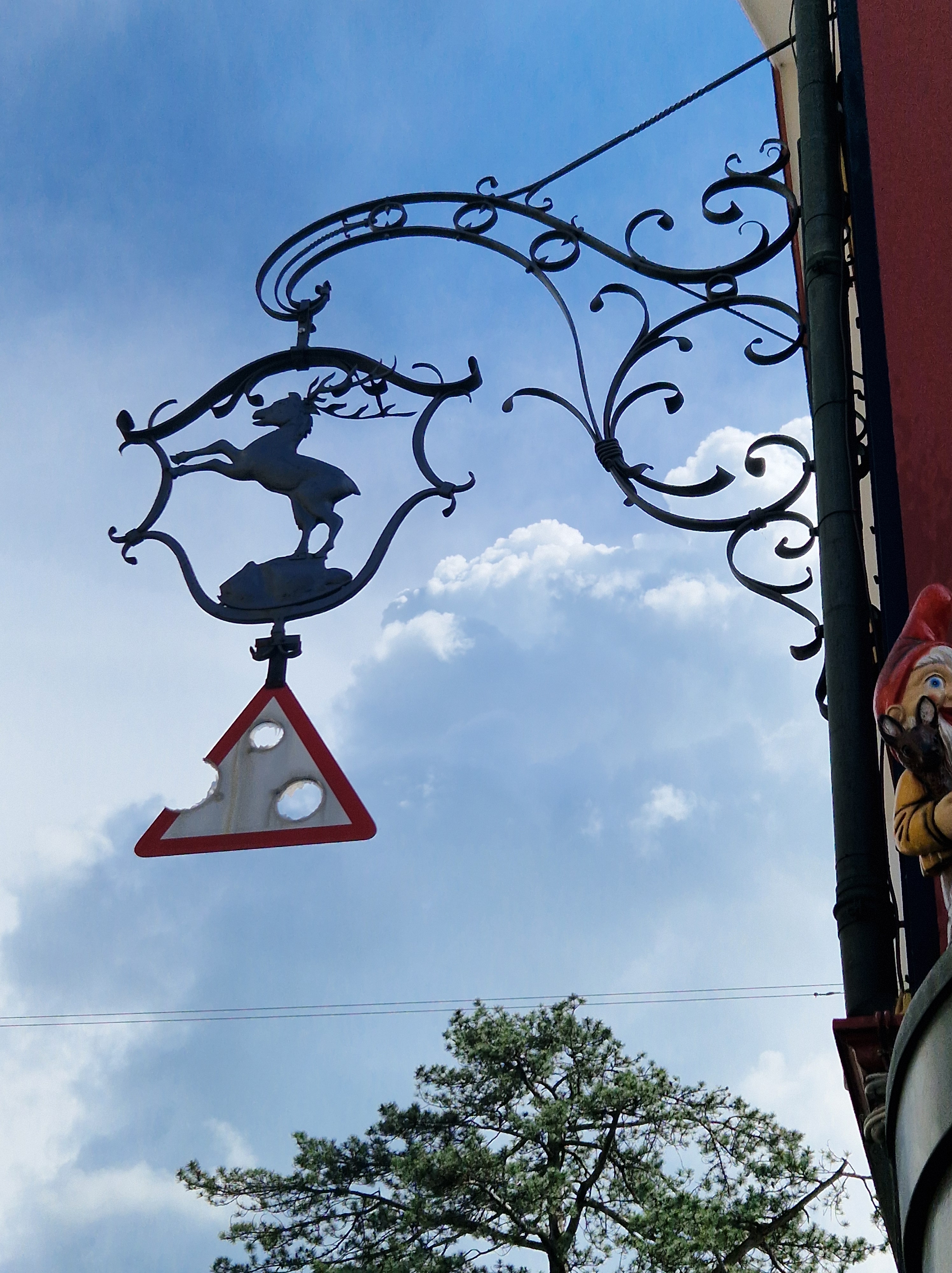
And lastly, here’s a traditional sign with a modern addition: It’s a hunting lodge, or inn that serves wild game meat. Next to it, peeking around the corner, is a figure from a toy shop.
 I hope you enjoyed this little excursion!
10 Comments

Filed under Articles, Etymology, History, History Undusted, Linguistics, Military History, Signs, Snapshots in History, Translations, Virtual Tours

History Undusted: The Great Vowel Shift

My husband and I were having lunch recently, and a package of Swedish crackers was on the table; I pointed to the brand name, Pågen. In English, our pronunciation of these vowels would lead us to say pagan /pæg-in/, whereas the Swedish would rather be more like /po-gen/. I just mentioned that English might have sounded similar to that before the Great Vowel Shift, which he’d never heard of (being Swiss, it’s not likely he would be familiar with this aspect of English etymology), so I promised to write a blog about it; here we go!

The term Great Vowel Shift was coined by the Danish linguist, Otto Jespersen (1860-1943), who specialised in the English language. Though the GVS is considered a single event (because of the changes being viewed as part of a chain reaction, with each vowel sound changing in a predictable way), the actual transition of English pronunciation was gradual, taking place over about 200 years, from ~1400 to ~1600. The shift began in Middle English, which was spoken from 1066 until the late 15th century – that form familiar to Geoffrey Chaucer (though his pronunciation would be unintelligible to us, his words still survive through his famous Canterbury Tales) – into Early Modern English (from the beginning of the Tudor period through to the Stuart Restoration period); Shakespeare would have been familiar with it. From there, English transitioned into Modern English in the mid-to-late 17th Century.

The main changes were that, from Middle to Early Modern English, the long vowels shortened; weef became wife, moos* became mice, beet became bite, and so on. (*The word moose entered English through Native American languages in 1610). I will also mention that in Scottish, a lot of the older vowel pronunciations still exist; house is still huus, full is homophonous with fool, etc.

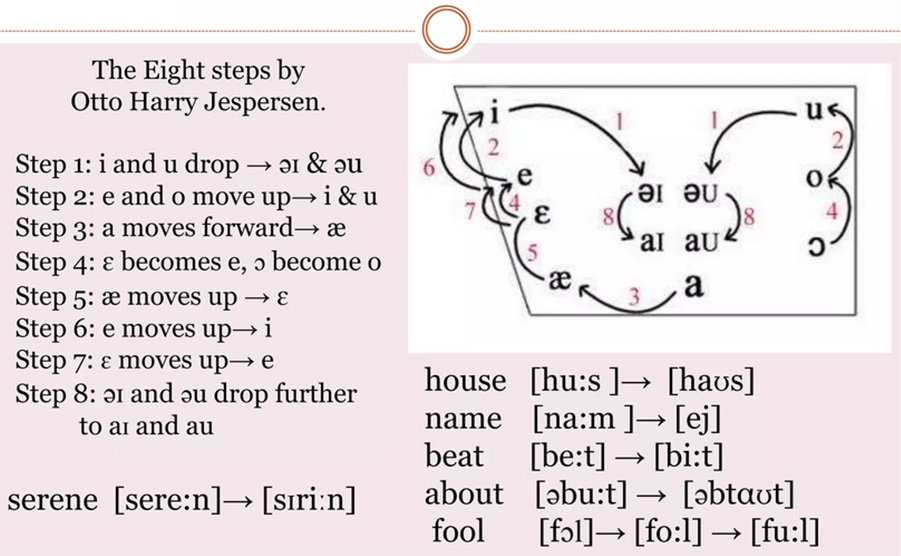
Here’s a look at just how the English vowels shifted:

Source: SlideShare

If you’ve been paying any sort of attention to English, you’ll know that our spelling is a bit chaotic; the language is full of homonyms, which are divided into either homophones (words that sound the same but have different spellings, e.g. beet and beat; bear and bare; to, too and two), or homographs (two words with differing meanings, same spellings, but not necessarily the same pronunciation: e.g. bank [of river; finance] or agape [with mouth open; love], or entrance [a way inside; to delight]) or tear [ripping; crying]. These -graphs and -phones came into English from regional dialects that were transported as migration and cultural mixing took place, and the GVS added its two pennies to the mix. Just think of the variety we have in the sounds /ea/ (bread, beat, bear, break); /oo/ (look, spool, blood); or /gh/ (through, cough, sight).

Certain factors contributed to the speed of language shift: The Black Death (1346-1353) wiped out up to 50% of Europe’s population. Stop a minute and let that sink in. What if the population of your town were reduced by half? And the next town, and the next. That single event changed the course of history on many levels; surfs could finally demand better wages wherever they ended up settling; if you lived in a town that no longer had the skills of a baker, blacksmith, or any other trade you’d depended on, you’d move to where those services existed – and jobs existed – and that meant places that had been hit the hardest by the plague and thus where everyone else was migrating, such as London. As mass movement followed the epidemic, people brought their dialects and their spellings with them. It began to converge into a new, distinct way of speaking, thinking and spelling. The geopolitical climate of the time also influenced English; England and France have been annoying each other for over a thousand years; whenever England was enamoured by all things French, they tried to emulate their pronunciations. That influence came and went; in one such moment, the pilgrims set sail for America (1620), taking a time capsule of the language with them, while England’s English continued to be influenced by French up until the French Revolution, when it quickly fell out of favour in England, though the changes had already taken place (one example is the American /k/ in schedule, closer to the original Latin, while the English say /sch/ without the /k/, which is closer to the French cedule). This factor of influence also affected differences of speech between the lower class and upper class at that time; the upper class wanted to sound more posh, more fashionable, and above all, not like the lower class.

A major contributing factor to our chaotic spelling is that ca. 1440, the Gutenberg printing technique was introduced, and by the 1470s, William Caxton had imported the invention to England; we have him to thank for Chaucer’s Canterbury Tales being known today, as that was the first book he printed in England. We also have him to thank for the influence of Chancery English (the English used by the secretariat of King Henry VI) in the standardization of the language, as he used it as his own guidelines in printing. The vowels had already begun to shift by that time; enter the written word, a rise in literacy, and you have the jumbled effects of “mid-shift” on English spelling – people began to adapt their pronunciation to the written word, so whichever form the printer used is the one that began to prevail, even though some sounds were still in transition. Like nailing down jelly. You could say that many of our odd spellings are simply a snapshot in time.

It is also important to point out that the GVS didn’t have the same influence everywhere: The main changes occurred around London, but the farther away you move from that epicentre, the less the effects on the local dialects, which still holds true today – though gradual merging has allowed people from, say, Cornwall, to understand people from Yorkshire – which wouldn’t have been the case centuries ago. Even though they can understand each other, their dialects are still distinct. I’ve already mentioned that Scots English (as opposed to Gaelic) still retains many of the longer vowels long since lost in standardized English; being so far from London, they simply ignored them. English may be taught in their schools, but Scots dialects prevail in the home and hearth. Regional dialects in English exist the world over, and though spelling and pronunciation may differ from region to region, and the language continues to be a living, breathing, growing and changing being, it’s still a language that enables the modern world to communicate, whether English is their mother tongue or not.

3 Comments

Filed under Articles, Etymology, Grammar, History, History Undusted, Liguistics, Linguistics, Snapshots in History