

The baroque town of Solothurn, though only an hour away from our home, was unfamiliar to us until my husband and I took a day trip this week. It has a beautiful historical centre and is known as the “city of elevens”: It was the 11th canton to join the Swiss Confederation; there are 11 towers in the fortification walls of the city; there are 11 churches and chapels, and 11 historical fountains throughout the city; the stairs leading up to the St. Ursus Cathedral have landings every 11 steps; the cathedral itself has 11 altars and 11 bells; the local brewery, producing an eponymous beer, is even called Oeufi – which is a Swiss dialectical word for eleven. 11:00 is the most “auspicious” time to set appointments in the town, and there is even a clock, hanging on the wall of a local bank, which is segmented into 11 hours; it has 11 cogs and 11 bells, which are chimed by a metalwork sculpture of a harlequin on the hours of 11:00, 12:00, 17:00 and 18:00. The bells chime to the tune of the city’s unofficial anthem, the Solothurner Lied.

Solothurn’s history dates back to the palaeolithic era, and its Roman era is dated to around AD 15-25; it was first mentioned in AD 219 as vico saloduro, and may have referred to a Celtic settlement, possibly meaning “Salo’s fort/stronghold”. In the Battle of Sempach, July 1386, the Habsburgs attacked Solothurn; it was a decisive Swiss victory, and even more importantly, it helped to solidify the loosely allied Swiss Confederation cantons into a more unified nation and is seen as a turning point in the growing strength of Switzerland as a nation. Today, it is largely bypassed by tourists due to its proximity to Bern, the Swiss capital, so it remains a hidden gem.
Another interesting clock is the clock tower, the “Zeitglockenturm”, a tower built in 1152 and first mentioned as a “clock tower” in 1406. If you look closely, you’ll see typical rain spouts coming off of the corners of the tower’s spire and roof, shaped like dragon’s heads. The 24-hour astronomical clock was built by Lorenz Liechti and Joachim Habrecht in 1545. The sun and moon hands both run counterclockwise; the moon makes one complete rotation every 27 days, while the sun makes one complete rotation every 365 days.

According to the Roter Turm website, there’s a humorous story connected to the upper, 12-hour clock: By 1753 the hour hand and the bells were no longer in sync; a commission contacted the watchmaker Niklaus Pfluger, reminding him of his gild’s oath, i.e. his responsibility to correct the clock. He suggested to the local government council that they add a minute hand; but minutes were not so important in the 18th century, apparently – they told him to leave it as it had always been. He took matters into his own hands (I guess it was easier to ask for forgiveness than permission…) and in 1756, he added a minute hand. He justified it as the “warning hand of God” – but he made it smaller, less noticeable than the hour hand, so on this clock, the small hand shows the minutes, not the hours.
Because the clock tower was built and added to over time, you’ll see four dates on the full image of the tower: 1411 and 2022 on the highest, 12-hour clock; and 1545 and 1883 on the central tableau; the latter dates usually refer to restorations.
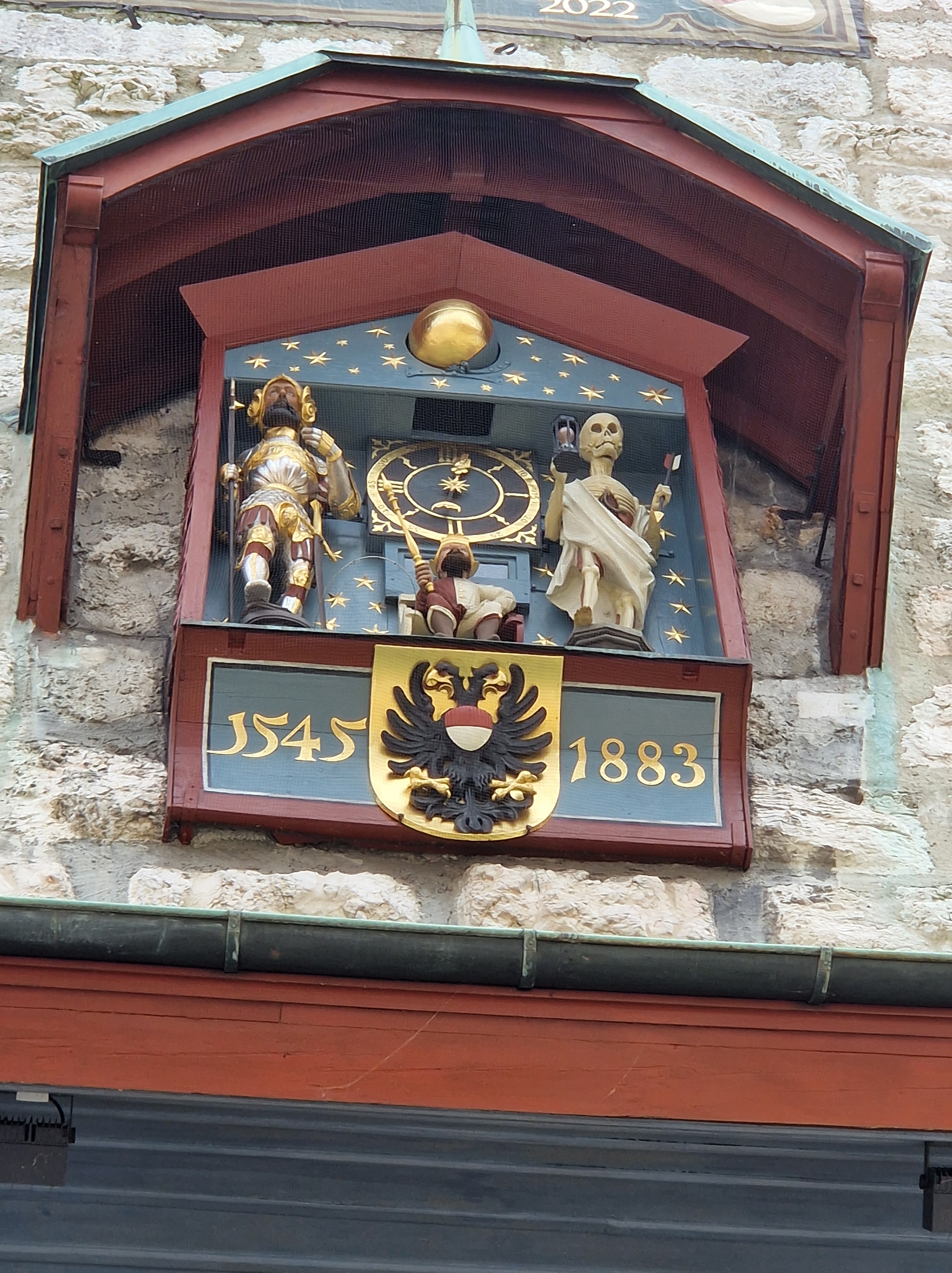
The three figures in the central tableau above the clock are a knight, king, and skeleton (Death), which perform every hour: The knight holds a battleaxe in his right hand, and a sword in his left; every quarter-hour, he turns his head toward Death and strikes his breast, signifying his loyalty to the central figure, the king. On the right stands Death; in its right hand is a hourglass, which is turned on the hour, symbolizing the contradictions of life – good, bad, life, death. In the other hand is an arrow, showing that one could be struck down at any moment. On the hour, its head turns toward the knight.
On the throne between these two figures is the king: In his right hand is a sceptre, which he lifts on the hour. His jaw moves in rhythm with the hour hand, and his beard represents wisdom. However, notice that he’s wearing red and white fool’s garb: If the king does not rule with wisdom and the humour of a fool, his reign will become a tyranny. It tells us that life should have moments of both wisdom and a jester’s humour.
While Death announces the hours, the king swings his sceptre. At the same time, Death nods with each stroke and confirms the relentless passing of the hours. The king with his fool’s garb reminds us of the memento mori. When death or illness reigns, even the power of a wise king can do little (Solothurn was hit by the plague, e.g. in 1348). Though the Freudian era banished death from contact with the living in many Western cultures, death personified as a skeleton is still a symbol seen in many countries around the world. Having death constantly before your eyes encourages you to savour each moment of life.
I hope you’ve enjoyed this brief glimpse into a beautiful city with an ancient history!




 Stephanie Huesler