
To me, the word Zarf sounds like a sci-fi comedy name for an inept villain. But, in fact, it’s a word that entered English in 1836, and is the Arabic word for “vessel”. It describes an object that you’ve seen or have likely had in your hand at some point. I will freely admit that the zarfs we know today have fallen a long way from their original forms: A zarf is the holder of a coffee cup. That sounds fairly straightforward. You may have instantly pictured a highly decorative, precious metal jewelled… no? Are those crickets I hear chirping in the vast silence of confusion? Or maybe you pictured the cardboard contraption around a hot cup of Starbucks coffee. Fallen a long way, indeed. (Camps are divided on whether the latter constitutes a zarf… for good reason: I think they would be better referred to as sleeves, as to put them on par with the bejewelled masterpieces would be an insult to the artisans of bygone days.)
Zarfs arose out of the necessity of protecting one’s hands from a hot cup; before the monster of plastic reared its ugly head, cups were made from metal or glass, often without handles. Further back, they might have been made from plant products such as coconut shells. The oldest known cups were found in Gough’s Cave in Cheddar Gorge, Somerset, England, and dated to 14,700 years ago; they were made of cannibalised human skulls.
During the 16th century, coffee gained popularity throughout the Ottoman Empire. It led to the popularity of coffee paraphernalia and coffee houses, which eventually spread worldwide and remain popular to this day. In Britain, for instance, a coffee-house culture arose in the 17th century; by the end of the century, there were over 3,000. Such venues became known as penny universities, because, for the price of a cup of coffee, men could join in the hubs of intellectual exchange and debate. Artists, journalists, poets and writers gathered to discuss God and the world; the Inklings, a literary group including C.S. Lewis and JRR Tolkien, met regularly at the Eagle and Child in St Giles’, Oxford.
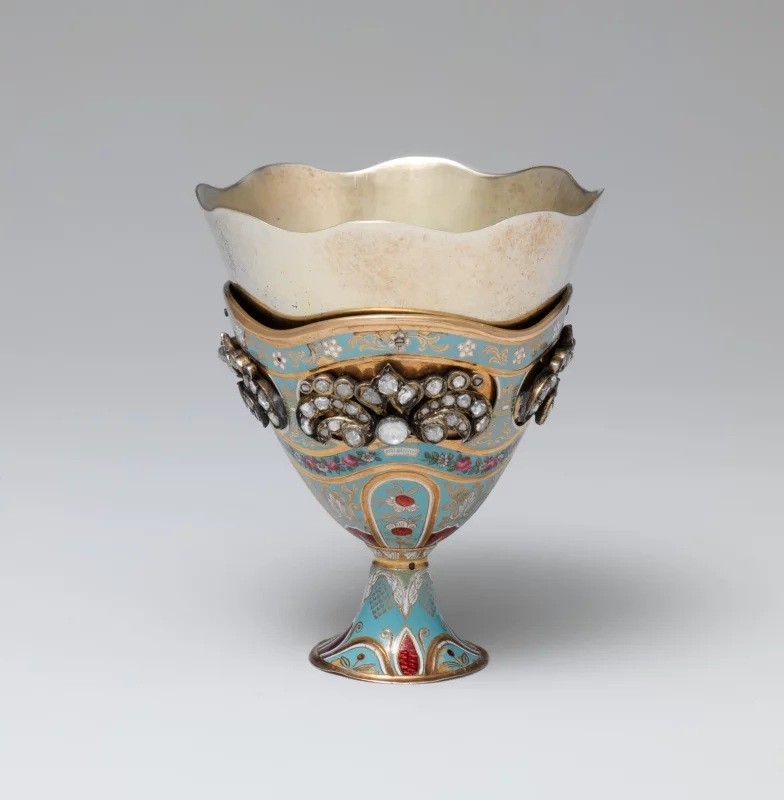
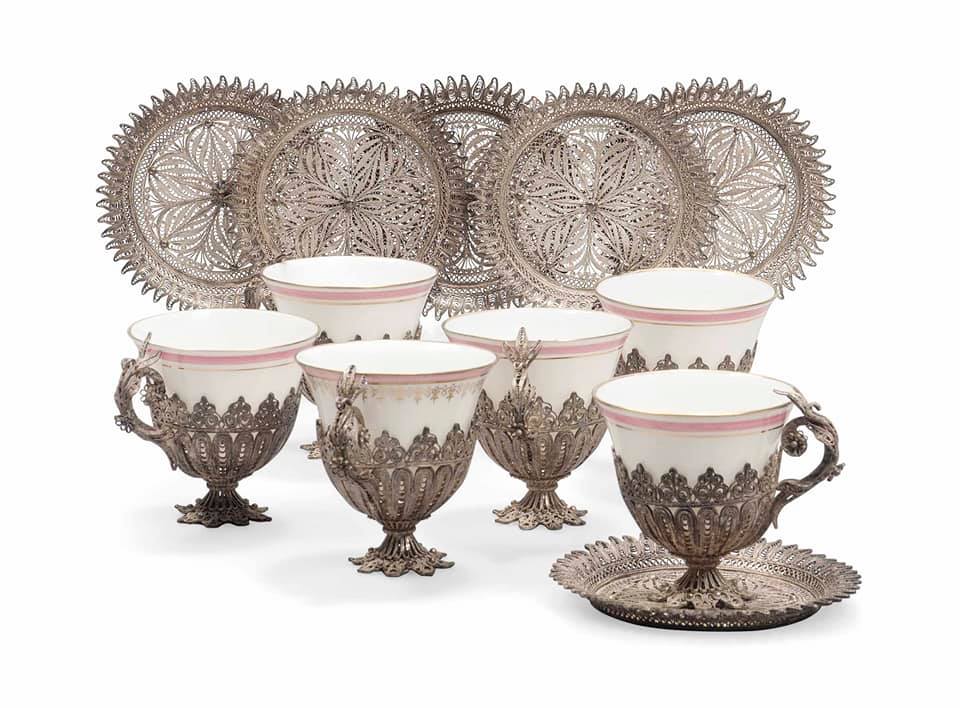
By the 19th century, the goldsmiths of Switzerland had become leaders in the production and export of ornate zarfs, made of precious metals and inlaid with precious stones or small hand-painted medallions. They were often made in fine filigree, with a smaller cup, known as a fincan, made of ceramic or glass, slipped inside to hold the coffee. A modern version of this is still widely used, called a demitasse (French for half cup), in which espresso is often served.
Without further ado, here are a few examples of zarfs and fincans, along with demitasses:









 Stephanie Huesler