Tag Archives: Normandy

History Undusted: Jumièges Abbey

Jumièges Abbey is one of the oldest Benedictine monasteries in Normandy; to dive into its history is akin to diving down Alice’s rabbit hole. For instance, I could say that the abbey was sponsored by the Frankish Queen Balthild, as she persuaded her husband, King Clovis II, to donate land to the Frankish nobleman Filibertus in order to found an abbey. But to know who she was, ah, that is where the intrigue begins.

Who and where were the Franks, when were they a thing, and what are they to us today?

Who, where and when: They were a Western European people who began as a Germanic people along the lower Rhine (which flows from Bonn, Germany, and ends up in the North Sea at the southwestern corner of the Netherlands), along the northern frontier of the Roman Empire. During the Middle Ages, they expanded their scope of rule as the Western Roman Empire began to collapse, and they imposed their power over many post-Roman kingdoms and beyond. That’s the crux of the matter though, as with any political history, it’s far more complex than that. The Franks are distinguished into two main groups by historians: The Salian Franks, to the west, and the Rhineland Franks, to the east.

In the mid-5th century, The Salian king, Childeric I, was a commander of Roman forces against the Gauls, most of whom Childeric and his son, Clovis I, conquered in the 6th century. Clovis was the first king of the Franks to unite the Frankish tribes under one ruler, and he founded the Merovingian dynasty – which ruled the Frankish tribes for 2 centuries. Clovis, in essence, is known as the first king of what would become France. As a side note, the Frankish name of Clovis is at the root of the French name of Louis, borne by eighteen kings of France.

Now, back to Queen Balthild (AD 626 – 680): Sold into slavery as a young girl, she was beautiful and intelligent. She served in the household of Erchinoald, the mayor of the palace of Neustria to Clovis II. Her master, a widower, wanted to marry her, but she hid herself from his sight until he married someone else (apparently the household of servants was numerous enough to enable her to avoid her unwanted suitor). Perhaps through Erchinoald’s notice of her, she came to the attention of Clovis II, who proposed to her and was accepted; hiding herself away may have been a political tactic to gain a higher rank with the king than with the mayor; According to the Vita Sancti Wilfrithi by Stephen of Ripon (written around AD 710), Bathild was a ruthless ruler, in conflict with the bishops and perhaps responsible for several assassinations. Some historians interpret Queen Balthild’s association with founding monasteries as a way of balancing or neutralizing aristocratic opposition to her rule. By installing her own bishops and donating lands for abbeys, she strengthened her own power as ruler (she was regent during the minority of her son). To put that in proper perspective, she was no different than most male counterparts of her day. [I could go off on a tangent about how adjectives differ when applied to the male or female state of affairs (a man is ambitious; a woman is pushy or ruthless), but I won’t. Yet.] From most accounts, however, she was pious and humble. Whichever way you butter that croissant, in ca. 860 she was canonized, thereafter to be referred to as Saint Balthild…

In 654, Balthild gave a parcel of royal land to Philibert, or Filibertus, on which he founded the Notre Dame de Jumièges. His main spiritual influence was that of the Irish monk, Columbanus (who founded several monasteries in the Frankish and Lombardi kingdoms).  The abbey flourished until the Viking invasions of 841 (Remember Rolf Ganger?), which caused disruptions to its first momentum, but it soon began to prosper again. The church itself was rebuilt between 1040 and 1066; it was dedicated on 1 July 1067, with none other present than William the Conqueror, Duke of Normandy and King of England (1066 and all that). The patronage of such a nobleman ensured the abbey’s success.

Jumièges Abbey was, like any abbey of its time, a veritable town. The church was only the heart of the community; there was a 14-acre enclosed park, terraced gardens, the abbatial manor, a bakery, landscaping to evoke biblical scenes, a hostelry, the 14th century “Charles VII” walkway (a covered walkway between the Notre Dame and St Peter’s church, named after the fact that Charles VII and his favourite mistress visited the monastery), and the cloister.

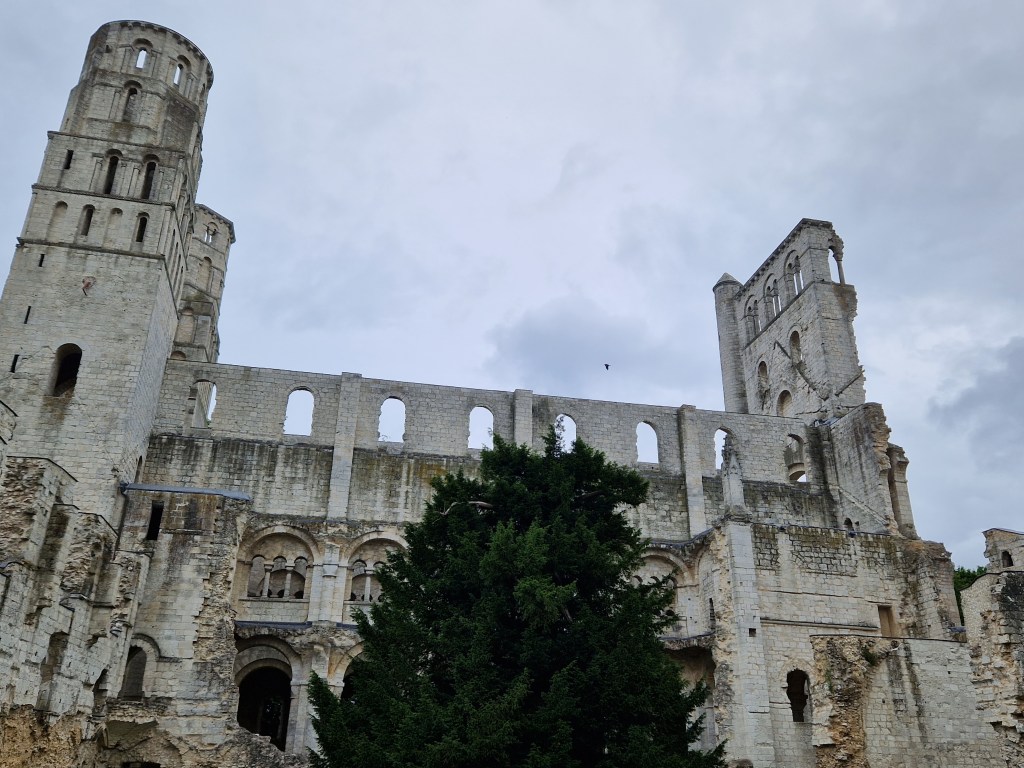
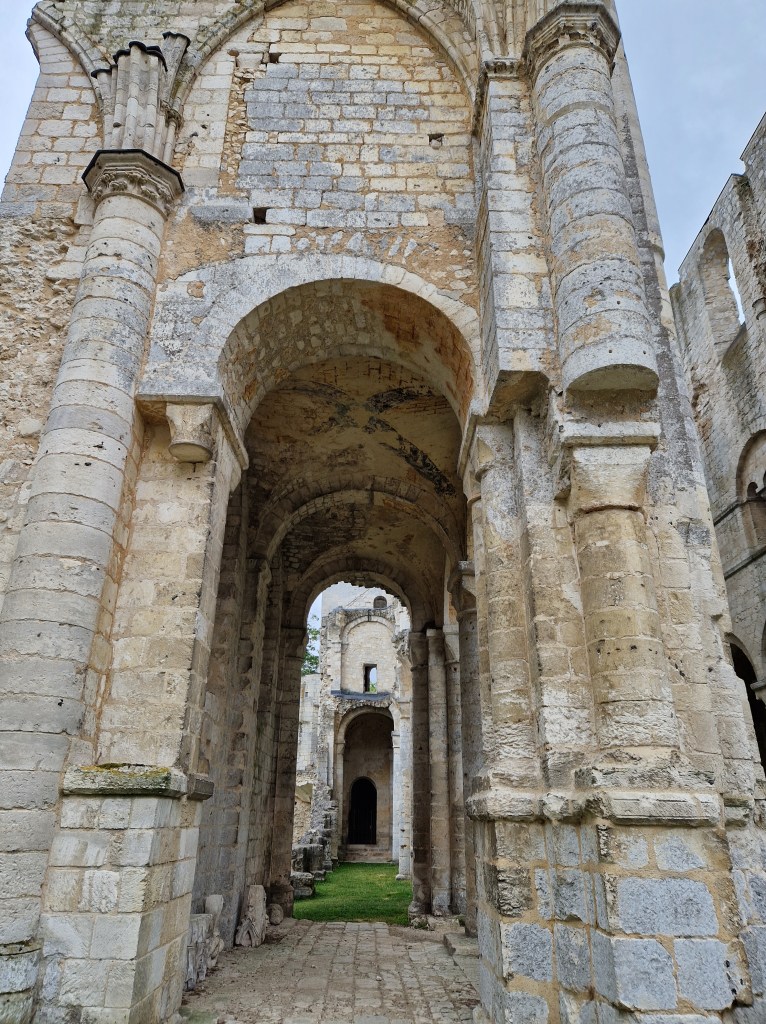
The next major disruption was from 1415, when the monks were forced to regularly seek refuge in Rouen as the English occupied Normandy during the Hundred Years’ War. The abbey eventually recovered and began to flourish again, until the whole province was plunged into the chaos of the Wars of Religion (1562-1598), resulting in the population’s decimation and famine. In 1649, the abbey was taken over by a Benedictine congregation, when some of its former glory was revitalized. Having survived all of that, its ruin came at the hands of the French Revolution, when it was sold as a “national property” and turned into a stone quarry (seen only as a source of ready-cut stones). At last, its historical value was recognized in the 19th century, putting an end to its wanton deconstruction.

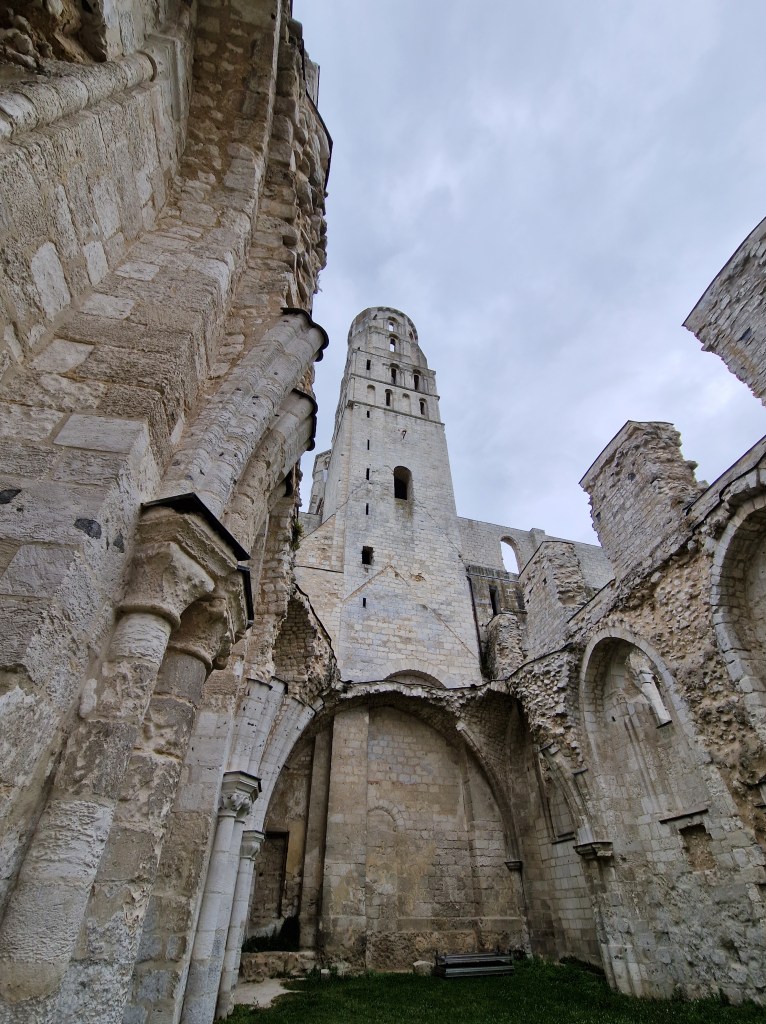
When we visited the abbey last summer, its grandeur, although only ruins today, is still evident; when it was at its height of prosperity, it must have been an awesome sight to behold! In the photos below, which I took during our visit, you can see evidence of the various phases of destruction and reconstruction. Enjoy!
2 Comments

Filed under Articles, Etymology, History, History Undusted, Military History, Snapshots in History

History Undusted: Rolf Ganger, Viking Outlaw and Founder of Normandy

How does a rabble-rousing Viking end up causing a war centuries after his death (as if stirring up trouble during his lifetime wasn’t enough fun and gigs)? Read on… this is going to be a quick, deep dive into history, so buckle up!

Firstly, let’s start with Rolf Ganger, aka Rollo, Rolloun, Rollon, or Hrôlfr – depending on which language you read. On his tomb, the Latin version of his name is Rollonis (see image).

Tomb of Rollonis (Rolf) Ganger, the first ruler of Normandy, in Rouen Cathedral (He’d probably roll in his grave to find himself so simperingly portrayed…!)

The Heimskringla is a collection of ancient Norwegian sagas about Norwegian kings and rulers, written by Snorri Sturluson (great name, by the way) around AD 1230. It tells us that Rolf was the oldest legitimate son of Earl Ragnvald, best friend of King Harald Harfager (“Fair Hair” – a nickname given to him by the Earl due to Harald’s thick, fair hair), who was the first king of Norway, reigning from ca. AD 872 to 930. It tells us that Rolf was so hefty that no horse could carry his weight; thus, he had no choice but to walk everywhere, from which Ganger, his second name derives (I cannot find a direct translation of the meaning of the name, but Germanic languages have similar words: In German, “gehen” means go or walk; “gangart” means gait, or way of walking).

Harald Harfagre, First King of Norway – Statue in Haugusund, Norway

He was rowdy, even by Viking standards. Heimskringla records that he plundered most of the East Sea (likely referring to what is now the region around the Baltic Sea). Then, “One summer, as he was coming from the east on a Viking’s expedition to the coast of Viken*, he landed there and made a cattle foray. As King Harald happened, just at that time, to be in Viken, he heard of it, and was in a great rage; for he had forbid, by the greatest punishment, the plundering within the bounds of the country. The king assembled a Thing**, and had Rolf declared an outlaw over all Norway.”

*Viken was a region that lay over the modern border between Norway and Sweden.

**To assemble a Thing means to gather a council or general assembly. These still take place in some parts of Switzerland, as well as on the Isle of Man and in Scotland; the Icelandic Althing is considered the oldest active, surviving parliament in the world, dating back to the AD 900s. The first detailed description of such a Thing was made by Tacitus, a Roman historian and senator, in AD 98; the oldest reference to a Thing is inscribed on a stone near Hadrian’s Wall, dated as early as AD 43.

According to the Heimskringla, Rolf, now banished from Norway, headed toward the Hebrides, and from there to “Valland” [In Norse legend, Valland is the name of the part of Europe which is inhabited by Celtic and Romance peoples, and Snorri Sturluson mentions it several times as the Old Norse name for Gaul, which was a region of Western Europe first clearly described by the Romans, encompassing present-day France, Belgium, Luxembourg, and parts of Switzerland, the Netherlands, Germany, and Northern Italy, and covering an area of around 494,000 km2.].

Arriving in Gaul, he did what he did best – went a-Viking, plundering and pillaging and “subduing for himself a great earldom”. He populated it with his own best rabble of Norsemen, which the French called Normanz, literally “north men” which quickly led to the Anglicized term Normans (similar to the word for the people group and language, Norse).

One of the places known to have been invaded by the Vikings in AD 841 is the Jumièges Abbey, which is along the Seine River on its way to Rouen, which they also ransacked. At some point (around AD 885), Rolf also raided Bayeux, carrying off a woman, Popa (whose lineage is unverified – later historians for the duke may have sanitized her parentage to legitimize their son’s noble lineage, as she was married “more danico”). She gave birth to his heir, William Longsword. When Rolf and his gang were all done hacking their way through towns and villages along the Seine, they eventually made their way back to Rouen, where he established the Duchy of Normandy in AD 912.

So, how did Rolf cause a war centuries later? Well, his son, William Longsword, fathered a son, Richard the Fearless (who became ruler of Normandy at the age of 10 when his father died). Richard’s son was called Richard the Good, and he became the father of Robert the Magnificent and grandfather to the illegitimate William the Bastard, who became known as William the Conqueror (a sword seems to have cleared up his illegitimacy quite neatly) – from whom all the subsequent English kings descended. Now to the crux of the matter: William, descendent of Rolf Ganger, fathered English kings, who thus claimed their right to the Norman throne by connection, birth, rank… in short, any excuse for raiding was still in their blood. Rouen was one of the largest and most prosperous cities of medieval Europe, and (as mentioned in my last post) was made wealthy through textiles and trade along the Seine River and beyond. Rouen became the focal point of the Hundred Years’ War (1337-1453) because of that pesky connection. So now ya know!

5 Comments

Filed under Articles, Etymology, History, History Undusted, Links to External Articles, Quotes

History Undusted: The Great Clock of Rouen, France

Last summer, my husband and I rented a privately-owned motorhome in Caen, France, and travelled around Normandy for 10 weather-perfect days. One of the places we had on our short list to see was the city of Rouen, a region with a long and rich history. One icon of the city is a clock. Not just any clock. The Great Clock of Rouen.

Rouen was a pivotal location in the Hundred Years’ War (1337-1453 – calling it the “Hundred-and-Sixteen Years’ War” is more accurate but not as catchy, though the name is likely based on the fact that there were periods of fragile truces); the central conflict was the English claim to the French throne. In the context of this war, Joan of Arc became a victim of male chauvinism and political expediency. But that’s another story.

The mechanism of this clock was built in 1389. Let’s put that into perspective: That’s over 100 years before Columbus set out to discover a western passage to the East Indies and inadvertently discovered America; Richard II took over as king of England; it was made during the Hundred Years’ War; Joan of Arc would have seen this clock on her way to her execution (by burning at the stake). It was made more than 190 years before our modern Gregorian calendar replaced the Julian calendar, in 1582.

The mechanism deserved not only a grand position, but a grand façade: The Rouennais aldermen decided that the town needed a clock, and the construction of a tower to house the clock took 9 years; the architect was Jehan de Bayeux, though the tower was completed by his son in 1398. The original designer of the clock’s facades, Jordan Delettre, was no more (whether he died or was removed is unknown), and it was completed by Jean de Felain, who became the first “governor of the clock”, maintaining it in exchange for a home in the clock’s tower. Towers and wars came and went, and the clock survived; it was moved to its current location in 1410, now housed astride an ornately carved stone archway.

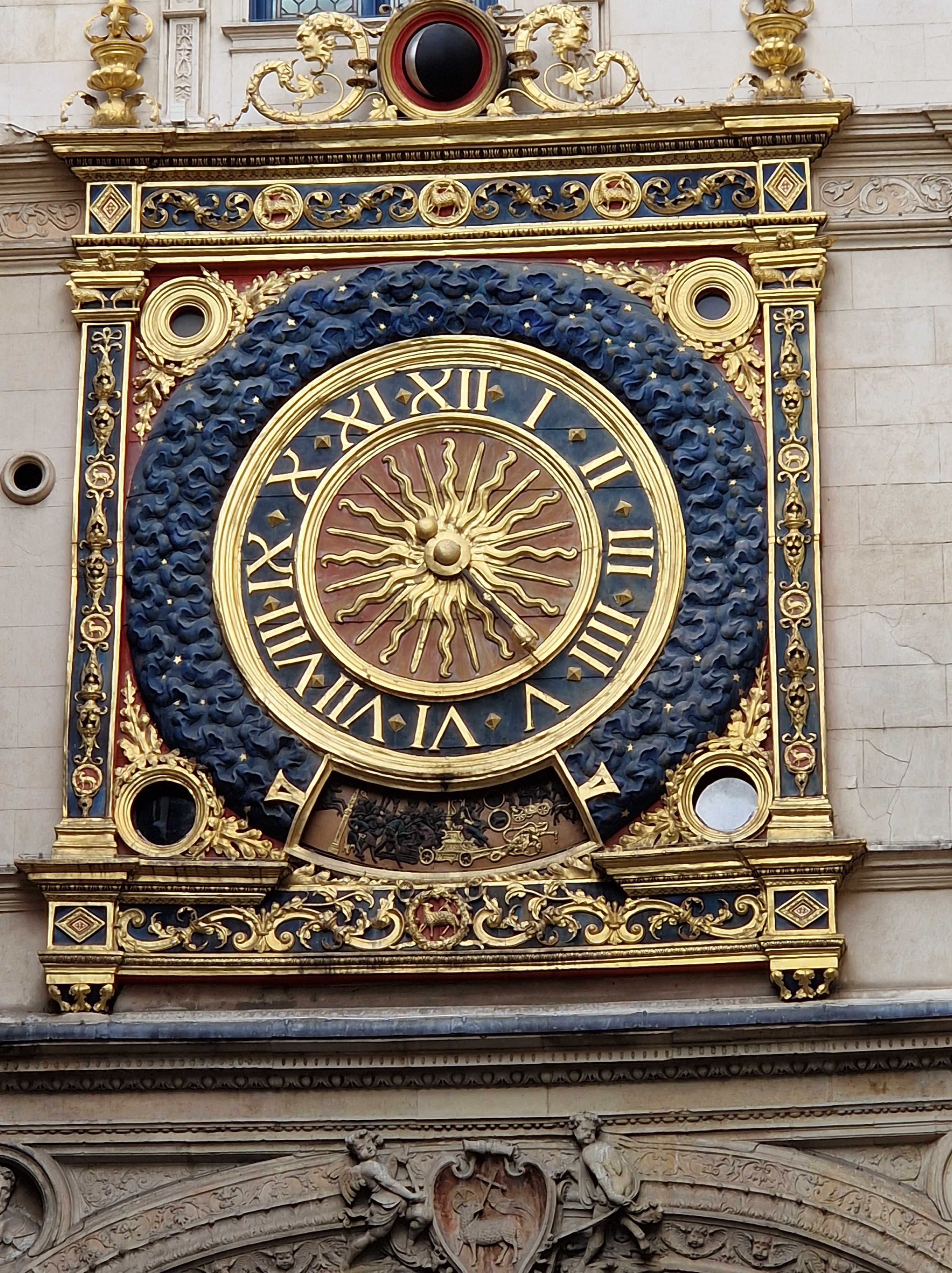
The clock faces (on both sides of a stone archway and connected to a central mechanism shared by both) are 2.5 metres (over 8 feet) in diameter, and each has only a single hand, tipped with the depiction of a lamb, which shows the hour; moon phases are indicated in the 30 cm oculus above the clock face, which makes a full rotation every 29 days. The face depicts 24 rays of the sun surrounded by a dark blue starry frame. A hand which shows the day of the week is located in an opening at the base of the dial, with each day represented by a different Greek god: Diane as the moon (Monday), Mars (Tuesday), Mercury (Wednesday), Jupiter (Thursday), Venus (Friday), Saturn (Saturday) and Apollo (Sunday).

Although the mechanism of the clock still works, it has been powered by electricity since 1928, and the tower itself was renovated in the late 1990s.

Underneath the clock in the centre of the archway, the coat of arms of Rouen can be seen: It depicts the Paschal lamb on a red background (the official colour of Rouen); it is held by two angels (if you look closely at the angel on the right, you’ll notice that its head is on wrong; it is thought to be due to disgruntled construction workers – obviously an age-old problem…). Beneath the arch are elaborate bas-reliefs of Jesus as the Good Shepherd caring for his flocks; the clock’s hand, the coat of arms and the reliefs all echo the importance of textile and wool trade to the city. One clock face alone has at least 15 sheep (zoom in on the picture of the clock and see if you can spot them all!). Next to the clock is a Gothic belfry tower built in the 14th and 15th centuries which houses the bells connected to the clock, which ring on the quarter-hour.

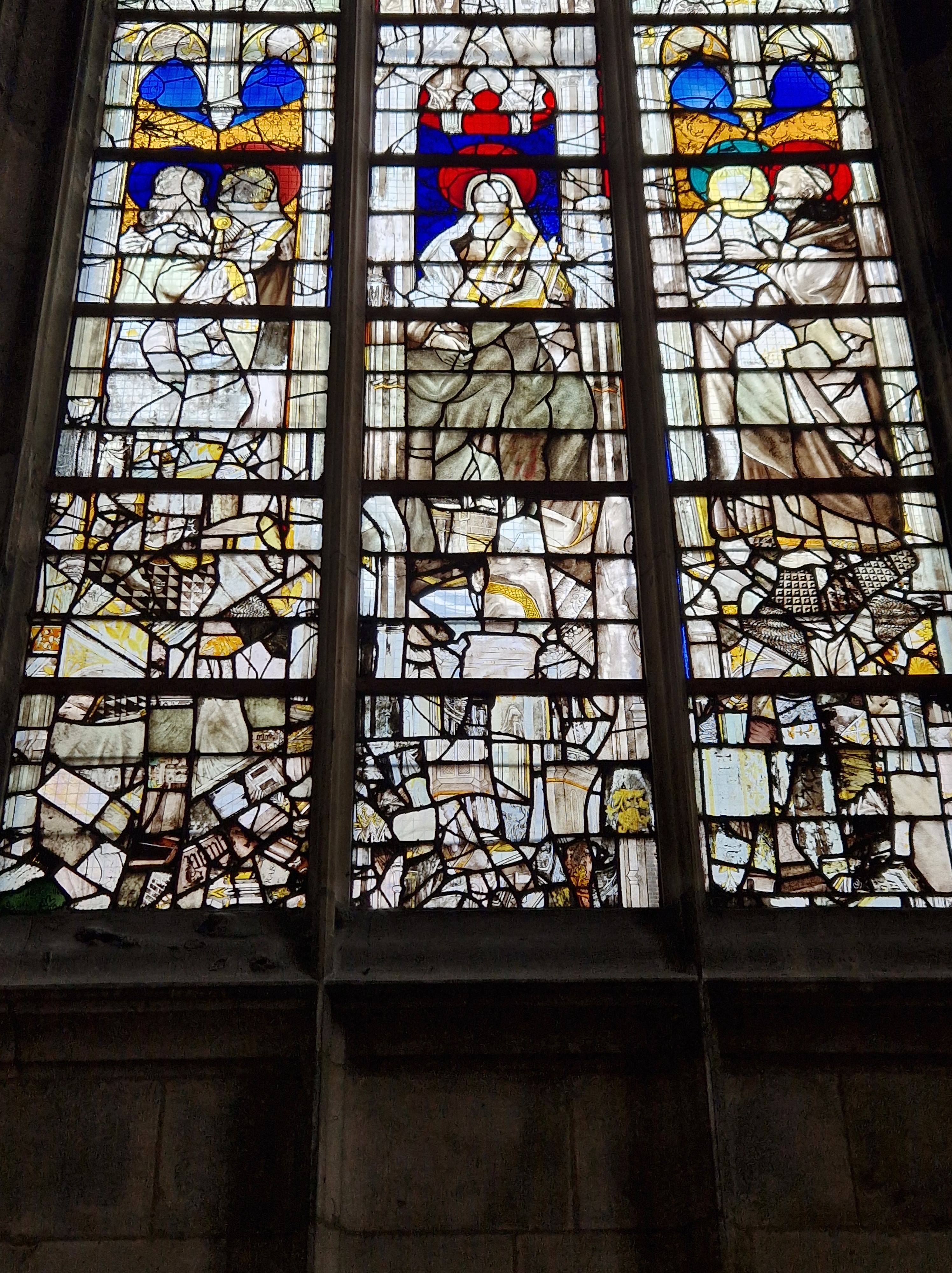
Rouen is a survivor: It has outlasted Viking raids that travelled up the Seine River, the Hundred Years’ War, the Religion Wars of the Renaissance period, the Franco-Prussian War of 1870, the French Revolution, and even World War 2; the latter damaged nearly half the city, and shrapnel and bullet scars can still be seen in façades. The cathedral’s stained-glass windows were shattered by a WW2 bomb and were subsequently reconstructed using the fragments, creating jumbled images that reflect its history and its survival.

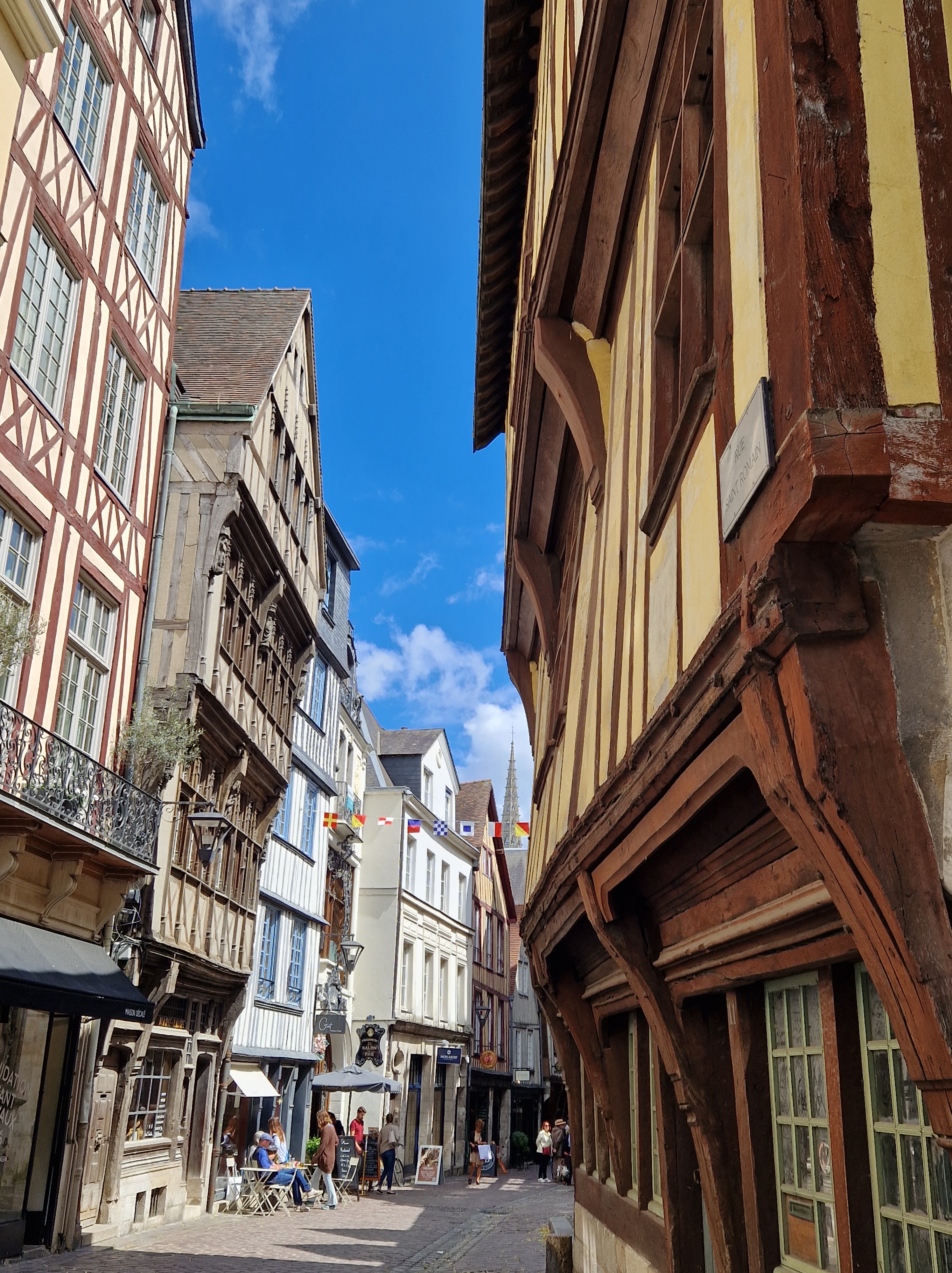
For me, the clock must really be seen within its context to truly appreciate it; it’s surrounded by wonky Medieval buildings which are three or four stories tall and built when plumb lines and uniformity were still futuristic concepts. They were built out of timber, as there is abundant forest nearby but no stone quarries.

The clock adorns the arch over the Rue du Gros-Horloge (“Street of the Great Clock”), which runs between the Gothic cathedral, made famous by Claude Monet (who painted over 30 canvases centred on the cathedral), and the old market square, where Joan of Arc was burned at the stake. Perhaps ironically in light of the latter event, the street just off of the clock’s archway is called Rue Massacre

Though I do not speak French, I know that in French, clocks today are referred to in the feminine form, la horloge; but prior to the 18th century, clocks were masculine; so, the great clock of Rouen, in French, is still Le Gros-Horloge.

Below are a few of our holiday photos: They include the cathedral’s jumbled windows and the clock from various angles, as well as a few of the wonky buildings. Enjoy!

5 Comments

Filed under History, History Undusted, Military History, Science & Technology, Snapshots in History

History Undusted: The Colour of Carrots

Unless you’ve been living under a rock all your life, chances are you’ve eaten carrots. Orange through and through, they can be eaten sweet, as in a carrot cake, or savoury with dips or in a stew. But where did they come from? Have they always been orange? The short answers are Central Asia, and nope.

Carrots - Carrot-Museum-co-uk

Carrots, which likely originated in the Himalayas and the Hindu Kush ranges and spread along the Silk Road, were white/ivory wild roots gleaned for their leaves and seeds – much like their genetic relatives of coriander and parsley, and it may be that the products of these plants were used medicinally, like many other plants and herbs.

They were first cultivated as a food crop in the Iranian Plateau and Persia, and even today the centre of diversity remains in the region, in Afghanistan. Long before they were cultivated, the wild varieties had become widespread throughout Europe, as far back as 5,000 years ago, though fossilized pollen has been identified as belonging to the carrot family in the Eocene period (55 to 34 million years ago).

These little roots have approximately 32,000 genes, which is more than you and I do; and just two of those genes are recessive, creating a build-up of alpha- and beta-carotene. Over a thousand years ago, purple and yellow varieties began to appear, and around 600 years ago, the orange variety began to dominate the market, appearing in Spain and Germany around the 15th or 16th century.

One apocryphal theory is that the orange coloured carrots were cultivated by the Dutch in honour of William of Orange, a 16th century commander who fought against the Habsburg dynasty; even if this legend isn’t true, the orange carrot did become associated with William of Orange, and during the 18th century, the noticeable display at market stalls was considered to be a provocative political gesture in support of William’s descendant, who had been driven from the English throne. The distaste for the political figure didn’t stem the taste for the root, however, and they grew in popularity. Most modern orange carrots descend from a strain grown in Hoorn, Holland; today’s carrots, more vivid orange, contain 50% more carotene than those of 1970. Modern carrot breeders continue to refine the carrot, improving flavour, colour and texture, as well as reducing bitterness and enhancing sweetness.

Though other varieties of carrots are making a comeback, the beta-carotene and vitamin A which causes the deep orange was thought to improve eyesight (that is a misnomer). This led to a diversion tactic of the British during World War 2: They claimed that eating carrots improved night-vision and that their pilots ate carrots to have that advantage; it was misinformation spread to hide the Royal Air Force’s development of radar technology from the Germans. Aside from the propaganda ploy by the military, carrots were a staple in the diets of the British, who used the humble root as a sweetener and a vegetable staple, and was promoted for health benefits. Food rationing tightened the Brits’ belts, but the carrot came to the rescue; it was a common, home-grown staple, and could be used as a substitute for restricted items as it was not subject to rationing. Carrot was even used as a secret code word, broadcast by the BBC in French to the French Resistance, to warn of the impending D-Day landing in Normandy: On the 4th of June 1944, several messages that seemed nonsensical to listeners were broadcast, including, “les carottes sont cuites, je répète, les carottes sont cuites!” (“The carrots are cooked, I repeat, the carrots are cooked!”) This gave the resistance fighters the signal to carry out their plans to sabotage railway and telephone lines. Carrots were the last vegetables added to a stew; if they were already cooked, it meant that the plans were set – no going back. Normandy landings began the next day, 5 June, which led to the liberation of France and the ultimate defeat of the Nazis.

The word carrot was first recorded in English around 1530 and was borrowed from Middle French carotte, originally from the Indo-European root *ker– (horn), probably due to its horn-like shape. At the time, carrots (white) were visually similar to parsnips, the two being collectively called moru (from the Proto-Indo-European word mork (edible root)); the German for carrot is Möhre).

For more information than most people could possibly use in their lifetime, check out this link to The Carrot Museum, my main source of information for this article (along with the Economist).

The next time you sit down to a good vegetable stew or a plate of crudité and dips, think of the grand history of the humble carrot.

6 Comments

Filed under Articles, Etymology, History, History Undusted, Links to External Articles, Military History, Research

War Zones Then and Now

The UK’s Huff Post ran a series of impressive photos superimposing the “now” scenes on the site of photographs from 1944 in the war zones of Europe; the juxtaposition of the two together give pause for thought:  How much we take for granted now; how much was sacrificed then; the freedom we across Europe and the Americas enjoy now was bought at a great price.  Never forget.  Click on the photo below to see the entire series of photographs, and the photos of veteran’s ceremonies in France.  If you’d like to learn about a few famous deceptions in World War 2, click here.

DDAY/


Leave a comment

Filed under History