
This article is longer than my usual blog, but please bear with me; the issues below affect all of us, and they are important to become aware of; after all, you can only keep an eye on something you see.
I watched a fascinating TED talk recently about an African American man, Theo E.J. Wilson, who went “undercover” online as a white supremacist. He did it in order to try and understand where some of the internet trolls who were attacking him were coming from, and to try and discover where they were getting their “information” and ideas from. His findings were insightful.
He discovered something that has become more and more obvious to me lately, and that is that we all live online in “digital echo chambers”. The definition of echo chamber is “A room or other enclosed space that is highly conducive to the production of echoes, particularly one that has been designed and built for this purpose. An insular communication space that is of no interest to outsiders or refuses their input.”
The echo chamber is harmless, though annoying, when it comes to shopping or interest feeds; but it can be catastrophic when it comes to life decisions and social or political views.
“If you surround yourself with voices that echo similar opinions to those you’re feeding out, they will be reinforced in your mind as mainstream, to the point that it can distort your perception of what is the general consensus.”
Alan Martin, Wired
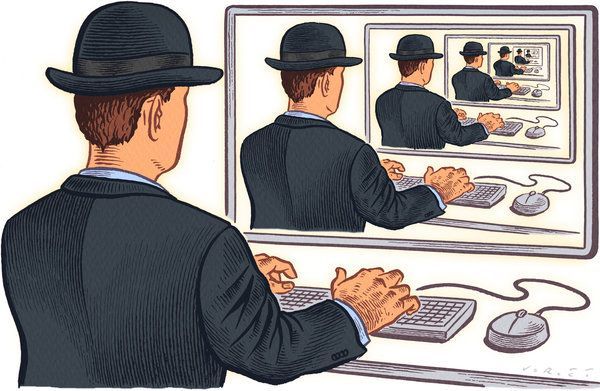
Big Brother
The question growing in my mind is, am I telling algorithms online what I want to see/hear/learn, or visa versa? I’ll give a few examples of what I mean:
Sitting at my dining table chatting over a tea with a friend, our cell phones sat off to one side. We were chatting about holidays, and she spontaneously mentioned Mallorca (Spanish islands). The next time we looked online, we both had ads for Mallorca. This has happened many times – that a live conversation in a private home, with no online searches previously made, have resulted in ads, or articles popping up in suggestions; the conclusion is that Google is listening in on your life. If you don’t have your phone on airplane mode and your cameras blocked (I keep small post-its on both front and back cameras on my phones, as well as my laptop’s camera), chances are you’re giving away a lot more than you want to. If you tend to say your passwords out loud as you’re typing them in, you may be giving them away.
Facebook & co.
Facebook, theoretically a social media site to connect with your friends, in reality decides what it is you see, and whose activities you see in your feed. I haven’t been on Facebook regularly for several months now as I removed it from my home tabs on my browser; that one move has saved a lot of time otherwise being wasted! Now, when I look on Facebook, I literally see the home feed activities from only a handful of friends out of 300+; most of what I now see in my home feed is Facebook ads, FB suggestions, memories they’ve selected, and unrelated video stream suggestions. They’re trying to draw me in; but they’ve missed the memo that I’m only there for real connections with friends, and I intend to keep it that way. Maybe I should turn on my phone’s Wi-Fi and say that out loud… [Keep in mind that Facebook, or Amazon, or Google are not “they” as in human faces seeing your information; they are algorithms designed to harvest it.]
The more time you spend online, the clearer your digital fingerprint becomes; the more the algorithms know about your likes and interests, the more they will feed you just that information. The dark side of this is that, if someone has temptations in a particular area, they will be bombarded by tailor-made algorithmic choices, guiding them toward the thing they may be trying to avoid. A recent article in our local newspaper stated that, according to Netzsieger, a comparison portal, 25% of all searches online are related to pornography. Let that statistic sink in a moment.
.Com is not .Com
And were you aware of the fact that, if you are outside of the borders of the US, a certain monopolistic shopping portal beginning with “Amaz” has been discriminating against you? The prices you see are not the prices an American within the borders of the US are seeing. I found this out recently when I was running a sale on one of my books; the sales price was 99 cents; the usual price is $2.99. But when I went on (I am a registered kindle customer at .com) to see if the sale had begun, the only price I saw was $3.56. That’s nearly a 20% price increase; no sale in sight. When I asked them about it, they gave a fluff algorithmic answer, but did not address the real issue. And they never answered my question whether I, as author, am being paid commission on the higher price or not.
It makes me wonder what else they’re not telling me as both author and as customer, and what else they’ve been charging me more for (likely, everything) than if I lived within the borders of the US; as a result, I’ve taken my online shopping elsewhere. I will be doing further investigation into this, and if you do online shopping, I would recommend you do the same, and call them on the carpet about it – write complaint emails, and make your voices heard! Have friends in other countries check out the prices on the same website and product, and compare.
[Now I have another example of the digital eavesdropping: I’ve been typing up this article in my Word program on my laptop – not directly into the WordPress blog; when I went onto Google to refresh my memory about percentage calculation, I began typing in, “how to calculate” – and it filled in “percentage” – with NO previous such search on my part… they didn’t choose “exchange rate” or any other more common option of mine…]
Breaking Out
So, how can we break out of our digital echo chambers and mess with the results of algorithms? There are quite a few ways, actually: Below are a few links to articles about that very topic. I would encourage you to get informed, and put into action various methods to burst the digital bubble, and breathe in the fresh air outside your echo chamber.
Five Ways to Break Out of Your Online Echo Chamber
You can break out of your echo chamber – and here’s how
How To Break Out Of An Echo Chamber – Your Bubble
Escape the echo chamber: How to fix your Facebook News Feed
5 Super Easy Ways to Eliminate Your Echo Chamber
Fake news, echo chambers and filter bubbles: Under-researched and overhyped






 Stephanie Huesler
Who’s Who in Quotes: Will Rogers
Will Rogers is one of those larger-than-life characters who seemed to have had his fingers in every pie imaginable: Born in November 1879 as a Cherokee Nation citizen in the Indian Territory now known as Oklahoma, he was the youngest of eight siblings, only three of whom survived into adulthood. His mother died when he was just ten years old. By the time he was 20, he’d begun appearing in rodeos, and in 1902 at the age of 22, he and a friend moved to Argentina to find work as gauchos (a skilled horseman, hired by ranchers in many South American countries). When their adventure failed, and they’d lost all their money, Will couldn’t bear to ask for money from home, so he took a boat to South Africa, where he was hired as a ranch hand. His career as a trick roper began there, as he joined the Texas Jack’s Wild West Circus. From there, armed with a letter of reference from Texas Jack, he moved to Australia and joined the Wirth Brothers Circus as a rider and trick roper. By 1904, he’d returned to the States and performed in the St. Louis World’s Fair, then began using his riding and roping skills in the Vaudeville circuits; he was often billed as The Cherokee Kid. His natural humour hit a chord with audiences, who loved his frontier twang of an accent coupled with his off-the-cuff wit and commentary on current events; he built his later career around that talent.
In 1908, he married Betty Blake, and they had four children; three survived into adulthood, all of whom went on to have careers in the public eye in one way or another.
By 1916, Rogers was a featured star in Ziegfeld’s Follies on Broadway; from there he branched off into silent films; at that time, most films were made in or around New York, which allowed him to continue performing on Broadway. The New York Times syndicated his weekly newspaper column, “Will Rogers Says”, from 1922 to 1935; he also wrote for The Saturday Evening Post; this progressed into books – over 30 of them. He also hosted a radio program, telling jokes and discussing current events with his simple, disarming humour.
Click here to see a short, 3-minute video showcasing some of his amazing rope tricks.
He was an avid supporter of the aviation industry, and he took many opportunities to fly to his various engagements. In 1926, while touring Europe, he saw how much more advanced the commercial services were there in comparison to the States; his newspaper columns often emphasized the safety and speed of travel aeroplanes offered, which helped shape public opinion about the new mode of transport.
In 1935, Wiley Post, a famous aviator of his time, proposed flying from the West Coast to Russia to find a mail-and-passenger air route, and Rogers asked to go with him in order to find new material for his newspaper columns. Post’s plane was modified for the long flight, and floats were added for landing on water. On 15 August, they took off from Fairbanks, Alaska, for Point Barrow, a headland on the Arctic coast. Bad weather hindered their ability to calculate their position, and, after landing in a lagoon to ask directions and taking off again, the engine failed at low altitude and plunged into the lagoon, killing both men. Rogers was 55.
In such a short life, he left a huge legacy in many fields of entertainment and helped shape public perspectives on politics and civil responsibility. He was a household name in the early 20th Century and a trusted voice during the Great Depression, identifying with the struggles of the average American and holding a mirror to politics with his witty satire.
Here are a few of his famous quotes:
2 Comments
Filed under History, History Undusted, Humanity Highlights, Quotes, Snapshots in History, YouTube Link
Tagged as Alaska, Australia, Aviation, Broadway, Cherokee Nation, Circus, Entertainment, Gauchos, Great Depression, Indian Territory, New York, New York Times, Oklahoma, Politics, Quotes, Satire, Saturday Evening Post, Social Commentary, The Cherokee Kid, Trick Roper, Vaudville, Who's Who in Quotes, Will Rogers, Ziegfeld's Follies