
Languages are constantly moving, changing their minds on the meanings of words, and taking on new words to fit their needs in a fast-paced world. Today, when we say nice, we mean agreeable, pleasant, or kind; but when it first entered English in the late 13th century, it meant foolish, frivolous, ignorant or senseless. By Jane Austen’s time, the word was disdained as overused, diffused to the point of meaning nothing… a nice day, a nice walk, a nice person. And depending on the tone, it can be sarcastic. A versatile, everyday word that we stole – uh, borrowed – from Old French.
English has borrowed quite a bit from French; in fact, some linguists estimate that up to 45% of English words can trace their origins back to French. Most of the influx into English came after William the Conqueror’s 1066 victory, when the French-speaking ruling class (of what we know today as England) moved in. To communicate with their new tyrants – uh, rulers – the conquered Anglo-Saxons needed to do some rapid assimilation, and ended up expanding their vocabulary by leaps and bounds. In the end, it’s up for debate as to who actually conquered whom, as English is spoken the world over by more than a billion people as a first or second language.
We can be gracious winners, and give the French tongue credit where crédit is due (it’s French, after all). Aside from words stol— borrowed centuries ago and adapted to fit our tongue, we have also assimilated purely French words or phrases that we use regularly:
Rendezvous, RSVP (répondez s’il vous plaît), arrangez-vous, mis en place, café, résumé, faux pas, déjà vu, à la carte, cliché, cuisine, sauté, avant-garde, chic, je ne sais quoi, cul-de-sac, en route, savoir-faire, carte blanche, boutique, lingerie, silhouette, matinée, décor, fiancé, and augment. To scrape the tip of the iceberg.
With up to 40-45% of English being French in origin, chances are that many more of the words I’ve just used to communicate this piece were originally French. Can you spot them? Please comment below!





 Stephanie Huesler
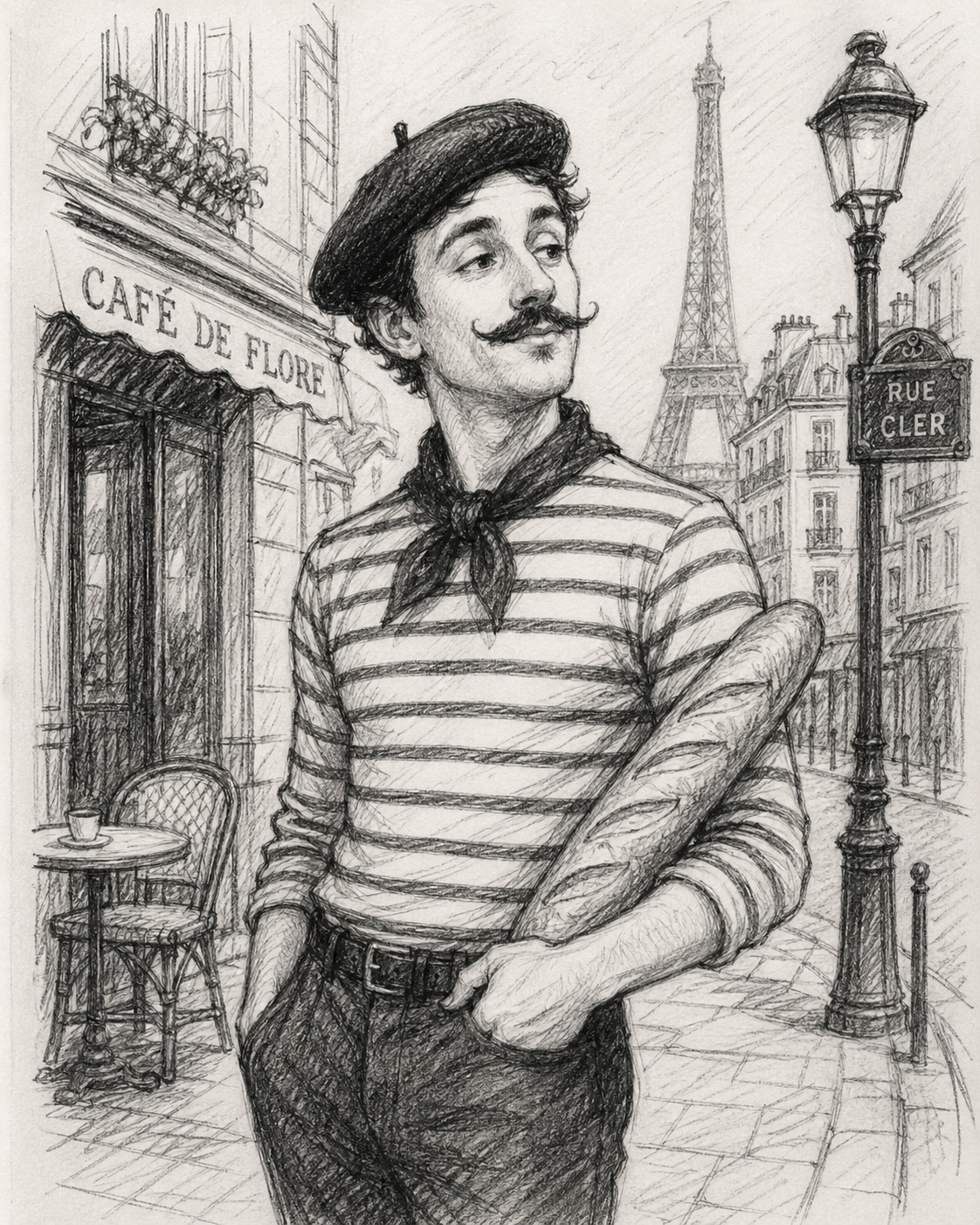
Well…the drawing has a baguette in it.
One interesting detail. While the farmers in Britain spoke English, the cooks were French. so we have:
sheep – mouton (when cooked)
cow – beef (boeuf)
chicken – coq (au vin)
etc.
I enjoyed this post. For the fun of it, I read the list of French words. I think I pronounced them correctly (American style) and knew the gist of the meanings. Fun reading!!
Clue #1.😉
We went through their pockets and stole loose words.😉
Thank you! Do you use any of the French words occasionally? Like rendezvous, de ja vu, or RSVP?
I went back to see what words or phrases I haven’t used. There were four in your list I’ve never used, although I’ve heard them all.
Which ones were new to you? I wonder if some are used more regionally in some places than others…
arrangez-vous, mis en place, je ne sais quoi, savoir-faire
These are the four that I have heard or read, but I’ve never used them myself.
I use the first two regularly; but that may be because I live in a country where French is one of the official languages, so people understand a bit, even if they don’t speak it here in the German-speaking region.