Believe it or not, the language second only to French in English borrowings is Latin. In all, it is estimated that up to 56% of English borrowings come from French and Latin (and since many French words come from Latin, it could be argued that Latin has had the greatest impact on the English language).
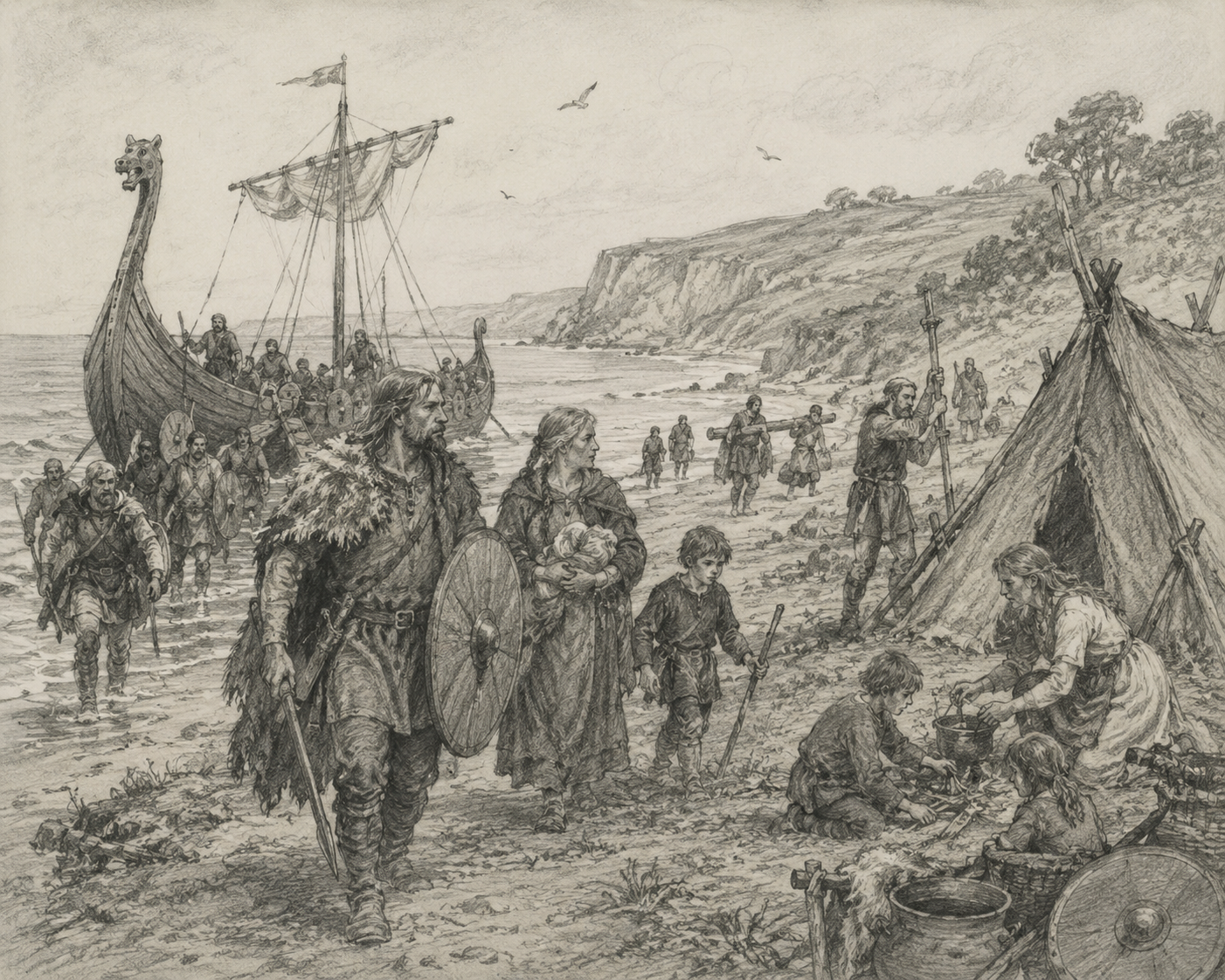
The Germanic tribes that fought the Roman Empire eventually moved west into what we know today as the British Isles; before they came, they’d already packed their linguistic bags with Latin terms, such as candle (candelabrum), cheese (caseum), camp (castra – from which we also derive castle), mile (mille passus, from which we also get [geographical] pass), mint (menta – for coins), pound (libra – for a weight unit, and from which the British pound sign £ is derived), and street (via strata), to name a few (many more were added during the period of Roman Britain, 55 BC – AD 410). The language of these ancient settlers was the ancestor of what would become English, but these tribes wrote in runes, and the language they spoke would be unintelligible to us today, as it had complex genders/noun cases and distinct vowel shifts.
Ancient Latin often borrowed words from Greek and then passed them on through the Romance languages to English, often through French. Some examples from Greek via Latin are school, anatomy, philosophy, music, machine, olive, bacteria, lamp, topic, idea, and place.
When Christian missionaries arrived in Britain in the 6th and 7th centuries, they brought Latin terms with them to describe new concepts. At that time, Latin was the Lingua Franca of medieval Europe. Sometimes, both the Old English and the Latin terms survived, such as OE Gospel (gödspell) and Latin evangelium (which comes from the Greek for “good news”; this is still the word used in German today). During that period, Latin terms tended to be used only in a religious context, with Old English being used in everyday life.
Latin moved beyond cathedral walls via science and technology; the era of scientific discovery required new words to describe new areas of knowledge and understanding. Words like carnivorous, apparatus, data, experiment, incubate, organic, structure, vertebra, and component entered the vocabulary during that time.
Other words borrowed from Latin include:
Absent, alter, amble, acceptable, agriculture, amiable, animal, appear, announce, aviary, barbarian, beatitude, benefit, campus, candidate, circumspect, civic, conspicuous, council, custody, deity, dictionary, digital, dragon, edible, extra, figure, focus, genus, habitat, imperial, invent, labour, legacy, library, marine, mediocre, medium, perfect, port, respect, ridicule, scholar, science, serpent, serve, superb, and so many more… ad infinitum!