Category Archives: Food History

History Undusted: Canning Jars

My quirky brain went down a rabbit hole last week; as I was putting away groceries into glass jars (for that explanation, please click here), I wondered who had been the genius behind the thread around canning jar lids, or, as most of my jars use, the bail closure.

Just to clarify terminology: Here is a threaded jar, a type of screw-on lid that is either one part or two:

Here is a jar with a bail closure, aka flip-tops, lightning jars, known also by their various brand names, e.g. Fido, Le Parfait, Kilner:
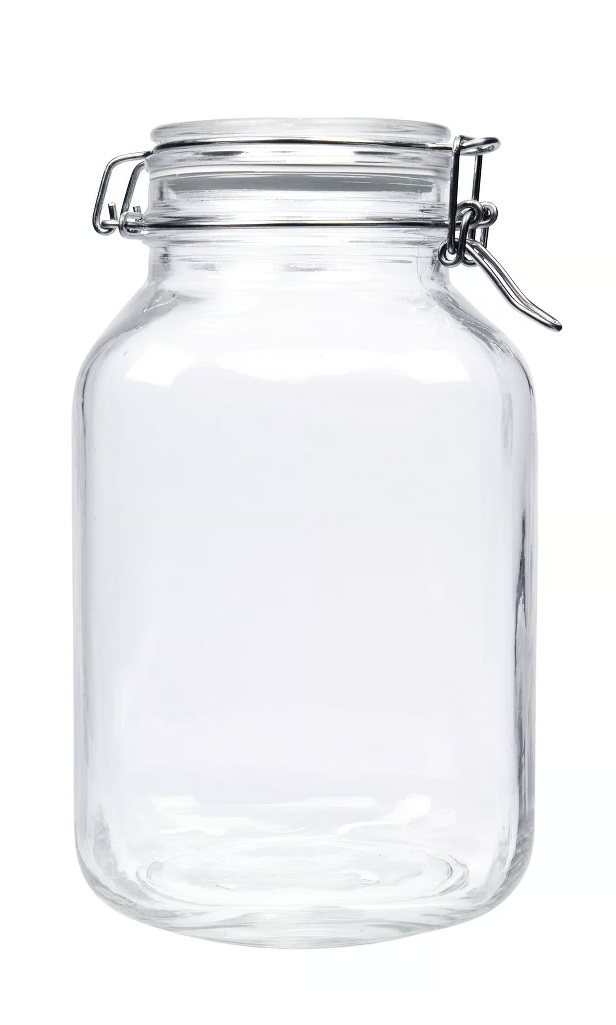
A third type of jar, German-made, is the Weck jar, with metal clips and a glass lid. I don’t like using these, so you won’t find them in our house.

5000-Year-Old Pharaonic wine jars found intact at Abydos – Egypt Museum

Closures have been an issue for thousands of years; ancient amphoras, which were used to transport wines and oils, were sealed with wood, cork, or a ceramic or pottery lid sealed with a type of mortar. Archaeology has many examples of clay or pottery pots with lids, Norse ornate metal containers with lids, and even ancient Egypt’s canopic jars, with their ornate lids. Another variety of closure is found on wooden barrels, which have side holes called bungholes, plugged with a cork or other wood.

The threaded jar lid was invented by the tinsmith John Landis Mason in 1858. Prior to his invention, a glass lid was laid atop an un-threaded canning jar and sealed with hot wax. It was messy, and if it wasn’t done right every time, it could allow dangerous bacteria into foods. Before refrigeration, the only way to preserve garden produce was basically to can with a wax seal and take your life into your hands. There were other preservation methods, such as drying, salting, smoking or pickling, but the new way of preserving offered a convenient, faster alternative; Mason’s threaded lids, combined with a rubber ring and a threaded glass jar, revolutionised canning. Unfortunately, he was not a savvy businessman, and though he filed a patent for the threaded screw-top jars, he failed to patent the rest of the invention, such as the rubber gaskets. He let the patent expire in 1879, and manufacturers took the idea and ran with it. Mason never made a fortune; in fact, he died in poverty in 1902. But his name lives on in the common term, “Mason Jars”. The concept is now used with countless products, from drinks to shampoos to household cleaners.

The invention of the bail closure design is a bit murkier: In the early 1840s, the Yorkshireman John Kilner invented the Kilner jar, using the rubber seal and wire bail closure.

In 1893, beverage bottles began using the Hutter stopper – a porcelain plug with a rubber gasket held in place with a metal strap.

In the 1930s, the La Parfait jars began production in Reims, France, by Verreries Mécaniques Champenoises, a historic French glassmaker.

The Bormioli family is an Italian name associated with glass-blowing since the Middle Ages; among their many brands is the Fido airtight jar, using the bail closure, which began production in 1968.

I personally have Kilner, La Parfait and Fido bail-closure jars, as well as many screw-top jars similar to Mason from these companies.

Do you use any such jars for storage in your home? Do you use them for canning or storing dried goods, or both? Please comment below!

5 Comments

Filed under Articles, Food History, History Undusted, Links to External Articles, Science & Technology

Etymology Undusted: Zarf

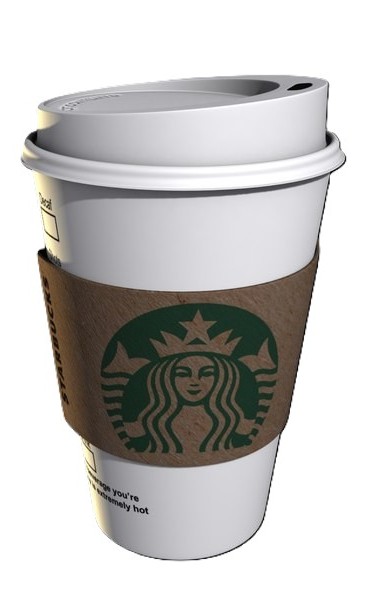
To me, the word Zarf sounds like a sci-fi comedy name for an inept villain. But, in fact, it’s a word that entered English in 1836, and is the Arabic word for “vessel”. It describes an object that you’ve seen or have likely had in your hand at some point. I will freely admit that the zarfs we know today have fallen a long way from their original forms: A zarf is the holder of a coffee cup. That sounds fairly straightforward. You may have instantly pictured a highly decorative, precious metal jewelled… no? Are those crickets I hear chirping in the vast silence of confusion? Or maybe you pictured the cardboard contraption around a hot cup of Starbucks coffee. Fallen a long way, indeed. (Camps are divided on whether the latter constitutes a zarf… for good reason: I think they would be better referred to as sleeves, as to put them on par with the bejewelled masterpieces would be an insult to the artisans of bygone days.)

Zarfs arose out of the necessity of protecting one’s hands from a hot cup; before the monster of plastic reared its ugly head, cups were made from metal or glass, often without handles. Further back, they might have been made from plant products such as coconut shells. The oldest known cups were found in Gough’s Cave in Cheddar Gorge, Somerset, England, and dated to 14,700 years ago; they were made of cannibalised human skulls.

During the 16th century, coffee gained popularity throughout the Ottoman Empire. It led to the popularity of coffee paraphernalia and coffee houses, which eventually spread worldwide and remain popular to this day. In Britain, for instance, a coffee-house culture arose in the 17th century; by the end of the century, there were over 3,000. Such venues became known as penny universities, because, for the price of a cup of coffee, men could join in the hubs of intellectual exchange and debate. Artists, journalists, poets and writers gathered to discuss God and the world; the Inklings, a literary group including C.S. Lewis and JRR Tolkien, met regularly at the Eagle and Child in St Giles’, Oxford.

By the 19th century, the goldsmiths of Switzerland had become leaders in the production and export of ornate zarfs, made of precious metals and inlaid with precious stones or small hand-painted medallions. They were often made in fine filigree, with a smaller cup, known as a fincan, made of ceramic or glass, slipped inside to hold the coffee. A modern version of this is still widely used, called a demitasse (French for half cup), in which espresso is often served.

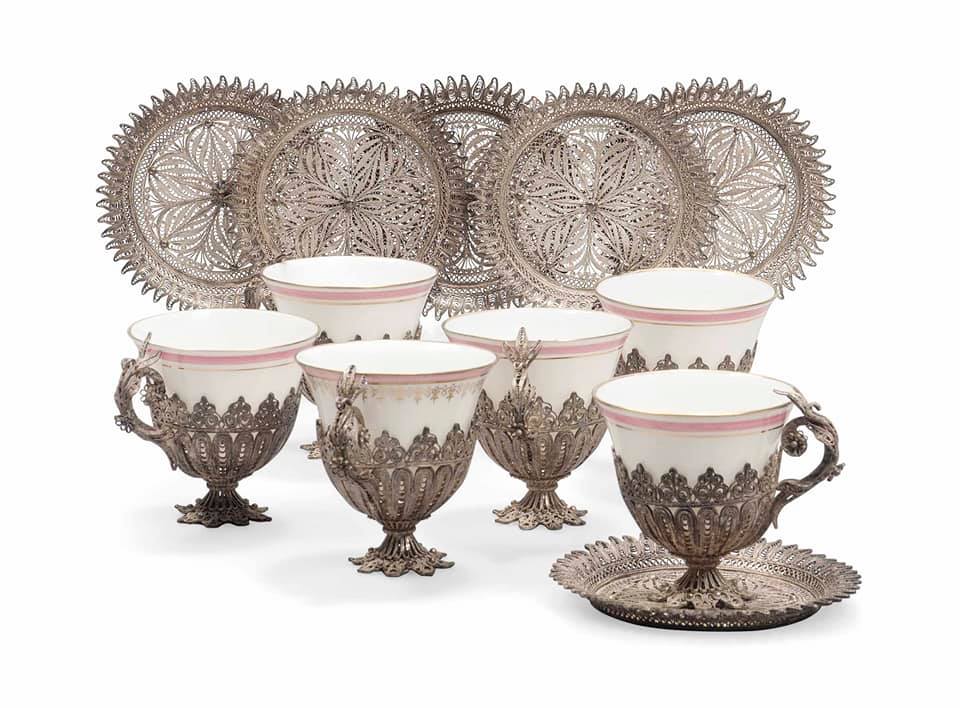
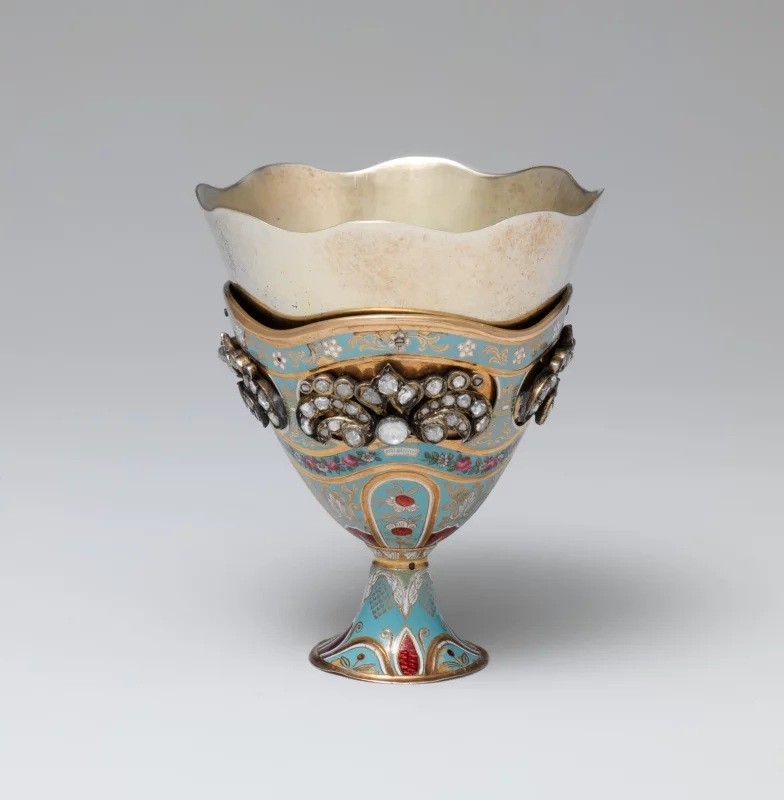
Without further ado, here are a few examples of zarfs and fincans, along with demitasses:

Source: Sothebys.com
A Swiss musical box zarf, ca. 1840 – Metropolitan Museum of Art
Fincans within zarfs
Demitasse set. Source, Wikipedia
Starbucks “zarf”, or sleeve

2 Comments

Filed under Etymology, Food History, History, Liguistics, Linguistics

Tasteful History: Hot Cross Buns

This “History Undusted” has a tasty twist: I’ll dive into the history behind this food popular throughout the English-speaking world and Commonwealth nations, and then I’ll include a recipe if you’d like to try it yourself.

Pompei Bread, AD 79

Hot Cross Buns can be traced back to the medieval period, though scoring the top of breads has been practised for thousands of years; a bread, found in the ashes of the volcanic eruption that wiped out Pompei, shows scoring – likely to make the portioning of the loaf easier; it’s a precursor to the sliced bread we know today. Early Hot Cross Buns used this knife-scoring; the version we recognize today was first introduced in 1361 by Brother Thomas Rocliffe, an English monk at St Alban’s Abbey, who made what he called the Saint Alban’s Bun; he distributed the baked goods to the poor and pilgrims on Good Friday. Many foods can be traced back to a specific holiday: For instance, when you think of a Christmas meal, wherever you are in the world that celebrates Christmas, specific combinations of dishes come to mind that you probably don’t eat at any other time of the year.

During the medieval period, the crossed buns would be hung from the rafters of houses for an entire year, believing that they would ward off evil spirits. During the 1600s, the Puritans put an end to that practice, and Queen Elizabeth I even banned the sweet breads, consigning them to consumption on Good Friday, Christmas, or at funerals (bad luck for the deceased, who missed the excuse for the treat). By the 18th century, it had become firmly associated with Good Friday. To give you a taste of history, click here to watch a short video from the York Castle Museum.

Today, all kinds of versions are on the market year-round, from the traditional, to chocolate, to Cheddar cheese and marmite.

So, without further ado, here’s a traditional recipe you can recreate for yourself.

Hot Cross Buns

To watch this recipe’s creation, click here. Below, I’ve listed out the ingredients and basic instructions, as used in this video by Chef Jack Ovens.

1½ C. (375 ml.) whole milk – heat the milk until just warm on the stove or in the microwave on short bursts, until around 104°F/40°C.

In a mixing bowl, add 1 Tbs./9gr. Dry yeast & 2 tsp. out of ½ C. sugar (the rest will be used later); pour in the warm milk and whisk until combined. Set it aside for 10 minutes to allow the yeast to feed off of the sugar. A froth will form, which means the yeast is active.

Add in 4 ¼ C. (640 gr.) bread flour

the rest of the ½ C. sugar

1½ C. sultanas (raisins) (you could substitute ¼ C. with candied orange for the traditional version)

2 tsp. ground cinnamon

2 tsp. ground allspice (cloves, for the traditional version)

The zest of 1 large orange

1 egg, beaten

50 gr. melted, cooled unsalted butter

¾ tsp. sea salt

Mix all of this until thoroughly combined – either using a mixer with a dough hook, or by hand.

Dust your workspace with flour, turn the dough out and knead for 8-10 minutes. Shape it into a smooth ball. In a greased mixing bowl, place the dough and cover with a warm, damp tea towel and allow to proof for 1 hour, or until doubled in size. When it’s risen, punch the dough a few times to remove the air; dust your workspace with flour and tip out the dough. Knead the dough to remove any air bubbles, then shape it into a log around 60 cm / 23 inches long. Slice that in half, then roll each section to a log to 40 cm / 15 inches long.

Slice each half into 6 even pieces; form each into a ball, tucking the edges underneath.

Line a deep-sided baking tray with parchment/baking paper, and lay your balls of dough in rows of 3 by 4. Cover with an oiled piece of plastic wrap to allow the buns to rise without sticking to a towel. Allow to proof for 40 minutes.

While it’s proofing this final time, preheat your oven to 180°C/350°F

To make the dough for the crosses:

½ C. /70 gr. bread flour

95 ml. cold water

Whisk these together until it forms a piping paste.

In either a piping bag with a 3mm nozzle or in a plastic bag with the corner snipped off, spoon in the dough and pipe it across the rows of buns, making sure to cover to the edges of the buns.

Bake for 20-22 minutes, rotating the tray halfway through. A few minutes before the buns are done, in a small bowl, mix:

½ C. / 110 gr. caster sugar

150 ml. boiling water

Mix with a pastry brush until the sugar is dissolved. Remove the buns from the oven and glaze them with the sugar water – just enough to cover each. This will give a nice crunch to the crust of the bun. Allow them to sit in the tray for a few minutes, then transfer to a wire rack. Slice, butter, and enjoy!

Leave a comment

Filed under Food History, History, History Undusted, Snapshots in History, YouTube Link