The adage “Murphy’s Law” refers to the idea that anything that can go wrong will go wrong. You forget your umbrella and it will be sure to rain; your computer crashes at the worst possible moment; your worst itch is always where you can least reach it, and so on.
Similar sentiments are centuries old: E.g. Augustus D. Morgan, a British mathematician, wrote in 1866: “Whatever can happen, will happen”; Alfred Holt, an engineer, wrote in 1877: “It is found that anything that can go wrong at sea generally does go wrong sooner or later.” British stage magician Nevil Maskelyne wrote in 1908, “Everything that can go wrong will go wrong.”
But who was Murphy? And why is it his law? I’d always assumed that Murphy was either a fictional black sheep created to blame everything on, or someone from a century or more ago, much like Hobson of the “Hobson’s Choice” idiom; but Murphy’s Law comes from the 1940s aerospace era.
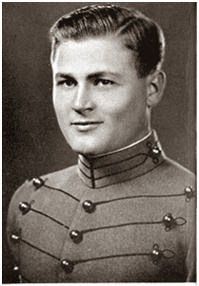
The “law” was coined by and named after Edward A. Murphy Jr. (b.11 January 1918; d.17 July 1990): Born in the Panama Canal Zone in 1918, he finished high school in New Jersey and eventually graduated from West Point in 1940, joining the Army Air Corps, serving in the Pacific Theatre of World War 2, and in the Korean War, reaching the rank of major. According to his obituary on findagrave.com, he is credited with design work on crew escape systems for some of the most famous experimental aircraft of the 20th century, including the F-4 Phantom, the SR-71 Blackbird, the X-15 rocket plane, and later the Apache helicopter. He also worked on safety and life support systems for NASA’s Apollo space missions. Although he was apparently chagrined by the namesake, he believed in the concept as a key to good defensive design – that one must always assume worst-case scenarios and work to counter them in thorough planning, engineering and execution of mechanical designs.
Around 1948, Murphy and his team were testing rocket sleds, which were used to test the acceleration of equipment deemed too hazardous to test in a piloted aircraft and also to test missile components without risking actual (more expensive) missiles in the testing. The saying arose when training his engineers to avoid designing missile components that could be confused one for another; he said, “If a part can be installed in more than one position, it will be incorrectly installed in the field.” Perhaps Murphy was familiar with the sentiment of those past engineers, given his background in engineering, but wherever it came from, his name was attached and, as they say, the rest is history.
Edward Aloysius Murphy Jr, in his West Point uniform
This week’s adventurous tale is a proverbial rabbit hole; diving into it takes us past the problem of Paris’ 18th century dilemma of dealing with the “explosive” issue of overfilled cemeteries, which forced King Louis XVI to take action: Bury them deeper. Following this problem and its solution into the ground, so to speak, leads us into the massive (1.5 km long) ossuary (bone depository) of Paris. Once you reach the ossuary, which contains the artfully arranged skulls and bones of some six million residents (around three times more than the actual population of central Paris, which as of 2023 was 2.1 million…), you aren’t officially allowed to go any further – because above your head is the bustling city of street cafés, boutiques, and historical buildings. And when someone buys a house up there, they are actually also buying the land on which it stands – which includes their section of the underground maze of mining tunnels and caverns; venturing beyond the official section makes you an intruder on private property or breaking and entering an actual shop – but more on that in a moment. The message above the entrance to the ossuary reads, Arrête! C’est ici l’empire de la Mort. (“Halt! This is the Empire of Death.”). That warning doesn’t stop it from being one of Paris’ most popular tourist attractions.
The tunnels, now known as The Catacombs, were originally dug far outside of the small 13th-century city when Lutetian limestone was mined as a local building material (any town or city with a distinctive architecture owes its appearance to whatever was available locally when it was founded – whether wood, stone, thatch or brick). Though no one knows with certainty, as the mining resources were eventually exhausted and the mines abandoned, an estimated 350 kilometres of tunnels undermined the city, which covers some 32 square kilometres beneath Paris… a city beneath a city, as it were.
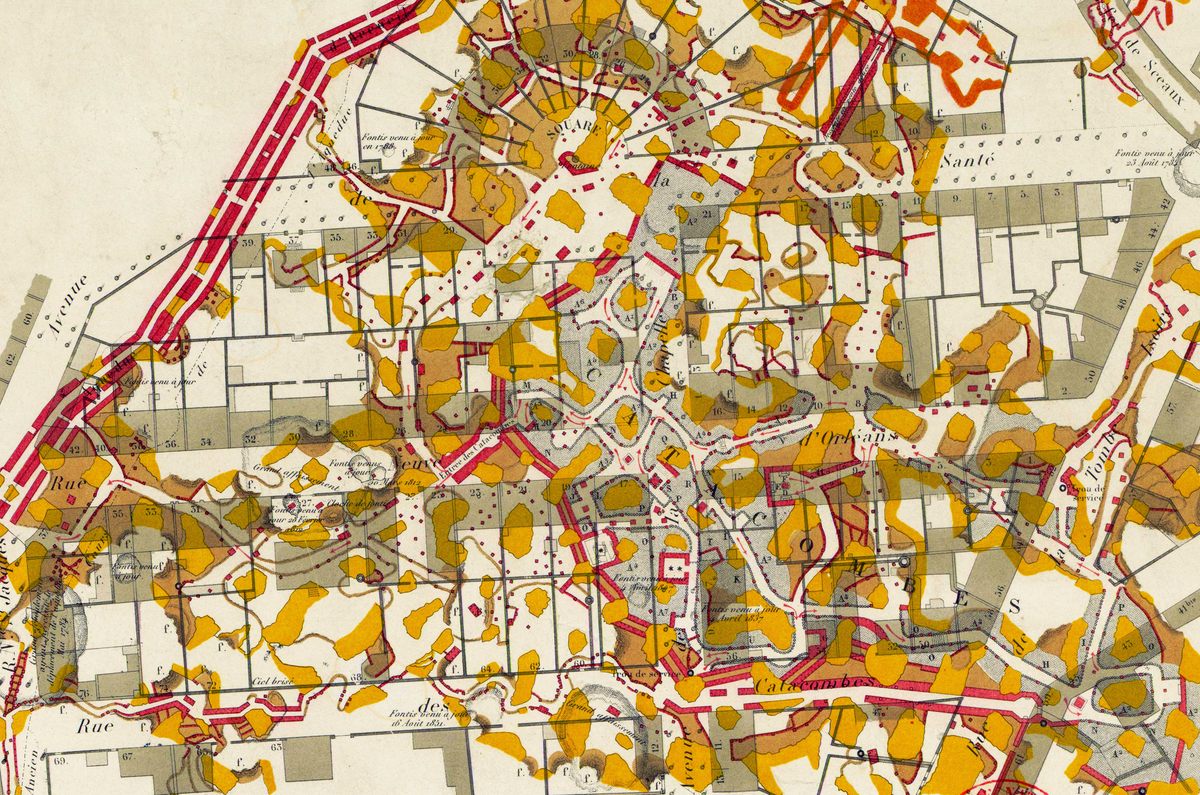
And yes, buildings have occasionally been swallowed; in 1774, about 30 metres of a street disappeared into a cavern below. This led to the formation of the Générale des Carrières (IGC), an office created in 1777 by King Louis XVI to oversee the mapping and maintenance of the catacombs. During the French Revolution, many things got lost and fell out of collective memory, including the underground map.
Paris Catacombs Map – Inspection Générale des Carrières, 1857, Pulbic Domain
Throughout the years, the tunnels have been put to various purposes, aside from the macabre: Mushrooms were cultivated there; beer was brewed, wine aged, and Chartreuse liquors were distilled down there by monks in the 17th century. The city beneath the city had no prime real estate overhead for businesses, and many took advantage of the free space, making access for their customers through the various access points throughout Paris. It also served the French Resistance during world war 2, even though the Nazis also used a section of the tunnels. Now, let’s go back up out of the rabbit hole for a brief moment.
Remember that I wrote officially allowed? Well, a secret maze of tunnels is too much to resist for the adventurous, called cataphiles. But there is a secret society at large down there, too.
When you think of a secret society, you might think of the Luminati or something else sinister; but the Les Ux would be more akin to Robin Hood. The story goes that in 1981, a group of kids were talking after school, and one of them mentioned that he could break into any building in Paris; in fact, his next target was the Pantheon. They didn’t believe him, and so they all went down together – and found out just how easy it was to go wherever they wanted. The Pantheon, which was the tallest structure in Paris until the Eifel Tower was constructed, vacillated between being a church and a secular building several times over its history, depending on the political regime, and it finally became a secular structure in 1885 under the Third Republic. It now is a mausoleum, with famous residents like Marie Curie, Victor Hugo, Alexandre Dumas and Voltaire; but it is also a museum, an art exhibition hall, hosts school events and lectures, and is linked to a section of the catacombs – which is where the group of school friends began their adventures.
During one of their nocturnal outings, the group stumbled upon a narrow passage full of electrical cables; following those, they found themselves in the basement of the Ministry of Communications. No security stopped them and they were able to explore at their leisure. In a drawer, they found the motherlode: A map of the entire catacomb structure. That changed the course of their lives, and they eventually became known as the Les Ux, short for “urban experiment”. These individuals, unknown to anyone but themselves, specialize in safeguarding Paris cultural goods – stepping in when the government can either not afford to or doesn’t care enough to preserve something of cultural or historical value. They seem to think that, unless it’s a big-ticket attraction like the Mona Lisa, things get neglected. For instance, the mission statement of one branch of Les Ux is to reclaim and transform disused city spaces for the creation of zones of expression for free and independent art.
The group, now a full-fledged underground movement, is divided up into teams with seemingly nonsensical names: The Mouse House (an all-female team of infiltrators), La Mexicaine De Perforation (in charge of clandestine artistic events and underground shows), and the Untergunther (specializing in restorations); they also have teams that specialize in things like running internal messaging systems and coded radio networks, a database team, and a team of photographers.
Some of their exploits include restoring a forgotten metro station, a 12th-century crypt, an old French bunker, and a World War 2 air raid shelter. One member, likely from the Mouse House, wrote a detailed report about a particular museum’s security, telling them how many ways she could have broken in and stolen had she been so inclined. She then infiltrated the museum and left the report on the desk of the museum’s head of security. He went straight to the police to press charges. They refused to pursue the matter.
They built an entire cinema complex in the catacombs, complete with a bar and restaurant, where they are thought to have held film festivals for several months or even years before being discovered by the police in a random training exercise. When the police returned to remove the cinema, everything was gone except a note which read, “Don’t try to find us.”
Les Ux has held many events within the Pantheon over the years, including parties and art exhibitions – all vanishing, and leaving the place cleaner when they left, before the museum opened the next day. One night, a team member (from Untergunther) decided to take a closer look at the broken Wagner clock, which hangs over a prominent entrance within the building. Their most public restoration (that we know of so far) was, of course, an embarrassment to the management of the Pantheon: One of the members, Jean-Baptiste Viot, was a professional clockmaker; the team snuck in for nearly a year to restore the clock. They built a secret workshop (complete with armchairs, bookcase, and bar, which they nicknamed the Unter and Gunther Winter Kneipe – German for winter boozer!) high up in the dome of the pantheon, and carried out the clock work by night. Once it was done, they knew that the clock would need to be wound regularly to continue working – so they broke protocol and met with the museum director to tell him the good news. He promptly pressed charges… but there are no laws in France about repairing an expensive clock at their own expense, and the case was dismissed with the comment, “This was stupid!” The museum director hired someone to break the clock, presumably to avoid the hassle of winding it up regularly, and also out of spite for losing his case and his face; the person refused to damage the clock, simply deactivating the mechanism. Les Ux snuck back in to let the clock chime over the days around Christmas, then went back in and removed a component to prevent any further damage the next time spite struck. I’ve read that since that time, the clockmaker of Untergunther has actually been hired by the Pantheon to maintain the clocks.
We only know of a fraction of their activities, of course, because they don’t publicise their accomplishments or events. Below are a few links if you’d like to read more on this fascinating topic! I hope you enjoyed this little exploration as much as I did!
Here are a few links to articles, if you’re interested in learning more:
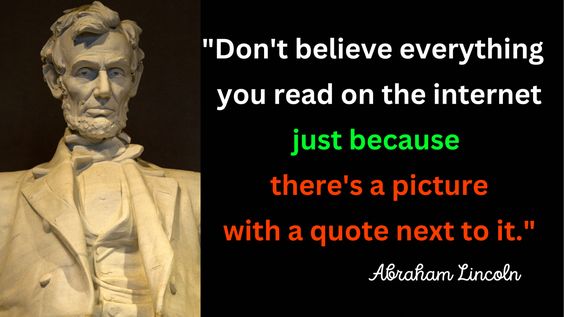
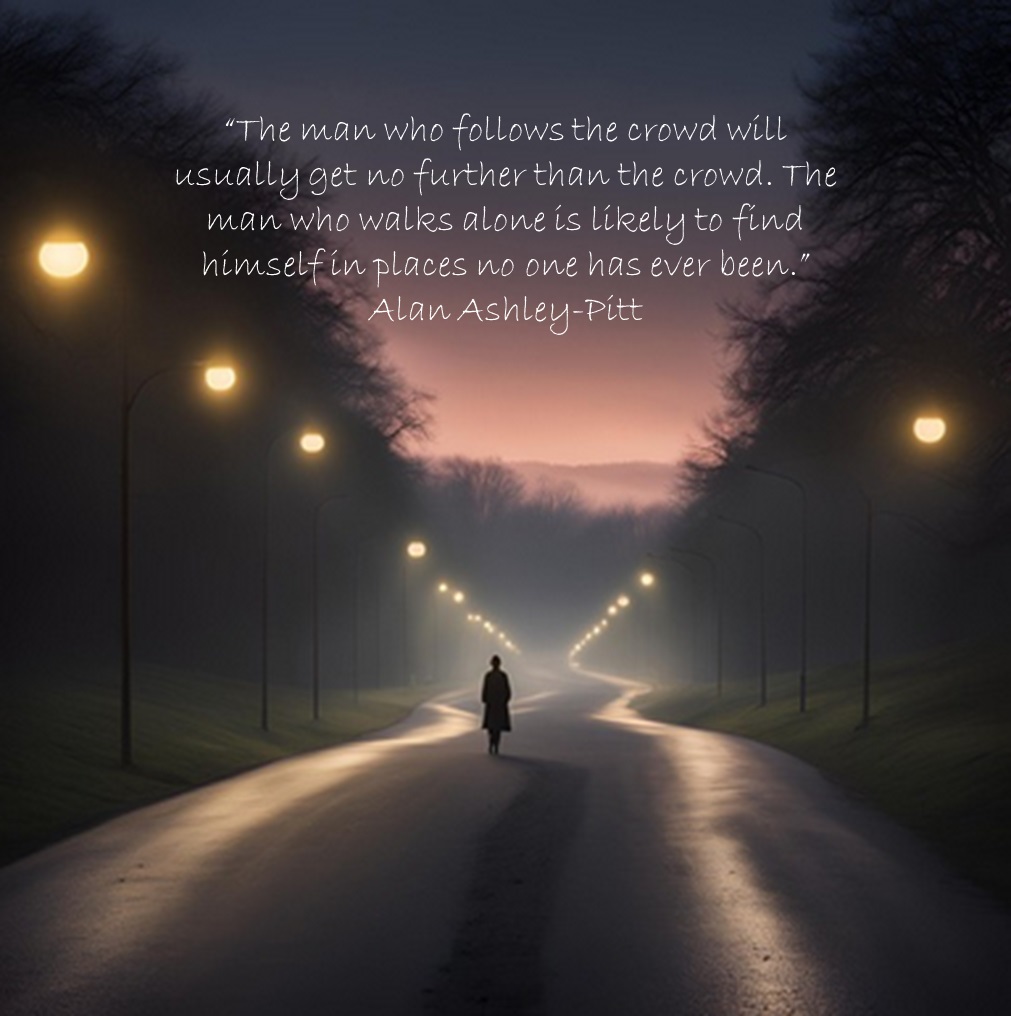
If you’re like me, you might come across a good quote and not think any further about the name attached to it; did that person really say that? I’ve seen quotes attributed to one person but which I know were actually said or written by someone else. Sometimes, a quote is drawn from someone’s writings, letters, essays, or journals from the past. Now, with the dawn of AI upon us, algorithms begin to feed off of their own creations—whether the first effort was accurate or not—which in turn disseminates falsehoods so frequently that most people begin to believe them. It’s important now more than ever that we pay attention and use discernment; don’t believe everything you see or read, but test it. This image is a classic case in point:
So who was Alan Ashley-Pitt? “He” was, in fact, a name made up by a greeting card and poster company headquartered in Santa Barbara, CA, in the late 1960s and early 1970s. The company needed a name to quote for the sayings made up by employees for their cards, decorations, and posters. Though the company was out of business by 1974, many of its creations live on in the Ashley-Pitt quotations. In a way, it’s ironically fitting that a made-up persona’s quote should be imposed on the AI-generated image (below); unfortunately, the AI programs I tried couldn’t grasp the concept of a fork in the road with a crowd on one road and a lone man on the other. It just goes to show you that the human imagination is more creative and able to grasp abstract concepts better than any AI… so far!
With the increasing complexity of our world and a political climate of distrust and division being spread recently, I’d like to offer an antithesis by encouraging everyone to do good, to make a difference by responding in the opposite spirit. Below is a short quiz that might spark a few ideas of how you can make that difference:
WHEN WAS THE LAST TIME THAT YOU…
…told someone that you appreciate what they do in your community?
…sent a message of encouragement to someone?
…invited someone out for a drink or a meal?
…invited someone new to your home?
…sent a message or made a phone call to someone who’s sick?
…intentionally identified someone who needs encouragement, and then acted on that?
…did something fun with one or more community members (e.g., a neighbourhood party, a bike ride, a picnic, or a fun-raising event)?
…spent time with children in your community? (Sometimes young people need encouragement from older community members.)
…thanked someone for their contributions to your community?
…given a small financial gift (anonymously or known) to someone who really needs a sign that someone cares about them?
If you haven’t done any of the above for a while, plan to do something about it this coming week!
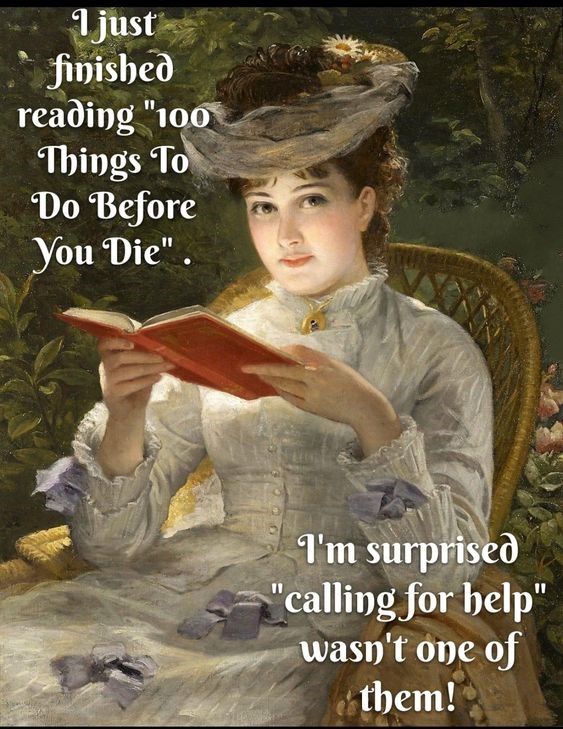
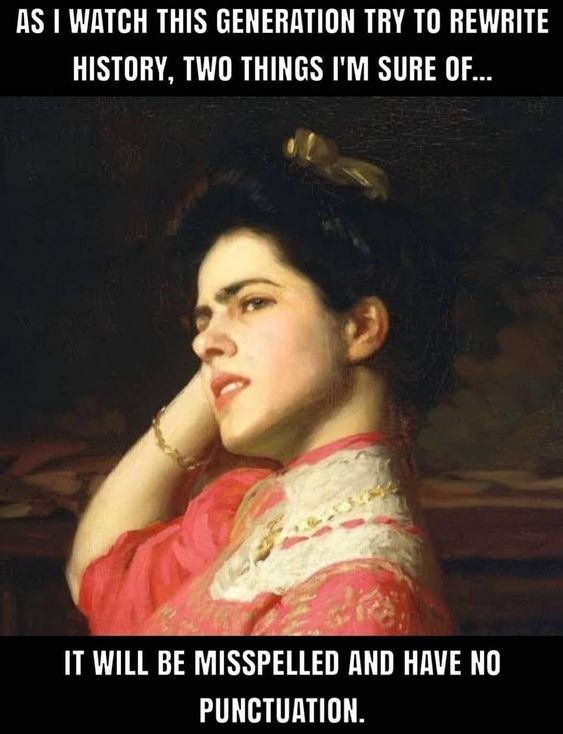
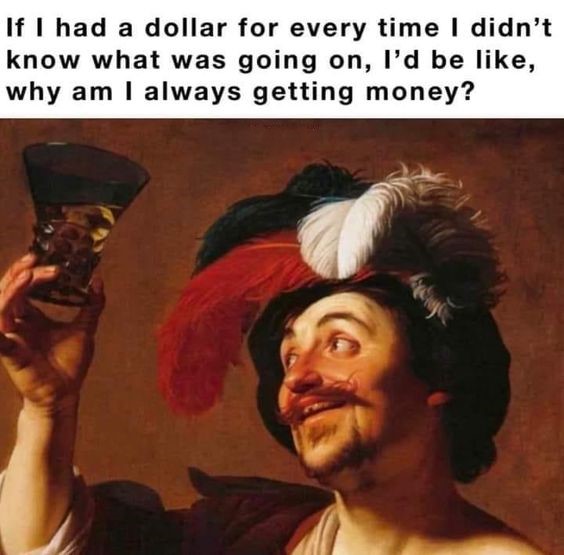
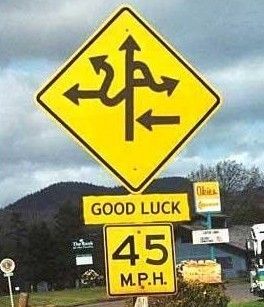
People’s creativity in seeing the world with a sense of humour is a beautiful thing. One form that creativity takes is memes – images with superimposed texts. Antique portraits – paintings from artists of the 18th and 19th centuries – have regained popularity through their use in what I refer to as vintage memes.
Here are a few that somehow hit a funny bone in me; I hope you enjoy them, too!
All of us can relate to having some form of ruts in our lives: Favourite meals, restaurants, seats in places we visit often, clothes we prefer, products we buy, food brands or makeup brands (if you wear it); all, patterns of movement or place or things. Recently, I heard of an app that made me curious to try it out; when I did, it was an eye-opener about how many things I use that I’ve taken for granted that their claims are accurate – I know that’s naïve, but part of that naivety is that greatest of marketing tools, willful ignorance.
Case in point: Speaking to the women out there, you probably have favourite makeup products or brands that you’re used to. But what if you found out that half of their ingredients build up in your system, damaging your liver, your thyroid, and the environment? That’s exactly what I have learned lately, and it’s shaken me awake: the app I cannot recommend highly enough is called Yuka. If I had known years ago what I know now, perhaps I would still have a thyroid; tumours put an end to that several years ago – but I can prevent further damage to my body by being aware of what’s in a product and buying safe alternatives.
The app works like this: You scan a product’s barcode – anything from food items to makeup to body products such as shampoos and hand creams; the app then ranks the products on a set list of 100 points and tells you whether it’s excellent, good, poor or bad; it then lists the ingredients and gives you the option to read more about each one, ranking the ingredients (colour-coded) as hazardous, moderate risk, low risk, or risk-free. If the products rank as poor or bad, below them will be a list of alternative products, with their rankings and ingredients for further information. The recommendations are unbiased as they are not supported by any company. The app also keeps a record of products I’ve already scanned; if I’m at the store, and scan products I don’t buy because of their rating, I can then delete one or several items from the list to keep it streamlined to my products/foods.
There are things that this app is NOT: It is not a substitute for medical or nutritional advice; it is not the be-all and end-all for telling you what to buy. But what it IS: A good guide to weighing the benefits vs. the disadvantages of using one product over another. Some of my products may clock in as “poor” – but when I consider why that rating is given, I may decide to continue its use until something better becomes available in my area.
For me, I’ve found that one ingredient pops up in most makeup and hair products: Phenoxyethanol; it is listed as a potential endocrine disruptor, potential allergen, and irritant. In the EU its use in cosmetics is regulated – but not in the USA or in Canada. In itself it may be within regulatory limits in a product; but accumulatively (several products, from shower gel to lip balm to foundation) it exceeds the limit and becomes a health concern. Knowing this has helped me find new, healthier products. Even within a product range, the ingredients may vary; for example, one lip balm may be good, but another colour of the same brand differs to produce the colour or gloss and ends up being listed as bad. Honestly, I won’t buy a product now without knowing it’s healthy. It’s not that I can’t and won’t think for myself and let an app tell me what to do, but I can use it to weigh a decision.
This past week, I wanted to find a lip gloss to replace the one I’d been using which was marked as “hazardous”; but the store I was in didn’t have customer wi-fi, so I bought a small Vaseline, thinking, “This has been around for ages, so it must be simple and safe”. Wrong. When I got home, I scanned it: Petrolatum is the mineral oil used, which has a moderate risk with a big BUT: this oil may contain problematic residues, such as MOAHs (genotoxic carcinogens which promote cancers and damage DNA) and MOSHs (these accumulate in the body, particularly lymph nodes and the liver). These oils should be avoided, especially in products that may be ingested… such as lip balms (and these two residues were present in half of all tested lip balms!) So now, that little jar is in my craft room to be used as a lubricant for my tools.
We all need to take steps to protect ourselves; big companies are not putting customers first, but customers’ wallets. If we don’t shake ourselves awake and work against our own willful ignorance, we shouldn’t be surprised when health issues pop up; but who would associate lip balms and blush and hand creams or canned foods and pre-made packaged food with those bigger issues? We need to start looking into it for our own sakes.
I’ve written before about Donald Norman and his book, “The Design of Everyday Things”; he emphasizes the need for products to have user-centred designs. The term “Norman Door” comes from the typical example he uses about doors – an everyday item that can often lead to confusion for the user simply by putting pull handles on a push door.
I was thinking about it this week, wondering what the opposite term should be, as I was opening a container of whipping cream. The tetra package for whipping cream is a prime example of a poorly designed item for me: It inevitably oozes out while I try to rip it open along the perforated line. If they made the perforation easier to tear or put a scissor symbol making it clear that that would be the preferred method from the outset… but no. Other items that come to mind are the flip-tops of products, such as hand creams or shampoos, that nearly require a knife to open. What happens? You simply stop buying that product, which might be perfectly fine, because of the poorly designed packaging.
Tell me your ideas for a good term for bad designs – something catchy and catch-all (Norman Doors refers to doors only, but so far it’s worked in a pinch). In the meantime, here are a few examples of non-user-centred designs.
Most English-speaking people have heard the term whitewashing: Literally, it means to paint a surface with a diluted white paint to lighten the surface and conceal blemishes. Figuratively, it means to downplay the negative aspects by emphasizing the positive ones of a person, event, or situation.
Greenwashing is a term related to environmental issues: It is the deliberate dissemination of a false or misleading impression of environmentally friendly practices used to conceal or obscure damaging practices.
Blackwashing is the use of public campaigns and advertising funded by the coal industry to draw attention away from environmentally unsustainable practices or to justify exclusion from carbon taxes.
Bluewashing is to tout a business or organization’s commitment to social responsibility while using this perception for public relations and economic gain; to present a humanitarian front while obscuring actual practices.
Redwashing is the practice of a state, organization, political party, politician or company presenting itself as progressive and concerned about social equality and justice, in order to use this perception for public relations or economic gain.
There are other colours of X-washing, but they all stem from greed: In marketing, these tactics are a way to charge customers more, because the higher price leads people to think, in connection with the misleading information or imagery, that the extra money spent is going to a good cause, e.g. schools for the workers’ children or working children, when in fact it’s likely going toward a CEO’s yacht.
On holiday recently, we’d forgotten to bring towels from home into the motorhome, so we went into a houseware store; I thought the towels would be a bit more expensive than another store I usually buy our towels from, but it was a whopping 50.- per towel more! On each towel was a tag; here’s the translation (the company name withheld):
“Cotton (name)® Made in green, inspiring confidence. Tested for polluting ingredients and sustainably produced according to (name)® guidelines. The label “made in green” gives you the assurance that this textile product has been made by pollutant-free materials in environmentally friendly factories in protected and socially acceptable work environments.”
Nowhere is it mentioned where this product was made; their testing agency, for accountability, is them. Inspires confidence? On what grounds? Price? Notice that they don’t claim to have passed those tests or what they were testing exactly, nor do they state what their guidelines were supposed to be.
These schemes prey on first-world people’s sense of guilt, or of wanting to pay a bit extra to help those less privileged. Yet their concept of “environmentally friendly factories in protected and socially acceptable work environments” might have nothing to do with your or my concepts – would the company’s execs be willing to work in those factories? I doubt it. This is also an example of bluewashing.
An E-Talk was given to show the marketing tactics in connection with the foods we eat. The disclosures made in the short talk are enough to leave the audience in stunned silence. I challenge you to watch the video (less than 7 minutes long) here. Marketing’s most effective, secret weapon is you. They bank on willful ignorance (the avoidance of making undesirable decisions or taking actions that accurate information might prompt).
All of these wash-tactics boil down to hogwash. So the next time you find yourself looking at the claims of a label, or seeing the sunny kitchen in a perfect home with perfect families on a commercial, take a moment to challenge what you’re reading or seeing, and use your purchasing power wisely. Research; see if the company is on any blacklist by organisations that actually care (WEF, Greenpeace, or any from a long list of NGOs). Search the topic online – there are a lot of informative articles out there with practical tips for making informed decisions. Here’s a website for checking a brand’s ratings: https://directory.goodonyou.eco/. If you find that a company is making bogus claims, stop buying their products; make the effort to blow the whistle on them – social media can be a positive tool in that aspect.
This brings us back to that secret weapon of marketers, our willful ignorance: The tragic factor in all of these tactics is that, like water, humans usually choose the path of least resistance… least effort… least active involvement, least time required; and so willful ignorance prevails. However, since we’re making an average of 35,000 decisions a day anyway, (automatic, habitual, emotional, stress-related, worry-related, or environment-related) let’s neutralise that ignorance one wise, informed choice at a time.
A few months ago, I began something that has added a layer of creativity and organisation to my life which, to be honest, is fairly creative and organised as it is. But this little addition adds a nice colour: Fieldnotes.
The original concept of taking fieldnotes comes from the scientific disciplines: An archaeologist in the field, taking notes on where, what and when something was uncovered; a geologist, botanist, ornithologist, or entomologist taking notes on observations, perhaps drawing an illustration of a specimen or a map of the landscape.
Fieldnotes can include writing, diagrams, drawings, or visual clues within an entry such as arrows or other visual connectors. They differ from a daily journal in that the fieldnotes are concise… rambling or expanding on a thought belongs elsewhere, but not in a “quick-draw” situation (pun intended).
Creative thinkers have jumped on the idea for reasons other than scientific observation: As a writer, fieldnotes help me capture snippets of ideas, dialogue, or an observation when out in public (I love to people-watch), or something I read – sometimes the comments on YouTube videos are a great capsule of humour! I also use fieldnotes to keep track of tasks on a busy day – lists of to-dos, to-writes, and so on. When I have a creative project, I take notes on the steps taken – such as making giant flowers that no one else has ever made; how to scale up a smaller version of a crepe paper flower is not always straightforward, and if I have several to make, it helps to have those detailed notes of the prototype phase for the next time around.
Taking fieldnotes might help get your creative juices flowing. If you’d like to start this practice, here are a few tips:
Use a small notebook – one that can fit into a shirt pocket, man-bag, or purse. I’ve made my own with 70gsm blank paper, which allows me to make the same size and style repeatedly. But if you can’t do that, just use something like a moleskin notebook; these come in various sizes, with or without lined pages. There is also a company with books called Field Notes, though they seem a bit pricey for what you can do on your own…
Use a good pen, or pencil, or coloured pencils if you want to sketch something with colour.
You can either take chronological notes, such as dating each entry, or you can organise your notes into groupings: One page per character, scene or topic, or for a to-do list, or whatever you want to capture on the go.
Use visual cues, such as boxes around certain elements or arrows connecting one thing to another. Use illustrations or draw diagrams; attach images from magazines, printouts, etc.
Highlight tags or keywords; consider numbering each page and keeping an index at the back of the book to help you find things later on.
One book that might help kick-start illustrative note-taking if it’s new to you is The Sketchnote Handbook, by Mike Rohde.
Think about how you’re recording things on the page: Do you always want to write straight, top left to bottom right, or do you want to mix things up and write diagonally, sideways, or even backwards? Yes, sometimes that’s a thing; Leonardo da Vinci wrote privately in a mirrored direction, only writing normally when he wanted others to read his notes; he also developed his own shorthand.
Leonardo da Vinci’s Vitruvian Man, with mirrored writing.
I also have my own shorthand for many things; Sometimes I use what I call pigeon Asian (I use this when I don’t want anyone else to read it); it’s something I learned when living in Hawaii. It looks like Kanji (the logographic writing of Japan), but it’s not – that’s all I’ll explain! I also use logographs, such as the ancient Anglo-Saxon rune of daeg, which includes the concept of day, dawn, intuition or breakthrough; I use this to designate those times when I’m writing: Rather than writing, “Today, I wrote/worked on the manuscript for...” I just write that symbol plus the name of the manuscript and details. I have a whole series of such shorthand symbols that I use daily.
While there are note-taking apps available (and I use one, called “Keep My Notes”, on my phone for things like shopping lists or feedback notes for singing students or bands that I take during performances and review with them later), sometimes it’s helpful to get away from digital screens. Sometimes I’ll write whole scenes away from the computer – I don’t use my fieldnotes for that, though it will probably be used to outline a scene that comes to mind until I get to another notebook. Something about writing long-hand sparks a level of creativity that might not come while working at a computer; hand-eye coordination should never be underestimated in creative endeavours. Once a scene has developed enough away from the screen to be integrated into my current manuscript, it then takes on another reiteration as I type it in, tweaking and changing… it’s what I call a “ripening process” as a wine metaphor for the creative maturing process a scene goes through by this method. It gets my head into a new space figuratively, literally, and literarily!
In an age when we are constantly bombarded with visuals wherever we go, sometimes it’s healthy to go back to good ol’ pen and paper. On those days so busy that I can’t remember what I’ve actually done, it’s helpful to look back at my fieldnotes as I write out my thoughts in my daily journal.
Do you write? Do you ever make lists for shopping, chores, people to contact, or things to do? If so, how have you kept track of such things so far? If it’s a system that works for you, brilliant! But if you find yourself wanting to switch things up or wanting to improve your use of time, would you consider taking fieldnotes? Please comment below!
Recently, my mother sent me a link on Facebook and asked me to write an article about it; it’s definitely an interesting topic – so thanks, Mom!
First of all, for those of you who don’t know what a folly is:
In architectural terms, a folly is a building that is either constructed as decoration which suggests another purpose or is a practical garden building that transcends its purpose with extravagant features. An example of the former term would be buildings that were designed from the outset to look like ancient ruins, such as Wimpole’s Folly in Cambridgeshire, England; an example of the latter would be buildings like the Dunmore Pineapple in Stirlingshire, Scotland (I’ve been to this site a few times and was once able to go inside the pineapple). Designed to look like a giant pineapple, it was actually a working hothouse; that’s perhaps another story to tell. As for today’s topic, the folly of King Alfred would fall into the former definition.
Second of all, who was King Alfred, and why does he bear the sobriquet Great?
Statue of Alfred the Great at Wantage, Oxfordshire
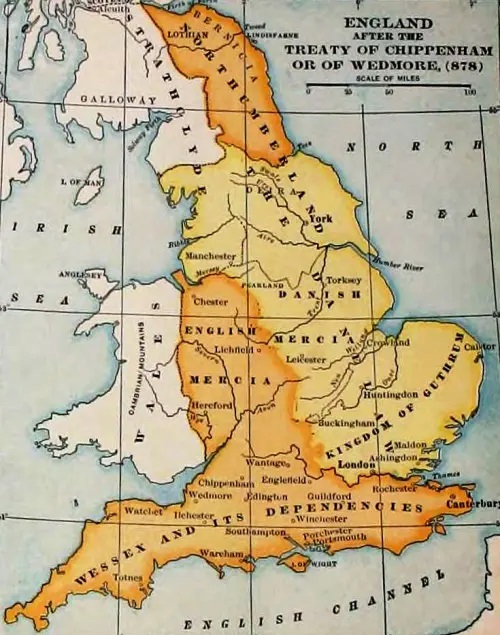
Born in 849 AD, Alfred the Great was King of the West Saxons from 871 to 886, and then King of the Anglo-Saxons from 886 to 899. He lived in a time when Viking invasions and warring tribes were common. Both of his parents died when he was young, and his three older brothers reigned before he eventually came to the throne. The battles, invasions and wars are too numerous to mention; to be a king meant to be at war. At the age of 21, he was already the King of the Wessex and a battle veteran. In early 878, the Danes struck like lightening, taking Chippenham (on the map below, you’ll see that it was in the heart of Alfred’s territories); inhabitants surrendered or fled, and it reduced Alfred and his men to hit and run means of getting provisions; they withdrew into the tidal marshes of Somerset (the area on the other side of the River Severn, just below Wales on the map below). Alfred reevaluated his strategy and learned from his enemy: He and his men began a guerilla war against the Danes, and by May, he’d defeated them in the Battle of Edington. Knowing that he would never be able to drive out such a powerful enemy, he made a treaty with them, establishing borders and what became known as the Danelaw territory; King Guthrum of the Danes converted to Christianity, with Alfred as his godfather and soon son-in-law as he sealed the treaty by marrying one of Guthrum’s daughters, Aethelflaed.
The Great comes from the fact that he united many of the disparate tribes; he recognized the deterioration in learning caused by years of disrupting wars and the Viking’s destruction of the monasteries, which were centres of learning and literacy. He recognized the fact that without widespread literacy, a king cannot rule – a people who were not united by a written language would be more vulnerable; but united through a common tongue, they would have a sense of loyalty and continuity in turbulent times. They would be able to adhere to laws, reach legal decisions, and be called to arms more readily if they could read a common language. He set out to make the English proud of being English and thus be prepared to fight for it.
By stopping the Viking advance against all odds, and consolidating his territories, he set the stage for future kings. His accomplishments in Wessex became the seed that eventually gave fruition to a united Anglo-Saxon England, which is why he alone among all kings or queens of England bears the sobriquet Great.
King Alfred’s Folly:
King Alfred’s Folly – Credit, Flickr, Andrew Bone
King Alfred’s Tower was built between 1769 and 1772. To put those dates into perspective, here are a few events from the year that construction began: 13-year-old Mozart, under his father’s control, was just finishing his third concert tour of Italy; James Watt improved his design for a steam engine that would spark the Industrial Revolution; King Charles III of Spain sent missionaries to California, founding San Diego, Santa Barbara, San Francisco and Monterey; Daniel Boone set out to explore what would become Kentucky; and finally, in August of that year, Napoleon Bonapart was born in Corsica.
The tower itself was built near the site of Egbert’s Stone, which is said to mark the mustering site for the troops of the Battle of Edington; the tower was intended to commemorate the end of the Seven Years’ War and the ascension of King George III to the throne of England. It was designed in the Palladian style (a European architectural style) by the architect Henry Flitcroft, at the commission of Banker Henry Hoare. While the reasons for commissioning the tower might be altruistic of Hoare, its site and magnificence might have had something to do with the fact that the tower was an eye-catcher for those touring the parks at his private estate, Stourhead.
Standing at over 40 metres high (131 feet) and a circumference of 51 metres (167 feet), it is completely hollow; it is a triangular structure with a round “tower” at each corner, though only one of them has a use – a spiral staircase of 205 steps, with no landing places along the dizzying ascent or descent. The only safety is a rope “railing” anchored occasionally along the central pillar of the staircase; passing others up or down can be a tight squeeze, and it is not a climb for the faint-hearted. Once reaching the top, you’ll find a crenelated parapet that surrounds a viewing platform offering a great view of the surrounding region; the centre of the platform is surrounded by a guard rail as it is a gaping hole straight down to the ground level; it’s covered with a mesh netting to prevent birds from using the tower as a dovecote.
In 1944, the tower was damaged when a Canadian single-engine plane crashed into it in the fog, killing all five aboard. In the 1980s, it finally underwent repairs and restoration; the statue of King Alfred above the main entrance was also repaired at that time, restoring a missing right forearm. A stone tablet (also in need of restoration) between the door and statue reads:
ALFRED THE GREAT AD 879 on this Summit Erected his Standard Against Danish Invaders To him We owe The Origin of Juries The Establishment of a Militia The Creation of a Naval Force ALFRED The Light of a Benighted Age Was a Philosopher and a Christian The Father of his People The Founder of the English MONARCHY and LIBERTY


















 Stephanie Huesler