Maybe this is something you’ve never stopped to think about, but everything we use on a daily basis was, at some point, invented, discovered or developed by someone. Before shoes, people walked barefoot, or wrapped leather around their feet in colder climates; before plastic, well, the world was far better off. But no matter where they lived in the world, or what their climate was like, people found ways to entertain themselves, or to have fun social interaction with board games, or with simple stones, sticks and rocks.
Even prehistoric people developed games to pass the time: The Mesopotamians had the Royal Game of Ur; in Egypt and across the Middle East, they played a game referred to as Fifty-eight Holes. A game that goes back thousands of years, with many different simultaneous versions across the world, is Mancala / Sungka / Congkak, played with hollowed dips (which could be made in dirt, wood, or stone) which players fill sequentially with stones or shells or nuts (whatever was readily available in their region of the world). As reading and writing became more widespread, word games and written riddles became popular.
In 1913, the journalist Arthur Wynne, working for the New York World newspaper, submitted the world’s first Crossword Puzzle (image below), which appeared in the Sunday paper on 21 December. An immigrant from England, Wynne based his idea on the magic square (in recreational mathematics, this is a square arrangement of numbers in which the sum of numbers in each row, column and both main diagonals is the same). In this concept, a given set of words would need to be arranged so that they form a square; but in Wynne’s version, the words had to be discovered first. The first puzzle contained 31 terms, with the word “fun” already filled in as an example.
In the beginning, crosswords (originally called Word-Cross Puzzles) were in a diamond shape; within a few years, the crossword craze had taken off, and eventually, the shape morphed into a square grid with blank or black cells where voids occur.
Today, crosswords have more competition: word search puzzles, scrabble, anagrams, ciphers, and various forms of Sudoku are the strongest contenders for puzzlers’ free time.
What is your favourite word puzzle type? Please comment below!
The topic of this article has been on my mind for the past two weeks; last week flew by so fast I barely had time to blink, let alone order my thoughts into coherent sentences. The topic was sparked by coming across an article online about what is known as the “Milan Conference” or “The Second International Congress on Education of the Deaf” (though it was, in fact, the first), held in Milan, Italy in 1880.
To give you a bit of my personal background, I learned BSL (The Glaswegian dialect) and translated for the deaf when I lived in Scotland. Being as close to that community as I was, I’d shockingly never heard about the Milan Conference until a fortnight ago.
When I first moved to Switzerland, I wanted to continue working with the deaf and began taking Swiss German sign classes. I immediately began hitting brick walls: The crux of the matter was spelled out – they didn’t want hearing people in their world. It made little sense to me back then, and it was frustrating. Also at that time, my husband wasn’t yet hearing impaired – which would have made a difference in their attitude toward me, as people with family members affected by hearing loss were more acceptable to them. In light of the Milan Conference, their reticence makes perfect sense. I never was able to break that barrier, and I’ve lost much of the sign language I once used fluently.
The conference was an international gathering of (hearing – with only ONE exception) educators of the deaf and mute. The imperialist arrogance of the discriminating resolutions passed profoundly wounded and damaged the deaf community for nearly 100 years.
To sum up the conference’s resolutions briefly, the majority decided that sign language was disadvantageous to integrating the deaf into the hearing world, and they banned – yes, banned – sign language from the education of the deaf in favour of “oralism” – forcing the deaf to read lips to make them assimilate to the hearing world’s culture. Deaf teachers lost their jobs, and an overall decline of deaf professionals resulted – they were no longer allowed the tools to communicate in their own language, and communication professions such as artists, lawyers and writers fell silent. Here in Switzerland, there was a two-fold impact: Deaf children were forced to sit on their hands and learn to lip-read from High German-speaking teachers; but when they went home on holidays, they couldn’t lip-read their own family’s dialects of Swiss German, and so they were isolated from society both in school and at home. The anger and resentment to the hearing world still runs deep.
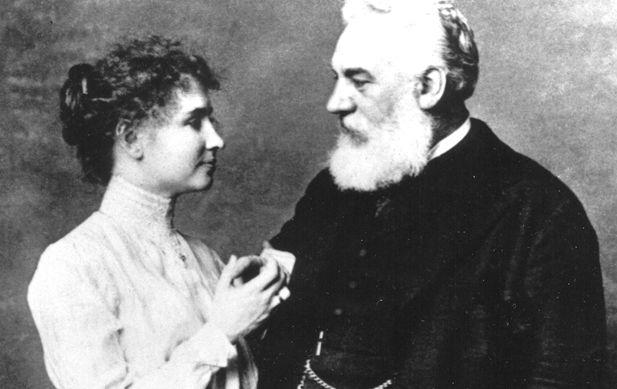
Most disturbing for me is the fact that Alexander Graham Bell, whose own mother and wife were deaf and who worked with the deaf throughout his life – including helping bring Helen Keller out of her silent world as a blind and deaf girl – was one of the strongest proponents for oralism at the conference. The most famous picture of Bell and Keller is one in which Keller is finger-spelling on Bell’s hand. It is a form of sign language. Yet he advocated to eradicate it.
The resolutions of 1880 held their ground until they were overturned in 2013 when an official apology was issued to the deaf community. Eleven years ago. Let that sink in. Inroads were made to teach sign in pockets here and there; in America, most schools for the deaf only began teaching sign language again in the 1960s; in the UK it was around a decade later. Generations suffered under the restriction. [For those who have been deaf their whole lives – what’s known as pre-lingually deaf – it means that sign language is their first language, while spoken English is their second; this can lead to difficulties in understanding complex or abstract messages in English. Imagine being denied your own native language…] Only in 2003, the British government recognised BSL as a minority language – but so far, Scotland is the only country in the UK that has given BSL legal recognition. The shift in understanding and recognition had already been set in motion by the time I’d moved to the UK, which is perhaps why the Milan Conference was no longer a topic when I was involved in the deaf community.
The ban is the main reason there are so many regional dialects today: Even though sign language was officially banned, the deaf still needed to communicate among themselves, and so signs evolved “under the table” within each pocket of deaf students. There was no exchange of information; for example, “bread” took on the shape of the local speciality, so in the French part it looks like a long baguette, while in the Zurich region, it looks more like a half-sphere. There are 5 major Swiss-German dialects; in Scotland, there were at least 7.
Please click here to watch a ~13-minute video by Storied about the history of sign language and the Milan Conference. If you’d like to learn more about the timeline of sign language in Britain, please click here to visit University College London’s website, and to learn more about BSL in Scotland, click hereto read the Scottish Parliament’s article.
ASL, American Sign Language, also has a forgotten predecessor that was largely written out of history: The Plains Indian Sign Language, also known as “hand talk”. For an interesting video about that history, click here.
I hope you’ve enjoyed this brief insight into a long and tangled topic, and that it encourages you to look into it more.
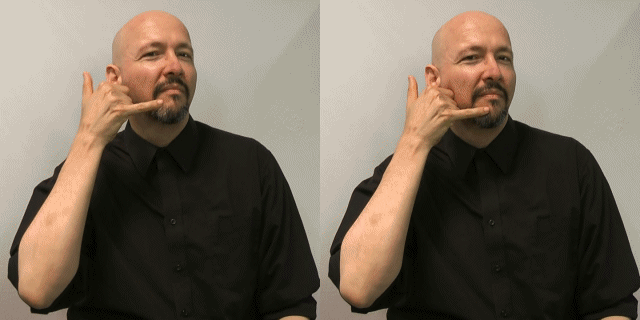
Just as a parting trivia: Everyone recognizes the sign for phone; but did you know that it became a euphemism in some deaf communities for the restroom/loo? Back when restaurants had their public phones near the “small closets”, the Deaf would sign “phone” as a polite, covert way of saying they were going to the restroom/loo.
Below are the British Sign Language and the American Sign Language alphabets; I’d encourage you to learn one or the other and stretch those grey cells a wee bit!
Recently I came across an article on the phenomena of “The Hum” – a low-frequency sound heard by people across the globe. The hums are often given their location’s place name, such as the Taos Hum of New Mexico, the Auckland Hum or the Windsor Hum. While these sounds are clearly heard, no one seems to agree on the source of the sound: It could be produced by electrical equipment, an unfamiliar animal sound (such as the toadfish), the Jet Stream shearing powerline posts, volcanic eruptions, lightning static, ocean wave vibrations, or internal biological auditory signals.
If you stop and listen, there are sounds everywhere. But The Hum is not tinnitus, which has a much higher sound frequency. I’ve had tinnitus for years; when it’s quiet, I can hear up to eight tones of ringing in my ears. It’s something that affects around 15% of the population, but the only time it really becomes an issue is if it triggers a fight-or-flight response in a person – I’ve heard that the more you focus on the ringing, the more you hear it (the more it bothers you). In almost half of the people who have tinnitus, it can lead to phases of anxiety or depression, likely linked to that psychological fear response. Some people don’t even realize they have tinnitus – they automatically, subconsciously distract themselves with sound (music or television being common tactics). The causes of tinnitus vary, but in my case, I know exactly when it started: I was flying from London to Glasgow, and I had a head cold. The flight was just at that altitude where your ears almost pop, and it was excruciating. I can still hear fleas sneeze and “tell you if they’re male or female”, but the ringing is always present – I just ignore it for the most part. I hear so well that I sleep with earplugs each night – otherwise, I can hear electricity in the walls, and a battery charger at the far end of our home sounds like a car alarm to me!
Have you heard The Hum? Do you have tinnitus, and if so, does it bother you in any way or are you able to ignore it?
If you’d like to learn a bit more about The Hum, and what it could be or what it could mean, please click here for a 12-minute BBC report on the issue.
Throughout history, people have always been fascinated by thinking beyond their own known world; before widespread writing and reading, ancient cultures thought about their own mortality (which, in some ages, wasn’t that far off) and the afterlife. Various cultures prepared for the afterlife in their own ways: The Egyptians removed organs and embalmed the rest, making sure to send on the heart & co. in separate jars (except the brain – who’d need that in the next world?), then sent them on their way with an army of servants (killed for the occasion); the Vikings buried their most honoured dead within a ship with their favourite animals and servants (ditto). Other cultures built pyres to send their loved ones up in smoke.
When writing came along, at first it was used to capture the past and the natural world, ala Pliny the Elder; poems, sagas, verbal tales and folklore began to be recorded; we have such writings still with us today: The Greek Epic Cycle, the Orkneyinga Sagas, the Heimskringla, the Poetic Edda.
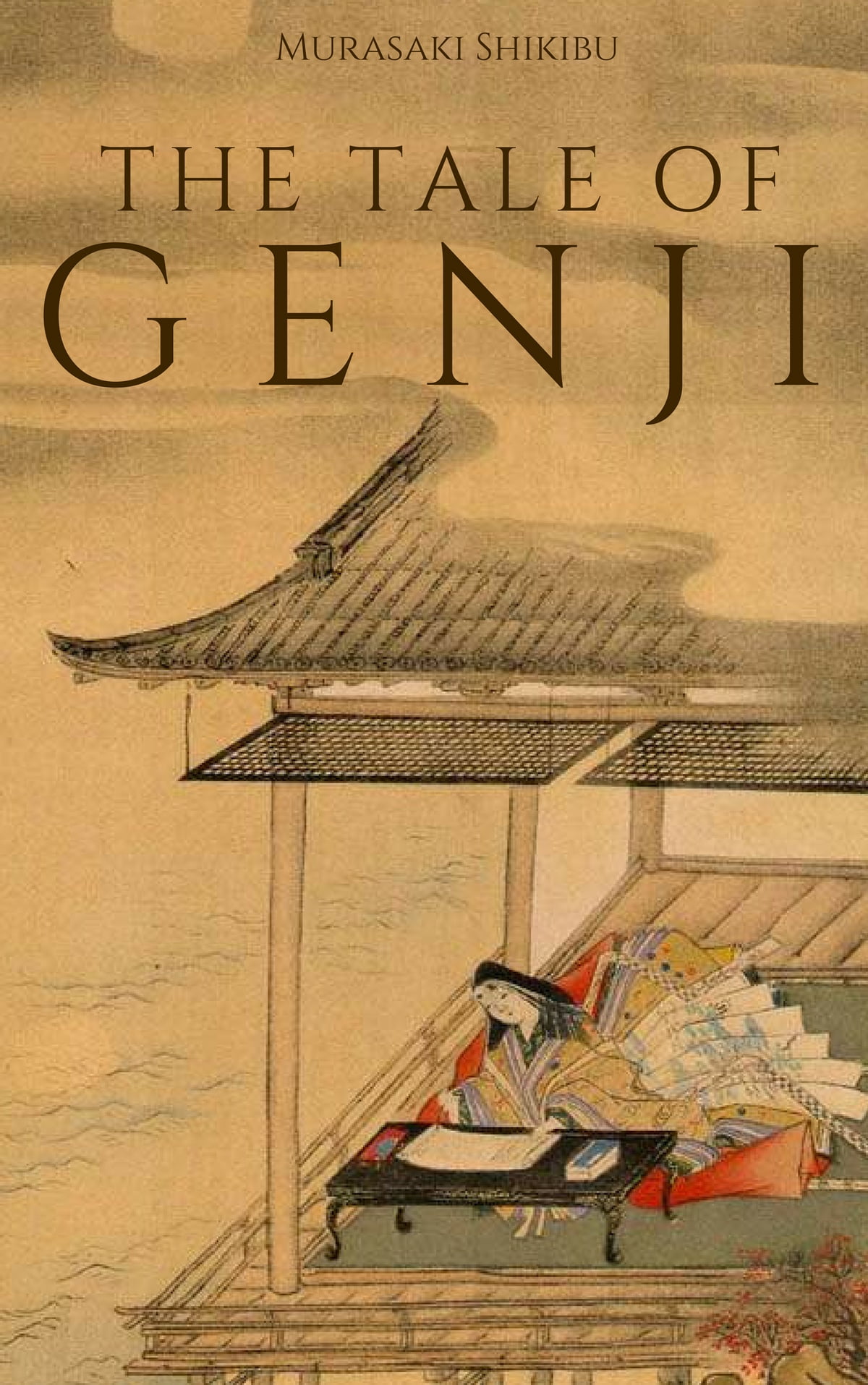
The first novel came along only 1,000 years ago: The Japanese epic The Tale of Genji was written by a woman, Murasaki Shikibu; novels were, for several centuries more, considered on the bottom rung of the literary hierarchy ladder, far behind “serious works” like history. Ironically, Mark Twain referred to history as “fluid prejudice”; it was nearly always recorded by powerful (white) men – hardly ever by a commoner, a member of an ethnic minority, or a woman. The interpretation of events was firmly in the hands of the conquerors. Because of that fact, for instance, we know more about Rome’s version of ancient Britons (Picts, Celts) than we do from their own artefacts; most Celtic and Pictish art is found outside of the UK – many carried off by the Vikings, but that’s another tale. Hollywood has helped perpetuate some of those ancient Roman notions (think of a blue-faced Mel Gibson in Braveheart).
In fact, we don’t even know what the Picts called themselves – the term derives from the Latin Picti, first seen in the writings of Eumenius in AD 297. It can be interpreted (dangerous words) as “to paint” – but there is no evidence that any people groups in northern Britannia painted themselves. Picts is simply a generic term for any people living north of the Forth-Clyde isthmus who fought the Roman Empire’s advancements into their territories. Again, the ink of history flowed from a Roman stylus.
Even Jane Austen herself didn’t begin publishing her novels under her own name. She was a single young woman – for shame that she would dare stain the male-hallowed ground of literature. The saga of how she got published speaks to her tenacity and the support of her family. But she got the last laugh, becoming famous within her (short) lifetime, and she is far better known today than any of the stuffy old men who wrote “proper” books of her day.
The insatiable fascination with other perspectives than our own explains why novels are so popular today. They take us into another time, place and situation, leading us through a story that, if written well, we can relate to and perhaps learn something from. In 1726, Jonathan Swift gave us Gulliver’s Travels. Though he originally wrote it as political satire, to “vex the world rather than divert it”, we know it still today. The fascination with someone being a giant in one land and a miniature in the next grabs our imagination; he travels to floating kingdoms, to an island of immortals, a la Death Becomes Her, and a land of talking horses.
Book Nook (Instagram repeat)
In the age of internet, visual arts have expanded as far as the global imagination can span: Not only paintings or drawings, but even crafts take us into another perspective. I recently saw a series of images in which people have taken the humble walnut shell and turned them into tiny worlds with bookshelves, ladders, lamps, beds and creatures. Book nooks are popular, too: A tiny village, street, or room within the space of a book on a shelf. Science fiction art takes us off-planet.
Films are visual perspectives that take us into other worlds, times and places: When George Lucas showed us a “commonplace” bar scene on Tatooine in the Mos Eisley Cantina in Star Wars, he blew our minds and kicked off a new era of visual storytelling. Avatar took us to another planet and another perception of reality, all the while being an allegorical tale of ecological care vs. abuse. Somewhere along the way, sometime in your life, I’ll bet you’ve been fascinated by a different perspective, whether presented to you through a book, a documentary, a sermon, a play, a film or a conversation. What did you learn from that encounter? How did it change you, or help shape your perspective? And what is your favourite “escape”: Films, books, visual arts, or music? Please comment below!
I came across this story today, and wanted to share it: In the US, coal mining used to be big business; but with the move away from fossil fuels toward solar and other less destructive sources, companies have been in decline; before the mid-1970s, mining companies could just abandon the scarred land, but laws were passed that would require the companies to revitalise the wasteland; but if a company simply went bankrupt, the land sat barren, polluting the surrounding environment for decades, as rocks and minerals that had been buried forever were exposed to air and water, releasing their substances into groundwater and the air. Millions of acres of scarred land are the result.
Now, Appalachian Botanical Company in West Virginia has begun reclaiming the land in a beautiful way: Hiring ex-miners who’ve lost their jobs or other people who need a second chance just like the land, such as ex-drug addicts, they are now working in fields of flowers. Lavender is a hardy plant in the mint family that likes to grow in poor soil; it’s a perfect match for the rocky wastelands around coal mines. Every part of the plant is used: The flowers and upper stems are distilled down to make lavender essential oils that are then also used to make various creams and lotions, honey, salts, and hand sanitisers; when it’s done, they transform the biomass into compost to revitalise the land. The lower leaves are first removed, dipped in rooting powder, and planted to make the next harvest.
It’s an amazingly holistic approach to the problems: Creating jobs in the regions that have been hard-hit by economic downturns; revitalising the land through restoration – lavender will help prepare the land for other less hardy species to take root; and on a larger scale, it provides an example of what could be done with scarred land. To watch the Business Insider video, just click here. To check out the ABCo website and their products, click on the image below. Enjoy, and if you’d like to support what they’re doing, check out the pages on their websites, too.
I love coming across stories about individuals making a difference in the world; it shows that one person can really make a difference – not just the rich and famous, but the unknown and unsung heroes that have a vision, and do what they can with what they have until they have more to see their vision unfold.
Alhaji Siraj Bah is such a person: a young Sierra Leonean, he lost his adoptive family to a mudslide when he was 17. The mudslides are an increasing problem, as 70% of the Sierra Leonean forests have been chopped down for firewood; most families use small wood-burning cookers. But something else that everyone does is eat coconuts. Every day, tons of coconut husks are emptied in the street markets, and the sellers then have to pay to remove their biowaste. Alhaji worked on and found a solution to both problems: Turning the biowaste into biofuel briquettes – coconut coal which gives off less smoke and burns four times more efficiently than wood-based products. This idea is not original – there are many similar products on the market; but what I like about his story is that he refused to give up, looking for a solution to local problems, providing jobs, a free removal service, and offering a locally-grown waste-turned-fuel.
To see an interesting video from Business Insider on his story, just click here.











 Stephanie Huesler