Tag Archives: Astronomy

History Undusted: Solothurn, Switzerland

The baroque town of Solothurn, though only an hour away from our home, was unfamiliar to us until my husband and I took a day trip this week. It has a beautiful historical centre and is known as the “city of elevens”: It was the 11th canton to join the Swiss Confederation; there are 11 towers in the fortification walls of the city; there are 11 churches and chapels, and 11 historical fountains throughout the city; the stairs leading up to the St. Ursus Cathedral have landings every 11 steps; the cathedral itself has 11 altars and 11 bells; the local brewery, producing an eponymous beer,  is even called Oeufi – which is a Swiss dialectical word for eleven. 11:00 is the most “auspicious” time to set appointments in the town, and there is even a clock, hanging on the wall of a local bank, which is segmented into 11 hours; it has 11 cogs and 11 bells, which are chimed by a metalwork sculpture of a harlequin on the hours of 11:00, 12:00, 17:00 and 18:00. The bells chime to the tune of the city’s unofficial anthem, the Solothurner Lied.

Solothurn’s history dates back to the palaeolithic era, and its Roman era is dated to around AD 15-25; it was first mentioned in AD 219 as vico saloduro, and may have referred to a Celtic settlement, possibly meaning “Salo’s fort/stronghold”. In the Battle of Sempach, July 1386, the Habsburgs attacked Solothurn; it was a decisive Swiss victory, and even more importantly, it helped to solidify the loosely allied Swiss Confederation cantons into a more unified nation and is seen as a turning point in the growing strength of Switzerland as a nation. Today, it is largely bypassed by tourists due to its proximity to Bern, the Swiss capital, so it remains a hidden gem.

Another interesting clock is the clock tower, the “Zeitglockenturm”, a tower built in 1152 and first mentioned as a “clock tower” in 1406. If you look closely, you’ll see typical rain spouts coming off of the corners of the tower’s spire and roof, shaped like dragon’s heads. The 24-hour astronomical clock was built by Lorenz Liechti and Joachim Habrecht in 1545. The sun and moon hands both run counterclockwise; the moon makes one complete rotation every 27 days, while the sun makes one complete rotation every 365 days.

According to the Roter Turm website, there’s a humorous story connected to the upper, 12-hour clock:  By 1753 the hour hand and the bells were no longer in sync; a commission contacted the watchmaker Niklaus Pfluger, reminding him of his gild’s oath, i.e. his responsibility to correct the clock. He suggested to the local government council that they add a minute hand; but minutes were not so important in the 18th century, apparently – they told him to leave it as it had always been. He took matters into his own hands (I guess it was easier to ask for forgiveness than permission…) and in 1756, he added a minute hand. He justified it as the “warning hand of God” – but he made it smaller, less noticeable than the hour hand, so on this clock, the small hand shows the minutes, not the hours.

Because the clock tower was built and added to over time, you’ll see four dates on the full image of the tower: 1411 and 2022 on the highest, 12-hour clock; and 1545 and 1883 on the central tableau; the latter dates usually refer to restorations.
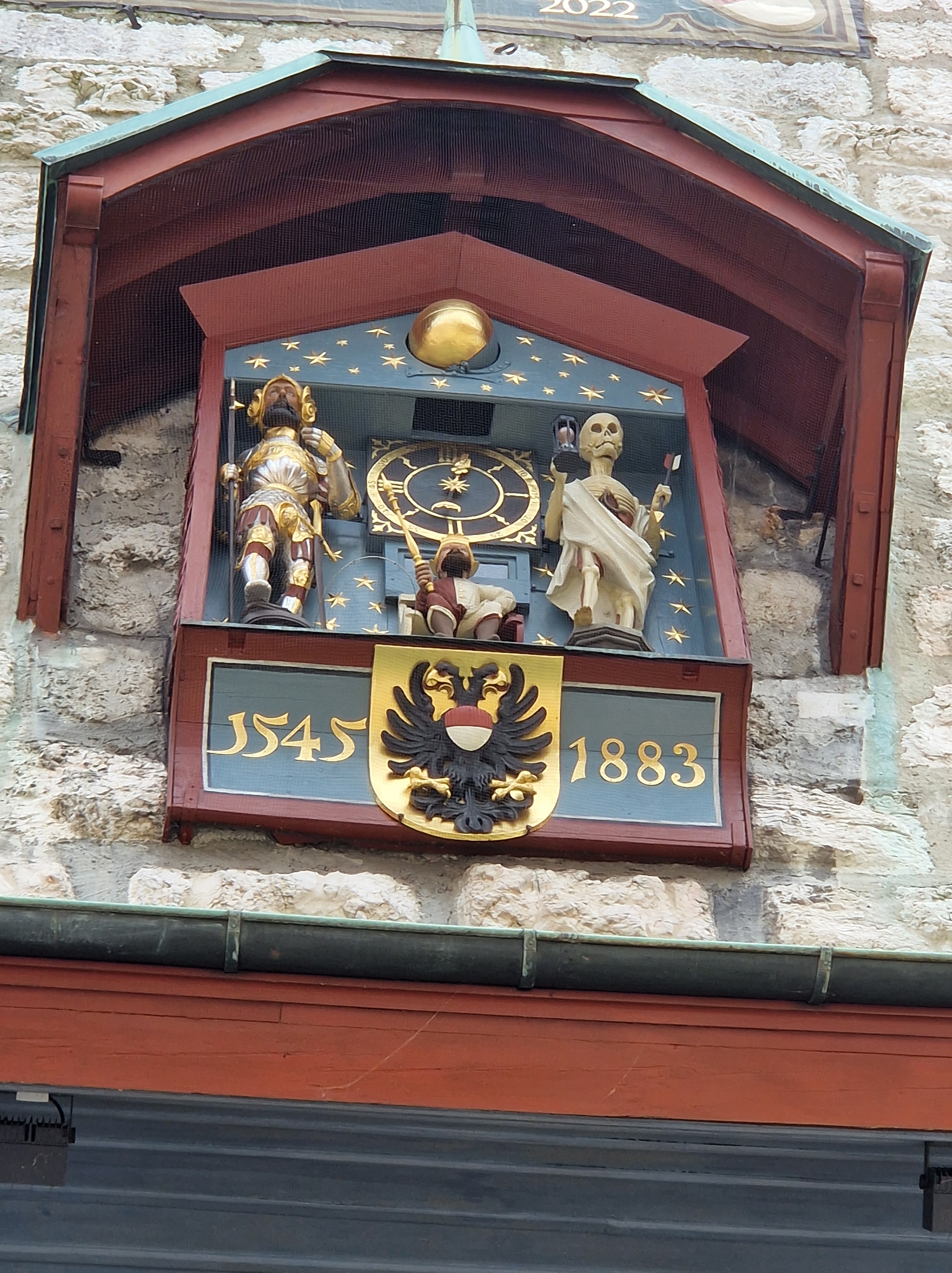
The three figures in the central tableau above the clock are a knight, king, and skeleton (Death), which perform every hour: The knight holds a battleaxe in his right hand, and a sword in his left; every quarter-hour, he turns his head toward Death and strikes his breast, signifying his loyalty to the central figure, the king. On the right stands Death; in its right hand is a hourglass, which is turned on the hour, symbolizing the contradictions of life – good, bad, life, death. In the other hand is an arrow, showing that one could be struck down at any moment. On the hour, its head turns toward the knight.

On the throne between these two figures is the king: In his right hand is a sceptre, which he lifts on the hour. His jaw moves in rhythm with the hour hand, and his beard represents wisdom. However, notice that he’s wearing red and white fool’s garb: If the king does not rule with wisdom and the humour of a fool, his reign will become a tyranny. It tells us that life should have moments of both wisdom and a jester’s humour.

While Death announces the hours, the king swings his sceptre. At the same time, Death nods with each stroke and confirms the relentless passing of the hours. The king with his fool’s garb reminds us of the memento mori. When death or illness reigns, even the power of a wise king can do little (Solothurn was hit by the plague, e.g. in 1348). Though the Freudian era banished death from contact with the living in many Western cultures, death personified as a skeleton is still a symbol seen in many countries around the world. Having death constantly before your eyes encourages you to savour each moment of life.

I hope you’ve enjoyed this brief glimpse into a beautiful city with an ancient history!

5 Comments

Filed under Articles, Etymology, History, History Undusted, Links to External Articles, Space, Astronomy

Space: The Final Frontier

For you Sci-Fi buffs out there, that title will be very familiar, as it is the opening line of the Star Trek manifesto.  The novel I’m working on at the moment is just that – Sci-Fi, albeit not Star Trek.  It nevertheless takes me into space, and that’s always a fascinating thing!  So here are a few fun facts about what lies beyond our atmosphere:

  • Jupiter’s Ganymede is the largest moon in the Solar System, and is even larger than the planet of Mercury.
  • Venus is the hottest planet in the solar system, with a surface temperature of 460°C. A day on Venus is 243 Earth-days long, but its year is only 224.7 days; Venus spins backwards on its axis.
  • Oxygen is the third most common element on the Sun, after helium and hydrogen.
  • A neutron star is the strongest known magnet in the universe, and such stars are among the fastest-spinning objects observed, spinning up to 500 times per second.
  • Since 1992, when the first exoplanet was discovered, there have been 3,728 confirmed planets in 2,794 systems, with 622 systems having more than one planet.
  • About 1 in 5 stars comparable to our sun have an Earth-sized planet in the habitable zone (known to scientists as the “Goldilocks Zone”). It is assumed that there are 200 billion stars in the Milky Way Galaxy alone; based on that, there would be 11 billion potentially habitable Earth-sized planets in our galaxy (and up to 40 billion if you count red dwarf stars as well).
  • Proxima Centauri is the nearest star to us beyond the Sun.
  • Russia is larger than the entire surface area of Pluto.
  • The largest known star is Westerlund 1-26, which is 2,000 times bigger than the Sun.
  • Olympus Mons, on Mars, is the largest volcano in the solar system. Due to the low gravity of Mars and the lack of plate tectonics, it has been able to grow to three times higher than Mount Everest.
  • Dark matter and dark energy are thought to make up nearly 95% of all matter in the universe.
  • The Boomerang Nebula (also known as “the Bow Tie Nebula”) is the coldest known place in the universe, with a temperature of 1 K (−272.15°C; −457.87°F).
  • The Sun is growing, but we won’t have to worry about it for a few billion years, when it will become close enough to swallow the Earth.
  • On Mercury during the day, the Sun rises, stops, and then sets where it rose.  It rotates on its axis exactly three times for every two revolutions it makes around the Sun, meaning that, if you lived on Mercury, you would only see one day every two years.
  • The Sun’s core releases the equivalent of 100 billion nuclear bombs every second, and its energy is emitted as heat and light.
  • The storm on Jupiter known as the ‘Great Red Spot’ has been going on for at least 350 years; it’s so large that dozens of Earths would fit into it.
  • A supermassive black hole is thought to be present in the centre of nearly every galaxy, including our own (ours is a runt compared to the average size).
  • Shooting stars really aren’t stars; they’re meteors – and even then, they are often only dust particles falling through our atmosphere that vaporize due to the heat of friction with the atmospheric gases. If they are large enough to survive the journey through our atmosphere and impact on the ground, they are called meteorites.
  • We are in constant motion; planets move within the solar system, the solar system moves within the Milky Way Galaxy, which in turn moves within The Local Group of Galaxies; the local group is moving toward the Virgo Cluster.
  • Apollo 14 astronaut Alan Shepard left two golf balls on the Moon in 1971.  They’re still there:  One is in the Javelin Crater, and the second fell near where the ALSEP (Apollo Lunar Surface Experiment) was deployed.
  • The Moon’s Javelin Crater gets its name because on the Apollo 14 mission, fellow astronaut to Shepard, Ed Mitchell, threw the Solar Wind Collector staff as a make-shift javelin.
  • Uranus has 27 known moons, all of which are named after characters from the works of William Shakespeare and Alexander Pope.
  • Jupiter has 69 known moons.
  • Jupiter, Saturn, Uranus and Neptune have no solid surface to land on, being comprised of gas.
  • Did you know that the Earth is actually a ringed planet by now?  At the last official count (2013), more than 170 million pieces of space junk debris smaller than 1 cm (0.4 in), about 670,000 debris 1–10 cm, and around 29,000 larger debris were estimated to be in orbit; these clouds (in both the geosynchronous Earth orbit and the low Earth orbit) make it hazardous for spacecraft, due to the dangers of collisions; they basically sandblast craft, which makes the launch of equipment like telescopes or solar panels extremely susceptible to damage.
  • Below 2,000 km (1,200 mi) Earth-altitude, debris are denser than meteoroids; most are dust from solid rocket motors, surface erosion debris like paint flakes, and frozen coolant from RORSAT nuclear-powered satellites (according to Wikipedia).  Maybe it’s actually a good thing that we can’t make it to other planets to colonize…

Below are images from APOD – enjoy!

This slideshow requires JavaScript.


6 Comments

Filed under Articles, History, Research, Science & Technology, Space, Astronomy

Buying Credit

No, the title is not referring to money or cash cards, but writing.  Stick with me.  If you’ve made yourself at home here and nosed through my cupboards, you’ll know that I do a LOT of research.  I love it.  It adds spice to my character’s meals, salty spray that blackens the redcoats of marines aboard a royal navy ship, tells me that heated arsenic smells like garlic, and makes the ship creak so loudly you’ll swear you’re going down to Davy Jones’ locker.  But there are times when, as an author, I’m required to blur the lines between fact and fiction.

There are certain things that people erroneously assume (such as Viking helmets) that I may need to adapt in order not to lose a reader’s trust (though trust me, I will never add horns!):  The sentence structures of bygone days were far more complex, with vestiges of Germanic linguistic influences – for my current manuscript (set in 18th century England and mostly aboard a Royal Navy ship of the line) I need to modernize the syntax without losing the High English flavour, and without compromising on the linguistic purity of my story’s time-setting; modern sensibilities (in social ladders, issues such as slavery, war, etc.); laxer standards (in, say, relationships or politics or social ranks), and so on.  A modern reader will most likely not appreciate the complex social mores of a time when men and women were never alone in a room – even when the man wanted to propose to the woman, and the parents wanted it to take place; and so, such things need to be adapted at times, to a certain extent, to reach a modern audience without alienating the audience that revels in bygone literature.

If I, as an author, want my reader (who is perhaps a stickler for all things historical) to give me the permission to bend a few social rules of the 18th century, I must first buy credit with them – prove to them that I’ve done my homework – so that they won’t get ripped out of the story in disbelief when I contrive to leave a man and a woman alone in the same room without a chaperone.  In my current manuscript, the husband and wife come from opposite ends of the social ladder, and the husband becomes a captain in the royal navy at the tender age of 20 or 21.  Both of these situations have many historical precedents; I know that from countless hours of research.  But most people who read historical novels might think, “But Viking helmets always have horns” – or something to that effect.  If written well, these disparities in understanding can be smoothed over, so that when I really DO break historical moulds, I am allowed to do so without offending the reader “in the know”.

1761-joshua-reynolds-lady-elizabeth-keppel

1761, Lady Elizabeth Keppel, by Sir Joshua Reynolds

This portrait illustrates an important point:  Many people, when thinking of the British rule of India, perceive it through postmodern lenses; we see it from the hindsight of Gandhi and the independence of the country from the imperialistic rule of British paramountcy.  But the other aspects were the children and wives of British soldiers, diplomats, and tradesmen, and the loneliness faced, the friendships struck with Indian men and women… these are important aspects to weave into a story, too, and thus require research.  Notice the pearls adorning the Indian woman below?  The researcher in me wants to know her story far more than the story of Lady Keppel (who died of a broken heart at the age of 29, just months after her husband had died of injuries from a riding accident).  Some readers may get jolted out of the world you create by the pearls, though it is historically accurate – so you’d still need to buy credit by setting up that aspect well.

These same credit-buying rules apply to any genre, even science fiction:  If you create a world set on another planet, that world will have laws – physics laws, indigenous social mores, etc. – and you as a writer must know what they are, and if or how they can be broken if need be.  You can’t claim that all liquid on the planet is frozen, and then have your character drinking from a fountain or stream, unless you explain how that’s possible.  If you do, you’ve taxed your believability credits and pulled the reader out of the world they’ve agreed to follow you into.  The manuscript that I’ll work on next (after the current one is published!) is science fiction; the air of the planet is toxic to humans, so I need to create a way for facial expressions, dialogue, etc. to come through even when the characters are outside in their suits.  I have done a lot of preliminary research into geology (that told me about heated arsenic, among other things); I also need to explain how a planet with multiple suns can have a stable enough orbit not to be drawn into one of the stars and burn up – i.e. I need to follow known physics laws, or explain how they are suspended for my planet.  I think you get the idea!

So if, as a writer, you want readers to believe what you write about a fictional character set in British India, you first need to buy credit with your readers by doing your historical homework and sculpting the landscape and characters in the rich tapestry they deserve.  If you are writing science fiction, establish your world and stick to your rules so that, if you need to bend them for a plot development, the readers will be willing to follow you on the adventure.  Whatever you do, keep writing!

Save

Save

Save

8 Comments

Filed under Articles, History, Military History, Nuts & Bolts, Plot Thots & Profiles, Research, Science & Technology, Writing Exercise

Musings A to Z Challenge: Z

Challenge:  Write a short paragraph (100 words or less) daily on a topic beginning with the sequential letter of the alphabet.

Zenith

Astronomical zeniths are easy enough to calculate; it’s the metaphorical ones that get tricky.  How do you know when someone is at the pinnacle of their career, or their success?  If someone could precisely know the zenith of stock prices and when to buy and sell, they’d make a handsome fortune.  The thing about zeniths, on a personal level, is that the word implies an end to growth or progress, and as such, is not something to be desired.  When we stop growing, learning, and maturing, we die.  Seen in that light, I suppose you could classify know-it-alls as zombies.

Zenith

Leave a comment

Filed under A-Z Writing Challenges, Images, Quotes, Writing Exercise