
Ah, the fun of leaving out two letters…

 Dialogue is (to point out the obvious) vital to a novel; it displays the voices of your characters and helps the reader get to know and care about the characters, understand their motives, their interrelationships, and distinguish each character’s point of view. If you don’t get the dialogue right, you rip the reader out of the story, or worse – make them put down your novel and add your name to “never again” lists! So, here are a few pointers and tips to keep in mind as you develop your characters and put words into their mouths:
1) Develop your characters well enough to make their voice distinct; do they have catch-phrases, or local dialects that influence their vocabulary? Do they tend toward long or short sentences, or are they from a past time and place that had a different way of speaking? Educate yourself if necessary in various modes of speech .
2) Dialogue is an illusion of conversation; but it’s also about what is not said. Non-verbal actions reveal:
a) How a character says something
b) What a character chooses not to say, but inadvertantly reveals through actions.
c) Why the character says what they do.
Do they have particular actions when they are upset or aggitated that communicate their moods to the reader? Do they bounce their knees when excited? Does their body language confirm or contradict their verbal message?
3) Fictional dialogue needs to cut to the chase; if there’s no point to the text (revealing motivation, character or plot point), then chop it!
4) Avoid the trap of using dialogue as exposition (the proverbial villain’s monologue as he prepares to destroy the hero), but rather reveal essential information through action, or narration.
Explore your characters and develop their voices, and above all – keep writing!
I try to read a book a week; it’s usually on a Saturday, when I have time to sit down and read a good chunk at a time. This past weekend I read a book which prompted thoughts around this concept of “sensing” a scene, and reading it aloud to hear any howlers that might have crept into the writing. The author of that book obviously did neither, though her editor might have told her to beef up descriptives – so they were clumped all together, staggering me as a reader to a halt while I tried to figure out the context of the pages of descriptives before remembering what the characters were doing there in the first place, and often the dialogue sounded very stilted (e.g. using “vocalized” instead of “shouted” – the latter of the two would have fit into the character’s time and place far better) – a good reading-aloud editing session might have done wonders for the novel.
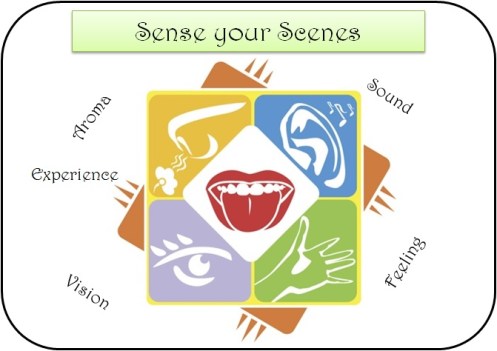 This image is one I have printed out on a card and hung near my desk when writing; it reminds me to apply all of my senses to a scene, to enrich the imagery and draw the reader in. Describe the sights, smells, sounds, feelings and taste of a scene; make it a sensory experience and it will be far more memorable; this is done through sentence structure and the pacing of those elements, but sometimes also through “camera angle” – looking at the scene from a particular perspective. How does your character feel in the moment? What are their perceptions? Does a smell remind them of something or someone? Here are a few tips to achieving these goals:
Writing is a dynamic process, and being a writer means constantly striving to improve oneself – building vocabulary and learning how to use words effectively, building your knowledge through research, studying, and reading, reading, reading! Keep on writing!
Filed under Articles, Images, Nuts & Bolts, Plot Thots & Profiles, Writing Exercise
 Once in a while, we need to get our creative juices flowing; here are some ideas to spark your imagination! Pick one, get a pen and paper, and start writing! See where it leads!
1. What is it that you are absolutely sure you will never forget?
2. doorbell rings
3. perfect family
4. zombie packing list
5. flight vs. invisibility
6. two animals into one hybrid
7. Describe each day of the week as if it was a person.
8. you fly but you lose a minute every time
9. design and describe the perfect bedroom
10. library, museum, zoo
11. which friend will become the most famous?
12. you give a personal concert
13. complain about kids these days
14. glow in the dark tattoo
15. magical mailbox
16. I deserve a day off school
17. average of five people
18. celebrity, famous person, character as sibling
19. describe daily life in 2045
20. honesty room
Filed under Lists, Writing Exercise
 Use your imagination for creating exciting new possibilities! And just to get you started, here’s a writing prompt:




 Stephanie Huesler