Tag Archives: Idioms

Idioms Undusted: When Too Many is Too Much

I know that most of you can relate to the occasional feeling of having too many things going on at once; juggling jobs, family, civic responsibilities and household management can bring on the feeling of a hamster in a wheel, moving, moving, but not really getting anywhere!

That feeling began creeping up again for me last week, and a few idioms came to mind related to that feeling – which tells me that the condition of being overwhelmed or over-busy is an age-old challenge.

You can’t dance at two weddings

This idiom means that you can’t do two things simultaneously – you have to decide for one or the other. Sometimes that’s a tough choice – both things would be great to be involved in but, unless you’ve learned how to clone yourself, a choice must be made.

The phrase’s etymology leads us to the Yiddish language: Historically Judeo-German, Yiddish is a West Germanic language historically spoken by Ashkenazi Jews and originated in the 9th century. What I find interesting is that, about 25 years ago, when I was still learning High German alongside Swiss German (Zurich dialect), my husband was invited to perform some of his troubadour songs in a concert with several other artists; one of the groups performed in Yiddish. I could understand and follow the story of their song, while my husband and other Swiss around me couldn’t. I think it was a combination of me being a fresh learner of the two languages simultaneously, having a musical ear and, perhaps more importantly, having a Scottish accent still in my ear and a bit in my Swiss German – for me, it sounded a bit like a combination of the two! My brain combined it all, and I could follow the story – my explanation to my husband was then confirmed by their translation given after the song was over.

The idiom is likely derived from the Hebrew translation of the story in 1 Kings 18:21; the English NIV says “How long will you waver between two opinions?” but the Tanach could be read as, “How long will you hop between two platforms?”

Spread butter too thin (over too much toast)

This idiom, with a similar connotation, implies that one overcommits to too many things, leading to unsuccessful results, or leading to exhaustion or poor performance.

A good example of this idiom is happening right now in our flat: Of all the companies we’ve had to work with on the various issues of resolving water damage (the entire process began in April 2024, and no, it’s not over yet!), one company has teams in several functions – floor renovation, plastering, painting… and probably others, of which I hope I never have experience. Every single repair they’ve undertaken has been shoddy, and they’ve had to repeat the exercise – meaning we have had to move half of our flat away from floors, walls and pathways several times already as they have to re-do badly-done work! I’ve put my foot down and insisted that project managers show up and check the work before the workers are done, from now until I never have to see the company again!

The companies that concentrate their expertise on one area, such as plumbing, balcony renovation, façade renovation, or electrical repairs, have all done great work, done and dusted.
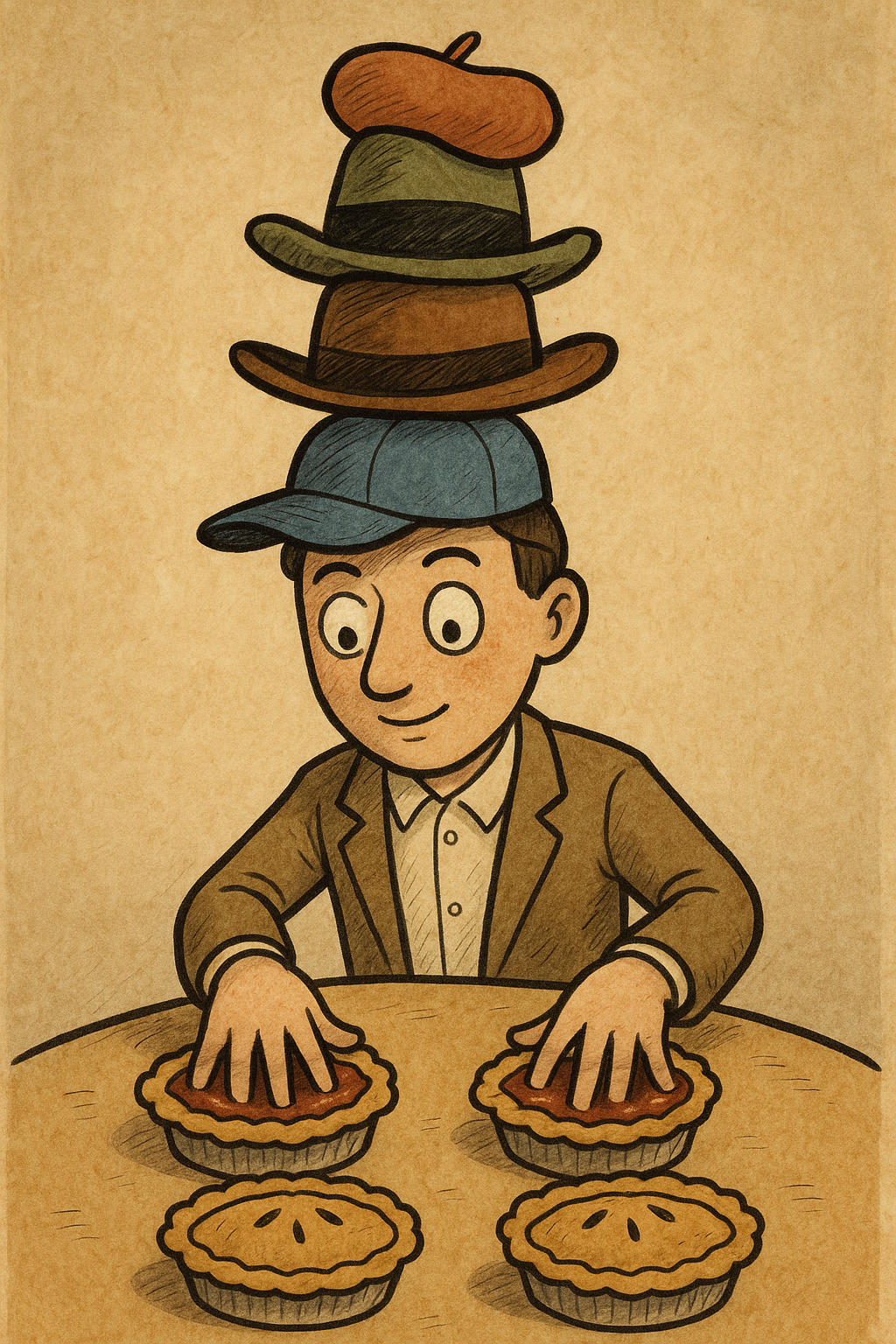
Have one’s fingers in too many pies

This idiom is similar to the butter metaphor, and it means to be involved in many different activities or projects at once, often to the point of being overstretched; It suggests a lack of focus or a tendency to dabble in various things without fully committing to any. 

Shakespeare used this imagery in Henry VIII, in which the Duke of Buckingham refers to Cardinal Wolsey: “The devil speed him! no man’s pie is freed from this ambitious finger“.

In Italian, the phrase “avere le mani in pasta” means to have one’s hand in the pies, or pasta, or simply being hands-on.

This idiom is so visual that it is difficult to trace its origins, as it likely had many concurrent origins throughout history. Shakespeare most likely wasn’t the first to use it, though he no doubt popularized it, like so many things he’s “credited” with.

Wearing too many hats

This idiom, also as “man of many hats” stems from a recent past when people wore hats on a daily basis.

Men had hats, usually bowlers, to wear in the city during the day, while they wore a different hat on the hunting field, another when riding horses, and another for evening parties. Cricketers, cowboys, players of various sports (baseball, American football, etc.), military ranks with casual uniforms or dress uniforms or combat uniforms all wear different hats.

To wear too many hats implies that a person is trying to perform too many different roles or jobs than is realistically feasible, implying that they may struggle to fulfil responsibilities effectively.

Have you had times in your lives when too many is too much? If so, let’s all learn to slow dance, eat less butter, bake fewer pies, and choose one hat at a time!
1 Comment

Filed under Etymology, History, History Undusted, Linguistics, Military History

Etymology Undusted: Murphy’s Law

The adage “Murphy’s Law” refers to the idea that anything that can go wrong will go wrong. You forget your umbrella and it will be sure to rain; your computer crashes at the worst possible moment; your worst itch is always where you can least reach it, and so on.

Similar sentiments are centuries old: E.g. Augustus D. Morgan, a British mathematician, wrote in 1866: “Whatever can happen, will happen”; Alfred Holt, an engineer, wrote in 1877: “It is found that anything that can go wrong at sea generally does go wrong sooner or later.” British stage magician Nevil Maskelyne wrote in 1908, “Everything that can go wrong will go wrong.”

But who was Murphy? And why is it his law? I’d always assumed that Murphy was either a fictional black sheep created to blame everything on, or someone from a century or more ago, much like Hobson of the “Hobson’s Choice” idiom; but Murphy’s Law comes from the 1940s aerospace era.

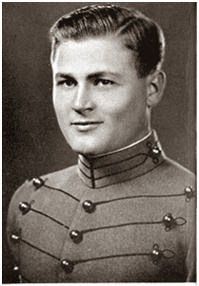
The “law” was coined by and named after Edward A. Murphy Jr. (b.11 January 1918; d.17 July 1990):  Born in the Panama Canal Zone in 1918, he finished high school in New Jersey and eventually graduated from West Point in 1940, joining the Army Air Corps, serving in the Pacific Theatre of World War 2, and in the Korean War, reaching the rank of major. According to his obituary on findagrave.com, he is credited with design work on crew escape systems for some of the most famous experimental aircraft of the 20th century, including the F-4 Phantom, the SR-71 Blackbird, the X-15 rocket plane, and later the Apache helicopter. He also worked on safety and life support systems for NASA’s Apollo space missions. Although he was apparently chagrined by the namesake, he believed in the concept as a key to good defensive design – that one must always assume worst-case scenarios and work to counter them in thorough planning, engineering and execution of mechanical designs.

Around 1948, Murphy and his team were testing rocket sleds, which were used to test the acceleration of equipment deemed too hazardous to test in a piloted aircraft and also to test missile components without risking actual (more expensive) missiles in the testing. The saying arose when training his engineers to avoid designing missile components that could be confused one for another; he said, “If a part can be installed in more than one position, it will be incorrectly installed in the field.” Perhaps Murphy was familiar with the sentiment of those past engineers, given his background in engineering, but wherever it came from, his name was attached and, as they say, the rest is history.

Edward Aloysius Murphy Jr, in his West Point uniform

5 Comments

Filed under Etymology, History, History Undusted, Humanity Highlights, Military History, Science & Technology, Space, Astronomy

Etymology Undusted: Catch-22

The idiom “Catch-22” comes from a book of the same title by American author Joseph Heller (1923-1999). The term originally referred to a military rule whose provisions are mutually frustrating. Heller used Catch-18 instead of Catch-22 when the first chapter of his book was originally published in 1955. He changed it by the time the entire book was published in 1961 because his publisher had already published a book that year with “18” in the title (Leon Uris’ novel, Mila 18). So in 1961, the phrase Catch-22 first appeared. It was first used figuratively in 1971 in Atlantic Monthly magazine. As far as the form goes, it is usually hyphenated and with a capital C, as that is the way Heller originally wrote it.

Since the author’s first usage of the idiom, it has taken on a life of its own: Today, its broader meaning is a paradoxical situation from which an individual cannot escape because of contradictory rules or limitations. It has also been used as a mnemonic for the symptoms of DiGeorge syndrome.

One particular quote from Heller is thought-provokingly insightful: “Everyone in my book accuses everyone else of being crazy. Frankly, I think the whole society is nuts – and the question is: What does a sane man do in an insane society?” In a way, this is perhaps an example of a Catch-22 for the sane person: If they stay in an insane society, they may lose their sanity; but by leaving such a society, they throw away any chance of bringing it back to a state of reason. Social and political polarisation are both poisons that infect society.

1 Comment

Filed under Etymology, Grammar, History Undusted, Images, Musings, Psychology Undusted, Quotes

Toe the Line vs. Tow the Line

Toe the LineRecently I used the title’s idiom, and to be honest I don’t know if I’d ever used it before in writing; I’ve heard it said onk-times, but never had much use for it so far in written form.  Then came the question, is it “toe” or “tow”?  Actually the original phrase is nautical; but that could still be either spelling.  I did a bit of research, in both etymology dictionaries and a book of naval slang, online and in my library.  The consensus, I present here.

“Toe the line,”  according to Naval History & Heritage, comes from the practice of waterproofing between deck boards with a layer of oakum, pitch and tar, thus creating a striped deck; when the crew was ordered to fall in at quarters they would line up at their designated area of the deck, toes to the line to ensure a neat line for inspection.  Toeing the line was also used as a form of punishment for lighter misdemeanours aboard a ship, such as younger crew members talking at the wrong time; they were made to stand at the line for a specified amount of time to remind them to behave.  A logical leap later and we have our idiom, because the young lads were warned to “toe the line” – they were to mentally toe the line to avoid getting in trouble.

Tow the LineHowever, “Tow the line” could be seen as a malapropism, a mondegreen, or an eggcorn.  A malapropism (also called Dogberryism) is the substitution of an inappropriate word or expression in place of the correct and similarly-sounding word.  Example:  “Officer Dogberry said, “Our watch, sir, have indeed comprehended two auspicious persons” (apprehended two suspicious persons).  A mondegreen is an error arising from  understanding a spoken word or song text incorrectly.  Example:  “The ants are my friends, blowin’ in the wind” (the answer my friends) – Bob Dylan.  An eggcorn is an idiosyncratic (but semantically motivated) substitution of a word or phrase for a word or phrase that sound identical, or nearly so, at least in the dialect the speaker uses.  Example:  “for all intensive purposes” instead of “for all intents and purposes”.  Depending on your view of things, “tow the line could fall into any of those categories.  But it has so often been misused that it has begun to develop its own connotation independent of the original idiom:  While “toe the line” indicates a passive agreement or adherence to a particular regulation or ideology, “tow the line” implies more of an active participation in the enforcement or propagation of that “line” whether political, social, or business policy, as towing an object is not passive, but participative.

10 Comments

Filed under Articles, History, Mistranslations, Nuts & Bolts, Research

The Separate Language

Having lived on both sides of the Puddle (that’s the Atlantic, for you Americans), I can confirm that English truly is a language that separates the Old World from the New.  While the American language seems to be simplifying through the school system and mass media (and don’t even get me started on the spelling!), I doubt that will ever happen in the UK… the language is far too entertaining to let it get boring.  Click on the image below for a few gems like “Donkey’s Years”, “it’s monkeys”, “to have a butcher’s”, and “up the wooden hill to Bedfordshire”.

Anglophenia


Leave a comment

Filed under Translations, Videos