For as long as humans have worn clothes, they’ve needed to find ways to hold them on, up, around, or to their bodies. Genesis 3:7 tells us that, once Adam and Eve realised they were naked, they “sewed fig leaves together and made coverings for themselves”. They likely sewed them with some kind of twisted or stripped plant fibres such as grass blades, green twigs or even fibrous roots; this method was used for millennia.
In Ancient Athens, tunics were fastened together at the shoulder by long dagger-like pins. That is, until a group of angry Athenian women used their pins to stab an Athenian soldier to death; according to Herodotus’s Histories, a law was passed forbidding the Athenian style of tunic in the Roman Empire thereafter. Understandable, that, but I wonder what Athenians used to fasten their tunics immediately after that decree…
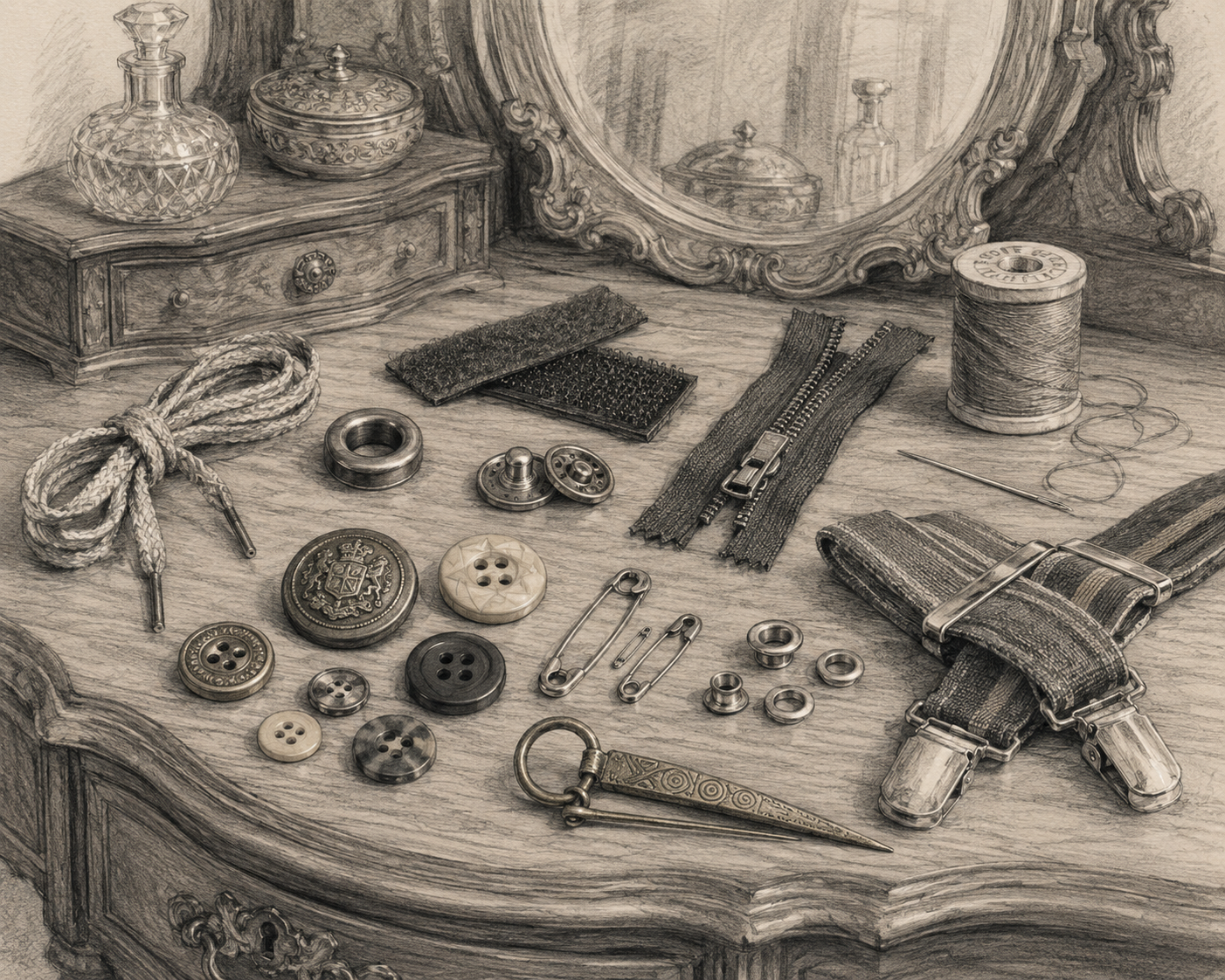
Clothing fasteners (hardware or notions used to connect two or more pieces of fabric together to open, close, or secure a garment) used today vary: Buttons, whether plastic, wood or metal; zippers; hooks and loops (commonly known as Velcro); eyelets (aka grommets); snaps; buckles; suspenders with clips; hooks and eyes (such as those found on skirts or bras), and even safety pins.
But before any of these came along, people literally sewed their garments on; even into 18th Century Europe, women were stitched in or pinned in by maids; Jane Austen alludes to this in Northanger Abbey, when Mrs Allen complains that a needle holding her sleeve in place was jabbing her, and she was afraid it would rip the muslin, for which she paid “but nine shillings a yard”. Every evening, they were either “unsewn” out of them, or they slipped some garments over their heads if possible. Corsets, as well as fashionable garments, were laced on, easier to remove than put on. When metal fasteners became increasingly available, it introduced new possibilities in fashion: it allowed for more fitted garments, and gave women the freedom from the need of being dressed by maids (or, if lower classes, of being dependent on a relative to help one dress). It didn’t dispense with corsets, but the metal front-fastening busks enabled women to put on their own.
If shoes are to be thought of as clothing, their history probably goes back as far as that of clothing itself: The oldest known shoes were sandals made of woven bark, dated to around 10.5 thousand years old. The first known leather shoes, found in Armenia, date to around 3,500 BC. Oetzi, the Austrian Iceman, wore shoes constructed of bearskin soles, deerskin side panels, and a bark cord that held them onto his feet. The modern shoelace, with the stiffened aglet, or tip, was invented by the Englishman Harvey Kennedy, patented in 1790. Before that, shoes were held on with buckles or buttons.
Today, some people (like me) usually have slip-on, fastener-free clothing articles like T-shirts, or trousers with elastic bands that require no other fasteners. What kinds of fasteners do you typically have on your garments today?