To me, the word Zarf sounds like a sci-fi comedy name for an inept villain. But, in fact, it’s a word that entered English in 1836, and is the Arabic word for “vessel”. It describes an object that you’ve seen or have likely had in your hand at some point. I will freely admit that the zarfs we know today have fallen a long way from their original forms: A zarf is the holder of a coffee cup. That sounds fairly straightforward. You may have instantly pictured a highly decorative, precious metal jewelled… no? Are those crickets I hear chirping in the vast silence of confusion? Or maybe you pictured the cardboard contraption around a hot cup of Starbucks coffee. Fallen a long way, indeed. (Camps are divided on whether the latter constitutes a zarf… for good reason: I think they would be better referred to as sleeves, as to put them on par with the bejewelled masterpieces would be an insult to the artisans of bygone days.)
Zarfs arose out of the necessity of protecting one’s hands from a hot cup; before the monster of plastic reared its ugly head, cups were made from metal or glass, often without handles. Further back, they might have been made from plant products such as coconut shells. The oldest known cups were found in Gough’s Cave in Cheddar Gorge, Somerset, England, and dated to 14,700 years ago; they were made of cannibalised human skulls.
During the 16th century, coffee gained popularity throughout the Ottoman Empire. It led to the popularity of coffee paraphernalia and coffee houses, which eventually spread worldwide and remain popular to this day. In Britain, for instance, a coffee-house culture arose in the 17th century; by the end of the century, there were over 3,000. Such venues became known as penny universities, because, for the price of a cup of coffee, men could join in the hubs of intellectual exchange and debate. Artists, journalists, poets and writers gathered to discuss God and the world; the Inklings, a literary group including C.S. Lewis and JRR Tolkien, met regularly at the Eagle and Child in St Giles’, Oxford.
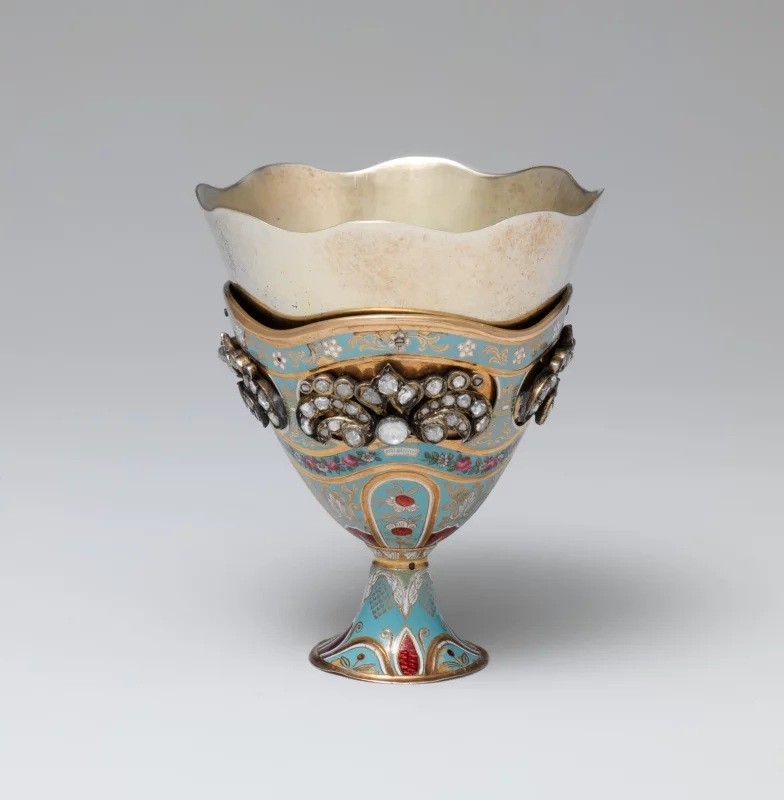
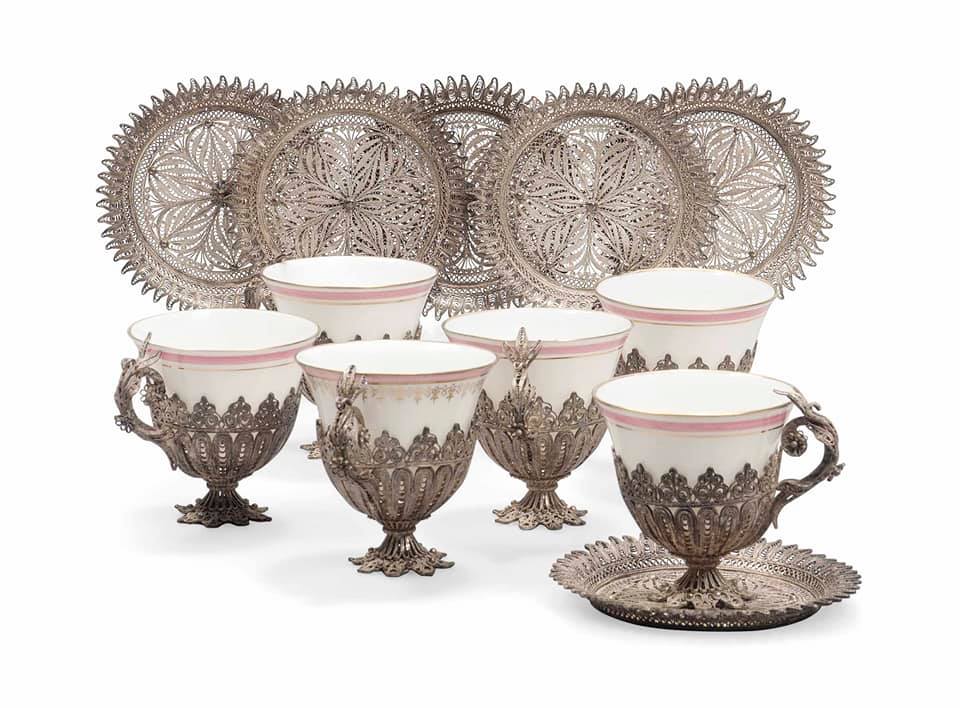
By the 19th century, the goldsmiths of Switzerland had become leaders in the production and export of ornate zarfs, made of precious metals and inlaid with precious stones or small hand-painted medallions. They were often made in fine filigree, with a smaller cup, known as a fincan, made of ceramic or glass, slipped inside to hold the coffee. A modern version of this is still widely used, called a demitasse (French for half cup), in which espresso is often served.
Without further ado, here are a few examples of zarfs and fincans, along with demitasses:
Source: Sothebys.com
A Swiss musical box zarf, ca. 1840 – Metropolitan Museum of Art
Recently, my mother sent me a link on Facebook and asked me to write an article about it; it’s definitely an interesting topic – so thanks, Mom!
First of all, for those of you who don’t know what a folly is:
In architectural terms, a folly is a building that is either constructed as decoration which suggests another purpose or is a practical garden building that transcends its purpose with extravagant features. An example of the former term would be buildings that were designed from the outset to look like ancient ruins, such as Wimpole’s Folly in Cambridgeshire, England; an example of the latter would be buildings like the Dunmore Pineapple in Stirlingshire, Scotland (I’ve been to this site a few times and was once able to go inside the pineapple). Designed to look like a giant pineapple, it was actually a working hothouse; that’s perhaps another story to tell. As for today’s topic, the folly of King Alfred would fall into the former definition.
Second of all, who was King Alfred, and why does he bear the sobriquet Great?
Statue of Alfred the Great at Wantage, Oxfordshire
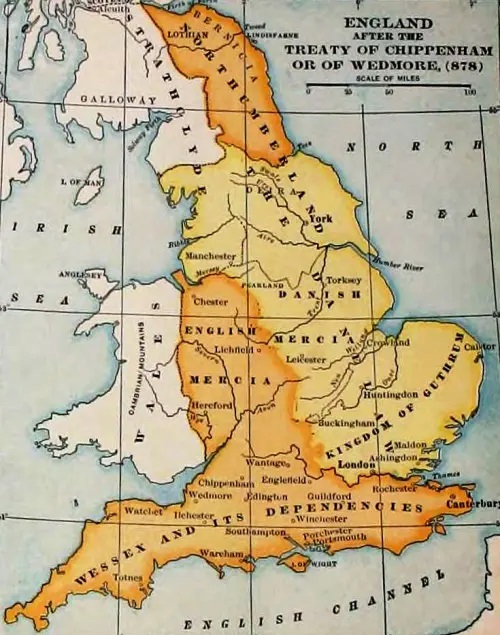
Born in 849 AD, Alfred the Great was King of the West Saxons from 871 to 886, and then King of the Anglo-Saxons from 886 to 899. He lived in a time when Viking invasions and warring tribes were common. Both of his parents died when he was young, and his three older brothers reigned before he eventually came to the throne. The battles, invasions and wars are too numerous to mention; to be a king meant to be at war. At the age of 21, he was already the King of the Wessex and a battle veteran. In early 878, the Danes struck like lightening, taking Chippenham (on the map below, you’ll see that it was in the heart of Alfred’s territories); inhabitants surrendered or fled, and it reduced Alfred and his men to hit and run means of getting provisions; they withdrew into the tidal marshes of Somerset (the area on the other side of the River Severn, just below Wales on the map below). Alfred reevaluated his strategy and learned from his enemy: He and his men began a guerilla war against the Danes, and by May, he’d defeated them in the Battle of Edington. Knowing that he would never be able to drive out such a powerful enemy, he made a treaty with them, establishing borders and what became known as the Danelaw territory; King Guthrum of the Danes converted to Christianity, with Alfred as his godfather and soon son-in-law as he sealed the treaty by marrying one of Guthrum’s daughters, Aethelflaed.
The Great comes from the fact that he united many of the disparate tribes; he recognized the deterioration in learning caused by years of disrupting wars and the Viking’s destruction of the monasteries, which were centres of learning and literacy. He recognized the fact that without widespread literacy, a king cannot rule – a people who were not united by a written language would be more vulnerable; but united through a common tongue, they would have a sense of loyalty and continuity in turbulent times. They would be able to adhere to laws, reach legal decisions, and be called to arms more readily if they could read a common language. He set out to make the English proud of being English and thus be prepared to fight for it.
By stopping the Viking advance against all odds, and consolidating his territories, he set the stage for future kings. His accomplishments in Wessex became the seed that eventually gave fruition to a united Anglo-Saxon England, which is why he alone among all kings or queens of England bears the sobriquet Great.
King Alfred’s Folly:
King Alfred’s Folly – Credit, Flickr, Andrew Bone
King Alfred’s Tower was built between 1769 and 1772. To put those dates into perspective, here are a few events from the year that construction began: 13-year-old Mozart, under his father’s control, was just finishing his third concert tour of Italy; James Watt improved his design for a steam engine that would spark the Industrial Revolution; King Charles III of Spain sent missionaries to California, founding San Diego, Santa Barbara, San Francisco and Monterey; Daniel Boone set out to explore what would become Kentucky; and finally, in August of that year, Napoleon Bonapart was born in Corsica.
The tower itself was built near the site of Egbert’s Stone, which is said to mark the mustering site for the troops of the Battle of Edington; the tower was intended to commemorate the end of the Seven Years’ War and the ascension of King George III to the throne of England. It was designed in the Palladian style (a European architectural style) by the architect Henry Flitcroft, at the commission of Banker Henry Hoare. While the reasons for commissioning the tower might be altruistic of Hoare, its site and magnificence might have had something to do with the fact that the tower was an eye-catcher for those touring the parks at his private estate, Stourhead.
Standing at over 40 metres high (131 feet) and a circumference of 51 metres (167 feet), it is completely hollow; it is a triangular structure with a round “tower” at each corner, though only one of them has a use – a spiral staircase of 205 steps, with no landing places along the dizzying ascent or descent. The only safety is a rope “railing” anchored occasionally along the central pillar of the staircase; passing others up or down can be a tight squeeze, and it is not a climb for the faint-hearted. Once reaching the top, you’ll find a crenelated parapet that surrounds a viewing platform offering a great view of the surrounding region; the centre of the platform is surrounded by a guard rail as it is a gaping hole straight down to the ground level; it’s covered with a mesh netting to prevent birds from using the tower as a dovecote.
In 1944, the tower was damaged when a Canadian single-engine plane crashed into it in the fog, killing all five aboard. In the 1980s, it finally underwent repairs and restoration; the statue of King Alfred above the main entrance was also repaired at that time, restoring a missing right forearm. A stone tablet (also in need of restoration) between the door and statue reads:
ALFRED THE GREAT AD 879 on this Summit Erected his Standard Against Danish Invaders To him We owe The Origin of Juries The Establishment of a Militia The Creation of a Naval Force ALFRED The Light of a Benighted Age Was a Philosopher and a Christian The Father of his People The Founder of the English MONARCHY and LIBERTY










 Stephanie Huesler