Tag Archives: Swiss History

History Undusted: Engadin Sgraffito

I know that, for most of you, neither Engadin nor Sgraffito have made you any wiser as to what this blog is about, so first, I’ll start off by explaining where and what they are, respectively.

Engadin (pronounced En-Ga-Deen) is a long, towering Alpine valley in the Romansh-speaking canton of Graubünden in southeast Switzerland. The first mention of this valley was in Latin as vallis Eniatina in AD 930; in the Romansh language (one of the four national languages of Switzerland), it is Engiadina. The river running through the valley is called the En or Inn, and it is the only river in Switzerland that runs (via Austria) into the Black Sea. The region is usually divided into lower and upper Engadin, and it is connected to the surrounding regions by several mountain passes.

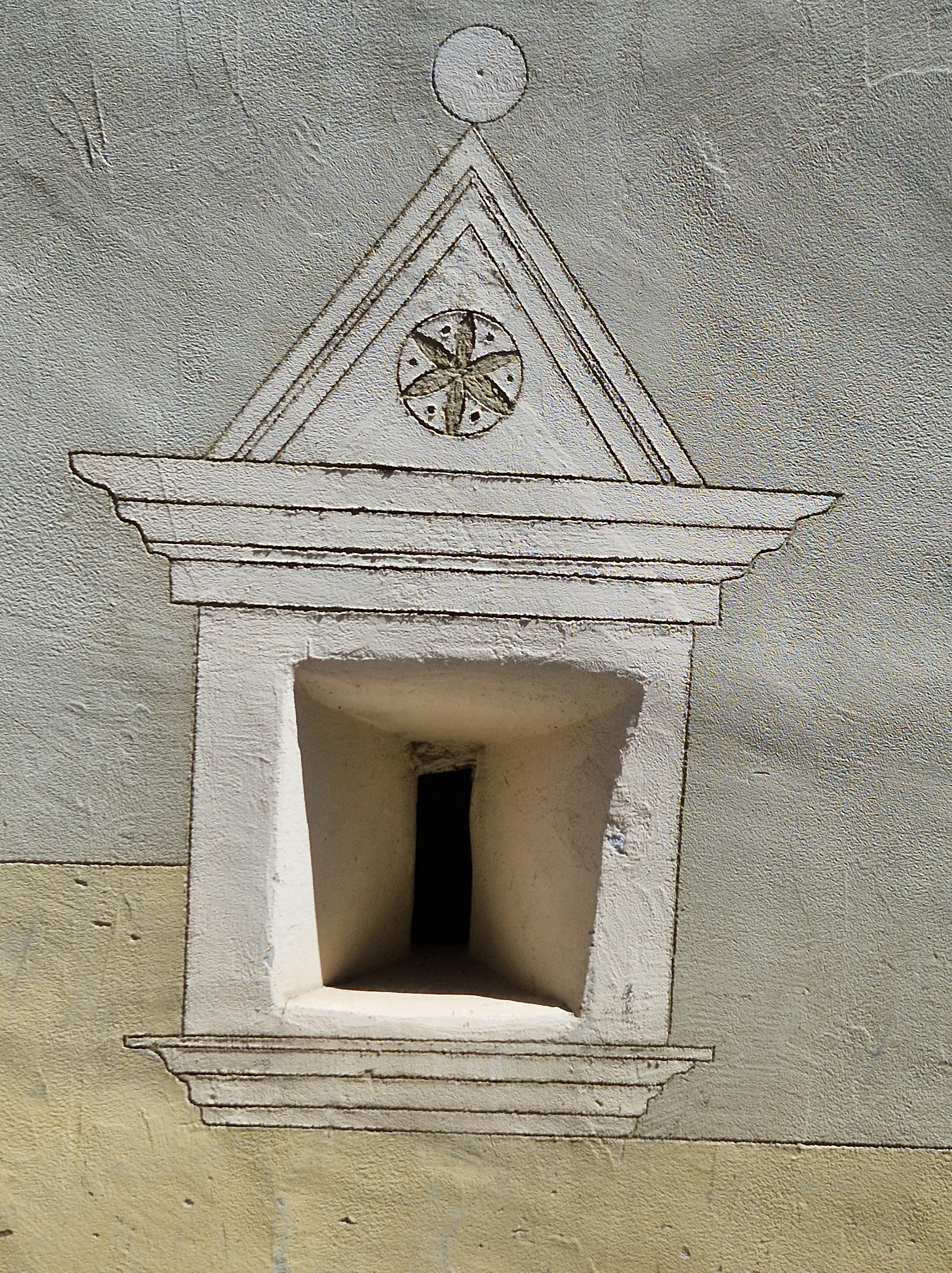
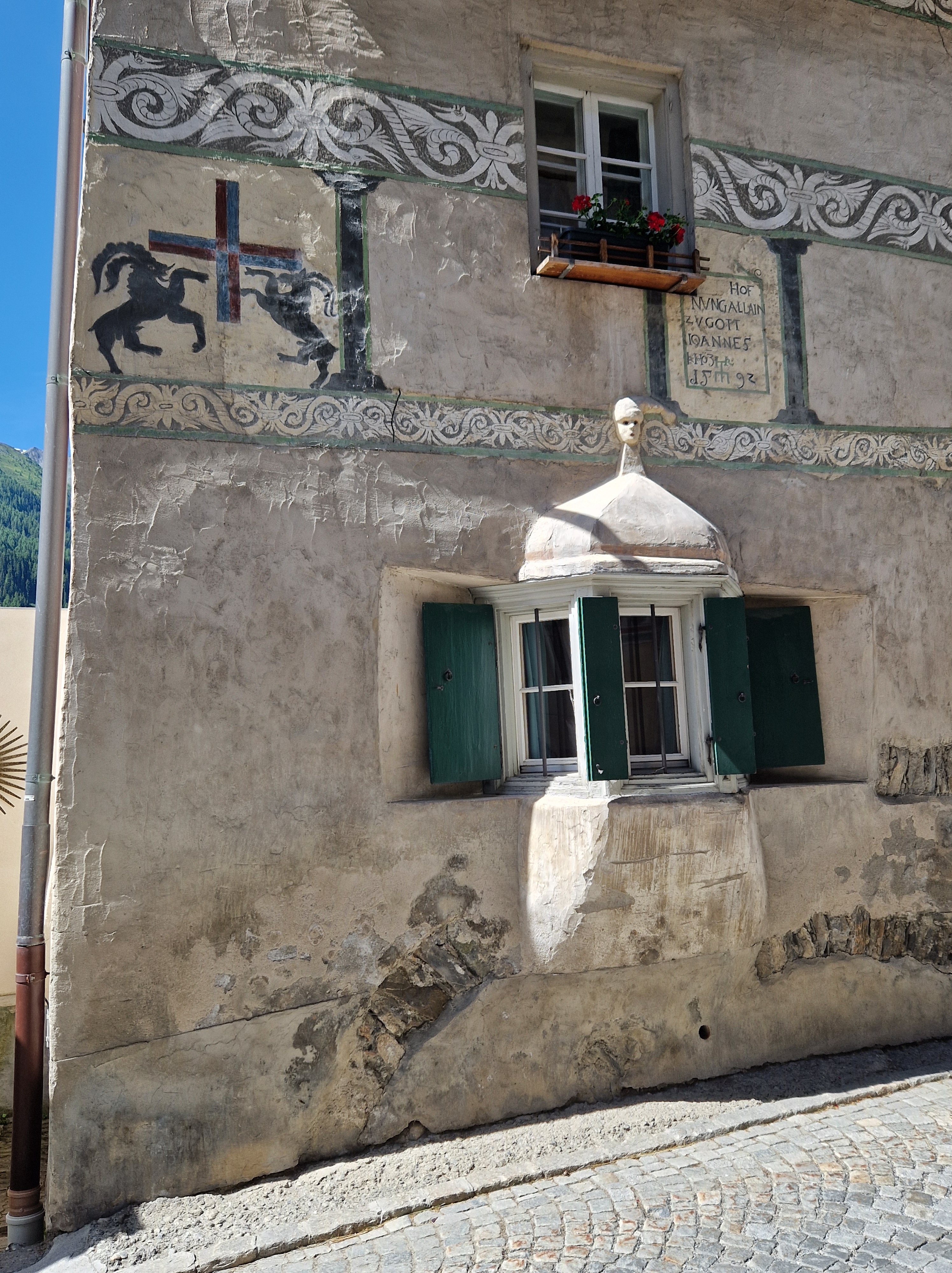
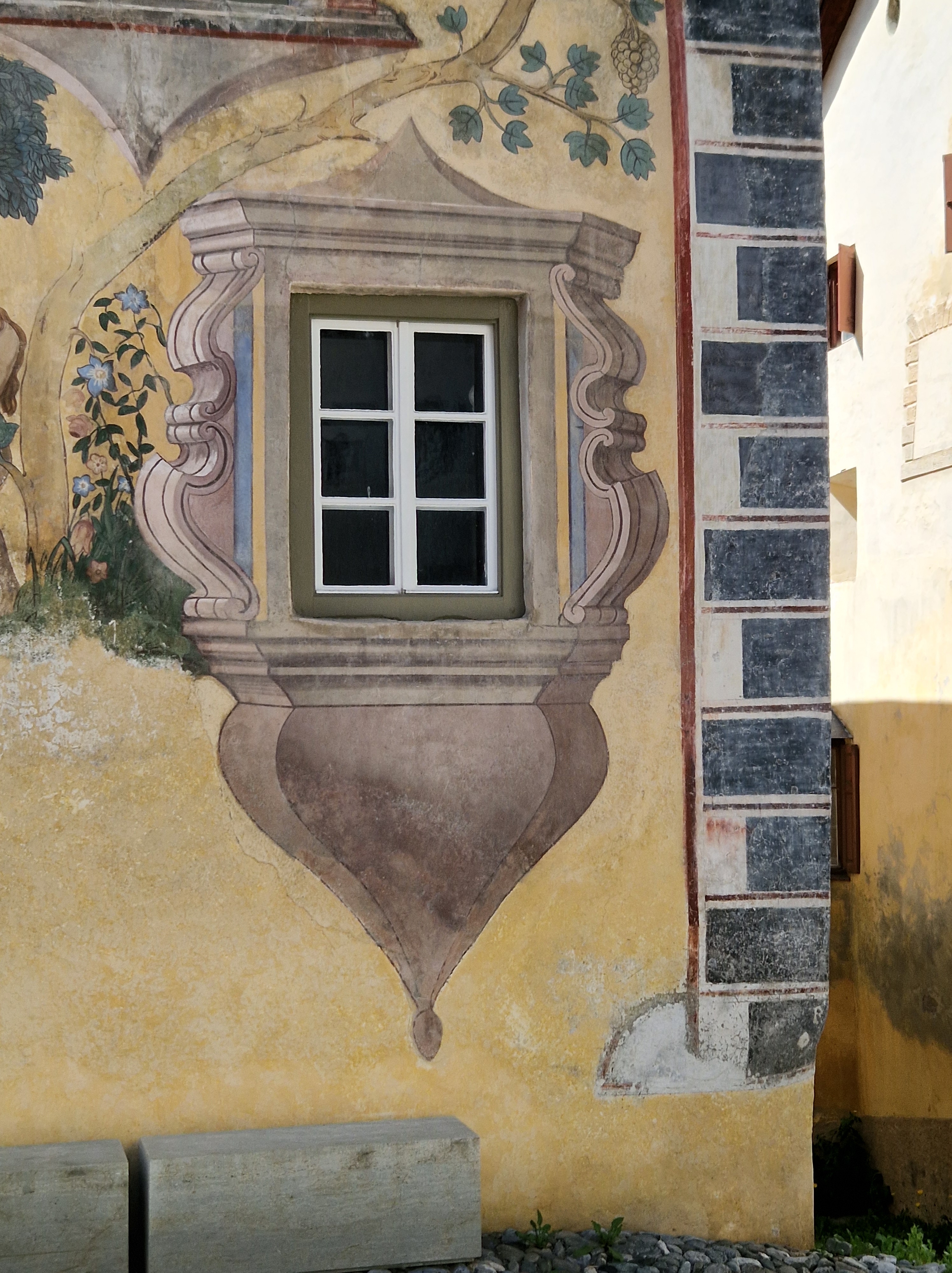
The second word, Sgraffito, describes a plaster technique that is traditional throughout Engadin: Layers of plaster of contrasting colours are scratched through, creating intricate designs on the facades of buildings (many of the buildings in Engadin towns were built (or rebuilt) in the late 1500s to early 1600s). The word comes from the Italian graffiare, which means to scratch; it can be traced back to the Greek word graphein, meaning to write (from which we also get any words containing the prefix, suffix, or derivative of graph (graphite, typography, graptolite, parallelogram, holograph, etc.). Sgraffito is not only used on buildings to make them look decorative, but it also serves the purpose of making a small feature look larger; on one building, the same floor had different-sized windows, likely installed over generations; the sgraffito was used to give a more uniform look to the façade. The decorations also make a plain building look grander, giving a more opulent impression. One building, pictured below, obviously had two occupants with very different characters back when they were originally decorated…
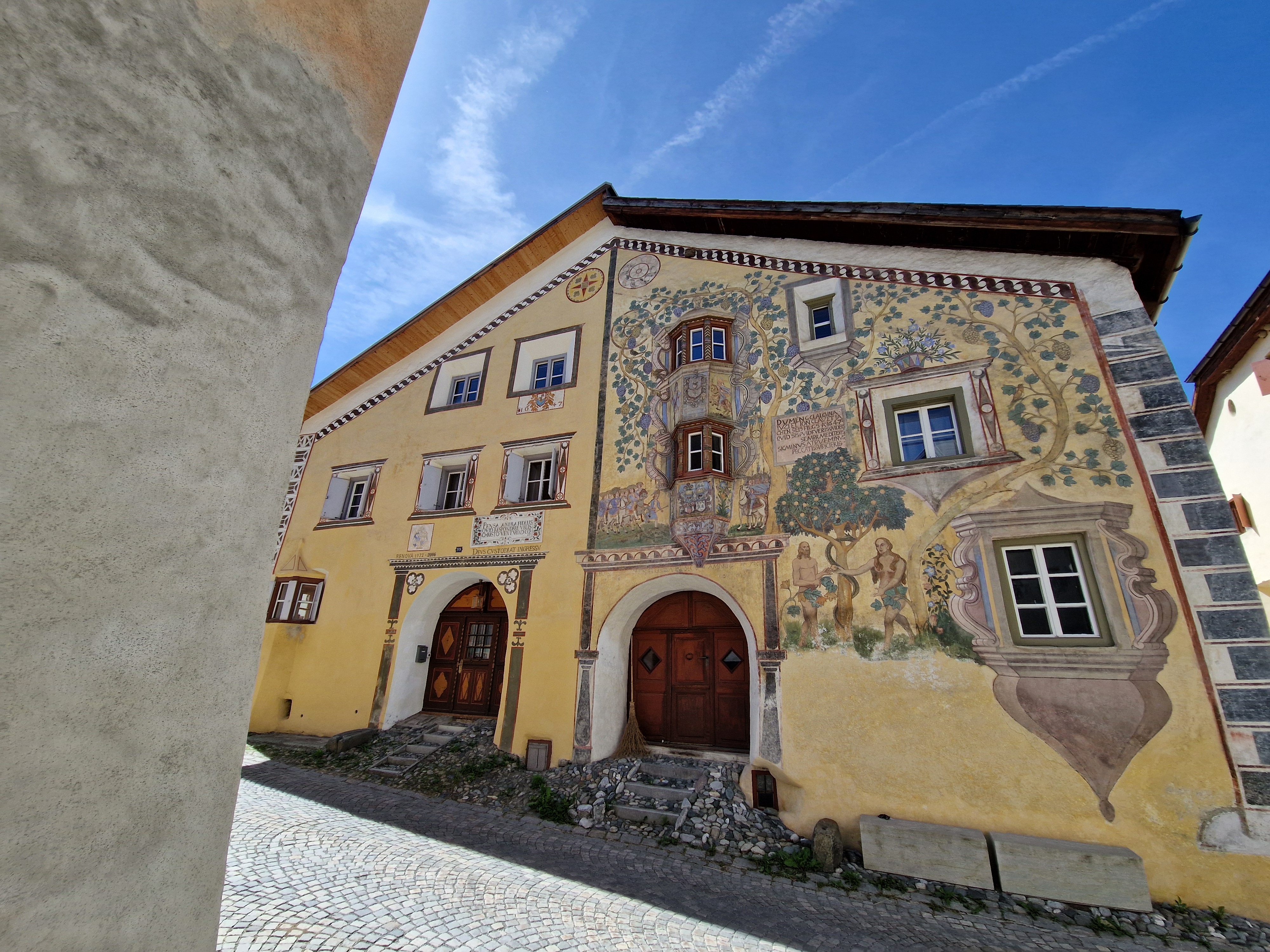
The basic technique for architectural features is to plaster the façade with the base colour; once that has set, it is then plastered with a contrasting colour; once that has set just enough, the scratching, or carving, begins. This is also a technique used in pottery and in creating stained glass effects (just click on the links if you’d like to see how these crafts are made).

One thing to note is that many old buildings here in Switzerland have dates listed on them: Of when they were originally built, and when they’ve been renovated. Part of the history of such renovations may include fires that swept through villages, or avalanches that buried a layer, or wars, such as the Swabian War and war against the Habsburgs, and the subsequent renovation or rebuilding of the towns or individual homes. Sometimes, along with the dates, a list of past and present occupants will also be displayed, preserving their names and memories within the history and changes of the building itself.

Below are a few pictures taken in Engadin during our recent summer holidays. Enjoy! Feel free to zoom in on the pictures to see the details.
5 Comments

Filed under Articles, Etymology, History, History Undusted, How It's Made, Liguistics, Links to External Articles, Military History, Snapshots in History, YouTube Link

History Undusted: Shop Signage

I’m fascinated by a few aspects of architecture in particular, such as doorways, knockers, unusual features such as sundials on the sides of buildings, mural paintings (here in Switzerland, these are sometimes hundreds of years old), and shop signage – you’ll see the latter even in the smallest town here.

This past summer, my husband and I rented a motorhome and travelled mostly in eastern Switzerland. I would say that 90% of my photos were of shop signs! I find that if you focus in on one topic, you’ll begin to see that thing everywhere.

Known as commercial signage or trade signs, such symbols of a shop’s products have been used as far back as ancient Egypt. As many people were illiterate, the pictorial shop sign not only advertised what was for sale in a shop but also distinguished the shops with similar items. By the mid-15th century, English laws even required shops that sold ale to hang a shop sign out; it made inspections of the quality of the ale easier. Some signs were temporary; for instance, if a woman made more ale or bread than her family could consume, she would put out a sign to sell the surplus and thus earn a bit of money. In the narrow streets of medieval towns, signs might be so large as to nearly touch the building on the other side of the lane, and they could become a hazard to passing horsemen or coachmen. By the mid-16th century, regulations were passed to limit the size of signage, and the securing of the sign to the building to avoid it endangering passersby. In Britain, hanging signs were eventually phased out in favour of what were are most familiar with – a flat sign denoting the store along the space above the front windows. But here in Switzerland, shop signage is everywhere – not just old, but also newer additions.

The development of the signs, including elements of guilds or heraldry symbols, led to competition between blacksmiths to create the most elaborate ironwork. The signs evolved from simple displays of ware to symbolic representations of a shop owner’s name or a heraldic connection or patronage of royalty (e.g. a crown). Examples might include shoemakers displaying a shoe or gilt boot, bakeries displaying bread, and haberdasheries displaying a needle and thread or a coat.

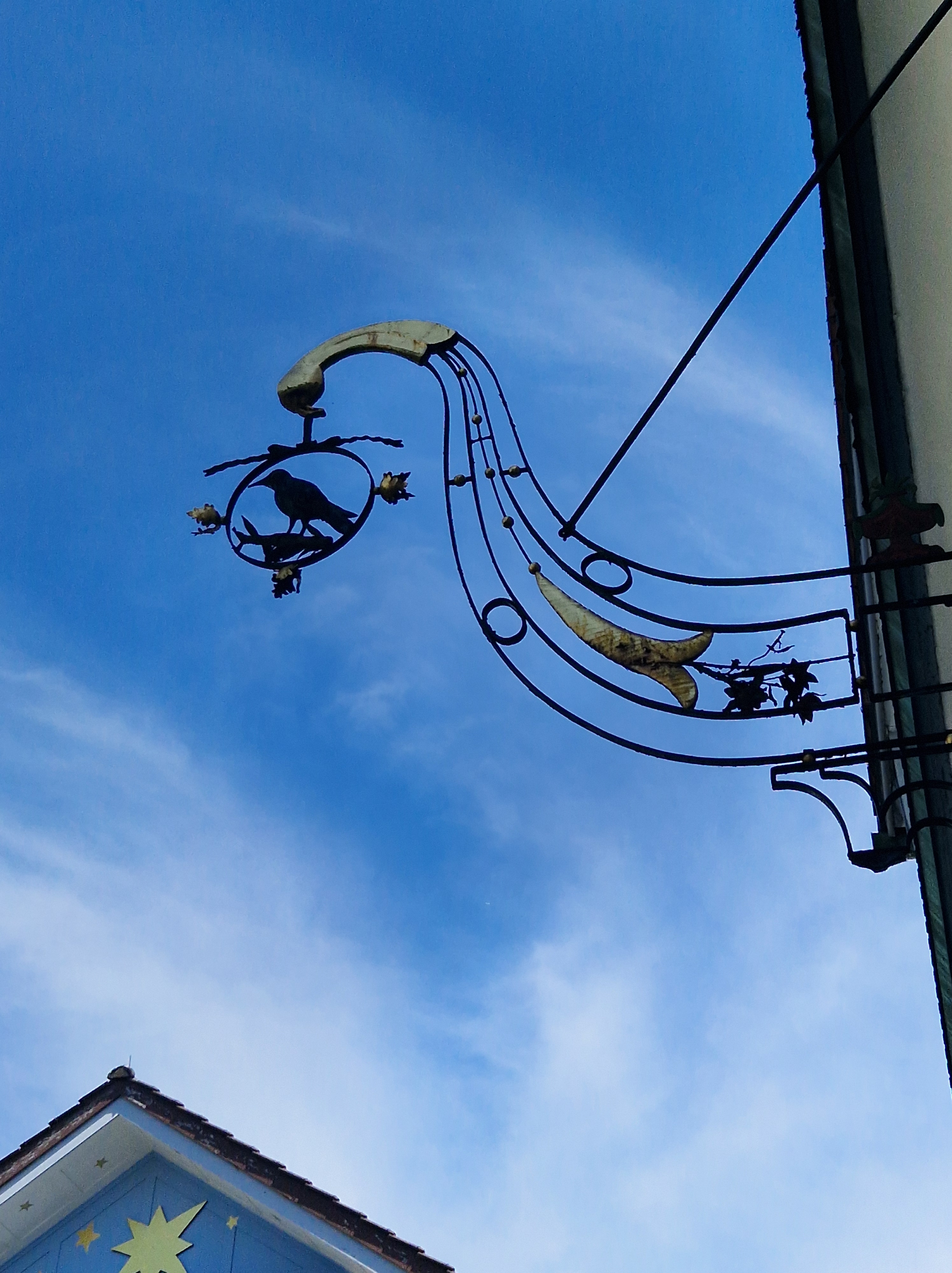
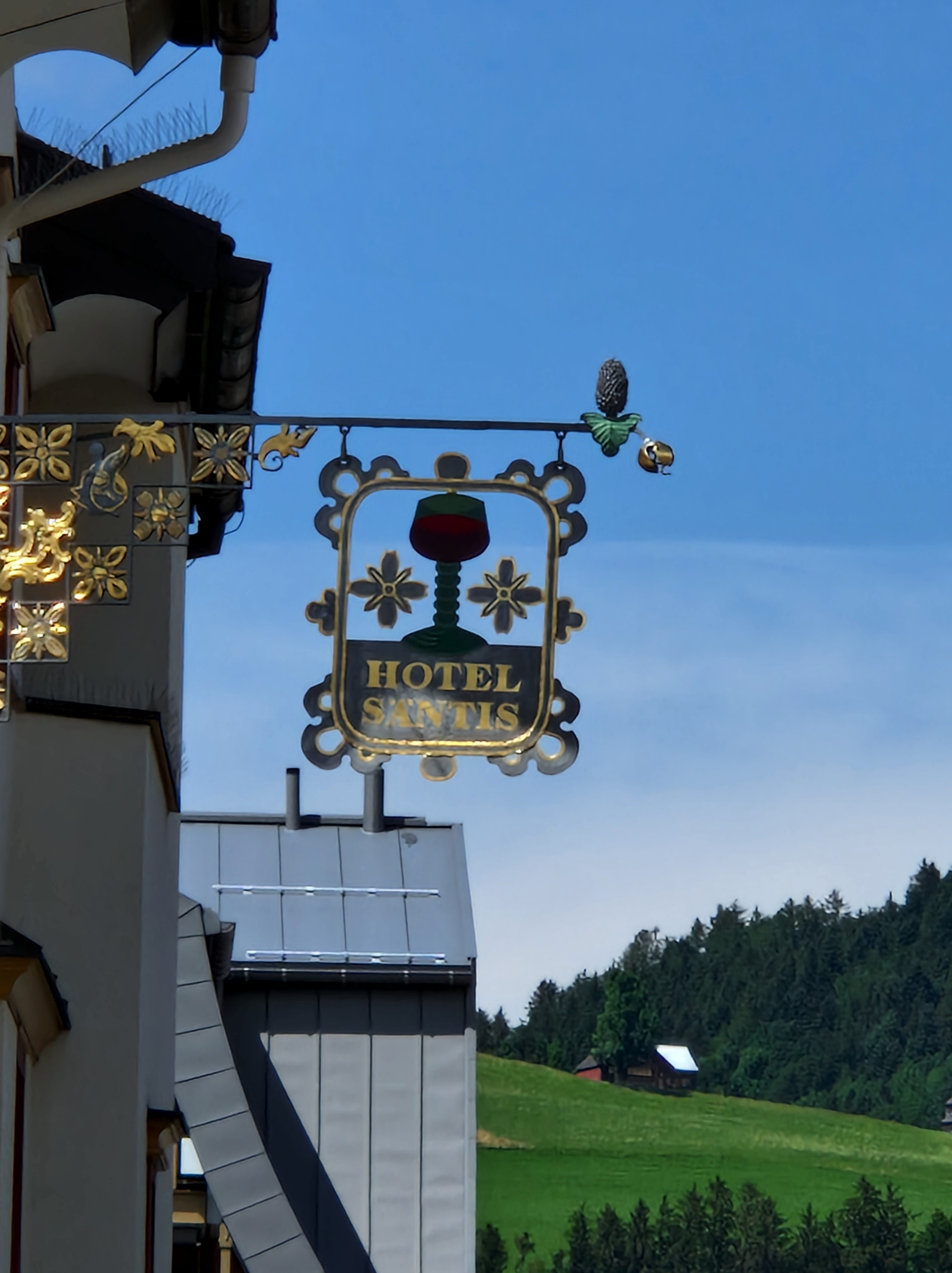
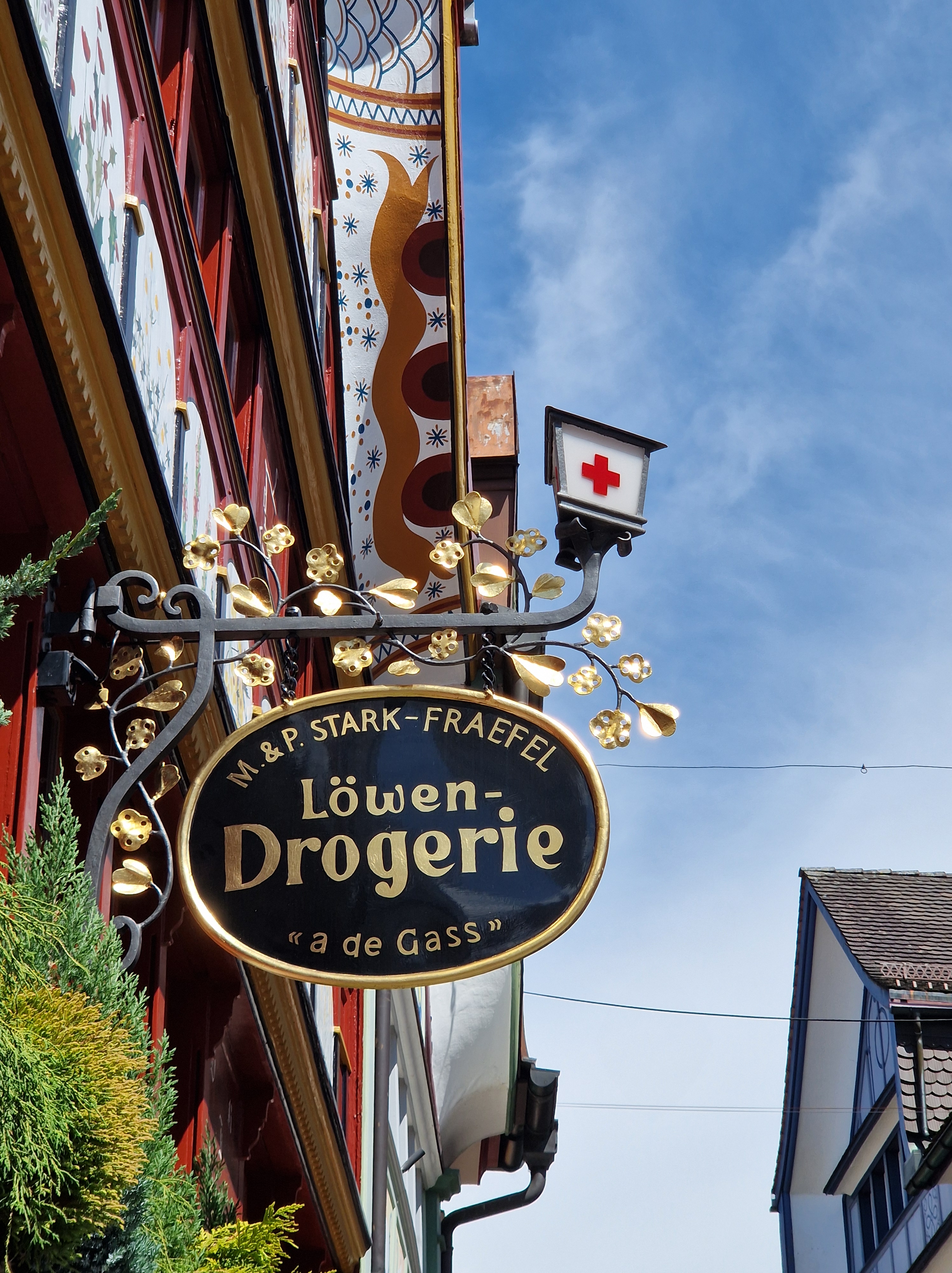
Here is just a fraction of the signs I photographed during our holidays, with brief explanations:

The building from which this sign hangs was built originally in 1664, and renovated to the current form in 1830. It was originally an inn/tavern on one side, and a forge (blacksmith) on the other. The Raven, as a tavern, took its symbol from the legend of St. Meinrad (797-861 AD); he was a hermit who rescued two young ravens from a sparrowhawk and raised them in his hut in the Finstern Wald (dark forest). In 861, he was murdered by two robbers; when they realized what they’d done, they fled to Zürich, but the crows followed them into a tavern and attacked them; the others present thought it unusual, so they took the men captive; they confessed, and were executed. The raven became a symbol of inns along a pilgrimage road; it was sometimes combined with a wine jug and bread.

The Hotel Santis sign has a few symbols: The wine is an obvious reference to a tavern, pub or inn; the pine cone is an interesting addition: It was the symbol of the field sign of the Roman legion stationed in Rhaetia in 15 BC, and hence it is used as a heraldic charge (an emblem on a shield). It may have been included in this sign to proclaim a good place for soldiers to eat or sleep, or as an advertisement that it was protected under a legion or unit of the military at a time when such protection would have been welcome. The bell symbolized a pilgrimage or an invocation of guardian angels over a premises.

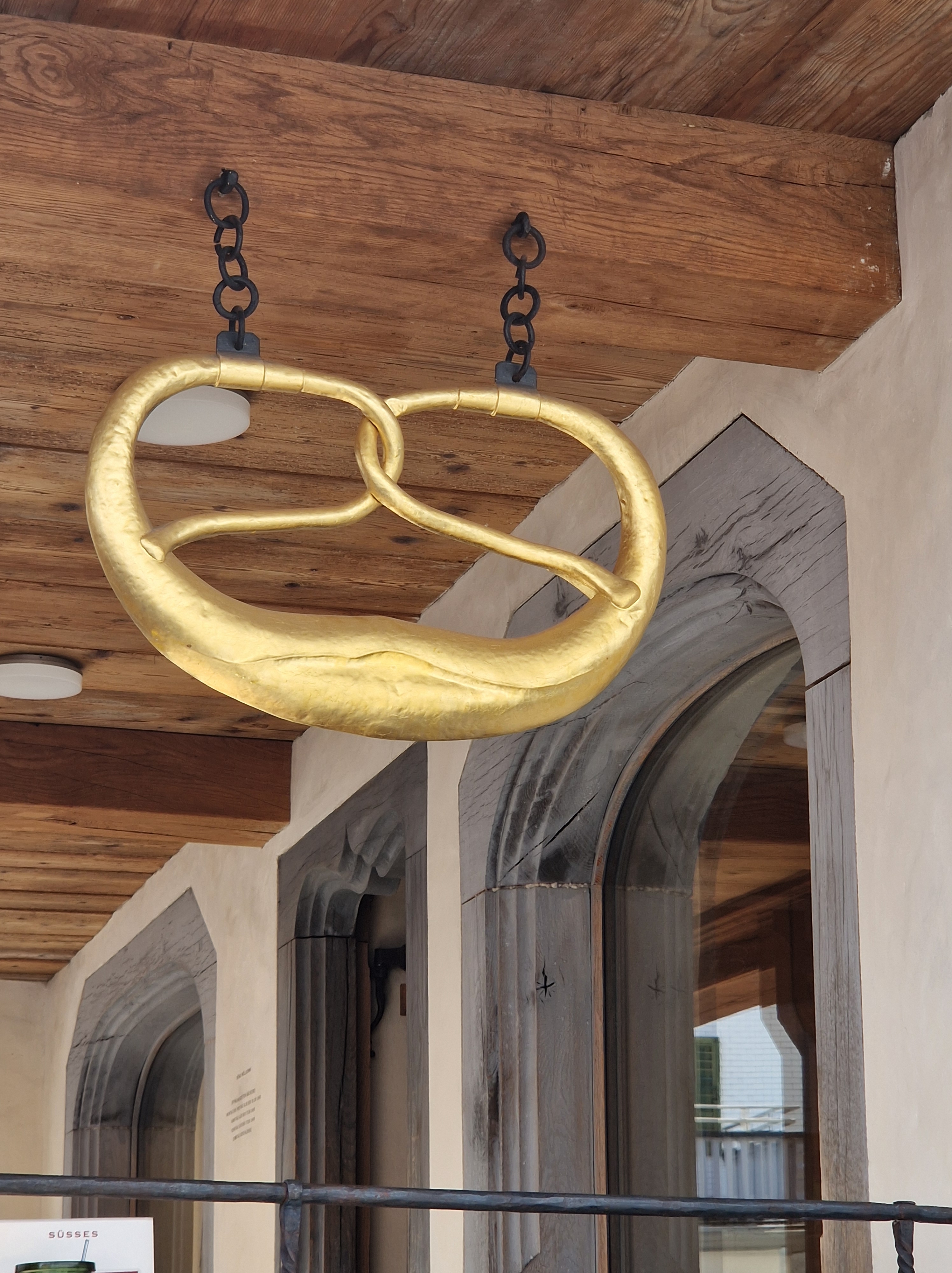
I think this is fairly clear – it’s a bakery!

This building is a pharmacy; the front of the building is a beautiful example of the mural painting I mentioned earlier; these panels represent the herbs and flowers used medicinally. The saying painted toward the right side reads: Vielerlei Kraut gegen Leibesnot, aber kein einzigs wider den Tod (Many herbs against bodily pain, but none against death).

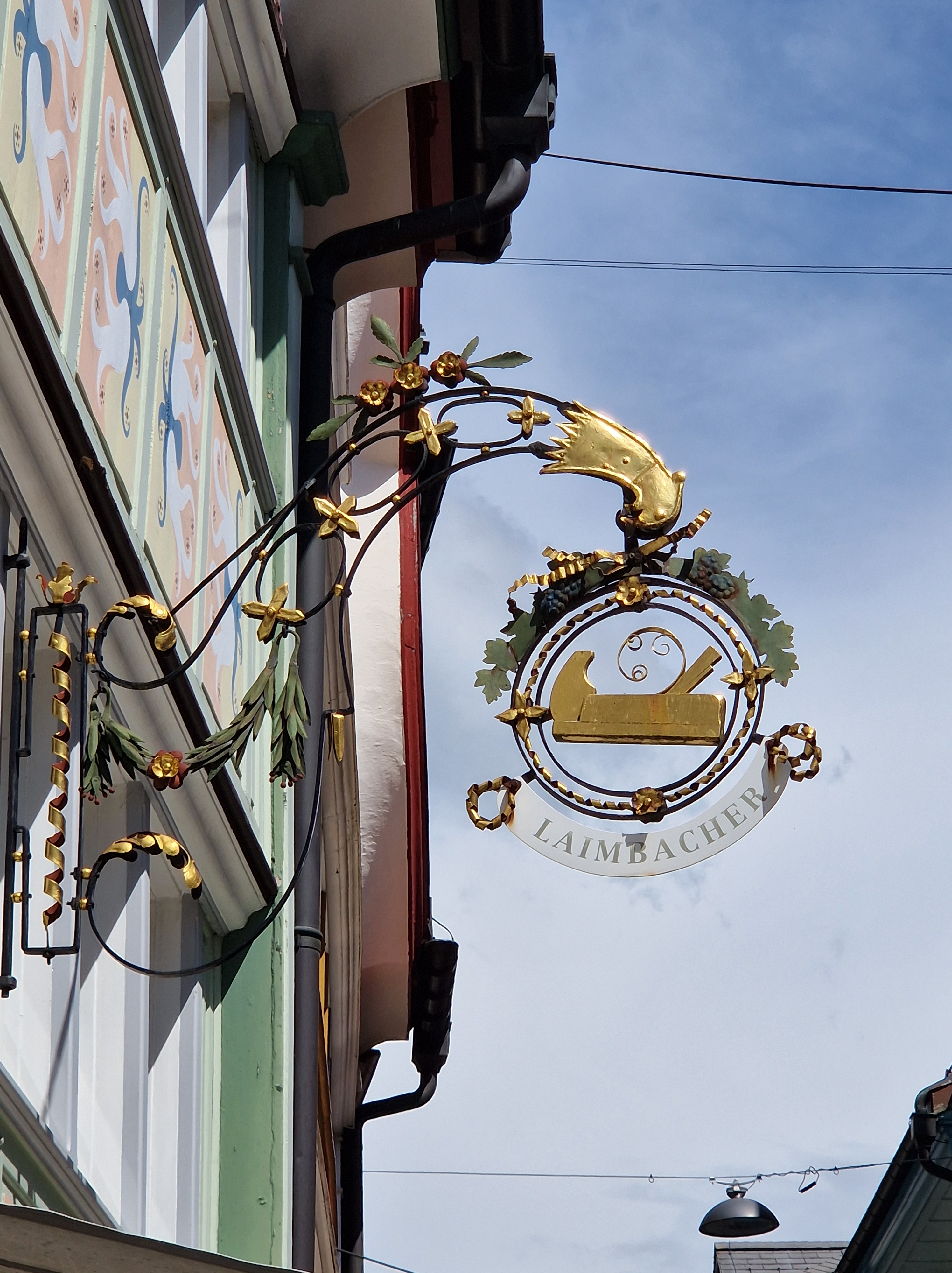
This symbol denotes a carpenter’s shop.

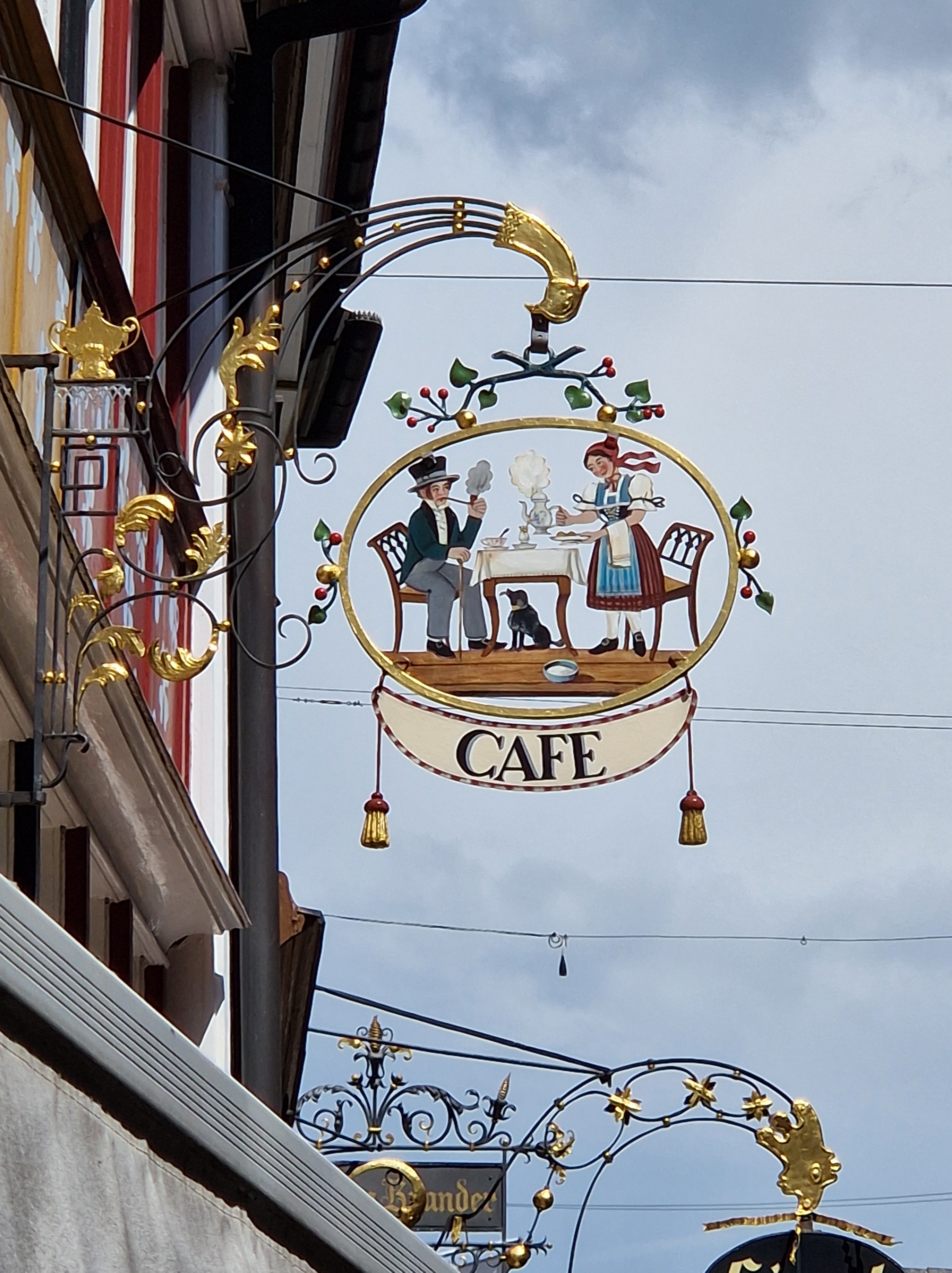
This café sign would be clear from any stagecoach stopping for a break and horse change what could be expected inside. The figures are dressed in traditional Appenzeller clothing.

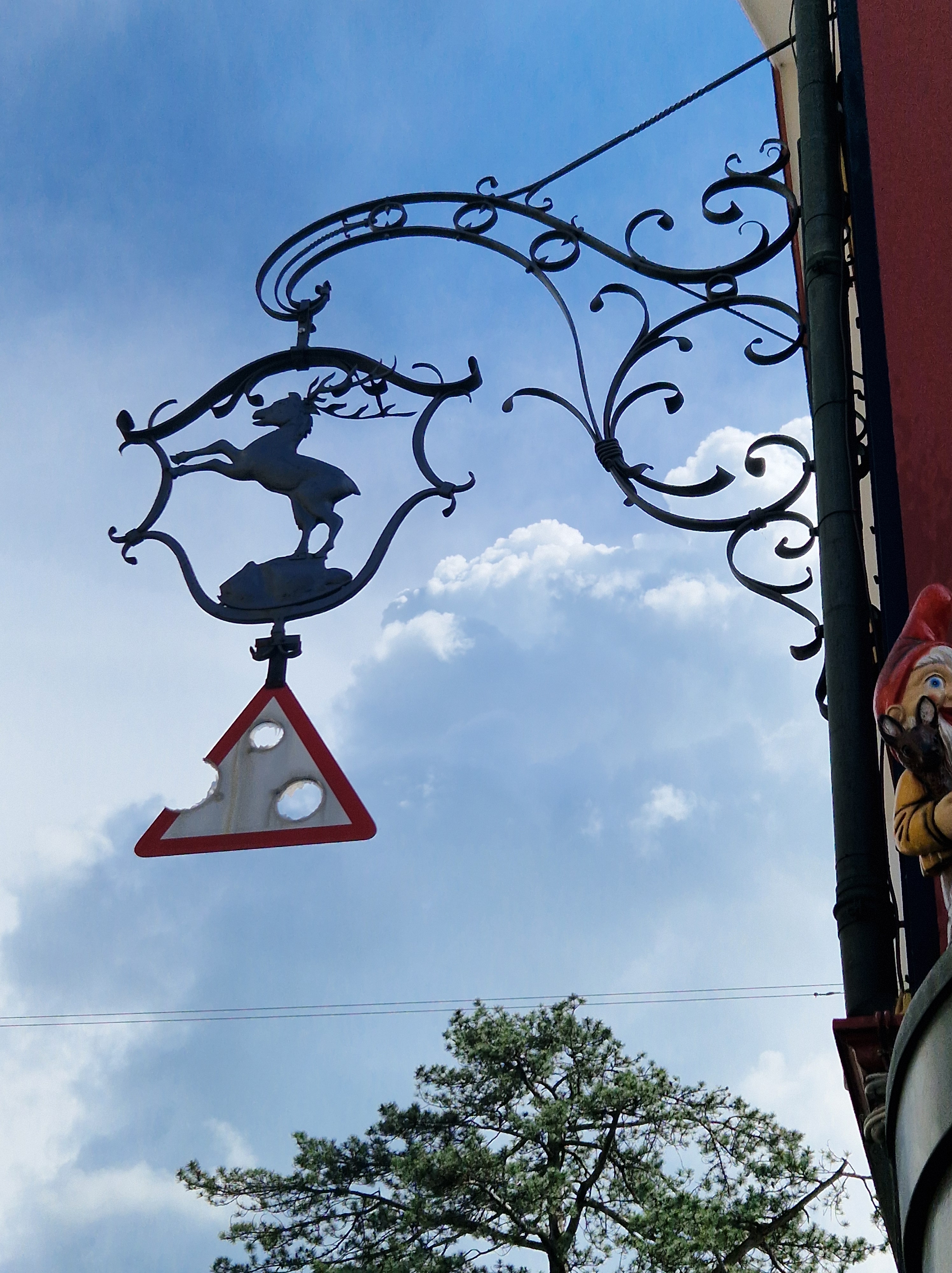
And lastly, here’s a traditional sign with a modern addition: It’s a hunting lodge, or inn that serves wild game meat. Next to it, peeking around the corner, is a figure from a toy shop.

 I hope you enjoyed this little excursion!

10 Comments

Filed under Articles, Etymology, History, History Undusted, Linguistics, Military History, Signs, Snapshots in History, Translations, Virtual Tours

History Undusted: Solothurn, Switzerland

The baroque town of Solothurn, though only an hour away from our home, was unfamiliar to us until my husband and I took a day trip this week. It has a beautiful historical centre and is known as the “city of elevens”: It was the 11th canton to join the Swiss Confederation; there are 11 towers in the fortification walls of the city; there are 11 churches and chapels, and 11 historical fountains throughout the city; the stairs leading up to the St. Ursus Cathedral have landings every 11 steps; the cathedral itself has 11 altars and 11 bells; the local brewery, producing an eponymous beer,  is even called Oeufi – which is a Swiss dialectical word for eleven. 11:00 is the most “auspicious” time to set appointments in the town, and there is even a clock, hanging on the wall of a local bank, which is segmented into 11 hours; it has 11 cogs and 11 bells, which are chimed by a metalwork sculpture of a harlequin on the hours of 11:00, 12:00, 17:00 and 18:00. The bells chime to the tune of the city’s unofficial anthem, the Solothurner Lied.

Solothurn’s history dates back to the palaeolithic era, and its Roman era is dated to around AD 15-25; it was first mentioned in AD 219 as vico saloduro, and may have referred to a Celtic settlement, possibly meaning “Salo’s fort/stronghold”. In the Battle of Sempach, July 1386, the Habsburgs attacked Solothurn; it was a decisive Swiss victory, and even more importantly, it helped to solidify the loosely allied Swiss Confederation cantons into a more unified nation and is seen as a turning point in the growing strength of Switzerland as a nation. Today, it is largely bypassed by tourists due to its proximity to Bern, the Swiss capital, so it remains a hidden gem.

Another interesting clock is the clock tower, the “Zeitglockenturm”, a tower built in 1152 and first mentioned as a “clock tower” in 1406. If you look closely, you’ll see typical rain spouts coming off of the corners of the tower’s spire and roof, shaped like dragon’s heads. The 24-hour astronomical clock was built by Lorenz Liechti and Joachim Habrecht in 1545. The sun and moon hands both run counterclockwise; the moon makes one complete rotation every 27 days, while the sun makes one complete rotation every 365 days.

According to the Roter Turm website, there’s a humorous story connected to the upper, 12-hour clock:  By 1753 the hour hand and the bells were no longer in sync; a commission contacted the watchmaker Niklaus Pfluger, reminding him of his gild’s oath, i.e. his responsibility to correct the clock. He suggested to the local government council that they add a minute hand; but minutes were not so important in the 18th century, apparently – they told him to leave it as it had always been. He took matters into his own hands (I guess it was easier to ask for forgiveness than permission…) and in 1756, he added a minute hand. He justified it as the “warning hand of God” – but he made it smaller, less noticeable than the hour hand, so on this clock, the small hand shows the minutes, not the hours.

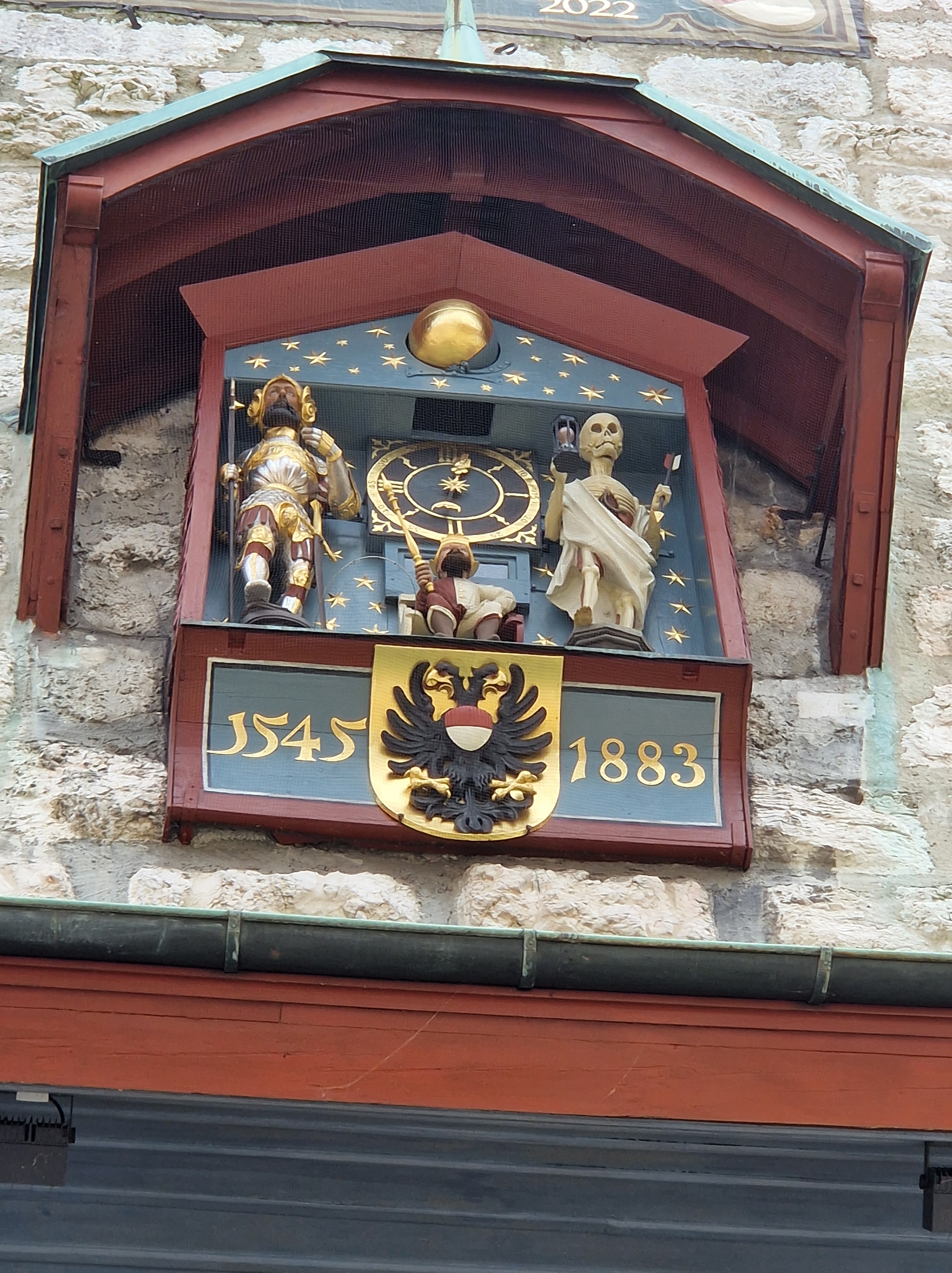
Because the clock tower was built and added to over time, you’ll see four dates on the full image of the tower: 1411 and 2022 on the highest, 12-hour clock; and 1545 and 1883 on the central tableau; the latter dates usually refer to restorations.

The three figures in the central tableau above the clock are a knight, king, and skeleton (Death), which perform every hour: The knight holds a battleaxe in his right hand, and a sword in his left; every quarter-hour, he turns his head toward Death and strikes his breast, signifying his loyalty to the central figure, the king. On the right stands Death; in its right hand is a hourglass, which is turned on the hour, symbolizing the contradictions of life – good, bad, life, death. In the other hand is an arrow, showing that one could be struck down at any moment. On the hour, its head turns toward the knight.

On the throne between these two figures is the king: In his right hand is a sceptre, which he lifts on the hour. His jaw moves in rhythm with the hour hand, and his beard represents wisdom. However, notice that he’s wearing red and white fool’s garb: If the king does not rule with wisdom and the humour of a fool, his reign will become a tyranny. It tells us that life should have moments of both wisdom and a jester’s humour.

While Death announces the hours, the king swings his sceptre. At the same time, Death nods with each stroke and confirms the relentless passing of the hours. The king with his fool’s garb reminds us of the memento mori. When death or illness reigns, even the power of a wise king can do little (Solothurn was hit by the plague, e.g. in 1348). Though the Freudian era banished death from contact with the living in many Western cultures, death personified as a skeleton is still a symbol seen in many countries around the world. Having death constantly before your eyes encourages you to savour each moment of life.

I hope you’ve enjoyed this brief glimpse into a beautiful city with an ancient history!

5 Comments

Filed under Articles, Etymology, History, History Undusted, Links to External Articles, Space, Astronomy