Category Archives: Articles

SWOT Analysis in Fiction

Writing fiction often brings the writer to a crossroads:  Should I take my character(s) down this road or that?  Will they decide this or that, and what will the consequences of either choice or decision be?  Which would fit best into my plot?  All of these questions can be answered by applying a corporate business tool called the SWOT analysis chart.  I have this baby hung on a magnet strip near my desk, along with other prompts such as the sensory image, and I apply it frequently.  Just last week I faced a crossroads:  Would A) my character run away, or would B) another character (or C) take her away?  On the latter question, I had another two options (thus, B & C); I needed the SWOT.

SWOT Analysis Chart, Watermark

This image shows you the variables of each option; internal vs. external influences or attributes of a situation or choice; helpful vs. harmful in reaching the character’s goals, or the consequences of the choices laid before you.  What are the Strengths, Weaknesses, Opportunities and Threats of each path at your character’s feet?

I’ll give you the example of my thought process as I applied it to my historical novel’s fictional situation:  If my character ran away (A) , the strength would be that she would be taking her destiny into her own hands – it’s what you want your main character to do; the threat would be that such an action might raise assumptions that would damage her reputation (was she pregnant?).  The opportunity of doing things in her own timing was overshadowed by the weakness of practicalities:  How would she, without support, get from her family’s estate to Portsmouth, at least a good half-day’s journey by carriage?  If the “B” character (her mother) took her to Portsmouth, the main character would be passive in the decision – the action would happen to her rather than her controlling or causing it.  The opportunity of solving the weakness of “A” by giving her a ride to Portsmouth was a strong incentive, but would raise a bigger threat in that it might seem like the mother was being just as manipulative as the father, forcing the main character into making a choice to suit the mother, which wasn’t the case.  If “C”, her future husband, came to sweep her away from the problems at home, again it would seem that the main female character wasn’t strong on her own two feet, or was too pliable and passive.

I took each scenario through the SWOT rigorously, and in the end I decided – well, when the book comes out next year, you can find out for yourself!

Applying such tools helps you focus your energies on finding solutions, rather than finding yourself stuck in writer’s block.

6 Comments

Filed under Articles, Images, Nuts & Bolts, Plot Thots & Profiles, Research, Writing Exercise

Two Essentials on Every Blog in WordPress Land

I love looking at other blogs – it gives me a window into another culture, another mind, another lifestyle and another perspective.  I also like to click on the Gravatars of others who’ve “liked” the same article, to see what like-minds have to offer.  In doing so, I’ve repeatedly come across Gravatars & blogs that have two essentials missing:  Blog links, and “Like” buttons.

Everyone who’s got a WordPress site has a Gravatar; on the Gravatar you’ve got the opportunity to put a link to your blog(s), your Twitter account, Facebook, Pinterest, or any other link you’d like to connect to one face, one place.  Think of it as a virtual pin board, or bulletin board.  If you’ve got a blog, that’s the place to have a link!

To the right of this blog page, you see the example of my own Gravatar:  A photo of moi, my Gravatar’s name and a brief description, followed by a list of my personal links – some are to my other three blogs, and my Amazon Author’s Page, as well as my Pinterest board.  I’ve never twittered, and maintaining a public Facebook page on top of four blogs plus a writer’s forum on another website was too much of a time-eating monster… I’d rather be working on my next novel’s manuscript!

I’ll explain how to get what you need, as sometimes it’s helpful – I’m sure a lot of you know more about finding your way around cyberspace than I do, but sharing knowledge is what makes connecting with others enjoyable!

gravatar-logo-512To add a link to your Gravatar:

On your blog, click on your Gravatar’s name (just under the Gravatar photo on your blog, if you’ve got that set up; if not, click on your chosen image at the top right of your screen’s bar – that will take you to the reader, where you should see the name in blue).  Once you’re signed in through WordPress, below the Gravatar’s name you should see the options “Edit My Profile” and “Hide My Profile”.  Click on Edit; on the new screen to the right you will see a list; chose “Websites”.  On the new screen, you can add a new website by copying and pasting the URL after clicking either of the “Add Website” options.  Be sure to title it too.

One more thought:  Don’t leave a generic image as your Gravatar’s face; put something that represents you, whether a photo of you or your cat or a flower – it’s a lot more attractive, individualized, and says something about the person behind the words.

Web

To add a Like button:

Go to your blog’s main page, and hover over “My Sites” in the top left corner; one from the bottom you should see “Settings”; click on that.  From this new screen, in the last section on the left you should see “sharing”.  Here you should be able to add a like option.

I’m not certain this is correct, as I’ve already got the option on all four of my blogs; but it may also depend on which theme you choose for your blog.  If anyone knows how to get the like button up front, please let me know!  If you can’t add like in the way described, you may want to consider changing your blog’s visual theme (different themes offer different options).  Your content matters, and people want to let you know!

Also, when adding a new post, make certain that you’ve ticked on the “Likes and Shares” (in the left-hand side bar).

Just one more thought:  Be aware of how colour schemes affect the reader:  If you’ve got a bright background and clashing font colours, it’s just plain irritating, and will likely drive more people from than to your blog.  Choose colour combinations that are easy on the eye, which makes them much more attractive to read.

Please tell me in the comments below how you’ve experienced these points, and if you have any tips on improving the layouts and function of blogs!

16 Comments

Filed under Articles, Nuts & Bolts

Tricks for Writing Dialogue

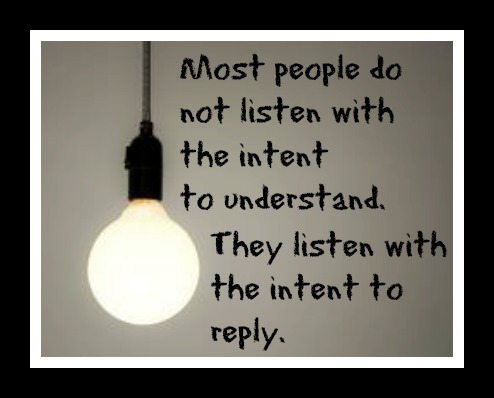
Listen, RespondI recently listened to a Ted Talk by British psychologist Elizabeth Stokoe, who analyses patterns, rhythms and wording in conversations. From her talk, I distilled a few interesting points that could be applied when writing a dialogue for fiction, and I’d like to share them with you:

  1. Are you willing?  If a person is given a sense of control or authority in the situation, they’re far more likely to cooperate.  If you ask, “Do you want this service / action to happen?” you may draw a blank response; but if you ask that person, “Would you be willing to receive this service / be willing to see X happen?” you’re more likely to get a positive response.
  2. How did you…?  When you want to find out particular information from a person, how and when you ask for that information in the course of a conversation / dialogue greatly decreases or increases your chances of getting a positive response / reply.  If rapport is first established, they are much more willing to reply.
  3. Why did you / were you…?  If an open-ended question is asked, target information may not come; but if a target-specific question is asked non-confrontationally, the desired information is more certain.  “Why did you do X?” or “Where have you been?” are both confrontational, and the reaction will likely be evasive or defensive.  But if you instead say, “I was wondering what your reasons for doing X were… could you explain?” or “I tried to reach you earlier, and was wondering where you were”, these are more likely to get a more positive response, or to solicit the information you’re searching for.
  4. Any or Some?  “Any” tends to elicit a negative response or a refusal, while “some” invites a more positive response.  A simple example is, “Would you like any tea?” – this implies an unwillingness or a reluctance on the speaker’s part to provide, whereas, “Would you like some tea?” implies the assumption of a positive response, and is thus more likely to solicit an affirmative response.  In both cases the person asked may want tea, but would be unwilling to coerce the one offering if they have the impression that the offer is made unwilling through the use of “any”.

When applying these ideas to writing a dialogue, a positive application will move your characters closer to a solution or resolution, whereas the negative application will lead them more toward miscommunication and conflict; depending on what you need to happen, you choose which way the dialogue takes your characters, and thus your readers.

Keep writing!

Leave a comment

Filed under Articles, Nuts & Bolts, Writing Exercise

Singularity vs. Anomaly

On our recent holiday in Scotland, my husband and I discussed the difference between singularity and anomaly; specifically, we were trying to decide whether we would call the Corryvreckan one or the other (as one does).

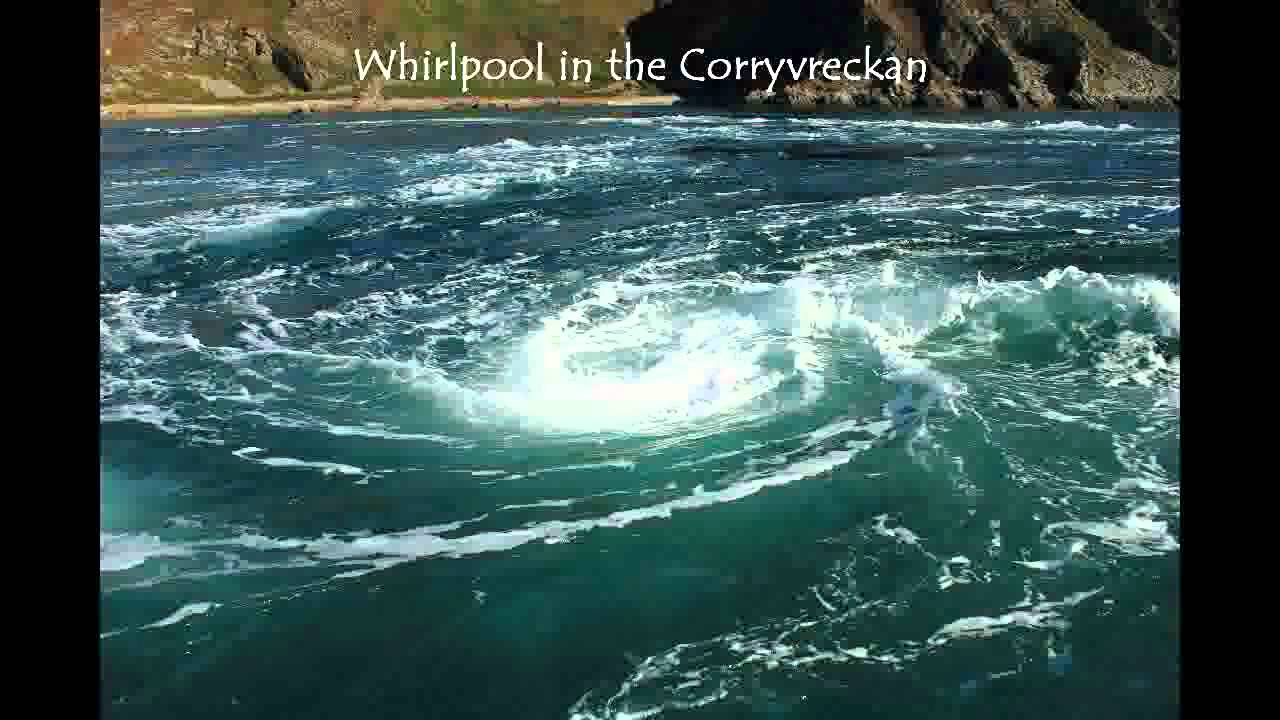
Corryvreckan WhirlpoolThe Corryvreckan, which is the strait between the isles of Jura and Scarba off the West Coast of Scotland, contains the world’s third largest whirlpool (following the Saltstraumen off of Norway, and the Moskstraumen, also off Norway), and is considered by many as the most dangerous scuba dive in the UK (there’s only a few minutes’ safe diving time there; when your bubbles start to go down, not up, you’ve overstayed your welcome).  Planted underwater in the middle of the strait is a giant pinnacle of basalt (the same rock that created the Scottish Isle of Staffa, and the Giant’s Causeway in Ireland); its position means that when tides flow in or out, they end up being churned into a broiling mass of suck-ships-under sea.

The name of Corryvreckan comes from the Gaelic Coire Bhreacain – “Cauldron of the Plaid”, and is connected with a myth of Cailleach Bheur, an old hag who was said to stir the waters of the strait in order to wash her plaid.  The English word whirlpool comes from Old English wirfelmere; in German this word paints the image of rolling dice (Würfel) on the ocean (Meer).  Harmlessly small swirling vortices of water are known as whirlpools, and you can see them when you drain a sink or flush a loo. But the more appropriate word for the ship-eating monster-vortices is the Norwegian word Maelstrom; since they have several of the largest, most dangerous ones, I think it’s only fair that they get to name them.

Now, is it a singularity or an anomaly?

Singularity:  “Anything singular, rare, or curious; the state of being singular, distinct, peculiar, uncommon or unusual.”

Anomaly:  “Something or someone that is strange or unusual; any event or measurement that is out of the ordinary regardless of whether it is exceptional or not.”

Our debate on which word to apply to the Corryvreckan is a tie, I think.  While it’s not singular as far as being the only maelstrom in the world, it is distinct, unusual and extraordinary; it’s an anomaly in the geological and topographical sense, which gives it its power and dangerous currents.  If you ever decide to check it out, don’t do it without a local guide unless you’re insane; if you are insane, enjoy washing your clothes with Cailleach Bheur.

6 Comments

Filed under Articles, History, Research

I got Staffa’d

If you’ve wondered why my last post was over a month ago, it’s because when I go on holiday I do just that – I take leave of life, of schedules, of obligations and responsibilities.  Now that I’m back, I thought I’d share some of my experiences.

They say you should write what you know; after our recent holidays to Scotland, I can now add to my arsenal that of being badly injured on a remote, uninhabited island!

DSCN5357 - The Isle of Staffa, from Ship

The Isle of Staffa

If you’ve never heard of the small Isle of Staffa, you don’t know what you’ve been missing:  Made of basalt columns, the island and its outcrops rise out of the Atlantic in an otherworldly fashion.  For hundreds of years tourists have been going to see this phenomenon of nature, and in  1829 it even inspired Felix Mendelssohn’s Hebrides Overture (Fingal’s Cave).  Fingal is the figure in the legend connecting Staffa with the same geology in Ireland known as the Giant’s Causeway:  The legend is that Fingal was a Gaelic giant who had a feud with an Ulster giant; in order to fight Fingal, the Ulster giant built a causeway between Ireland and Scotland.  Irish tales differ to Scottish as to how the causeway was destroyed, but only the two ends remained – one at Staffa and the other in Antrim, Northern Ireland.  Other famous visitors to the island include Jules Verne, Sir Walter Scott, Robert Louis Stevenson, Queen Victoria and Alfred, Lord Tennyson.

Now to my own experience:  My husband Stefan and I were on the Isle of Mull off of the west coast of Scotland; we left our motor home there for the day and took a small boat, along with about thirty other hearty souls, on a 50-minute ride across open ocean to Staffa.  It is never guaranteed that the boats can actually land on the island, but on the day we took the excursion the weather was perfect, and the sea was as calm as open sea can be without the doldrums.

A larger ship than ours, boarding passengers at Staffa Pier.

A larger ship than ours, boarding passengers at Staffa Pier.

To get to the stone pier on Staffa, here’s how it’s done:  The captain of the boat waits outside of the jagged basalt outcrops jutting out from the island until a wave swells large enough to heave the boat in; then he revs the engine and speeds up to the pier on the lift of the wave.  From there, passengers are gradually handed off one at a time whenever the boat and the pier are relatively even between the swell of waves.  This same process is repeated to reload passengers, and the same at the pier of Mull (without the jagged rocks).

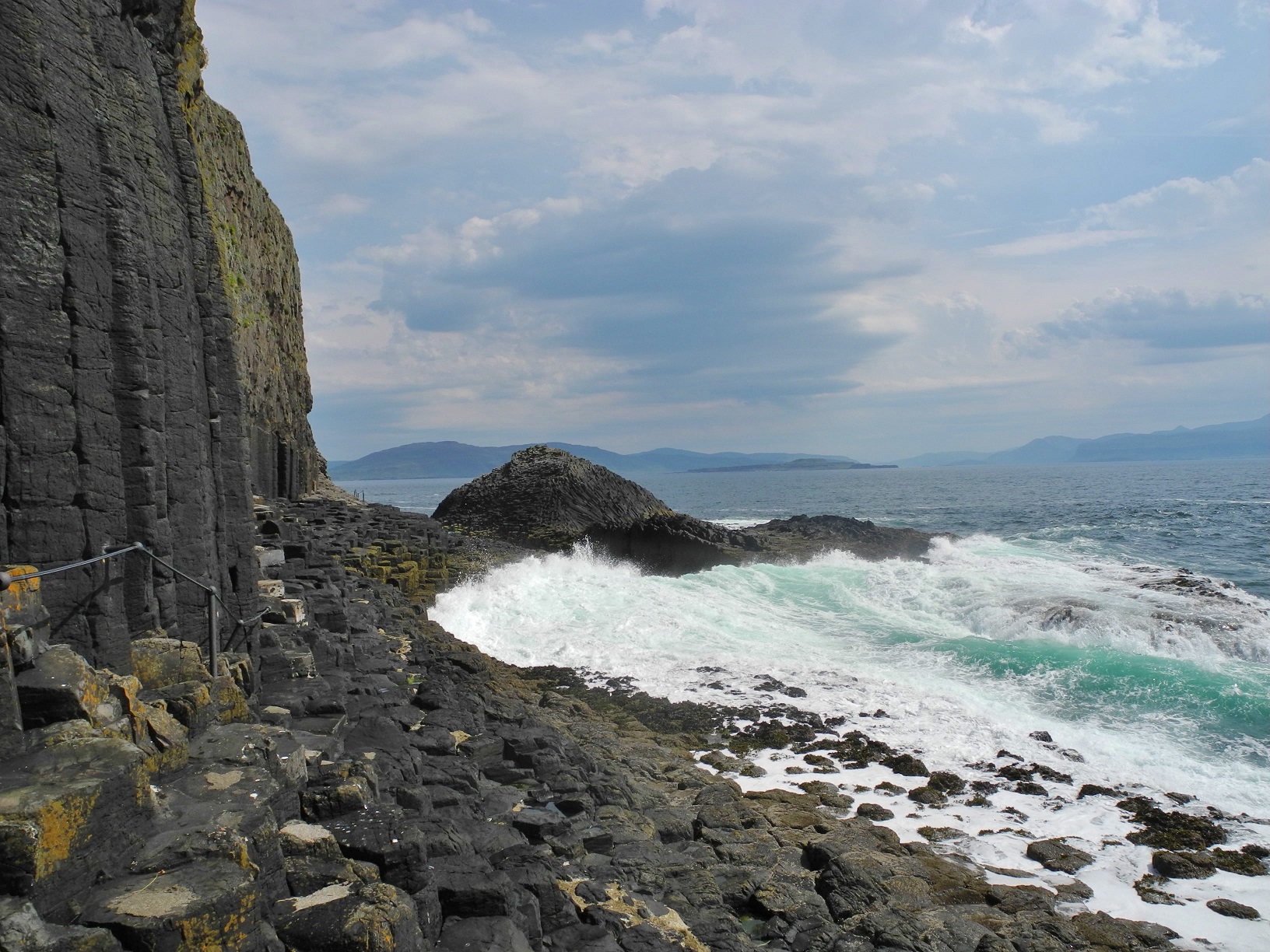
We landed safely and were walking, carefully watching each step on the uneven hexagonal basalt columns, toward Fingal’s Cave; I was literally thirty steps from the cave when my left ankle turned on a column that was apparently split, though the two surfaces were not visible on the black stones due to the angle of the sun.  Turned, as in dislocated… as in the foot was completely sideways at an angle one should never have to see one’s own foot!  I grabbed for the railing to keep from falling and swung myself to sit on a taller column; Stefan was right there, and I told him to “grab my ankle and wrench it back into place!”  Fortunately he didn’t stop to think about it – he just did it!  I could feel that it wasn’t broken, but it wasn’t going to be happy with me either.

Just passing us on their way back from the cave were a Canadian fire fighter’s wife and her adult son; she knew first aid and went into immediate action, having us pour cold water on my sock to keep it soaked and cold since we had no ice pack; she also gave me strong Tylenol and some extra to keep the pain and swelling in check.  I think my husband was in a bit of shock at what had just happened; I asked him to go on to the cave and take photos since I wouldn’t make it… it was also a way of giving him time to adjust, and to let him know that I wasn’t seriously injured, though I only thought of those reasons later.  The woman and her son helped me back to the stone pier; what had taken me five minutes to walk took twenty minutes back.  Now, remember how they landed the boat and disembarked passengers?  Do that with one foot.  Twice.

DSCN5386 - The Isle of Staffa

A bit of surf

The boat crew called the doctor on Mull, and he met us at his practice (once we manoeuvred the motor home up the single-track roads there).  Without an x-ray machine he couldn’t tell if it was broken; perhaps hairline fractured.  If that were the case, either way I’d just need to keep my foot elevated; a compression tube sock was my only new wardrobe accessory.  When we got out to have lunch in a pub at Fionnphort (the port for excursions), the waitress asked what happened and then said, “Let me guess:  Staffa?”  Thus, apparently, I can be added to a long list of injured tourists who got Staffa’d.

The blessing in disguise of it happening only a few days into our holidays was that I had two weeks of forced inaction to elevate my foot; thanks to the “brilliant” NHS system of Britain, it was impossible to get a pair of crutches that might have enabled me to leave the motor home (in Switzerland, one stop at the pharmacy got me rented crutches), so I got to see Scotland from the inside of the ‘home!  It wasn’t our first trip there, and certainly won’t be our last, so I didn’t miss a once-in-a-lifetime trip; and my attitude is that complaining about lost opportunities is simply a waste of time and energy – the situation was what it was, and we made the best of it.  My husband became my eyes and ears outside of the ‘home, and when he was out on hikes and excursions I got a lot of reading and writing toward my next novel done!  I still have a month to go of behaving myself – no dancing, hiking, or even driving a car – so I guess I’ll have a lot more time to read and write! (PS – That month turned into four months… and then six months.)

14 Comments

Filed under Articles

The Glorious Chaos of English

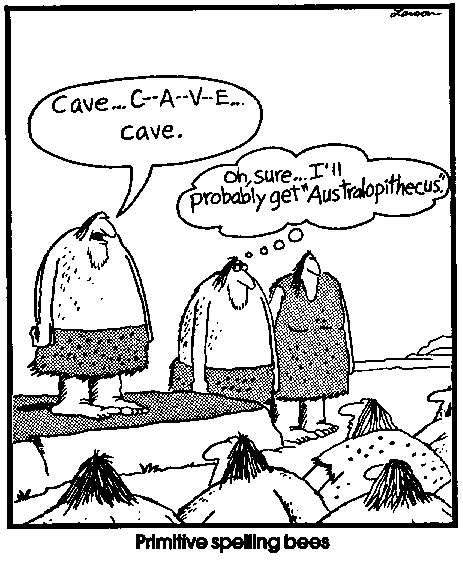
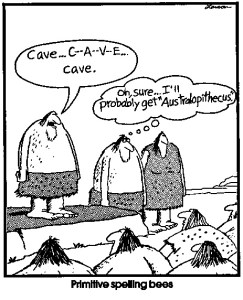
Primative Spelling BeesEnglish, in many ways, is one of the simplest languages to learn quickly and in which to converse fluently; but scratching below the surface one rapidly finds incongruities.  As a teacher for English as a foreign language for adults (TEFLA), I was frequently confronted with the challenges of teaching students to spell and pronounce words correctly, but I was also comforted by the fact that English nouns only come with four possible preceding cases, or articles (a, an, the, and none), rather than, say, German, in which each noun has a nominative, genative, dative or accusative, singular or plural form of their case; or Finnish, which has a whopping 15 cases.

The Chaos, a poem written by the Dutch traveller & teacher,  Gerard Nolst Trenité (1870–1946), gives ~800 examples of irregular spelling.  In general one can say that there are spelling “rules”, but English, in all its historic complexities of absorbing, digesting and recycling influences from conquerors, enemies, travelling companions and allies, seems designed to say “rules can and will be broken”.  I would never give his last advice to anyone – but after reading this poem, you’ll understand that English needs tenacity and constant practice to use well!

The Chaos

by G. Nolst Trenite’ a.k.a. “Charivarius” 1870 – 1946

Dearest creature in creation

Studying English pronunciation,

I will teach you in my verse

Sounds like corpse, corps, horse and worse

I will keep you, Susy, busy,

Make your head with heat grow dizzy.

Tear in eye your dress you’ll tear,

So shall I! Oh, hear my prayer,

Pray, console your loving poet,

Make my coat look new, dear, sew it!

Just compare heart, beard and heard,

Dies and diet, lord and word,

Sword and sward, retain and Britain.

(Mind the latter, how it’s written).

Made has not the sound of bade,

Say said, pay-paid, laid, but plaid.

Now I surely will not plague you

With such words as vague and ague,

But be careful how you speak,

Say break, steak, but bleak and streak.

Previous, precious, fuchsia, via,

Pipe, snipe, recipe and choir,

Cloven, oven, how and low,

Script, receipt, shoe, poem, toe.

Hear me say, devoid of trickery:

Daughter, laughter and Terpsichore,

Typhoid, measles, topsails, aisles.

Exiles, similes, reviles.

Wholly, holly, signal, signing.

Thames, examining, combining

Scholar, vicar, and cigar,

Solar, mica, war, and far.

From “desire”: desirable–admirable from “admire.”

Lumber, plumber, bier, but brier.

Chatham, brougham, renown, but known.

Knowledge, done, but gone and tone,

One, anemone. Balmoral.

Kitchen, lichen, laundry, laurel,

Gertrude, German, wind, and mind.

Scene, Melpomene, mankind,

Tortoise, turquoise, chamois-leather,

Reading, reading, heathen, heather.

This phonetic labyrinth

Gives moss, gross, brook, brooch, ninth, plinth.

Billet does not end like ballet;

Bouquet, wallet, mallet, chalet;

Blood and flood are not like food,

Nor is mould like should and would.

Banquet is not nearly parquet,

Which is said to rime with “darky.”

Viscous, Viscount, load, and broad.

Toward, to forward, to reward.

And your pronunciation’s O.K.,

When you say correctly: croquet.

Rounded, wounded, grieve, and sieve,

Friend and fiend, alive, and live,

Liberty, library, heave, and heaven,

Rachel, ache, moustache, eleven,

We say hallowed, but allowed,

People, leopard, towed, but vowed.

Mark the difference, moreover,

Between mover, plover, Dover,

Leeches, breeches, wise, precise,

Chalice, but police, and lice.

Camel, constable, unstable,

Principle, disciple, label,

Petal, penal, and canal,

Wait, surmise, plait, promise, pal.

Suit, suite, ruin, circuit, conduit,

Rime with “shirk it” and “beyond it.”

But it is not hard to tell,

Why it’s pall, mall, but Pall Mall.

Muscle, muscular, gaol, iron,

Timber, climber, bullion, lion,

Worm and storm, chaise, chaos, and chair,

Senator, spectator, mayor,

Ivy, privy, famous, clamour

And enamour rime with hammer.

Pussy, hussy, and possess,

Desert, but dessert, address.

Golf, wolf, countenance, lieutenants.

Hoist, in lieu of flags, left pennants.

River, rival, tomb, bomb, comb,

Doll and roll and some and home.

Stranger does not rime with anger.

Neither does devour with clangour.

Soul, but foul and gaunt but aunt.

Font, front, won’t, want, grand, and grant.

Shoes, goes, does. Now first say: finger.

And then: singer, ginger, linger,

Real, zeal, mauve, gauze, and gauge,

Marriage, foliage, mirage, age.

Query does not rime with very,

Nor does fury sound like bury.

Dost, lost, post; and doth, cloth, loth;

Job, Job; blossom, bosom, oath.

Though the difference seems little,

We say actual, but victual.

Seat, sweat; chaste, caste.; Leigh, eight, height;

Put, nut; granite, and unite.

Reefer does not rime with deafer,

Feoffer does, and zephyr, heifer.

Dull, bull, Geoffrey, George, ate, late,

Hint, pint, Senate, but sedate.

Scenic, Arabic, Pacific,

Science, conscience, scientific,

Tour, but our and succour, four,

Gas, alas, and Arkansas.

Sea, idea, guinea, area,

Psalm, Maria, but malaria,

Youth, south, southern, cleanse and clean,

Doctrine, turpentine, marine.

Compare alien with Italian,

Dandelion with battalion.

Sally with ally, yea, ye,

Eye, I, ay, aye, whey, key, quay.

Say aver, but ever, fever.

Neither, leisure, skein, receiver.

Never guess–it is not safe:

We say calves, valves, half, but Ralph.

Heron, granary, canary,

Crevice and device, and eyrie,

Face but preface, but efface,

Phlegm, phlegmatic, ass, glass, bass.

Large, but target, gin, give, verging,

Ought, out, joust, and scour, but scourging,

Ear but earn, and wear and bear

Do not rime with here, but ere.

Seven is right, but so is even,

Hyphen, roughen, nephew, Stephen,

Monkey, donkey, clerk, and jerk,

Asp, grasp, wasp, and cork and work.

Pronunciation–think of psyche–!

Is a paling, stout and spikey,

Won’t it make you lose your wits,

Writing “groats” and saying “grits”?

It’s a dark abyss or tunnel,

Strewn with stones, like rowlock, gunwale,

Islington and Isle of Wight,

Housewife, verdict, and indict!

Don’t you think so, reader, rather,

Saying lather, bather, father?

Finally: which rimes with “enough”

Though, through, plough, cough, hough, or tough?

Hiccough has the sound of “cup.”

My advice is–give it up!

1 Comment

Filed under Articles, Cartoon, Grammar, Nuts & Bolts, Quotes, Writing Exercise

Mrs Palfrey at the Claremont

Writers love to read; I think there’s also a bit of a movie buff in each one of us!  I like to watch films for the entertainment, but also for the analytical aspects; to see how the plot is built, how characters are developed, how scenes unfold, and which camera angles work best in a particular moment (that translates in writing to the point of view in a given context).

Mrs Palfrey at the Claremont“Mrs Palfrey at the Claremont” (2005) is a beautiful piece of cinematic craft in which characters are explored with a great deal of tenderness, wit and insight.  The film is based on the eponymous book by the English writer Elizabeth Taylor (1912-1975), considered one of the greatest British authors of the twentieth century.  There are a wide range of characters, from the calm and insightful Mrs Palfrey or the spontaneous and warm-hearted honorary grandson, to a collection of oddball characters all staying together in the same London hotel for better or worse, and the great minor characters such as the “bellboy”, the waitress, the ex-girlfriend or the real grandson.

It’s a gem of a film; if you haven’t seen it, consider getting your hands on it to watch!  It’s one to enjoy, and then re-watch and take notes on how it unfolds.  Be inspired, and keep writing!

2 Comments

Filed under Articles, Plot Thots & Profiles

Thoughts From Gibraltar and London

I just returned from a research trip a week ago; after the dust of “coming home” has settled, it’s time to sit down and get to work in earnest on my next novel.  I’m working on the third book in my 18th century historical trilogy, and to be honest, up until this trip I would have rather been working on a different manuscript!  My time away was research into the major section of the book which takes place in the Royal Navy aboard a ship of the line.  Part of the reason I think I’ve had “writer’s block” on this manuscript is that the military aspect of the plot is not my favourite topic to delve into from a writing aspect – I love reading about it, but condensing that down into dialogue and prose is not my forté.  But I know myself:  As with anything, if it’s not my strength I’ll work at it and hone it until it is.

The Cutty Sark 1

The Cutty Sark

A very important thing for me to remember in the midst of the research is that I’m not writing a maritime history book, but a novel; I’ve got to take the research, sift it for the elements that support my plot and leave the rest of the information aside as “nice to know”.  I’ve bought, read and taken notes on dozens of history books focused on the Royal Navy; I spent a day taking in impressions aboard the Cutty Sark (one of the fastest clippers from the days of Sail, on the right), and talking to curators both there and in the Maritime Museum, as well as the British Museum; I spent time on a clipper on the Thames, taking in the sights, sounds, smells, salt spray and tastes of the river.   My hotel was literally just round the corner from the largest used book shop in London (Skoob Books)… a very dangerous thing.  Trust me.  I found some great gems, from a history book on the Seven Years War (exactly in my time period), to a portrait collection of 18th century fashions – invaluable visual aids, with explanations of things like mob caps, waistcoats, etc.  If I’d had more time (and more room in my carry-on-sized luggage), I still would have had to leave hundreds of great books behind…!

Gibraltar - Barbary macaque 2

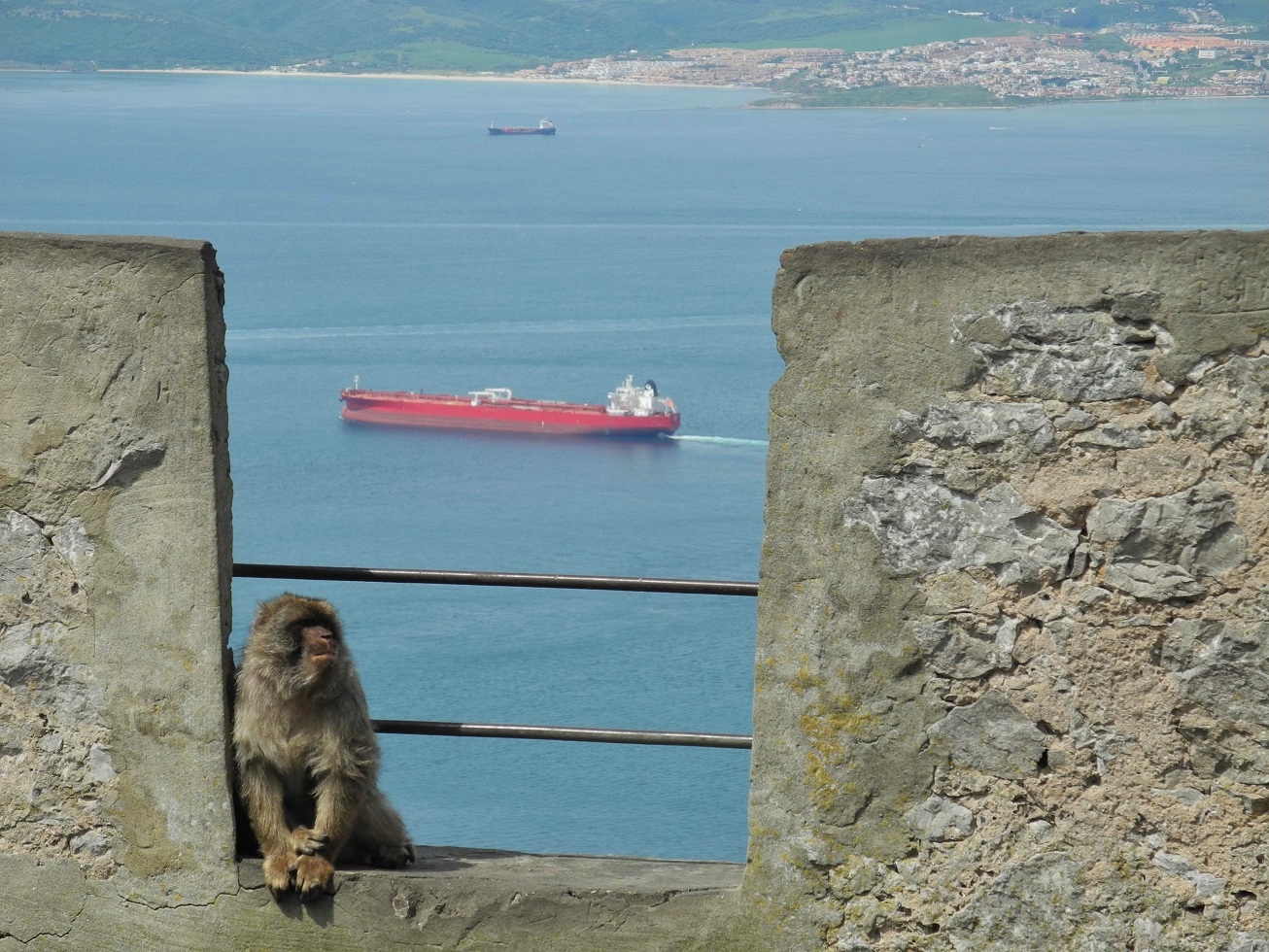
A Barbary Ape, with Spain in the distance.

Gibraltar itself was a special time:  I was there with my husband, who then took off for a 10-day bike ride toward Madrid on the day I flew to London.  Gibraltar was vitally important as a British Naval base for centuries, and you literally cannot walk down any street without being reminded of its military past:  Atop the Rock are the ruins of fortifications; St Michael’s cave was a strategic hideout; in the town are cannons everywhere; ramparts are now part of walled parks, and everywhere there are military street names, town square names, and military ships in the harbour; Spain is a spit away, and Morocco is visible even on a foggy day; it is literally the gateway to the Mediterranean.  Taking a cable car to the top of the Rock you’ll find Barbary Macaque (aka Barbary Apes, though they are tailless monkeys) everywhere; they were originally brought from Africa in the 18th century by British sailors.  A few of them escaped and set up house on the rocky slopes above the town, and now they run the show; tourists are lower down in the pecking order than they are, and if they get half a blink they’ll steal your food if you’re silly enough to take it outside.  They usually stay up on the Rock, but it’s still not wise to leave your hotel window open…

Gibraltar: The War Memorial with a Russian cannon in the foreground.

Gibraltar: The War Memorial with a Russian cannon in the foreground.

So now that I’m back, I’m looking forward to sinking my teeth into this new manuscript!  Sometimes it just helps to get away, get new impressions, percolate ideas, and become inspired.  If you’re stuck on something you’re writing, get out!  Go on a research trip, or if you can’t afford it time- or money-wise, then get out to a park, or somewhere different for a change; take your notebook, and let your mind wander.  You’ll find a way through the block!

Leave a comment

Filed under Articles, History, Research, Writing Exercise

Writing Tips: Dialogue

howtobebritish1Dialogue is (to point out the obvious) vital to a novel; it displays the voices of your characters and helps the reader get to know and care about the characters, understand their motives, their interrelationships, and distinguish each character’s point of view.  If you don’t get the dialogue right, you rip the reader out of the story, or worse – make them put down your novel and add your name to “never again” lists!  So, here are a few pointers and tips to keep in mind as you develop your characters and put words into their mouths:

1) Develop your characters well enough to make their voice distinct; do they have catch-phrases, or local dialects that influence their vocabulary?  Do they tend toward long or short sentences, or are they from a past time and place that had a different way of speaking?  Educate yourself if necessary in various modes of speech .

2) Dialogue is an illusion of conversation; but it’s also about what is not said.  Non-verbal actions reveal:

a) How a character says something

b) What a character chooses not to say, but inadvertantly reveals through actions.

c) Why the character says what they do.

Do they have particular actions when they are upset or aggitated that communicate their moods to the reader?  Do they bounce their knees when excited?  Does their body language confirm or contradict their verbal message?

3)  Fictional dialogue needs to cut to the chase; if there’s no point to the text (revealing motivation, character or plot point), then chop it!

4)  Avoid the trap of using dialogue as exposition (the proverbial villain’s monologue as he prepares to destroy the hero), but rather reveal essential information through action, or narration.

Explore your characters and develop their voices, and above all – keep writing!

Leave a comment

Filed under Articles, Cartoon, Nuts & Bolts, Plot Thots & Profiles, Writing Exercise, Writing Prompt

Archetypes: Aphrodite vs. Dionysus

Throughout literary history, archetypes have been used to help us relate to characters, their stories, the morals of the tale and the paths they choose and why.  Understanding the archetypes helps to figure out how to portray a particular character; it keeps you on the “same page” as you write, as you develop characters, and try to figure out what makes them tick and where that ticking will take you and them.  Today I’d like to take a closer look at Aphrodite and her male counterpart, Dionysus.  I’ll give examples of these characters from films and books, relatable to most whether you like to read or prefer the visual experience of film.

Kim Novak,  Vertigo

Kim Novak, Vertigo

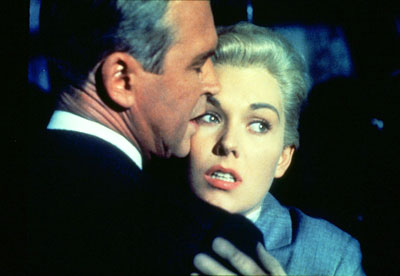
Aphrodite was the Greek goddess of love, pleasure, beauty and procreation.  Like a coin, there are two sides to the character:  The Lover (or seductive muse), and the Femme Fatale.  On the Lover’s side of the coin, there are characters such as Julia Roberts in Pretty Woman, or Ginger on Gilligan’s Island.  The positive side of this character motivates others to improve themselves.  The flip side of that coin are seen in Sharon Stone’s portrayal in Basic Instinct, Kim Novak’s character in Vertigo, or the Bible characters of Salome or Delilah.  On one side you have a character that is nurturing, attractive, seductive and at the core often good, while the Femme Fatale is seductive with often quite dark ulterior motives.  Sean Young’s character in Blade Runner is a good example of the Seductive Muse; she forces Harrison Ford’s character to examine his own sense of humanity by her mere existence.

Mr. Willoughby, in Sense & Sensibility

Mr. Willoughby, in Sense & Sensibility

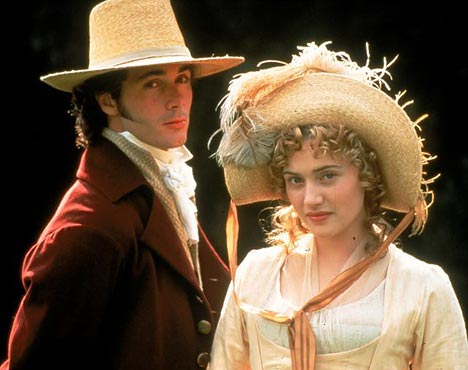
Dionysus is her male counterpart:  His two sides are the Woman’s Man, and the Seducer.  Either way, Dionysus needs women in his life.  He loves women; on the positive side, he loves to make women feel loved.  The flip side is abuse in one form or another, with darker motivations behind his love.  Fifty Shades of Grey is a touchy topic right now; on one hand it’s immensely popular, and on the other very harshly condemned as glorifying abuse, violence and manipulation in the guise of relationship or love.  I tend toward the latter view, as did the main actor in interviews during his junket (he often found himself apologizing to his co-star after their scenes, which speaks volumes about his instincts of what’s right and wrong, and Shades definitely crossed that line for him and for a growing number of critics).  Other examples are Mel Gibson’s character in What Women Want – his character makes the arc from the negative side to the positive; Cary Grant’s character in An Affair to Remember makes a similar arc.  Leo DeCaprio’s Jack in Titanic sits firmly on the positive side of the coin, and makes for a memorable and loved character.  Count Dracula is a typical Seducer, as is Jane Austen’s character of Mr Willoughby in Sense and Sensibility.

There are many other archetypes; if you’d like to know more on the topic, check out Victoria Lynn Schmidt’s 45 Master Characters.

Keep writing!

1 Comment

Filed under Articles, Plot Thots & Profiles, Research, Writing Exercise