Category Archives: Articles

All About Perspective

So much is exhibited to the eye that nothing is left to the imagination.  It sometimes seems almost possible that the modern world might be choked by its own riches, and human faculty dwindle away amid the million inventions that have been introduced to render its exercise unnecessary.  The articles in the quarterlies extend to thirty or more pages, but thirty pages is now too much. So we witness a further condensing process and, we have the fortnightly and the Contemporary which reduce thirty pages to fifteen pages so that you may read a larger number of articles in a shorter time and in a shorter form.  As if this last condensing process were not enough the condensed articles of these periodicals are further condensed by the daily papers, which will give you a summary of the summary of all that has been written about everything.  Those who are dipping into so many subjects and gathering information in a summary and superficial form lose the habit of settling down to great works.  Ephemeral literature is driving out the great classics of the present and the past… hurried reading can never be good reading.” – G.J. Goschen, First Annual Address to the Students, Toynbee Hall, London, 1894

1894.  We tend to think of such times as “the good old days,” when life was slow and time was taken to read, contemplate, and discuss topics at great length.  Compared to now of course, they did; but the time in which we live now will look slow to future generations.  We tend to think that women today tend to be more scantily dressed than 50 years ago, and it’s true; but 100 years ago they thought exactly the same thing of their own time.

Future generations will think it quaint that we had things called “CDs” or “DVDs” (that looked exactly the same but the playing devices were incompatible with one another!) that were physical discs you actually have to put into a machine to hear music or watch a film; or telephones that actually needed electricity, or computers that needed an internet cable, or batteries that needed changing.  Our miniscule cell phones will look as bulky and clumsy to them as ‘80s films’ cell phones do to us now.  Magazine ads from the late ‘60s were more wordy than some full-length newspaper articles today.  Ads today don’t even use words – they have to grab you with an image because you’ve just sped past in your car, on your bike, or in a tram or bus or train.

First passenger railway 1830, Liverpool & Manchester Railway.  Source - Wikipedia

First passenger railway 1830, Liverpool & Manchester Railway

Literature is changing too.  When was the last time you read a tome?  Do you like to enjoy slow reading, like fine cuisine, or do you prefer to read a book in a weekend, and if it will take much longer you’re not as interested?

“With the advent of cheap newspapers and superior means of locomotion… the dreamy quiet old days are over… for men now live and think and work at express speed.  They have their Mercury or Post laid on their breakfast table in the early morning, and if they are too hurried to snatch from it the news during that meal, they carry it off, to be sulkily read as they travel… leaving them no time to talk with the friend who may share the compartment with them… the hurry and bustle of modern life… lacks the quiet and repose of the period when our forefathers, they day’s work done, took their ease…” – William Smith, Morley:  Ancient and Modern, 1886

It’s all about perspective.  So the next time you get impatient, stop and think about those past generations who felt intimidated by the speed of a steam locomotive, and instead be grateful you’re stuck in traffic.
Leave a comment

Filed under Articles, Quotes, Research

That Low-Down Word

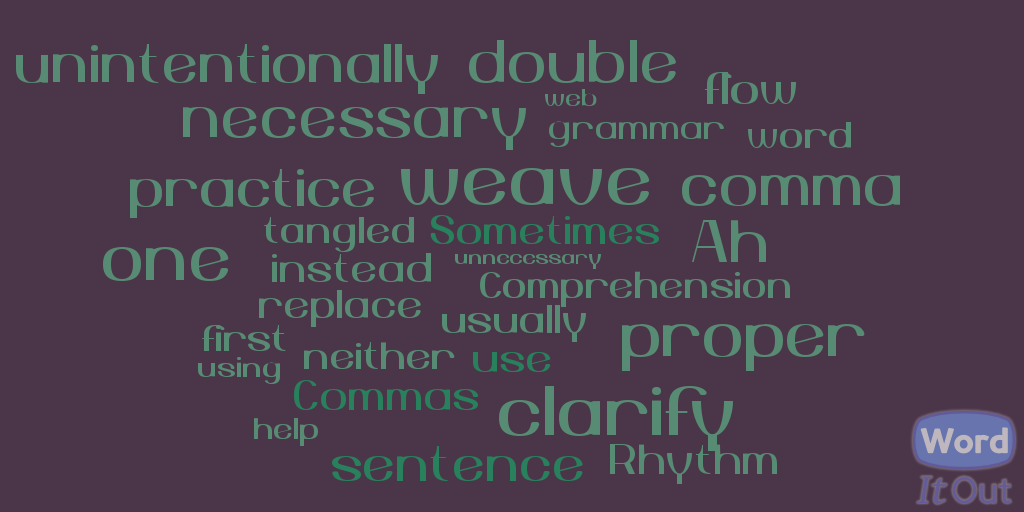
That Word CloudI run a forum on a British writers’ website for grammatical problems, and answer questions that come up in the course of their writing projects.  This week the question came up about that little word, “that” – when to use it and when to lose it.  When do you use that?  When do you use a comma instead?  And when is neither one necessary?  Ah, what a tangled web we weave, when first we practice proper grammar.  Hey, just kidding – it’s not that complicated!  Sometimes it doesn’t matter, and sometimes it can be confusing without it.  So, here’s the low-down:

1) Remember Rhythm:  How does your sentence flow?  Read your sentence aloud; does it have a better rhythm with or without that?  When in doubt and rhythm / comprehension is fine with or without, use it – inclusion may benefit the understanding of the sentence as a whole, and omission may cause misunderstandings.  Sometimes using that is a matter of personal taste.  Here’s a sentence that could be understood with or without:  “Fiona thinks (that) Alistair works too hard.

If you’ve already got a that in the sentence elsewhere, consider how your sentence can be reworded to avoid an overload. A double that is usually unnecessary.  In the sentence, “I realised that that would not be a good idea” the first that (acting as a conjunction, whereas the second acts as a pronoun) could be eliminated, aiding the flow but not impeding the comprehension.  Sometimes that is required in one part of a sentence, and when a second that comes up a choice needs to be made:  Take this sentence, from an AP report:  “Ford Motor Co. warned that it no longer expects to return to profitability by next year and that it is trimming North American production of pickups and SUVs for the rest of this year because of high gas prices and a shaky economy.”  The second instance could be eliminated thus:  “…next year; it is trimming…”

2) Comprehension:  Sometimes a sentence can be unintentionally misleading, and using that can help clarify.  For example,  “Fiona maintains Alistair works too hard.”  Does Fiona maintain Alistair and he works too hard? If you insert a that after maintains, it becomes clear that maintains refers to an opinion, and not maintenance of Alistair.

Sometimes in our writing, however, we want to intentionally lead the reader or a character down the garden path toward the wrong conclusion.  It’s a fine art, and understanding how another person interprets what you’ve written or could interpret it goes a long way toward walking that fine line between misdirection and deception; the first will leave a “gotcha” smile, and the latter might leave your next book unread….  As a plot element, it has its uses; but as a badly written sentence, it only results in confusing and frustrating the reader, who has to find the beginning of the sentence and read it again to understand it properly.

3) Commas:  Commas can sometimes replace the word that.  In this example, “Peter Coveney writes that ‘[t]he purpose and strength of . . .’” it would never be “Peter Coveney writes that,” or “Peter Coveney writes, that…” though it could be, “Peter Coveney writes, “…”

I hope that helps some of you dealing with similar issues in writing!

Leave a comment

Filed under Articles, Nuts & Bolts, Research

Regarding Netiquette

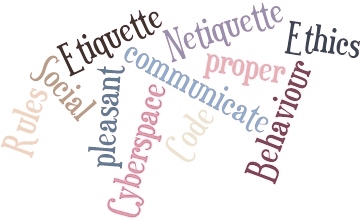
netiquetteThe internet is the collective human expression of Self, in all its facets:  You can find ANYTHING on here, literally.  I for one am very grateful; historical, scientific, archaeological, medical, and general research available online enables writers such as myself to stand on the shoulders of generations gone before and view the wider world from that enriched perspective.   You can also find anything for sale or free, an endless knowledge base, or entertainment, or simply a trivial waste of time, available to the entire wireless planet 24/7.  It’s a place to express opinions (informed or not), ideas (thought-through or not), philosophies (ditto), creations from songs to videos, crafts, discoveries and more.  Wonders to behold, as well as just plain wondering what the heck someone was thinking when they uploaded that.

But with the good come the bad.  I’ve gotten spam sidelined; it’s obviously spam when the text is something like, “I think you people just need to lighten up.  The writer of this article is just trying to…  (blah, blah, blah)”; there are no comments on that particular article yet, which tells me the spam’s originator is just out to stir up dissention if it happens to land on a live and already-active blog.  Why?  Are people so directionless in their lives that they have nothing better to do than stir up trouble?  Apparently.

The anonymity of the internet often brings out the worst side of people; they seem to think that, because they don’t know the person they are responding / reacting to and will probably never meet, that somehow gives them the license to be rude, belligerent, aggressive, offensive, and sloppy with everything from spelling to sentence structure.  Whatever happened to Netiquette?  Remember that quaint word (I was about to say old, but wait – internet has only been on the scene since 1993) that was an updated version of its predecessor, etiquette?  The definition (according to Wikipedia) of netiquette is, “Conduct while online that is appropriate and courteous to other Internet users.”  Ironically, the word is exactly as old as the internet itself; the need was quickly seen of reminding people to be courteous within such an anonymous setting.  In that most famous of books, the Bible, one guideline is found in Colossians 4:6:  “Let your conversation be always full of grace, seasoned with salt, so that you may know how to answer everyone.”  That’s what’s missing in a lot of the communication online:  Graciousness.  Salt is mentioned because it is a preservative, and something that adds flavour.  Graciousness not only preserves your own dignity, but guards the dignity of the person being responded to, and those that will end up reading it.  The danger in unguarded remarks is that they will bite back; it’s all too easy to wear blinders, thinking everyone will agree with our viewpoint while forgetting that we live on a planet of diversity.  Rudeness isolates; graciousness invites.  It’s the old adage about honey drawing more bees than vinegar.

There seem to be a lot of people out there who have either never learned, or have forgotten the basic rules of Netiquette.  On one hand it’s easiest and most comfortable to say that it’s not our place to educate them; after all, they’re strangers, and to each his own, right?  I say wrong:  Why do I write, if not to communicate what’s important to me?  Why do I interact with others online if not to learn something new, or be encouraged by a great story or news item or event in the life of a friend on Facebook?  And if I interact, that means addressing issues, comfortable or not.  If someone is rude, the challenge is to point it out with graciousness, not reacting to fire with fire, but with water – putting out the brush fires that have potential to do damage… taking the wind out of their sails in a gentle way.  And try to use the sandwich technique:  A compliment first, the meat of the matter (graciously put, the correction, or rebuke, or however you want to label it), and then ending on another positive note.  If they continue a barrage of crudeness, there’s always that “delete” or “block” possibility.  Peer pressure is the most effective way of making changes, for good and bad.  Let’s become peers for good in this vast cyberworld, one step at a time.   And the next time you’re tempted to fight fire with fire, remember the salt of Grace.

Leave a comment

Filed under Articles

Thoughts on Writing from a Reader’s Perspective

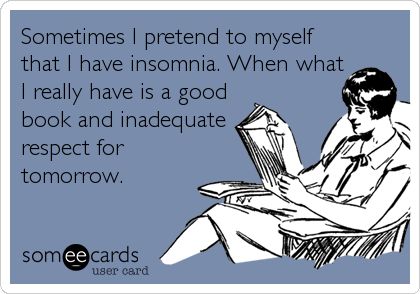
Card - InsomniaFor me, reading a book is about escaping to a new world, diving into that world through the medium of the senses that are stimulated by well-chosen words, precision instruments that play a symphony of emotions, smells, sights, sounds, touches, tastes, balance and harmony.  I’ve never really appreciated books that are written with gratuitous scenes of violence or sex; sometimes it seems to me (as a reader) that writers throw in scenes willy-nilly to spice things up or to patch over the fact that they haven’t researched and developed their characters thoroughly, or because they run out of plot ideas and just spin their wheels.  Such scenes grate against my senses just as much as random punctuation or bad spelling does.  If such elements are not organic, logical, and a natural development of the plot, they do not belong there.  Period.  It’s an insult to my intelligence and a brazen demand on my “believability credits” that is frankly not the author’s to demand… those credits are something that I as a reader give gladly to a good writer, but a writer has to earn them, and has no right to demand that I suspend disbelief to dive into their story when they haven’t bothered to make it believable.  The writer’s job is to earn those credits through good writing, good writing, and good writing, i.e. plot, character development, grammar, syntax, orthography, and structure.

Don’t misunderstand me:  There are times when the darker scenes are organic; they are necessary to portray the character, or are a natural outflow of the character’s flaws or decision process, or lack of positive input earlier on in life.  Sexual scenes can be sexy without being vulgar, sensual without being slutty.  Sometimes I read books that deal with such issues, but more as a writer than a reader, to see how they are structured.  I read part of a book recently (I gave up quite early, which not a good sign for the writer) where the author had seemingly tried to cram as many vulgar terms as they could into one chapter, or one page, or one dialogue.  It got so ridiculous that I started reading as an editor, slicing out entire passages to improve the script.  As far as I’m concerned, there’s not really a point in publishing something that will likely offend half your demographic sector away from buying a second book.

Give me something to read that’s intelligent, entertaining, witty, smart, deep, and that I can come away from the experience wanting more – not just another book with those characters, but that I come away having learned something about myself or the world around me, having been positively changed, encouraged, enlightened or satisfied.

2 Comments

Filed under Articles, Cartoon

Coherency: Just sayin’…

gibberish-cartoonIs it just my imagination, or is written English slipping in quality, even among writers?  Is it that less attention is paid to the end results than to the actual “getting it out there to be read by others”?  I just returned to my blog after taking a jaunt around WordPress Land; the blogs I visited, I went to with good will, interested to see what others are thinking and writing about.  But I have to admit I couldn’t understand half of what was written.  Half.  Now, I’m an English teacher and writer and all that, and yes, I’ve been living in a non-English speaking environment for a quarter of a century.  But has it really deteriorated to the point of not only miscommunication, but of downright gibberish at times?  I’m not looking down my nose at those who are trying to communicate (something); I am simply throwing out this question into the cosmos and asking if I’m the only one who’s noticed this?

Where is the satisfaction of a job well done in a sentence that looks like it was fed through BabbleFish a few dozen times?  Where is the pride in having written something well, communicated the heart of the matter, and allowed others a glimpse into the mind of the writer without confusing them with poor spelling, syntax and punctuation?  I find myself editing more than reading sometimes, and that does not bode well for the writer.  As a writer I take my job seriously, in all its aspects, from research, to presentation.  If we as writers don’t set a good example to follow, how will the next generation know right from wrong, or rite from wong?

A few simple rules I follow:

1) Read your text aloud before you hit that “post” button.

2) Have a good dictionary available (such as onelook.com), and check those words you’re unsure of.

3) Do NOT trust a spell-checker!  Learn the basic rules of spelling, punctuation and syntax, and if you’re still not sure, double-check online with reliable sources.

Let’s swim against the tide of laziness and stagnation in writing; let’s expand our vocabulary instead of relying on the same ol’ same ol’; let’s set an example of good writing, even though it may not be perfect every time.


2 Comments

Filed under Articles, Cartoon, Nuts & Bolts, Writing Exercise