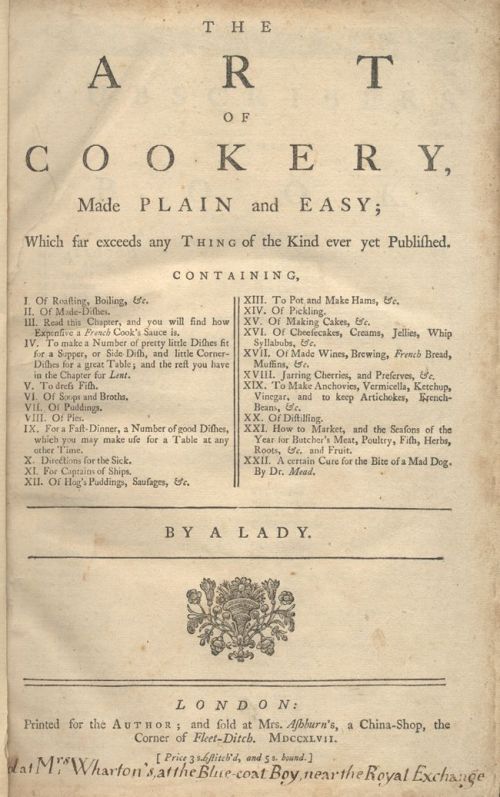
The Art of Cookery made Plain and Easy was written in 1747 by Hannah Glasse (1708-1770) and played a dominant role in shaping the practices of domestic cooks in England and the American colonies for over one hundred years. It is an excellent reference for historical writers, reenactors, and living museums. Hannah wrote mostly for the “lower sort” as she called them, domestic servants who might not have had much exposure to various cooking techniques or ingredients before entering the service of a larger household. She wrote it in a simple language, and can come across at times quite condescending; her writing style, spelling variations (including capitalisation which was much like German, with all nouns capitalised), and punctuation are in themselves a fascinating look at the standard of printing and editing, and what was most likely “acceptable English” of the times (I dread to think what future generations might assume is the “standard” of our own times, based on the slipshod average of what is unleashed online…!). I’ve tried to leave Hannah’s work as-is, though sometimes the auto-correct sneaks by even the most diligent.
In my current manuscript, the third book in The Northing Trilogy, Asunder, my heroine goes from being of the upper class to marrying a lieutenant in the Royal Navy, disobliging her family and being cut off by the father. Her mother sends her Hannah Glasse’s book, and she writes a journal entry regarding her use of it and trying to decipher just what is meant by instructions that, even with the attempt at instructing servants new to the kitchen, assumes a great deal of pre-knowledge (e.g. “first skin the meat and take off all the fat” or “chicken, which must be very nicely picked and clean“).
She had a very clear opinion as to what was right and wrong, how a thing was to be prepared and “there is no other way to do it right.” Many of the “receipts” (recipes) are still known, such as Hasty Pudding or Yorkshire pudding, while others would be unthinkable – whole Woodcocks, Ortolans and snipes (with nothing removed), or how to prepare meat when it’s begun to stink. They served every part of the animal, from entrails neatly presented to split skulls (with specific directions for how to lay the tongue most becomingly…). There were a surprising variety of spices, herbs and ingredients used, and which she assumed every household would have on hand, such as China root, balsam of Tolu, and liquorice; she even included a few Indian curry recipes, reflecting the East Indian connections. She minced no words on what she thought of extravagant (read wasteful) French cooking habits, and her disdain was evident in numerous passages. Her recipes were by no means all original; many were common sense, but many were also shamelessly plagiarised from other published works (perhaps we should be grateful for that now, as otherwise they might have been lost to the mists of time!). There are recipes of how to certainly avoid the plague, how a ship’s captain could have food prepared for long voyages, and recipes for medicinal purposes.
Not all homes had ovens, and in one recipe it is worded “send it to the oven… when it comes home” – this would imply that it was sent to the village bakery, and brought home to finish off once it had been sent away to be baked. Because of that limitation, many recipes are for boiling; they seemed to boil the living daylights out of meat, vegetables, or anything else that they could put in a pot.
It is a fascinating historical document, reference work and recipe source (many, purely for the pleasure of grossing out your kids or guests) for those interested; but for those not interested, it would be a torture for me to post hideously long blogs on the topic. The book can be found nowadays on Amazon in paperback, or online in PDF format. Below, I’ll share the original “pre-index” image, and her own personal note “To The Reader”, which in and of itself is entertaining, informative and historical. She minces no words on her disdain for the French, so to my French readers, I ask that they please take it on the chin with a pinch of salt and a wink!
Hannah Glasse’s “To the Reader.”
“I Believe I have attempted a branch of Cookery, which nobody has yet thought worth their while to write upon: but as I have both seen, and found, by experienced, that the generality of servants are greatly wanting in that point, therefore I have taken upon me to instruct them in the best manner I am capable; and, I dare say, that every servant who can but read will be capable of making a tolerable good cook, and those who have the least notion of Cookery cannot miss of being very good ones.
“If I have not wrote in the high polite style, I hope I shall be forgiven; for my intention is to instruct the lower sort, and therefore must treat them in their own way. For example: when I bid them lard a fowl, if I should bid them lard with large lardoons, they would not know what I meant; but when I say they must lard with little pieces of bacon, they know what I mean. So, in many other things in Cookery, the great cooks have such a high way of expressing themselves, that the poor girls are at a loss to know what they mean: and in all Receipt Books yet printed, there are such an odd jumble of things as would quite spoil a good dish; and indeed some things so extravagant, that it would be almost a shame to make use of them, when a dish can be made full as good, or better, without them. For example: when you entertain ten or twelve people, you shall use for a cullis, a leg of veal and a ham, which, with the other ingredients, makes it very expensive, and all this only to mix with other sauce. And again, the essence of ham for sauce to on dish; when I will prove it, for about three shillings I will make as rich and high a sauce as all that will be, when done. For example:
“Take a large deep stew-pan, half a pound of bacon, fat and lean together, cut the fat and lay it over the bottom of the pan; then take a pound of veal, cut it into thin slices, beat it well with the back of a knife, lay it all over the bacon; then have six-penny worth of the coarse lean part of the beef cut thin and well beat, lay a layer of it all over, with some carrot, then the lean of the bacon cut thin and laid over that: then cut two onions and strew over, a bundle of sweet-herbs, four or five blades of mace, six or seven cloves, a spoonful of whole pepper, black and white together, half a nutmeg beat, a pigeon beat all to pieces, lay that all over, half an ounce of truffles and morels, then the rest of your beef, a good crust of bread toasted very brown and dry on both sides: you may add an old cock beat to pieces; cover it close, and let it stand over a slow fire two or three minutes, then pour on boiling water enough to fill the pan, cover it close, and let it stew till it is as rich as you would have it, and then strain off all that sauce. Put all your ingredients together again, fill the pan with boiling water, put in a fresh onions, a blade of mace, and a piece of carrot; cover it close, and let it stew till it is as strong as you want it. This will be full as good as the essence of ham for all sorts of fowls, or indeed most made-dishes, mixed with a glass of wine, and two or three spoonfuls of catchup. When your first gravy is cool, skim off all the fat, and keep it for use. – This falls far short of the expense of a leg of veal and ham, and answers every purpose you want.
“If you go to market, the ingredients will not come to above half a crown, or for about eighteen-pence you may make as much good gravy as will serve twenty people.
“Take twelve-penny worth of coarse lean beef, which will be six or seven pounds, cut it all to pieces, flour it well, take a quarter of a pound of good butter, put it into a little pot or large deep stew-pan, and put in your beef: keep stirring it, and when it begins to look a little brown, pour in a pint of boiling water; stir it all together, put in a large onion, a bundle of sweet herbs, two or three blades of made, five or six cloves, a spoonful of whole pepper, a crust of bread toasted, and a piece of carrot; then pour in four or five quarts of water, stir all together, cover close, and let it stew till it is as rich as you would have it; when enough, strain it off, mix it with two or three spoonfuls of catchup, and half a pint of white wine; then put all the ingredients together again, and put in two quarts of boiling water, cover it close, and let it boil till there is about a pint; strain it off well, add it to the first, and give it a boil together. This will make a great deal of rich good gravy.
“You may leave out the wine, according to what use you want it for; so that really one might have a genteel entertainment, for the price the sauce of one dish comes to: but if gentlemen will have French cooks, they must pay for French tricks.
“A Frenchman in his own country will dress a fine dinner of twenty dishes, and all genteel and pretty, for the expense he will put an English lord to for dressing one dish. But then there is the little petty profit. I have heard of a cook that used six pounds of butter to fry twelve eggs; when everybody knows (that understands cooking) that half a pound is full enough, or more than need be used; but then it would not be French. So much is the blind folly of this age, that they would rather be imposed on by a French booby, than give encouragement to a good English cook!
“I doubt I shall not gain the esteem of those gentlemen; however, let that be as it will, it little concerns me; but should I be so happy as to gain the good opinion of my own sex, I desire no more; that will be a full recompence for all my trouble; and I only beg the favour of every lade to read my Book throughout before they censure me, and then I flatter myself I shall have their approbation.
“I shall not take upon me to meddle in the physical way farther than two receipts, which will be of use to the public in general: one is for the bit of a mad dog: and the other, if a man would be near where the plague is, he shall be in no danger; which, if made use of, would be found of very great service to those who go abroad.
“Nor shall I take upon me to direct a lady in the economy of her family, for every mistress does, or at least ought to know, what is most proper to be done there; therefore I shall not fill my Book with a deal of nonsense of that kind, which I am very well assured none will have regard to.
“I have indeed given some of my dishes French names to distinguish them, because they are known by those names: and where there is a great variety of dishes and a large table to cover, so there must be a variety of names for them; and it matters not whether they be called by a French, Dutch or English name, so they are good, and done with as little expence as the dish will allow of.
“I shall say no more, only hope my Book will answer the ends I intend it for; which is to improve the servants, and save the ladies a great deal of trouble.”