Category Archives: Musings

Etymology Undusted: Tangle

Do you ever have those moments where you catch yourself thinking about the simplest of things in life? Things that are common to you, yet you’ve never stopped to think about why you call something by a certain term and where those words or phrases come from? I do, with alarming frequency… I guess it’s the product of a curious mind.

I have long hair; so long that, if it’s not in a braid or some other up-do, I’d be sitting on it with ease. I braid it every day and every night – otherwise, it tangles. And thus, while brushing my hair out this morning, the word tangle tangled in my tangled mind. As someone once said, my hair isn’t messy; it’s just erupting with awesomeness.

As a verb, meaning “to knit together confusedly, encumber, or enmesh”, it came into English in the mid-14th century via Old Norse þongull, meaning seaweed, from the Proto-Germanic thangul. Other Germanic languages have related words: In both Dutch and German, we find Tang (seaweed), and in Frisian we find Tung [Frisia is a cultural region that lies over the border between the Netherlands and Germany.] Looking at the image below, it’s easy to imagine a ship’s tackle becoming entangled in the tang…

Image Credit: The Norwegian Blue Forests Network

As with any useful word, it began to collect variations: The transitive sense of entrapping someone or bringing someone under one’s influence; the sense of fighting with someone; Tanglefoot was a western slang meaning strong whiskey, and tanglesome (1823), meaning complicated.

So I hope I’ve untangled the origins of this tanglesome word! Have a great, untangled week!

4 Comments

Filed under Articles, Etymology, Images, Liguistics, Musings

Etymology Undusted: Catch-22

The idiom “Catch-22” comes from a book of the same title by American author Joseph Heller (1923-1999). The term originally referred to a military rule whose provisions are mutually frustrating. Heller used Catch-18 instead of Catch-22 when the first chapter of his book was originally published in 1955. He changed it by the time the entire book was published in 1961 because his publisher had already published a book that year with “18” in the title (Leon Uris’ novel, Mila 18). So in 1961, the phrase Catch-22 first appeared. It was first used figuratively in 1971 in Atlantic Monthly magazine. As far as the form goes, it is usually hyphenated and with a capital C, as that is the way Heller originally wrote it.

Since the author’s first usage of the idiom, it has taken on a life of its own: Today, its broader meaning is a paradoxical situation from which an individual cannot escape because of contradictory rules or limitations. It has also been used as a mnemonic for the symptoms of DiGeorge syndrome.

One particular quote from Heller is thought-provokingly insightful: “Everyone in my book accuses everyone else of being crazy. Frankly, I think the whole society is nuts – and the question is: What does a sane man do in an insane society?” In a way, this is perhaps an example of a Catch-22 for the sane person: If they stay in an insane society, they may lose their sanity; but by leaving such a society, they throw away any chance of bringing it back to a state of reason. Social and political polarisation are both poisons that infect society.

1 Comment

Filed under Etymology, Grammar, History Undusted, Images, Musings, Psychology Undusted, Quotes

Yuka: Shaken Awake

All of us can relate to having some form of ruts in our lives: Favourite meals, restaurants, seats in places we visit often, clothes we prefer, products we buy, food brands or makeup brands (if you wear it); all, patterns of movement or place or things. Recently, I heard of an app that made me curious to try it out; when I did, it was an eye-opener about how many things I use that I’ve taken for granted that their claims are accurate – I know that’s naïve, but part of that naivety is that greatest of marketing tools, willful ignorance.

Case in point: Speaking to the women out there, you probably have favourite makeup products or brands that you’re used to. But what if you found out that half of their ingredients build up in your system, damaging your liver, your thyroid, and the environment? That’s exactly what I have learned lately, and it’s shaken me awake: the app I cannot recommend highly enough is called Yuka. If I had known years ago what I know now, perhaps I would still have a thyroid; tumours put an end to that several years ago – but I can prevent further damage to my body by being aware of what’s in a product and buying safe alternatives.

The app works like this: You scan a product’s barcode – anything from food items to makeup to body products such as shampoos and hand creams; the app then ranks the products on a set list of 100 points and tells you whether it’s excellent, good, poor or bad; it then lists the ingredients and gives you the option to read more about each one, ranking the ingredients (colour-coded) as hazardous, moderate risk, low risk, or risk-free. If the products rank as poor or bad, below them will be a list of alternative products, with their rankings and ingredients for further information. The recommendations are unbiased as they are not supported by any company. The app also keeps a record of products I’ve already scanned; if I’m at the store, and scan products I don’t buy because of their rating, I can then delete one or several items from the list to keep it streamlined to my products/foods.

There are things that this app is NOT: It is not a substitute for medical or nutritional advice; it is not the be-all and end-all for telling you what to buy. But what it IS: A good guide to weighing the benefits vs. the disadvantages of using one product over another. Some of my products may clock in as “poor” – but when I consider why that rating is given, I may decide to continue its use until something better becomes available in my area.

For me, I’ve found that one ingredient pops up in most makeup and hair products: Phenoxyethanol; it is listed as a potential endocrine disruptor, potential allergen, and irritant. In the EU its use in cosmetics is regulated – but not in the USA or in Canada. In itself it may be within regulatory limits in a product; but accumulatively (several products, from shower gel to lip balm to foundation) it exceeds the limit and becomes a health concern. Knowing this has helped me find new, healthier products. Even within a product range, the ingredients may vary; for example, one lip balm may be good, but another colour of the same brand differs to produce the colour or gloss and ends up being listed as bad. Honestly, I won’t buy a product now without knowing it’s healthy. It’s not that I can’t and won’t think for myself and let an app tell me what to do, but I can use it to weigh a decision.

This past week, I wanted to find a lip gloss to replace the one I’d been using which was marked as “hazardous”; but the store I was in didn’t have customer wi-fi, so I bought a small Vaseline, thinking, “This has been around for ages, so it must be simple and safe”. Wrong. When I got home, I scanned it: Petrolatum is the mineral oil used, which has a moderate risk with a big BUT: this oil may contain problematic residues, such as MOAHs (genotoxic carcinogens which promote cancers and damage DNA) and MOSHs (these accumulate in the body, particularly lymph nodes and the liver). These oils should be avoided, especially in products that may be ingested… such as lip balms (and these two residues were present in half of all tested lip balms!) So now, that little jar is in my craft room to be used as a lubricant for my tools.

We all need to take steps to protect ourselves; big companies are not putting customers first, but customers’ wallets. If we don’t shake ourselves awake and work against our own willful ignorance, we shouldn’t be surprised when health issues pop up; but who would associate lip balms and blush and hand creams or canned foods and pre-made packaged food with those bigger issues? We need to start looking into it for our own sakes.

13 Comments

Filed under Articles, Humanity Highlights, Links to External Articles, Musings, Research, Science & Technology

Norman Doors (Counter-Intuitive Designs)

I’ve written before about Donald Norman and his book, “The Design of Everyday Things”; he emphasizes the need for products to have user-centred designs. The term “Norman Door” comes from the typical example he uses about doors – an everyday item that can often lead to confusion for the user simply by putting pull handles on a push door.

I was thinking about it this week, wondering what the opposite term should be, as I was opening a container of whipping cream. The tetra package for whipping cream is a prime example of a poorly designed item for me: It inevitably oozes out while I try to rip it open along the perforated line. If they made the perforation easier to tear or put a scissor symbol making it clear that that would be the preferred method from the outset… but no. Other items that come to mind are the flip-tops of products, such as hand creams or shampoos, that nearly require a knife to open. What happens? You simply stop buying that product, which might be perfectly fine, because of the poorly designed packaging.

Tell me your ideas for a good term for bad designs – something catchy and catch-all (Norman Doors refers to doors only, but so far it’s worked in a pinch). In the meantime, here are a few examples of non-user-centred designs.

1 Comment

Filed under How It's Made, Humanity Highlights, Humor, Musings

The Hues of Hogwash

Most English-speaking people have heard the term whitewashing: Literally, it means to paint a surface with a diluted white paint to lighten the surface and conceal blemishes. Figuratively, it means to downplay the negative aspects by emphasizing the positive ones of a person, event, or situation.

Greenwashing is a term related to environmental issues: It is the deliberate dissemination of a false or misleading impression of environmentally friendly practices used to conceal or obscure damaging practices.

Blackwashing is the use of public campaigns and advertising funded by the coal industry to draw attention away from environmentally unsustainable practices or to justify exclusion from carbon taxes.

Bluewashing is to tout a business or organization’s commitment to social responsibility while using this perception for public relations and economic gain; to present a humanitarian front while obscuring actual practices.

Redwashing is the practice of a state, organization, political party, politician or company presenting itself as progressive and concerned about social equality and justice, in order to use this perception for public relations or economic gain.

There are other colours of X-washing, but they all stem from greed: In marketing, these tactics are a way to charge customers more, because the higher price leads people to think, in connection with the misleading information or imagery, that the extra money spent is going to a good cause, e.g. schools for the workers’ children or working children, when in fact it’s likely going toward a CEO’s yacht.

On holiday recently, we’d forgotten to bring towels from home into the motorhome, so we went into a houseware store; I thought the towels would be a bit more expensive than another store I usually buy our towels from, but it was a whopping 50.- per towel more! On each towel was a tag; here’s the translation (the company name withheld):

Cotton (name)® Made in green, inspiring confidence. Tested for polluting ingredients and sustainably produced according to (name)® guidelines. The label “made in green” gives you the assurance that this textile product has been made by pollutant-free materials in environmentally friendly factories in protected and socially acceptable work environments.”

Nowhere is it mentioned where this product was made; their testing agency, for accountability, is them. Inspires confidence? On what grounds? Price? Notice that they don’t claim to have passed those tests or what they were testing exactly, nor do they state what their guidelines were supposed to be.

These schemes prey on first-world people’s sense of guilt, or of wanting to pay a bit extra to help those less privileged. Yet their concept of “environmentally friendly factories in protected and socially acceptable work environments” might have nothing to do with your or my concepts – would the company’s execs be willing to work in those factories? I doubt it. This is also an example of bluewashing.

An E-Talk was given to show the marketing tactics in connection with the foods we eat. The disclosures made in the short talk are enough to leave the audience in stunned silence. I challenge you to watch the video (less than 7 minutes long) here. Marketing’s most effective, secret weapon is you. They bank on willful ignorance (the avoidance of making undesirable decisions or taking actions that accurate information might prompt).

All of these wash-tactics boil down to hogwash. So the next time you find yourself looking at the claims of a label, or seeing the sunny kitchen in a perfect home with perfect families on a commercial, take a moment to challenge what you’re reading or seeing, and use your purchasing power wisely. Research; see if the company is on any blacklist by organisations that actually care (WEF, Greenpeace, or any from a long list of NGOs). Search the topic online – there are a lot of informative articles out there with practical tips for making informed decisions. Here’s a website for checking a brand’s ratings: https://directory.goodonyou.eco/. If you find that a company is making bogus claims, stop buying their products; make the effort to blow the whistle on them – social media can be a positive tool in that aspect.

This brings us back to that secret weapon of marketers, our willful ignorance: The tragic factor in all of these tactics is that, like water, humans usually choose the path of least resistance… least effort… least active involvement, least time required; and so willful ignorance prevails. However, since we’re making an average of 35,000 decisions a day anyway, (automatic, habitual, emotional, stress-related, worry-related, or environment-related) let’s neutralise that ignorance one wise, informed choice at a time.

6 Comments

Filed under Articles, Etymology, Humanity Highlights, Links to External Articles, Musings, Psychology Undusted

Fieldnotes

A few months ago, I began something that has added a layer of creativity and organisation to my life which, to be honest, is fairly creative and organised as it is. But this little addition adds a nice colour: Fieldnotes.

The original concept of taking fieldnotes comes from the scientific disciplines: An archaeologist in the field, taking notes on where, what and when something was uncovered; a geologist, botanist, ornithologist, or entomologist taking notes on observations, perhaps drawing an illustration of a specimen or a map of the landscape.

Fieldnotes can include writing, diagrams, drawings, or visual clues within an entry such as arrows or other visual connectors. They differ from a daily journal in that the fieldnotes are concise… rambling or expanding on a thought belongs elsewhere, but not in a “quick-draw” situation (pun intended).

Creative thinkers have jumped on the idea for reasons other than scientific observation: As a writer, fieldnotes help me capture snippets of ideas, dialogue, or an observation when out in public (I love to people-watch), or something I read – sometimes the comments on YouTube videos are a great capsule of humour! I also use fieldnotes to keep track of tasks on a busy day – lists of to-dos, to-writes, and so on. When I have a creative project, I take notes on the steps taken – such as making giant flowers that no one else has ever made; how to scale up a smaller version of a crepe paper flower is not always straightforward, and if I have several to make, it helps to have those detailed notes of the prototype phase for the next time around.

Taking fieldnotes might help get your creative juices flowing. If you’d like to start this practice, here are a few tips:

  1. Use a small notebook – one that can fit into a shirt pocket, man-bag, or purse. I’ve made my own with 70gsm blank paper, which allows me to make the same size and style repeatedly. But if you can’t do that, just use something like a moleskin notebook; these come in various sizes, with or without lined pages. There is also a company with books called Field Notes, though they seem a bit pricey for what you can do on your own…
  2. Use a good pen, or pencil, or coloured pencils if you want to sketch something with colour.
  3. You can either take chronological notes, such as dating each entry, or you can organise your notes into groupings: One page per character, scene or topic, or for a to-do list, or whatever you want to capture on the go.
  4. Use visual cues, such as boxes around certain elements or arrows connecting one thing to another. Use illustrations or draw diagrams; attach images from magazines, printouts, etc.
  5. Highlight tags or keywords; consider numbering each page and keeping an index at the back of the book to help you find things later on.
  6. One book that might help kick-start illustrative note-taking if it’s new to you is The Sketchnote Handbook, by Mike Rohde.
  7. Think about how you’re recording things on the page: Do you always want to write straight, top left to bottom right, or do you want to mix things up and write diagonally, sideways, or even backwards? Yes, sometimes that’s a thing; Leonardo da Vinci wrote privately in a mirrored direction, only writing normally when he wanted others to read his notes; he also developed his own shorthand.
Leonardo da Vinci’s Vitruvian Man, with mirrored writing.

I also have my own shorthand for many things; Sometimes I use what I call pigeon Asian (I use this when I don’t want anyone else to read it); it’s something I learned when living in Hawaii. It looks like Kanji (the logographic writing of Japan), but it’s not – that’s all I’ll explain! I also use logographs, such as the ancient Anglo-Saxon rune of daeg, which includes the concept of day, dawn, intuition or breakthrough; I use this to designate those times when I’m writing: Rather than writing, “Today, I wrote/worked on the manuscript for...” I just write that symbol plus the name of the manuscript and details. I have a whole series of such shorthand symbols that I use daily.

While there are note-taking apps available (and I use one, called “Keep My Notes”, on my phone for things like shopping lists or feedback notes for singing students or bands that I take during performances and review with them later), sometimes it’s helpful to get away from digital screens. Sometimes I’ll write whole scenes away from the computer – I don’t use my fieldnotes for that, though it will probably be used to outline a scene that comes to mind until I get to another notebook. Something about writing long-hand sparks a level of creativity that might not come while working at a computer; hand-eye coordination should never be underestimated in creative endeavours. Once a scene has developed enough away from the screen to be integrated into my current manuscript, it then takes on another reiteration as I type it in, tweaking and changing… it’s what I call a “ripening process” as a wine metaphor for the creative maturing process a scene goes through by this method. It gets my head into a new space figuratively, literally, and literarily!

In an age when we are constantly bombarded with visuals wherever we go, sometimes it’s healthy to go back to good ol’ pen and paper. On those days so busy that I can’t remember what I’ve actually done, it’s helpful to look back at my fieldnotes as I write out my thoughts in my daily journal.

Do you write? Do you ever make lists for shopping, chores, people to contact, or things to do? If so, how have you kept track of such things so far? If it’s a system that works for you, brilliant! But if you find yourself wanting to switch things up or wanting to improve your use of time, would you consider taking fieldnotes? Please comment below!

2 Comments

Filed under Articles, Etymology, Humanity Highlights, Links to External Articles, Lists, Musings, Nuts & Bolts, Research, Science & Technology, Writing Exercise, Writing Prompt

In a Name

My husband and I have a quirky sense of humour; we recently had a good laugh coming up with pets’ names in pairs (don’t ask why that topic came up – it’s too hard to reconstruct!): There are pairs of names commonly associated with each other, such as Tom and Jerry, or Cain and Abel; last night, we thought of naming two cats Maelstrom and Doldrum – the irony is that these are nautical terms for ocean conditions and we live in a land-locked country. My husband says that if we ever have a snake, he’ll name it “Abebambelela” (which is a Swiss German phrase meaning “to hang down”)! There are certain words that I find funny, like Asparagus (or the old English version, Sparrowgrass), and I can imagine naming cats something Latinesque, some of which are actually quite beautiful (Aurora, Adamaris, etc.)

Pet names are as creative as the owners, so the sky’s the limit! I once heard of a dog called Dillingham Osborn Gunderson… initials being DOG. Naming a pet Velcro, Big Mac, Groucho or Tweezer seems tame to some purebred titles (such as Bluewater Full Metal Jacket – Jack for everyday wear). When our cat had kittens (the mother, Gandria, and father, Caprino, were named after towns along Lake Lugano), we used musical terms (sticking with Italian): The first came out vocal, so he became Crescendo; the second was slow and calm, thus Piano; and the 3rd is gentle but friendly – Allegra. We kept Allegra, who is curled up between my feet as I write this; the other two were adopted by neighbours – who subsequently moved to give the cats more room!

I will never have a purebred pet; more often than not, the animals are sickly, as traits have been unnaturally bred into them; pugs and Persian cats are prime examples of pets that simply cannot breathe properly, and have respiratory infections or even failure. These health issues are hot topics between breeders and vets or those who care for animals such as the Kitten Lady. Give us a good ol’ farm cat, “Heinz 57-pedigree”, and they’ll do just fine! We have three cats: Allegra (born in 2009), Andromeda Zora (from an animal shelter, born in 2020), and Mira Bella (born in a home nearby, 2021).

Do you have any pets? If so, what are their names, and how did you choose them? Please comment below!

Left to Right: Allegra, Andromeda, Mira

4 Comments

Filed under Articles, Etymology, Family History, Musings, YouTube Link

When It Rains, It Pours

You’ve probably heard the saying, “When it rains, it pours” (or the British version, “It never rains but it pours”). The idiom refers to a series of unfortunate events occurring within a short amount of time.

I wouldn’t necessarily limit it to unfortunate events; sometimes they’re just inevitable occurrences or busy times. The latter two would describe my past few months: From mid-January to last weekend, one of our nephews was staying with us every weekend when he had time off from his basic military training; this 18-week period is mandatory here in Switzerland, but our nephew is half-Swiss, half-Mexican, and is currently living in South Africa, so he actually volunteered. Not only did he want to be near Swiss family and have the experience of being away from his home and in a camaraderie, but when he returns next autumn to begin university studies here, it would be easier for him to be accepted if he did so.

What that meant for us is that, though we really enjoyed having him here and spending time with him, the things that normally happen on weekends simply had no room, and the weeks were ultra-busy, leaving little time to tackle those things. When our nephew was here, the focus was on him; “Tia” (Spanish for “aunt”; Tio is “uncle”) was frequently heard. Laundry (tons of it!), cooking, shopping, meal-planning… they all happened much more frequently – he was a bottomless pit, as most teenage boys are. The first month or two were most intensive, as he had grown up with a maid – which he rapidly learned I am NOT. He learned a lot of “life lessons”, and about family house rules – things he’ll need to know when he finds a student flat-share; he learned to cook a few new meals, clean up the kitchen after himself, and how to cut his own hair. He learned that if he put his socks into the laundry bunched up into a ball, that’s exactly how he’d get them back – that, and we have no clothes dryer (only drying racks) – so timing on getting his clothes back clean and dry for the following week was a crash course. He learned to think about and change habits to reduce his environmental footprint.

My weekends were usually when I could plan, write and edit blogs. Because that time was either reduced or swallowed up entirely every weekend, some tasks took precedence; when I had time, focus and energy for writing, it went into getting my five books prepped for paperback release, and gradually getting them sent off for proof copies. So far, I’ve been able to release two of the five novels. The printer (who is either in England or in France) doesn’t ship to Switzerland (why do companies frequently act as if Switzerland is on another planet?!); it’s been a challenge getting the books to me – fortunately, some of our family lives in France, so they can receive it. Sometimes the packages are sent, sometimes carried by hand to closer family, sometimes handed off in car parks!

Two weeks before our nephew’s time here came to an end, we accidentally discovered that we’ve got a huge problem in our flat: Water damage coming from somewhere that will now require walls, floors, balcony tiles, windows and downstairs ceiling to be ripped out and repaired! Raining, pouring… For the past four years, repairmen have come and gone but none of them have gotten to the root cause. So this time, I’ll be watching them like a hawk and pestering them to push beyond their nose to find the actual cause, repairing that first! And that all begins this week.

After the past few intensive months, I’ve been trying to catch up on those things that, of necessity, were neglected, and those things I need to prepare for when our home is invaded by an army of repairmen – at least that’s what I’m imagining, though it will more likely be a steady stream of comings and goings, appointments, and cleaning up the aftermath of dust and debris…

And now that my schedule can resume a partial semblance of normal, I want to get back into creative writing – my next novel, as well as this blog! So many projects, so little time! But if a day had 40 hours, it would still not be enough to accommodate everything I’d like to do. Maybe it’s God’s mercy that we don’t have 40-hour days!

4 Comments

Filed under Articles, Family History, Musings

History Undusted: Memories of Hawaii

It’s hard to imagine, but the Hawaiian islands a generation ago were not a hotspot of tourism and a bustling modern culture; most people lived simple lives with few amenities. It’s also hard to imagine a time when exotic fruits were not found in your local store year round – exotic being bananas, kiwi fruit, avocadoes or papayas. My Swiss mother-in-law remembers when bananas came to Switzerland, and they were exotic and expensive; in her house, they were only bought for her brother, who was very sick at the time, as a source of energy; that was during World War 2.  Once, she confessed to stealing some money from her brother’s piggy bank to buy herself a banana.

By clicking here, you can watch a ~10-minute video of a series of short video clips from the 1920’s of Hawaii, interspersed with silent-film-era title cards.  Not only is it an interesting glimpse into a simpler time on the islands, but it’s also an insight into what the rest of America “knew” about the islands, foods and customs.   Back then, the world in general also knew very little about strange activities such as “surf riding” (surfing), and the footage of surfers is utterly tame compared to the monster wave-riding considered “for surfers” today!  Volcanic activity also seems to have been a fascination; such footage may well have been the first time anyone had seen such a thing outside of volcanic regions; it still had to be described in colours, however, such as “cherry red” for the lava, as the footage was, obviously, in black and white.

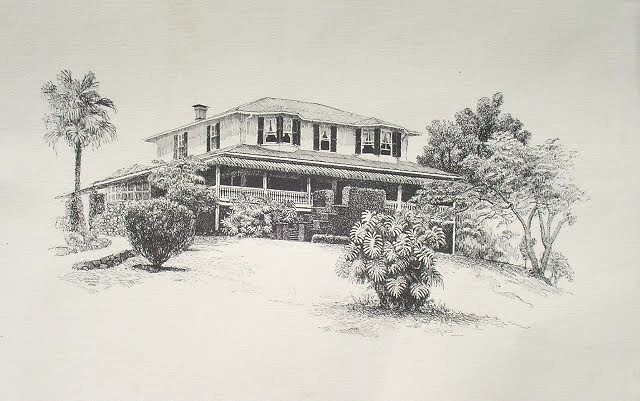
The image below is of King’s Mansion, in Kealakekua, Hawaii, on the Big Island.  As a student, I lived there in 1986 (my dorm window was the left bay window at the front).  We had avocado trees in the back garden, and our neighbour’s horses, across a stone wall, would come trotting to the wall when they saw us in the garden, hoping for an avocado; we’d feed them, entertained as they carefully chewed away the flesh around the pit (reminding me of an old man chewing tobacco!), and then skillfully spit the seed out.  At the bottom of our front garden stood a huge banyan tree [if you were standing on the covered lanai (porch) at the front of the house, it would be to your left – not shown]; it was a favourite tree to climb. At the bottom of our terraced garden was a volleyball court; it was popular, though we could also hike up the next hill over to the local school, where we could use their tennis courts. If you hit the ball over the high fence, you’d be hiking through the jungle to bring the ball back! Maybe the local students got tired of the same problem, as the jungle eventually gave way to a baseball diamond.

On 8 July, we were asleep in our dorm bunk beds; at around 2:30 a.m., I was awakened by what I first thought was my restless bunkmate – but which turned out to be an earthquake. The San Andreas Fault had slipped, and what had taken me 9 hours to fly took the earthquake 9 minutes to travel, hitting the Big Island. It kicked off a chain event of volcanic eruptions, aftershocks, and strange weather conditions: The heat of the volcanic air and the cool ocean created thick, milky white clouds at the level of our house (at the top of a hill) that rolled over our lanai and into the open classroom – soaking our books and the carpet the first time; after that, we got smart and put our books on our laps whenever the thick cloud rolled in. It also made gorgeous “sunsets” mid-day, as the volcanic ash dimmed the sun. I don’t know if they were connected, but soon after the volcanic eruption, Hurricane Estelle hit the islands; as King’s Mansion is up in the hills, we mainly felt the tropical storms, wind and rain, though it was creating 15 to 20-foot waves at one point, which we could see from our vantage point. I grew up in the heart of Tornado Alley and chased tornadoes for the fun of it as a teenager, so I took the earthquakes and storms in my stride.

One person deserves a special place in such memories: Gran’pa Joe Cho. He was a retired Hawaiian neighbour who enjoyed spoiling us rotten. He’d bring us treats and take us girls out on the town. He would admonish the boys to treat women right and then show them how to do it! One memorable evening, Joe Cho had taken a group of us girls out to get Kona Mud Pie, then to Manta Ray Point (aka the Kona Surf Hotel’s surf zone – the rays would swim around the underwater lights near the shore, catching the plankton attracted by the lights), and then we stretched out on a green of the Kona Country Club golf course, right on the edge of a rocky cliff, to watch the stars; we saw a meteor shoot so brightly that its reflection could be seen on the ocean waves.

It was a lifetime ago, but they will always be grand memories…

6 Comments

Filed under Articles, History Undusted, Links to External Articles, Musings, Snapshots in History, Videos

Winter Visitor

I’m curious to know how many of you who read this have had Covid once or multiple times. If you’re okay with sharing that, please comment below.

I first had C-19 from March 2020 to November 2021, so “Long Covid”. Since then, I’ve had two other strains, and continue to have what I refer to as “flare days” – those days when energy suddenly takes a nosedive, joints ache and a splitting migraine suddenly shoots up from the base of my skull (and no medication has ever made a dent in those headaches – they’re 24 hours long).

It’s difficult to know if those tiny little viruses have just made my immune system oversensitive to winter bugs, or if it has to do with other health issues, but whatever the cause, I’ve been sick for 3 weeks flat. I’ve spent most of my time and energy coughing and breathing. Before it began, I had half of an interesting blog written, and I will post it as soon as I have energy enough to focus on research and complex thoughts again.

As you can imagine, being sick over Christmas and New Year put a damper on social engagements; fortunately, we didn’t have many appointments to cancel. Our Christmas was a quiet one; my husband and I exchanged gifts, but this year we did something different: We re-gave gifts. In the past, for instance, if we received several books at Christmas, we might not have had time to read all of them; I chose a few books I knew my husband would enjoy and dropped them into eco-friendly cloth gift bags (I made a variety of sizes that we use instead of wrapping paper). It was fun to see what each other chose. My husband raided my craft room and gave me random craft items! We enjoyed the fun, without the need to find, buy and add new items to our home.

I hope you had a healthy and happy Christmas and New Year’s Eve / Day! I hope you’ve not had the “winter visitor” of flus, bronchitis or Corona (other than the Mexican beer kind!), and that you stay healthy through the rest of the wintery season (if you’re in the northern hemisphere – if you’re in the southern, enjoy the warmth before your rainy season kicks in!).

I will post as soon as I can finish the article! In the meantime, just for a smile:

6 Comments

Filed under Humor, Just for Fun, Musings