Today’s topic is the kind of thing that flashes through my brain at 4 a.m. when I’m dropping off to sleep.
Sometimes rock and stone can be used interchangeably, depending on the context of science, society or conversation; but some phrases are intuitively either stone- or rock-rooted: We say rock road, rockslide and rock salt, but stonemason, stone wall and Stonehenge.
In geological terms, a rock is a naturally occurring mass of minerals, particularly those with a distinctive composition (e.g. granite, bedrock, igneous, or features such as Ayers Rock). Other geological terms range from clay, silt, sand, pebble, gravel, cobble, boulder or glacial erratic (material moved by geological forces from one location to another) to mountain in size.
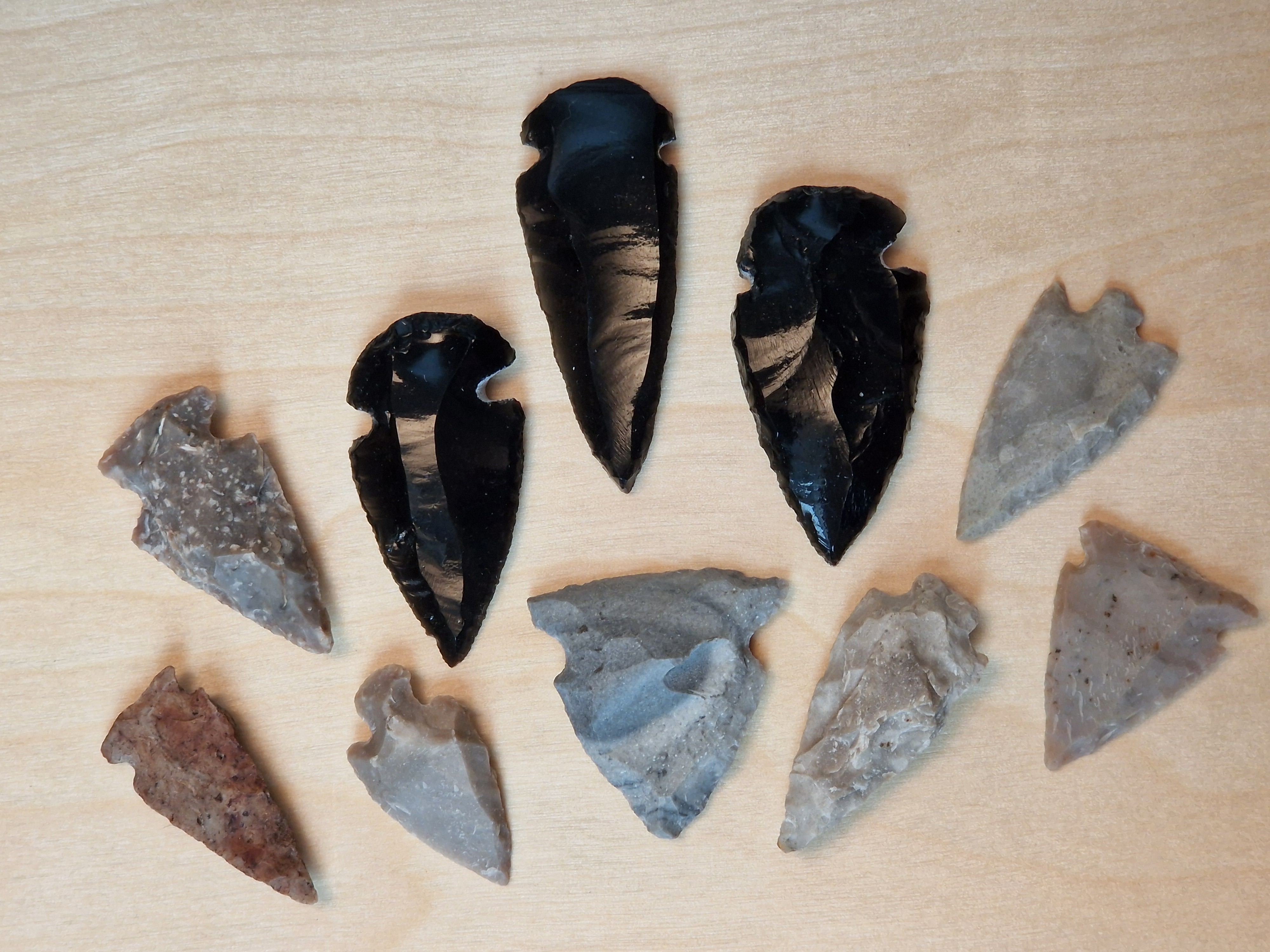
In Archaeological terms, rock refers to a geological formation, while stone refers to any rock that has been placed or modified into a tool by humans (ergo, Stonehenge, not Rockhenge). When an archaeological dig is underway and they pull out a rock, trained eyes can spot signs of scarring, or scoring, such as on a core, which is a piece of rock that has been worked by a stone tool referred to as a hammerstone (for obvious reasons), used to shape another rock into a tool, such as in the process of flint knapping (the more refined the knapping process, the more refined the tools become, such as using antler or copper nubs to chip away finer areas of an arrowhead or hunting barb). In Kansas, where I grew up, arrowheads are still discovered occasionally; I have a small collection, along with a few obsidian arrowheads.
In archaeological excavations, what might appear to be a natural rock formation may turn out to be an ancient boundary wall, with stones intentionally stacked for a specific purpose. In that sense, though a rock road has intentionally been placed, it is not stone – it is placed for a purpose, yes, but its arrangement is left as it falls, so it is referred to as a rock road.
Years ago, when my husband and I were walking along a rocky riverbank in Ticino (in the Italian-speaking part of Switzerland), I picked up a stone; it had obvious signs of human activity, with smoothed sides where hands held it, and scrapes along the top and bottom, such as might be caused by sharpening a tool – whether antler or arrowhead. As it was washed down from its resting place in the rapids, it was no longer in situ and therefore would have no archaeological significance.
So which is it, stone or rock? For me, the answer is this: When it has been modified or intentionally placed or ordered by humans, it’s stone; when it’s naturally occurring, it’s rock.
I’ll leave you with a few idioms carved in stone or rock:
Before we dive into today’s topic, let’s talk about two of my favourite words: Flotsam and Jetsam. I just love the way they sound! The way I understand them, the difference between the two is intention: Flotsam are things unintentionally donated to the sea – things washed overboard from a ship, or things blown off land by a storm. Jetsam is rather something intentionally jettisoned – if a ship needs to lighten its load to avoid sinking, for instance; in the case of the great garbage patches, it is a mixture of both: Without proper disposal systems in place, such as municipal garbage disposal, or education in ecological footprints, social debris is simply tossed and forgotten. But it ends up somewhere, often finding its way to the ocean through rivers and streams. And this leads us to the topic of ocean currents.
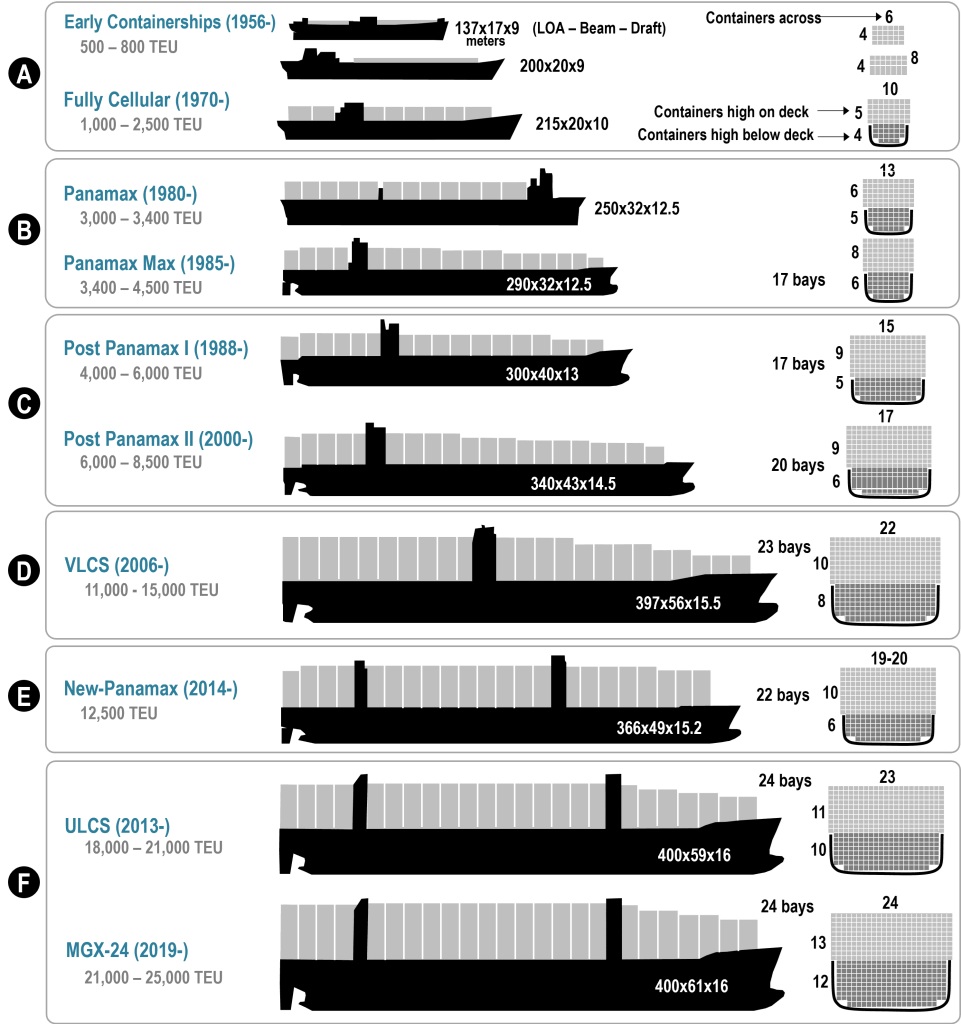
Today’s topic is a fascinating dive into a world of global trade; research has shown that around 90% of international trade is carried by shipping containers, and the World Bank statistics show that in 2019, nearly 800 million were shipped annually; given the increase over the past few years in online shopping, I can imagine that figure is by now significantly higher. The unit used for measuring how much a ship can carry is TEU (Twenty-foot Equivalent Unit); the chart below shows the adaptation of ship sizes over the years, driven by global trade:
Now, imagine a shipping container stacked at the top of a pile that’s the height of the actual ship; add to that ocean swells and waves. I’ve been on ships in the Atlantic facing waves so high, I could count fish through my window. I’ve been on ships in the “Sailor’s Nightmare” – the Pentland Firth passage between Scotland and the Orkney Islands – which is characterised by rough bathymetry (the underwater equivalent to topography) and extremely high currents (which also ricochet and collide off of the coasts of the islands and Scottish cliffs), tossing anything on the surface like a leaf in the wind. The World Shipping Council estimates that, over the past 16 years, an average of 1,500 containers have been lost at sea annually. Every year, the contents of those containers are carried along until the container is breached by either corrosion or impact. Then the contents are carried by ocean currents; where they finally make landfall depends on where they entered the ocean. If you were marooned on an island and tossed out an SOS in a bottle, it could make landfall anywhere between two and one hundred years – or never, if it’s caught in a gyre (more on that later). A message in a bottle was found on a beach in Norway that had been sent off 101 years earlier.
So what does that have to do with rubber ducks? In 1992, a shipping container with a consignment of what has been dubbed Friendly Floatees – 28,800 yellow rubber ducks, red beavers, blue turtles and green frogs – was washed overboard (along with 11 other containers) into the Atlantic. Because they are designed to float on water, they have survived at sea for an amazingly long time. Seattle oceanographers Curtis Ebbesmeyer and James Ingraham, who were working on an ocean current model, OSCUR (Ocean Surface Currents Simulation), began to track their progress; and those wee toys went on all kinds of adventures: Ten months after they broke free, some began showing up along the Alaskan coast; some showed up in Hawaii; some went to see the site of the Titanic sinking before getting frozen into ice, eventually emerging again and travelling to the US eastern coast, Britain and Ireland, making landfall around 2007. The researchers contacted coastal regions, asking beachcombers to report their finds; they recorded findings and began to accurately predict where landfall would occur. Over the years, the ducks and beavers had faded to white, but the blues and greens had retained their colours.
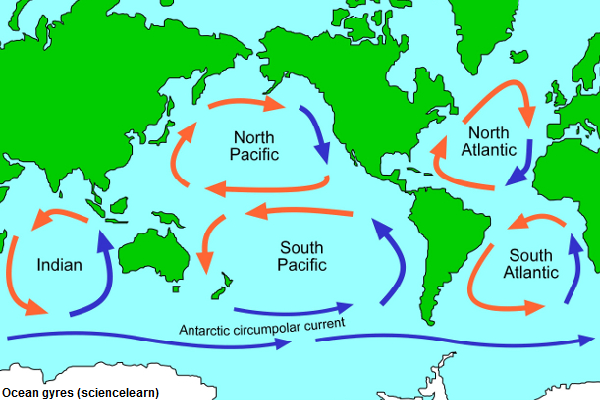
Flotsam and Jetsam have played key roles in helping researchers understand not only how ocean currents travel, but also how the areas known as garbage patches, oceanic gyres, are formed and retained by the swirl of ocean currents. Currently, five patches are known; many of the rubber ducks are likely caught in such currents, so we may hear about more white ducks finding their way to beaches in the coming years.
So the next time you see a rubber duck, think of all the adventures its siblings have been on!
If you’d like to see for yourself how ocean currents work, click here for an interactive map; just click on any area of the map to see how and where the currents carry debris from that point.
Back in January, I wrote about the phenomenon of the Hum, something that occurs around the world.
Another global phenomenon is that of “ghost lights,” also known as fata morgana, mirages (both inferior and superior), will-o’-the-wisps, fairy fires, or ignis fatuus (“foolish flame”).
I grew up in a climate zone with hot, dry summers and wide, flat highways that stretched to the horizon. On a hot summer day, you could see the cab of a semi-truck floating mid-air for some distance before you actually saw the truck finally touch the ground. Sometimes the highway would look flooded – this kind of water mirage is also a danger in desert regions. Death Valley is dangerous, not only because of the heat but also because of disorienting mirages.
Ghost Lights can have a variety of natural causes: methane gas combustion or other organic decay which can cause photon emissions (these lights often appear over swamp or boggy areas); light refraction in certain atmospheric conditions that cause the lights of cars on distant roads or firelights from campfires to “float” midair (like the semi-truck cab above); it may also be caused by the bioluminescence of various micro-organisms and insects.
For a fun dive into these phenomena, the Why Files has a video covering the topic (the actual content starts at 4:15); I enjoy his videos because the author in me likes the way he sets stories up as real – as if reporting facts – before he debunks them or offers probable explanations. While he knows that many people likely believe in the stories he eventually debunks, he goes about it in a respectful, tongue-in-cheek way.
Around the world, fireworks are a traditional part of certain celebrations: Here in Switzerland, the two national nights would be the 1st of August (1291, Independence Day), and New Year’s Eve. In America, the 4th of July is probably the most widespread fireworks night. In Japan, fireworks competitions are enjoyed by spectators during the Sumidagawa Firework Festival, and in India, it’s Diwali, the Festival of Lights. In many countries in South America, Christmas is the big night; in Britain, Guy Fawkes Night is celebrated with both fireworks and bonfires (in Scotland); he was most associated with a failed gunpowder plot intended to blow up parliament and assassinate King James I of Scotland / James IV of England and Ireland.
Most people have, at some time in their lives, seen fireworks go off; but most people have no idea how they produce varying shapes and colours. Derek Muller, aka Youtuber of the Veritasium channel, goes into the details of what makes fireworks take shape, have varying colours and enable them to have precision timing in displays. To watch the video, called “The Hidden Science of Fireworks”, which includes footage of a drone’s perspective amid a fireworks display, just click on the image below! Enjoy!
This past week, I’ve been knee-deep in my craft room making flowers. I’ve made crepe paper flowers before, but these are on a whole new level: Giants, to be precise. So far, I’ve made three giant daisies that stand about two metres tall and two of four dandelions in different phases or similar size.
Dandelions are something everyone knows – you’ve seen them, you may have been irritated by their invasiveness in a garden, but honestly, have you ever stopped to look at them? In this project, I’ve needed to look at them in detail – where do the leaves sit on the stem? What colour is the stem? How do the bud leaves fall from the bloom? When does the yellow turn into white fuzzy parachutes?
I found a year-long timelapse of the growth of a dandelion, from seed to seedhead; click on the image below to watch the 3:46-minute video. What I find fascinating is the animation of plants that are only seen when we view them sped up; they stretch, move and grow – the movement is coming from the plant itself as this video was made in a controlled environment (no wind involved).
The edible plant has been used for centuries as a leafy green, leaf, flower or root tea, medicine, and as a source of nutrition for animals such as horses or ruminates (herbivorous grazing animals, such as cattle or deer). It’s an important plant for pollinators as it’s often the earliest flowering plant. For more information about its many uses, check out the Wikipedia article linked here. For a short but informative (and entertaining) video about the lion’s tooth, dent de lion, click here.
The next time you’re outside enjoying nature, stop and moment and appreciate the humble, often overlooked flower! And make yourself a dandelion salad.
Recently I came across an article on the phenomena of “The Hum” – a low-frequency sound heard by people across the globe. The hums are often given their location’s place name, such as the Taos Hum of New Mexico, the Auckland Hum or the Windsor Hum. While these sounds are clearly heard, no one seems to agree on the source of the sound: It could be produced by electrical equipment, an unfamiliar animal sound (such as the toadfish), the Jet Stream shearing powerline posts, volcanic eruptions, lightning static, ocean wave vibrations, or internal biological auditory signals.
If you stop and listen, there are sounds everywhere. But The Hum is not tinnitus, which has a much higher sound frequency. I’ve had tinnitus for years; when it’s quiet, I can hear up to eight tones of ringing in my ears. It’s something that affects around 15% of the population, but the only time it really becomes an issue is if it triggers a fight-or-flight response in a person – I’ve heard that the more you focus on the ringing, the more you hear it (the more it bothers you). In almost half of the people who have tinnitus, it can lead to phases of anxiety or depression, likely linked to that psychological fear response. Some people don’t even realize they have tinnitus – they automatically, subconsciously distract themselves with sound (music or television being common tactics). The causes of tinnitus vary, but in my case, I know exactly when it started: I was flying from London to Glasgow, and I had a head cold. The flight was just at that altitude where your ears almost pop, and it was excruciating. I can still hear fleas sneeze and “tell you if they’re male or female”, but the ringing is always present – I just ignore it for the most part. I hear so well that I sleep with earplugs each night – otherwise, I can hear electricity in the walls, and a battery charger at the far end of our home sounds like a car alarm to me!
Have you heard The Hum? Do you have tinnitus, and if so, does it bother you in any way or are you able to ignore it?
If you’d like to learn a bit more about The Hum, and what it could be or what it could mean, please click here for a 12-minute BBC report on the issue.
I’ve been preparing my manuscripts for new releases through a new publisher, and making crafts for our church’s annual craft sale; in the latter process, I’ve discovered a wealth of images through Pinterest (nothing new to me in itself). How many of you used to collect stamps, or postcards, or specific objects? For me, the new method is Pinterest. You can find stamps on any topic, and rare ones; you can find coins, bank notes, and just about anything you used to collect physically, now available at a click with historic backgrounds and full details you could never have fit into an album.
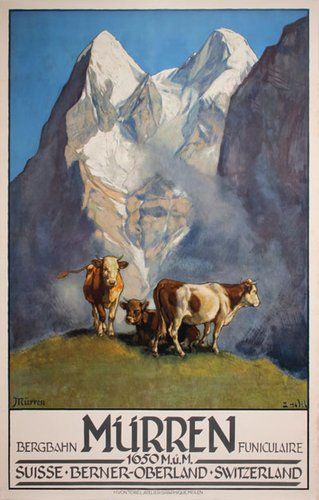
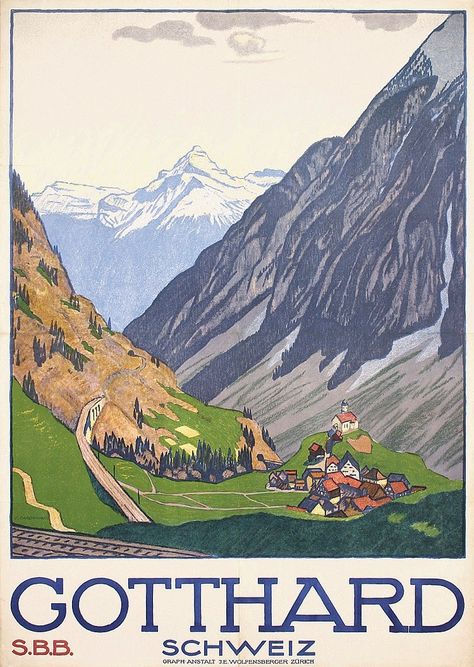
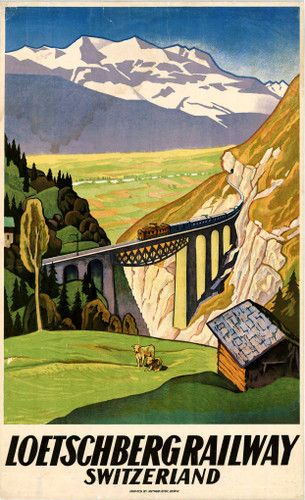
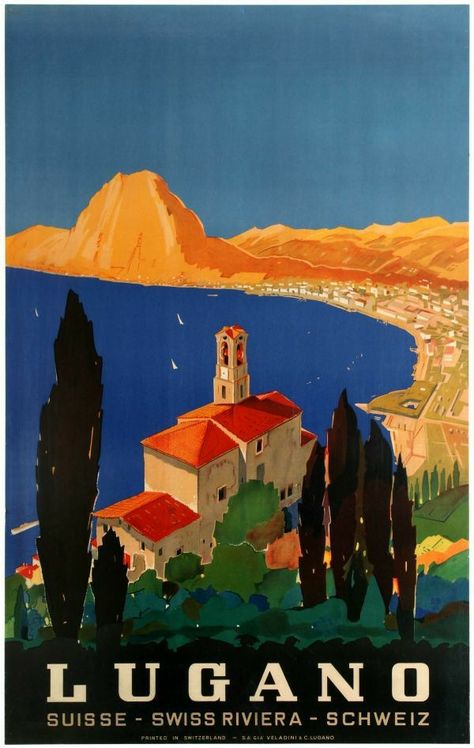
But today, I’d like to focus on Vintage travel posters, specifically for Switzerland. So far, I have nearly 350 in my collection, and it’s likely a drop in the bucket of what was produced; every region advertised itself to attract tourists or travellers, and it’s fascinating to see what they highlighted, how they did so, what their perspective was, and how the people dressed (if they’re shown – in Switzerland, at least, a big focus is on the Alps). Did you know that the word “homesick” in English came from Switzerland? The Swiss merchants that travelled abroad in the 17th century took the word with them; when they spoke of “Heimweh”, however, they weren’t referring to people, or their home, or even their town, but of the mountains. They missed the Alps when they were away… and I can understand why. I think it must run in the veins of every Swiss-born person; when my husband and his mother speak of the mountains, it’s a foreign language to me (even though I’m fluent in Swiss German!).
We might tend to think of tourism as a modern thing; but Grand Tours began in the 17th Century, when wealthy young men, and sometimes women, would embark from the UK on a European tour. At the beginning, Switzerland was a sleepy backwater in some ways – there were few, if any, hotels – if a traveller arrived in a town seeking accommodation for themselves, their servants, postillions and horses, they were often invited to stay in the home of the local politician, who likely had the largest house… But the Swiss soon caught up with the trend, and tourism became a vital source of income, especially for small settlements in the mountainous regions.
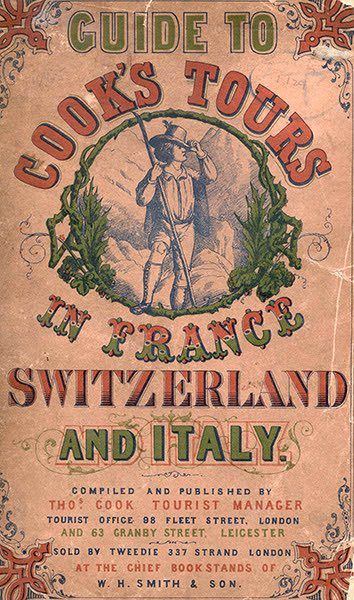
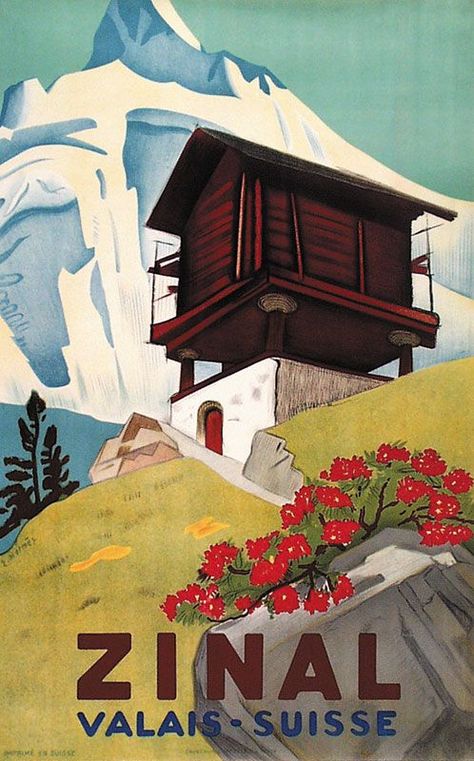
The three images below are, from left to right, from 1897, 1865, and likely the early 19th century. The house shown in the Zinal ad is typical of Wallis (Valais in French): It is built on stilts with round, flat stones between the pillar and house base; we chatted with an elderly man when we were on holidays in the region and asked him about it; it is a way to keep rats and mice out of the houses. It also means that the back, and sometimes even the front, is only accessible by ladder.
The 1865 poster is about a tour organized by Thomas Cook, a well-known name in the British travel industry even today; Cook took his first tour group of around 485 people on an 11-mile train trip from Leicester station to Loughborough, in 1841. Soon, he began to expand his scope, and by the 1860s, that included Switzerland.
The Spiez poster below shows the castle and lake; The Zürich poster shows a view over Lake Zürich from atop the Uetliberg mountain, the summit of which is called Uto Kulm. To see a live-cam panorama from that vantage point, just click here. The Mürren poster is a view typical of every Alpine pasture, even today.
The next 3 images are firmly in the Alps: The glacier shown in the first image is the Aletsch Glacier, the largest in the Alps, covering around 80 square kilometres (31 m2), with a length of ~23 km (14 miles) with a maximum thickness of ~1 km of ice. As with most glaciers in the world, it is retreating. Gotthard (officially the Saint-Gotthard Massif) is an impressive region connecting north and south Switzerland between Uri and Ticino, German- and Italian-speaking cantons, respectively. It has long been a major axis of Europe, with a road across, a vehicle tunnel through (built 1980), a cargo and transport train tunnel (opened 1882), and now a passenger- and vehicle-transport train tunnel which opened in 2016 and is the world’s longest railway tunnel and the deepest traffic tunnel, as well as the first flat low-level tunnel through the Alps. The 3rd poster highlights the Lötschberg, a massif with a train transport tunnel linking the north and south of Switzerland through the Berne and Valais routes. We often take this route when going to Valais or Ticino on holidays; the train is an open, continuous carriage, meaning you drive on, sit in your car, and watch the tunnel fly past.
The next 3 posters highlight something nearly ubiquitous in Switzerland: Lakes. They’re everywhere. We even share Lake Constance with Germany and Austria, and Lake Geneva with France. From border to border, we have over 100 main lakes and countless smaller ones (in an area what easily fits within the state of Maine, US, to give you a size comparison). The first poster is encouraging locals to explore, commemorating the 650th anniversary of the formation of the core of Switzerland. The second shows Lake Lugano from the perspective of Monte Bre, with the city of Lugano along the shore. It’s a perspective I know well, as the family had a holiday home on the flanks of Monte Bre until last year. San Salvatore is the mountain peak shown. The third poster is of the Vierwaldstättersee (“Lake of the four forested settlments”): This is the most complex lake in Switzerland, and not only for its names: In English it’s known as Lake Lucerne, although that is just one arm of the sprawl. Sections are Lake Lucerne, Lake Urner, Lake Kussnacht, Chrüztrichter and Lake Alpnacher. The many-armed lake is shared by the cantons of Uri, Schwyz, Obwalden, Nidwalden (originally one canton known as Unterwalden) and Lucerne. Signs of settlements found by archaeologists go back to at least 3,000 BC. To see this lake through live-cams, just click here. The site is in German, but just click on the view you’d like to explore.
I hope you’ve enjoyed this virtual tour! And perhaps you’ll come to Switzerland one day to see it for yourself!
I came across this story today, and wanted to share it: In the US, coal mining used to be big business; but with the move away from fossil fuels toward solar and other less destructive sources, companies have been in decline; before the mid-1970s, mining companies could just abandon the scarred land, but laws were passed that would require the companies to revitalise the wasteland; but if a company simply went bankrupt, the land sat barren, polluting the surrounding environment for decades, as rocks and minerals that had been buried forever were exposed to air and water, releasing their substances into groundwater and the air. Millions of acres of scarred land are the result.
Now, Appalachian Botanical Company in West Virginia has begun reclaiming the land in a beautiful way: Hiring ex-miners who’ve lost their jobs or other people who need a second chance just like the land, such as ex-drug addicts, they are now working in fields of flowers. Lavender is a hardy plant in the mint family that likes to grow in poor soil; it’s a perfect match for the rocky wastelands around coal mines. Every part of the plant is used: The flowers and upper stems are distilled down to make lavender essential oils that are then also used to make various creams and lotions, honey, salts, and hand sanitisers; when it’s done, they transform the biomass into compost to revitalise the land. The lower leaves are first removed, dipped in rooting powder, and planted to make the next harvest.
It’s an amazingly holistic approach to the problems: Creating jobs in the regions that have been hard-hit by economic downturns; revitalising the land through restoration – lavender will help prepare the land for other less hardy species to take root; and on a larger scale, it provides an example of what could be done with scarred land. To watch the Business Insider video, just click here. To check out the ABCo website and their products, click on the image below. Enjoy, and if you’d like to support what they’re doing, check out the pages on their websites, too.
If you don’t follow certain vloggers on YouTube, you might not have heard of #TeamSeas yet; if you do and have, then join the team!
First, a bit of history on this campaign: Back in 2019, YouTuber MrBeast hit 20 million followers, and a fan suggested that he celebrate it by planting 20 million trees (as one does). Fellow YouTuber and engineer/inventor Mark Rober, formerly of Nasa’s JPL Mars Curiosity rover team, joined the effort to launch the collaboration with the Arbor Day Foundation; YouTubers would raise the money through raising awareness, and for each dollar donated, a tree seedling would be planted by volunteers somewhere it was most needed, based on the assessments of the foundation’s research. The goal was reached before the end of 2020, reaching over $23,166,000 and counting.
Now fast forward to 29 October 2021: The same YouTubers have teamed up once again to launch TeamSeas, the aim of which is to clean up plastic marine debris.
Plastics, in the broader sense of the word, have been around for thousands of years, though the original products were made of natural rubbers or animals horns, both of which would break down and be reabsorbed into the environment with little impact. What we think of as plastics really began to boom after World War 2. The tragedy, or travesty, of it is that, from the beginning, manufacturers had no solution for recycling their product waste, but that didn’t slow down production. Every piece of plastic that has ever been made is in the environment somewhere.
In the oceans specifically, there are five natural gyres, or large circular ocean currents, and these corral floating debris into what are now known as “garbage patches”. The Great Pacific Garbage Patch is twice the size of Texas, and that’s just what’s floating on the surface.
The topic is a fascinating one to me, because I’ve collected garbage from beaches when we’ve gone on holidays to coastal areas, and I’ve seen the problem growing. About ten years ago, a Dutch teenager, Boyan Slat, was diving while on holiday in Greece. The garbage outnumbered the fish, and he decided to do something about it. He has invented robotic boats that are “great at catching plastic and terrible at catching fish,” as the catchments only go down a few meters, and move slow enough for fish and marine animals to simply swim down and away. He plans to release a fleet of these ships not only to the garbage gyres but also to the sources of the problems – rivers that wash garbage into the ocean from upstream.
The goal is for TeamSeas to raise $30 million before the end of this year; as of the moment of writing this, they have reached over $12,720,000. Half of the money raised will be going to Boyan Slat’s nonprofit organization to build and launch garbage-eating ships, and the other half of the money will go toward ocean conservation – this will be in the form of providing volunteers with the equipment necessary to clean up the beaches and waterways, and getting out onto the ocean to join the Ocean Cleanup’s work.
To find out more, please take the time to follow the links below:
The Ocean Cleanup begins to tackle the Great Pacific Garbage Patch and closes the loop by recycling the collected garbage into pellets, which can be turned into useable products, such as sunglasses.
Please consider getting involved in any way you can! If you can’t get out there and collect rubbish from a beach, a few dollars will go a long way to helping others reach the goal of cleaning up the oceans. The biggest thing you can do is to become aware of your own environmental impact: Recycle; use products wisely and dispose of them properly; upcycle where possible; check with your local government agencies about ways to improve collection and reuse of rubbish in your area; buy products that are not wrapped in plastic (e.g. fresh fruits and vegetables bought loose rather than in a plastic-wrapped convenience pack). Like the butterfly effect, every little step makes a huge difference in the long run.
I came across this word today, and knew I had to find out more: Coined by scientific researchers in 2020, it refers to the impact on wildlife that Covid-19 has had; specifically, the pause of mankind on a global scale through lockdowns and travel restrictions.
Whales have changed their conversations – it’s quieter out there, with fewer cruise ships (those massive floating cities can drown out every other sound in underwater monitors for an hour as they pass by); Pumas have been spotted roaming through Santiago, Chile, and flocks of Flamingos have landed in the waterways of Mumbai, India. The wild animals that live in cities, coming out only at nights in normal times, have started coming out to play in broad daylight. Birds, who have had to learn to call louder to attract mates in areas with traffic, can suddenly be heard loud and clear.
Not all changes have been positive, however; we live in a complex world, and in a world where some people will take advantage of the situation: Poaching has risen, as has Amazon deforestation. But on the whole, wildlife has benefited from the absence or reduction of human activity and presence. Roadkill has been reduced, and in those areas near nesting sites, such as beaches, birds have been laying more eggs than in previous years, possibly because they feel safer and are less disturbed by human noise pollution. Studies are beginning to emerge about just how the withdrawal of humans on a mass scale is impacting the environment and wildlife, and I hope that one of the results of such research is a plan for making our lives on a global scale become more compatible with, and supportive of, nature and natural rhythms.
In the meantime, with lockdowns continuing in many parts of the world (and because one never knows when and how travel restrictions will return, and no one wants to get stuck paying for a hotel in a foreign country for weeks on end of quarantine, travel is largely self-restricted), mankind is safely behind closed doors, and wildlife will come out to play.