The adage “Murphy’s Law” refers to the idea that anything that can go wrong will go wrong. You forget your umbrella and it will be sure to rain; your computer crashes at the worst possible moment; your worst itch is always where you can least reach it, and so on.
Similar sentiments are centuries old: E.g. Augustus D. Morgan, a British mathematician, wrote in 1866: “Whatever can happen, will happen”; Alfred Holt, an engineer, wrote in 1877: “It is found that anything that can go wrong at sea generally does go wrong sooner or later.” British stage magician Nevil Maskelyne wrote in 1908, “Everything that can go wrong will go wrong.”
But who was Murphy? And why is it his law? I’d always assumed that Murphy was either a fictional black sheep created to blame everything on, or someone from a century or more ago, much like Hobson of the “Hobson’s Choice” idiom; but Murphy’s Law comes from the 1940s aerospace era.
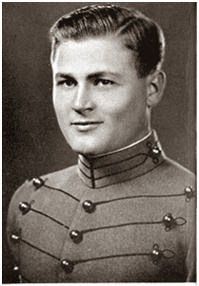
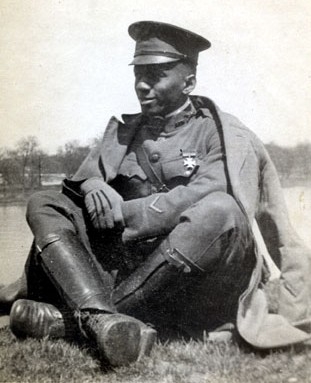
The “law” was coined by and named after Edward A. Murphy Jr. (b.11 January 1918; d.17 July 1990): Born in the Panama Canal Zone in 1918, he finished high school in New Jersey and eventually graduated from West Point in 1940, joining the Army Air Corps, serving in the Pacific Theatre of World War 2, and in the Korean War, reaching the rank of major. According to his obituary on findagrave.com, he is credited with design work on crew escape systems for some of the most famous experimental aircraft of the 20th century, including the F-4 Phantom, the SR-71 Blackbird, the X-15 rocket plane, and later the Apache helicopter. He also worked on safety and life support systems for NASA’s Apollo space missions. Although he was apparently chagrined by the namesake, he believed in the concept as a key to good defensive design – that one must always assume worst-case scenarios and work to counter them in thorough planning, engineering and execution of mechanical designs.
Around 1948, Murphy and his team were testing rocket sleds, which were used to test the acceleration of equipment deemed too hazardous to test in a piloted aircraft and also to test missile components without risking actual (more expensive) missiles in the testing. The saying arose when training his engineers to avoid designing missile components that could be confused one for another; he said, “If a part can be installed in more than one position, it will be incorrectly installed in the field.” Perhaps Murphy was familiar with the sentiment of those past engineers, given his background in engineering, but wherever it came from, his name was attached and, as they say, the rest is history.
Edward Aloysius Murphy Jr, in his West Point uniform
Back in January, I wrote about the phenomenon of the Hum, something that occurs around the world.
Another global phenomenon is that of “ghost lights,” also known as fata morgana, mirages (both inferior and superior), will-o’-the-wisps, fairy fires, or ignis fatuus (“foolish flame”).
I grew up in a climate zone with hot, dry summers and wide, flat highways that stretched to the horizon. On a hot summer day, you could see the cab of a semi-truck floating mid-air for some distance before you actually saw the truck finally touch the ground. Sometimes the highway would look flooded – this kind of water mirage is also a danger in desert regions. Death Valley is dangerous, not only because of the heat but also because of disorienting mirages.
Ghost Lights can have a variety of natural causes: methane gas combustion or other organic decay which can cause photon emissions (these lights often appear over swamp or boggy areas); light refraction in certain atmospheric conditions that cause the lights of cars on distant roads or firelights from campfires to “float” midair (like the semi-truck cab above); it may also be caused by the bioluminescence of various micro-organisms and insects.
For a fun dive into these phenomena, the Why Files has a video covering the topic (the actual content starts at 4:15); I enjoy his videos because the author in me likes the way he sets stories up as real – as if reporting facts – before he debunks them or offers probable explanations. While he knows that many people likely believe in the stories he eventually debunks, he goes about it in a respectful, tongue-in-cheek way.
The baroque town of Solothurn, though only an hour away from our home, was unfamiliar to us until my husband and I took a day trip this week. It has a beautiful historical centre and is known as the “city of elevens”: It was the 11th canton to join the Swiss Confederation; there are 11 towers in the fortification walls of the city; there are 11 churches and chapels, and 11 historical fountains throughout the city; the stairs leading up to the St. Ursus Cathedral have landings every 11 steps; the cathedral itself has 11 altars and 11 bells; the local brewery, producing an eponymous beer, is even called Oeufi – which is a Swiss dialectical word for eleven. 11:00 is the most “auspicious” time to set appointments in the town, and there is even a clock, hanging on the wall of a local bank, which is segmented into 11 hours; it has 11 cogs and 11 bells, which are chimed by a metalwork sculpture of a harlequin on the hours of 11:00, 12:00, 17:00 and 18:00. The bells chime to the tune of the city’s unofficial anthem, the Solothurner Lied.
Solothurn’s history dates back to the palaeolithic era, and its Roman era is dated to around AD 15-25; it was first mentioned in AD 219 as vico saloduro, and may have referred to a Celtic settlement, possibly meaning “Salo’s fort/stronghold”. In the Battle of Sempach, July 1386, the Habsburgs attacked Solothurn; it was a decisive Swiss victory, and even more importantly, it helped to solidify the loosely allied Swiss Confederation cantons into a more unified nation and is seen as a turning point in the growing strength of Switzerland as a nation. Today, it is largely bypassed by tourists due to its proximity to Bern, the Swiss capital, so it remains a hidden gem.
Another interesting clock is the clock tower, the “Zeitglockenturm”, a tower built in 1152 and first mentioned as a “clock tower” in 1406. If you look closely, you’ll see typical rain spouts coming off of the corners of the tower’s spire and roof, shaped like dragon’s heads. The 24-hour astronomical clock was built by Lorenz Liechti and Joachim Habrecht in 1545. The sun and moon hands both run counterclockwise; the moon makes one complete rotation every 27 days, while the sun makes one complete rotation every 365 days.
According to the Roter Turm website, there’s a humorous story connected to the upper, 12-hour clock: By 1753 the hour hand and the bells were no longer in sync; a commission contacted the watchmaker Niklaus Pfluger, reminding him of his gild’s oath, i.e. his responsibility to correct the clock. He suggested to the local government council that they add a minute hand; but minutes were not so important in the 18th century, apparently – they told him to leave it as it had always been. He took matters into his own hands (I guess it was easier to ask for forgiveness than permission…) and in 1756, he added a minute hand. He justified it as the “warning hand of God” – but he made it smaller, less noticeable than the hour hand, so on this clock, the small hand shows the minutes, not the hours.
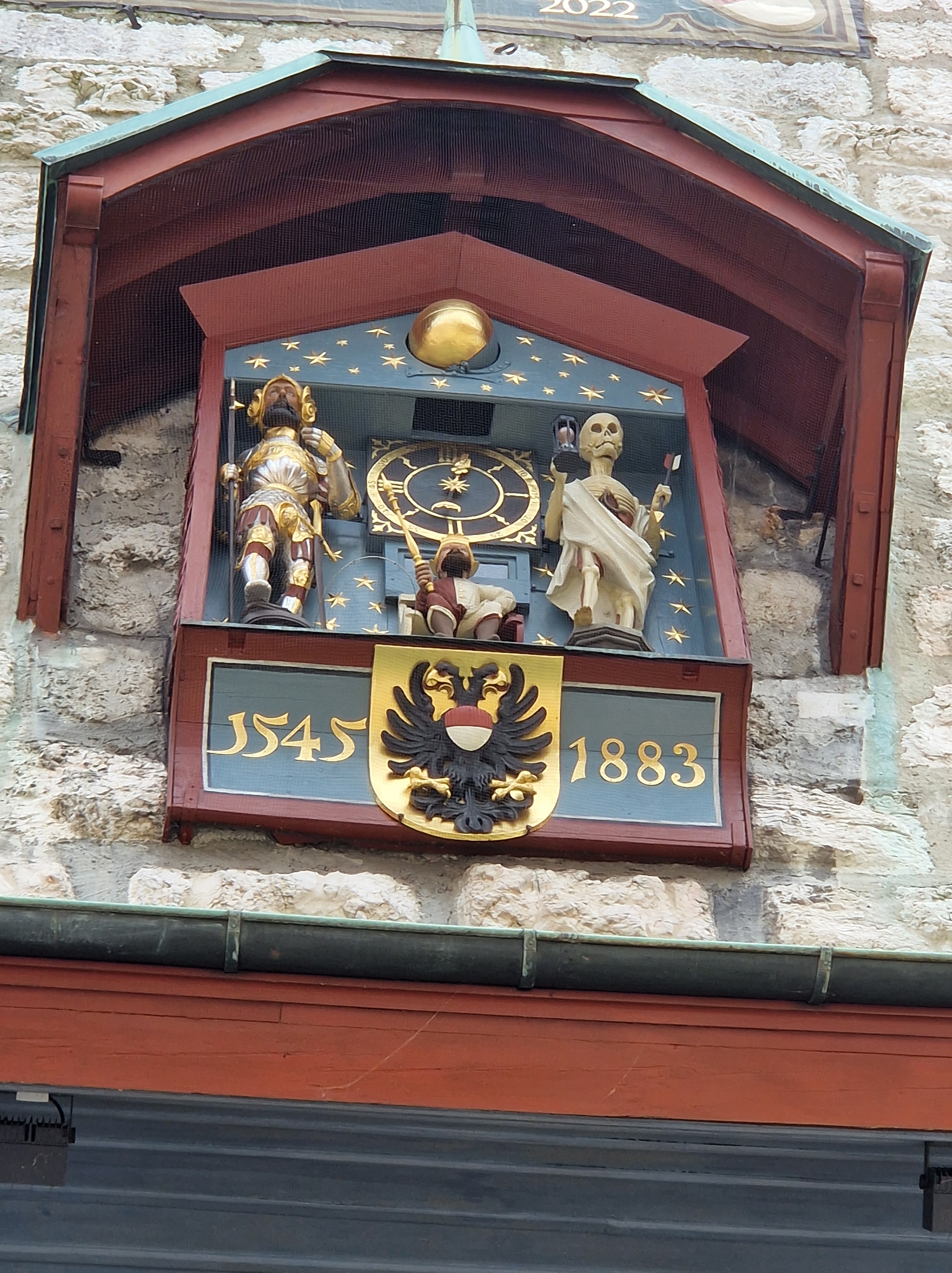
Because the clock tower was built and added to over time, you’ll see four dates on the full image of the tower: 1411 and 2022 on the highest, 12-hour clock; and 1545 and 1883 on the central tableau; the latter dates usually refer to restorations.
The three figures in the central tableau above the clock are a knight, king, and skeleton (Death), which perform every hour: The knight holds a battleaxe in his right hand, and a sword in his left; every quarter-hour, he turns his head toward Death and strikes his breast, signifying his loyalty to the central figure, the king. On the right stands Death; in its right hand is a hourglass, which is turned on the hour, symbolizing the contradictions of life – good, bad, life, death. In the other hand is an arrow, showing that one could be struck down at any moment. On the hour, its head turns toward the knight.
On the throne between these two figures is the king: In his right hand is a sceptre, which he lifts on the hour. His jaw moves in rhythm with the hour hand, and his beard represents wisdom. However, notice that he’s wearing red and white fool’s garb: If the king does not rule with wisdom and the humour of a fool, his reign will become a tyranny. It tells us that life should have moments of both wisdom and a jester’s humour.
While Death announces the hours, the king swings his sceptre. At the same time, Death nods with each stroke and confirms the relentless passing of the hours. The king with his fool’s garb reminds us of the memento mori. When death or illness reigns, even the power of a wise king can do little (Solothurn was hit by the plague, e.g. in 1348). Though the Freudian era banished death from contact with the living in many Western cultures, death personified as a skeleton is still a symbol seen in many countries around the world. Having death constantly before your eyes encourages you to savour each moment of life.
I hope you’ve enjoyed this brief glimpse into a beautiful city with an ancient history!
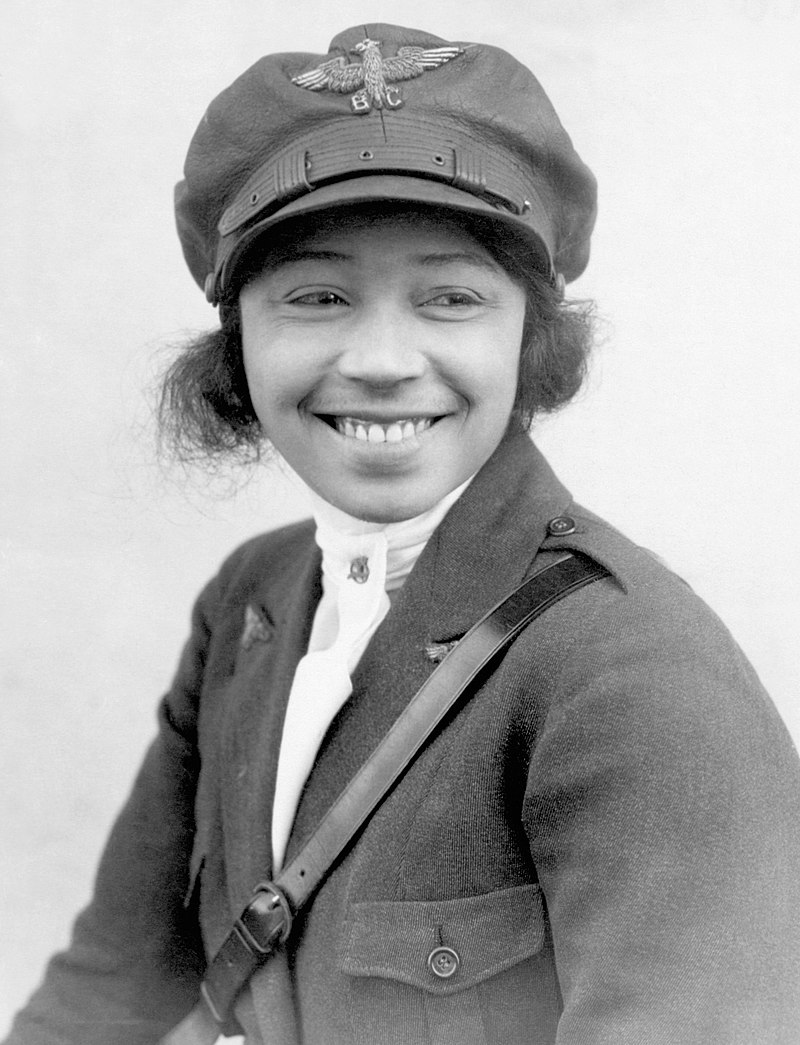
I like to highlight, or “undust” figures or circumstances from history that few may have ever heard about, but that deserve to be remembered. Bessie Coleman is one such figure from history: In her life that was cut short, she made a difference by going against the norms and following her dreams, regardless of the limitations put on her by society because of her race and gender.
Bessie Coleman, 1923 – Photo Credit: George Rinhart, Corbis via Getty Images
Born in January 1892 in Atlanta, Texas, as the tenth of thirteen children in a sharecropper family, she worked in the cotton fields and attended a small, segregated school. She was not only African American but also had Cherokee heritage through her mixed-race father. Despite her humble beginnings, by 18 she’d managed to save enough money to attend one term of college at Oklahoma Colored Agricultural and Normal University (now Langston University) in Oklahoma, which was probably the closest university that would take a young black woman in the early 1900s. With no funds left, she moved back home, working and saving her money. At 23, she moved in with her brothers in Chicago, Illinois, and worked as a manicurist in a barbershop; there, she heard the tales of World War I pilots, and her dream was born.
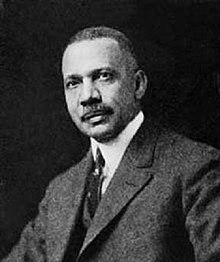
Robert Sengstacke Abbot, Photo, Chicago Literary Hall of Fame
At the time, American aviation schools had no place for either African Americans or for women, but she was encouraged by Robert S. Abbott, founder and publisher of the Chicago Defender, to study abroad. He publicized her story in his newspaper, and she received the financial support to pursue her dream from a prominent African American banker, Jesse Binga, and from the Defender.
Jesse Binga, Credit: Wikipedia, John Schmidt
She took a French language course in Chicago, and in November 1920, she travelled to Paris to earn her pilot licence. On June 15, 1921, Coleman became the first African American woman as well as the first Native American to earn a pilot license and an international aviation license from the Fédération Aéronautique Internationale. She then spent the next two months learning more from a French veteran pilot near Paris. In September 1921, she sailed back to America and became a media sensation.
With civilian commercial flights still a thing of the future, she would have to earn her money as a “barnstorming” stunt pilot. The skills needed to fly dangerous stunts were beyond her scope, and still out of her reach in America, so she again returned to Europe, where she trained in France. From there she went to the Netherlands to meet Anthony Fokker, one of the world’s most distinguished aircraft designers. At his company in Germany, she received further training from one of the company’s chief pilots. Returning once again to the US, she finally launched her career in exhibition flying.
“Queen Bess” was a popular draw for the next five years. She used public attention to engage audiences in promoting aviation and battling racism; she refused to take part in any aviation exhibitions that barred African Americans from attending. At one point, she was offered a role in a film, “Shadow and Sunshine.” She accepted, hoping that it would help her raise enough money to open her own aviation school. But when she learned that the first scene would portray her in ragged clothes, she walked off the set – her principles would not allow her to spread the disparaging image most whites had of most blacks.
Her goal was not just flying, but to make a difference in history; unfortunately, she did not live long enough to see just what a great influence she would have: On 30 April 1926, a faulty plane went into a dive and spin at 3,000 feet above ground; on the way down, Bess was thrown from the plane and killed on impact. Later, it was found that a wrench used to service the plane had been forgotten inside and had jammed the controls.
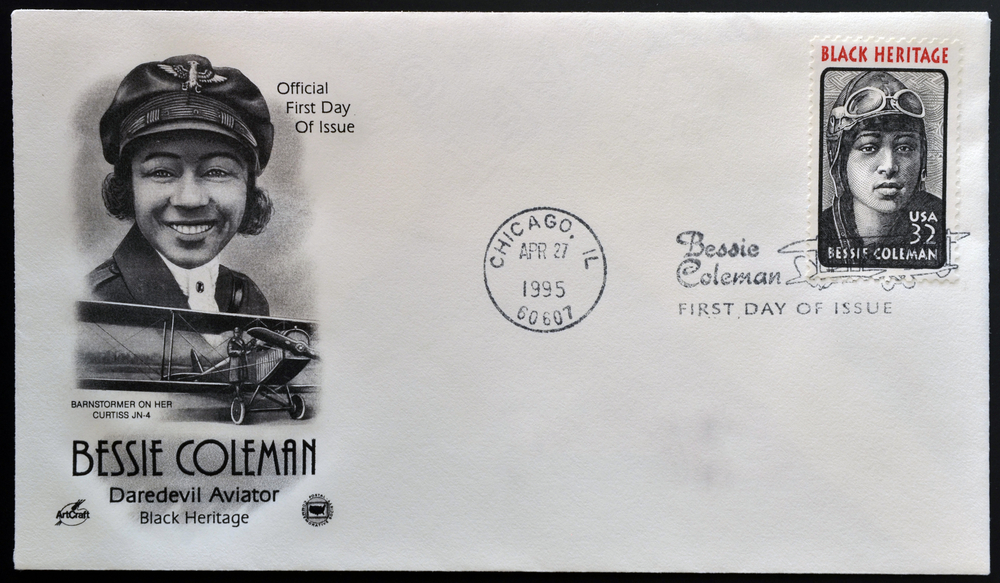
Posthumously, her name is honoured through the renaming of streets (including three in France), of roads near airports (including one at Frankfurt Germany’s international airport), a public library in Chicago, schools, aviation-related companies and wings of airports, scholarships, a US postage stamp (in 1995), a cartoon character, and she has been inducted into several halls of fame for both women as well as aviation; and last but certainly not least, she has a geological feature on the southern hemisphere of Pluto named in her honour, Coleman Mons.
William J. Powell, Pioneer aviator and civil rights activist
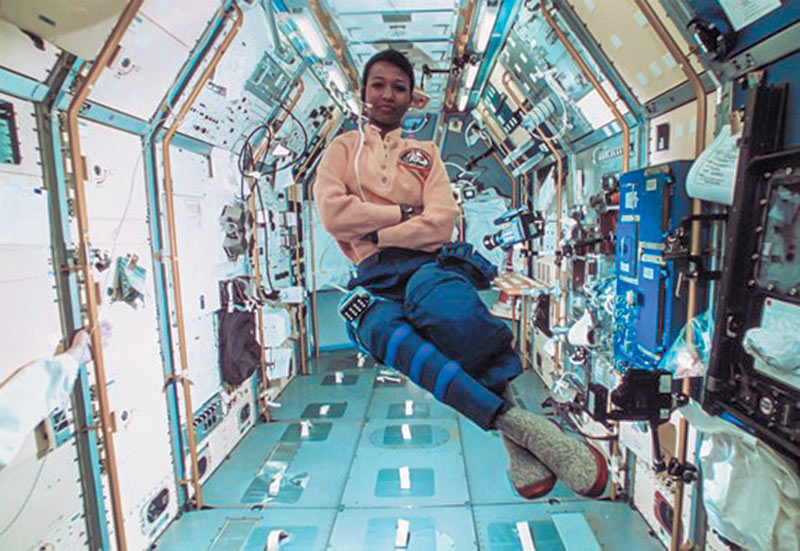
Lieutenant William J. Powell dedicated his book, Black Wings, to her. His sentiment is summed up well in a quote: “We have overcome that which was worse than racial barriers. We have overcome the barriers within ourselves and dared to dream.” Powell founded the Bessie Coleman Aero Club in 1929. Mae Jemison, the first African-American female astronaut in space, carried a photo of Bessie Coleman with her on her first mission.
Mae Jemison, Photo credit: The Museum of Fine Arts, Houston
What I find most inspiring about her story is not only her unwavering determination to reach her goals, but that throughout her life, she found people willing and able to support her in accomplishing it: Without the idea encouraged by a publisher to look beyond the borders of America and promoted in his newspaper to raise support, without the teachers in Europe investing in her skills (how many inter-war pilots could say they’d been trained by top war ace pilots?), and without the financial support given at a time she needed it, her dreams might have remained unfulfilled, or too long in the making – those parameters needed to make her into a pilot who inspired future generations shifted drastically with the outbreak of the Second World War.
In Esther 4:14, Mordecai, the uncle of Queen Esther, tells her, “Who knows but that you have come to your royal position for such a time as this?” In the brief window of time that Bessie reached for the heavens, she may not have lived to see her legacy, but her life and death were not in vain.
I do a lot of crafts. I mean, a lot variety-wise, and a lot quantity-wise. When I’m not writing, managing our household, planning meetings or teaching students (I’m a vocal coach and an English teacher for adults), I’m usually doing some kind of craft, and it more often than not involves some form of upcycling – turning “trash” into “treasures”. Recently, I’ve been making sheets of plastic-confetti-filled bubble wrap, ironed into what’s known as “ploth” (plastic cloth). These can then be sewn into bags, etc. It got me to thinking about just how bubble wrap came to be. I have tons of the stuff, stashed here and there in the craft room, for such projects – and I’m constantly on the lookout for creative uses for that poppable fun.
Did you know that originally it wasn’t intended as packing material but as wallpaper? In 1957, Swiss chemist Marc Chavannes and his business partner, Alfred Fielding, wanted to make a wallpaper that would appeal to the emerging Beat culture [for those of you unfamiliar with that term, it was a generation of post-war, anti-establishment rebels who were more or less the precursor to the 60’s hippie and counterculture movements]. What the partners did was simple enough: They put two layers of a plastic shower curtain through a heat-sealing machine. But it came out in what they first saw as a failure, with air bubbles trapped between the two layers. They figured they were onto something, failure or not, and so they got a patent and then began experimenting to find other uses. Wallpaper wasn’t popular; neither was their suggestion to use it as insulation for greenhouses (perhaps that was simply a matter of marketing to the wrong demographic). Then, around 1960, IBM began shipping their newly-designed 1410 computers and needed a way to protect the delicate dinosaurs – eh, I mean, computing mammoths. That’s a LOT of bubble wrap. The rest is, as they say, history. And in case you’re wondering, yes, people have been popping the bubbles from the beginning, just for fun. So much fun, in fact, that the last Monday of every January is officially “Bubble Wrap Appreciation Day”.
Click on the image below to watch an IBM recruiting film (1 minute), from 1960. You can also see one of IBM’s massive scientific mainframes being used by the original “computers” of NASA in the film “Hidden Figures“.
IBM’s 1410 computer promotional photo, 1959. Credit, Computer History Museum archives
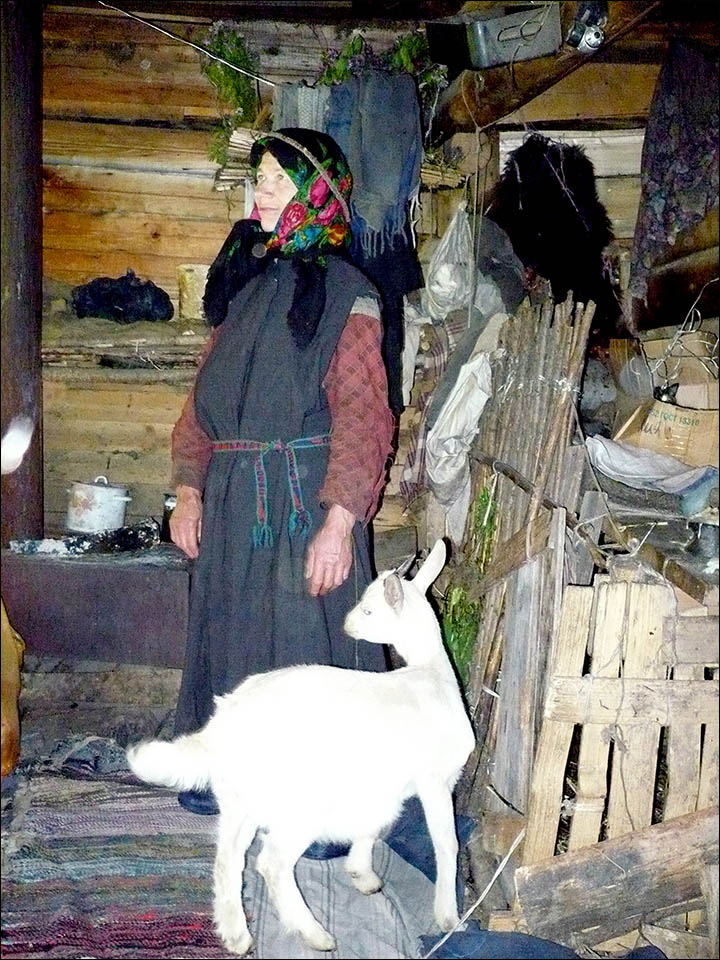
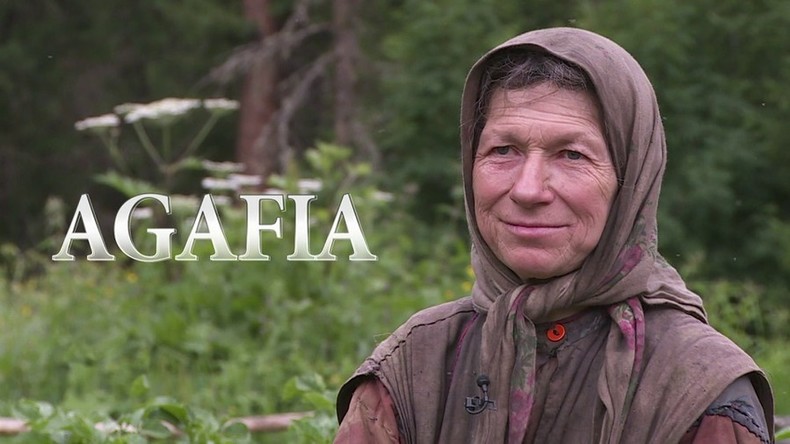
I recently came across a documentary about a woman, Agafia Lykov. I’d come across information about her family years ago, and had intended to write an article about them; life happened, and I forgot about it, so I’m glad to do it now.
The Lykov family were part of what is known as the “Old Believers” – Eastern Orthodox Christians from Russia who refused to submit to the new regulations laid out by the Patriarch Nikon of Moscow, between 1652 and 1666. At a time when religious affiliation was political power, they were viewed as a threat and were shunned and persecuted. In 1936, Karp Lykov’s brother was killed by communists during Stalin’s religious purgings, and he fled with his wife and two children into the Taiga wilderness, an inhospitable region of Siberia. In this isolation, 250 km (160 miles) from the nearest settlement, two more children were born; Agafia was born in 1944.
The family was a living time capsule; they weren’t aware that World War 2 had come and gone; they missed the birth of the Space Age, though they knew that something had taken place when rocket chunks began raining down in the Taiga near their home, as they are under the flight path of the Baikonur Cosmodrome in Kazakhstan (if you have Google Earth, just search for her name; her homestead is marked). Survival was difficult, and they had to work constantly; in 1961, the mother, Akulina, starved herself to death in order to give the children a fighting chance of survival when food was scarce. At one point, they were forced to eat their leather shoes to survive. Agafia’s teeth have been worn down from eating such tough foods.
In 1978, they were discovered by accident when a geology team’s helicopter was searching for a place to land in the remote wilderness; they saw the homestead and decided to trek to it when they’d finally landed. Most likely as a result of contact with outsiders, in 1981, three of the four children died of pneumonia. At first, the geologists thought the children were mentally disabled, as they spoke a strange lilting and chirping language; but they soon realized that it was simply the isolation and family dialect that had developed a shorthand between themselves; Agafia actually speaks two languages: Russian and Old Slavic, which modern Russians cannot understand (it would be the same for English speakers to hear Old English; it’s related, but unrecognizable to its modern version).
Born into such isolation and alone since 1988, Agafia is surprisingly informed about the wider world; she has left her homestead for populated areas only six times since contact with the outside world began, but she prefers her home – the world is too busy for her, too many cars, bad air in the cities, and no peace. Her beliefs are also a time capsule; she only knows what her father taught her, and has had no teaching beyond that; her prayer book is over 400 years old, a family heirloom, and one she uses every day.
In January 2016, she was airlifted to a hospital in Tashtagol, Russia, due to pain in her legs caused by the cold. Before the end of the month, she had returned home – all the time she was away, she was worried about her goats and chickens, and about Georgy, and Old Believer who had come to live with her to help in her old age.
I find her life fascinating; she is an example of the unquenchable human tenacity to survive, and thrive in any environment; she is content with her simple life, as hard as it is, because it is what she knows; she knows of modern conveniences, and has accepted some things – learning how to make bread, or accepting supplies such as salt and flour (as long as the products don’t have barcodes on them, which she considers a “mark of the beast”); but for the most part, she wants nothing of the modern world.
To watch a 35-minute documentary (made in 2013) of her daily life, just click on the image below.
The topic of names could cover quite a wide variety of areas, such as naming babies, place names, collective names of animal groups, or translations of names into languages such as Elvish or Runes; but I’d like to focus on the naming of characters for fiction writers.
Choosing character names can be fairly straightforward if you’re writing contemporary fiction; having said that, be sure to choose names that are not too similar from one character to the next. Unless there is a reason for close names, such as Sandy and Brandi for twins, the names need to stand apart to help readers keep straight who’s who, especially if there are multiple characters in a scene. In Lord of the Rings, however, JRR Tolkien uses names to comical effect when naming the dwarves: Bifur, Bofur & Bombur; Dori, Nori & Ori; Kili & Fili; Balin & Dwalin; Gloin & Oin; only Thorin stands out as leader and king with a unique name.
When choosing names for modern characters, consider their place, time and age: If you’re writing a grandfatherly character, he can have a name that was popular in the ‘30s or ‘40s; but if your character is in their 20s, then don’t name them Mildred or Frank. If you are writing children’s fiction, keep the names modern and simple to pronounce when reading aloud.
If you’re writing historical fiction, consider the era and country in which you’ve set your characters. For my 18th century trilogy, I compiled a list of names from parish records in southern England from the early-to-mid 18th century, and then condensed it down according to frequency; that gave me a list of the top 20 male names and top 20 females names from which to choose. Back then, children could only be christened with Christian names approved of by the church; names of kings and queens were popular, such as James, William, Charles, Anne, Charlotte, or Elizabeth. Biblical names from the New Testament such as Timothy or Mary were also popular, but Old Testament names, such as Jacob or Rachel, were only given to Jewish children. If you’re setting your story in the ancient Middle East, then find out what names were common then and there; just make sure that whatever you name your characters, they’re easy to read. Combinations of consonants that are difficult to read will be skipped over – a pity, if your main character is saddled with a forgettable name, such as Cthulhu (Lovecraft), or Tylwyth or Tleilax (Dune). In my 18th century trilogy, I also had a few characters’ names which emphasized their general character: Mrs Stacklesprat was a prickly, withered, gossiping, sour woman, while Mrs Huddlepoke was a cuddly, motherly, soft & jolly woman.
For Science Fiction and Fantasy genres, names can be drawn from sources such as planets, galaxies or stars (Andromeda, Galaxus, Draco), or objects such as trees or flowers, or natural occurrences (Vortex, Sparkle, Wave, etc.)
There are so many resources available for choosing names these days: Online you’ll find dozens of sites for baby names and what they mean; a great place to find names is in film credits – I watch those with pen in hand, and when I find an interesting first or last name, I jot them down; you can combine them randomly and come up with some great fictional names.
Things to consider when choosing your names:
Culture: Don’t assume a name is Japanese when it might be Chinese – research!
Era: Don’t choose a modern name for a character set in the 1920’s, and vice versa.
Age of character: Give age-appropriate names to each character, especially for modern fiction.
Combinations with other characters’ names: Unless you’re going for the comical effect of JRR Tolkien and have the language chops to carry it off, choose names that differ from the others in your story.
Occupation: Don’t name your murderer Fluffy…
Ensure it’s fictional: Don’t name a character and publish your book, only to find out it’s a real name (unless it’s John Doe – then I’d say, go back to the drawing board with choosing a good name)! Google it to see if it exists…
Be cautious: If a character is closely based on someone you know, choose a name unrelated to your (soon-to-be-ex) friend or relative…! Also, there are certain names that are taboo due to historical events; I’d never recommend naming your character Adolf, or Hitler, or Stalin.
Personality: If your character is a sturdy, reliable, powerful personality, don’t give them a wimpy name! And if a character is a wimp by nature, don’t give them a powerful-sounding name – unless they’re going to grow into the name over the arc of the story.
Meaning: A name’s meaning might have bearing on your character; it could also add a double meaning. In the story I’m currently writing, a character is called Janus; this was the name of a Roman god who was two-faced – one looking to the past and the other to the future; it is also the name of one of Saturn’s moons. As the story is Science Fiction, either meaning applies to my character.
I hope these thoughts help you on your way to choosing memorable character names for your own projects. Whatever you do, keep writing!
There’s no denying the fact that computers are huge blessings – combined with that little invention called “internet” they’re an unstoppable pair… until they stop, and life comes to a screeching halt.
That happened last week, as our main office computer gave up the ghost, after fighting a long, painful demise. My own laptop, from which I write, has been limping and is in need of repair, but it was our only lifeline to ordering a replacement… done, and three days later, the packages arrived! I’ve spent the better hours of 5 days sorting out things like transfer of emails and contact lists, programmes, updates, software and hardware setups, and patch-jobs to get old programmes to understand the new ones and vice-versa!
Instead of the “old fashioned” desktop computer with a huge processor that either stands on the floor and collects cat hairs and dust bunnies or stands on our desk and collects dust bunnies and cat hairs, we decided to go with a laptop hooked up to a docking station and two screens. Sweet! And yes, I can use both… it’s great when I’ve got research documents open while writing, or doing translations or editing two documents simultaneously. Now, to get my laptop repaired.
It’s amazing how we’ve become so dependent on computers, isn’t’ it? Personal computers didn’t really begin to enter households in any significant way until around 1990; technically, they hit the market in the early ’80’s, but the products were mostly limited to electronics geeks and university libraries. We got our first home computer in 1993, and it had RAM of a whopping 256 MB!! How could anyone ever use THAT much?? Now we’ve passed Gigabytes, and we’re into terabytes (TB, 10004 ), and it won’t be long until we’re into petabytes (PB, 10005), exabytes (EB, 10006 ), zettabytes (ZB, 10007) and yottabytes (YB, 10008). I remember writing business letters in DOS – back before Windows, virtual desktops or virtual wallpaper had even been dreamt of. I remember floppy discs – the latest in technology, now used as drink coasters somewhere in the world, I’m sure. 5-inch floppy discs became passé with the advent of (gasp!) 2-inch version… how could anything that small have so much space on it (1.44 MB). Imagine – back in the advent of computers, there was no Microsoft, no Amazon, no internet, no cloud storage, no dropbox, no websites, no Skype… they were essentially an information processor, with transfer of information only possible through a floppy disc or good ol’ fashioned printouts and photocopies (we won’t even go into the whole issue of the love-hate relationship most secretaries had with the first few generations of photocopiers).
Do you remember cassette tapes? Polaroid cameras? Now music is on a cloud or virtual shelf, and selfies and Instagram have made physical print photos nearly obsolete, except as an art form.
These images show how far we’ve come in less than 40 years. But you ain’t seen nothin’ yet. Check out these up-and-coming products or concepts that are in the making: Just hover your cursor over each image for more information.
For you Sci-Fi buffs out there, that title will be very familiar, as it is the opening line of the Star Trek manifesto. The novel I’m working on at the moment is just that – Sci-Fi, albeit not Star Trek. It nevertheless takes me into space, and that’s always a fascinating thing! So here are a few fun facts about what lies beyond our atmosphere:
Jupiter’s Ganymede is the largest moon in the Solar System, and is even larger than the planet of Mercury.
Venus is the hottest planet in the solar system, with a surface temperature of 460°C. A day on Venus is 243 Earth-days long, but its year is only 224.7 days; Venus spins backwards on its axis.
Oxygen is the third most common element on the Sun, after helium and hydrogen.
A neutron star is the strongest known magnet in the universe, and such stars are among the fastest-spinning objects observed, spinning up to 500 times per second.
Since 1992, when the first exoplanet was discovered, there have been 3,728 confirmed planets in 2,794 systems, with 622 systems having more than one planet.
About 1 in 5 stars comparable to our sun have an Earth-sized planet in the habitable zone (known to scientists as the “Goldilocks Zone”). It is assumed that there are 200 billion stars in the Milky Way Galaxy alone; based on that, there would be 11 billion potentially habitable Earth-sized planets in our galaxy (and up to 40 billion if you count red dwarf stars as well).
Proxima Centauri is the nearest star to us beyond the Sun.
Russia is larger than the entire surface area of Pluto.
The largest known star is Westerlund 1-26, which is 2,000 times bigger than the Sun.
Olympus Mons, on Mars, is the largest volcano in the solar system. Due to the low gravity of Mars and the lack of plate tectonics, it has been able to grow to three times higher than Mount Everest.
Dark matter and dark energy are thought to make up nearly 95% of all matter in the universe.
The Boomerang Nebula (also known as “the Bow Tie Nebula”) is the coldest known place in the universe, with a temperature of 1 K (−272.15°C; −457.87°F).
The Sun is growing, but we won’t have to worry about it for a few billion years, when it will become close enough to swallow the Earth.
On Mercury during the day, the Sun rises, stops, and then sets where it rose. It rotates on its axis exactly three times for every two revolutions it makes around the Sun, meaning that, if you lived on Mercury, you would only see one day every two years.
The Sun’s core releases the equivalent of 100 billion nuclear bombs every second, and its energy is emitted as heat and light.
The storm on Jupiter known as the ‘Great Red Spot’ has been going on for at least 350 years; it’s so large that dozens of Earths would fit into it.
A supermassive black hole is thought to be present in the centre of nearly every galaxy, including our own (ours is a runt compared to the average size).
Shooting stars really aren’t stars; they’re meteors – and even then, they are often only dust particles falling through our atmosphere that vaporize due to the heat of friction with the atmospheric gases. If they are large enough to survive the journey through our atmosphere and impact on the ground, they are called meteorites.
We are in constant motion; planets move within the solar system, the solar system moves within the Milky Way Galaxy, which in turn moves within The Local Group of Galaxies; the local group is moving toward the Virgo Cluster.
Apollo 14 astronaut Alan Shepard left two golf balls on the Moon in 1971. They’re still there: One is in the Javelin Crater, and the second fell near where the ALSEP (Apollo Lunar Surface Experiment) was deployed.
The Moon’s Javelin Crater gets its name because on the Apollo 14 mission, fellow astronaut to Shepard, Ed Mitchell, threw the Solar Wind Collector staff as a make-shift javelin.
Uranus has 27 known moons, all of which are named after characters from the works of William Shakespeare and Alexander Pope.
Jupiter has 69 known moons.
Jupiter, Saturn, Uranus and Neptune have no solid surface to land on, being comprised of gas.
Did you know that the Earth is actually a ringed planet by now? At the last official count (2013), more than 170 million pieces of space junk debris smaller than 1 cm (0.4 in), about 670,000 debris 1–10 cm, and around 29,000 larger debris were estimated to be in orbit; these clouds (in both the geosynchronous Earth orbit and the low Earth orbit) make it hazardous for spacecraft, due to the dangers of collisions; they basically sandblast craft, which makes the launch of equipment like telescopes or solar panels extremely susceptible to damage.
Below 2,000 km (1,200 mi) Earth-altitude, debris are denser than meteoroids; most are dust from solid rocket motors, surface erosion debris like paint flakes, and frozen coolant from RORSAT nuclear-powered satellites (according to Wikipedia). Maybe it’s actually a good thing that we can’t make it to other planets to colonize…








 There’s no denying the fact that computers are huge blessings – combined with that little invention called “internet” they’re an unstoppable pair… until they stop, and life comes to a screeching halt.





 Stephanie Huesler