Category Archives: Writing Exercise

Comprehensive Examination

Recently, my office got an upgrade, my “office” being in our home library. I got a larger desk, and in the process of moving the old out and the new in, I took the opportunity to do a bit of “house cleaning” – sorting through papers, a notebook full of articles, and bits and bobs I’d kept over the years for teaching English to adults (I was an active EFLA teacher for more years than I care to calculate!). One of the papers I came across was the following; I knew I needed to share it because it always gives me and my husband a good laugh. I don’t know who originally wrote this, but it’s genius!

Comprehensive Examination

Instructions: Read each question carefully. Answer all questions. Time limit: 4 hours.  Begin immediately.

HISTORY: Describe the history of the papacy from its origins to the present day, concentrating especially but not exclusively, on its social, political, economic, religious and philosophical impact on Europe, Asia, America and Africa. Be brief, concise and specific.

MEDICINE: You have been provided with a razor blade, a piece of gauze and a bottle of scotch. Remove your appendix. Do not suture until your work has been inspected. You have fifteen minutes.

PUBLIC SPEAKING: 2,500 riot-crazed Aborigines are storming the classroom. Calm them. You may use any ancient language except Latin or Greek.

BIOLOGY: Create life. Estimate the differences in subsequent human culture if this form of life had developed 500 million years earlier, with special attention to its probable effect on the English parliamentary system. Prove your thesis.

MUSIC: Write a piano concerto. Orchestrate and perform it with flute and drum. You will find a piano under your seat.

PSYCHOLOGY: Based on your knowledge of their works, evaluate the emotional stability, degree of adjustment and repressed frustrations of each of the following: Alexander of Aphrodisias, Ramses II, Gregory of Nicea, Hammurabi. Support your evaluation with quotations from each man’s work, making appropriate references. It is not necessary to translate.

SOCIOLOGY: Estimate the sociological problems which might accompany the end of the world. Construct an experiment to test your theory.

MANAGEMENT SCIENCE: Define management. Define Science. How do they relate?

COMPUTER SCIENCE: Create a generalized algorithm to optimize all managerial decisions, assuming an 1130 CPU supporting 50 terminals, each terminal to activate your algorithm; design the communications interface and all necessary control programs.

ENGINEERING: The disassembled parts of a high-powered rifle have been placed in a box on your desk. You will also find an instruction manual, printed in Swahili. In ten minutes a hungry Bengal tiger will be admitted to the room. Take whatever action you feel appropriate. Be prepared to justify your decision.

ECONOMICS: Develop a realistic plan for refinancing the national debt. Trace the possible effects of your plan in the following areas: Cubism, the Donatist controversy, and the wave theory of light. Outline a method for preventing any negative effects. Criticize this method from all possible points of view. Point out the deficiencies in your point of view, as demonstrated in your answer to the last question.

POLITICAL SCIENCE: There is a red phone on the desk beside you. Start World War III. Report at length on its socio-political effects, if any.

EPISTEMOLOGY: Take a position for or against the truth. Prove the validity of your position.

PHYSICS: Explain the nature of matter. Include in your answer an evaluation of the impact of the development of any other kind of thought.

PHILOSOPHY: Sketch the development of human thought; estimate its significance. Compare this with the development of any other kind of thought.

GENERAL KNOWLEDGE: Describe in detail. Be objective and specific.

EXTRA CREDIT: Define the universe; give three examples.

7 Comments

Filed under Humor, Just for Fun, Lists, Writing Exercise

Fieldnotes

A few months ago, I began something that has added a layer of creativity and organisation to my life which, to be honest, is fairly creative and organised as it is. But this little addition adds a nice colour: Fieldnotes.

The original concept of taking fieldnotes comes from the scientific disciplines: An archaeologist in the field, taking notes on where, what and when something was uncovered; a geologist, botanist, ornithologist, or entomologist taking notes on observations, perhaps drawing an illustration of a specimen or a map of the landscape.

Fieldnotes can include writing, diagrams, drawings, or visual clues within an entry such as arrows or other visual connectors. They differ from a daily journal in that the fieldnotes are concise… rambling or expanding on a thought belongs elsewhere, but not in a “quick-draw” situation (pun intended).

Creative thinkers have jumped on the idea for reasons other than scientific observation: As a writer, fieldnotes help me capture snippets of ideas, dialogue, or an observation when out in public (I love to people-watch), or something I read – sometimes the comments on YouTube videos are a great capsule of humour! I also use fieldnotes to keep track of tasks on a busy day – lists of to-dos, to-writes, and so on. When I have a creative project, I take notes on the steps taken – such as making giant flowers that no one else has ever made; how to scale up a smaller version of a crepe paper flower is not always straightforward, and if I have several to make, it helps to have those detailed notes of the prototype phase for the next time around.

Taking fieldnotes might help get your creative juices flowing. If you’d like to start this practice, here are a few tips:

  1. Use a small notebook – one that can fit into a shirt pocket, man-bag, or purse. I’ve made my own with 70gsm blank paper, which allows me to make the same size and style repeatedly. But if you can’t do that, just use something like a moleskin notebook; these come in various sizes, with or without lined pages. There is also a company with books called Field Notes, though they seem a bit pricey for what you can do on your own…
  2. Use a good pen, or pencil, or coloured pencils if you want to sketch something with colour.
  3. You can either take chronological notes, such as dating each entry, or you can organise your notes into groupings: One page per character, scene or topic, or for a to-do list, or whatever you want to capture on the go.
  4. Use visual cues, such as boxes around certain elements or arrows connecting one thing to another. Use illustrations or draw diagrams; attach images from magazines, printouts, etc.
  5. Highlight tags or keywords; consider numbering each page and keeping an index at the back of the book to help you find things later on.
  6. One book that might help kick-start illustrative note-taking if it’s new to you is The Sketchnote Handbook, by Mike Rohde.
  7. Think about how you’re recording things on the page: Do you always want to write straight, top left to bottom right, or do you want to mix things up and write diagonally, sideways, or even backwards? Yes, sometimes that’s a thing; Leonardo da Vinci wrote privately in a mirrored direction, only writing normally when he wanted others to read his notes; he also developed his own shorthand.
Leonardo da Vinci’s Vitruvian Man, with mirrored writing.

I also have my own shorthand for many things; Sometimes I use what I call pigeon Asian (I use this when I don’t want anyone else to read it); it’s something I learned when living in Hawaii. It looks like Kanji (the logographic writing of Japan), but it’s not – that’s all I’ll explain! I also use logographs, such as the ancient Anglo-Saxon rune of daeg, which includes the concept of day, dawn, intuition or breakthrough; I use this to designate those times when I’m writing: Rather than writing, “Today, I wrote/worked on the manuscript for...” I just write that symbol plus the name of the manuscript and details. I have a whole series of such shorthand symbols that I use daily.

While there are note-taking apps available (and I use one, called “Keep My Notes”, on my phone for things like shopping lists or feedback notes for singing students or bands that I take during performances and review with them later), sometimes it’s helpful to get away from digital screens. Sometimes I’ll write whole scenes away from the computer – I don’t use my fieldnotes for that, though it will probably be used to outline a scene that comes to mind until I get to another notebook. Something about writing long-hand sparks a level of creativity that might not come while working at a computer; hand-eye coordination should never be underestimated in creative endeavours. Once a scene has developed enough away from the screen to be integrated into my current manuscript, it then takes on another reiteration as I type it in, tweaking and changing… it’s what I call a “ripening process” as a wine metaphor for the creative maturing process a scene goes through by this method. It gets my head into a new space figuratively, literally, and literarily!

In an age when we are constantly bombarded with visuals wherever we go, sometimes it’s healthy to go back to good ol’ pen and paper. On those days so busy that I can’t remember what I’ve actually done, it’s helpful to look back at my fieldnotes as I write out my thoughts in my daily journal.

Do you write? Do you ever make lists for shopping, chores, people to contact, or things to do? If so, how have you kept track of such things so far? If it’s a system that works for you, brilliant! But if you find yourself wanting to switch things up or wanting to improve your use of time, would you consider taking fieldnotes? Please comment below!

2 Comments

Filed under Articles, Etymology, Humanity Highlights, Links to External Articles, Lists, Musings, Nuts & Bolts, Research, Science & Technology, Writing Exercise, Writing Prompt

Imagination is a Superpower

I’ve taught English as a foreign language for adults for years, from the age of 13 up until Covid put such gatherings on hold. I would often use some kind of exercise that allowed students to think outside of their normal lives, to stretch their vocabulary and to practice speaking and forming sentences outside of their comfort zone. I once had a nursing student, meeting as a semi-private student with another fellow nurse, who categorically refused to do any exercises requiring a make-believe scenario; she called herself a “realist”. Despite reasoning with her, or her friend asking her to participate so that she could learn more, she refused. I found it frustrating as a teacher, but I found it tragic as a writer and creative thinker.

Thinking outside of the box and thinking creatively stretches our brains in extraordinary ways; it promotes creative problem solving, allows us to put ourselves in someone else’s shoes for a moment, and can help us view a situation from several different angles. By thinking into fictitious scenarios, we learn something about ourselves along the way – those things that make us tick, our strengths, or our weaknesses.

For years, I’ve collected interesting writing prompts whenever I’ve come across them; it’s going down the proverbial rabbit hole to follow leads on the internet, but because I’ve collected them willy-nilly, I can’t tell you exactly where they originated – it’s a common problem with online research, and as often as I can, I try to give proper credit to images that I use if they’re not my own; the people out there who offer their creative perspectives, photography talents, or Photoshop skills deserve credit where credit’s due. But it’s one reason that I don’t often share such prompts here, for those of you following who are also writers. Another reason is that there are enough sites out there stuffed to the gills with prompts. What I would like to do today is share an exercise in imagination.

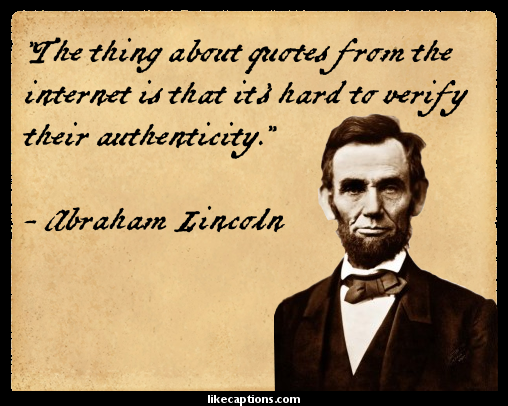
Albert Einstein quotes run rampant on the internet; without a reference book to know what he actually said, I feel that many of them fall into this category:

Having said that, sometimes you can gather the essence of what he probably said by reading “diagonally” through the supposed quotes, and one such sentiment is that Einstein said something like, “Imagination is more important that knowledge; knowledge is limited to all we know and understand, while imagination embraces the entire world.” Mark Twain once wrote*, “You can’t depend on your eyes when your imagination is out of focus.” [* Excerpt from his Complete Works] (By the by, if you’d like more Mark Twain wit, I wrote an article about his views on Switzerland, and the German language – just click here.)

So here’s something to exercise your imagination with:

You have the choice between flight and invisibility; which do you choose and why? What will you do with this superpower?

I’d love to hear your answers in the comments below!

13 Comments

Filed under Articles, Humor, Images, Musings, Quotes, Research, Writing Exercise, Writing Prompt

Calligram # 1: Ticino

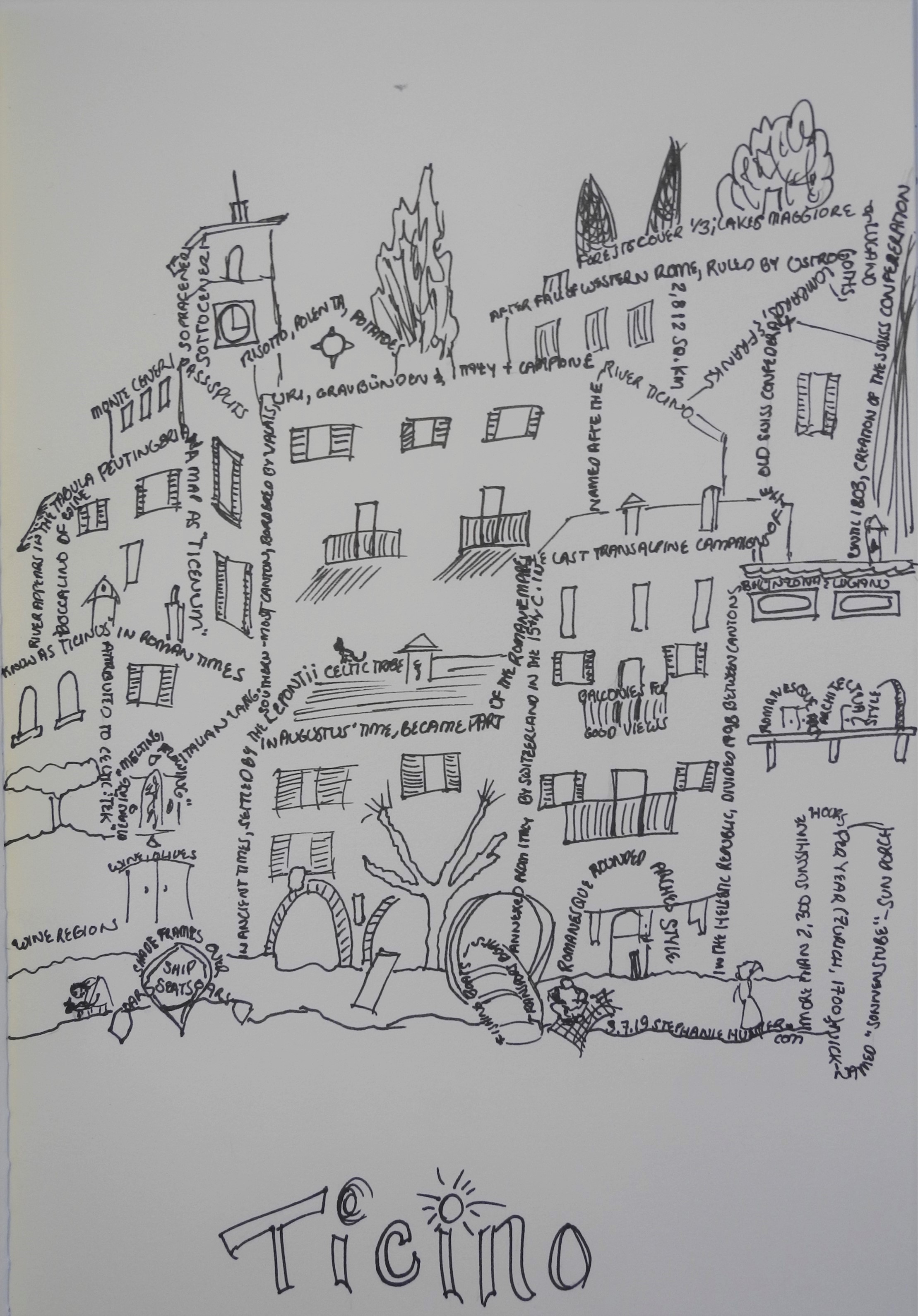
For those of you unfamiliar with calligrams, they are images created out of spatially-arranged text, usually related to the image they create.

I began doing calligrams several years ago, and enjoy the “bite-sized” research involved in gathering facts, history and general information about a subject. The first one I made was probably a Viking ship or the wassail tree; the latter, I accidentally found being used as the back cover design of an art magazine online out of Romania; I asked them to attach my web address and credit the image to me, and they did so, but it taught me a valuable lesson: embed my name into the calligram!

Below is one that I did recently while on holiday in Lugano. You’ll hear more about that soon, but in the meantime, enjoy this calligram!  Just click on it to enlarge it. The image itself is based on a vintage postcard collage.

If anyone would like to use this in any way, please contact me through the comments below; whenever using any image, please give credit – whenever possible – where credit is due!

Ticino Brighter

6 Comments

Filed under Articles, Calligram, History, History Undusted, Images, Publications, Research, Writing Exercise

Finding Time

Lately, I’ve been thinking about time; how much we have in a day, how fast it passes, and that days never seem to be long enough. In dwelling on time, is it a waste of time? Is productivity only what our hands produce, or does it include, in our perception, what our minds ruminate on? Obviously, the trail led me to idioms about time.

What idioms or phrases do you use to describe your day? I use one phrase about four times a week, as I write it in my journal to describe my day in a nutshell before I go into details: “Hit the Ground Running” (I just write HTGR). I’m grateful for the days I don’t use it… those days are like a secret stash of chocolate to be enjoyed (if you knew my husband, you’d know that’s a matter of self-preservation – but don’t tell him. Hoi, Schätzli). The phrase, etymologically speaking, came into use in the late 19th century, but really, well, hit the ground running during World War 2: It became a popular way of describing deployment from ships or parachuting into combat. Later it moved to a figurative sense; some days, I use it both literally and figuratively.

'Here's my plan,you hit the ground running.'

Here is a collection of idioms about using one’s time. Let me know if you use any of them regularly. If you know of any others, please share it in the comments below!

A day late and a dollar short

Against the clock

A good time

A hard time

A laugh a minute

A matter of time

A mile a minute

A month of Sundays

Around the clock

As honest as the day is long

A whale of a time

Beat the clock

Behind the times

Better late than never

Bide one’s time

By degrees

Call it a day/night

Call time (on something)

Carry the day

Catch someone at a bad time

Clock in, clock out

Crack of dawn

Crunch time

Day in the sun

Day to day

Dog Days

Donkey’s years

Don’t know whether to wind a watch or bark at the moon

Do time

Dwell on the past

Eleventh hour

Feast today, famine tomorrow

Five o’clock shadow

For the time being

From now on

From time to time

Have one’s moments

Have time on one’s side

Here today, gone tomorrow

High time

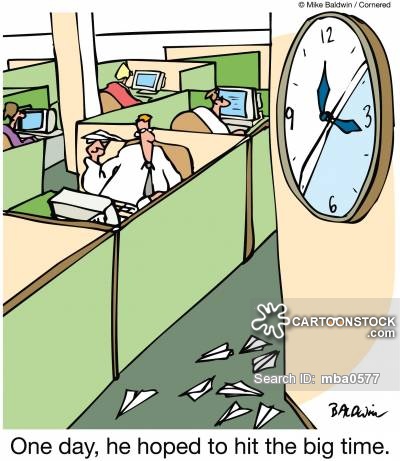
Hit the big time

One day, he hoped to hit the big time.

Hour of need

In an instant / In the blink of an eye

In the interim

In the long run

In the right (wrong) place at the right (wrong) time

In this day and age

Just in the nick

Kill time

Like clockwork

Like there’s no tomorrow

Long time no see

Make my day

Make time

Not in a million years

No time like the present

No time to lose

Now and then

Now or never

Once in a blue moon

Once upon a time

Only time will tell

Pressed for time

Serve time

Shelf life

Sooner or later

Stand the test of time

Stuck in a time warp

Take one day at a time

The moment of truth

The ship has sailed

The time is ripe

The time of one’s life

Time for a change

Time flies

Time heals all wounds

Time is money

Time is of the essence

Time off for good behaviour

Too much time on one’s hands

Turn back the hands of time

Until hell freezes over

Waste of time

Wasting time

When the moon turns to blood

Year in, year out

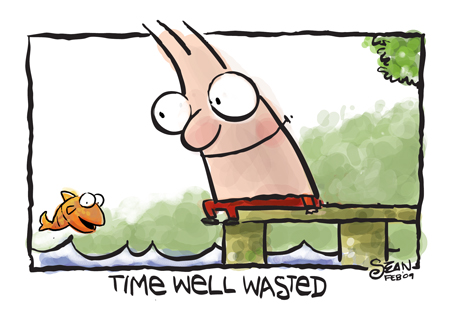
Time_Well_Wasted

8 Comments

Filed under Articles, Cartoon, Etymology, Lists, Musings, Nuts & Bolts, Writing Exercise

The Long and Short of it

If you’ve been hanging around here for a while, you know I’ve written a few novels; the recent sale was a great success!

I’ve been working on something that will not only help me market those novels to a wider audience, but it’s also giving me good experience in another genre: Short stories. Just like a novel, a short has a setting, a character, character arc, conflict and resolution – just in a much more compact and simpler landscape, so to speak. You can’t afford to flesh out an ensemble of characters or have a slow-burn leading up to the time-bomb or ticking clock of conflict. I’ve been trying my hand at various lengths, from flash fiction of 6 words, or exactly 53 words long, to short stories up to 7,500 words. They all have their own challenges.

Until recently, I’d been taking a distance-learning course on the topic of short fiction, but I quickly realized that it wasn’t worth the money – and was refunded; I’ve taken a course through the same institute before, so I’ll be glad to continue looking at their options since they were helpful in resolving the issue. While the premise of the course was a good one, I am a quick and independent learner, and I’d learned enough through online research to have all the principles – it’s just about putting them into practice.

I won’t be sharing any of the stories here, because I’ll be using them to enter writing competitions, and one of the frequent prerequisites is that a story has never been released online or elsewhere. But I’ll share a cartoon with you that kind of reflects the life of a writer: Writing, re-drafting, hoping others will appreciate it, and eventually releasing the story into the wider world…

Writer vs Reader

If you’re a writer, keep at it! Hopefully you live in an area where you can join a writers’ group, or at least find other writers that can encourage you and give you feedback; if, like me, you’re on your own and living in a country that speaks another language than the one you write in, then keep at it – find your encouragers online, or within your family or circle of local friends.

If you’re interested in finding out how to write short stories, here are a few recommendations:

James Scott Bell’s “How to Write Short Stories

How to Analyze Short Stories

Short Story Tips: 10 Ways to Improve Your Creative Writing

Keep writing!

7 Comments

Filed under Articles, Links to External Articles, Publications, Research, Writing Exercise

Feeding the Right Wolf

Two Wolves

There’s an old Native American proverb about two wolves:  One is a black wolf, and the other, white.  The black wolf is everything that is bad, and the white one is everything that is good.  These wolves are constantly at battle inside each one of us:  Which wolf wins?  The one you feed.

This story has truth at its core, and we can apply this principle to any area of our lives:  Thoughts; diet; exercise; writing; speech; relationships; habits, and anything else you can think of.  Another adage comes to mind:  “Garbage in, garbage out” – what we feed ourselves (any part of our trinity, whether mind, body or spirit) is what will come out of us.  There are all kinds of sayings around this truth – roots and fruits, and all that.

Each one of us has a daily routine; it may vary greatly from person to person, but it’s there.  We all probably have habits we’d like to break; they could be things that are time- or energy-wasters, or habits like smoking or overeating.  I’d like to focus on the habits of writers.

Creativity, like caffeine, is a legal addictive substance; an addiction is formed from repeated applications (i.e. habit).  If we feed the right wolves, we will reach our goals, whatever they are, but if we feed the wrong wolves, we won’t – it’s that simple.  For some, it’s finishing the first chapter; for others, it’s publishing; for others, it might be collecting enough poems, artwork, or other creative forms until there’s enough for release (art show, cookbook, anthology, etc.).

Each creative expression has its own unique pair of wolves.  One common black wolf is what I would name “NEDs” – Negative Energy Drains.  It can be expressed through negative talk about yourself or your writing (whether its source is internal from a lack of self-confidence, or external from unsupportive environments or relationships), or a pressure placed on yourself (again, internal or external) to complete a goal based on unrealistic expectations.  Another common black wolf is “Ambiguity”:  As long as we don’t know what concrete steps to take to reach a goal, it’s difficult to move forward; as long as we allow ambiguity to feed, it will paralyze us.

In this scenario, the white wolves would be named PEFs (Positive Energy Feeds) and Preciseness.  Those might simply manifest themselves as speaking positively to yourself every time NED tries to speak or putting up positive post-its of where you’re going with your goals.  For the second wolf, define the steps needed – set yourself an appointment for the purpose of researching the steps, and finding concrete resources to help you reach your goals, then take one step at a time.  Keep that appointment.

Which wolf do you feed?

TwoWolves-black-white

2 Comments

Filed under Articles, Musings, Writing Exercise

Similes Galore

Have you ever wanted to compare two people, places or things in a pithy way, but couldn’t remember a particular saying, or think of a way to put it?  For starters, what you’re looking for is called a “simile”, and they abound in English!   A simile is a figure of speech used to compare one thing to another, usually using “like” or “as”.  Some are obvious, some are quirky, and some must have a fascinating history.  Here is a small selection using “as…as”; if you know of any others, please add them in the comments below!  Have a great weekend, and keep writing!

blind as a bat & drunk as a skunk - by jellogiant, Deviantart

As likely as not

As long as your arm

As loud as thunder

As mad as a hatter / a March hare

As mad as a wet hen / a hornet

As mean as a snake

As meek as a lamb

As merry as a cricket

As mild as a dove / a lamb / milk / May

As much use as a handbrake on a canoe

As mute as a fish / an oyster / a statue / a stone

As naked as a jaybird / the day they were born

As nervous as a cat (in a room full of rocking chairs) / pig in a packing plant

As nutty as a fruitcake

As obstinate as a mule

As often as not

As old as the hills / Adam / Methuselah

As pale as a ghost / death / ashes

As patient as Job / an ox

As plain as a pikestaff / day / the sun / the nose on your face

As playful as a kitten

As pleased as punch / a dog with two tails

As plump as a partridge

As poor as a church mouse / a rat / Job / Lazarus / dirt

As pretty as a picture

As proud as Lucifer

As proud / pleased as punch

As proud / vain as a peacock

As pure as a lily / (the driven) snow

As quick as a dog can lick a dish / a wink / lightning / a flash

As quiet / still as a mouse / whisper

As red as a rose / a cherry / beetroot / a lobster / a turkey-cock / blood / fire

As regular as clockwork

As rich as Crassus / a Jew

As right as rain / nails / a trivet

As round as a barrel / a ball / an apple / a globe

As safe as houses / the Bank of England

As scarce as hen’s teeth / ice water in hell

As scared as a rabbit

As sharp as a tack / a needle / a razor

As sick as a dog / a parrot

As silent as the dead / the grave / the stars

As silly as a goose / a sheep

As slim as a willow

As slippery as an eel / ice

As slow as a snail / a wet week / molasses in winter / molasses in January

As sly as a fox

As smooth as butter / oil / silk / glass

As snug as a bug in a rug

As sober as a judge

As soft as butter / down / silk / velvet / clay / wax

As sound as a bell

As sour as vinegar

As straight as an arrow / a ramrod

As steady as a rock / the Rock of Gibraltar

As sticky as jam

As stiff as a poker / a ramrod / a board / pikestaff

As still as a mouse / death / the grave

As straight as a die / an arrow / a poker / a ramrod

As strong as an ox / a horse / a bull

As stubborn as a mule / a goat

As sure as death and taxes / death / taxes / a gun / eggs are eggs

As sweet as honey / sugar

As tall as a steeple / maypole / a skyscraper

As thick as thieves / blackberries / pea soup

As thick as two (short) planks

As thin as a rail / paper / thread / a stick

As timid as a deer / hare / rabbit / mouse

As tired as a dog

As tough as old boots / nails / leather

As tricky as a monkey

As true as steel / flint

As ugly as sin / a scarecrow / a toad

As useful as a chocolate teapot

As vain / proud as a peacock

As warm as toast

As watchful as a hawk

As weak as a kitten / a baby / water

As wet as a drowned rat

As white as a ghost / a sheet

As white as snow / chalk / milk

As wide as the poles are apart

As wise as Solomon / an owl

As yielding as wax

9 Comments

May 27, 2017 · 12:23 PM

Saturday Riddle #1: A Five-Letter Word

Just for fun, I thought I’d toss you a riddle; try to figure out the answer without using a search engine!

Take away my first letter, and I still sound the same. Take away my last letter, I still sound the same. Even take away my letter in the middle, I will still sound the same. I am a five-letter word. What am I?

Write your guesses in the comments below, and I’ll give the answer in the comments tomorrow!  Have fun!

Riddles

31 Comments

Filed under Humor, Riddles, Writing Exercise, Writing Prompt