Wallace Hall of Heroes: Margaret MacDonald Mackintosh

After our holidays in Lugano, mentioned in the last post, I went to Scotland with my husband for a five-day whirlwind visit with friends. Spending time together with them morning and evening, we took day trips out in between and were able to see astonishingly much in that short time!

One of the things we went to see was the Wallace Monument, near Stirling; we trekked up the steep, narrow spiral staircase to the top, stopping along the way at each of three levels before reaching the top (with a stunning view). One of the levels was called the “Hall of Heroes”: Filled with marble statues of Scottish scientists, politicians, shakers and makers of the past centuries, without exception, they were all men. Until this year. Two statues of women have been added, along with 6 pillars of women who were chosen by a panel of judges from among the long list of Scottish women who have been influential in Scottish history.

As the saying goes, “Behind every great man, there’s a great woman”. Many of these women were ignored by history, which is more often than not written down by men, from a man’s perspective, for a man’s world. I’m not a feminist by any stretch of the imagination; but I do have a strong sense of justice, and I am a woman who has often been overlooked and marginalized by society, by prospective bosses, and by mentalities that belittle women solely based on gender. So I take pleasure when I see women from the past being acknowledged for the contributions they’ve made, and I take special pleasure in “undusting” their history for you here on my blog. With that said, here’s the first:

How many of you are familiar with Charles Rennie Mackintosh? Perhaps not the name, but certainly the distinctive art style he is known for:

Charles Rennie Mackintosh Rose

He is frequently claimed as Scotland’s most influential and distinguished artist, yet he once reportedly said of his wife (whom he married on 22 August 1900), “Margaret has genius, I have only talent.” If you look at her own work, you see that she was the main inspiration behind his more simplistic designs; the famous “Mackintosh rose” is clearly seen in her works:

This slideshow requires JavaScript.

Margaret MacDonald Mackintosh, born 5 November 1864, was part of what was known as the “Glasgow Four”, which included her sister Frances, Herbert MacNair, and Charles Rennie Mackintosh, and during her lifetime, she was recognized for her defining influence in the “Glasgow Art” style of the 1890s, during which period she and her sister opened an art studio together (the MacDonald Sisters Studio at 128 Hope Street, Glasgow) – at a time when women were still very much expected to get married and live a quiet life in submission to a husband. Though she was known and respected in her own lifetime, consequent generations have forgotten her genius; for instance, Charles was famous as an architect, yet in a letter to his wife he wrote, “Remember, you are half if not three-quarters in all my architectural work.” Her interior designs (often mixed mediums, including the use of gesso, beads, metal and textiles) made his buildings typically “Mackintosh”, yet there is not a single mention of her in an article about Mackintosh architecture on a website devoted to architectural design, though they had ample opportunity to give her deserved recognition.

Margaret MacDonald Mackintosh - Interior Design for a Music Room

Margaret MacDonald Mackintosh – Interior Design for a Music Room

Between 1895 and 1924, she contributed to more than forty European and American exhibitions. She exhibited with her husband at the 1900 Vienna Secession, where her work could arguably be described as an influence on the Secessionists Gustav Klimt and Josef Hoffmann, yet again, she is ignored posthumously.

Ill health decreased her artistic output from around 1921, and she passed away in 1933, five years after her husband’s death. Her artwork lives on, and I hope her legacy earns equal recognition with that of her husband’s as times change, and the women of history begin to receive the recognition they truly deserve.

6 Comments

Filed under Articles, History, History Undusted, Research, Snapshots in History

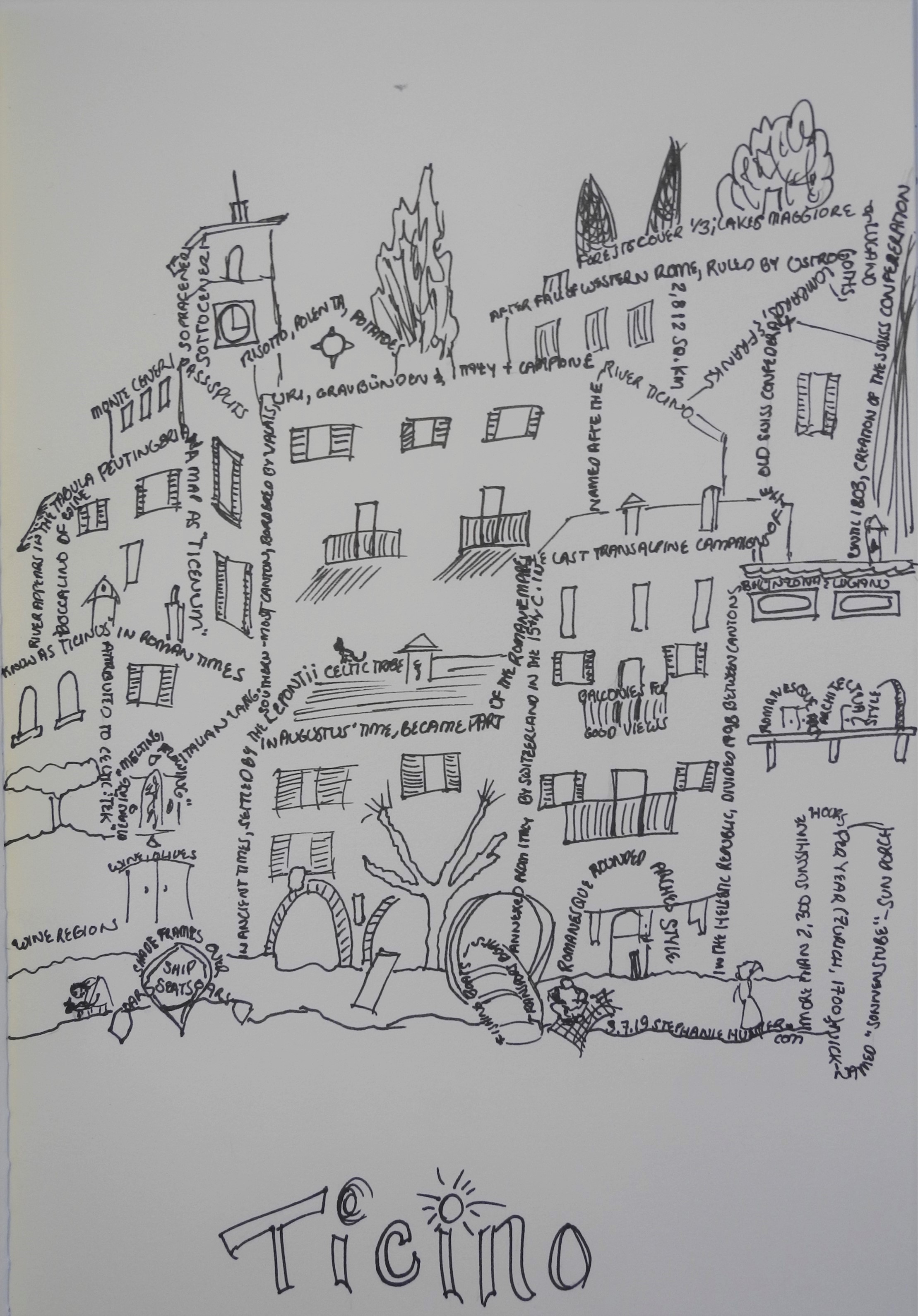
Calligram # 1: Ticino

For those of you unfamiliar with calligrams, they are images created out of spatially-arranged text, usually related to the image they create.

I began doing calligrams several years ago, and enjoy the “bite-sized” research involved in gathering facts, history and general information about a subject. The first one I made was probably a Viking ship or the wassail tree; the latter, I accidentally found being used as the back cover design of an art magazine online out of Romania; I asked them to attach my web address and credit the image to me, and they did so, but it taught me a valuable lesson: embed my name into the calligram!

Below is one that I did recently while on holiday in Lugano. You’ll hear more about that soon, but in the meantime, enjoy this calligram!  Just click on it to enlarge it. The image itself is based on a vintage postcard collage.

If anyone would like to use this in any way, please contact me through the comments below; whenever using any image, please give credit – whenever possible – where credit is due!

Ticino Brighter

6 Comments

Filed under Articles, Calligram, History, History Undusted, Images, Publications, Research, Writing Exercise

Wordless Wednesday #63: DIY Book

IKEA Book

2 Comments

July 10, 2019 · 12:13 AM

History Undusted: A Grain of Mustard

MustardMy husband and I once discussed mustard (as one does).  Specifically, he had been on Google Earth and mentioned that he saw rapeseed fields near Dijon; I replied that they were more likely to be mustard fields.  He was under the impression that mustard was a bush, or a tree, and we wondered if there might be varieties of the plant that ranged in size, especially if left to grow wild.  And thus, a bit of research into the mustard plant ensued (naturally).
First, a bit of history on Dijon mustard:  Originating in 1856, the first Dijon mustard was made by substituting green (unripe) grape juice for the more typical vinegar, though today that unripe grape juice is a spade called a spade, white wine.  Surprisingly, 90% of the mustard seed used in local Dijon production comes (mainly) from Canada – so those yellow flowering fields near Dijon could be rapeseed after all!

Dijon, France doesn’t just make the eponymous mustard, but has dozens of specialityDijon Hand-Painted Jar mustards; when travelling through a few years ago, we picked up jars of orange mustard, fig mustard, lavender mustard and tomato mustard.  They often come in hand-painted pots, though plain glass jars are common as well.  The word mustard itself comes from Old French mostarde, which comes from Latin mustum, meaning “new wine”.  This may also be related to a Swiss-German term Most, meaning apple juice that’s nearly fermented; it’s often sold in the autumn from farmer’s shops, if they have an apple orchard from which to produce it.
Mustard seeds come in white, brown or black.  White seeds contain fewer volatile oils and so are milder than brown or black.  Years ago I consulted a doctor for remedies I could recommend to singing students who often struggle with sore throat issues; she told me to have them put 1 teaspoon of dark mustard seeds into a hot foot bath and soak the feet for 10-15 minutes; the mustard oils draw out the infection.

Mustard, as a condiment, was likely first made in Rome, appearing in cookbooks as far back as the 4th or 5th centuries.  They probably exported the seeds to France (Gaul), and by the 10th century monks were experimenting with recipes.  Grey-Poupon was established in 1777 between the partners Maurice Grey and Auguste Poupon.

So were those French fields rapeseed or mustard?  Well, actually, both:  Rapeseed is a bright-yellow flowering member of the family Brassicaceae (mustard or cabbage family).  While both rapeseed and mustard are harvested for their oils, they are as similar as mustard is to cabbage; rapeseed oil is the third-largest source of vegetable oil in the world, while mustard seeds are usually prepared as mustard condiment (though mustard oil is also popular in cuisines such as Indian).

Now we know!

Originally posted on History Undusted, 17

5 Comments

Filed under Etymology, History, History Undusted, Research

Wordless Wednesday #62: Boat Launch

Boat launch

Leave a comment

July 3, 2019 · 2:49 PM

A Rabble of Animals

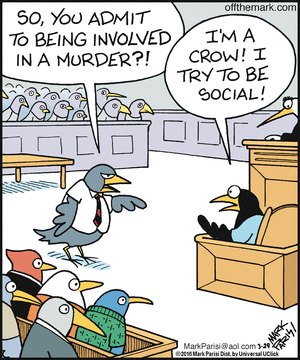
Collective Noun - Murder of Crows

Did you know that a group of vultures has a sense of humour? Or at least the people who decided to name them did (likely back in the 16th century, when a slew of collective nouns emerged): While hanging out and doing nothing, vultures are called a committee. When feeding, they’re called a wake. There’s irony in them thar’ varmints.

Some collective nouns are common sense, and others simply common, such as packs of wolves, flocks of birds or herds of cattle; but did you know that lice flock, and sea urchins form herds, too? If I say swarm, you might think of flies or gnats or even minnows; but you could use the same word to describe a group of eels.

Worms bed, dotterels trip, cheetahs form a coalition, and Hippopotami bloat. Rhinoceroses either crash or form a stubbornness, while skunks stench and squirrels scurry. Jellyfish smack, brood or fluther, while oysters bed and goldfish glint or create a troubling. Butterflies flutter, swarm or kaleidoscope; caterpillars army, while grasshoppers cloud.

There are some fun combinations: Crows murder (they also gather as a storytelling or a parcel), Flamingos flamboyance, guillemots bazaar, gulls screech (don’t they, though?), and hawks kettle (flying in large numbers) and boil (two or more spiralling on an updraft). Hummingbirds charm, as do Magpies (unless they murder), and owls and rooks hold a parliament – I’d trust them to do so more than most politicians. Peacocks muster, ostentation and pride, while penguins tuxedo or huddle (I kid you not). Young penguins gather in a Créche, just like human toddlers, and seagulls squabble.

Starlings form beautiful murmurations and chatterings, while swifts scream and tigers ambush. I’d love to see a zeal of zebras, but not so much a prickle of porcupines. Whales pod while trout hover and stingrays fever; snails walk, frogs knot and, believe it or not, rattlesnakes rhumba! Elephants gather as a memory, while deer gang and bucks clash, and gnus form an implausibility. Running into a mob of kangaroos might be quite pleasant, but not an intrusion of cockroaches!

There are hundreds more such collective nouns; English is an ever-changing language, but some things are just too good to allow them to go the way of the Dodo, so add a few more colourful expressions to your language, and enjoy the idiosyncrasies of English!

I’ll just add that, by now, my grammar-checking program is having a nervous breakdown.

Leave a comment

Filed under Articles, Cartoon, Grammar, Humor, Lists, Nuts & Bolts, Research

Wordless Wednesday #61: Room Service

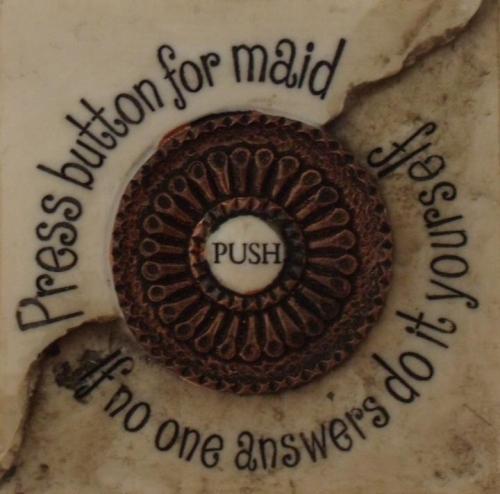
maid

Leave a comment

June 26, 2019 · 12:14 PM

What a Buttload!

Now, now… if you thought I was going to be rude, you don’t know me very well.  While I am certain that the term “butt” has led to countless jibes and jokes down through the centuries, it is (among other things) in fact an English measuring unit for wine.  A Buttload is a unit for liquids which contains 126 gallons (~476 litres) which is one-half tun (252 gallons / 953 litres), and equivalent to the pipe (the latter also referred to the large container used for storing liquids or foodstuffs; now we rather use the terms cask or vat).  That they needed a term for a unit of wine that massive may seem odd at first; but when you consider that the water they had to drink was the same water that flowed downhill from the landlord’s latrine, the cows in the pasture, and the washerwoman upstream, wine, beer and ale (depending on which harvest climate you lived in) was by far the safest thing to drink.  If wine was available in your area, it was stored in barrels and thus was drunk relatively young; also, to counter the effects of drinking it at every meal, wine was often diluted 4 or 5-to-1 with water; that took all of the buzz out of it (and added who knows how many bugs that they were drinking wine to avoid in the first place…).  Now you know.  What a buttload off my mind… I think it’s time for a glass of (undiluted) wine.

Treading Grapes.jpg


Originally Posted on History Undusted, August 2015

4 Comments

Filed under Etymology, History, History Undusted, Nuts & Bolts, Riddles

Wordless Wednesday #60: Book Club

Book Club

Leave a comment

June 19, 2019 · 2:42 PM

History Undusted: Earrings in the 18th Century

I recently watched the film “Emma”, with Gwyneth Paltrow and Jeremy Northam; as the proposal scene was playing, I noticed her earring and wondered if that was historically accurate – did they have pierced earrings in England at that time (the early 1800s)? I’m not into fashion (that’s an understatement – I’m very pragmatic when it comes to clothes!), but the historical aspect fascinated me enough to look into the matter.

While we have probably all heard of “Girl with a Pearl Earring”, painted ~1665 by Johannes Vermeer (doubts have been raised as to whether it is actually pearl or rather polished tin or coque de perle, given the reflective qualities and size, but that’s another issue), it is a Dutch painting from the 17th century and thus doesn’t answer my question. My interest lies more in the 1700s (18th Century) of Britain, and so I began researching 18th C. English portraits.

I discovered that, while there are many portraits with earrings displayed, there are far more without. So it would have been possible, but was by no means as common as it is today. Also, sometimes the current hairstyle hid the ears, such as that of the 1770s and 1780s, or perhaps their ears were hidden by the custom of married women wearing mob caps, even beneath other “public” hats.


Mid-to-late 1780s

Typical 1780s hairstyle; such a style would have either hidden earrings or made them obsolete.


Mrs. Lewis Thomas Watson (Mary Elizabeth Milles, 1767–1818) by Sir Joshua Reynolds, 1789

A married woman wearing a mob cap under her bonnet (though from the black cape and hat combined with a white dress, she may be at the end of a period of mourning, wearing “half weeds”). Mrs Lewis Thomas Watson (Mary Elizabeth Milles, 1767–1818) by Sir Joshua Reynolds, 1789


The portraits do not reveal whether or not they were merely clip-on earrings or studs, though ear piercing has been around for centuries, varying in intensity and use from culture to culture (some for religious purposes, some for ownership such as slave earrings, and others were status symbols for royalty or nobility). I’ve found many portraits from Europe as a whole, between the 16th and 19th centuries which portray women wearing earrings; here are a few, with their details:

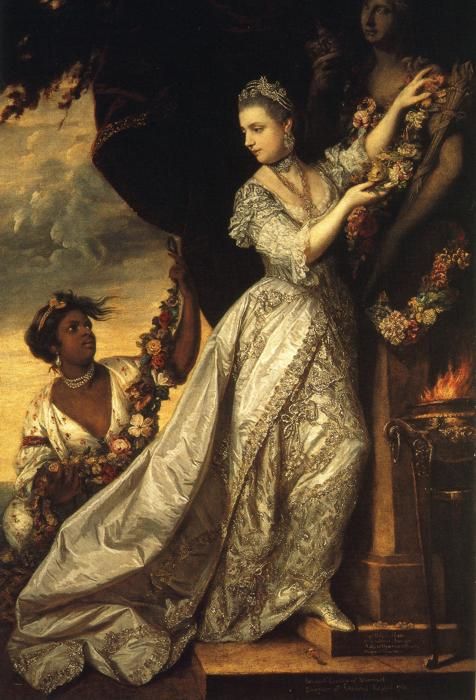
1761 Joshua Reynolds. Lady Elizabeth Keppel

1761, by Joshua Reynolds: Lady Elizabeth Keppel. Note that the Indian woman is also wearing an earring(s), and a rope of pearls; I don’t know whether she is portrayed as a servant or merely inferior in rank, due to her placement in the portrait…


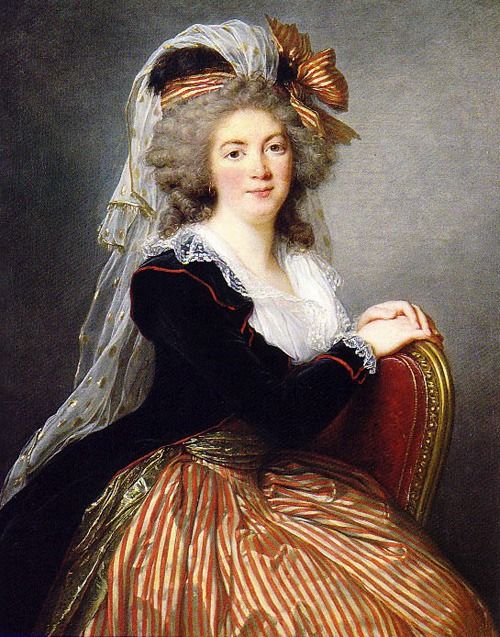
Genevieve-Sophie le Coulteux du Molay, 1788 by Elisabeth Louise Vigee Le Brun

Genevieve-Sophie le Coulteux du Molay, 1788 by Elisabeth Louise Vigee Le Brun. Though this is a French portrait by subject & painter, it is from the period in question and displays a hoop earring, as well as the hairstyle common in this period in England as well.


Turkish Dress c1776 Portrait of a Woman, possibly Miss Hill

Turkish Dress, c1776 Portrait of a Woman, possibly Miss Hill


Young Woman in Powder Blue, ca. 1777

A young woman in powder blue, ca. 1777


Thomas Gainsborough, 1727-1788 London, Portrait of Lady Anne Furye, née Greenly - born 1738

Thomas Gainsborough, 1727-1788 London, Portrait of Lady Anne Furye, née Greenly


Based on History Undusted Original Post, June 2015


4 Comments

Filed under Articles, History, History Undusted, Images, Links to External Articles, Research