Buying Credit

No, the title is not referring to money or cash cards, but writing.  Stick with me.  If you’ve made yourself at home here and nosed through my cupboards, you’ll know that I do a LOT of research.  I love it.  It adds spice to my character’s meals, salty spray that blackens the redcoats of marines aboard a royal navy ship, tells me that heated arsenic smells like garlic, and makes the ship creak so loudly you’ll swear you’re going down to Davy Jones’ locker.  But there are times when, as an author, I’m required to blur the lines between fact and fiction.

There are certain things that people erroneously assume (such as Viking helmets) that I may need to adapt in order not to lose a reader’s trust (though trust me, I will never add horns!):  The sentence structures of bygone days were far more complex, with vestiges of Germanic linguistic influences – for my current manuscript (set in 18th century England and mostly aboard a Royal Navy ship of the line) I need to modernize the syntax without losing the High English flavour, and without compromising on the linguistic purity of my story’s time-setting; modern sensibilities (in social ladders, issues such as slavery, war, etc.); laxer standards (in, say, relationships or politics or social ranks), and so on.  A modern reader will most likely not appreciate the complex social mores of a time when men and women were never alone in a room – even when the man wanted to propose to the woman, and the parents wanted it to take place; and so, such things need to be adapted at times, to a certain extent, to reach a modern audience without alienating the audience that revels in bygone literature.

If I, as an author, want my reader (who is perhaps a stickler for all things historical) to give me the permission to bend a few social rules of the 18th century, I must first buy credit with them – prove to them that I’ve done my homework – so that they won’t get ripped out of the story in disbelief when I contrive to leave a man and a woman alone in the same room without a chaperone.  In my current manuscript, the husband and wife come from opposite ends of the social ladder, and the husband becomes a captain in the royal navy at the tender age of 20 or 21.  Both of these situations have many historical precedents; I know that from countless hours of research.  But most people who read historical novels might think, “But Viking helmets always have horns” – or something to that effect.  If written well, these disparities in understanding can be smoothed over, so that when I really DO break historical moulds, I am allowed to do so without offending the reader “in the know”.

1761-joshua-reynolds-lady-elizabeth-keppel

1761, Lady Elizabeth Keppel, by Sir Joshua Reynolds

This portrait illustrates an important point:  Many people, when thinking of the British rule of India, perceive it through postmodern lenses; we see it from the hindsight of Gandhi and the independence of the country from the imperialistic rule of British paramountcy.  But the other aspects were the children and wives of British soldiers, diplomats, and tradesmen, and the loneliness faced, the friendships struck with Indian men and women… these are important aspects to weave into a story, too, and thus require research.  Notice the pearls adorning the Indian woman below?  The researcher in me wants to know her story far more than the story of Lady Keppel (who died of a broken heart at the age of 29, just months after her husband had died of injuries from a riding accident).  Some readers may get jolted out of the world you create by the pearls, though it is historically accurate – so you’d still need to buy credit by setting up that aspect well.

These same credit-buying rules apply to any genre, even science fiction:  If you create a world set on another planet, that world will have laws – physics laws, indigenous social mores, etc. – and you as a writer must know what they are, and if or how they can be broken if need be.  You can’t claim that all liquid on the planet is frozen, and then have your character drinking from a fountain or stream, unless you explain how that’s possible.  If you do, you’ve taxed your believability credits and pulled the reader out of the world they’ve agreed to follow you into.  The manuscript that I’ll work on next (after the current one is published!) is science fiction; the air of the planet is toxic to humans, so I need to create a way for facial expressions, dialogue, etc. to come through even when the characters are outside in their suits.  I have done a lot of preliminary research into geology (that told me about heated arsenic, among other things); I also need to explain how a planet with multiple suns can have a stable enough orbit not to be drawn into one of the stars and burn up – i.e. I need to follow known physics laws, or explain how they are suspended for my planet.  I think you get the idea!

So if, as a writer, you want readers to believe what you write about a fictional character set in British India, you first need to buy credit with your readers by doing your historical homework and sculpting the landscape and characters in the rich tapestry they deserve.  If you are writing science fiction, establish your world and stick to your rules so that, if you need to bend them for a plot development, the readers will be willing to follow you on the adventure.  Whatever you do, keep writing!

Save

Save

Save

8 Comments

Filed under Articles, History, Military History, Nuts & Bolts, Plot Thots & Profiles, Research, Science & Technology, Writing Exercise

History Undusted: Naval Slang

In our everyday language, we often use sayings without really knowing how they originated.  Sayings such as “to swing a cat” or “down the hatch” or “break the ice”.  These three have something in common:  They all began life as naval slang.

cat-o_-nine-tails__psf_The first, “to swing a cat,” has a rather gruesome beginning:  It refers to the cat-o’-nine-tails, a whip made up of nine knotted cords roughly 75 cm long that was designed by the British Royal Navy to inflict severe pain and lacerate the skin.  It was used in flogging for anything from drunkenness to mutinous talk to stealing.  It was known as a “cat,” and obviously they needed room to swing it, to get the full effect.  Today it merely refers to the size of a room or space as being “too small to swing a cat”.  Another nautical idiom with cat was “to cat the anchor”:  The cat referred to here was a large wooden beam on either side of the bow of a sailing ship which was used to support the weight of the anchor as it was raised or lowered; since there was usually the head of a lion or large cat carved at the head of the beam, it was called a cathead.

“Down the hatch” is more straightforward:  The hatch was the covering of the hatchway on a ship, an opening in the deck which allowed vertical access into the hold for loading cargo.  It means the act of drinking in particular, the mouth being the “hatch”.

“To break the ice” means to remove the invisible social barriers between strangers to ease conversation and social contact.  It comes from the specialized ships called “ice breakers,” which were designed to plough through icy waters, making the passage of other vessels possible.  Without such a ship, arctic expeditions could find themselves frozen in, land-locked by shifting ice sheets.

For many more sayings relating to naval history, check out “Not Enough Room to Swing a Cat” – Naval Slang and its Everyday Usage by Martin Robson.

Originally posted 28 on History Undusted.

22 Comments

Filed under Etymology, History, History Undusted, Military History, Research

A Little Light Reading… Not

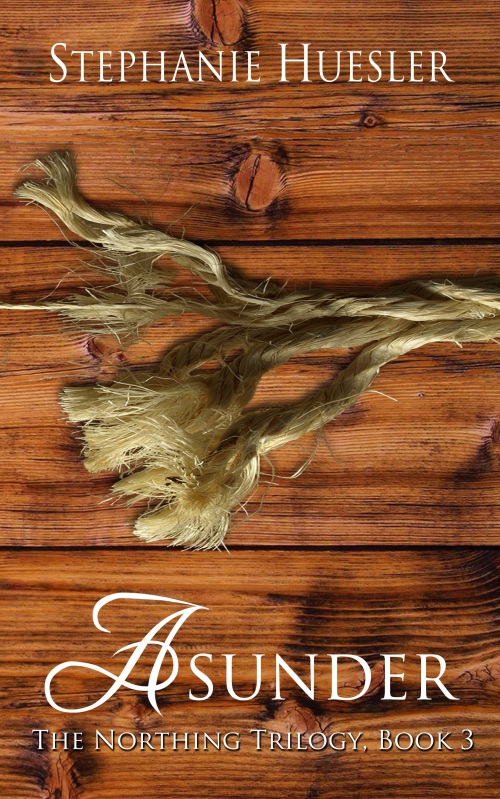
I will admit that I have quite odd tastes in reading, especially for a woman; I tend toward history, nautical, and obscure or long-forgotten books.  In writing my current manuscript, which is Asunder, the third book in the Northing Trilogy, I’ve read more than a fair share of military history books, specifically covering the 18th century of the Royal Navy.  Once, on a research trip to London, I searched out a bookstore that specializes in military and transport books, even reputed to have remainders; I don’t think they’d seen a woman in the shop in years (who’d entered intentionally) by the looks I got; one of the men even said, “The beauty shop’s two doors down, love.”  When I asked if they had the out-of-print autobiography by William Spavens, a unique lower deck view of the 18th century navy, they froze as if they hadn’t heard me correctly.  The question must have been laced with catnip, because after that I had the entire shop of men eating out of my hand, and I spent nearly two hours in there being helped to the finest pick of naval history books (including the autobiography I was after!).  Sadly, the last time I was there the shop was gone, but I’ve since found the largest used book shop in London, Skoob, which is highly dangerous for a bibliophile with a private library…!

A few of the books I’ve read in the course of research for Asunder are fairly gory, like Medicine Under Sail (I’d bet my bottom dollar that the screen writers for “Master and Commander“, with Russell Crowe, read that book as they wrote the script) and “Poxed & Scurvied” – the story of sickness and health at sea, while others have been like reading a thriller, such as “The Seven Years War” by Rupert Furneaux  or “A Sailor of King George” by Captain Frederick Hoffman.

I devour history books like other people devour pulp fiction; but especially during the first draft of the book, I had to continually keep in mind that I was writing historical fiction, not a history book; the details that I included had to serve the plot and character development, and not visa versa.  Only a fraction of what I learned has gone into the book; but those rich details give salt to the waves, creaks to the ship, and whip to the rope (I’ve also spent hours aboard the Cutty Sark “filling in the blanks” of a docked ship, so to speak, but that’s another story).  I could have peppered the dialogue with so much naval slang you wouldn’t have been able to swing a cat (naval slang, by the way), but if readers were to get ripped out of the story trying to figure things out, then I would have missed the mark.

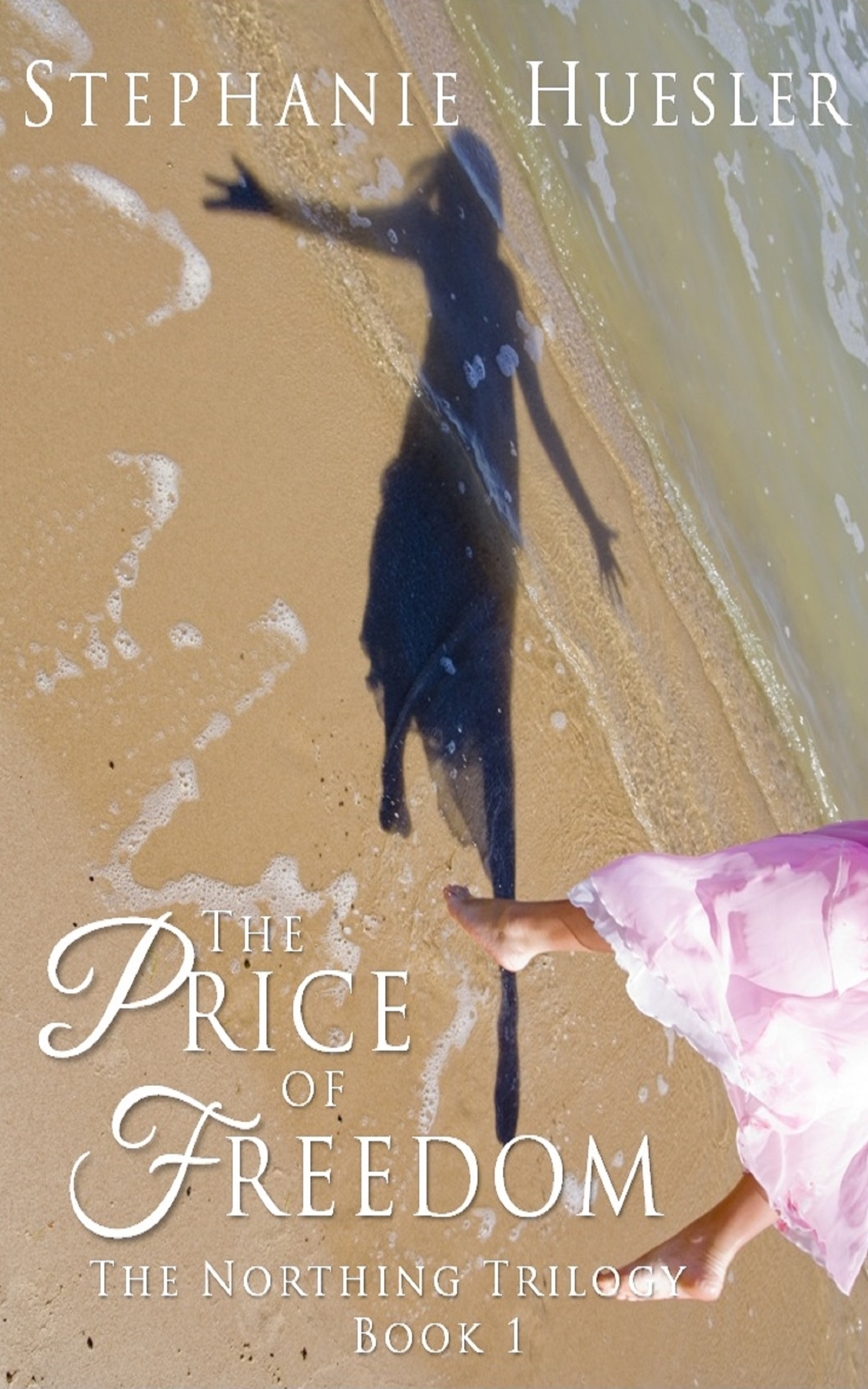
So, the next time you sit down for a little light reading, you might want to consider one of the books linked above; then again, if you don’t want gory dreams, rather go with “The Price of Freedom“, or “Redemption“, or “The Cardinal, Part One or Part Two“…  and enjoy!

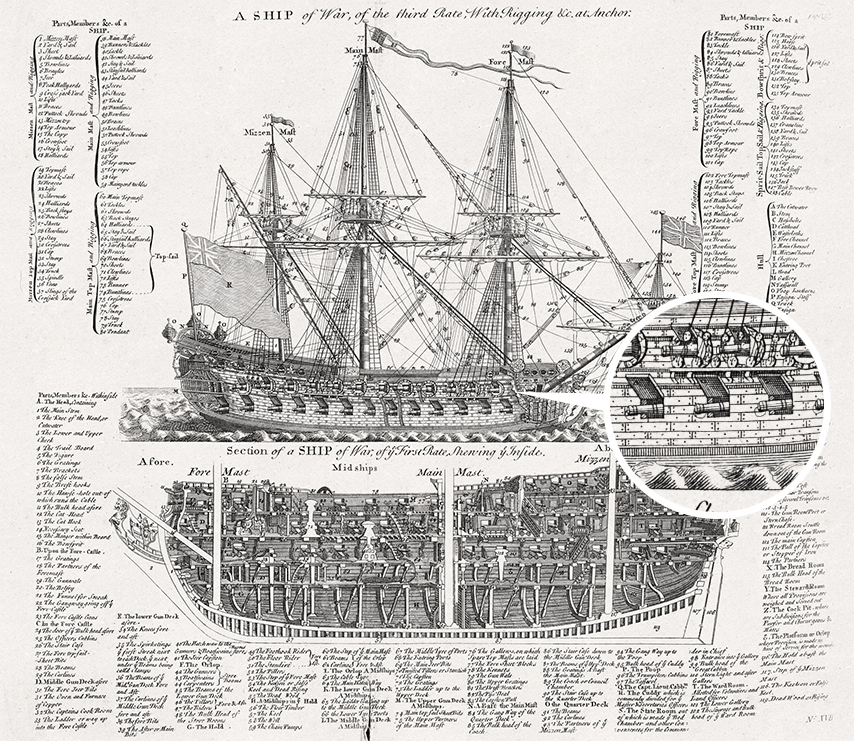
third-rate-ship-of-the-line-diagram

One of my library posters

8 Comments

Filed under Articles, History, Military History, Musings, Nuts & Bolts, Research

History Undusted: Decisions, Decisions

In May 2013, I began blogging here on WordPress; at the time, I had several topics of interest that I wanted to pursue, and to that end I began several blogs.  As time has marched on sometimes other priorities took over, or focus changed, and now I have three active blogs.  This eponymous blog is my home-base, but one of my favourite blogs to write besides this one is History Undusted.  I love finding the dusty bits of history and “undusting” them for the unsuspecting public.  But sadly, it has never really seemed to find notice by WordPress, and many of the posts have gone unseen.

Because history and the research thereof is a big part of my writing process, whether it be Viking history, archaeology, Scottish history, 18th century England, science, technology, advertisement, historical characters, or any of a dozen other topics, I have decided to combine the two blogs into this one.  If history isn’t your thing, don’t worry – I will still enjoy posting articles regularly about the writing process and the nuts and bolts involved!  I will begin “importing” (and, if necessary, augmenting) those blogs gradually, until they’re all safely here.

So without further ado, here is the first offering:

Decisions, Decisions

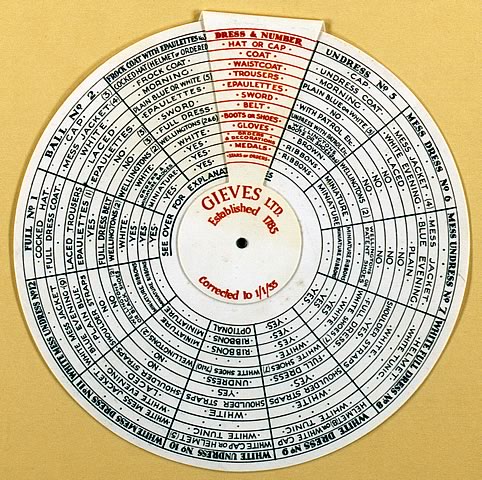
gieves-dress-wheelHave you ever heard of a butler (or male servant, in general) referred to as “Gieves” or “Jeeves”?  This might just be where it all started:  The Gieves Gentlemen’s Tailor Company was founded in 1771, and became a limited company in 1785; their dress wheel aided naval officers in choosing what to wear at any particular occasion, for any part of the world they might have found themselves in at the time.  Dressing, even for men, was an extremely complex social signal in bygone eras.  By 1935 there were twelve styles of dress, including tropical options.  By turning the wheel, an officer could see just what to wear on any occasion.  A handy little marketing device, it gained Gieves loyal royal naval customers, and the company has thrived ever since, with loyal customers including members of the British royal family today. For an interesting history of the company, click here.

Sir P.G. Wodehouse, an English author and one of the most widely-read humorists of the 20th century, named the comical fictional character of his shrewd valet “Jeeves”; the name was taken from Percy Jeeves, who was a cricketer killed during the First World War. Both the wheel and the fictional character served to cement the name in the collective conscience of the western world as a reliable servant.

Originally posted 27 May 2013 on History Undusted

10 Comments

Filed under Articles, Etymology, History, Images, Military History, Research

The Ultimate Final Exam

DIGITAL CAMERAAfter 11 months with an exchange student here with us, our life is now beginning to revert to its previous “business as usual” state.  That means that I can schedule my time, my days, and even weeks, and actually see those goals come within reach and grasp them.  It means that I can sit down at my computer, and write 10 hours straight if I’m on a roll!  It’s suspiciously quiet here now, but that does not mean something’s afoot this time… unless the cats are up to something.  With all of her exams through the school year, I was reminded of a list I’d seen years ago; when I shared a similar list in my previous post, I decided to track this one down and share it with you.

This ought to keep you entertained and out of trouble, while I dive into my fifth novel’s manuscript with a fresh eye (since I haven’t really seen hide or hair of it since April…!).  Enjoy, and have a great week!

Warning:  I take no responsibility for snorted drinks or explosions of anything out of your north or south ends

The Ultimate Final Exam

  Read each question carefully.  Answer all questions.    Time Limit: Four hours. 

 HISTORY:

Describe the history of the papacy from its origins to the present day, concentrating especially but not exclusively, on its social, political, economic, religious and philosophical impact on Europe, Asia, America and Africa.  Be brief, concise and specific.

  GEOGRAPHY:

Predict the position of the tectonic plates as they will appear two billion years from now. Be prepared to prove your results.

  MEDICINE:

You have been provided with a razor blade, a piece of gauze and a bottle of Scotch.  Remove your appendix.  Do not suture until your work has been inspected.  You have fifteen minutes.

  BIOLOGY:

Create life.  Estimate the differences in subsequent human culture if this form of life had developed 500 million years earlier with special attention to its probable effect on the English parliamentary system.  Prove your thesis.

  PUBLIC SPEAKING:

2500 riot-crazed aborigines are storming the classroom.  Calm them.  You may use any ancient language except Latin or Greek.

  ART:

Give an objective analysis of the relative significance and quality of the works of the major artists of the past three millennia. Be specific, and prove your analysis with detailed examples.

  MUSIC:

Write a piano concerto.  Orchestrate and perform it with flute and drum.  You will find a piano under your seat.

  PSYCHOLOGY:

Based on your knowledge of their works, evaluate the emotional stability, degree of adjustment and repressed frustrations of each of the following:

  • Alexander of Aphrodisias
  • Ramses II
  • Gregory of Nicea
  • Hammurabi

Support your evaluation with quotations from each man’s work, making appropriate references.  It is not necessary to translate.

  SOCIOLOGY:

Estimate the sociological problems which might accompany the end of the world.  Construct an experiment to test your theory.

  COMPUTER SCIENCE:

Write a program that will end world hunger and homelessness. You may use the computer console next to you, however use of a modem or any other communications device is prohibited, as is the use of electricity.

  ENGINEERING:

The disassembled parts of a high-powered rifle have been placed in a box on your desk.  You will also find an instruction manual, printed in Swahili. In ten minutes a hungry Bengal tiger will be admitted to the room.  Take whatever action you feel appropriate. Be prepared to justify your decision.

  PHYSICS:

Explain the nature of matter.  Include in your answer an evaluation of the impact of the development of mathematics on science.

  ASTRONOMY:

Create a miniature stellar fusion reaction, and describe in detail the effects of close-range stellar radiation on human flesh.

  POLITICAL SCIENCE:

There is a red telephone on the desk beside you.  Start World War III; report at length on its socio-political effects, if any.

  EPISTEMOLOGY:

Take a position for or against truth. Prove the validity of your position.

  RELIGIOUS STUDIES:

Prove or disprove the existence of God, without the use of religious texts over a century old. Be specific, and include a discussion on the possible true meanings and uses for the Tetragrammaton. Also be prepared show how your proof relates to the national debt and the Watergate scandal.

  ECONOMICS

Develop a realistic plan for refinancing the national debt.  Trace the possible effects of your plan in the following areas:

  • Cubism
  • The Donatist controversy
  • The wave theory of light

Outline a method for preventing these effects.  Criticize this method from all possible points of view.  Point out the deficiencies in your point of view, as demonstrated in your answer to the last question.

  PHILOSOPHY:

Sketch the development of human thought; estimate its significance.  Compare with the development of any other kind of thought.

  GENERAL KNOWLEDGE:

Describe in detail.  Be objective and specific.

  EXTRA CREDIT:

Define the Universe; give three examples.

Save

23 Comments

Filed under Lists, Writing Prompt

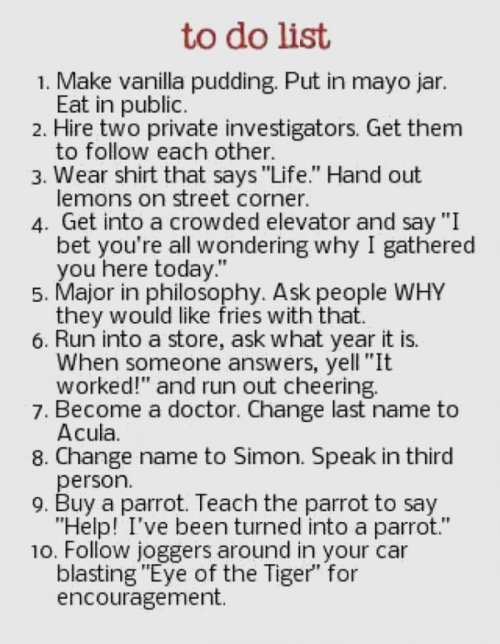
Wordless Wednesday no. 15

to-do-list

15 Comments

January 18, 2017 · 4:19 PM

Rules of Writing: Elmore Leonard

elmore-leonard-authorElmore Leonard, best known for countless novels and their film adaptations, such as Get Shorty, Jackie Brown and Out of Sight, was known for this gritty writing style and strong dialogues.
Here are a few of his gems of advice for writers (with my comments in parentheses):

  • “If it sounds like writing, I rewrite it.”
  • “Try to leave out the parts that readers tend to skip.” (Think: thick paragraphs of prose; boring lists; role calls that seem to be there more to remind the writer who’s in the scene than to entertain the reader.)
  • “If proper (grammar) usage gets in the way, it may have to go.  I can’t allow what we learned  in English composition to disrupt the sound and rhythm of the narrative.” (This advice should follow the adage, however:  First learn the rules; then you’ll know how and when you can break them.)
  • “Never open a book with weather.  There are exceptions.  If you happen to be Barry Lopez, who has more ways to describe snow and ice  than an Eskimo, you can do all the weather reporting you want.”
  • “I never see my bad guys as simply bad.  They want pretty much what you and I want:  They want to be happy.”
  • “At the time I begin writing a novel, the last thing I want to do is follow a plot outline.  To know too much at the start takes the pleasure out of discovering what the book is about.”
  • “It doesn’t have to make sense, it just has to sound like it does.”

19 Comments

Filed under Lists, Nuts & Bolts, Plot Thots & Profiles, Quotes

Quintus Quotes: Groucho Marx

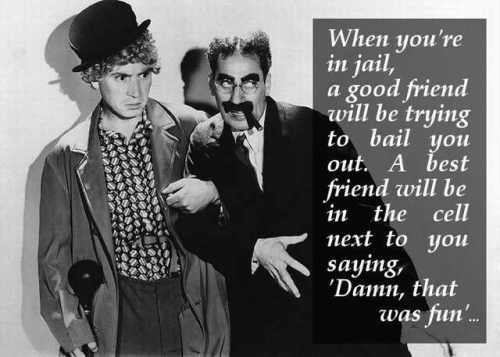
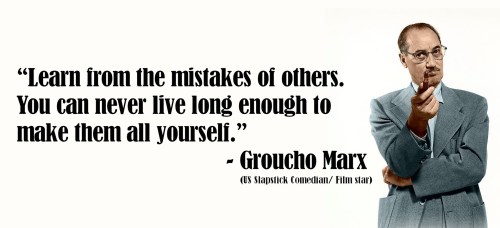
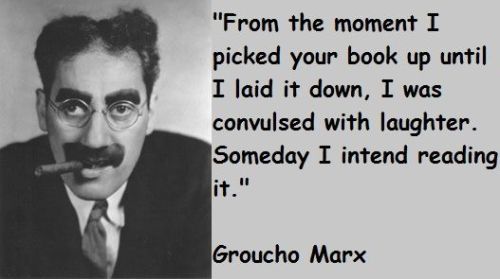
Julius Henry Marx (1890-1977) is best known as Groucho Marx, a member of the Marx Brothers comedy group (along with three of his brothers, Harpo,and Chico and Zeppo).  He was known for his rapid-fire wit and snappy comebacks.

He also once said, “I get credit all the time for things I never said.”  A case in point is a quote that is famously attributed to him, though he denied ever having said:  When Marx was hosting a television show called You Bet Your Life, he asked a contestant why she had chosen to raise such a large family (19 children), to which she is said to have replied, “I love my husband”.  Marx supposedly retorted, “I love my cigar, but I take it out of my mouth once in awhile.” Though the show was pre-recorded for editing purposes (he was known for innuendo-laced remarks), there was never any footage that contained such a remark.

Groucho’s career spanned seven decades, and his famous grease-paint eyebrows and moustache are still recognizable today, imitated and homaged in the arts in various expressions (just google “groucho marx caricature”!).  So without further ado, here are five of my favourite quotes:

groucho-marx-1groucho-marx-2groucho-marx-3groucho-marx-7groucho-marx-6

7 Comments

Filed under History, Humor, Images, Lists, Quotes

New Year’s Resolutions

new-years-resolutions-3It’s that time of the year again, when people talk about “New Year’s Resolutions”, as if the turning of the yearly calendar will somehow magically give them the impetus to make changes.  Rarely does it work that way, however.
A work colleague of my husband once upon a time trained to be a competitive  cyclist, and he said that once one makes the decision to give up in a race – for whatever reason – it makes it all the more difficult to persevere thereafter… once resolve caves, winning it back is harder work than ever before.  The same can be said of life, and resolutions.  If our daily goals don’t match our long-term goals, those long-term goals will never be reached; if we give up or cave in, we’ll find daily excuses why we can’t reach for the goal “yet”, and we’ll have a growing sense of guilt that makes us less willing to face the challenge.

Resolutions at the beginning of the year are usually related to a desire to better oneself; but resolve is something that’s built on a day-to-day basis, and should be a process.  If you set a mental goal – such as going to the gym twice a week  – which is not in agreement with your heart’s desires, then it won’t happen; our mind and heart need to get aligned in order for us to reach any target.

So I say, rather than making a resolution, become resolved.  Take baby steps to reach a goal; those steps might be to go on a walk once a week, or to take the stairs instead of the lift, or to purchase an exercise bike and put it somewhere in your home that’s a motivating place (e.g. near a window with a nice view), and then resolve to build up your stamina gradually with an initial time limit, stretching it as you feel you want to rise to the challenge.  If your goal is to write more, then decide on a specific amount, and take those baby steps – make space in your schedule, or learn how to utilize “limbo” moments toward your goal; carry a notebook and pen, and use them.  If your goal is to appreciate those around you more, then begin to focus on the positives, not the negatives; learn to compliment more and criticize less.

Whatever you want to see change in your life, go for it!  If you fail today, pick yourself back up, dust off your knees, and try again tomorrow.  Anything worth reaching is worth the effort, and every new day is full of opportunities.

Have a wonderful year, and may you look back on 2017 with satisfaction, knowing you’ve grown in positive ways!

6 Comments

Filed under Articles, Cartoon, Musings

Christmas Cheer

Merry Christmas, everyone!  Here are a few cartoons to bring a smile.  I hope your Christmas is relaxing, refreshing, and cheerful!

This slideshow requires JavaScript.

2 Comments

Filed under Images