Tag Archives: grammar syntax

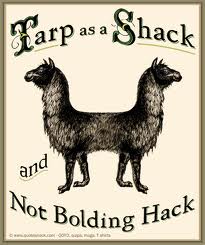
Spoonerisms

A Spoonerism is a deliberate (or accidental) play on words in which the corresponding consonants of two words, vowels, or morphemes are switched between two words in a sentence to create two new words.  For instance, “talking back” becomes “balking tack.”  The name comes from an Oxford minister, Rev. William A. Spooner, who was notorious for making these mistakes.  He must have been an entertaining minister to listen to!  The poor fellow didn’t appreciate the honour of using his name for such mistakes; he had enough on his plate with being Albino with poor eyesight, but he was well-liked, and the dubious honour accorded him was kindly meant.

spoonerism 3Here are a few examples (the interchangeable letters are capitalized):

The Weight of Rages will press hard upon the employer. (Rev. Spooner)

a Tip of the Slung

Dear old Queen / Queer old Dean

Runny Babbit

is the Bean Dizzy?

Fight in your Race

a Pack of Lies

Pest in DRink

the Might is in my Lies

Belly Jeans

BRimulate your Stain

as the FLow CRies

SMart Feller

I’d rather have a bottle in front of me than a frontal lobotomy.

SHake a Tower

well-boiled icicle, well-oiled bicycle

the Pea little THrigs

Roaring with Pain

Ragged Jocks

the Loose that Gaid the olden Geggs

the Mog in the Danger

the Pag at the STool

Beeping SLeauty

… and the Gist Loes on!


All I can say is, Roonerisms SPock!

Leave a comment

Filed under Articles, Nuts & Bolts

Paraprosdokians. Parawhat?

Paraprosdokian is not a word I would readily remember.  I can even admit freely I’d never heard of it until recently.  Maybe I’m just weird, but I can remember a word much better if I know where it came from; this one actually makes sense: (Greek) para– meaning “against”, and prosdokaō meaning “I expect.”  Against expectations.  It’s not actually that old, and is thought of by some linguists as a bogus term; but there are a lot of words that have crept into the English language on just such a pretext, and have hung around for centuries (thereby gaining loyalty from linguists).  I’d say that sounds like a bit of cosmic humour.

A Paraprosdokian is a phrase or sentence that ends with an unexpected twist.  Now it may be as common as rain where you live, but not here.  I tend to think of these sentences as one-liners, and with good reason – this figure of speech is popular with comedians as it’s short and ends on a punch.  Some Paraprosdokians use a familiar phrase and twist the ending such as the first sentence (“Where there’s a will, there’s a way”).  So I say, call them what you will – just use them well!
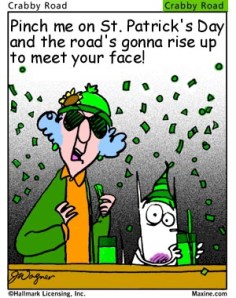
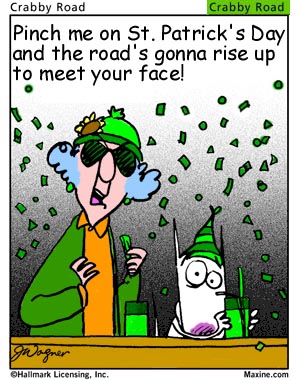
Crabby Road

Where there’s a will, I want to be in it.

I sleep eight hours a day and at least ten at night. (Bill Hicks)

The last thing I want to do is hurt you, but it’s still on my list.

Since light travels faster than sound, some people appear bright until you hear them speak.

You can always count on the Americans to do the right thing – after they have tried everything else. (Winston Churchill)

If I agreed with you, we’d both be wrong.

I don’t belong to an organized political party. I’m a Democrat. (Will Rogers)

We never really grow up, we only learn how to act in public.

War does not determine who is right – only who is left.

This is not a novel to be tossed aside lightly.  It should be thrown with great force.

Knowledge is knowing a tomato is a fruit. Wisdom is not putting it in a fruit salad.

They begin the evening news with Good Evening, then proceed to tell you why it isn’t.

He Ain’t Heavy, He’s My Brother. (Variations on this phrase are attested as early as 1884.)

There’s a fine line between cuddling and holding someone down so they can’t get away.

To steal ideas from one person is plagiarism. To steal from many is research.

If I am reading this graph correctly… I’d be very surprised. (Stephen Colbert)

I haven’t slept for ten days, because that would be too long. (Mitch Hedberg)

Money can’t buy happiness, but it sure makes misery easier to live with.

Buses stop in bus stations. Trains stop in train stations. On my desk is a work station.

I thought I wanted a career. Turns out I just wanted paychecks.

In filling out an application, where it says, ‘In case of emergency, notify, I put DOCTOR.

I like going to the park and watching the children run around because they don’t know I’m using blanks. (Emo Philips)

I didn’t say it was your fault, I said I was blaming you.

Women will never be equal to men until they can walk down the street with a bald head and a beer gut, and still think they are sexy.

Behind every successful man is his woman. Behind the fall of a successful man is usually another woman.

A clear conscience is the sign of a fuzzy memory.

You do not need a parachute to skydive. You only need a parachute to skydive twice.

I used to be indecisive. Now I’m not so sure.

He was at his best when the going was good. (Alistair Cooke on the Duke of Windsor)

You’re never too old to learn something stupid.

To be sure of hitting the target, shoot first and call whatever you hit, the target.

Nostalgia isn’t what it used to be.

Change is inevitable, except from a vending machine.

I’ve had a perfectly wonderful evening, but this wasn’t it. (Groucho Marx)

A modest man, who has much to be modest about. (Winston Churchill, about Clement Attlee)

If I could just say a few words… I’d be a better public speaker.

She was good as cooks go, and as cooks go she went.

Leave a comment

Filed under Articles, Cartoon, Grammar, Humor, Nuts & Bolts

Stop Apostrophe Abuse

Okay, grammar pet peeve time:  Apostrophe abuse.  It needs to stop.  Now.apostrophe Puppy

There are only two instances in the English language in which apostrophes are used:

1) Contractions, as in:  you are = you’re, or have not = haven’t, or I am = I’m.  Just keep in mind that the apostrophe takes the place of the missing letter(s); if you take a letter out to combine (contract) two words together, place the apostrophe where the missing letter would have been written.

2) Possessives, as in:  Steve’s hat (the hat belongs to Steve), or today’s specials (specials on for today)

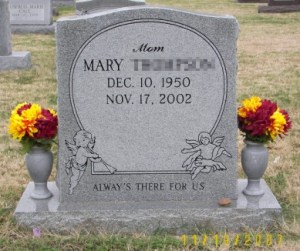
Apostrophe Tombstone

Alway’s there for us. Who is Alway?

Never, I repeat NEVER should an apostrophe be used to indicate a plural!!  Never, EVER.  If you see it used as a plural, it’s wrong – even if it’s on a tombstone (see the image below). Apostrophe Tombstone 2

In the illustration on the right, “Alway’s there for us,” it obviously means “Alway is there for us.”  But who is Alway?  I thought Mary was trying to rest in peace here…  It’s just wrong on so many levels, because it’s not even a plural (which they were aiming for), but an adverb.

Let’s (as in “let us”) look at another very common mistake:  1) it vs. 2) it’s vs. 3) its:

1) “It” is fairly straightforward; it is the third person singular pronoun (used in place of a noun) for objects or gender-neutral references; e.g. The chair is red = It is red.

2) “It’s” is the contracted form of “it is”, as in It’s raining or “it has”, as in It’s been a long time since we saw each other last.

3) “Its” is the possessive form of the third person singular pronoun:  “the dog’s paws” = “its paws”  REMEMBER:  You would never spell “his shirt” as “hi’s shirt”, or “her skirt” as “he’r skirt”; in the same way you should never use the contracted form as the possessive form of it.

It’s not “CD’s” or “DVD’s” as the plural form; this is actually the possessive (which therefore requires an object for that subject’s possessive form, as in the CD’s case), and I find myself asking, “CD’s what?”

If you want more examples, from tombstones to shop signs to tattoos that are embarrassingly wrong, take a look at  www.apostropheabuse.com.  Okay, pet peeve appeased.  Glad to get that off my chest.

5 Comments

Filed under Articles, Cartoon, Grammar, Nuts & Bolts, Writing Exercise

That Low-Down Word

That Word CloudI run a forum on a British writers’ website for grammatical problems, and answer questions that come up in the course of their writing projects.  This week the question came up about that little word, “that” – when to use it and when to lose it.  When do you use that?  When do you use a comma instead?  And when is neither one necessary?  Ah, what a tangled web we weave, when first we practice proper grammar.  Hey, just kidding – it’s not that complicated!  Sometimes it doesn’t matter, and sometimes it can be confusing without it.  So, here’s the low-down:

1) Remember Rhythm:  How does your sentence flow?  Read your sentence aloud; does it have a better rhythm with or without that?  When in doubt and rhythm / comprehension is fine with or without, use it – inclusion may benefit the understanding of the sentence as a whole, and omission may cause misunderstandings.  Sometimes using that is a matter of personal taste.  Here’s a sentence that could be understood with or without:  “Fiona thinks (that) Alistair works too hard.

If you’ve already got a that in the sentence elsewhere, consider how your sentence can be reworded to avoid an overload. A double that is usually unnecessary.  In the sentence, “I realised that that would not be a good idea” the first that (acting as a conjunction, whereas the second acts as a pronoun) could be eliminated, aiding the flow but not impeding the comprehension.  Sometimes that is required in one part of a sentence, and when a second that comes up a choice needs to be made:  Take this sentence, from an AP report:  “Ford Motor Co. warned that it no longer expects to return to profitability by next year and that it is trimming North American production of pickups and SUVs for the rest of this year because of high gas prices and a shaky economy.”  The second instance could be eliminated thus:  “…next year; it is trimming…”

2) Comprehension:  Sometimes a sentence can be unintentionally misleading, and using that can help clarify.  For example,  “Fiona maintains Alistair works too hard.”  Does Fiona maintain Alistair and he works too hard? If you insert a that after maintains, it becomes clear that maintains refers to an opinion, and not maintenance of Alistair.

Sometimes in our writing, however, we want to intentionally lead the reader or a character down the garden path toward the wrong conclusion.  It’s a fine art, and understanding how another person interprets what you’ve written or could interpret it goes a long way toward walking that fine line between misdirection and deception; the first will leave a “gotcha” smile, and the latter might leave your next book unread….  As a plot element, it has its uses; but as a badly written sentence, it only results in confusing and frustrating the reader, who has to find the beginning of the sentence and read it again to understand it properly.

3) Commas:  Commas can sometimes replace the word that.  In this example, “Peter Coveney writes that ‘[t]he purpose and strength of . . .’” it would never be “Peter Coveney writes that,” or “Peter Coveney writes, that…” though it could be, “Peter Coveney writes, “…”

I hope that helps some of you dealing with similar issues in writing!

Leave a comment

Filed under Articles, Nuts & Bolts, Research

Thoughts on Writing from a Reader’s Perspective

Card - InsomniaFor me, reading a book is about escaping to a new world, diving into that world through the medium of the senses that are stimulated by well-chosen words, precision instruments that play a symphony of emotions, smells, sights, sounds, touches, tastes, balance and harmony.  I’ve never really appreciated books that are written with gratuitous scenes of violence or sex; sometimes it seems to me (as a reader) that writers throw in scenes willy-nilly to spice things up or to patch over the fact that they haven’t researched and developed their characters thoroughly, or because they run out of plot ideas and just spin their wheels.  Such scenes grate against my senses just as much as random punctuation or bad spelling does.  If such elements are not organic, logical, and a natural development of the plot, they do not belong there.  Period.  It’s an insult to my intelligence and a brazen demand on my “believability credits” that is frankly not the author’s to demand… those credits are something that I as a reader give gladly to a good writer, but a writer has to earn them, and has no right to demand that I suspend disbelief to dive into their story when they haven’t bothered to make it believable.  The writer’s job is to earn those credits through good writing, good writing, and good writing, i.e. plot, character development, grammar, syntax, orthography, and structure.
Don’t misunderstand me:  There are times when the darker scenes are organic; they are necessary to portray the character, or are a natural outflow of the character’s flaws or decision process, or lack of positive input earlier on in life.  Sexual scenes can be sexy without being vulgar, sensual without being slutty.  Sometimes I read books that deal with such issues, but more as a writer than a reader, to see how they are structured.  I read part of a book recently (I gave up quite early, which not a good sign for the writer) where the author had seemingly tried to cram as many vulgar terms as they could into one chapter, or one page, or one dialogue.  It got so ridiculous that I started reading as an editor, slicing out entire passages to improve the script.  As far as I’m concerned, there’s not really a point in publishing something that will likely offend half your demographic sector away from buying a second book.

Give me something to read that’s intelligent, entertaining, witty, smart, deep, and that I can come away from the experience wanting more – not just another book with those characters, but that I come away having learned something about myself or the world around me, having been positively changed, encouraged, enlightened or satisfied.

2 Comments

Filed under Articles, Cartoon