Tag Archives: Quotes

Who’s Who in Quotes: John Bertram Phillips

Deciding who to highlight here in this space sometimes comes down to a moral choice; some of the people I’ve investigated as a result of a quote from my collection have turned out to have lived lives that are, frankly, not worthy of my spending time and effort to share their history. One was a multi-billionaire who was a womanizer and a miser who loved tormenting people under his control. He lived a miserable life and died a lonely death. As Jesus said, “What good is it for someone to gain the whole world, yet forfeit their soul?” (Mark 8:36). Others, while they may have lived lives worth remembering, made strings of unwise choices that led to scandals and/or dodgy associations with corrupt foreign powers. While a quote or two from such a person might hold a grain of truth or wit, I personally find it difficult to un-see the stains behind the curtain, as it were, and so I choose to highlight lives that have something worth learning from or from those people who’ve done something worthy of our respect.

The person I’d like to highlight today is John Bertram Philips (1906-1982), best known for his translation of the New Testament and part of the Old Testament into modern English. This work wasn’t done in a stuffy theologian’s office, but in the bomb shelters of the London Blitz of World War 2. During that war, he was the Anglican vicar of the Church of the Good Shepherd in Lee, London, and he realized that the young people in his church had difficulty relating to, or understanding, the Authorized Version of the Bible, aka the King James Bible, which was first published in 1611*. By the mid-1940s, English had changed fundamentally, and it has continued to grow and adapt; the older version of the biblical translation was and is (for most people) stuffy and unrelatable. [For those of you wondering which version of the Bible is most accurately translated from the original Greek, Hebrew and Aramaic texts, the NIV Bible adheres most closely to them; 2011 saw a major revision to the NIV translation, based on recently published critical editions from biblical scholars.]

[*The history of how The King James Bible came to be the king’s Bible is long and sordid, littered with spies, political intrigue and betrayal, ending in the gruesome martyrdom of William Tyndale, whose translation was basically appropriated after his death, which is ironic, as he was tried because his translation was illegal…”unauthorized” by the Holy Roman Empire political elite… but that’s another story.]

Encouraged by his friend, C.S. Lewis, Philips published the first section of the New Testament, starting with Paul’s letters to the churches, in 1947, with the Gospels following in 1952. The final compilation of the New Testament was published in 1958. In the 1960s, he translated and published parts of the Old Testament, though this was never finished within his lifetime.

As a minister and translator, a communicator at heart, it’s no wonder that there are numerous quotes taken from his writings, sermons, and letters written during his lifetime; in some ways, like Tyndale, he was ahead of his time in his understanding of God and our relationship with Him. As the saying goes, we today see further because we stand on the shoulders of giants. Whether or not you believe in God, if you live in any nation with Judeo-Christian foundations, you benefit from those shoulders in more ways than you know.

If you’d like to read more about the life of this complex man, who struggled with clinical depression most of his life and yet remained firm in his faith, please click on the link to an article titled, A Bruised Reed Firmly Planted.

Without further ado, here is a selection of quotes from John Bertram Phillips:

  • The refusal to be committed and the attitude of indifference can, in fact, never be neutral.
  • Christianity is not a religion at all but a way of life, a falling in love with God, and through him a falling in love with our fellows (fellow man).”
  • Christ is the aperture through which the immensity and magnificence of God can be seen.
  • God is not discoverable or demonstrable by purely scientific means, unfortunately for the scientifically minded. But that really proves nothing. It simply means that the wrong instruments are being used for the job.
  • All poetry and music, and art of every true sort, bears witness to man’s continual falling in love with beauty and his desperate attempt to induce beauty to live with him and enrich his common life.”
  • It is refreshing and salutary to study the poise and quietness of Christ. His task and responsibility might well have driven a man out of his mind. But He was never in a hurry, never impressed by numbers, never a slave of the clock.”
  • You can throw the whole weight of your anxieties upon him, for you are his personal concern.” (from his NT translation)
  • There is… no easy answer to the evil and suffering problem and no easy road to its solution. But Christ tackled the matter radically and realistically by winning the allegiance of a few men and women to a new way of living…They were to be the spearhead of good against evil.”
  • Love knows no limit to its endurance, no end to its trust, no fading of its hope; it can outlast anything. It is, in fact, the one thing that still stands when all else has fallen.” (from his NT translation)

3 Comments

Filed under History, History Undusted, Links to External Articles, Military History, Quotes, Research, Snapshots in History

Who’s Who in Quotes: Will Rogers

Will Rogers is one of those larger-than-life characters who seemed to have had his fingers in every pie imaginable: Born in November 1879 as a Cherokee Nation citizen in the Indian Territory now known as Oklahoma, he was the youngest of eight siblings, only three of whom survived into adulthood. His mother died when he was just ten years old. By the time he was 20, he’d begun appearing in rodeos, and in 1902 at the age of 22, he and a friend moved to Argentina to find work as gauchos (a skilled horseman, hired by ranchers in many South American countries). When their adventure failed, and they’d lost all their money, Will couldn’t bear to ask for money from home, so he took a boat to South Africa, where he was hired as a ranch hand. His career as a trick roper began there, as he joined the Texas Jack’s Wild West Circus. From there, armed with a letter of reference from Texas Jack, he moved to Australia and joined the Wirth Brothers Circus as a rider and trick roper. By 1904, he’d returned to the States and performed in the St. Louis World’s Fair, then began using his riding and roping skills in the Vaudeville circuits; he was often billed as The Cherokee Kid. His natural humour hit a chord with audiences, who loved his frontier twang of an accent coupled with his off-the-cuff wit and commentary on current events; he built his later career around that talent.

In 1908, he married Betty Blake, and they had four children; three survived into adulthood, all of whom went on to have careers in the public eye in one way or another.

By 1916, Rogers was a featured star in Ziegfeld’s Follies on Broadway; from there he branched off into silent films; at that time, most films were made in or around New York, which allowed him to continue performing on Broadway. The New York Times syndicated his weekly newspaper column, “Will Rogers Says”, from 1922 to 1935; he also wrote for The Saturday Evening Post; this progressed into books – over 30 of them. He also hosted a radio program, telling jokes and discussing current events with his simple, disarming humour.

Click here to see a short, 3-minute video showcasing some of his amazing rope tricks.

He was an avid supporter of the aviation industry, and he took many opportunities to fly to his various engagements. In 1926, while touring Europe, he saw how much more advanced the commercial services were there in comparison to the States; his newspaper columns often emphasized the safety and speed of travel aeroplanes offered, which helped shape public opinion about the new mode of transport.

In 1935, Wiley Post, a famous aviator of his time, proposed flying from the West Coast to Russia to find a mail-and-passenger air route, and Rogers asked to go with him in order to find new material for his newspaper columns. Post’s plane was modified for the long flight, and floats were added for landing on water. On 15 August, they took off from Fairbanks, Alaska, for Point Barrow, a headland on the Arctic coast. Bad weather hindered their ability to calculate their position, and, after landing in a lagoon to ask directions and taking off again, the engine failed at low altitude and plunged into the lagoon, killing both men. Rogers was 55.

In such a short life, he left a huge legacy in many fields of entertainment and helped shape public perspectives on politics and civil responsibility. He was a household name in the early 20th Century and a trusted voice during the Great Depression, identifying with the struggles of the average American and holding a mirror to politics with his witty satire.

Here are a few of his famous quotes:

  • Be thankful we’re not getting all the government we’re paying for.
  • Even if you are on the right track, you will get run over if you just sit there.
  • Everything is funny, as long as it’s happening to somebody else.
  • I don’t make jokes. I just watch the government and report the facts.
  • My ancestors didn’t come over on the Mayflower, but they were there to meet the boat.
  • Live so that you wouldn’t be ashamed to sell the family parrot to the town gossip.
  • The only difference between death and taxes is that death doesn’t get worse every time Congress meets.
  • The trouble with practical jokes is that very often they get elected.
  • There’s no trick to being a humorist when you have the whole government working for you.
  • This country has come to feel the same when Congress is in session as when the baby gets hold of a hammer.
Will Rogers

2 Comments

Filed under History, History Undusted, Humanity Highlights, Quotes, Snapshots in History, YouTube Link

Who’s Who in Quotes: Samuel Johnson

Dr Samuel Johnson (1709-1784) was an English poet, playwright, essayist, moralist, literary critic, sermonist, biographer, editor, and lexicographer, and his writings have lasted the test of time. He has been called “the most distinguished man of letters in English history” (The Oxford Dictionary of National Biography). His most notable work is “A Dictionary of the English Language” (1755), though he was a prolific writer in every expression of the craft.

Based on biographies by those who knew him, such as his friend, James Boswell, his mannerisms and behaviours were so well documented that a posthumous diagnosis of Tourette’s Syndrome can be attributed to him. The most famous portrait of Johnson is the one above, painted by Joshua Reynolds, with whom he founded The Literary Club in 1764. The club would meet regularly, and included members from the literary and historical disciplines; membership was by unanimous election only; if a nominee was undesirable, a member could submit a black ball (white and black balls were likely deposited in an urn to keep the vote confidential). The term “to blackball someone” arose in 1770, and it means “to exclude from a club by adverse votes”. It may have originated at this club or simply have been a general practice employed in clubs and societies around this time.

So, without further ado, here are 10 quotes by Dr Johnson:

“I know not, Madam, that you have a right, upon moral principles, to make your readers suffer so much.”

“I never desire to converse with a man who has written more than he has read.”

“It is better to live rich than to die rich.”

“No man will be a sailor who has contrivance enough to get himself into a jail; for being in a ship is being in a jail, with the chance of being drowned. … A man in a jail has more room, better food and commonly better company.” (Boswell’s Life of Johnson)

“The chains of habit are too weak to be felt until they are too strong to be broken.”

“The use of travelling is to regulate imagination by reality, and instead of thinking how things may be, to see them as they are.”

“Great works are performed not by strength, but by perseverance.”

“In order that all men may be taught to speak truth, it is necessary that all likewise should learn to hear it.”

“When a man knows he is to be hanged in a fortnight, it concentrates his mind wonderfully.”

“The superiority of some men is merely local. They are great because their associates are little.”

3 Comments

Filed under Articles, Etymology, History, History Undusted, Quotes, Snapshots in History

Who’s Who in Quotes: Alan Ashley-Pitt

If you’re like me, you might come across a good quote and not think any further about the name attached to it; did that person really say that? I’ve seen quotes attributed to one person but which I know were actually said or written by someone else. Sometimes, a quote is drawn from someone’s writings, letters, essays, or journals from the past. Now, with the dawn of AI upon us, algorithms begin to feed off of their own creations—whether the first effort was accurate or not—which in turn disseminates falsehoods so frequently that most people begin to believe them. It’s important now more than ever that we pay attention and use discernment; don’t believe everything you see or read, but test it. This image is a classic case in point:

So who was Alan Ashley-Pitt? “He” was, in fact, a name made up by a greeting card and poster company headquartered in Santa Barbara, CA, in the late 1960s and early 1970s. The company needed a name to quote for the sayings made up by employees for their cards, decorations, and posters. Though the company was out of business by 1974, many of its creations live on in the Ashley-Pitt quotations. In a way, it’s ironically fitting that a made-up persona’s quote should be imposed on the AI-generated image (below); unfortunately, the AI programs I tried couldn’t grasp the concept of a fork in the road with a crowd on one road and a lone man on the other. It just goes to show you that the human imagination is more creative and able to grasp abstract concepts better than any AI… so far!

2 Comments

Filed under History Undusted, Humanity Highlights, Images, Quotes, Snapshots in History

Etymology Undusted: Catch-22

The idiom “Catch-22” comes from a book of the same title by American author Joseph Heller (1923-1999). The term originally referred to a military rule whose provisions are mutually frustrating. Heller used Catch-18 instead of Catch-22 when the first chapter of his book was originally published in 1955. He changed it by the time the entire book was published in 1961 because his publisher had already published a book that year with “18” in the title (Leon Uris’ novel, Mila 18). So in 1961, the phrase Catch-22 first appeared. It was first used figuratively in 1971 in Atlantic Monthly magazine. As far as the form goes, it is usually hyphenated and with a capital C, as that is the way Heller originally wrote it.

Since the author’s first usage of the idiom, it has taken on a life of its own: Today, its broader meaning is a paradoxical situation from which an individual cannot escape because of contradictory rules or limitations. It has also been used as a mnemonic for the symptoms of DiGeorge syndrome.

One particular quote from Heller is thought-provokingly insightful: “Everyone in my book accuses everyone else of being crazy. Frankly, I think the whole society is nuts – and the question is: What does a sane man do in an insane society?” In a way, this is perhaps an example of a Catch-22 for the sane person: If they stay in an insane society, they may lose their sanity; but by leaving such a society, they throw away any chance of bringing it back to a state of reason. Social and political polarisation are both poisons that infect society.

1 Comment

Filed under Etymology, Grammar, History Undusted, Images, Musings, Psychology Undusted, Quotes

History Undusted: Rolf Ganger, Viking Outlaw and Founder of Normandy

How does a rabble-rousing Viking end up causing a war centuries after his death (as if stirring up trouble during his lifetime wasn’t enough fun and gigs)? Read on… this is going to be a quick, deep dive into history, so buckle up!

Firstly, let’s start with Rolf Ganger, aka Rollo, Rolloun, Rollon, or Hrôlfr – depending on which language you read. On his tomb, the Latin version of his name is Rollonis (see image).

Tomb of Rollonis (Rolf) Ganger, the first ruler of Normandy, in Rouen Cathedral (He’d probably roll in his grave to find himself so simperingly portrayed…!)

The Heimskringla is a collection of ancient Norwegian sagas about Norwegian kings and rulers, written by Snorri Sturluson (great name, by the way) around AD 1230. It tells us that Rolf was the oldest legitimate son of Earl Ragnvald, best friend of King Harald Harfager (“Fair Hair” – a nickname given to him by the Earl due to Harald’s thick, fair hair), who was the first king of Norway, reigning from ca. AD 872 to 930. It tells us that Rolf was so hefty that no horse could carry his weight; thus, he had no choice but to walk everywhere, from which Ganger, his second name derives (I cannot find a direct translation of the meaning of the name, but Germanic languages have similar words: In German, “gehen” means go or walk; “gangart” means gait, or way of walking).

Harald Harfagre, First King of Norway – Statue in Haugusund, Norway

He was rowdy, even by Viking standards. Heimskringla records that he plundered most of the East Sea (likely referring to what is now the region around the Baltic Sea). Then, “One summer, as he was coming from the east on a Viking’s expedition to the coast of Viken*, he landed there and made a cattle foray. As King Harald happened, just at that time, to be in Viken, he heard of it, and was in a great rage; for he had forbid, by the greatest punishment, the plundering within the bounds of the country. The king assembled a Thing**, and had Rolf declared an outlaw over all Norway.”

*Viken was a region that lay over the modern border between Norway and Sweden.

**To assemble a Thing means to gather a council or general assembly. These still take place in some parts of Switzerland, as well as on the Isle of Man and in Scotland; the Icelandic Althing is considered the oldest active, surviving parliament in the world, dating back to the AD 900s. The first detailed description of such a Thing was made by Tacitus, a Roman historian and senator, in AD 98; the oldest reference to a Thing is inscribed on a stone near Hadrian’s Wall, dated as early as AD 43.

According to the Heimskringla, Rolf, now banished from Norway, headed toward the Hebrides, and from there to “Valland” [In Norse legend, Valland is the name of the part of Europe which is inhabited by Celtic and Romance peoples, and Snorri Sturluson mentions it several times as the Old Norse name for Gaul, which was a region of Western Europe first clearly described by the Romans, encompassing present-day France, Belgium, Luxembourg, and parts of Switzerland, the Netherlands, Germany, and Northern Italy, and covering an area of around 494,000 km2.].

Arriving in Gaul, he did what he did best – went a-Viking, plundering and pillaging and “subduing for himself a great earldom”. He populated it with his own best rabble of Norsemen, which the French called Normanz, literally “north men” which quickly led to the Anglicized term Normans (similar to the word for the people group and language, Norse).

One of the places known to have been invaded by the Vikings in AD 841 is the Jumièges Abbey, which is along the Seine River on its way to Rouen, which they also ransacked. At some point (around AD 885), Rolf also raided Bayeux, carrying off a woman, Popa (whose lineage is unverified – later historians for the duke may have sanitized her parentage to legitimize their son’s noble lineage, as she was married “more danico”). She gave birth to his heir, William Longsword. When Rolf and his gang were all done hacking their way through towns and villages along the Seine, they eventually made their way back to Rouen, where he established the Duchy of Normandy in AD 912.

So, how did Rolf cause a war centuries later? Well, his son, William Longsword, fathered a son, Richard the Fearless (who became ruler of Normandy at the age of 10 when his father died). Richard’s son was called Richard the Good, and he became the father of Robert the Magnificent and grandfather to the illegitimate William the Bastard, who became known as William the Conqueror (a sword seems to have cleared up his illegitimacy quite neatly) – from whom all the subsequent English kings descended. Now to the crux of the matter: William, descendent of Rolf Ganger, fathered English kings, who thus claimed their right to the Norman throne by connection, birth, rank… in short, any excuse for raiding was still in their blood. Rouen was one of the largest and most prosperous cities of medieval Europe, and (as mentioned in my last post) was made wealthy through textiles and trade along the Seine River and beyond. Rouen became the focal point of the Hundred Years’ War (1337-1453) because of that pesky connection. So now ya know!

5 Comments

Filed under Articles, Etymology, History, History Undusted, Links to External Articles, Quotes

Imagination is a Superpower

I’ve taught English as a foreign language for adults for years, from the age of 13 up until Covid put such gatherings on hold. I would often use some kind of exercise that allowed students to think outside of their normal lives, to stretch their vocabulary and to practice speaking and forming sentences outside of their comfort zone. I once had a nursing student, meeting as a semi-private student with another fellow nurse, who categorically refused to do any exercises requiring a make-believe scenario; she called herself a “realist”. Despite reasoning with her, or her friend asking her to participate so that she could learn more, she refused. I found it frustrating as a teacher, but I found it tragic as a writer and creative thinker.

Thinking outside of the box and thinking creatively stretches our brains in extraordinary ways; it promotes creative problem solving, allows us to put ourselves in someone else’s shoes for a moment, and can help us view a situation from several different angles. By thinking into fictitious scenarios, we learn something about ourselves along the way – those things that make us tick, our strengths, or our weaknesses.

For years, I’ve collected interesting writing prompts whenever I’ve come across them; it’s going down the proverbial rabbit hole to follow leads on the internet, but because I’ve collected them willy-nilly, I can’t tell you exactly where they originated – it’s a common problem with online research, and as often as I can, I try to give proper credit to images that I use if they’re not my own; the people out there who offer their creative perspectives, photography talents, or Photoshop skills deserve credit where credit’s due. But it’s one reason that I don’t often share such prompts here, for those of you following who are also writers. Another reason is that there are enough sites out there stuffed to the gills with prompts. What I would like to do today is share an exercise in imagination.

Albert Einstein quotes run rampant on the internet; without a reference book to know what he actually said, I feel that many of them fall into this category:

Having said that, sometimes you can gather the essence of what he probably said by reading “diagonally” through the supposed quotes, and one such sentiment is that Einstein said something like, “Imagination is more important that knowledge; knowledge is limited to all we know and understand, while imagination embraces the entire world.” Mark Twain once wrote*, “You can’t depend on your eyes when your imagination is out of focus.” [* Excerpt from his Complete Works] (By the by, if you’d like more Mark Twain wit, I wrote an article about his views on Switzerland, and the German language – just click here.)

So here’s something to exercise your imagination with:

You have the choice between flight and invisibility; which do you choose and why? What will you do with this superpower?

I’d love to hear your answers in the comments below!

13 Comments

Filed under Articles, Humor, Images, Musings, Quotes, Research, Writing Exercise, Writing Prompt

History Undusted: Bells

Recently, my husband was catching up with the articles on my blog, and he made the cheeky comment that I’d written about everything except the history of bells. Now, I know that’s not true – there are other things out there I still have yet to discover – but I took up the challenge; hence, this post. The history of bells, or of anything, for that matter, is an audacious title; as Mark Twain once said, “The very ink with which all history is written is merely fluid prejudice.” At best, such an online article can skim the surface of any historical topic; my purpose is not to give an extensive report – it’s to whet your appetites to search out history for yourself. I “undust” it for you – it’s up to you to grab it by the horns and hang on.

Every country has their favourite bells: Americans have the Liberty Bell (“At noon, on the Fourth of July, 1826, while the Liberty Bell was again sounding its old message to the people of Philadelphia, the soul of Thomas Jefferson passed on; and a few hours later John Adams entered into rest, with the name of his old friend upon his lips.” – Allen Johnson); the Brits have Big Ben (it’s the actual name of the bell, not the clock tower) and other, regional celebrities; the Russians have the Tsar Bell, in Moscow; the Polish have the Sigismund, located in Wawel Cathedral in Krakow, Poland. but where did they come from originally? What was their original purpose?

The oldest known bell is from around 2000 BC, from Neolithic China, and it was made of pottery tiles. As far as historians can deduce, the bell has always been associated with two social functions: As a signal for messages, such as when a work day would begin or end, and for calls to religious ceremonies or as reminders for specific times of day for various rituals. The sound of bells have always been associated with divinity, likely because it was a sound unlike any natural sound known to the people who heard them ringing out over a great distance – they could hear them, but not see the source of the sound. In ancient times, when most people were both uneducated and superstitious, it’s not hard to follow such reasoning.

Bells can range from tiny jingle bells to several tonnes; the Great Bell of Dhammazedi was the largest bell ever made, in 1484, for King Dhammazedi of Hanthawaddy Pegu (Lower Burma), and weighed 327 tonnes. It was placed in the temple of Shwedagon Pagoda and stolen by the Portuguese – whose ship promptly sunk under the weight of the bell.

Today, church bells still ring out across Europe, calling parishioners to church services, as well as ringing out on the hour to mark the passing of time. They ring out in special ways for various celebrations, whether weddings or holidays such as Christmas, New Year’s Eve, and Easter.

16th century Islamic painting of Alexander the Great lowered in a glass diving bell - Wikipedia

16th-century Islamic painting of Alexander the Great lowered in a glass diving bell – Wikipedia

Certain kinds of bells hold special value: Ship’s bells are like catnip to divers – they’re the primary method of identifying ships, as their names are engraved on the bells even long after the painted names on the hulls have succumbed to the sea; they are a wreck-diver’s trophy of desire, and always hold special place in their collections. An interesting link between diving and bells is that the first actual diving bells – the rigid chambers designed to transport divers from the surface to the depths and back – were shaped like ringing bells; the air would be trapped in the upside-down chamber, allowing a person to be underwater and still breathe. The first description of its use is recorded by Aristotle in the 4th century BC; the most famous diver from that period is Alexander the Great.


English has many idioms associated with bells: Alarm bells ringing (or set off alarm bells, or warning bells going off – i.e. your mind is warning you about a danger or deception in a particular situation); to be as sound as a bell (to be healthy or in good condition); when something has (all the) bells and whistles (extra or entertaining features or functions that aren’t necessary, but nice-to-haves); Hell’s bells! (an expression when one is surprised or annoyed); something rings a bell (i.e. sounds familiar); saved by the bell (i.e. a difficult situation is ended suddenly by an unforeseen interruption); with bells on (i.e. if you go somewhere or do something with bells on, you do it with great enthusiasm or energy); to bell the cat (i.e. undertake a difficult or dangerous task); something to be as clear as a bell (i.e. clearly understood); pull the other leg/one – it has bells on it (i.e. you don’t fool me); one can’t unring a bell (once something has been said or done, you can’t unsay or undo it); the final bell (the end of an event or, euphemistically, a life). I’m sure there are more – if you know of one, please leave it in the comments below!

There is also a powerful experience written by Corrie Ten Boom, a Holocaust survivor, about the Bells of Forgiveness – you can read her story here.

If you’ve got an hour to spare, BBC has an hour-long “History of Bell Ringing” video on YouTube.

So there you have it: Bells, undusted, to pull your rope cord and get those bells ringing in your head, to find out more for yourself!

8 Comments

Filed under Articles, Grammar, History, History Undusted, Military History, Quotes, Research

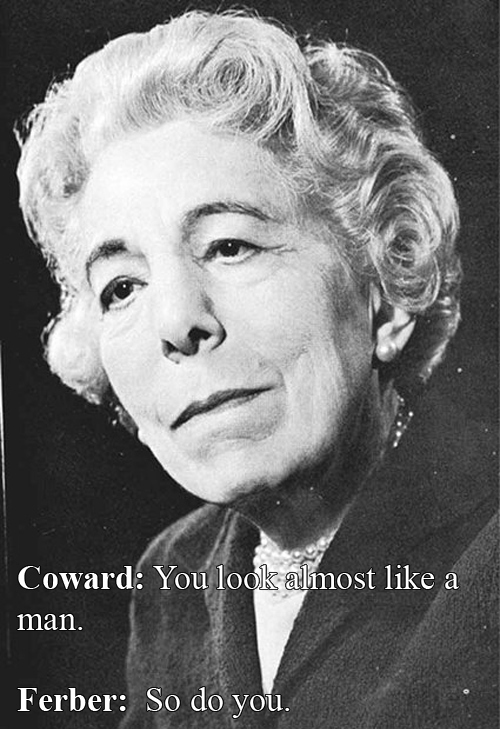
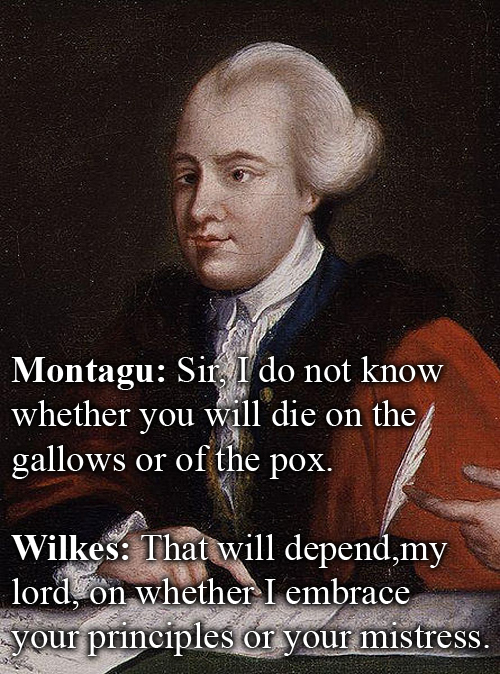
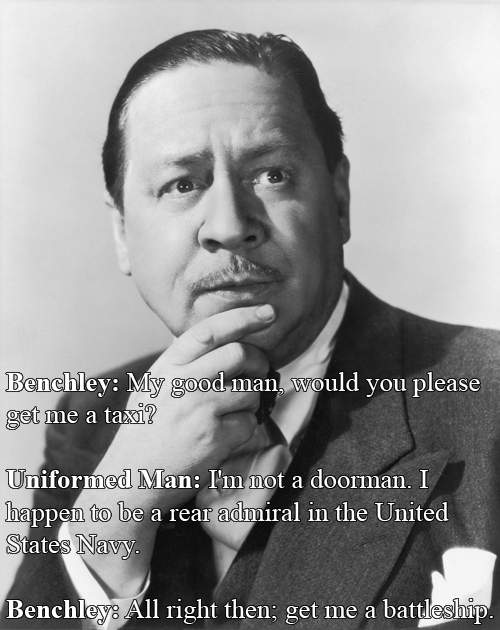
Quintus Quotes: More Witty Comebacks

Witty Comebacks - Calvin CoolidgeWitty Comebacks - Churchill vs Bessie BradockWitty Comebacks - Edna Ferber Vs. Noel CowardWitty Comebacks - John Wilkes vs John MontaguWitty Comebacks - Robert Benchley Vs. A Man In Uniform

3 Comments

Filed under Humor, Images, Quotes

History Undusted: Famous Misquote

Sometimes famous last words occur long before the individual dies; what I mean by that is that a pivotal statement is made, and thereafter (whether immediately, or down through history ever after) the person ends up eating their hat.  Here’s an example:

Charles H. Duell, director of the US patent office 1899, is thought to have said, “Everything that can be invented has been invented.

But we should never judge a book by its cover; because he never said this!  What he actually said was, “In my opinion, all previous advances in the various lines of invention will appear totally insignificant when compared with those which the present century will witness. I almost wish that I might live my life over again to see the wonders which are at the threshold.” ( The Friend, Volume 76, 1902)  Quite a different matter.

It was, in fact, an earlier Patent Office Commissioner, Henry Ellsworth that may have been responsible for the sentiment: In a report to the 1843 Congress, Ellsworth states, “The advancement of the arts, from year to year, taxes our credulity and seems to presage the arrival of that period when human improvement must end.“*

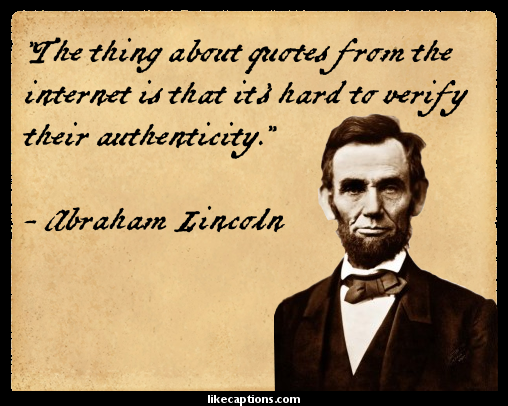
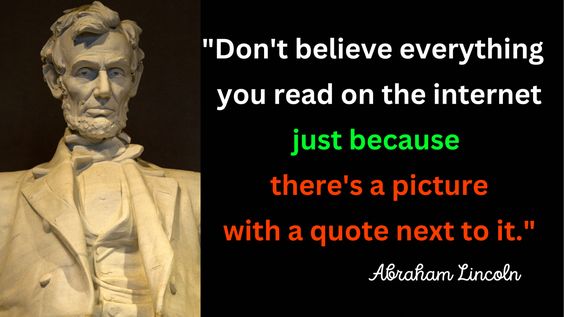
Oddly, you will find the misquote in published books and all over the web; let that be a reminder to us to do a bit of investigation of our own.  Don’t even trust news sources such as newspapers or television news, as they are known to hype up, propagandize, invent, or at the very least embellish events. This last link is a short talk about journalism in the US, and it’s an important reminder for everyone in the world that just because it’s in print or on the news doesn’t mean you can fully trust its veracity.

Abraham-Lincoln-Internet-Quote.png
*Source:  Wikipedia (Take even that source with a pinch of salt!)
Originally posted on

Leave a comment

Filed under History, History Undusted, Quotes, Research