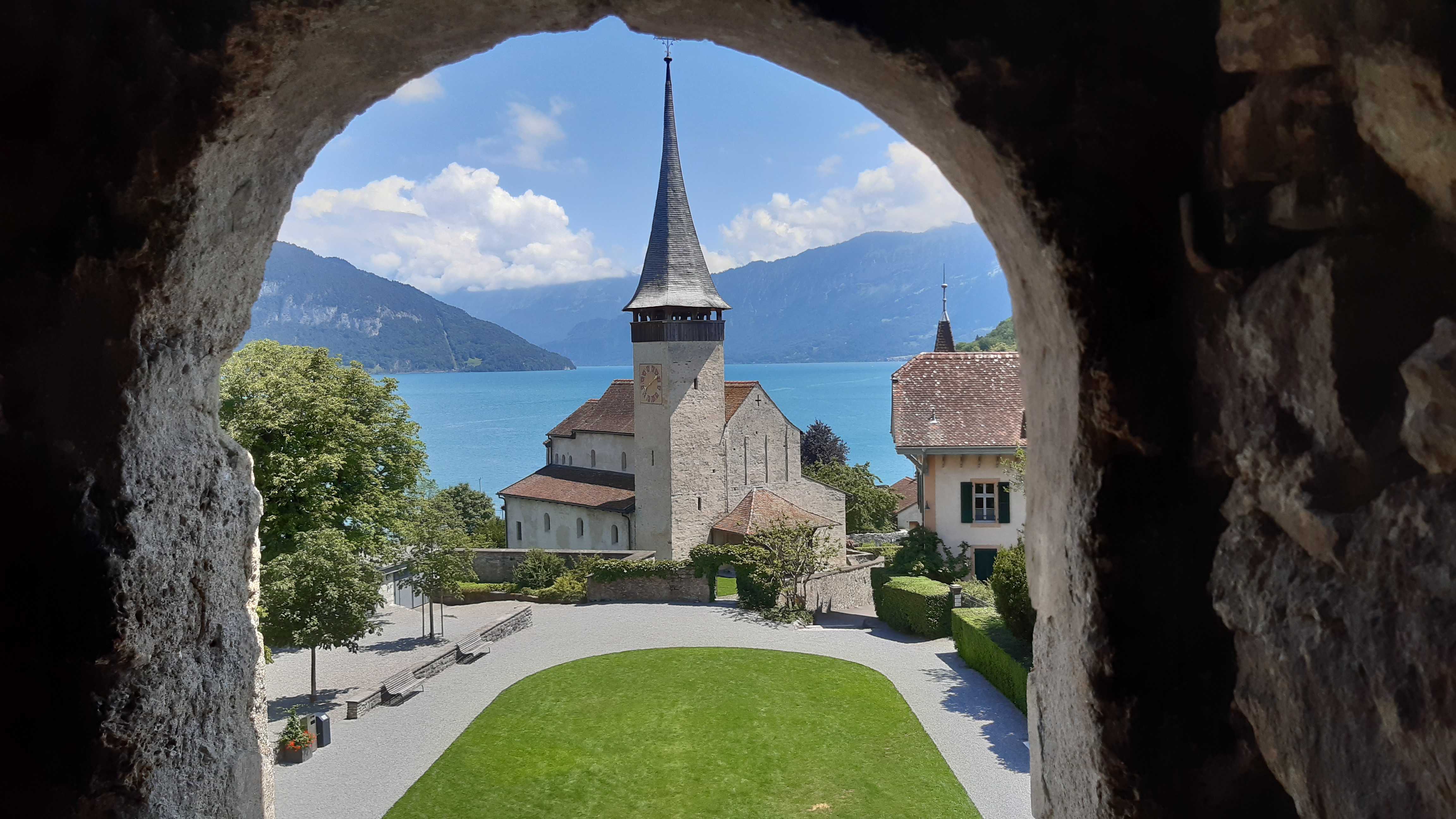
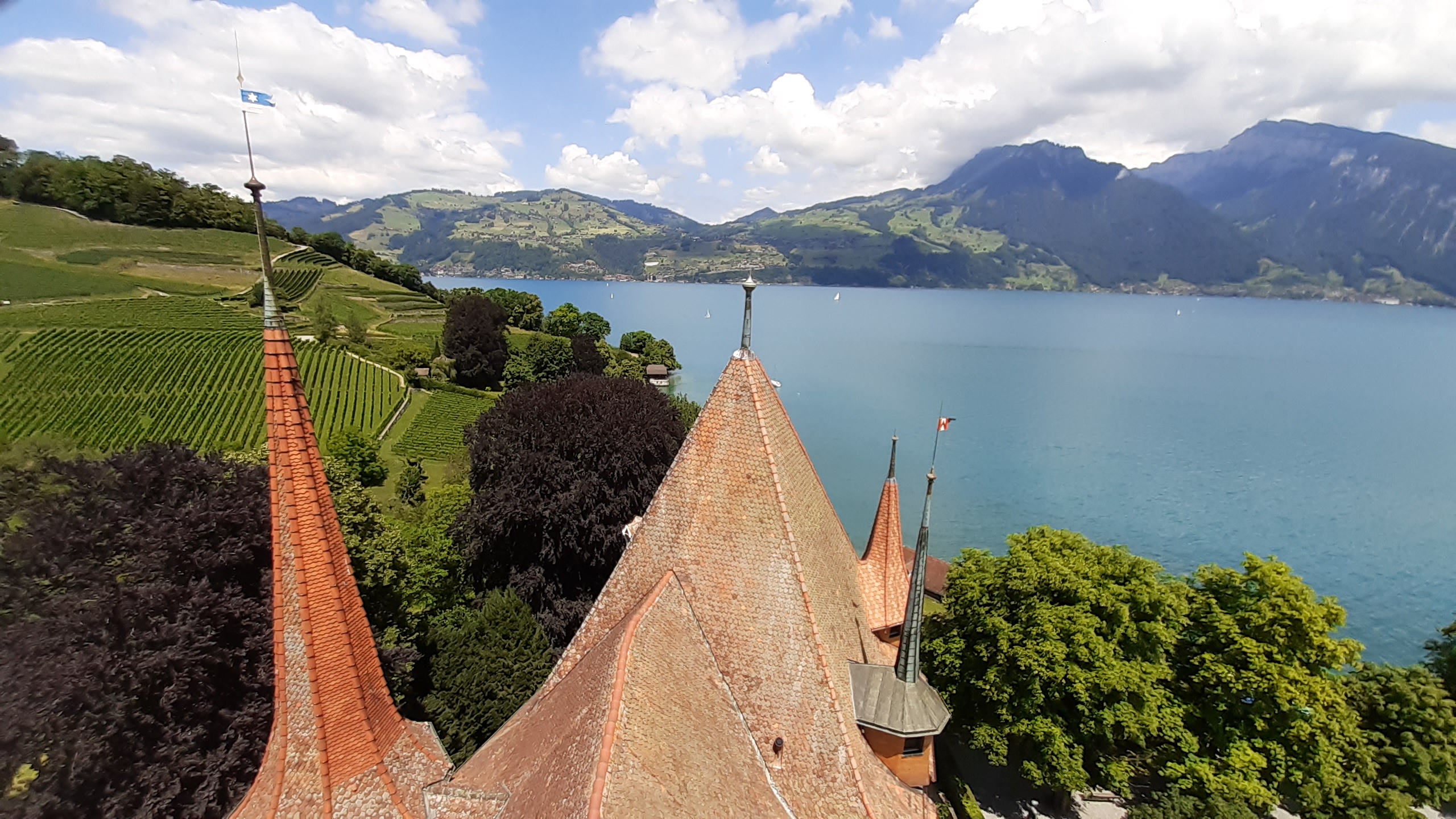
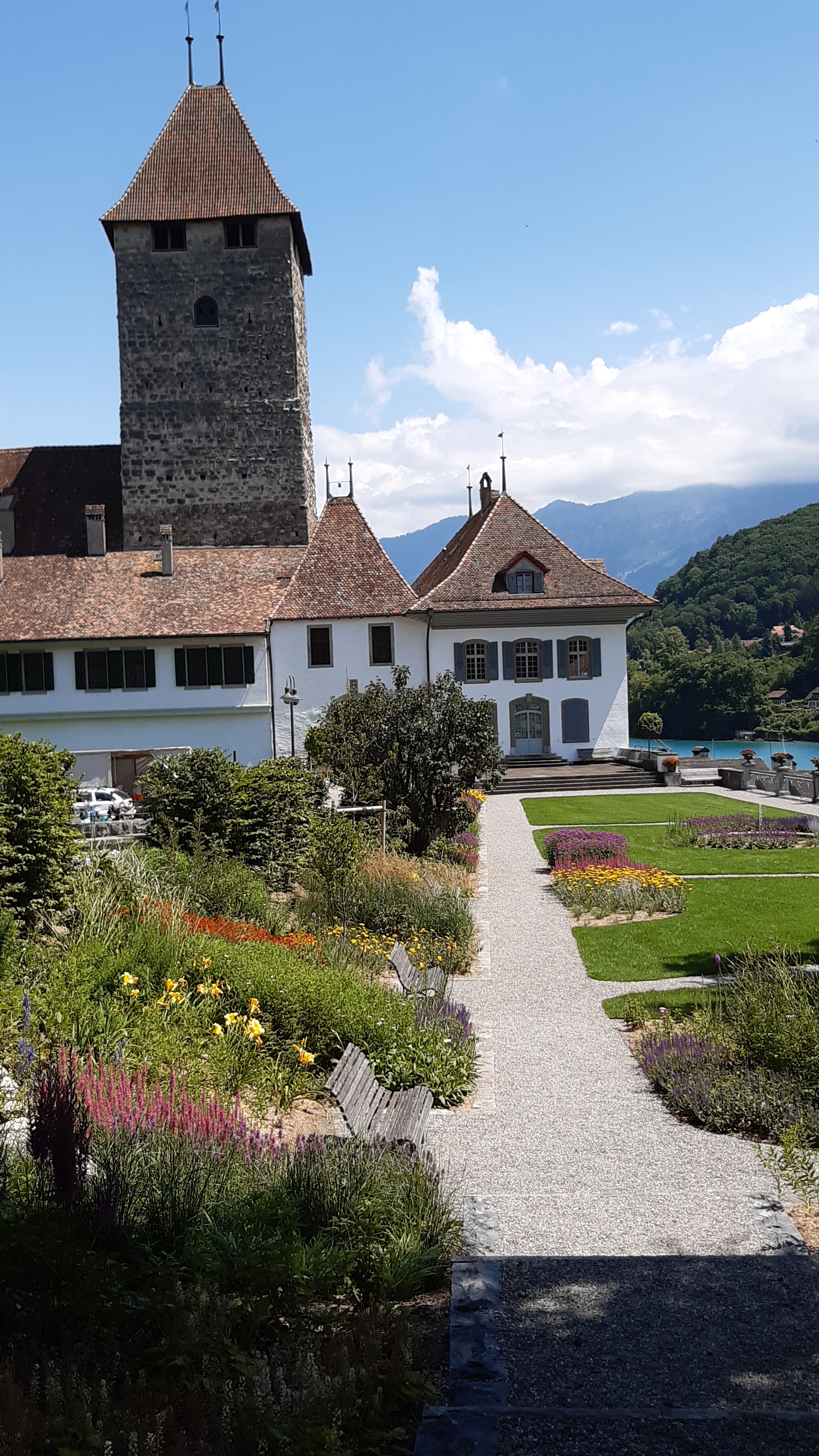
Let’s take a virtual tour of a beautiful little castle on Lake Thun, here in Switzerland: Spiez Castle is a grand but pocket-sized edifice that sits on a spit of land jutting out into the lake, with the town of Spiez surrounding it. The area has several substantial bronze- and iron-age settlement sites, which shows that the area has been rich in natural resources and populated since time immemorial. The town and its church were first mentioned around AD 762, when Bishop Heddo of Strasbourg disposed of the church and tithes in his will. In AD 933, the King of Burgundy, Rudolph II, had Spiez castle built, and soon the Freiherr of Strättligen settled there. [Freiherr was a rank of nobility within Germanic-speaking areas that would have roughly translated to the English rank of baron.] Sections of the current shield walls and tower were built in the 12th century, and though the town was originally located within the castle walls, by the 13th century it had outgrown the walled enclosures. The small church, which is on the castle grounds, is one of the twelve Lake Thun churches mentioned in the Strättliger Chronicle [a Swiss dynastic and national history of the rulers of Bebenberg and Strättligen and their lands and churches – all within canton Bern, covering from AD 1100 through 1464].
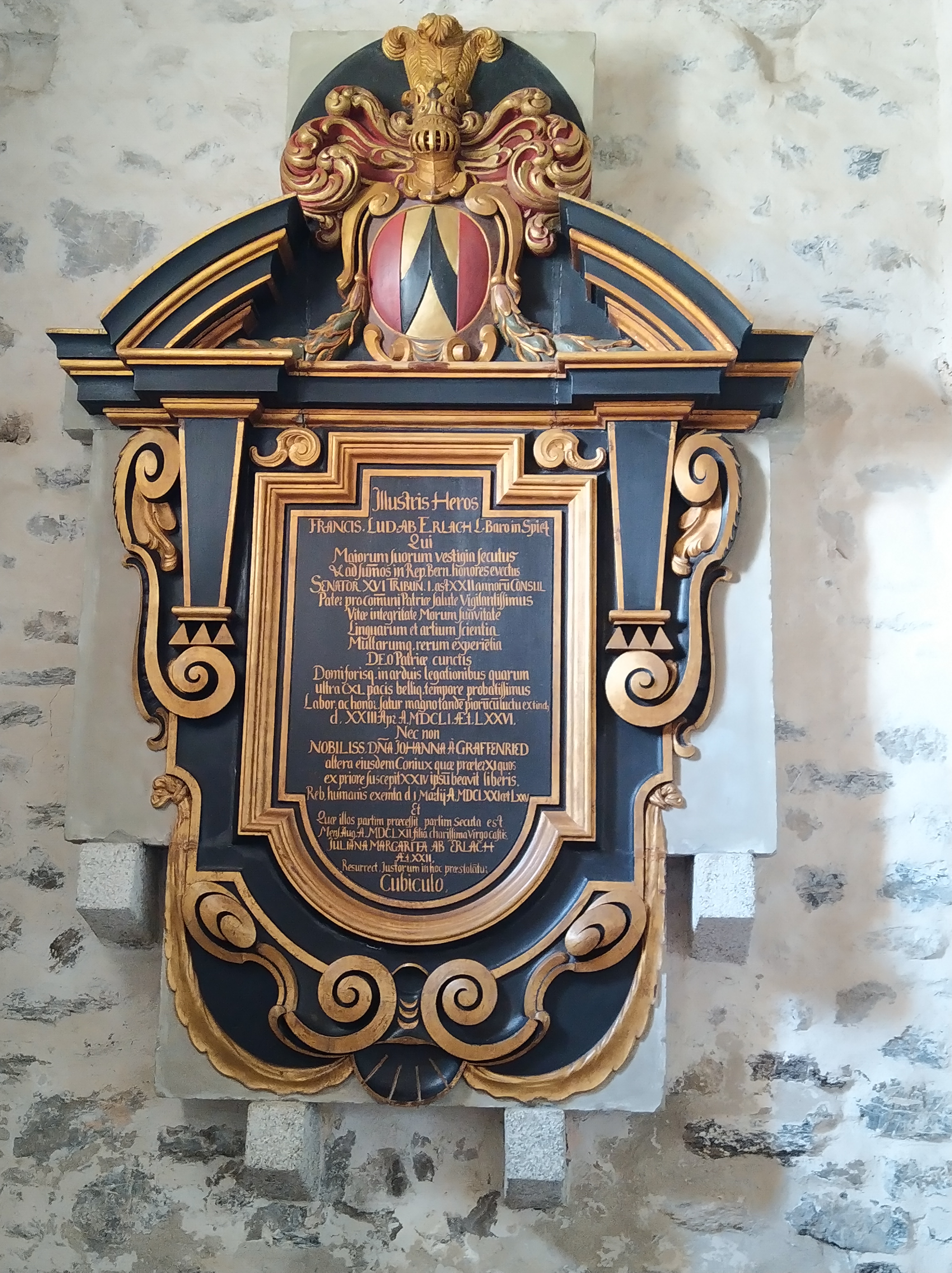
The castle changed hands numerous times, whether through political manoeuvring or through dynastic extinction. Last week, my article touched on the French invasion of Switzerland; After that 1798 French invasion and the creation of the Helvetic Republic, the von Erlach family lost the rights to hold the lands as well as their jurisdiction over the village, but retained ownership of the castle until 1875. In the church is a panel in Latin about the titles of the baron von Erlach and of (who I assume was) his wife, Johanna Graffenried (from another noble family in Berne), with the family crest (see the images below).
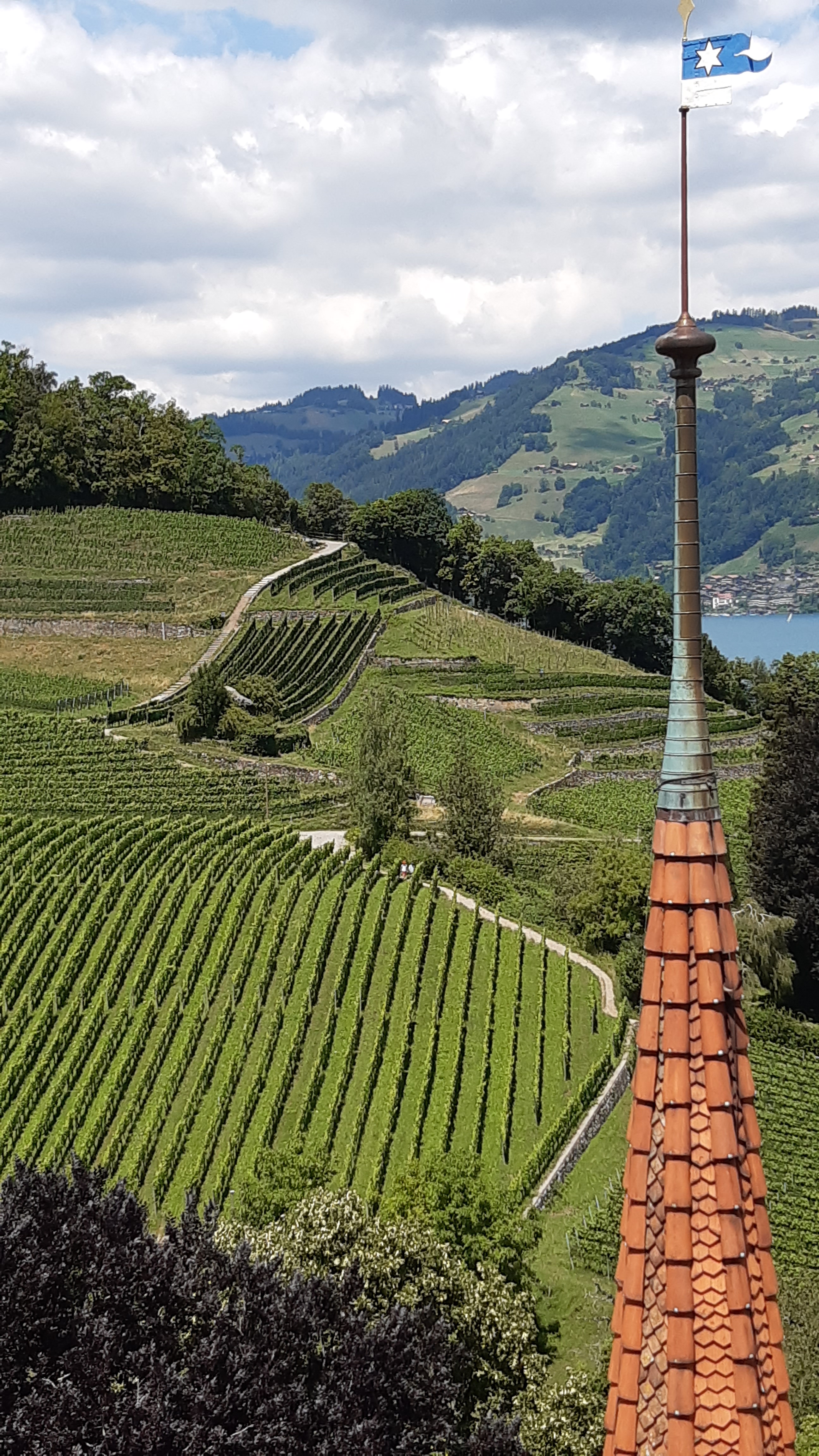
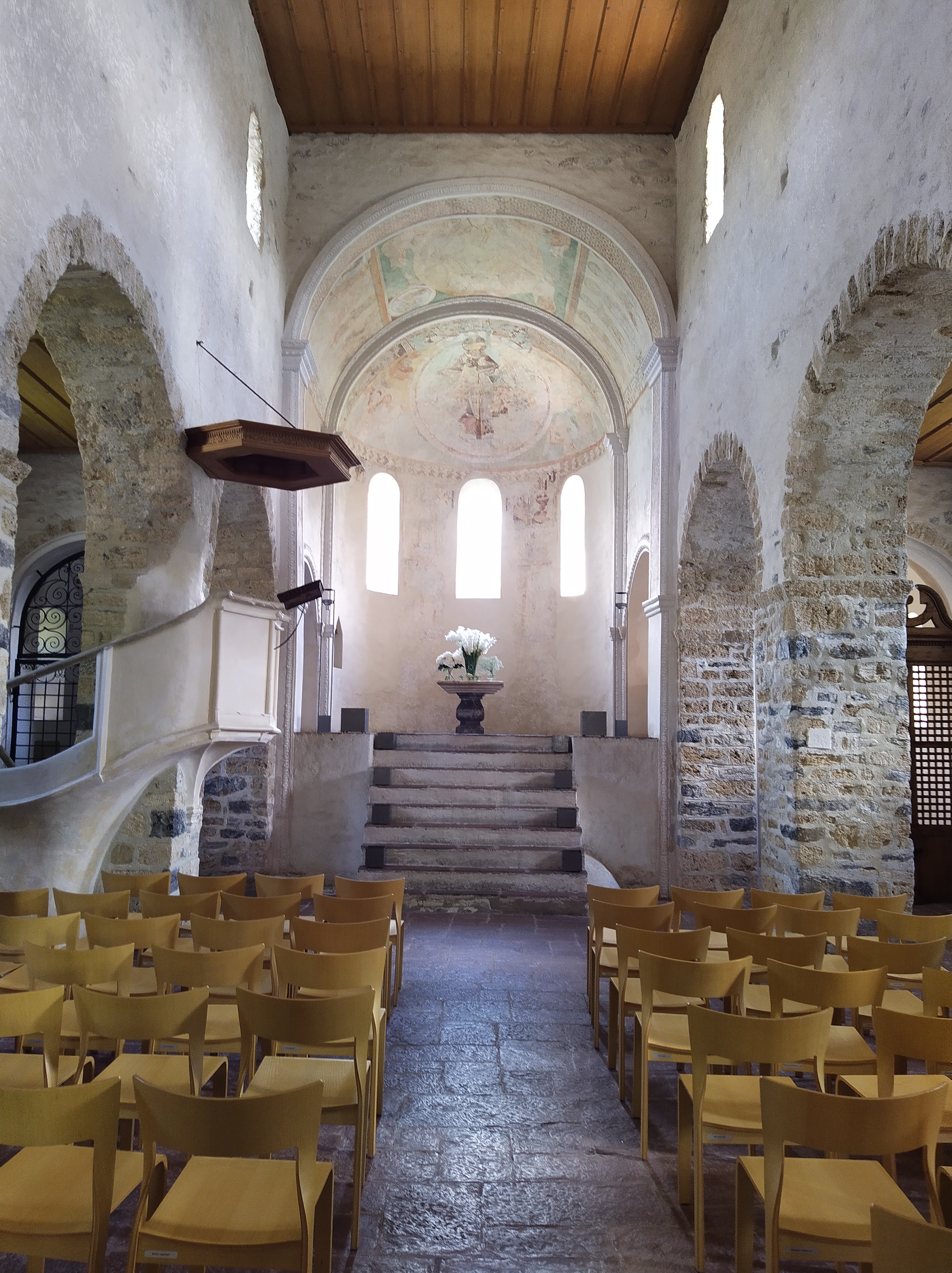
This past summer, my husband and I toured the castle and the church; it was an awe-inspiring feeling to know that we were walking where people have walked for well over a thousand years; where nobility and peasants, servants and pilgrims have stood, walked, talked, lived and passed. Here are a few impressions of the castle, church and the views we enjoyed, and I hope you enjoy, too.
This past summer, my husband and I rented a motorhome and travelled around Switzerland; we tend to prefer nature or museums to overly-touristy attractions. One of the places we visited was Spiez Castle. Before I tell you about that, however, a little historical backdrop is necessary, so buckle up and enjoy the ride!
Everyone’s heard of the French Revolution, which began in May 1789: It was a struggle to become free from the heavy yoke of an elitist monarchical regime, quasi out of the frying pan and into the fire of the Reign of Terror – during which many of the original rebels, in a twist of morbid irony, also had their heads removed by Monsieur Guillotine; it ended in November 1799 with the abolition of the Ancien Régime and the creation of constitutional monarchy (not far from where they started) and the French Consulate (which lasted nearly 5 years until the start of the Napoleonic Empire in May 1804).
But what many people might not know is that the French Revolution was internationally both influenced and influential. Modern “small world” effects are not modern at all; even in ancient times, people had international news: Travelling merchants and traders, messengers, signal towers (such as those the Romans used along the British frontiers), and even smoke signals, all conveyed news. When the French Revolution began, there was already a growing political dissent spreading throughout Western Europe; the English “coffeehouse culture” enabled men to gather in small groups and discuss business and politics; this concept travelled to America, and the discontent culminated in the American Revolution, starting in April of 1775. The French people watched and learned. The British government naturally became wary – they were losing the American colonies to the Revolutionary War, which they finally lost in September 1783. The Americans were supported during that time by France and Spain (the two main long-term enemies of Britain), so the British were hemmed in by threats to their own social order from both the east and the west, and they had well-founded fears of the discontent sparking revolt in the dry tinder of their own oppressed ranks.
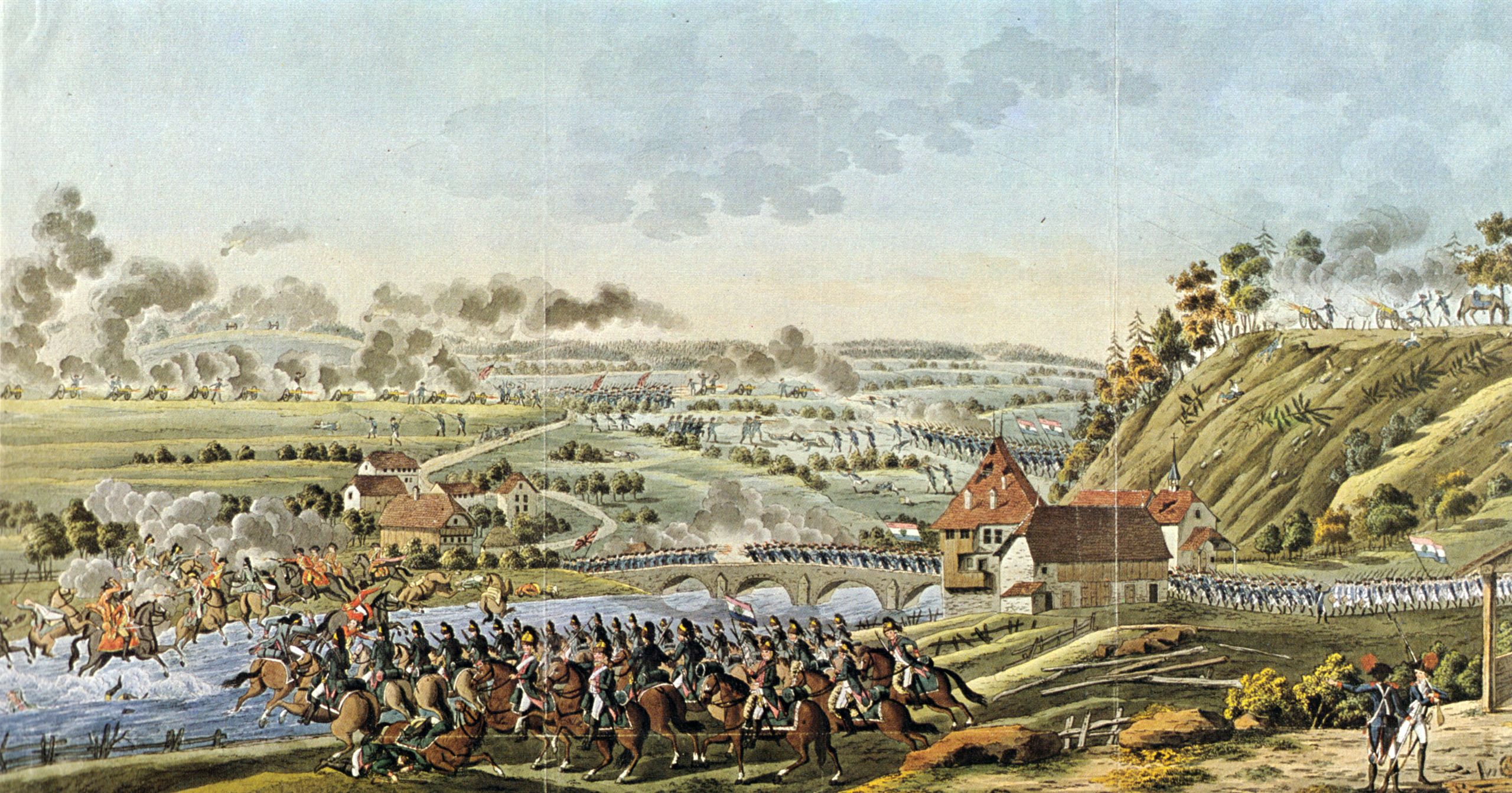
And now we come to Switzerland: To understand the Swiss backstory in a nutshell, which does no justice to a history that began in the Palaeolithic Age or further back, let me sum it up: The Old Swiss Confederacy was an alliance between independent small states, starting on 1 August 1291 with the “Rütlischwur”(an oath of allegiance between the cantons of Uri, Schwyz and Unterwalden), which date is considered by the Swiss to be the birth of the nation (though history is more complicated). As the French Revolution was beginning to wind down, Napoleon Bonaparte, then a French general, pressed the French Directory (the then-current French governing committee) to invade Switzerland. The atmosphere within the Old Swiss Confederacy was tense, fearing that the French Revolution would spill over with or without direct French military involvement. At the invitation of a French-speaking faction in Vaud (then part of Canton Berne), 12,000 French troops invaded through Vaud on 28 January 1798, and for the next four months, battles were waged between the French and the Swiss “Loyal Legions”. It ended in May with the swift collapse of the Swiss Old Confederacy.
The Battle of Neuenegg, 1798 – Graphics Collection, Central Library, Zürich
However, the French Directory needed a solid neighbour, a buffer zone along their eastern borders, not a loosely associated collection of small states; they tried to steer toward a re-establishment of national unity with a Paris-drawn constitution, but on April 1798, Swiss cantonal leaders proclaimed the Helvetic Republic, with new legal structures that abolished feudal rights within individual cantons in favour of a national unity. A few battles later, and coalition armies waging war in and around Switzerland against France, eventually left Switzerland as a sovereign, neutral nation; it has remained so ever since, despite two world wars.
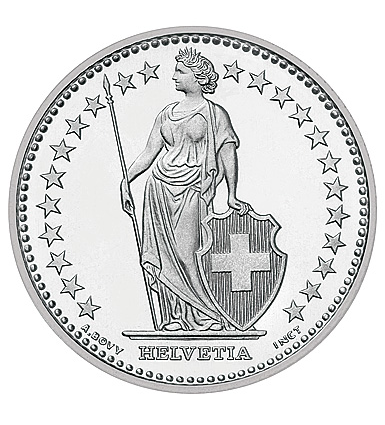
An etymological side note on the Latin name of the Swiss Confederation (Switzerland), Confoederatio Helvetica: Helvetia is the female personification of Switzerland, found on nearly every coin, much like Lady Liberty of America. The name derives from Helvetii, a Celtic tribe that inhabited the Swiss Plateau since before the Roman Era. The earliest reference of the name is dated to ca. 300 BC, written in Etruscan on a vessel from Mantua (located in Lombardy, Italy). By the time the Romans arrived, they were well-established tribes governed by noblemen; the Roman historians tended to refer to anyone not Roman as “barbarian”, which tends to skew modern understanding of the peoples they conquered; it was perhaps their way of justifying invasions against peaceful, intact civilisations. Naming no names, but R—– is repeating that same shameful tactic today; there’s nothing new under the sun.
It’s easy to overlook the complexities of historical events or view them from only one nation’s side; after all, as Mark Twain once wrote, “The very ink with which all history is written is merely fluid prejudice.” History’s angle is in the hands of those who wrote it – if they were Roman, everyone else was barbarian; if they were English, the Scottish / Irish / Indians were backwaters in need of a guiding stick, and so on.
So, now that you know a bit more about the history in and around Switzerland, I’ll highlight Spiez Castle next!
Hi everyone! As I mentioned in my last blog in June, I thought I’d solved the problem of accessing my blog; but after that, I was blocked out until 10 minutes ago! Finally, I got the help needed; until now, every time I’ve logged in and started to do anything, it would log me out again. I figured it was a clash between WordPress and some other app or program, but I couldn’t figure out the connections. Now it’s sorted, and I’ll know what to look for in the future if it happens again.
Since my last blog, life has hit a bump or two in the fast lane: We caught Covid a second time just before our summer holidays. Since that time, I’ve had frequent Covid migraines, which are a different monster than the usual species of migraines in that there’s nothing you can do about them – no medicine works. They start at the base of the skull and shoot into existence in a flash sometimes, and then they hang on for up to 24 hours. Not conducive to focus or creative writing, so I’ve used what time I can in my craft room to get things done toward a Christmas market at which I sell things every year.
At the same time we had Covid, we had a very sick senior cat that ended up needing surgery to remove a few impacted teeth; antibiotics and pain medicines both ended just in time to hand over cat-sitting without the extra complications before we headed out for much-needed holidays. She’s now doing better, though her diet is mostly soft food – which seems to suit her just fine.
Summer holidays this year were spent in our own back garden, so to speak, here in Switzerland. We rented a small motor home and spent most of our time in the French-speaking area for a week. After that, we’d planned to take day-trips out from home; we managed to get in one or two until my right knee decided to blow out; that took a few weeks to heal, so I was basically house-bound, but we’ve got a nice, large flat to be stuck in, if need be.
July and August flew by in a blur, and September is following suit. I’m hoping to get my next novel out before Christmas, but with the delays of migraines and life catching up to us after summer holidays, it’s been a challenge to block out the world and focus on graphics and all the technical bits and bobs that go along with launching a book.
Now that I can access my blog again, I’ll take you on a few virtual tours around Switzerland next!
I hope this finds all of you well!
Spiez Castle: View from an arrow slit in the tower











 Stephanie Huesler