
In May 2013, I began blogging here on WordPress; at the time, I had several topics of interest that I wanted to pursue, and to that end I began several blogs. As time has marched on sometimes other priorities took over, or focus changed, and now I have three active blogs. This eponymous blog is my home-base, but one of my favourite blogs to write besides this one is History Undusted. I love finding the dusty bits of history and “undusting” them for the unsuspecting public. But sadly, it has never really seemed to find notice by WordPress, and many of the posts have gone unseen.
Because history and the research thereof is a big part of my writing process, whether it be Viking history, archaeology, Scottish history, 18th century England, science, technology, advertisement, historical characters, or any of a dozen other topics, I have decided to combine the two blogs into this one. If history isn’t your thing, don’t worry – I will still enjoy posting articles regularly about the writing process and the nuts and bolts involved! I will begin “importing” (and, if necessary, augmenting) those blogs gradually, until they’re all safely here.
So without further ado, here is the first offering:
Decisions, Decisions
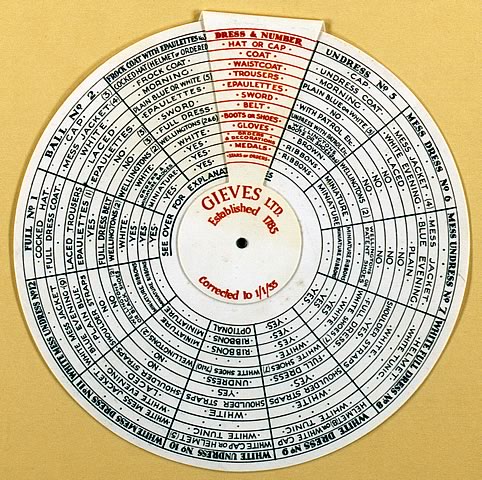 Have you ever heard of a butler (or male servant, in general) referred to as “Gieves” or “Jeeves”? This might just be where it all started: The Gieves Gentlemen’s Tailor Company was founded in 1771, and became a limited company in 1785; their dress wheel aided naval officers in choosing what to wear at any particular occasion, for any part of the world they might have found themselves in at the time. Dressing, even for men, was an extremely complex social signal in bygone eras. By 1935 there were twelve styles of dress, including tropical options. By turning the wheel, an officer could see just what to wear on any occasion. A handy little marketing device, it gained Gieves loyal royal naval customers, and the company has thrived ever since, with loyal customers including members of the British royal family today. For an interesting history of the company, click here.
Sir P.G. Wodehouse, an English author and one of the most widely-read humorists of the 20th century, named the comical fictional character of his shrewd valet “Jeeves”; the name was taken from Percy Jeeves, who was a cricketer killed during the First World War. Both the wheel and the fictional character served to cement the name in the collective conscience of the western world as a reliable servant.
 Language is a fluid concept, constantly changing, adapting, creating, compensating and inventing itself. Euphemisms are a prime example of that fluctuation and adaptation; successive generations come to know only the euphemism which in turn ceases to be one by that very definition, and which means that new ones will be invented to skirt the issue once again. For instance, there are hundreds of words for smell or stink, yet only a handful of satisfactory synonyms for words like fragrance, simply because hiding the ugly requires far more creativity than hiding the lovely. For that reason alone, writers who fall back on expletives like the highly offensive F-word (a euphemism for, well, you know) are simply lazy in my book; they’re missing a great opportunity for creativity! Interestingly, that word’s meaning has never shifted over time – it’s been in the English language since before the fifteenth century, and even then it was only written in cipher because it was too offensive to record in ink. In my opinion it still is, and one should consider






 Stephanie Huesler