Category Archives: History Undusted

History Undusted: Burma-Shave

For those outside of the US and/or Millennials, the term “Burma-Shave” might be new to you – which is why I’d like to “undust” this fascinating little piece of history.

The 1920s was a time of change; World War 1 was over, and the following Spanish flu had wiped out more people than the war itself; the survivors just wanted to celebrate life. Out went the starchy mentality of Victorian dresses and in came the flappers; innovations and scientific breakthroughs fed the hunger for the new and anything that made life easier.

At the time, men shaved themselves with shaving cream applied to the face with a brush and a straight razor blade (still common into the 1950s, when the double-edged safety razor began to gradually take over).

Enter, the Burma-shave brushless shaving cream: Introduced in 1925 by the Burma-Vita Company in Minneapolis, Minnesota, it was purported to have come from “the Malay Peninsula and Burma.” It was, in fact, a result of chemical experiments by chemist Carl Noren. The monicker was a marketing gimmick, much like products touting to be “Swiss” that are unknown here (even “Swiss cheese” – which one of the hundreds is meant?). The cream didn’t really take off, and while other similar products were coming out of larger companies such as Barbasol and Gilette, Burma-Shave managed to beat the odds when their clever advertising campaign was hit upon.

Around this time, the Ford Model T had become a huge success, with millions of new automobiles on ever-expanding road systems. Roadside signage was taking off, and the advertising gimmick was destined to go down in history as one of the quirkiest success stories.

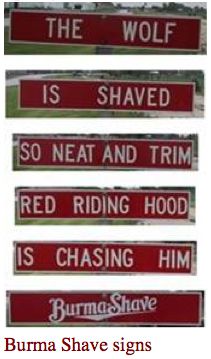
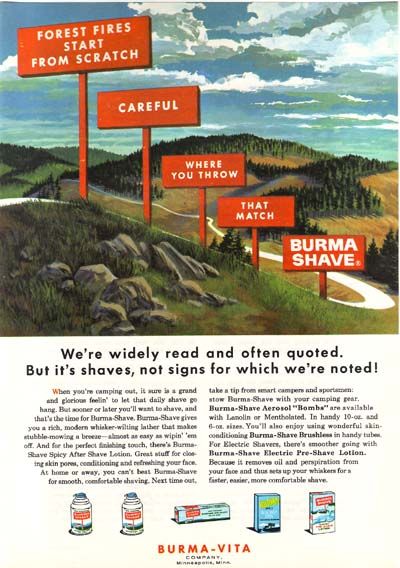
Burma-Shave ads were a series of signs along the road that concluded in the sign saying “Burma-Shave”. The first couple of years, the signs were rather prosaic ads for the company; but as they began bringing in repeat customers, the signs became bolder and more experimental. They became more humorous rhymes – usually five signs, with a sixth ending the series as “Burma-Shave”.

Here are a few examples:

  • Shaving brushes / you’ll soon see ’em / on the shelf / in some / museum / Burma-Shave (1943)
  • Uncle Rube / buys tube / one week / looks sleek / like sheik / Burma-Shave (1930)
  • A shave / that’s real / no cuts to heal / a soothing / velvet after-feel / Burma-Shave (1932)
  • Shaving brush / and soapy smear / went out of / style with / hoops my dear / Burma-Shave (1936)
  • The Burma girls / in Mandalay / dunk bearded lovers / in the bay / who don’t use / Burma-Shave (1937)

As cars began to speed up, safety messages increased around 1939:

  • Hardly a driver / Is now alive / Who passed / On hills / At 75 / Burma-Shave (1939)
  • If you dislike / big traffic fines / slow down / ‘till you / can read these signs / Burma-Shave (1939)
  • At crossroads / don’t just / trust to luck / the other car / may be a truck / Burma-Shave (1939)
  • Don’t pass cars / on curve or hill / if the cops / don’t get you / morticians will / Burma-Shave (1940)
  • At intersections / look each way / a harp sounds nice / but it’s / hard to play / Burma-Shave (1941)

When World War 2 came around, the signs reflected the social conscience:

  • Maybe you can’t / shoulder a gun / but you can shoulder / the cost of one / buy defence bonds / Burma-Shave (1942)
  • Shaving brush / in army pack / was straw that broke / the rookie’s back / use brushless / Burma-Shave (1942)
  • Slap / the Jap / with / iron / scrap / Burma-Shave (1943)
  • Tho tough / and rough / from wind and wave / your cheek grows sleek / with / Burma-Shave (1943)

A few humorous signs:

  • She kissed / the hairbrush / by mistake / she thought it was / her husband Jake / Burma-Shave (1941)
  • We know / how much / you love that gal / but use both hands / for driving pal / Burma-Shave (1947)
  • I use it too / the bald man said / it keeps my chin / just like / my head / Burma-Shave (1947)
  • Road was slippery / curve was sharp / white robe, halo / wings and harp / Burma-Shave (1948)
  • If you think / she likes / your bristles / walk bare-footed / through some thistles / Burma-Shave (1948)
  • A man / a miss / a car – a curve / he kissed the miss / and missed the curve / Burma-Shave (1948)
  • Our fortune / is your / shaven face / it’s our best / advertising space / Burma-Shave (1963)

Toward the latter part of the signage, they began recycling earlier messages. Road signs and maintenance became increasingly expensive, and cars sped by faster than ever. The signs disappeared from the roads in 1963 when the company was sold to Phillip Morris and they discontinued the marketing campaign, which turned out to be a mistake; sold once again, the product eventually disappeared, but the term “Burma-Shave” can still be heard, referring to short, quirky rhymes.

To read more about this topic:

Route Magazine: Defining the American Dream, One Sign at a Time

I hate to end / this fun article / but time is short / so here’s what’s possible / Burma-Shave examples from Pinterest:
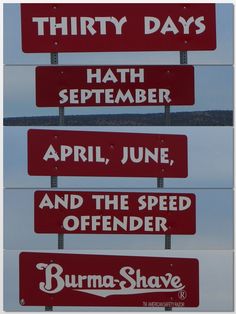
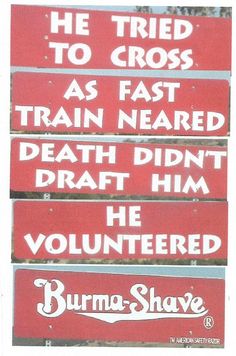
This illustration is from “A History of the Burma-Vita Company”, written by Frank Rowsome Jr. and illustrated by Carl Rose (published by the Stephen Greene Press in 1963).

12 Comments

Filed under Articles, History, History Undusted, Links to External Articles, Lists, Military History, Quotes, Signs, Snapshots in History

History Undusted: The Atrocities of the Milan Conference

The topic of this article has been on my mind for the past two weeks; last week flew by so fast I barely had time to blink, let alone order my thoughts into coherent sentences. The topic was sparked by coming across an article online about what is known as the “Milan Conference” or “The Second International Congress on Education of the Deaf” (though it was, in fact, the first), held in Milan, Italy in 1880.

To give you a bit of my personal background, I learned BSL (The Glaswegian dialect) and translated for the deaf when I lived in Scotland. Being as close to that community as I was, I’d shockingly never heard about the Milan Conference until a fortnight ago.

When I first moved to Switzerland, I wanted to continue working with the deaf and began taking Swiss German sign classes. I immediately began hitting brick walls: The crux of the matter was spelled out – they didn’t want hearing people in their world. It made little sense to me back then, and it was frustrating. Also at that time, my husband wasn’t yet hearing impaired – which would have made a difference in their attitude toward me, as people with family members affected by hearing loss were more acceptable to them. In light of the Milan Conference, their reticence makes perfect sense. I never was able to break that barrier, and I’ve lost much of the sign language I once used fluently.

The conference was an international gathering of (hearing – with only ONE exception) educators of the deaf and mute. The imperialist arrogance of the discriminating resolutions passed profoundly wounded and damaged the deaf community for nearly 100 years.

To sum up the conference’s resolutions briefly, the majority decided that sign language was disadvantageous to integrating the deaf into the hearing world, and they banned – yes, banned – sign language from the education of the deaf in favour of “oralism” – forcing the deaf to read lips to make them assimilate to the hearing world’s culture. Deaf teachers lost their jobs, and an overall decline of deaf professionals resulted – they were no longer allowed the tools to communicate in their own language, and communication professions such as artists, lawyers and writers fell silent. Here in Switzerland, there was a two-fold impact: Deaf children were forced to sit on their hands and learn to lip-read from High German-speaking teachers; but when they went home on holidays, they couldn’t lip-read their own family’s dialects of Swiss German, and so they were isolated from society both in school and at home. The anger and resentment to the hearing world still runs deep.

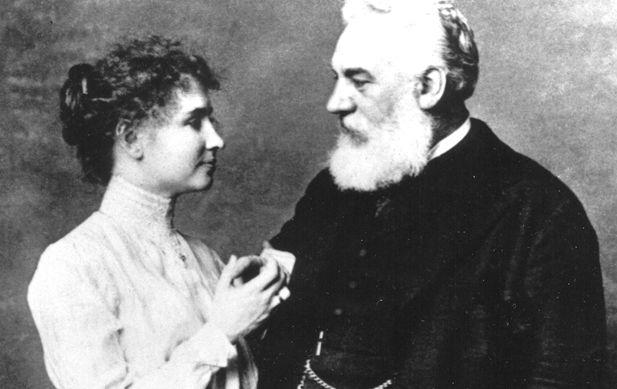
Most disturbing for me is the fact that Alexander Graham Bell, whose own mother and wife were deaf and who worked with the deaf throughout his life – including helping bring Helen Keller out of her silent world as a blind and deaf girl – was one of the strongest proponents for oralism at the conference. The most famous picture of Bell and Keller is one in which Keller is finger-spelling on Bell’s hand. It is a form of sign language. Yet he advocated to eradicate it.

The resolutions of 1880 held their ground until they were overturned in 2013 when an official apology was issued to the deaf community. Eleven years ago. Let that sink in. Inroads were made to teach sign in pockets here and there; in America, most schools for the deaf only began teaching sign language again in the 1960s; in the UK it was around a decade later. Generations suffered under the restriction. [For those who have been deaf their whole lives – what’s known as pre-lingually deaf – it means that sign language is their first language, while spoken English is their second; this can lead to difficulties in understanding complex or abstract messages in English. Imagine being denied your own native language…] Only in 2003, the British government recognised BSL as a minority language – but so far, Scotland is the only country in the UK that has given BSL legal recognition. The shift in understanding and recognition had already been set in motion by the time I’d moved to the UK, which is perhaps why the Milan Conference was no longer a topic when I was involved in the deaf community.

The ban is the main reason there are so many regional dialects today: Even though sign language was officially banned, the deaf still needed to communicate among themselves, and so signs evolved “under the table” within each pocket of deaf students. There was no exchange of information; for example, “bread” took on the shape of the local speciality, so in the French part it looks like a long baguette, while in the Zurich region, it looks more like a half-sphere. There are 5 major Swiss-German dialects; in Scotland, there were at least 7.

Please click here to watch a ~13-minute video by Storied about the history of sign language and the Milan Conference. If you’d like to learn more about the timeline of sign language in Britain, please click here to visit University College London’s website, and to learn more about BSL in Scotland, click here to read the Scottish Parliament’s article.

ASL, American Sign Language, also has a forgotten predecessor that was largely written out of history: The Plains Indian Sign Language, also known as “hand talk”. For an interesting video about that history, click here.

 I hope you’ve enjoyed this brief insight into a long and tangled topic, and that it encourages you to look into it more.

Just as a parting trivia: Everyone recognizes the sign for phone; but did you know that it became a euphemism in some deaf communities for the restroom/loo? Back when restaurants had their public phones near the “small closets”, the Deaf would sign “phone” as a polite, covert way of saying they were going to the restroom/loo.

Below are the British Sign Language and the American Sign Language alphabets; I’d encourage you to learn one or the other and stretch those grey cells a wee bit!

9 Comments

Filed under Articles, Etymology, Grammar, History, History Undusted, Humanity Highlights, Links to External Articles, Signs, Translations, YouTube Link

History Undusted: Memories of Hawaii

It’s hard to imagine, but the Hawaiian islands a generation ago were not a hotspot of tourism and a bustling modern culture; most people lived simple lives with few amenities. It’s also hard to imagine a time when exotic fruits were not found in your local store year round – exotic being bananas, kiwi fruit, avocadoes or papayas. My Swiss mother-in-law remembers when bananas came to Switzerland, and they were exotic and expensive; in her house, they were only bought for her brother, who was very sick at the time, as a source of energy; that was during World War 2.  Once, she confessed to stealing some money from her brother’s piggy bank to buy herself a banana.

By clicking here, you can watch a ~10-minute video of a series of short video clips from the 1920’s of Hawaii, interspersed with silent-film-era title cards.  Not only is it an interesting glimpse into a simpler time on the islands, but it’s also an insight into what the rest of America “knew” about the islands, foods and customs.   Back then, the world in general also knew very little about strange activities such as “surf riding” (surfing), and the footage of surfers is utterly tame compared to the monster wave-riding considered “for surfers” today!  Volcanic activity also seems to have been a fascination; such footage may well have been the first time anyone had seen such a thing outside of volcanic regions; it still had to be described in colours, however, such as “cherry red” for the lava, as the footage was, obviously, in black and white.

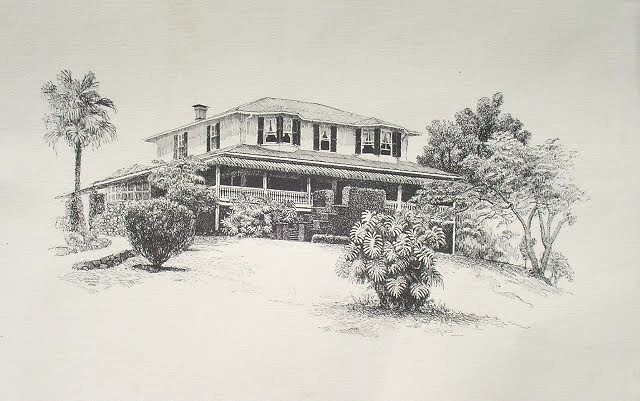
The image below is of King’s Mansion, in Kealakekua, Hawaii, on the Big Island.  As a student, I lived there in 1986 (my dorm window was the left bay window at the front).  We had avocado trees in the back garden, and our neighbour’s horses, across a stone wall, would come trotting to the wall when they saw us in the garden, hoping for an avocado; we’d feed them, entertained as they carefully chewed away the flesh around the pit (reminding me of an old man chewing tobacco!), and then skillfully spit the seed out.  At the bottom of our front garden stood a huge banyan tree [if you were standing on the covered lanai (porch) at the front of the house, it would be to your left – not shown]; it was a favourite tree to climb. At the bottom of our terraced garden was a volleyball court; it was popular, though we could also hike up the next hill over to the local school, where we could use their tennis courts. If you hit the ball over the high fence, you’d be hiking through the jungle to bring the ball back! Maybe the local students got tired of the same problem, as the jungle eventually gave way to a baseball diamond.

On 8 July, we were asleep in our dorm bunk beds; at around 2:30 a.m., I was awakened by what I first thought was my restless bunkmate – but which turned out to be an earthquake. The San Andreas Fault had slipped, and what had taken me 9 hours to fly took the earthquake 9 minutes to travel, hitting the Big Island. It kicked off a chain event of volcanic eruptions, aftershocks, and strange weather conditions: The heat of the volcanic air and the cool ocean created thick, milky white clouds at the level of our house (at the top of a hill) that rolled over our lanai and into the open classroom – soaking our books and the carpet the first time; after that, we got smart and put our books on our laps whenever the thick cloud rolled in. It also made gorgeous “sunsets” mid-day, as the volcanic ash dimmed the sun. I don’t know if they were connected, but soon after the volcanic eruption, Hurricane Estelle hit the islands; as King’s Mansion is up in the hills, we mainly felt the tropical storms, wind and rain, though it was creating 15 to 20-foot waves at one point, which we could see from our vantage point. I grew up in the heart of Tornado Alley and chased tornadoes for the fun of it as a teenager, so I took the earthquakes and storms in my stride.

One person deserves a special place in such memories: Gran’pa Joe Cho. He was a retired Hawaiian neighbour who enjoyed spoiling us rotten. He’d bring us treats and take us girls out on the town. He would admonish the boys to treat women right and then show them how to do it! One memorable evening, Joe Cho had taken a group of us girls out to get Kona Mud Pie, then to Manta Ray Point (aka the Kona Surf Hotel’s surf zone – the rays would swim around the underwater lights near the shore, catching the plankton attracted by the lights), and then we stretched out on a green of the Kona Country Club golf course, right on the edge of a rocky cliff, to watch the stars; we saw a meteor shoot so brightly that its reflection could be seen on the ocean waves.

It was a lifetime ago, but they will always be grand memories…

6 Comments

Filed under Articles, History Undusted, Links to External Articles, Musings, Snapshots in History, Videos

10 Everyday Phrases with Nautical Origins #3

Some of today’s nautical idioms are well known, such as to be on board with a proposal or suggestion or learning the ropes in a new job or position, while others, such as three sheets to the wind are less common (unless you happen to work in a bar – then it may come in quite handy). Either way, enjoy these, matey!

Be On Board: As part of a crew, a sailor bore their part of the responsibilities. In today’s terms, it means to accept or agree with a proposal or a way of doing something and go along with it.

Rats Deserting a Sinking Ship: Rats and mice were common aboard ships, often in the bulkhead (lowest section of a ship, where the grains were stored (the weightier things being stored low and balanced to keep the ship sturdy in rough seas). If the ship began to take on water, the rats would go up the deck ladders to stay away from the water; if they started jumping overboard, sailors wouldn’t stand much better of a chance (most sailors could not swim). It’s a vividly grim picture of life aboard. Now, it’s an idiom describing people abandoning a failing activity or situation.

Close/Tight Quarters: Tightly packed (e.g. people in a small space). Space was at a premium, especially on the lower decks of a ship of sail. Men slept in hammocks close together and shared the space with stowed ship equipment and their own storage chests. Even today on submarines, bunks are shared by those who are off-duty and those on-duty to save sleeping quarter space.

Run a Tight Ship: Manage and organization strictly, efficiently, and effectively. A ship, especially in times of war, was run tightly to avoid unnecessary dangers and/or deaths, and to maintain discipline that would be needed to succeed in crucial moments.

Learn the Ropes: Sails were raised and lowered with ropes, and knowing how to control the sails allowed a ship to take full advantage of the wind and sail safely. There were miles of ropes on a ship, each with an important and specific function. Learning the ropes was essential for everyone aboard – it would keep others out of danger and oneself alive! Today, one learns the way things are done in a given setting or situation.

Broadside: The broadside was the side of the ship which sat above the waterline; cannons were arranged on several decks, and when ships sat broadsides facing, firing simultaneously, it was known as broadsiding. Today, it refers to being taken off guard or being surprised by something unpleasant.

 Broad in the Beam: Describes the width of the beam or mast on a larger ship. It denotes a person who’s wide across the hips and buttocks.

Keel Over: To collapse, to die. If the keel of a boat were to rise out of the water, the ship would be in danger of capsizing; this might happen due to a storm or damage by an enemy attack.

To Keelhaul: To rebuke harshly. It was a punishment meted out in extreme cases by dragging someone, ankles weighted, by ropes beneath the ship along or over the keel (the backbone of wood along the bottom of the ship). As these were usually covered with barnacles, clothes and skin would be shredded by the barnacle shells, and if the salt water of the ocean didn’t disinfect the wounds on the way up, it could be a death sentence. How much it was actually practised is difficult to say, as written records are sparse (perhaps a cruel captain didn’t want it on record, or perhaps it was not as widely practised as we think); the most concrete records of the punishment come from the Dutch. It was banned by the British Royal Navy around 1720, and by the Dutch around 1750. That bans were necessary tells its own tale…

Three Sheets to the Wind: Implies an unsteady, drunk person. The sheet referred to the ropes (lines) used to control the trim (the advantageous angle of the sails in relation to the wind) of the sail. If the sheets are loose, the sails will flap in the wind which causes the ship to lurch about like a drunken sailor. There are variations of the number of sheets in the idiom: 1 would be tipsy, 3 would be staggering drunk!

3 Comments

Filed under Etymology, History, History Undusted, Lists, Military History

History Undusted: The Westray Dons

My past two articles have been about everyday phrases with maritime roots; not only is a language affected by sailors, but sometimes entire populations.

Around the British Isles, there have been countless shipwrecks. The waters can be treacherous, with islets and rocky outcrops just under the waves – splinters of divided continents worn down by the power of the sea until they become hidden snares. My husband and I were once on holiday on St Mary’s, Scilly Islands; with every tide, flotsam fragments of shipwrecks (nearly 1,000 known so far) from the 16th through the 19th centuries wash ashore, and I gathered a handful of beach pottery and glass, not knowing at the time that the worn but still decorated pieces could be centuries old. Buried beneath the sand, they’d retained their colourful glazing until washed ashore.

That’s the goods and plates aboard; but what of the people? Many sailors of past centuries couldn’t swim; if their ships foundered too far from shore, they sank to Davy Jones’s Locker. Those who were fortunate enough to make it ashore were not guaranteed a safe sojourn; if the island had scant supplies, it could get ugly – as it did for Spanish sailors on Fair Isle (more on that in a moment). But first, a brief background on the situation that led to the Spanish Armada being in British waters, and their shipwrecks:

The reasons the Armada moved to attack England are complex; let’s just say that Philip II, heir apparent to the Spanish throne, had married (in a political manoeuvre) Bloody Mary, the Catholic queen of England, who’d had her Protestant half-sister, Elizabeth, placed under house arrest to prevent any political ambitions from growing in the Protestant faction. When Mary died childless, Philip (King of Spain and Portugal, as well as of Ireland and England through marriage and until Mary’s death in 1558) returned to his own kingdom in Spain, and Queen Elizabeth I ascended to the throne of England. But being the daughter of King Henry VIII and his second wife, Anne Boleyn (whom he’d had executed when Elizabeth was two years old), Elizabeth was illegitimate in the eyes of many Catholics, as her parents’ marriage had been annulled two days before her mother’s execution. Ironically, confinement hadn’t taught Elizabeth any compassion; she had her Catholic cousin, Mary, Queen of Scots, imprisoned for nineteen years, and eventually executed in February of 1587. Mary had been Spain’s Catholic ally, and her death was the final straw for Philip II of Spain, as the religious tensions had been mounting between England and Spain. Philip prepared his Armada, sailing out of Lisbon in 1588.

If you look at a map of Europe, you will see that Spain is southwest of the British Isles; they had to sail through the Bay of Biscay, and then either west of England through the waters between England and Ireland, or east through the English Channel and French waters (and the French were usually at war with everyone) to reach the east coast of England.

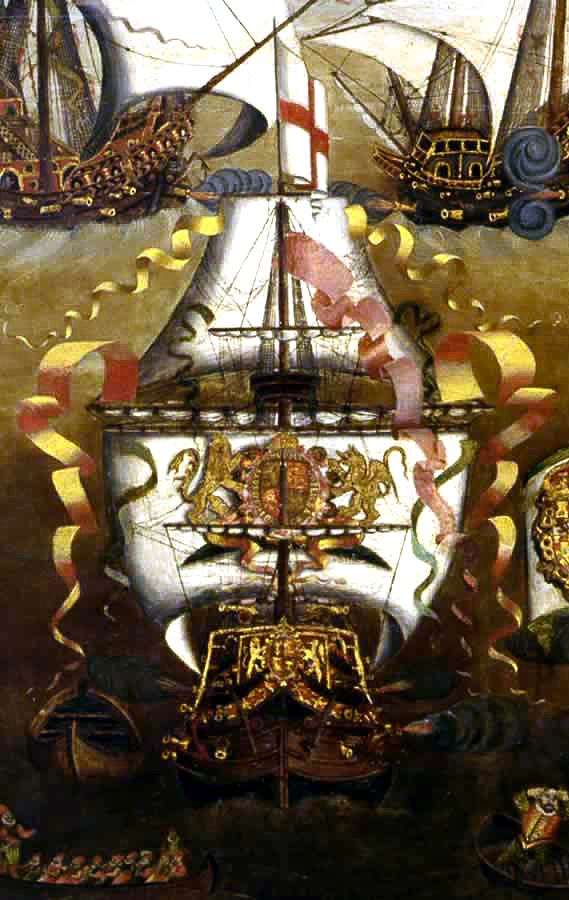
Sir Francis Drake’s Revenge, with Armada ships in the background. Credit, Wikipedia

The battle ensued; the English ships had superior long-range cannon, with which they harried the Spanish fleet. Weather and prevailing winds interfered; battle lines were redrawn, only to be scuppered again. In August 1588, the Spanish fleet had been defeated by Sir Francis Drake’s command of the English ships, and the remnants of the fleet retreated into the North Sea. By early September, seventeen ships had been lost to storms. Many of the ships not sunk by the British navy or taken out by the sea were blown onto the rocky shores of Ireland and Scotland; of the 150 ships that set out from Lisbon, only 65 returned.

Replica of the 16th century Spanish Galeón Andalucía. Photo credit, Fundacion Nao Victoria. Click on the image to see details about the ship.

Three of the ships were separated in the storm from the rest of the fleet: The Barca de Amburgo foundered off of Fair Isle, but the crew was rescued by the El Gran Grifón and the Trinidad Valencera. With the extra crew aboard, the El Gran Grifón tried to anchor to make repairs but was wrecked on the rocks of Stroms Hellier, Fair Isles (a steep, rocky outcrop of land halfway between Shetland to the north and Orkney to the south). According to historian Sir Robert Sibbald (1641-1722), the crew was on the island for two months (~August-September 1588); though they paid for their supplies, tensions were high with locals as food stores were meagre and “Spanish money doesn’t fill hungry bellies”. The island itself has never supported more than 400 inhabitants (today’s population is 65); the Spanish shipwreck brought 300 to shore. 50 of the crew either starved to death or were killed when the locals turned on them: Any Spaniard found alone was tossed over a cliff; when that wasn’t efficient enough, the islanders deliberately collapsed a flagstone roof over the sleeping crew.

The survivors fled; some to Shetland, and some to Orkney. Enter that dusty bit of history, the Westray Dons.

Westray is the northernmost island of the Orkney archipelago, a group of 70 islands*, 16 of which are inhabited (*or more, depending on who you ask – skerries or uninhabited islets may or may not count). They not only welcomed the Spaniards but intermarried with them. The men remained on the island, and their descendants became known as the Westry Dons. Spanish heritage is still seen in the Orcadian population today, though the Dons are no longer a separate community; Orkney has a higher percentage of dark-haired, dark-eyed inhabitants than any other Scandinavian-heritage region. Orcadian oral tradition, according to the Sanday folklorist Walter Traill Dennison, says that the Dons were exceptional seamen, many of whose descendants went on to become sailors and sea captains. The Dons largely adopted Orcadian surnames, the most common (but not exclusively) being Petrie, Hewison, and Reid.

I hope you enjoyed this quick dive; if you’d like to read and hear a Scottish song about the Dons, just click here (warning: It’s in thick Scottish brogue!).

To see a timeline of the Spanish Armada battle, just click on the image below.

3 Comments

Filed under Articles, History, History Undusted, Links to External Articles, Military History, Snapshots in History

10 Everyday Phrases with Nautical Origins #2

Today’s everyday phrases can come in handy when you’re in a tight spot, avoiding danger, or reaching your goal (land ho!) Chockablock came in handy for me last week, as it described how I felt after having been sick for nearly two months (Covid into bronchitis, joy), and then catching up with all those little things in our household that had gone undone. Anyone who’s been married for any length of time will know that spouses tend to take over specific jobs – whether that’s carrying out the rubbish or doing the laundry, cleaning drains or watering plants. I’ll let you guess which jobs are whose. Catching up with those undone jobs stemmed the tide of accumulating chores, and helped me get our home back to shipshape and in Bristol fashion! So enjoy these phrases, and please share in the comments which ones apply to your life!

Chockablock: Jam-packed; overcrowded; completely filled, stuffed, or jammed tightly together. You may have heard the term block and tackle; This refers to a system in which a rope, chain or cable (= tackle) is passed over pulleys enclosed in two or more blocks, one fixed and one attached to a load (see image). When these blocks are pulled so close together that no further movement is possible, this is known as being chockablock (this is the usual spelling, which illustrates its meaning perfectly – no space, not even a dash between words!).

Stem the Tide: Try to prevent a situation from becoming worse than it already is. Nautically, it means to tack (steer) against the tide or oncoming storm to avoid being blown off course or capsized.

To be Shanghaied: A city in China, Shanghai implied a long voyage (just as Switzerland today implies neutrality in the collective conscious). When landsmen were impressed (volunteered against their will) into the British or American navies in the days of wooden ships of sail, to be Shanghaied meant to be impressed and sent away from home for a long time or extended voyage (not necessarily to China!).

Limey: Shortened slang for “lime juicer”, referring to the English naval ships and the practice of carrying barrels of limes or lime juice to ward off scurvy on long voyages. As the British navy was a dominant force on the seas, the term gradually came to mean British.

Shipshape (and in Bristol Fashion): Everything is okay and in good order. Bristol was, at one point, Britain’s main west coast port; the idiom was used to describe everything being in order with cargo and at the port.

Give a Wide Berth: Leave space for, veer around. Even when a ship is at anchor, it will move with the tide and wind, so the berth, or a docking space, for a ship needs to be ample for a safe mooring. The modern phrase still denotes the danger of steering too close to an unpredictable situation.

Loose Cannon: Unpredictable danger (can be said of a person or situation). When a cannon or a cannonball broke free from its mooring, it created a hazardous situation as it rolled around or across the deck during a storm or in battle.

Port, Starboard: This simple explanation is that these are left and right, respectively, on any ship or airplane. But simple is a bit boring! Buckle up: In the past, as today, the majority of people were right-handed; ships of sail had rudders centred on the stern (back of the ship), but the steering oar came up onto the quarter deck through the right side of the stern. This leads us to the term starboard: Old English steorbord literally meant steer-board, the side on which a vessel was steered.

When pulling into a port, as the steering oar was on the right side, they would anchor starboard out, port in. The port, the left side of the ship as seen from the stern facing forward toward the bow, was formerly known as larboard, from Middle English ladde-borde, meaning loading board (side); it was eventually renamed as the similarity to starboard was confusing in the loud life aboard.

Most airplanes follow this tradition today, with boarding being on the left (port) side. In fact, jet bridges are designed to match the left side of the plane, so unless you are climbing into a grasshopper flight on a remote island, you will board port side!

Ahoy: Used to hail a ship, a boat or a person, or to attract attention. Used today as a humorous warning of impending danger or inconvenience.

Land Ho: To call out “Land ho!” was to let the crew know that land had been spotted. It is a way to let everyone know that the end of a voyage is imminent.

2 Comments

Filed under Articles, Etymology, History, History Undusted, Lists, Military History

10 Everyday Phrases with Nautical Origins #I

A phrase I use often is to “batten down the hatches” – meaning “put things away in preparation for (leaving on holidays, guests arriving, or the next project)”. I know that it originates from ship jargon, where it means preparing for rough seas or as a precaution to some other danger. That set me thinking about how many other phrases and idioms we use regularly in English that have their roots in nautical history. I’ve written on this topic before, highlighting the phrases of cathead, to swing a cat, down the hatch or break the ice, and even toe the line vs tow the line. Here are 10 more to get you thinking, with more to come!

Long Shot: A situation needing a good deal of luck. The guns aboard ships of sail were often inaccurate, or the decks would be too high for close-range accuracy. If a cannon successfully struck its target from a “long shot”, it was considered extraordinarily good luck.

Flotsam and Jetsam: A collection of miscellaneous items of little importance; odds bods, odds and ends. Flotsam refers to items unintentionally cast adrift or washed ashore, while Jetsam describes items intentionally cast overboard, such as when lightening the load for buoyancy.  They are almost always a paired idiom.

Taken Aback: Suddenly or unexpectedly checked or disappointed; startled or surprised.  It comes from the situation when a ship’s square sails were flattened against the masts by a sudden change of wind, stopping the forward motion.

In the Doldrums: Listless, depressed. Doldrums, aka the Intertropical Convergence Zone (ITCZ), is an area of the ocean near the equator where calms, squalls, and light, baffling winds are common. Sailing ships would often hit the Doldrums and be stranded until the wind could pick up their sails and empower the ship to move on. Large ships of sail had the disadvantage of having no ability to be oared forward.

The Cut of One’s Jib: One’s general appearance. The jib was the large, triangular foresail of a ship. When someone on the watch spotted a vessel on the horizon, they would look at the cut of the sails to determine whether they were friend or foe. A modern equivalent would be plane spotters, who can determine the make of an airplane by the shape of its hull and wings.

Show One’s True Colours: Being honest, open. Though the cut of the jib would determine a ship’s origin, it became more complicated as ships were captured by an enemy and repurposed for their own use. Because of that, ships of sail would hoist their colours – flags – to proclaim their current nationality. To show one’s true colours meant being honest, because enemy vessels might fly false colours until within firing range and then switch flags, declaring their true intentions at the last minute.

Pipe Down: Imperative – be quiet. Aboard a ship, the bo’sun’s pipe whistle would signal various activities.  To “pipe down” was the signal given to dismiss the crew from duty.

Landlubber: This word has a long history, though it eventually became known as a derogatory nautical term for people who struggle with being at sea or who get seasick and therefore dislike boats, or what the sailor considered a lazy person preferring life ashore. The term lubber goes much further back: In the mid-fourteenth century, it meant a clumsy, stupid person who lives in idleness. An earlier form, Lobi, meaning lazy lout, may have Scandinavian roots; it may also derive from the Old French term lobeor, meaning swindler, parasite. Any way you slice it, being called a Landlubber was basically an insult – or an accurate description of your character, depending on whether you were on the receiving or giving end of the word…

Bottoms Up: Known today as a drinking cheer to encourage people to finish off their drink, it has a much darker past. During the days of sail, the British navy would press men into service. If you volunteered, you were given “the King’s shilling” as first payment. Scrupulous press gangs would slip a shilling into a man’s drink, and if he finished off the drink, he was considered as having accepted the payment and was hauled off to sea. Innkeepers became wise to their tactics and began serving drinks in glass beer mugs rather than earthenware mugs, encouraging their patrons to check “bottoms up” to make sure there wasn’t a coin in the glass.

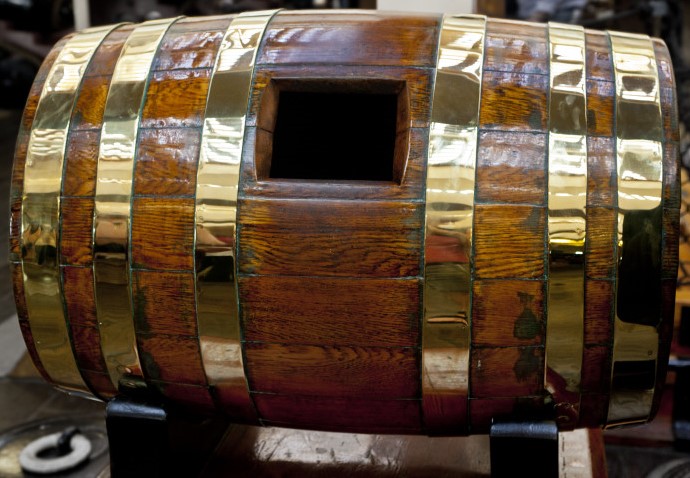
Scuttlebutt: The Butt was a cask with a capacity of between 110 to 140 imperial gallons of liquid (see my article about it here).  Scuttle was an opening in the ship’s deck, and as a verb, it meant to intentionally sink a ship by either putting a hole in it or leaving the portholes open with the intention of making a vessel unusable by an enemy. The barrels aboard ships were usually laid on their sides within braces, and a scuttle was a hole in the side for a cup or scoop to be inserted. The drinking hole became a popular gathering place, and the term “drinking hole” also became synonymous with the office drinking fountain or the local pub – a place to gather and have a drink together. To scuttlebutt means to idly chatter, start rumours, or gossip.

Which of these phrases are new to you? How many do you use, and if you use them, how frequently? I’d love to hear about it in the comments!

4 Comments

Filed under Etymology, History, History Undusted, Lists, Military History, Snapshots in History

History Undusted: Keys

Some people collect things like stamps, postcards, or coins. I’m drawn to unique doors, locks, and keys.

Keys are something everyone has; whether it’s a house key, a car key, or an inner door key. Modern keys come in several forms: Lever (usually used in padlocks or furniture), pin tumbler, dimple, computerized laser (often used in cars), Nutech, cross, skeleton, barrel, transponder, cards, Abloy, and many more.

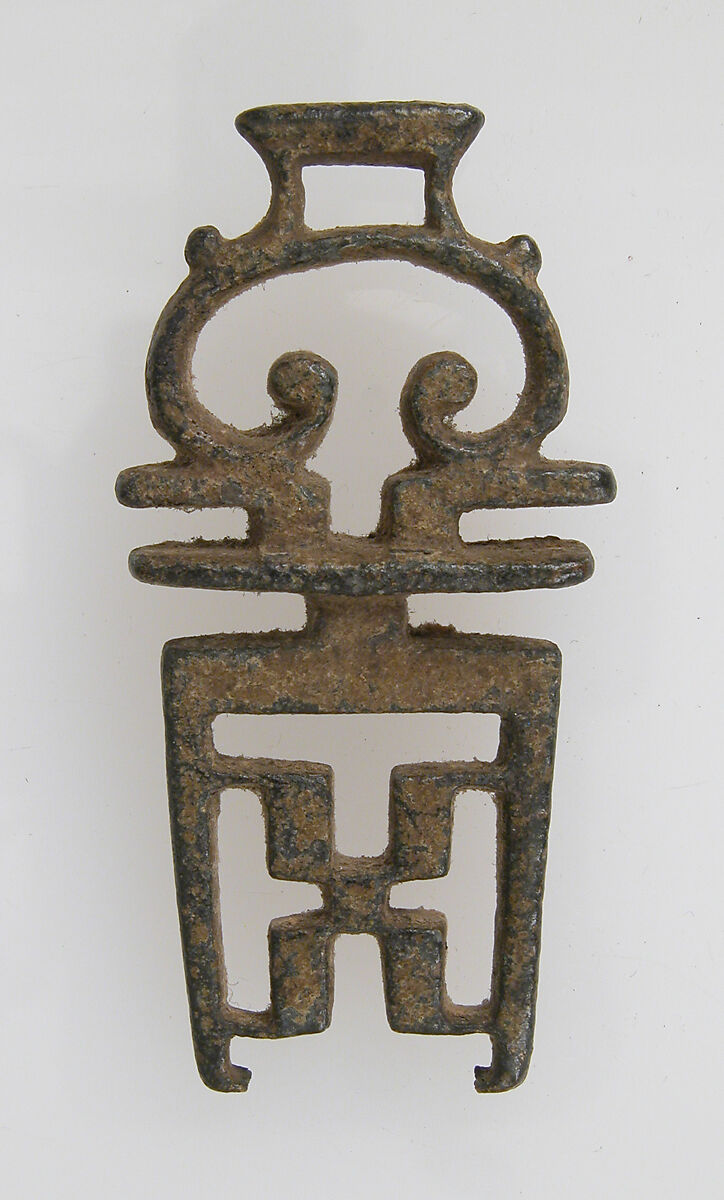
We tend to think of skeleton keys as antiquated, but here in Switzerland, even modern room doors within a home have skeleton keys for their locks (though we use dimple keys on main doors). Even though they’re still used, skeleton keys are one of the oldest forms of keys in history. The Romans had elaborate keys that were nearly as wide as they were long, but they already had the typical ringed head we think of when we think of a skeleton key; it made it easy to slip in a finger and pull the key out of the lock.

Roman Key Latch as old as 1st Century AD – Metmuseum

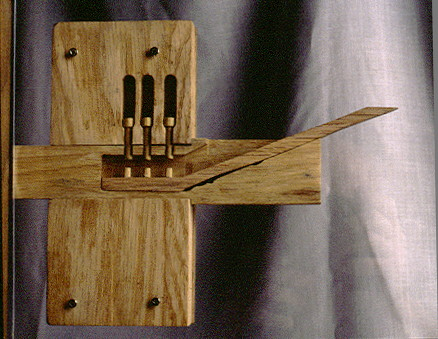
The oldest key found was in the ruins of Ninevah (the capital of ancient Assyria), going back to around 4,000 BC. It was a simple wooden prodder inserted into a hole in a door to lift pegs within a wooden bar used to hold the door securely from the inside; it could only be secured from the inside and was easy to open with any pegged stick. This type of wooden pin lock was common in ancient Egypt, but they’ve also been found in places like Japan and Scandinavia. It is alluded to in the Bible in such passages as Nehemiah 3:3,6,13-15 or Isaiah 22:22-23.

Ancient wooden peg key lock

The Romans improved on the idea and began making brass and iron keys with the ground-breaking technology of projections (wards) inside the lock that required a specific combination to be opened, thus requiring a specific key. The warded key outlasted the Roman Empire itself by more than a thousand years. Though these locks were easy to pick, no major advancements were made in the design until the late 18th century, when Robert Barron invented a new locking mechanism that we essentially recognize as the tumbler lock. Joseph Bramah improved further on the design a few years later, using a cylindrical key with patterned notches that aligned with the metal slides within the lock. The Bramah lock is still used and sold today (after finishing this article, take a moment on Google Images to search “Bramah lock” – you’ll see a wide range of old and new examples).  In 1818, Jeremiah Chubb improved the design by adding a retaining spring that held back a tumbler when shifted by the turn of the wrong key; this prevented not only the bolt from being lifted but indicated that someone had tried to pick the lock; they were known as detector locks.

Over time, many more improvements and refinements followed, until today’s key styles are so varied that a comprehensive list would be lengthy – there are variations within categories of keys; some cars today no longer even require a key to start. But to adapt the old adage of “where there are horses there are horse thieves”, where there is a lock there will be a lock pick. Even keyless cars are not theft-proof.

How many keys do you use daily? How have key styles changed in your lifetime?

4 Comments

Filed under History, History Undusted, How It's Made, Images, Links to External Articles, Science & Technology

Insatiable Fascination

Throughout history, people have always been fascinated by thinking beyond their own known world; before widespread writing and reading, ancient cultures thought about their own mortality (which, in some ages, wasn’t that far off) and the afterlife. Various cultures prepared for the afterlife in their own ways: The Egyptians removed organs and embalmed the rest, making sure to send on the heart & co. in separate jars (except the brain – who’d need that in the next world?), then sent them on their way with an army of servants (killed for the occasion); the Vikings buried their most honoured dead within a ship with their favourite animals and servants (ditto). Other cultures built pyres to send their loved ones up in smoke.

When writing came along, at first it was used to capture the past and the natural world, ala Pliny the Elder; poems, sagas, verbal tales and folklore began to be recorded; we have such writings still with us today: The Greek Epic Cycle, the Orkneyinga Sagas, the Heimskringla, the Poetic Edda.

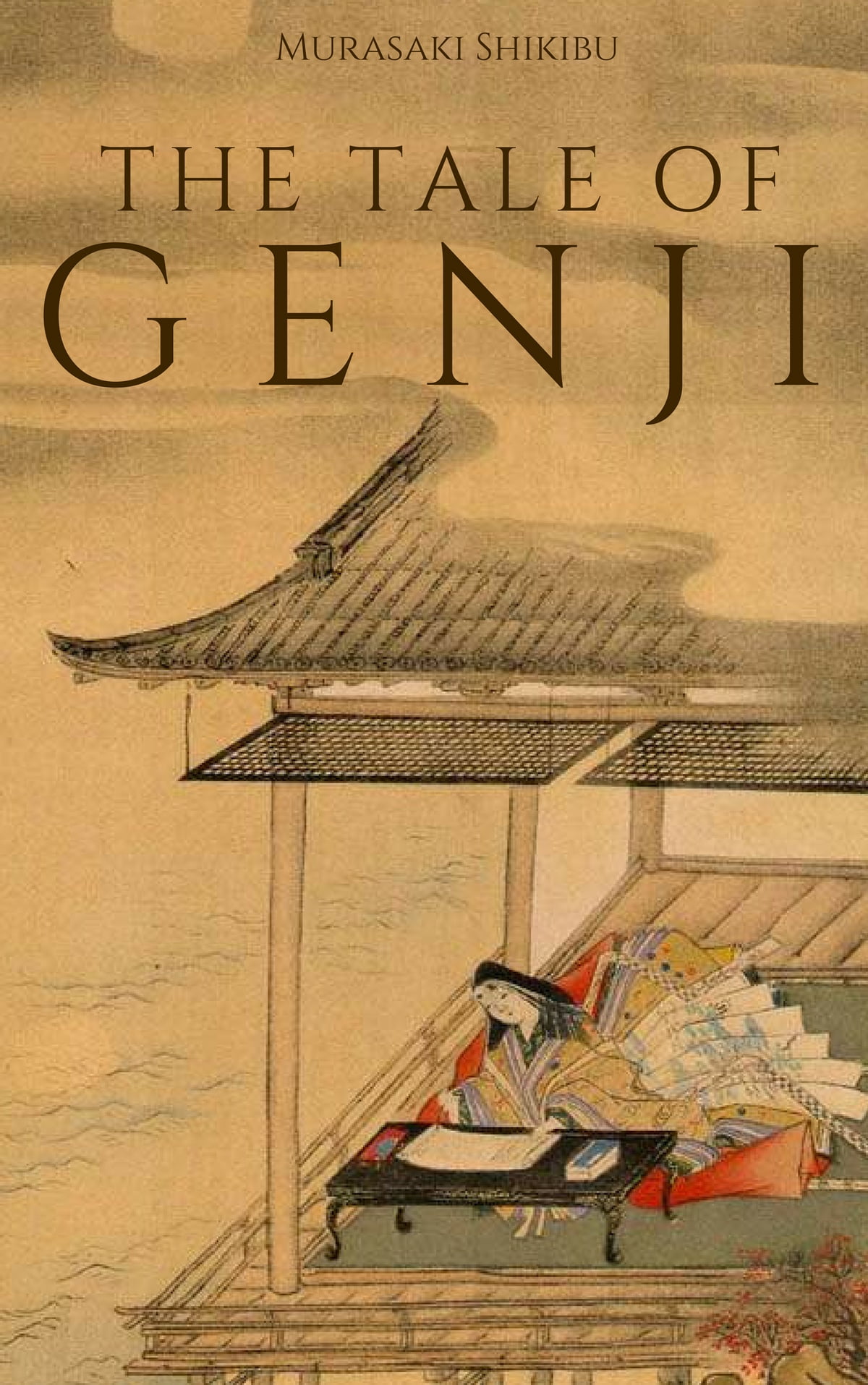
The first novel came along only 1,000 years ago: The Japanese epic The Tale of Genji was written by a woman, Murasaki Shikibu; novels were, for several centuries more, considered on the bottom rung of the literary hierarchy ladder, far behind “serious works” like history. Ironically, Mark Twain referred to history as “fluid prejudice”; it was nearly always recorded by powerful (white) men – hardly ever by a commoner, a member of an ethnic minority, or a woman. The interpretation of events was firmly in the hands of the conquerors. Because of that fact, for instance, we know more about Rome’s version of ancient Britons (Picts, Celts) than we do from their own artefacts; most Celtic and Pictish art is found outside of the UK – many carried off by the Vikings, but that’s another tale. Hollywood has helped perpetuate some of those ancient Roman notions (think of a blue-faced Mel Gibson in Braveheart).

In fact, we don’t even know what the Picts called themselves – the term derives from the Latin Picti, first seen in the writings of Eumenius in AD 297. It can be interpreted (dangerous words) as “to paint” – but there is no evidence that any people groups in northern Britannia painted themselves. Picts is simply a generic term for any people living north of the Forth-Clyde isthmus who fought the Roman Empire’s advancements into their territories. Again, the ink of history flowed from a Roman stylus.

Even Jane Austen herself didn’t begin publishing her novels under her own name. She was a single young woman – for shame that she would dare stain the male-hallowed ground of literature. The saga of how she got published speaks to her tenacity and the support of her family. But she got the last laugh, becoming famous within her (short) lifetime, and she is far better known today than any of the stuffy old men who wrote “proper” books of her day.

The insatiable fascination with other perspectives than our own explains why novels are so popular today. They take us into another time, place and situation, leading us through a story that, if written well, we can relate to and perhaps learn something from. In 1726, Jonathan Swift gave us Gulliver’s Travels. Though he originally wrote it as political satire, to “vex the world rather than divert it”, we know it still today. The fascination with someone being a giant in one land and a miniature in the next grabs our imagination; he travels to floating kingdoms, to an island of immortals, a la Death Becomes Her, and a land of talking horses.

Book Nook (Instagram repeat)

In the age of internet, visual arts have expanded as far as the global imagination can span: Not only paintings or drawings, but even crafts take us into another perspective. I recently saw a series of images in which people have taken the humble walnut shell and turned them into tiny worlds with bookshelves, ladders, lamps, beds and creatures. Book nooks are popular, too: A tiny village, street, or room within the space of a book on a shelf. Science fiction art takes us off-planet.

Films are visual perspectives that take us into other worlds, times and places: When George Lucas showed us a “commonplace” bar scene on Tatooine in the Mos Eisley Cantina in Star Wars, he blew our minds and kicked off a new era of visual storytelling. Avatar took us to another planet and another perception of reality, all the while being an allegorical tale of ecological care vs. abuse. Somewhere along the way, sometime in your life, I’ll bet you’ve been fascinated by a different perspective, whether presented to you through a book, a documentary, a sermon, a play, a film or a conversation.  What did you learn from that encounter? How did it change you, or help shape your perspective? And what is your favourite “escape”: Films, books, visual arts, or music? Please comment below!

8 Comments

Filed under Articles, History Undusted, Humanity Highlights, Images, Psychology Undusted

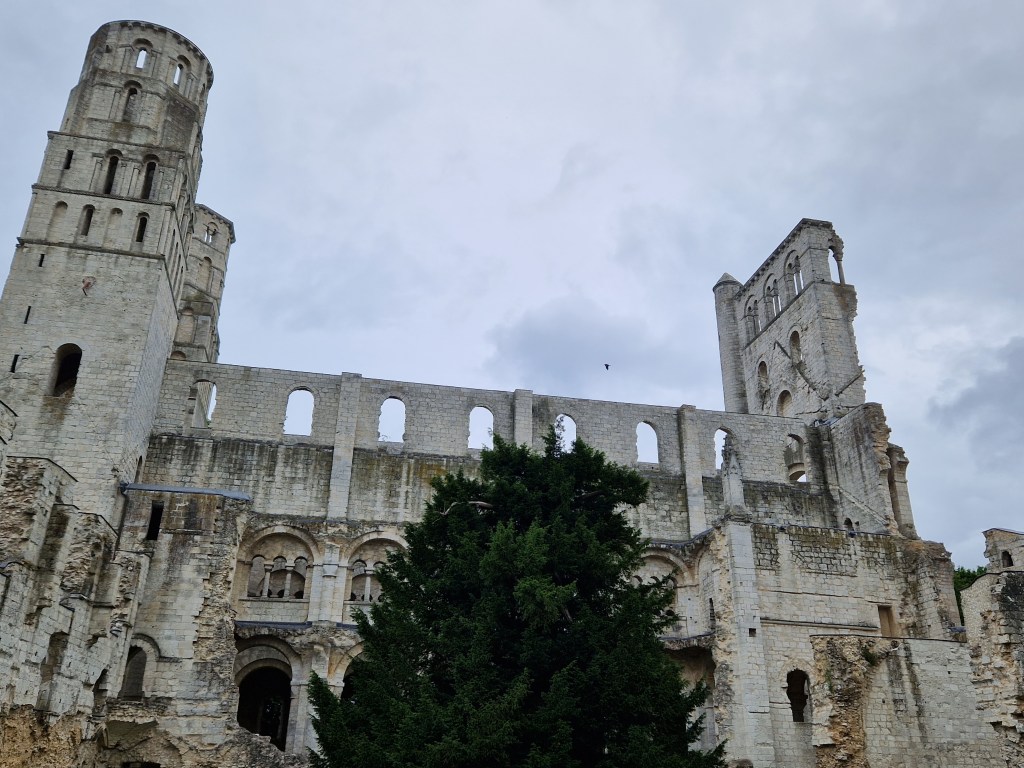
History Undusted: Jumièges Abbey

Jumièges Abbey is one of the oldest Benedictine monasteries in Normandy; to dive into its history is akin to diving down Alice’s rabbit hole. For instance, I could say that the abbey was sponsored by the Frankish Queen Balthild, as she persuaded her husband, King Clovis II, to donate land to the Frankish nobleman Filibertus in order to found an abbey. But to know who she was, ah, that is where the intrigue begins.

Who and where were the Franks, when were they a thing, and what are they to us today?

Who, where and when: They were a Western European people who began as a Germanic people along the lower Rhine (which flows from Bonn, Germany, and ends up in the North Sea at the southwestern corner of the Netherlands), along the northern frontier of the Roman Empire. During the Middle Ages, they expanded their scope of rule as the Western Roman Empire began to collapse, and they imposed their power over many post-Roman kingdoms and beyond. That’s the crux of the matter though, as with any political history, it’s far more complex than that. The Franks are distinguished into two main groups by historians: The Salian Franks, to the west, and the Rhineland Franks, to the east.

In the mid-5th century, The Salian king, Childeric I, was a commander of Roman forces against the Gauls, most of whom Childeric and his son, Clovis I, conquered in the 6th century. Clovis was the first king of the Franks to unite the Frankish tribes under one ruler, and he founded the Merovingian dynasty – which ruled the Frankish tribes for 2 centuries. Clovis, in essence, is known as the first king of what would become France. As a side note, the Frankish name of Clovis is at the root of the French name of Louis, borne by eighteen kings of France.

Now, back to Queen Balthild (AD 626 – 680): Sold into slavery as a young girl, she was beautiful and intelligent. She served in the household of Erchinoald, the mayor of the palace of Neustria to Clovis II. Her master, a widower, wanted to marry her, but she hid herself from his sight until he married someone else (apparently the household of servants was numerous enough to enable her to avoid her unwanted suitor). Perhaps through Erchinoald’s notice of her, she came to the attention of Clovis II, who proposed to her and was accepted; hiding herself away may have been a political tactic to gain a higher rank with the king than with the mayor; According to the Vita Sancti Wilfrithi by Stephen of Ripon (written around AD 710), Bathild was a ruthless ruler, in conflict with the bishops and perhaps responsible for several assassinations. Some historians interpret Queen Balthild’s association with founding monasteries as a way of balancing or neutralizing aristocratic opposition to her rule. By installing her own bishops and donating lands for abbeys, she strengthened her own power as ruler (she was regent during the minority of her son). To put that in proper perspective, she was no different than most male counterparts of her day. [I could go off on a tangent about how adjectives differ when applied to the male or female state of affairs (a man is ambitious; a woman is pushy or ruthless), but I won’t. Yet.] From most accounts, however, she was pious and humble. Whichever way you butter that croissant, in ca. 860 she was canonized, thereafter to be referred to as Saint Balthild…

In 654, Balthild gave a parcel of royal land to Philibert, or Filibertus, on which he founded the Notre Dame de Jumièges. His main spiritual influence was that of the Irish monk, Columbanus (who founded several monasteries in the Frankish and Lombardi kingdoms).  The abbey flourished until the Viking invasions of 841 (Remember Rolf Ganger?), which caused disruptions to its first momentum, but it soon began to prosper again. The church itself was rebuilt between 1040 and 1066; it was dedicated on 1 July 1067, with none other present than William the Conqueror, Duke of Normandy and King of England (1066 and all that). The patronage of such a nobleman ensured the abbey’s success.

Jumièges Abbey was, like any abbey of its time, a veritable town. The church was only the heart of the community; there was a 14-acre enclosed park, terraced gardens, the abbatial manor, a bakery, landscaping to evoke biblical scenes, a hostelry, the 14th century “Charles VII” walkway (a covered walkway between the Notre Dame and St Peter’s church, named after the fact that Charles VII and his favourite mistress visited the monastery), and the cloister.

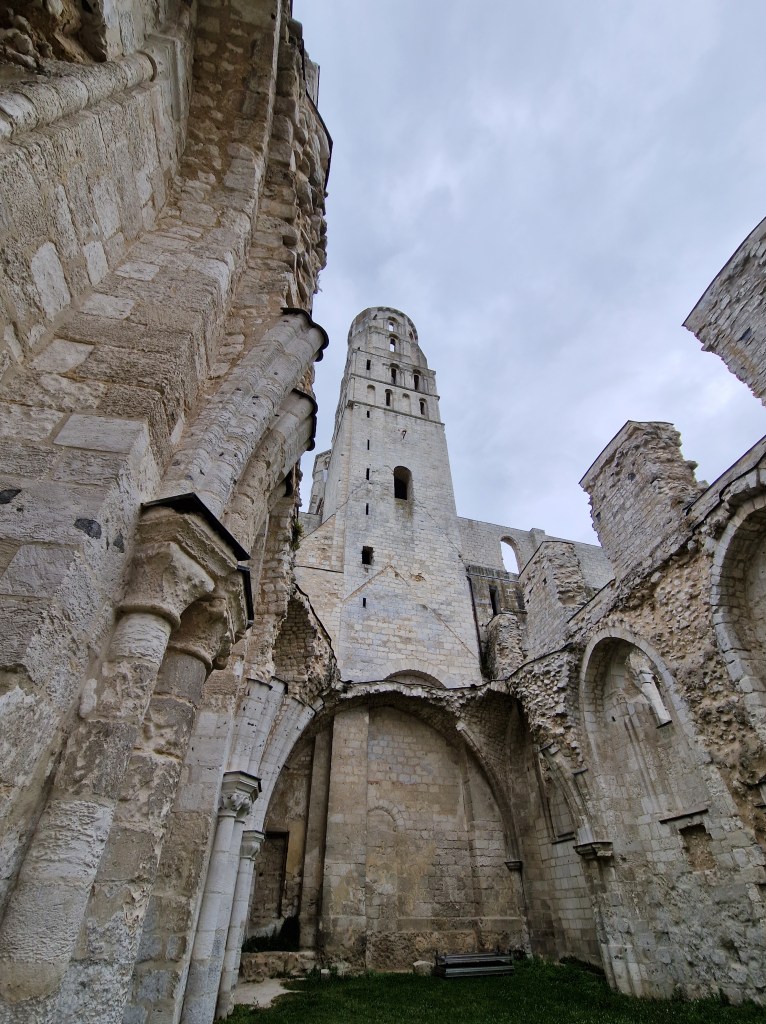
The next major disruption was from 1415, when the monks were forced to regularly seek refuge in Rouen as the English occupied Normandy during the Hundred Years’ War. The abbey eventually recovered and began to flourish again, until the whole province was plunged into the chaos of the Wars of Religion (1562-1598), resulting in the population’s decimation and famine. In 1649, the abbey was taken over by a Benedictine congregation, when some of its former glory was revitalized. Having survived all of that, its ruin came at the hands of the French Revolution, when it was sold as a “national property” and turned into a stone quarry (seen only as a source of ready-cut stones). At last, its historical value was recognized in the 19th century, putting an end to its wanton deconstruction.

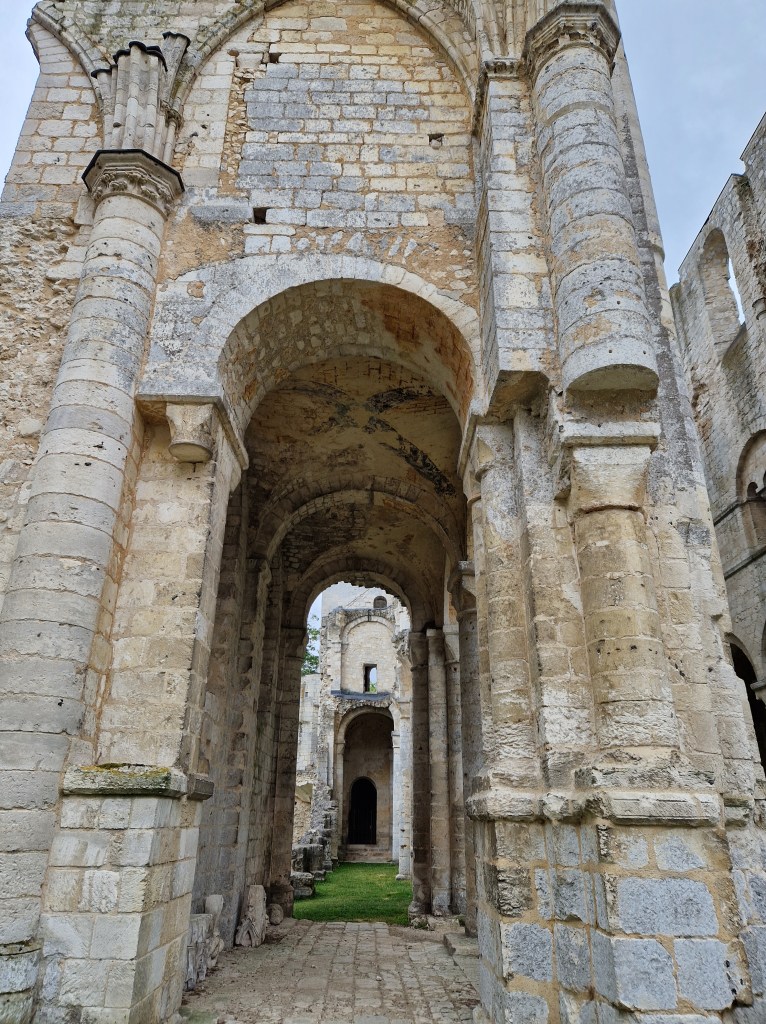
When we visited the abbey last summer, its grandeur, although only ruins today, is still evident; when it was at its height of prosperity, it must have been an awesome sight to behold! In the photos below, which I took during our visit, you can see evidence of the various phases of destruction and reconstruction. Enjoy!

2 Comments

Filed under Articles, Etymology, History, History Undusted, Military History, Snapshots in History