Happy New Year, everyone! As usual, January starts off with a bang of busy catch-up; for me, perhaps more than normal, as I was sick the whole month of December (bronchitis) and had to push appointments forward. Let me back up a moment to explain what also happened leading up to December:
At the end of October, we realised that our elderly cat, Allegra, was tired of life; she’d been sick for a while, but we’d managed with daily pain meds, and she was happy and active – until about mid-October, when she began doing little more than sleeping. We said our goodnights on 3 November, leaving us with 2 cats: Andromeda, 5½, whom we adopted from a local animal shelter, and Mira, 5, whom we adopted from a private family when she was old enough to leave her mother. We knew we wanted three cats, so mid-December, we returned to the same animal shelter and adopted Callisto, born end-August 2025. He has two speeds: Whirlwind and cuddle. Since around day 4 of his being here, he and Adromeda have been fast friends, playing, sleeping and snacking together.
A problem emerged with Mira, who would go out of her way to attack Callisto – when she wasn’t staring at him and stalking him incessantly. Fortunately, he has a sunny disposition and the attention span of a gnat, so it didn’t faze him! We thought Mira’s behaviour would taper off after a few days, but as the weeks went on, we realised that she was making it clear that she would be happier in a solo-cat home. She’d never really understood the body language of our other cats, anyway, and she’d never played with them; also, she doesn’t like surprises – and Callisto is full of them! We were quickly able to find her a good, loving home with some friends of ours who had lost their elderly cat and had not yet adopted another cat, so it was perfect timing! Mira is slowly coming out of her shell in her new home and starting to play again. Now to shake up our home once more and adopt another cat as soon as we can arrange it!
Between nursing a sick cat through to October, preparing all of my crafts for sale and being present at our annual Advent market, then being sick for a month, breaking up cat fights, and keeping an eye on an energy ball who is in that toddler phase of putting everything in his mouth – including electrical cables*, I haven’t had much focus or energy to write or edit; I don’t like wasting time, even when I’m sick, so I’ve been crafting – that’s free therapy…if you know, you know! [* We were sitting at breakfast the Sunday before Christmas, when half of our tree lights went dark; a cable shred was swinging helplessly as Callisto began to move on to the other cable! Our first deed of the day was to wrap as many cables as we could in chew-guard tubes!]
I hope your 2026 has started off well, and I look forward to what this year will bring!
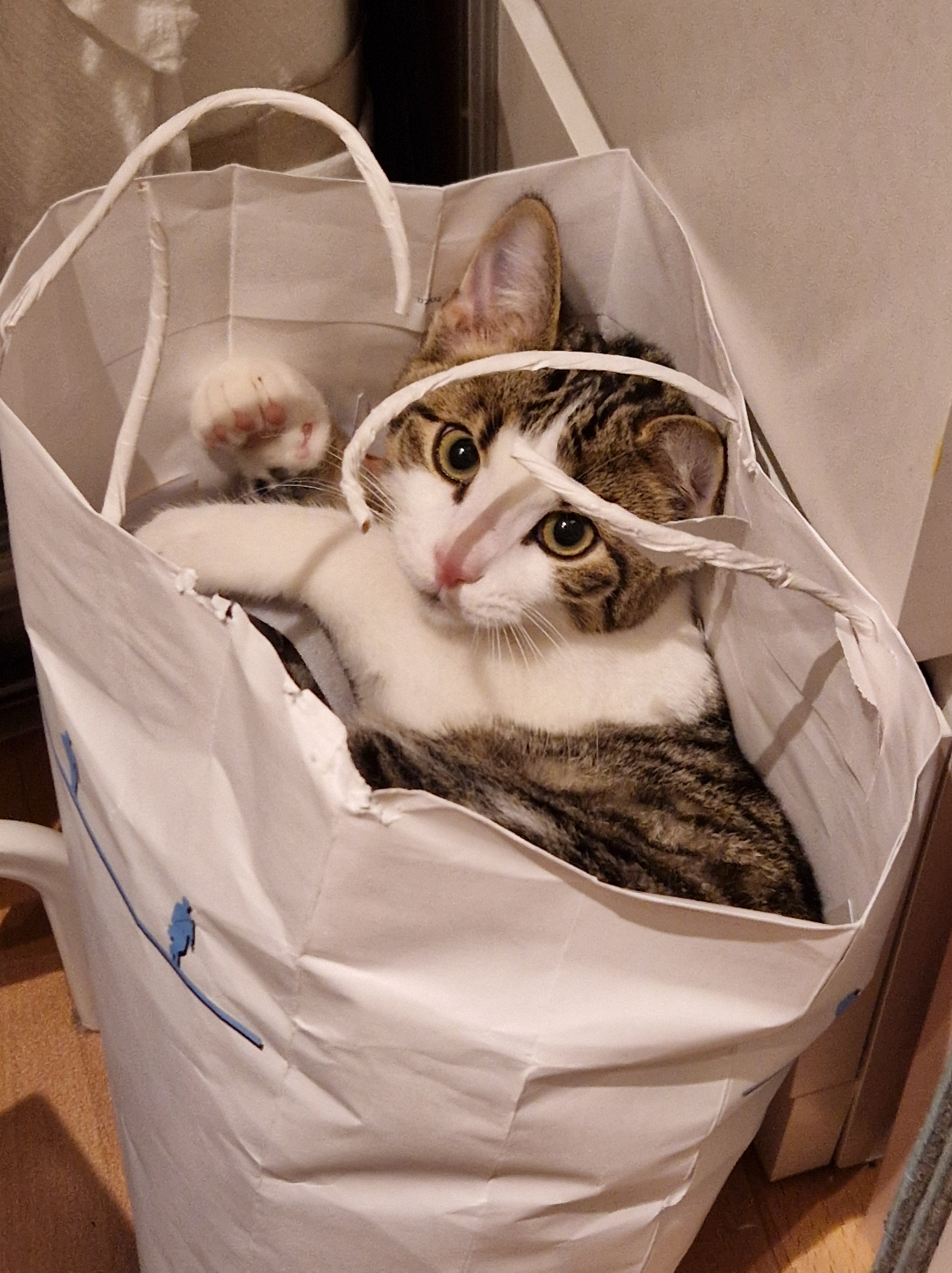
The whirlwind, Callisto, dismantling my craft room’s paper recycling bag one piece at a time…
Good intentions of writing a blog this week went out the window when temperatures soared to mid-30s Celsius (which, local microclimate-wise, is high 30s into 40s); it’s simply too hot to focus right now… I know what I want to write about, but heat-induced brain fog is real!
So in the meantime, I’ll leave you with something just for fun!😉
Today’s topic is the kind of thing that flashes through my brain at 4 a.m. when I’m dropping off to sleep.
Sometimes rock and stone can be used interchangeably, depending on the context of science, society or conversation; but some phrases are intuitively either stone- or rock-rooted: We say rock road, rockslide and rock salt, but stonemason, stone wall and Stonehenge.
In geological terms, a rock is a naturally occurring mass of minerals, particularly those with a distinctive composition (e.g. granite, bedrock, igneous, or features such as Ayers Rock). Other geological terms range from clay, silt, sand, pebble, gravel, cobble, boulder or glacial erratic (material moved by geological forces from one location to another) to mountain in size.
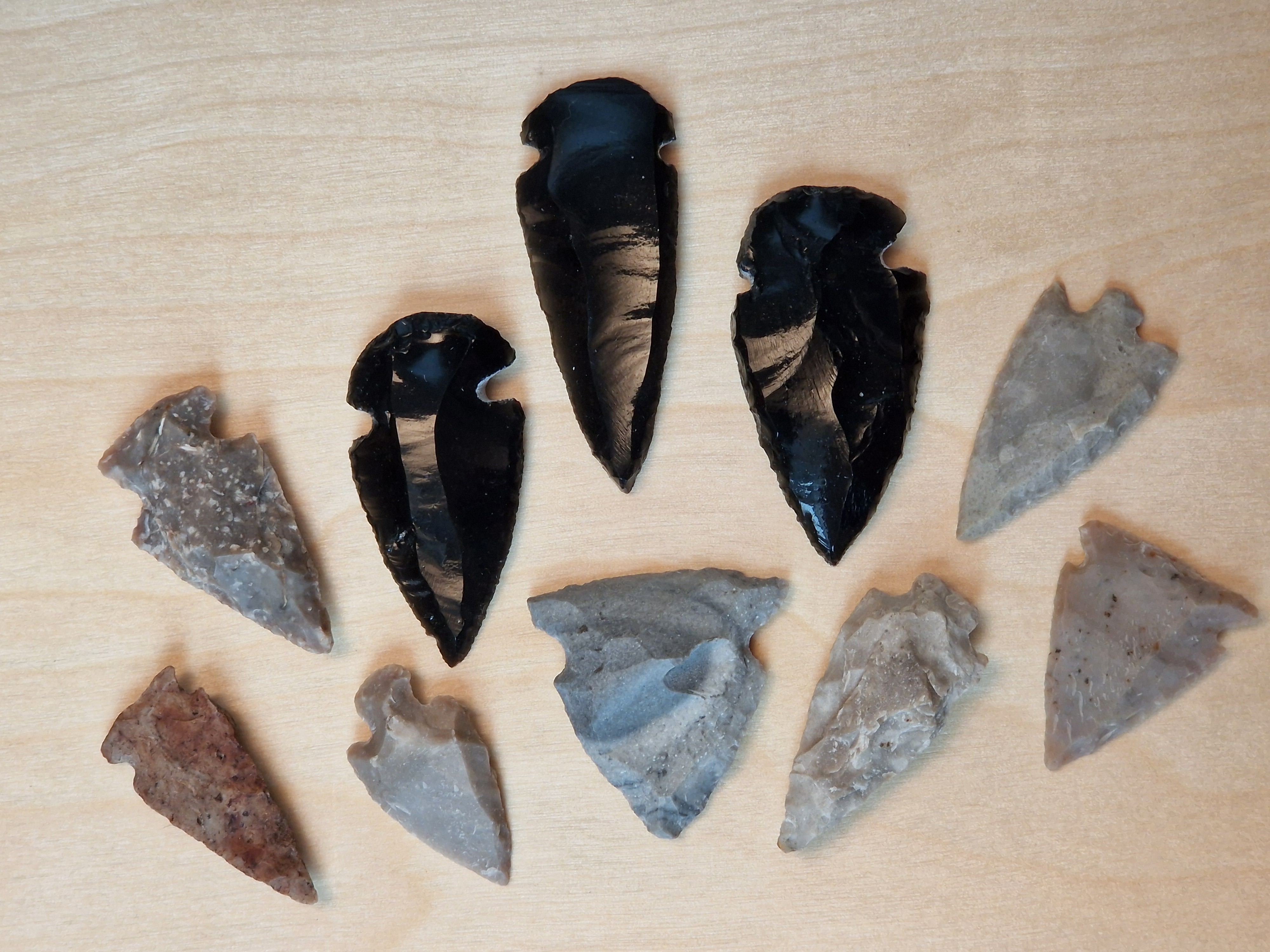
In Archaeological terms, rock refers to a geological formation, while stone refers to any rock that has been placed or modified into a tool by humans (ergo, Stonehenge, not Rockhenge). When an archaeological dig is underway and they pull out a rock, trained eyes can spot signs of scarring, or scoring, such as on a core, which is a piece of rock that has been worked by a stone tool referred to as a hammerstone (for obvious reasons), used to shape another rock into a tool, such as in the process of flint knapping (the more refined the knapping process, the more refined the tools become, such as using antler or copper nubs to chip away finer areas of an arrowhead or hunting barb). In Kansas, where I grew up, arrowheads are still discovered occasionally; I have a small collection, along with a few obsidian arrowheads.
In archaeological excavations, what might appear to be a natural rock formation may turn out to be an ancient boundary wall, with stones intentionally stacked for a specific purpose. In that sense, though a rock road has intentionally been placed, it is not stone – it is placed for a purpose, yes, but its arrangement is left as it falls, so it is referred to as a rock road.
Years ago, when my husband and I were walking along a rocky riverbank in Ticino (in the Italian-speaking part of Switzerland), I picked up a stone; it had obvious signs of human activity, with smoothed sides where hands held it, and scrapes along the top and bottom, such as might be caused by sharpening a tool – whether antler or arrowhead. As it was washed down from its resting place in the rapids, it was no longer in situ and therefore would have no archaeological significance.
So which is it, stone or rock? For me, the answer is this: When it has been modified or intentionally placed or ordered by humans, it’s stone; when it’s naturally occurring, it’s rock.
I’ll leave you with a few idioms carved in stone or rock:
The first weekend in June, I took a much-needed break. Our home renovations, which lasted 14 months altogether, were finally finished. For a few months, I’d been looking for a suitable writers’ retreat, or a creative retreat – ones that didn’t have yoga as part of the course (I won’t go into my reasons; let’s just say I wouldn’t be able to relax in that kind of atmosphere). I’d finally found one – and it would be at a place in the Dordogne (one of the “departments”, or regions, of France) I already knew from the YouTube channel Manor & Maker. After I’d booked the course, which would have been a creative weekend around the theme of fairy tales, it unfortunately had to be cancelled. But as I’d paid for the course and flights, I decided to go anyway.
The “weekend” started off on Thursday, with the worst travelling day I’ve experienced in years: In France, workers will strike at the drop of a hat; I think they still haven’t figured out that the French Resistance and the habit of inconveniencing everyone just because they can is passé. But the Bordeaux taxis were on strike Thursday and Friday – which meant that the roads in and out of the Bordeaux airport were blocked (the police were even helping the strikers). Therefore, the airport shuttle across the city to Gare Saint-Jean (train station) was thrown off its scheduled routes. I waited in vain for the shuttle to arrive at its alternative location, and, through a succession of helpful advice (more or less – not everyone was informed about the strike and changed traffic routes as a result), what should have taken 30 minutes ended up taking 3 hours (carrying luggage). I finally arrived, then bought a train ticket (the last train of the day possible), then waited. And waited. Other trains leaving after mine popped up on the board, but not the train for Limoges (my stop would be Thiviers).
In the ticket office, the woman in charge (who spoke little English when she chose and had fobbed me off to someone more capable) had belligerence and a little-god/diva complex down to a fine art. (As the saying goes, be careful how you treat me or you’ll end up in one of my novels…) As the train’s track information didn’t pop up and still didn’t show up, I braced myself and got back into the queue to ask about it. Fortunately for me, the older French couple in the queue in front of me asked about the train for Limoges; I could follow enough of the French and body language to know what happened next: The diva answered curtly with a generous portion of rudeness added – and promptly had her head scrubbed, bitten off and handed to her on a silver platter – to the applause of everyone who’d had to deal with her already. The husband of the couple was ready to rip her hair out for speaking to him the way she had, until another ticket woman stepped in between them and tried to diffuse the situation – apparently, she had practice at it. This second woman then came out with the growing crowd of waiting passengers to see what the problem was at the information board; after several minutes on the headset with the control room (I assume), it finally popped up. Naturally, it was the farthest train track, and we had only 5 minutes to reach it! The couple took me under their wing, and we made it to our seats just before the doors closed. I finally arrived at my destination, Thiviers, around 9 p.m.
I was met there by Stephen, the Chatelain of Chateau de Saint-Germain-des-prés, and driven back to their home. What followed was a lovely, long weekend; only one other B&B couple were there, but rarely seen. I had time to unwind, work on my next novel, and spend time with Stephen and Sara (the Chatelaine) and Sara’s mother, Dee. Sara is a costume seamstress, and she was working on a Regency coat for Steve for an upcoming BBC segment at the chateau of their friends. Dee and I helped piece the pattern together, and the billiard table in their grand salon became the sewing table for the project.
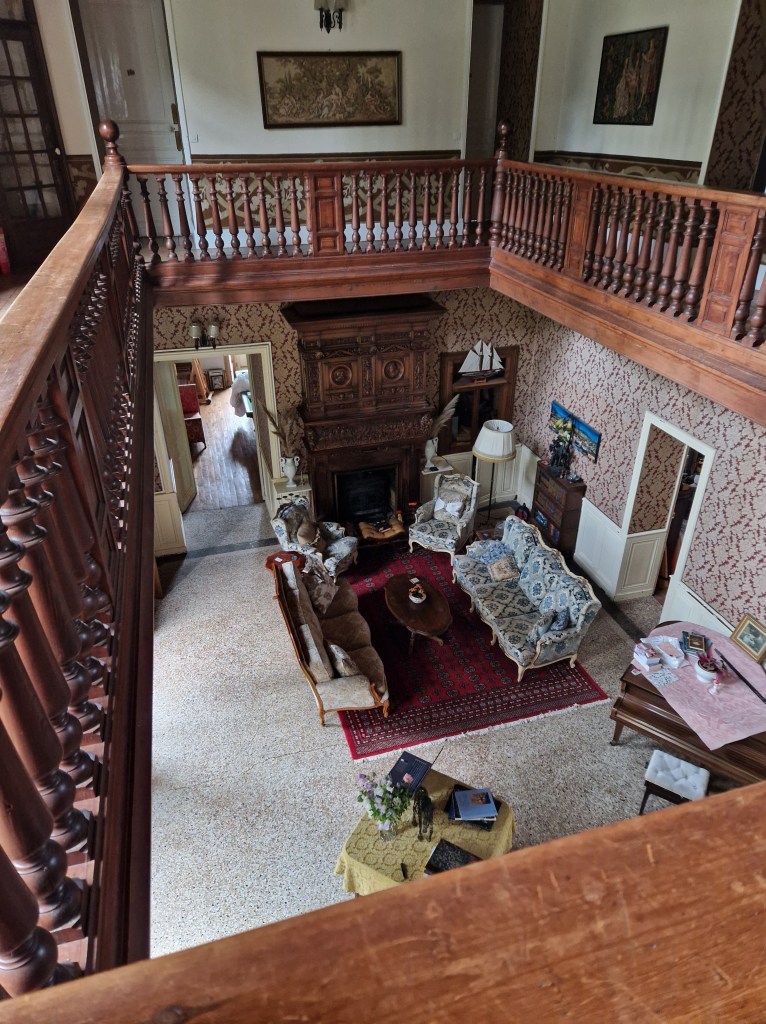
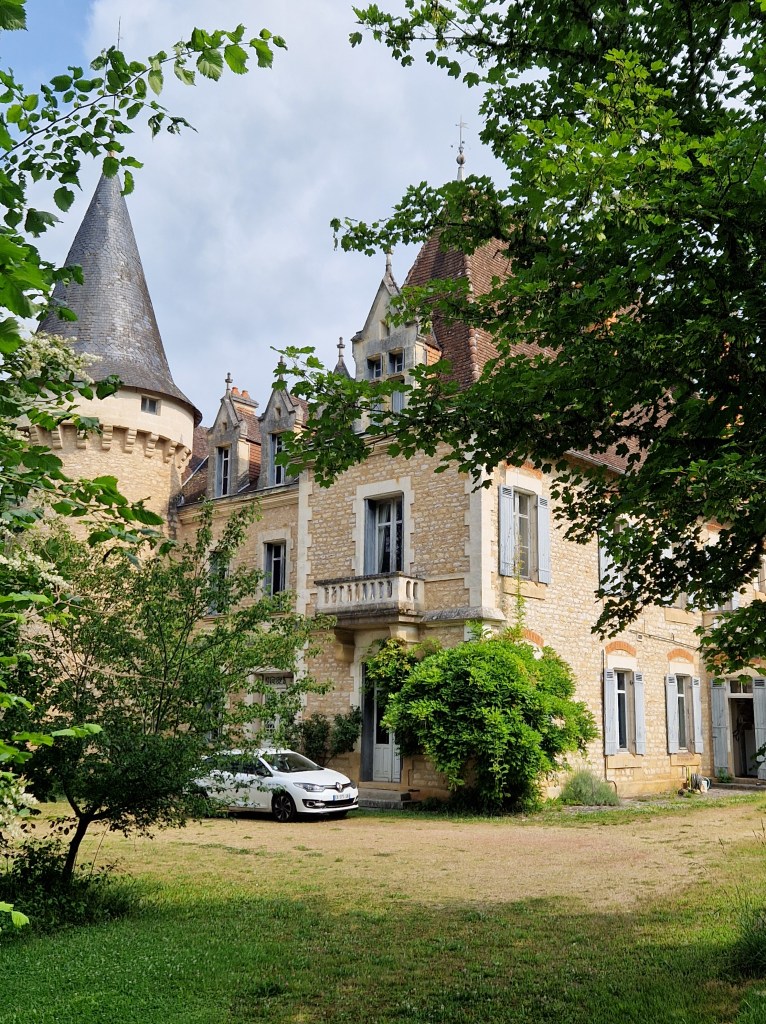
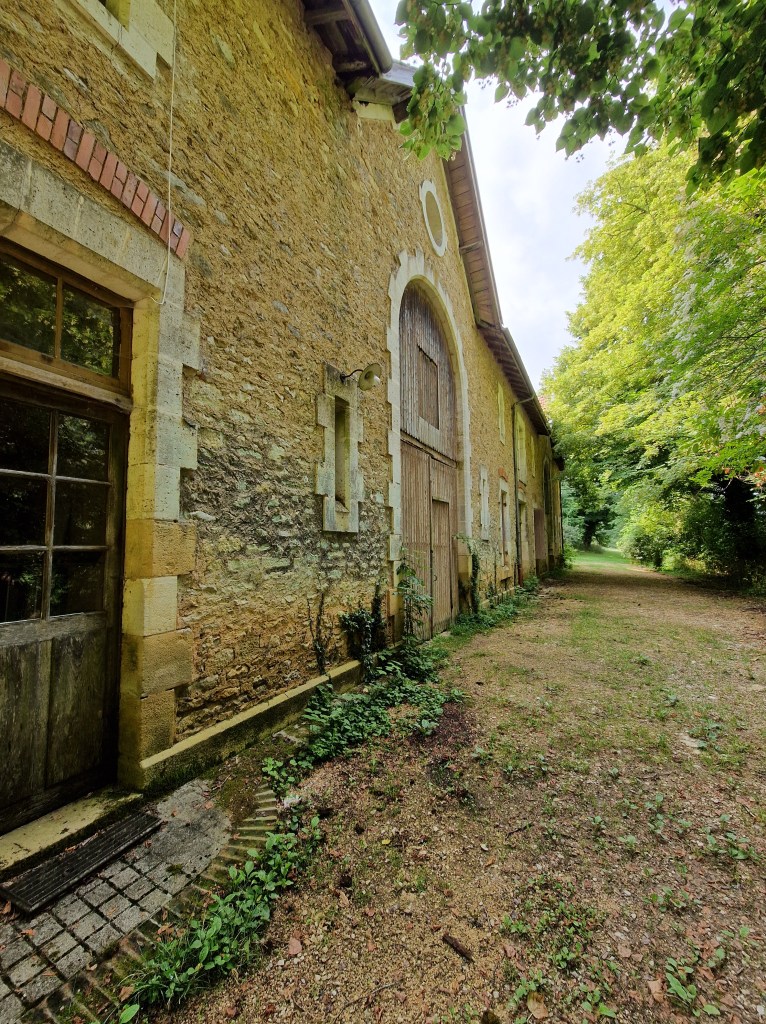
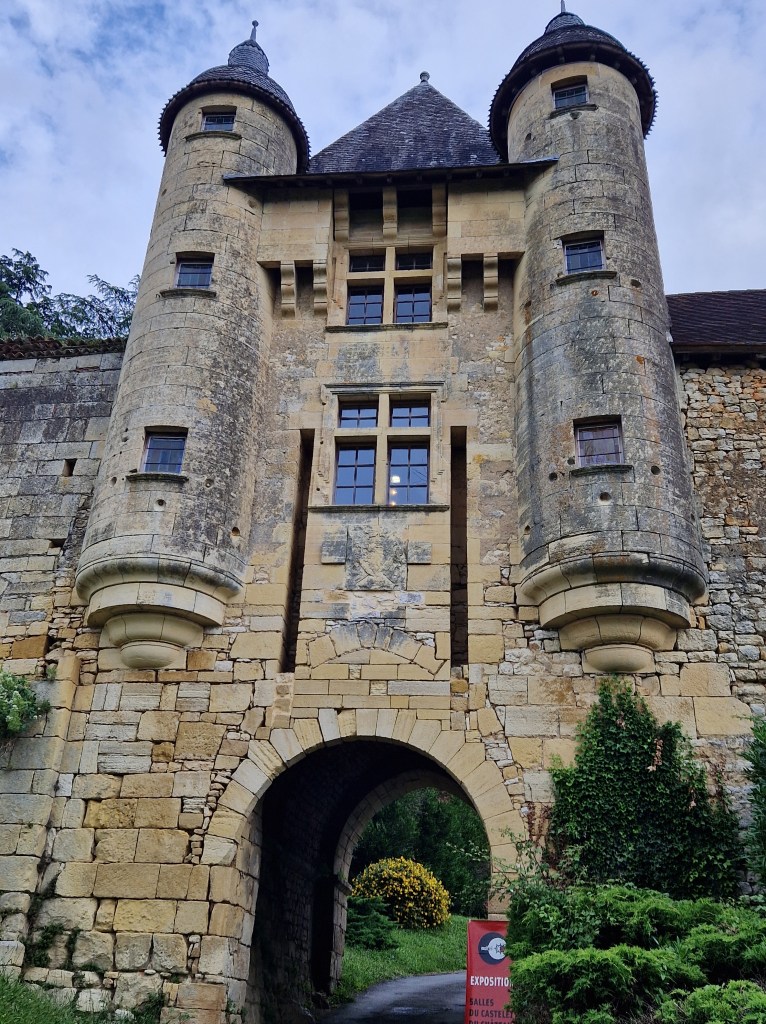
Here are a few pictures from the weekend, which included a modern art exhibition at another local chateau, as well as an outdoor artisan pottery fair. Barring strikes, I’d love to go again sometime!
View from my suite’s doorChateau ChateauChateau’s barnSitting room – “my” writing spot with a footstoolModern art exhibition host chateauFrom the pottery fairFrom the pottery fairComing home; not a cloud in the sky, just snowy peaks!
Last Sunday at church, a friend filled an entire room with her late father’s books, setting up an impromptu book shop. I chose several books, most of which are in Fraktur typeface, known to some people as “Gothic” or “Old German”. I enjoy reading such books because they offer a snapshot of a cultural way of thinking. The books I chose were printed between 1877 and 1940. The latter date is significant, as you’ll soon see.
First of all, let’s clarify a few terms: Though many people think of font and typeface as interchangeable, in fact, they refer to two different aspects of a writing style. Typeface refers to a particular style of lettering (e.g. Times New Roman), while font refers to the variations within that style, such as size and weight (CAPS, bold, italic, etc.). Another term we know but may not fully understand is Serif: This refers to the small stroke or line attached to the larger stroke of a letter; an example would be an A with “feet” at the bottom of each down-stroke. Sans Serif simply means “without Serif”.
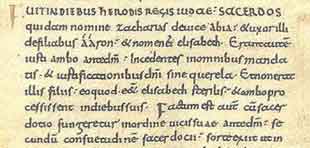
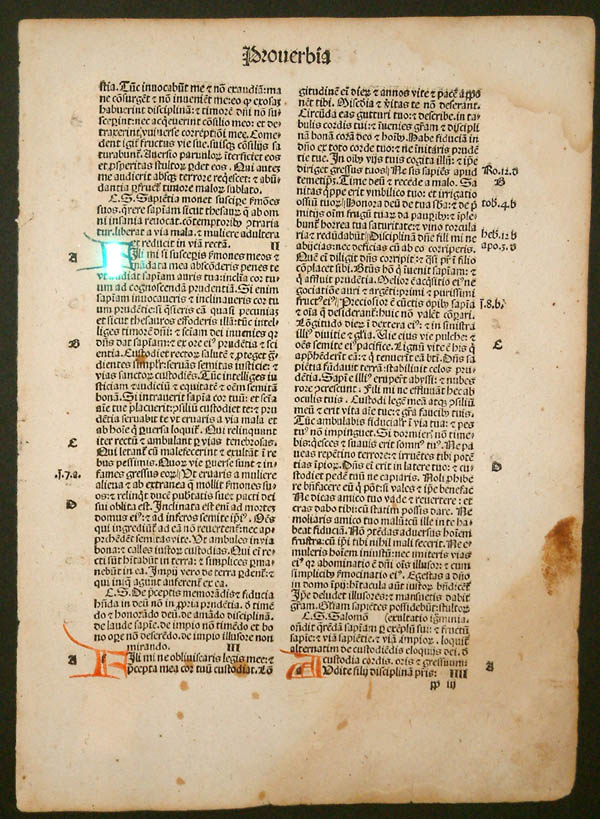
The first moveable-type printing press, designed by Johannes Gutenberg in Germany around 1440, was based on the ancient Roman design of a screw press used to press wine or oil, which in turn went on to be used to press designs into cloths. He was likely familiar with intaglio printing and may have done some work himself in copper engraving. These designs and uses likely fermented in his inventor’s mind into what became the revolutionary turning point of literacy. Gutenberg’s original typeface was called Donatus-Kalender; the metal type design was itself a form of Textura (more on that in a moment).
Donatus Kalender
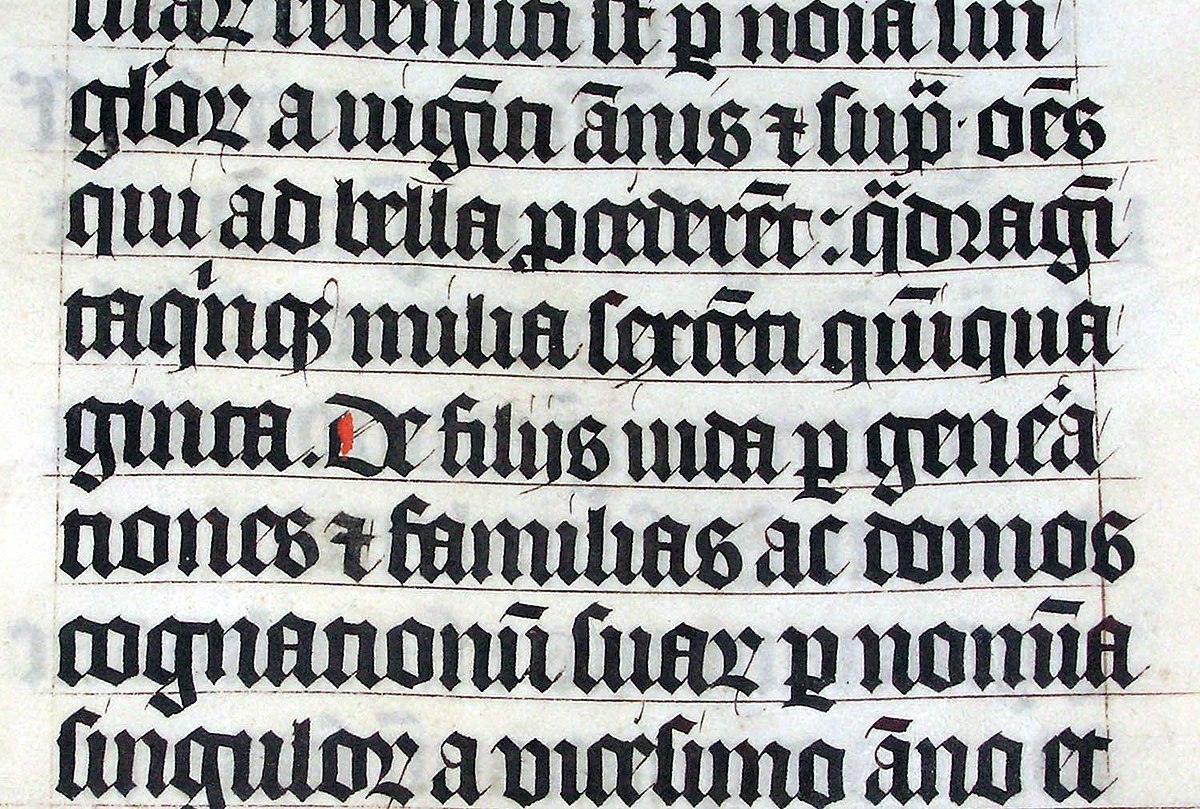
Example of Blackletter (Source: Wikipedia)
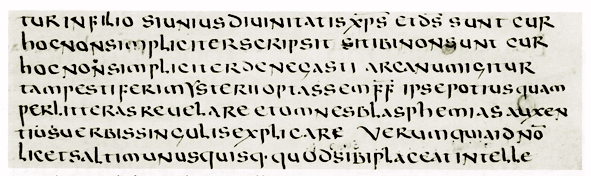
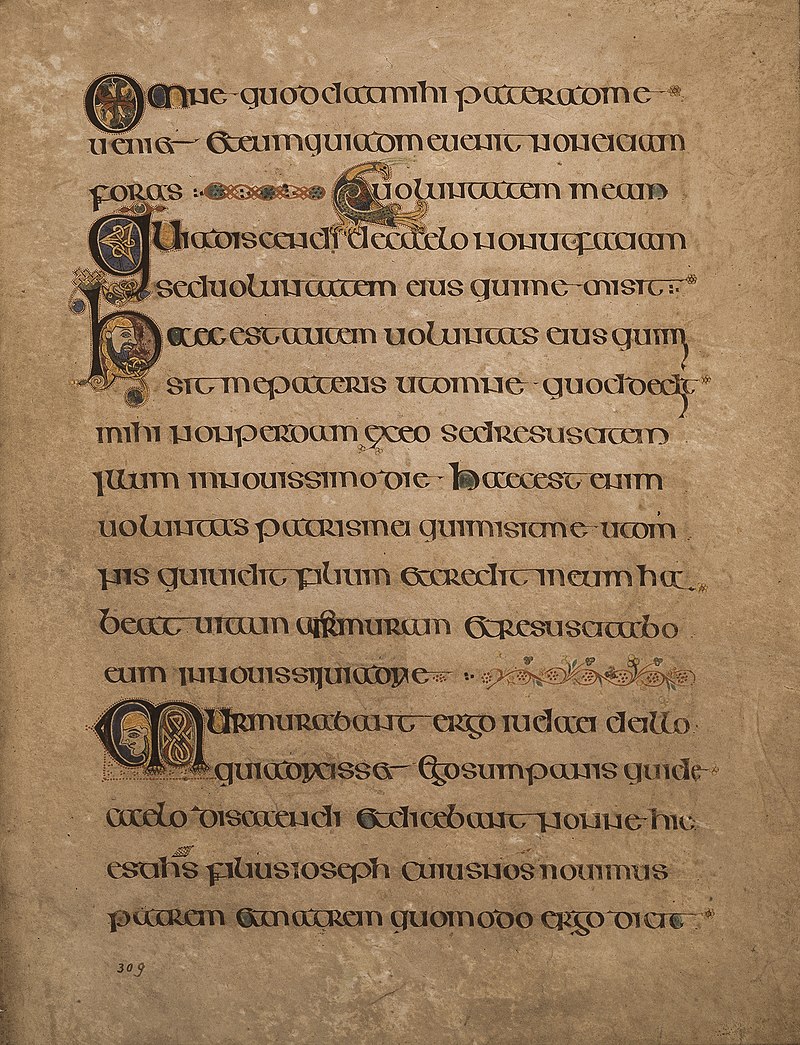
This original family of typefaces was known as “Blackletter”, aka “Gothic scripts”, with the height of popularity peaking around the 14th to 15th centuries. The ancestor of the Blackletter was called the Carolingian minuscule, a calligraphic standard of handwriting widely used in the medieval period, when literacy began increasing and a need for books in a wide range of subjects began to be in demand. It is thought to have been developed in the mid-770s by Benedictine monks north of Paris in the Corbie Abbey, famous for its scriptorium and library. The minuscule itself was derived from Roman Uncial as well as Irish Insular script, which was developed in Irish monasteries and spread throughout Europe.
Carolingian Minuscule
Roman Uncial
From the Book of Kells, an example of the Irish Insular script
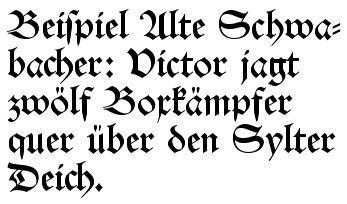
The family of Blackletter typefaces included Early Gothic, which was a transitional script between the Carolingian miniscule and Textura (the most calligraphic form of Blackletter); Schwabacher was a form popular in early German print typefaces (it became widely known with the spread of Luther Bibles from 1522), in use from the 15th century until it was eventually replaced by Fraktur around 1530, though it was still used alongside Fraktur for emphasis, much like we use bold or italic today.
Schwabacher Typeface
Textura Typeface
Another blackletter typeface developed between 1470 and 1600: Antiqua. This typeface’s letters were designed to look like the handwriting of ancient Roman documents, with the letters flowing together, strokes connecting them in a continuous line, whereas Fraktur was distinguished by having letters “fractured” – separate from one another. The Antiqua-Fraktur Dispute deserves its own article, so stay tuned!
Antiqua Typeface (Source: Wikipedia)
Fraktur Typeface (Source: Fonts in Use)
The Habsburg Emperor Maximillian I (1459-1519) was King of the Romans* from 1486 to 1519 [the title of king was used by the kings of East Francia, the territory later referred to as the Kingdom of Germany, from the time of Henry II (1002) to Joseph II (1764)]. The king commissioned the artist Albrecht Dürer to create a series of woodcut engravings of the Triumphal Arch [Though many are familiar with the Arc de Triomphe in Paris, it is only one example of this ancient Roman architectural feature used as a free-standing structure (rather than the Greek version, which was used within a structure such as a temple).]. These engravings would be used to create what we would recognize today as essentially wallpaper, though its purpose was more of a statement of power or propaganda (read personal marketing) commemorating his nobility, generosity, and military conquests – an incongruous combination, if you ask those conquered… The final composite of printed papers stood nearly 3 metres (12 feet) high and was only one part of a series of three enormous prints commissioned by the king.
Albrecht Dürer’s The Triumphal Arch, for Maximilian I
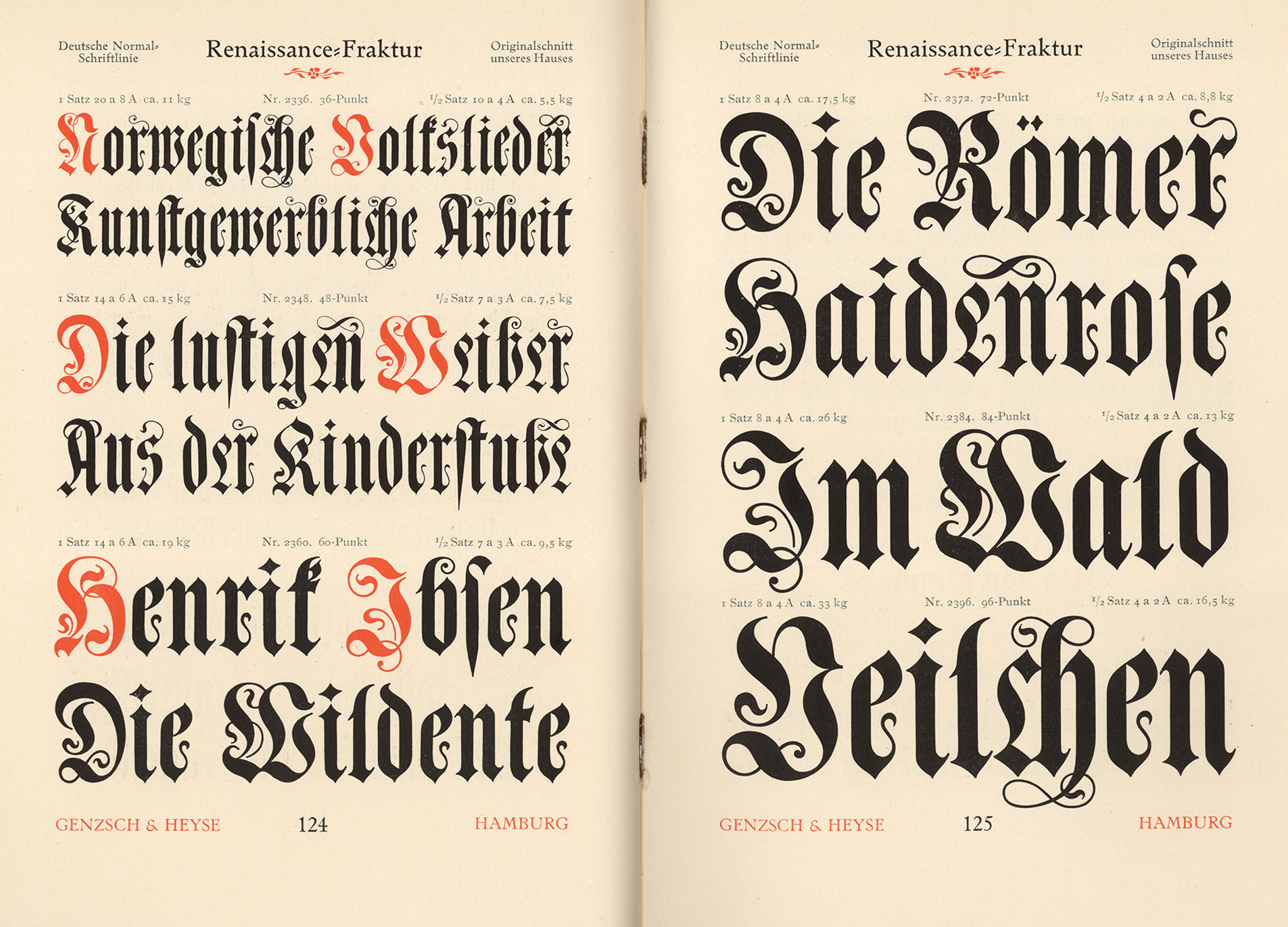
The Fraktur typeface was designed in the 1530s by Hieronymus Andreae, a German woodblock cutter, printer, publisher, and typographer closely connected to Albrecht Dürer. The typeface was made to decorate the arch, telling the stories of the figures depicted throughout. The typeface became popular in Europe and was in use in the German-speaking world, as well as areas under its influence (Scandinavia, Central Europe, and some eastern European regions), into the 20th century. Specifically, Fraktur was in use in German until 1941, when it was actually banned (which places one of the books I purchased on Sunday within one year of the end of the era of Fraktur!). The atmosphere that led to that ban arose from the dispute mentioned above. Once the Nazis were defeated, the ban was lifted, but Fraktur never regained its widespread popularity after that, though you can still see it occasionally in pub signs or various forms of ads, like beer brands.
I just pulled two books from my library shelves: One is an English book originally printed in 1895, with my book being printed in 1915; the other is a German book printed in 1892. The typefaces are widely different: The English text likely used the French Oldstyle, while the German book uses Renaissance Fraktur for the text body, while the end pages act as indexes and use a variety of blackletter typefaces, such as Muenchner Fraktur, Antike Kanzlei, and Enge verzierte Altdeutsch. To see examples of the typefaces mentioned here, please click on the link for Fonts In Use.
I hope you enjoyed this jaunt through history! Nearly every name mentioned, every typeface, and every event deserves its own undusting. Next time, we’ll deep-dive into the dispute that lasted well over a century!
Before we dive into today’s topic, let’s talk about two of my favourite words: Flotsam and Jetsam. I just love the way they sound! The way I understand them, the difference between the two is intention: Flotsam are things unintentionally donated to the sea – things washed overboard from a ship, or things blown off land by a storm. Jetsam is rather something intentionally jettisoned – if a ship needs to lighten its load to avoid sinking, for instance; in the case of the great garbage patches, it is a mixture of both: Without proper disposal systems in place, such as municipal garbage disposal, or education in ecological footprints, social debris is simply tossed and forgotten. But it ends up somewhere, often finding its way to the ocean through rivers and streams. And this leads us to the topic of ocean currents.
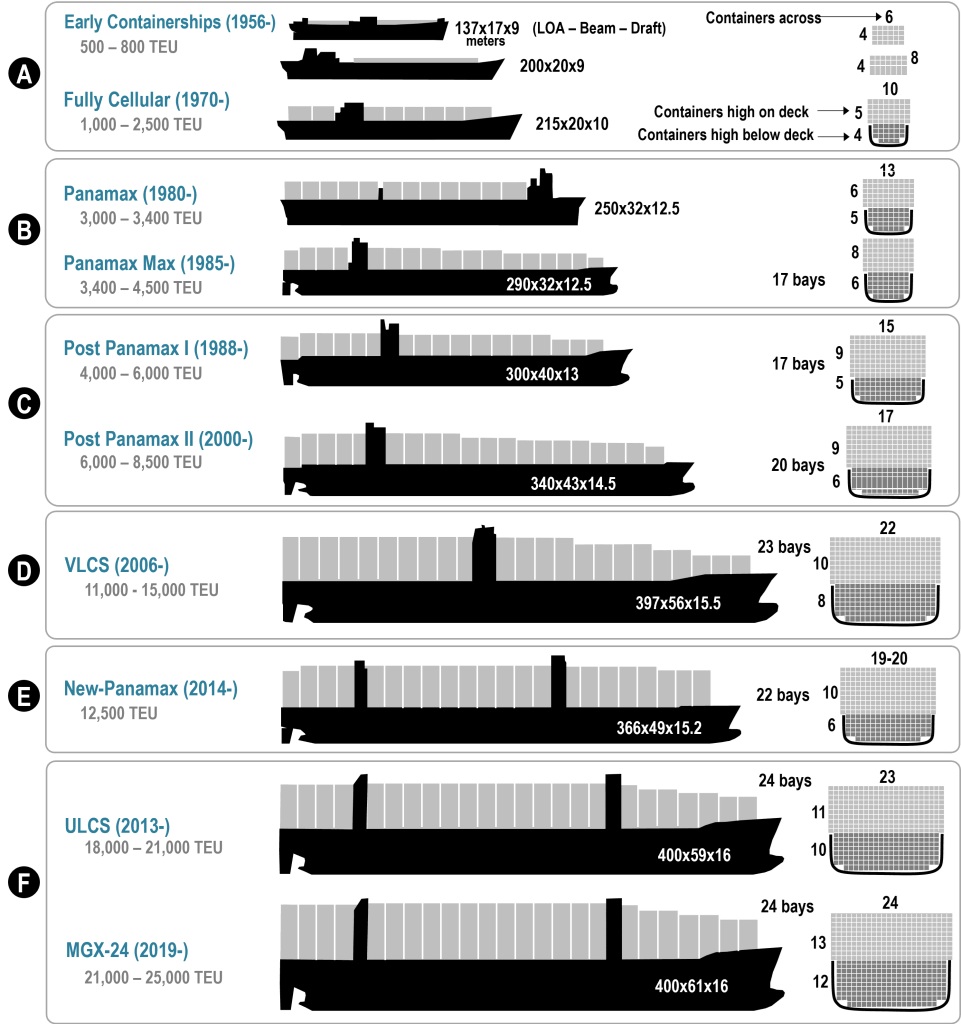
Today’s topic is a fascinating dive into a world of global trade; research has shown that around 90% of international trade is carried by shipping containers, and the World Bank statistics show that in 2019, nearly 800 million were shipped annually; given the increase over the past few years in online shopping, I can imagine that figure is by now significantly higher. The unit used for measuring how much a ship can carry is TEU (Twenty-foot Equivalent Unit); the chart below shows the adaptation of ship sizes over the years, driven by global trade:
Now, imagine a shipping container stacked at the top of a pile that’s the height of the actual ship; add to that ocean swells and waves. I’ve been on ships in the Atlantic facing waves so high, I could count fish through my window. I’ve been on ships in the “Sailor’s Nightmare” – the Pentland Firth passage between Scotland and the Orkney Islands – which is characterised by rough bathymetry (the underwater equivalent to topography) and extremely high currents (which also ricochet and collide off of the coasts of the islands and Scottish cliffs), tossing anything on the surface like a leaf in the wind. The World Shipping Council estimates that, over the past 16 years, an average of 1,500 containers have been lost at sea annually. Every year, the contents of those containers are carried along until the container is breached by either corrosion or impact. Then the contents are carried by ocean currents; where they finally make landfall depends on where they entered the ocean. If you were marooned on an island and tossed out an SOS in a bottle, it could make landfall anywhere between two and one hundred years – or never, if it’s caught in a gyre (more on that later). A message in a bottle was found on a beach in Norway that had been sent off 101 years earlier.
So what does that have to do with rubber ducks? In 1992, a shipping container with a consignment of what has been dubbed Friendly Floatees – 28,800 yellow rubber ducks, red beavers, blue turtles and green frogs – was washed overboard (along with 11 other containers) into the Atlantic. Because they are designed to float on water, they have survived at sea for an amazingly long time. Seattle oceanographers Curtis Ebbesmeyer and James Ingraham, who were working on an ocean current model, OSCUR (Ocean Surface Currents Simulation), began to track their progress; and those wee toys went on all kinds of adventures: Ten months after they broke free, some began showing up along the Alaskan coast; some showed up in Hawaii; some went to see the site of the Titanic sinking before getting frozen into ice, eventually emerging again and travelling to the US eastern coast, Britain and Ireland, making landfall around 2007. The researchers contacted coastal regions, asking beachcombers to report their finds; they recorded findings and began to accurately predict where landfall would occur. Over the years, the ducks and beavers had faded to white, but the blues and greens had retained their colours.
Flotsam and Jetsam have played key roles in helping researchers understand not only how ocean currents travel, but also how the areas known as garbage patches, oceanic gyres, are formed and retained by the swirl of ocean currents. Currently, five patches are known; many of the rubber ducks are likely caught in such currents, so we may hear about more white ducks finding their way to beaches in the coming years.
So the next time you see a rubber duck, think of all the adventures its siblings have been on!
If you’d like to see for yourself how ocean currents work, click here for an interactive map; just click on any area of the map to see how and where the currents carry debris from that point.
Do you ever have those moments where you catch yourself thinking about the simplest of things in life? Things that are common to you, yet you’ve never stopped to think about why you call something by a certain term and where those words or phrases come from? I do, with alarming frequency… I guess it’s the product of a curious mind.
I have long hair; so long that, if it’s not in a braid or some other up-do, I’d be sitting on it with ease. I braid it every day and every night – otherwise, it tangles. And thus, while brushing my hair out this morning, the word tangle tangled in my tangled mind. As someone once said, my hair isn’t messy; it’s just erupting with awesomeness.
As a verb, meaning “to knit together confusedly, encumber, or enmesh”, it came into English in the mid-14th century via Old Norse þongull, meaning seaweed, from the Proto-Germanic thangul. Other Germanic languages have related words: In both Dutch and German, we find Tang (seaweed), and in Frisian we find Tung [Frisia is a cultural region that lies over the border between the Netherlands and Germany.] Looking at the image below, it’s easy to imagine a ship’s tackle becoming entangled in the tang…
Image Credit: The Norwegian Blue Forests Network
As with any useful word, it began to collect variations: The transitive sense of entrapping someone or bringing someone under one’s influence; the sense of fighting with someone; Tanglefoot was a western slang meaning strong whiskey, and tanglesome (1823), meaning complicated.
So I hope I’ve untangled the origins of this tanglesome word! Have a great, untangled week!
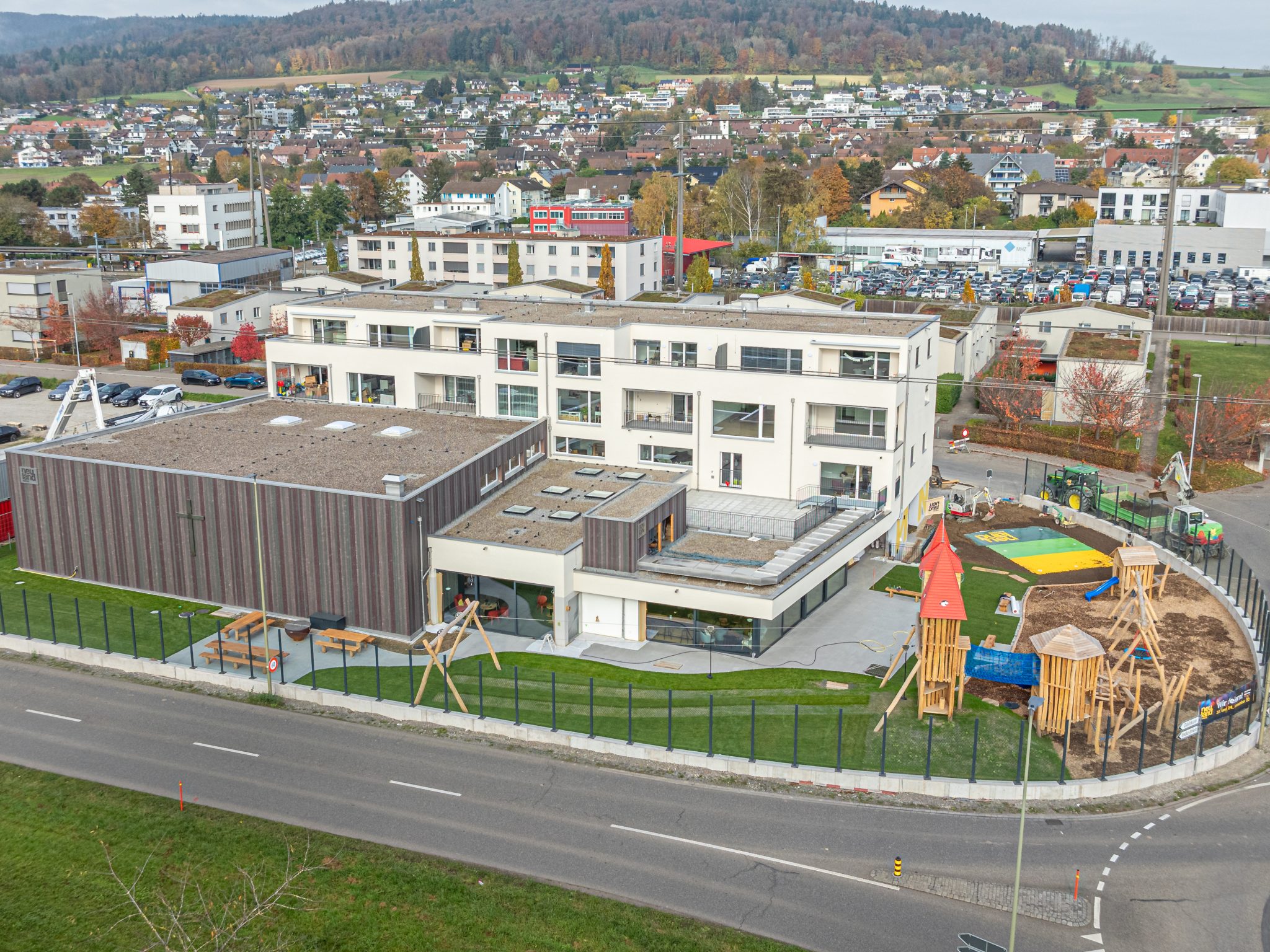
The past two weeks have been crazy! Our church recently moved into our new building, so we had a two-day open-house celebration, and on Sunday the mayor spoke, as well as regional church leaders from the Catholic church, the Protestant (State) church, and a few regional leaders from our church’s denomination. We were directly or inadvertently involved most of the time. As we are both active in our church, we’re often there; with the Advent season, more so than usual. Below is a photo of our new church, with the playground in progress. It is already a huge attraction in the town!
Also, the work on our balcony finally began in the last week of November! If you don’t know already, we discovered extensive water damage back in April (actually, it’s been ongoing for 4 years, but every time we’d have a repairman, he’d fix one thing and say, “that was the problem – all done.” Fix. Fix. Fix.) In April, we started the ball rolling with extensive repairs – but it got lost in the works as our management company had personnel changes; someone took our file home for work, then either went on vacation or was let go (unsure which came first). The summer flew by, and finally, in September, all the ducks were in a row – insurance, neighbours’ consents, etc.
Our balcony was ripped up, the privacy glass walls removed, scaffolding set up, and repairs began – but last week, they discovered a problem that brought work to a stop: The wood underneath our balcony window was basically compost. Now, the specialist for window repair has been brought in; an offer will be made, but all tradesmen go on holiday from the 20th of December, which means things cannot be ordered/received/scheduled… until late January 2025. Sigh. It means we cannot even go onto our upper balcony until possibly March… Scaffolding will be removed and re-installed when it’s needed again.
With all of that going on, and workers coming and going, I haven’t had any time to even think about creative writing apart from the novel I hope to wrap up (first draft) before Christmas, so that, over the holidays, my beta readers can read and give feedback.
In all of that, my sewing machine died (at least I could do crafts of some kind between workers, phone calls and appointments); I’ve been wanting to replace it ever since, but I haven’t even had time to go three streets over to the shop! After our church’s celebration, the organizer had a box full of out-of-date flyers for the event; she was going to throw them away when her son suggested giving them to me (I have a bit of a reputation; so far, I’ve also inherited four craft rooms…). When I’ve had time in-betweens, and couldn’t focus on writing because of noise (drilling, hammering, etc.), I’ve been making notebooks from the flyers, covered with scrap paper. I took a batch on Sunday; most were handed out at the welcome station! More, ready to go!
This morning, for the first time in ages, I’ve been able to think about blog topics once more! So keep an eye on this space for another blog this week. Thank you for your patience, and keep learning, keep being curious, and if you’re a writer, keep writing!
The Sunday, 14 April 1994 edition of the Washington Post held a contest in which readers were asked to come up with excuses to miss a day of work. The results will bring a smile to your face!
•If it is all the same to you I won’t be coming in to work. The voices told me to clean all the guns today.
•When I got up this morning, I took two Ex-Lax in addition to my Prozac. I can’t get off the john, but I feel good about it.
•I set half the clocks in my house ahead an hour and the other half back an hour Saturday and spent 18 hours in some kind of space-time continuum loop, reliving Sunday (right up until the explosion). I was able to exit the loop only by reversing the polarity of the power source exactly e*log(pi) clocks in the house while simultaneously rapping my dog on the snout with a rolled-up Times. Accordingly, I will be in late, or early.
•My stigmata’s acting up.
•I can’t come in to work today because I’ll be stalking my previous boss, who fired me for not showing up for work. OK?
•I have a rare case of 48-hour projectile leprosy, but I know we have that deadline to meet…
•I am stuck in the blood pressure machine down at the Food Giant.
•Yes, I seem to have contracted some attention-deficit disorder and, hey, how about them Skins, huh? So, I won’t be able to, yes, could I help you? No, no, I’ll be sticking with Sprint, but thank you for calling.
•Constipation has made me a walking time bomb.
•I just found out that I was switched at birth. Legally, I shouldn’t come to work knowing my employee records may now contain false information.
•The psychiatrist said it was an excellent session. He even gave me this jaw restraint so I won’t bite things when I am startled.
•The dog ate my car keys. We’re going to hitchhike to the vet.
•I prefer to remain an enigma.
•My mother-in-law has come back as one of the Undead and we must track her to her coffin to drive a stake through her heart and give her eternal peace. One day should do it.
•I can’t come to work today because the EPA has determined that my house is completely surrounded by wetlands and I have to arrange for helicopter transportation.
•I am converting my calendar from Julian to Gregorian.
•I am extremely sensitive to a rise in the interest rates.
•I refuse to travel to my job in the District until there is a commuter tax. I insist on paying my fair share.



















 Stephanie Huesler