Category Archives: Writing Prompt

The Ultimate Final Exam

DIGITAL CAMERAAfter 11 months with an exchange student here with us, our life is now beginning to revert to its previous “business as usual” state.  That means that I can schedule my time, my days, and even weeks, and actually see those goals come within reach and grasp them.  It means that I can sit down at my computer, and write 10 hours straight if I’m on a roll!  It’s suspiciously quiet here now, but that does not mean something’s afoot this time… unless the cats are up to something.  With all of her exams through the school year, I was reminded of a list I’d seen years ago; when I shared a similar list in my previous post, I decided to track this one down and share it with you.

This ought to keep you entertained and out of trouble, while I dive into my fifth novel’s manuscript with a fresh eye (since I haven’t really seen hide or hair of it since April…!).  Enjoy, and have a great week!

Warning:  I take no responsibility for snorted drinks or explosions of anything out of your north or south ends

The Ultimate Final Exam

  Read each question carefully.  Answer all questions.    Time Limit: Four hours. 

 HISTORY:

Describe the history of the papacy from its origins to the present day, concentrating especially but not exclusively, on its social, political, economic, religious and philosophical impact on Europe, Asia, America and Africa.  Be brief, concise and specific.

  GEOGRAPHY:

Predict the position of the tectonic plates as they will appear two billion years from now. Be prepared to prove your results.

  MEDICINE:

You have been provided with a razor blade, a piece of gauze and a bottle of Scotch.  Remove your appendix.  Do not suture until your work has been inspected.  You have fifteen minutes.

  BIOLOGY:

Create life.  Estimate the differences in subsequent human culture if this form of life had developed 500 million years earlier with special attention to its probable effect on the English parliamentary system.  Prove your thesis.

  PUBLIC SPEAKING:

2500 riot-crazed aborigines are storming the classroom.  Calm them.  You may use any ancient language except Latin or Greek.

  ART:

Give an objective analysis of the relative significance and quality of the works of the major artists of the past three millennia. Be specific, and prove your analysis with detailed examples.

  MUSIC:

Write a piano concerto.  Orchestrate and perform it with flute and drum.  You will find a piano under your seat.

  PSYCHOLOGY:

Based on your knowledge of their works, evaluate the emotional stability, degree of adjustment and repressed frustrations of each of the following:

  • Alexander of Aphrodisias
  • Ramses II
  • Gregory of Nicea
  • Hammurabi

Support your evaluation with quotations from each man’s work, making appropriate references.  It is not necessary to translate.

  SOCIOLOGY:

Estimate the sociological problems which might accompany the end of the world.  Construct an experiment to test your theory.

  COMPUTER SCIENCE:

Write a program that will end world hunger and homelessness. You may use the computer console next to you, however use of a modem or any other communications device is prohibited, as is the use of electricity.

  ENGINEERING:

The disassembled parts of a high-powered rifle have been placed in a box on your desk.  You will also find an instruction manual, printed in Swahili. In ten minutes a hungry Bengal tiger will be admitted to the room.  Take whatever action you feel appropriate. Be prepared to justify your decision.

  PHYSICS:

Explain the nature of matter.  Include in your answer an evaluation of the impact of the development of mathematics on science.

  ASTRONOMY:

Create a miniature stellar fusion reaction, and describe in detail the effects of close-range stellar radiation on human flesh.

  POLITICAL SCIENCE:

There is a red telephone on the desk beside you.  Start World War III; report at length on its socio-political effects, if any.

  EPISTEMOLOGY:

Take a position for or against truth. Prove the validity of your position.

  RELIGIOUS STUDIES:

Prove or disprove the existence of God, without the use of religious texts over a century old. Be specific, and include a discussion on the possible true meanings and uses for the Tetragrammaton. Also be prepared show how your proof relates to the national debt and the Watergate scandal.

  ECONOMICS

Develop a realistic plan for refinancing the national debt.  Trace the possible effects of your plan in the following areas:

  • Cubism
  • The Donatist controversy
  • The wave theory of light

Outline a method for preventing these effects.  Criticize this method from all possible points of view.  Point out the deficiencies in your point of view, as demonstrated in your answer to the last question.

  PHILOSOPHY:

Sketch the development of human thought; estimate its significance.  Compare with the development of any other kind of thought.

  GENERAL KNOWLEDGE:

Describe in detail.  Be objective and specific.

  EXTRA CREDIT:

Define the Universe; give three examples.

Save

23 Comments

Filed under Lists, Writing Prompt

Wordless Wednesday no. 10

stories-yet-to-be-written

Save

14 Comments

Filed under Images, Wordless Wednesday, Writing Prompt

Finding Creative Inspiration Part 1: Notebooks and Sketchpads

Here’s an excellent article on creativity, and how to stir it up! Enjoy!

J M Duke's avatarJanice Duke Illustration

2-tools-of-the-trade

As a creative that often works to deadlines I am in the business of using imagination and inspiration as tools, rather than viewing them as the rare and fleeting gifts of fickle muses. I see it as entirely possible to produce inspiration and train the imagination, because I do this on a regular basis, as do all creatives. In this series of articles I intend to demystify the idea of the “creative genius” a bit by offering some concrete things you can actually do to find inspiration.

The number one tip should probably be that you want to be inspired, that you crave that fabulous idea so much that a bit of poking and prodding will convince it to scurry out of hiding and harass you like a hungry cat to make it happen. This should really be obvious, but if you try my suggestions and come up empty I’m…

View original post 875 more words

4 Comments

Filed under Links to External Articles, Writing Exercise, Writing Prompt

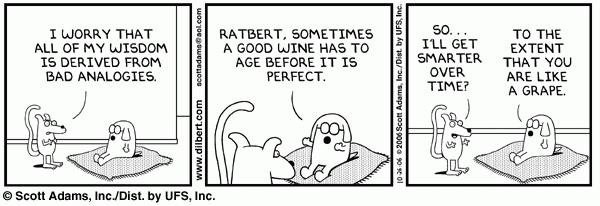
The Pitfalls of Analogies

These are priceless examples of creativity gone awry.  I don’t know who originally wrote these gems or compiled them; if you know, please tell me so that I can give credit where credit is due!

21 Analogies Used by High School Students in English Essays

  1. “When she tried to sing, it sounded like a walrus giving birth to farm equipment.”
  2. “Her eyes twinkled, like the moustache of a man with a cold.”
  3. “She was like a magnet: Attractive from the back, repulsive from the front.”
  4. “The ballerina rose gracefully en pointe and extended one long slender leg behind her, like at dog at a fire hydrant.”
  5. “She grew on him like she was a colony of E. Coli and he was a room temperature Canadian beef.”
  6. “She had him like a toenail stuck in a shag carpet.”
  7. “The lamp just sat there, like an inanimate object.”
  8. “Her face was a perfect oval, like a circle that had two sides gently compressed by a Thigh Master.”
  9. “Her eyes were like the stars, not because they twinkle, but because they were so far apart.”
  10. “His career was blowing up like a man with a broken metal detector walking through an active minefield.”
  11. “The sun was below the watery horizon, like a diabetic grandma easing into a warm salt bath.”
  12. “From the attic came an unearthly howl. The whole scene had an eerie, surreal quality, like when you’re on vacation in another city and Jeopardy comes at 7:00 p.m. instead of 7:30.”
  13. “It was as easy as taking candy from a diabetic man who no longer wishes to eat candy.”
  14. “She had a deep, throaty, genuine laugh, like that sound a dog makes before it throws up.”
  15. “Their love burned with the fiery intensity of a urinary tract infection.”
  16. “It’s basically an illusion and no different than if I were to imagine something else, like Batman riding a flying toaster.”
  17. “If it was any colder, it would be like being in a place that’s a little colder than it is here.”
  18. “Joy fills her heart like a silent but deadly fart fills a room with no windows.”
  19. “The bird flew gracefully into the air like a man stepping on a landmine in zero gravity.”
  20. “He felt confused. As confused as a homeless man on house arrest.”
  21. “The revelation that his marriage of 30 years had disintegrated because of his wife’s infidelity came as a rude shock, like a surcharge at a formerly surcharge-free ATM.”

dilbert-bad-analogies

4 Comments

Filed under Cartoon, Grammar, Humor, Lists, Nuts & Bolts, Writing Exercise, Writing Prompt

Writing Tips: Dialogue

howtobebritish1Dialogue is (to point out the obvious) vital to a novel; it displays the voices of your characters and helps the reader get to know and care about the characters, understand their motives, their interrelationships, and distinguish each character’s point of view.  If you don’t get the dialogue right, you rip the reader out of the story, or worse – make them put down your novel and add your name to “never again” lists!  So, here are a few pointers and tips to keep in mind as you develop your characters and put words into their mouths:

1) Develop your characters well enough to make their voice distinct; do they have catch-phrases, or local dialects that influence their vocabulary?  Do they tend toward long or short sentences, or are they from a past time and place that had a different way of speaking?  Educate yourself if necessary in various modes of speech .

2) Dialogue is an illusion of conversation; but it’s also about what is not said.  Non-verbal actions reveal:

a) How a character says something

b) What a character chooses not to say, but inadvertantly reveals through actions.

c) Why the character says what they do.

Do they have particular actions when they are upset or aggitated that communicate their moods to the reader?  Do they bounce their knees when excited?  Does their body language confirm or contradict their verbal message?

3)  Fictional dialogue needs to cut to the chase; if there’s no point to the text (revealing motivation, character or plot point), then chop it!

4)  Avoid the trap of using dialogue as exposition (the proverbial villain’s monologue as he prepares to destroy the hero), but rather reveal essential information through action, or narration.

Explore your characters and develop their voices, and above all – keep writing!

Leave a comment

Filed under Articles, Cartoon, Nuts & Bolts, Plot Thots & Profiles, Writing Exercise, Writing Prompt

Obscurities: Darkling

The use of Darkling over time.  Source:  Google

The use of Darkling over time. Source: Google

Darkling comes from Middle English derkelyng, and the verb darkle is a back formation thereof.  As a noun it means either darkness or a (fantasy) creature that lives in the dark.  It can also appear as an adjective meaning dark or darkening, or something that is obscure, unseen, or happening in the cover of darkness.  As an adverb it means in the dark or obscurity.

There is a Darkling Beetle, and a poem by Thomas Hardy called The Darkling Thrush, though the more usual use of the word is to be found in Science Fiction, e.g. in Star Trek Voyager, Marvel Comics, and a wide range of fantasy characters on the dark side of the fence.

According to the Urban Dictionary, you are a darkling if you are more sarcastic than charming, or if you are a geek, but a cool one.  Another application might be a portmanteau word from dark and darling.

Obscure 2


Leave a comment

Filed under Etymology, Obscurities, Writing Prompt