Playing keeps us young. Everyone who’s got a healthy sense of balance has a little kid inside of them that likes to come out to play once in a while. And because it’s something all of us can relate to in one way or another, some clever folks have put together a museum dedicated to having fun! From toys, electronic games, television programmes like Sesame Street, board games, ball games, dolls, card games – you name it, they’ve probably got an exhibit about it! The Strong National Museum of Play also has a large number of online exhibits, so if you don’t live near Rochester, New York, you can still enjoy their collections. So come along on a tour of playing – just click on the image below and enjoy playing around!
Question: What was your favourite game as a child? I’d love to hear from you in the comments below!
Photo Credit: Strong National Museum of Play website
“It’s the things we play with and the people who help us play that make a great difference in our lives.”
Fred Rogers, American television personality, 1928–2003
Before we dive into our virtual tour of the world of umbrellas, I’ll take a moment to let you know what I’ve been up to the past fortnight: Editing. I’ve been working on the final draft of my next novel, and I call this phase the “cutting room floor” phase. If any of you have written a novel, you know that there are many ways an author approaches a story. I personally tend to toss my characters into a room and see how things develop. I start off with an idea of where it will end, but how it gets there is the fun part! Once the story is fleshed out, character arcs and story arcs complete, it might be too wordy; and every word needs to count, so tightening the dialogues or prose is a necessary step in the process. My current manuscript needs a fairly good “chop” to bring it into market norms for Science Fiction. So that’s what I’ve been working on. Looming on the future horizon is the fact that BOTH companies that I’ve been working with in the past have been acquired by other companies, meaning that I will now need to chuck out everything I’ve learned about their formatting requirements and processes and reinvent the wheel… Joy. But hopefully, working with the new companies will be a positive experience.
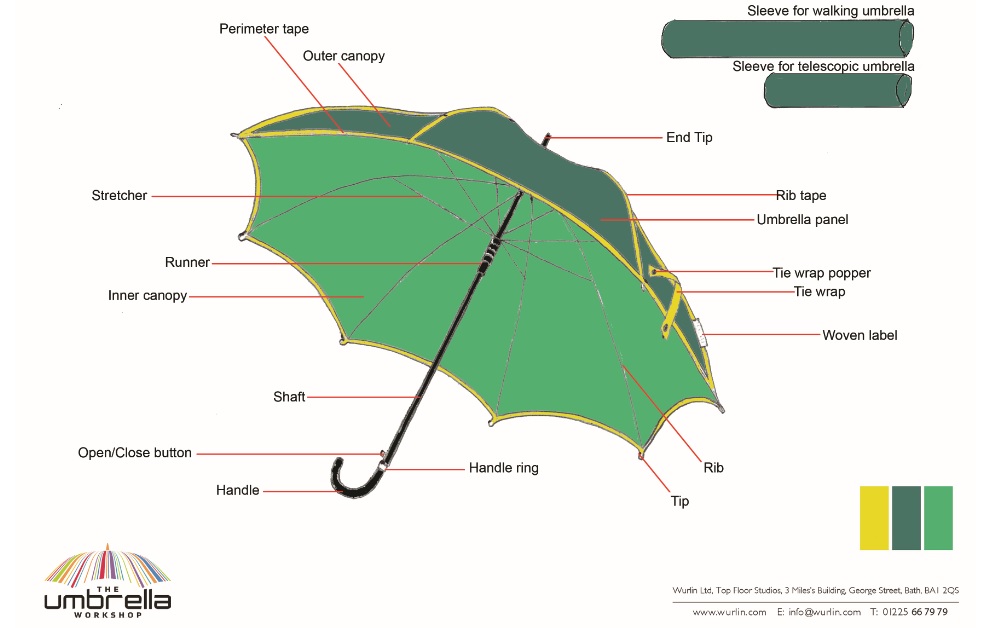
When I need a mental break from writing, I read, or I watch something interesting on YouTube. Recently in our local news, I came across a story about the only umbrella repairman in Switzerland, Erich Baumann. Every one of us has an umbrella; but I’ve never really stopped to think about the fact that each one is different – different mechanical parts and different tools needed to bring them all together. When I lived in Scotland, umbrellas (“Brollies”) were often considered “one-use” objects – the wind would swirl and suck the umbrella’s canopy upward with such violence that the ribs and stretchers would often snap. It didn’t matter whether it was a cheap or an expensive one – they didn’t last long.
Today, many umbrellas come from Asia; that means that replacement parts are hard to find if you live elsewhere; that also means that umbrella repairmen need the spare parts of those throw-away brollies. If you have a moment, go and get one of your umbrellas, open it, and take a good look inside. Appreciate how complex such an everyday object is. And now, take a look at two videos: The first is how an artisan umbrella is made by hand; the second is a look at how they’re repaired. Enjoy!
Learning something new every day keeps us on our toes!
I might be odd for a woman, but I love history; in particular the history of World War 2. But as much as I’ve read about it, and as many documentaries and films as I’ve watched on the topic, I had never heard about this episode until I read a comment from a YouTube video which told about how that person’s grandfather had served in the only US territory to be occupied by the Japanese during the war: The Aleutian Islands.
Anyone who knows a bit about World War 2 probably knows about Midway– a pivotal point in the Pacific arena. But at the same time Japan was targeting that US island base in the middle of the Pacific, they also had their sites set on the Bering Strait; specifically, the six island groups of the Aleutian Islands. In June 1942, they attacked and occupied the US territory islands of Kiska and Attu. Anyone would be excused for thinking that these inhospitable, frozen, volcanic mountains rising out of the sea were insignificant, but they were a strategic launching point for keeping the Japanese at bay in the Pacific, and as a gateway for supplies to the Allied troops. If the Japanese managed to maintain their hold on those islands, it would strengthen the defence of their northern territories, and it was also feared that they would use the islands as springboards from which to attack the US West coast or invade through Alaska and into Canada and the northwestern mainland territory of the US. The battles there are considered the “forgotten battles” because, although there was public outrage in the US at the time, they were soon largely overshadowed in the press by Midway and by the Guadalcanalcampaigns. But the number of casualties there was comparable to that of Pearl Harbor, and the Attu battle was better known in Japan than in America: It was a major propaganda coup for the Imperial Army.
To watch a 1943 documentary about the Aleutian Islands and their strategic significance, called “Forgotten Battle of the Aleutian Islands“, just click on the link (~45 min.). It not only gives a glimpse into the geography and military aspect, but the human aspect, showing the soldiers in their daily off-duty activities and their duties; it gives you a sense of what they were like, where they came from, and what they did. For a shorter summary (~12 min), click here.
The Aleutian Islands, showing Russia to the west and Alaska to the east.
Way back when in grade school, we used to take tours of local factories; it was one of the highlights of the year for me, because I’ve always had a curious mind, wanting to know the hows and whys. Have you ever wondered how candy is made? Let’s go on a virtual factory tour today! Just click the image below to watch a fascinating guided tour as they make candy canes and other hard candies. What I especially enjoy about this tour is the obvious love of the craft and the philosophical perspective of the candymaker himself. Passion for what you do is an essential ingredient, no matter what your occupation is.
I like to highlight, or “undust” figures or circumstances from history that few may have ever heard about, but that deserve to be remembered. Bessie Coleman is one such figure from history: In her life that was cut short, she made a difference by going against the norms and following her dreams, regardless of the limitations put on her by society because of her race and gender.
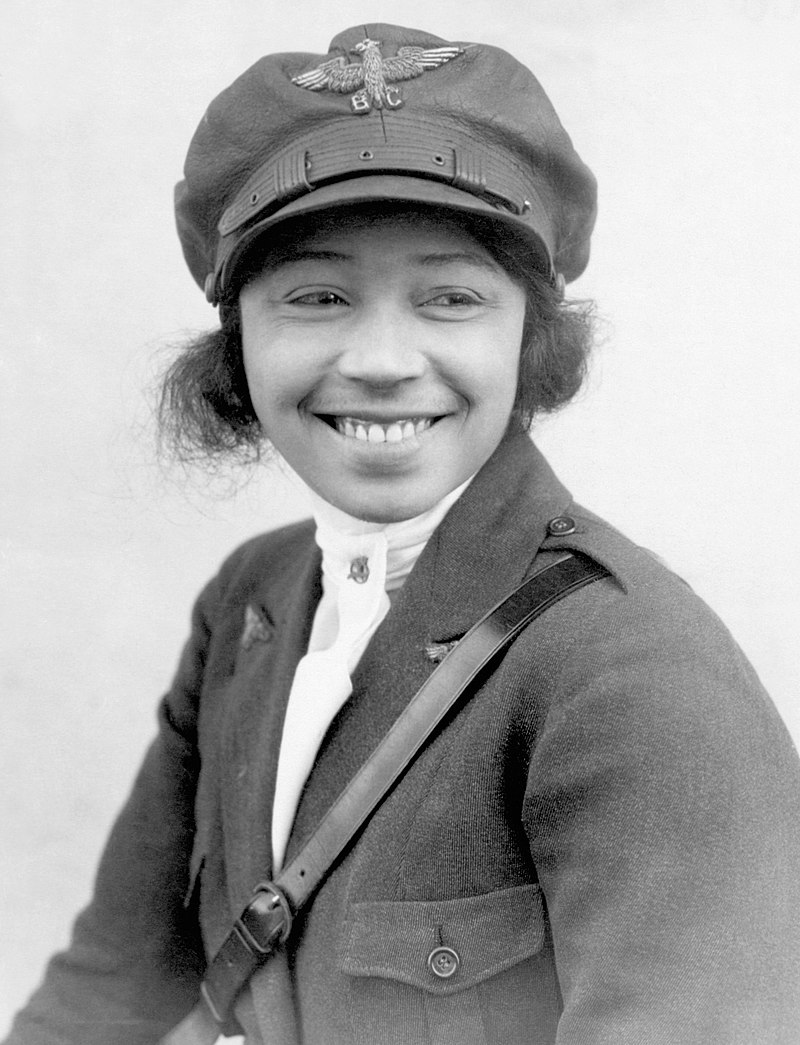
Bessie Coleman, 1923 – Photo Credit: George Rinhart, Corbis via Getty Images
Born in January 1892 in Atlanta, Texas, as the tenth of thirteen children in a sharecropper family, she worked in the cotton fields and attended a small, segregated school. She was not only African American but also had Cherokee heritage through her mixed-race father. Despite her humble beginnings, by 18 she’d managed to save enough money to attend one term of college at Oklahoma Colored Agricultural and Normal University (now Langston University) in Oklahoma, which was probably the closest university that would take a young black woman in the early 1900s. With no funds left, she moved back home, working and saving her money. At 23, she moved in with her brothers in Chicago, Illinois, and worked as a manicurist in a barbershop; there, she heard the tales of World War I pilots, and her dream was born.
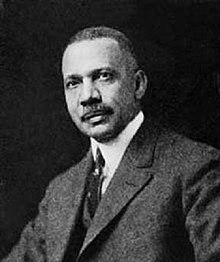
Robert Sengstacke Abbot, Photo, Chicago Literary Hall of Fame
At the time, American aviation schools had no place for either African Americans or for women, but she was encouraged by Robert S. Abbott, founder and publisher of the Chicago Defender, to study abroad. He publicized her story in his newspaper, and she received the financial support to pursue her dream from a prominent African American banker, Jesse Binga, and from the Defender.
Jesse Binga, Credit: Wikipedia, John Schmidt
She took a French language course in Chicago, and in November 1920, she travelled to Paris to earn her pilot licence. On June 15, 1921, Coleman became the first African American woman as well as the first Native American to earn a pilot license and an international aviation license from the Fédération Aéronautique Internationale. She then spent the next two months learning more from a French veteran pilot near Paris. In September 1921, she sailed back to America and became a media sensation.
With civilian commercial flights still a thing of the future, she would have to earn her money as a “barnstorming” stunt pilot. The skills needed to fly dangerous stunts were beyond her scope, and still out of her reach in America, so she again returned to Europe, where she trained in France. From there she went to the Netherlands to meet Anthony Fokker, one of the world’s most distinguished aircraft designers. At his company in Germany, she received further training from one of the company’s chief pilots. Returning once again to the US, she finally launched her career in exhibition flying.
“Queen Bess” was a popular draw for the next five years. She used public attention to engage audiences in promoting aviation and battling racism; she refused to take part in any aviation exhibitions that barred African Americans from attending. At one point, she was offered a role in a film, “Shadow and Sunshine.” She accepted, hoping that it would help her raise enough money to open her own aviation school. But when she learned that the first scene would portray her in ragged clothes, she walked off the set – her principles would not allow her to spread the disparaging image most whites had of most blacks.
Her goal was not just flying, but to make a difference in history; unfortunately, she did not live long enough to see just what a great influence she would have: On 30 April 1926, a faulty plane went into a dive and spin at 3,000 feet above ground; on the way down, Bess was thrown from the plane and killed on impact. Later, it was found that a wrench used to service the plane had been forgotten inside and had jammed the controls.
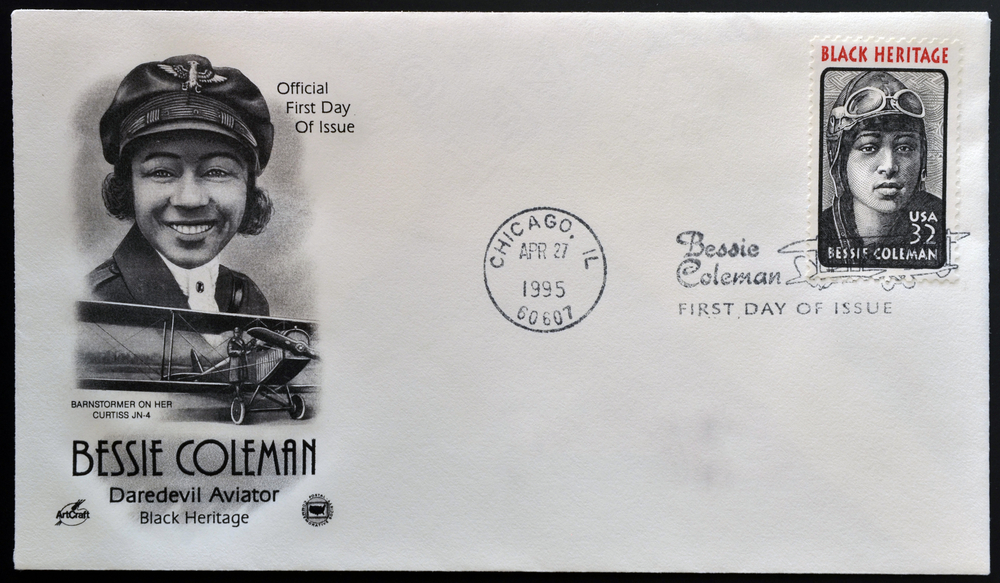
Posthumously, her name is honoured through the renaming of streets (including three in France), of roads near airports (including one at Frankfurt Germany’s international airport), a public library in Chicago, schools, aviation-related companies and wings of airports, scholarships, a US postage stamp (in 1995), a cartoon character, and she has been inducted into several halls of fame for both women as well as aviation; and last but certainly not least, she has a geological feature on the southern hemisphere of Pluto named in her honour, Coleman Mons.
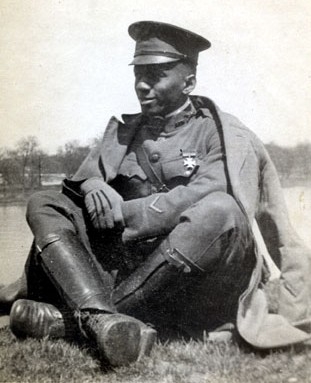
William J. Powell, Pioneer aviator and civil rights activist
Lieutenant William J. Powell dedicated his book, Black Wings, to her. His sentiment is summed up well in a quote: “We have overcome that which was worse than racial barriers. We have overcome the barriers within ourselves and dared to dream.” Powell founded the Bessie Coleman Aero Club in 1929. Mae Jemison, the first African-American female astronaut in space, carried a photo of Bessie Coleman with her on her first mission.
Mae Jemison, Photo credit: The Museum of Fine Arts, Houston
What I find most inspiring about her story is not only her unwavering determination to reach her goals, but that throughout her life, she found people willing and able to support her in accomplishing it: Without the idea encouraged by a publisher to look beyond the borders of America and promoted in his newspaper to raise support, without the teachers in Europe investing in her skills (how many inter-war pilots could say they’d been trained by top war ace pilots?), and without the financial support given at a time she needed it, her dreams might have remained unfulfilled, or too long in the making – those parameters needed to make her into a pilot who inspired future generations shifted drastically with the outbreak of the Second World War.
In Esther 4:14, Mordecai, the uncle of Queen Esther, tells her, “Who knows but that you have come to your royal position for such a time as this?” In the brief window of time that Bessie reached for the heavens, she may not have lived to see her legacy, but her life and death were not in vain.
Let’s go on a virtual outing! This time, to a Swiss museum located on my doorstep, in Zürich. I can’t imagine a better place to have a museum on that topic.
Have you ever wondered where coins started, or what the history of money is? Look no further. Have you ever wondered what blockchain technology is, or what cryptocurrencies are (and there are over 8 thousand so far!)?
Included in the tour are 5-minute podcasts exploring the topic of money, as well as visual tours of coins throughout time and regions.
Besides the online presence, this museum is also a library and a forum, where people can gather for lectures and discussion groups around the topic of money, finances, markets, etc.
Coins are just one form of payment, but throughout the centuries, different people have put a value on different objects, and trading them became a type of currency: When the Russian currency nosedived in value, vodka became a currency because, in that culture, vodka was the most stable commodity! In other cultures, beads, shells, water gourds, and many other objects have been currency; in another article, I’ve talked about hack silver – jewellery worn with scoring to allow easy division into pieces to trade for goods.
Here’s a quick question for you: Do you know what your money really looks like? We may have handled it dozens of times in a week, but have we ever really stopped to examine it? I remember back when shillings were still valid coinage in Britain – they were used in lieu of 5p pieces; when the new coins came into circulation, I would have been hard-pressed to tell you what they’d looked like before! The same goes for banknotes here in Switzerland, which changed to the current design back in 1995. Once a new coin or banknote comes into use, it’s hard to remember what the old ones looked like. Interestingly, some Swiss coins have not changed; I once found a 10-rappen coin in my purse from 1899! It went straight into my coin collection. Since then, I always check my loose change. As a matter of fact, the 10-rappen coin holds the Guinness World Record for the oldest original currency in circulation.
The history and scope of money is a fascinating one, once you scratch below the surface. Click hereto take the virtual tour through the world of money, and enjoy!
The Swiss 10-rappen coin, the oldest original currency in circulation today.
Happy New Year! I don’t know about you, but I’m happy to leave 2021 behind me! On New Year’s Eve, my husband and I sit down and review the last year, and talk about what we’d like to see or do in the following; this year, when we reviewed the last 12 months, we had to say, “what did we experience unrelated to health issues?” and we were hard-pressed to come up with anything substantial: Holidays were a non-topic, as my husband was in and out of the hospital, sometimes emergency, with complications that delayed his chemotherapy; finally, that got started – which meant that either he had little energy for taking day trips, or we couldn’t go because he had appointments. If anyone has had it themselves or has a family member who’s had cancer, you’ll know the “routine” – if you can even call it that.
In the midst of all that, with my energy and focus on him, or on communicating with friends and family, everything else seemed to fall to the back burner, including regular blog posts. In the past few months, if I wrote at all, I worked on my next novel; I finished the final draft in mid-December! Then I immediately did a straight read-through and began the work of fine-tuning and editing. I have Beta readers for feedback, but because I’m an Indie publisher, I do all of the nitty-gritty myself, the work of graphics, formatting, editing, and a long list of to-dos that could fill a book by themselves. Those are what I’m tackling next – after the feedback is in and incorporated where needed.
Now that chemotherapy is behind us (his last ended on Christmas Day!), we’re still not out of the woods but at least we can see the skies through the thinning trees. Also in December, I had my 2nd Covid vaccination and have noticed a marked drop in the long-term symptoms that had been slowing me way down, some days stopping me altogether, since March 2020. The end of those two issues gives me more hope for the coming year! It also means that we can look forward. Last year, it was impossible to plan; at the worst times, we couldn’t even plan an hour ahead. Of course, Covid complicates things, with travel restrictions or threats of lockdowns, but I think we’re all used to that by now.
Have you made any holiday plans for the coming year? If we could fly anywhere, without Covid complications at the airport or crossing borders, ideally we would love to go back to Scotland, where I used to live and where we met back in the day! But we live in one of the other most beautiful patches on Earth, so we’re hoping to take the Grand Tour route of Switzerland this year instead. In the past, we’ve often rented a motorhome for holidays, whether in New Zealand, Norway or Scotland, so perhaps we’ll do that here, too. Every plan is qualified these days with a maybe, perhaps, or we’ll see.
My hope for this blog in the coming year is that I can take control of time and energy once again and begin posting regularly. I have a few ideas, so keep an eye on this space!
This month has flown by! Last weekend was our church’s annual advent market, and I was present with tables full of crafts, as well as marble-iced cookies, Spitzbuben, cheese cookies & apple chips (dehydrated). Before it took off, I was preparing, baking, labelling, and doing all the little bits and bobs to get ready; it went off well, considering the limitations of Covid. I also got our own Advent calendar completed – I talk about that more in a previous post. But the whole topic of the market got me wondering where Advent calendars started, so I thought I’d share with you what I’ve discovered:
As you probably know, advent calendars today can take any form you choose; the only common factor is that they usually cover 24 days and begin on 1 December (as opposed to following the 4 Advent Sundays – this year, the first Sunday fell on 28 November).
The first calendars weren’t: In the early 1800s, German protestants began marking chalk lines on a wall or lighting a candle each day of the Advent season; they sometimes accompanied the act with a devotional reading or with an image centered around the advent, or coming, of Jesus (traditionally celebrated on 25 December, though that was hardly his birthday – but that’s another topic). The first actual calendars were made of cardboard in Germany, and appeared in the early 1900s; they often had either a poem or a picture behind each door, and were produced until World War 2, when the Nazis banned their use on the excuse that cardboard was scarce – and then, in 1943, they promptly sent out advent booklets to every mother in the land – but they seem to have missed the point: their versions had images of German soldiers blowing up Russian tanks and sinking allied ships!
The Nazi’s idea of Advent celebrations… the less said, the better!
After the war, Richard Sellmer, of Stuttgart, was able to get permission from the allied officials to begin printing cardboard Advent calendars once again, and his company still produces them today – click here to visit their website. After the war was over, the American soldiers took the idea back to the States; their popularity took off in the 1950s after a photo appeared in a newspaper of President Eisenhower’s grandchildren with a Sellmer calendar.
Image from the Sellmer website, showing President Eisenhower’s grandchildren opening a Sellmer calendar
I guess you could say that the rest is history! With Advent beginning, I hope yours is ready for Wednesday!
And Christmas is coming soon! If you’re interested in knowing the history behind Santa’s red suit, just click here!












 Stephanie Huesler