No one likes a doryphore – a pedantic & annoyingly persistent critic of others; a petty pedant, a person who complains about minor mistakes. The word comes to us through French, and is also the term used for the Colorado beetle – perhaps alluding to the meaning of the word related to “pest” (doing double duty for a bug and for someone who is a pest). Alas, I think doryphore deserves to be brought back – it’s much more sophisticated and subtle than mere pest.
Most languages in the world probably have a term for such people as they are, unfortunately, rife; in Swiss German we would say that someone is “bünzlig” – they’re usually the people who become meter readers and give you a parking ticket as you’re getting into your car 10 seconds too late. We recently paid a parking ticket because we parked for 10 minutes in a business parking, on a Saturday when the business was closed and spots were empty; yes, technically a ticket can be issued; but most authorities use common sense in such situations – but not the doryphore; they were likely waiting, watching for shoppers to do just that. In all the years I’ve been driving and parking in Switzerland, it’s the first time this has happened, but there will always be that one bünzlig person. Pity them. They live in shrinking worlds.
Although it’s already summer, we have only had one day over 30°C. Don’t get me wrong – I’m perfectly happy with cooler days; you can layer clothes, but when it’s hot, you can only take off so much and still be socially acceptable.
But when the weather begins to warm up, thoughts turn to spring cleaning. The practice goes back centuries: For climates that experience cold winter months, spring cleaning usually takes place when the weather begins to be warm enough to open windows but not warm enough yet for swarms of bugs coming in as a side effect. Also, back when wood was the main source of heat, if it was warm enough not to need the wood-burning stove, it was the ideal time to clean out the soot and to dust the house, letting the breeze help carry it away. In modern times, where most houses no longer depend on wood or fireplaces as the main heat source and windows can be opened year-round (with the heater returning indoors to comfortable temperatures), spring cleaning is still a tradition.
Most people have those areas in their homes where things can stand around for months or even years before they put them in their proper places; sometimes those things that don’t have a proper place stand around even longer. Spring cleaning is the ideal occasion to look around, notice those stand-arounds, and put them away properly or eliminate them altogether.
“Mis en place” is a French culinary term meaning “putting in place”, or “gathering” (as in gathering ingredients in preparation for cooking). Outside of the kitchen, it can be used as a description for putting everything in its place. Spring cleaning and mis en place is a great opportunity to de-clutter.
Here are 10 tips for de-cluttering:
Once-in-the-hand principle: Firstly, get yourself a basket to carry from room to room to gather things that need putting in their places; once the basket is full, put the items where they go. Don’t lay things down somewhere else “for now”!
Two-Year Gauge: If you haven’t touched, missed, or used an item in the past two years, chances are you won’t miss it – give it away, donate it to a second-hand shop, or recycle it.
Clothes: Do you have clothes you’ve kept but never wear, or they’re the wrong size, or they’re worn out? Keep one worn-out outfit for dirty work, but bag up the other items to donate, scrap, or give away.
Kitchen: Go through your food cupboards: Toss out anything past its expiry date (this is at your discretion; foods today rather more honestly call it a “best before date”, as canned goods are often good for a while past that…); rotate the older cans of food to the front, the newest toward the back (also best practice when putting away new shopping); toss out any spices that have gone off or are stale.
Storage: Do you have plastic containers without matching lids or lids without containers? Get rid of them. Do you have duplicate utensils that you don’t need? Donate them. Do you have pots or pans that are worn out? Replace them if need be.
Linens (towels, bedding, etc.): Toss or recycle any threadbare, ripped, or worn-out items. Fold the keepers and store them neatly (stacks tend to get lazy over time, don’t they?).
Electronic Gadgets: Go through your electronic items and match cables to each piece of (working) equipment, and recycle the rest. Along the same line, clean out your inbox of superfluous emails.
Toiletries: Toss anything that has gone off – hand cream, makeup, nail polish and medicines included.
Paperwork: Get rid of any guarantees that have expired, old paperwork, or manuals for items you no longer own; file and organize what you keep. While you’re there, check those pens to see which ones still work and chuck the rest.
Sentimentality: Don’t hold on to something out of guilt (someone gave you X…) or obligation (they might notice I’ve tossed it). If it brings you no joy, is not practical, or isn’t in keeping with your aesthetic, don’t keep it.
Have you already started spring cleaning this year? Tackling one point at a time (in a day, or a week) will make it possible, and you’ll be done before the cat can lick its ear!
I’m curious to know if any of these tips inspire you to de-clutter a specific area – please comment below!
A few months ago, I began something that has added a layer of creativity and organisation to my life which, to be honest, is fairly creative and organised as it is. But this little addition adds a nice colour: Fieldnotes.
The original concept of taking fieldnotes comes from the scientific disciplines: An archaeologist in the field, taking notes on where, what and when something was uncovered; a geologist, botanist, ornithologist, or entomologist taking notes on observations, perhaps drawing an illustration of a specimen or a map of the landscape.
Fieldnotes can include writing, diagrams, drawings, or visual clues within an entry such as arrows or other visual connectors. They differ from a daily journal in that the fieldnotes are concise… rambling or expanding on a thought belongs elsewhere, but not in a “quick-draw” situation (pun intended).
Creative thinkers have jumped on the idea for reasons other than scientific observation: As a writer, fieldnotes help me capture snippets of ideas, dialogue, or an observation when out in public (I love to people-watch), or something I read – sometimes the comments on YouTube videos are a great capsule of humour! I also use fieldnotes to keep track of tasks on a busy day – lists of to-dos, to-writes, and so on. When I have a creative project, I take notes on the steps taken – such as making giant flowers that no one else has ever made; how to scale up a smaller version of a crepe paper flower is not always straightforward, and if I have several to make, it helps to have those detailed notes of the prototype phase for the next time around.
Taking fieldnotes might help get your creative juices flowing. If you’d like to start this practice, here are a few tips:
Use a small notebook – one that can fit into a shirt pocket, man-bag, or purse. I’ve made my own with 70gsm blank paper, which allows me to make the same size and style repeatedly. But if you can’t do that, just use something like a moleskin notebook; these come in various sizes, with or without lined pages. There is also a company with books called Field Notes, though they seem a bit pricey for what you can do on your own…
Use a good pen, or pencil, or coloured pencils if you want to sketch something with colour.
You can either take chronological notes, such as dating each entry, or you can organise your notes into groupings: One page per character, scene or topic, or for a to-do list, or whatever you want to capture on the go.
Use visual cues, such as boxes around certain elements or arrows connecting one thing to another. Use illustrations or draw diagrams; attach images from magazines, printouts, etc.
Highlight tags or keywords; consider numbering each page and keeping an index at the back of the book to help you find things later on.
One book that might help kick-start illustrative note-taking if it’s new to you is The Sketchnote Handbook, by Mike Rohde.
Think about how you’re recording things on the page: Do you always want to write straight, top left to bottom right, or do you want to mix things up and write diagonally, sideways, or even backwards? Yes, sometimes that’s a thing; Leonardo da Vinci wrote privately in a mirrored direction, only writing normally when he wanted others to read his notes; he also developed his own shorthand.
Leonardo da Vinci’s Vitruvian Man, with mirrored writing.
I also have my own shorthand for many things; Sometimes I use what I call pigeon Asian (I use this when I don’t want anyone else to read it); it’s something I learned when living in Hawaii. It looks like Kanji (the logographic writing of Japan), but it’s not – that’s all I’ll explain! I also use logographs, such as the ancient Anglo-Saxon rune of daeg, which includes the concept of day, dawn, intuition or breakthrough; I use this to designate those times when I’m writing: Rather than writing, “Today, I wrote/worked on the manuscript for...” I just write that symbol plus the name of the manuscript and details. I have a whole series of such shorthand symbols that I use daily.
While there are note-taking apps available (and I use one, called “Keep My Notes”, on my phone for things like shopping lists or feedback notes for singing students or bands that I take during performances and review with them later), sometimes it’s helpful to get away from digital screens. Sometimes I’ll write whole scenes away from the computer – I don’t use my fieldnotes for that, though it will probably be used to outline a scene that comes to mind until I get to another notebook. Something about writing long-hand sparks a level of creativity that might not come while working at a computer; hand-eye coordination should never be underestimated in creative endeavours. Once a scene has developed enough away from the screen to be integrated into my current manuscript, it then takes on another reiteration as I type it in, tweaking and changing… it’s what I call a “ripening process” as a wine metaphor for the creative maturing process a scene goes through by this method. It gets my head into a new space figuratively, literally, and literarily!
In an age when we are constantly bombarded with visuals wherever we go, sometimes it’s healthy to go back to good ol’ pen and paper. On those days so busy that I can’t remember what I’ve actually done, it’s helpful to look back at my fieldnotes as I write out my thoughts in my daily journal.
Do you write? Do you ever make lists for shopping, chores, people to contact, or things to do? If so, how have you kept track of such things so far? If it’s a system that works for you, brilliant! But if you find yourself wanting to switch things up or wanting to improve your use of time, would you consider taking fieldnotes? Please comment below!
Around the world, fireworks are a traditional part of certain celebrations: Here in Switzerland, the two national nights would be the 1st of August (1291, Independence Day), and New Year’s Eve. In America, the 4th of July is probably the most widespread fireworks night. In Japan, fireworks competitions are enjoyed by spectators during the Sumidagawa Firework Festival, and in India, it’s Diwali, the Festival of Lights. In many countries in South America, Christmas is the big night; in Britain, Guy Fawkes Night is celebrated with both fireworks and bonfires (in Scotland); he was most associated with a failed gunpowder plot intended to blow up parliament and assassinate King James I of Scotland / James IV of England and Ireland.
Most people have, at some time in their lives, seen fireworks go off; but most people have no idea how they produce varying shapes and colours. Derek Muller, aka Youtuber of the Veritasium channel, goes into the details of what makes fireworks take shape, have varying colours and enable them to have precision timing in displays. To watch the video, called “The Hidden Science of Fireworks”, which includes footage of a drone’s perspective amid a fireworks display, just click on the image below! Enjoy!
My husband and I have a quirky sense of humour; we recently had a good laugh coming up with pets’ names in pairs (don’t ask why that topic came up – it’s too hard to reconstruct!): There are pairs of names commonly associated with each other, such as Tom and Jerry, or Cain and Abel; last night, we thought of naming two cats Maelstrom and Doldrum – the irony is that these are nautical terms for ocean conditions and we live in a land-locked country. My husband says that if we ever have a snake, he’ll name it “Abebambelela” (which is a Swiss German phrase meaning “to hang down”)! There are certain words that I find funny, like Asparagus (or the old English version, Sparrowgrass), and I can imagine naming cats something Latinesque, some of which are actually quite beautiful (Aurora, Adamaris, etc.)
Pet names are as creative as the owners, so the sky’s the limit! I once heard of a dog called Dillingham Osborn Gunderson… initials being DOG. Naming a pet Velcro, Big Mac, Groucho or Tweezer seems tame to some purebred titles (such as Bluewater Full Metal Jacket – Jack for everyday wear). When our cat had kittens (the mother, Gandria, and father, Caprino, were named after towns along Lake Lugano), we used musical terms (sticking with Italian): The first came out vocal, so he became Crescendo; the second was slow and calm, thus Piano; and the 3rd is gentle but friendly – Allegra. We kept Allegra, who is curled up between my feet as I write this; the other two were adopted by neighbours – who subsequently moved to give the cats more room!
I will never have a purebred pet; more often than not, the animals are sickly, as traits have been unnaturally bred into them; pugs and Persian cats are prime examples of pets that simply cannot breathe properly, and have respiratory infections or even failure. These health issues are hot topics between breeders and vets or those who care for animals such as the Kitten Lady. Give us a good ol’ farm cat, “Heinz 57-pedigree”, and they’ll do just fine! We have three cats: Allegra (born in 2009), Andromeda Zora (from an animal shelter, born in 2020), and Mira Bella (born in a home nearby, 2021).
Do you have any pets? If so, what are their names, and how did you choose them? Please comment below!
You’ve probably heard the saying, “When it rains, it pours” (or the British version, “It never rains but it pours”). The idiom refers to a series of unfortunate events occurring within a short amount of time.
I wouldn’t necessarily limit it to unfortunate events; sometimes they’re just inevitable occurrences or busy times. The latter two would describe my past few months: From mid-January to last weekend, one of our nephews was staying with us every weekend when he had time off from his basic military training; this 18-week period is mandatory here in Switzerland, but our nephew is half-Swiss, half-Mexican, and is currently living in South Africa, so he actually volunteered. Not only did he want to be near Swiss family and have the experience of being away from his home and in a camaraderie, but when he returns next autumn to begin university studies here, it would be easier for him to be accepted if he did so.
What that meant for us is that, though we really enjoyed having him here and spending time with him, the things that normally happen on weekends simply had no room, and the weeks were ultra-busy, leaving little time to tackle those things. When our nephew was here, the focus was on him; “Tia” (Spanish for “aunt”; Tio is “uncle”) was frequently heard. Laundry (tons of it!), cooking, shopping, meal-planning… they all happened much more frequently – he was a bottomless pit, as most teenage boys are. The first month or two were most intensive, as he had grown up with a maid – which he rapidly learned I am NOT. He learned a lot of “life lessons”, and about family house rules – things he’ll need to know when he finds a student flat-share; he learned to cook a few new meals, clean up the kitchen after himself, and how to cut his own hair. He learned that if he put his socks into the laundry bunched up into a ball, that’s exactly how he’d get them back – that, and we have no clothes dryer (only drying racks) – so timing on getting his clothes back clean and dry for the following week was a crash course. He learned to think about and change habits to reduce his environmental footprint.
My weekends were usually when I could plan, write and edit blogs. Because that time was either reduced or swallowed up entirely every weekend, some tasks took precedence; when I had time, focus and energy for writing, it went into getting my five books prepped for paperback release, and gradually getting them sent off for proof copies. So far, I’ve been able to release two of the five novels. The printer (who is either in England or in France) doesn’t ship to Switzerland (why do companies frequently act as if Switzerland is on another planet?!); it’s been a challenge getting the books to me – fortunately, some of our family lives in France, so they can receive it. Sometimes the packages are sent, sometimes carried by hand to closer family, sometimes handed off in car parks!
Two weeks before our nephew’s time here came to an end, we accidentally discovered that we’ve got a huge problem in our flat: Water damage coming from somewhere that will now require walls, floors, balcony tiles, windows and downstairs ceiling to be ripped out and repaired! Raining, pouring… For the past four years, repairmen have come and gone but none of them have gotten to the root cause. So this time, I’ll be watching them like a hawk and pestering them to push beyond their nose to find the actual cause, repairing that first! And that all begins this week.
After the past few intensive months, I’ve been trying to catch up on those things that, of necessity, were neglected, and those things I need to prepare for when our home is invaded by an army of repairmen – at least that’s what I’m imagining, though it will more likely be a steady stream of comings and goings, appointments, and cleaning up the aftermath of dust and debris…
And now that my schedule can resume a partial semblance of normal, I want to get back into creative writing – my next novel, as well as this blog! So many projects, so little time! But if a day had 40 hours, it would still not be enough to accommodate everything I’d like to do. Maybe it’s God’s mercy that we don’t have 40-hour days!
This past week, I’ve been knee-deep in my craft room making flowers. I’ve made crepe paper flowers before, but these are on a whole new level: Giants, to be precise. So far, I’ve made three giant daisies that stand about two metres tall and two of four dandelions in different phases or similar size.
Dandelions are something everyone knows – you’ve seen them, you may have been irritated by their invasiveness in a garden, but honestly, have you ever stopped to look at them? In this project, I’ve needed to look at them in detail – where do the leaves sit on the stem? What colour is the stem? How do the bud leaves fall from the bloom? When does the yellow turn into white fuzzy parachutes?
I found a year-long timelapse of the growth of a dandelion, from seed to seedhead; click here to watch the 3:46-minute video. What I find fascinating is the animation of plants that are only seen when we view them sped up; they stretch, move and grow – the movement is coming from the plant itself as this video was made in a controlled environment (no wind involved).
The edible plant has been used for centuries as a leafy green, leaf, flower or root tea, medicine, and as a source of nutrition for animals such as horses or ruminates (herbivorous grazing animals, such as cattle or deer). It’s an important plant for pollinators as it’s often the earliest flowering plant. For more information about its many uses, check out the Wikipedia article linked here. For a short but informative (and entertaining) video about the lion’s tooth, dent de lion, click here.
The next time you’re outside enjoying nature, stop and moment and appreciate the humble, often overlooked flower! And make yourself a dandelion salad.
Today, I went with a friend to a large second-hand warehouse; it’s an organized treasure hunt of sorts. Every section is well-defined, so you know where to look if you’re looking for something specific, and don’t need to waste time scanning isles of glass dishes when you’re looking for office supplies. But it got me thinking about the whole topic and the cultural differences around the world.
When I first came to Switzerland, “Brockenhäuser” (or Brocki, as they’re called here) were few and far between; Swiss people weren’t usually found in such shops. I think Swiss people (and I can only really compare this to the Zürich area – perhaps in other areas of Switzerland the sentiments were different) used to have a sense of embarrassment, as if one wasn’t successful enough to buy new. But nowadays the importance of recycling has grown, and people have discovered the fun of treasure hunting.
I grew up in a region of America where garage sales were every Thursday through Sunday during summer months; my father and I were the most frequent hunters in our family, searching for treasures amongst the junk. I once found a 1920s white gold, 24-diamond dinner ring for 10¢! Someone had cleaned out grandma’s house and had no idea what they had; I took it to a jeweller to have it examined, so I knew that what I’d found was the real deal. I once took my Swiss husband along on the cultural experience when we were in the States on holiday, and he found a stack of pristine Life magazines of the first moon landing. They now grace our library shelves among the astronomy books.
In Britain, I know of some roads where nearly every other shop is a charity shop; one had a sign in the window asking for books, because they were selling nearly a thousand a week. Whenever I’m in Britain, I fly with as empty a bag as I can manage to leave room for charity shop treasures.
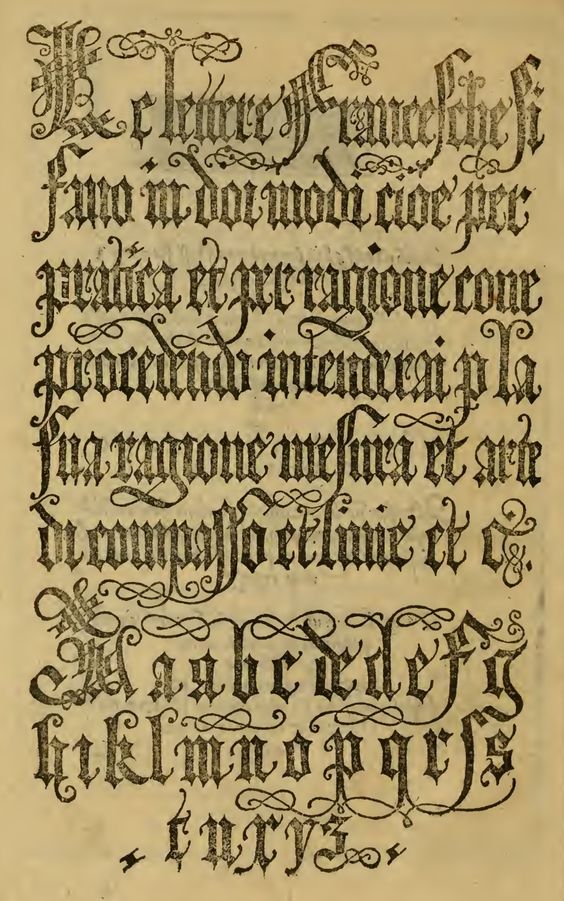
Fraktur Script
Today when I was at the shop, I was looking for specific things, mostly to do with crafts; I got a few antique German books (with the Fraktur script, often generically referred to as “Gothic text”); I’m fluent in German, but even I have to really concentrate to decipher the old type-text, especially as spelling has shifted or become more standardised. So honestly, I’m fine with using them in crafts, though the antique book lover in me fights to preserve them! I also bought sheet music for the same purpose. I kept an eye out for things I could use to make gigantic flowers with – that’s the next prop I’ll be making for our church stage area for the spring/summer season. In this particular shop, by the way, there are very few items with prices; once you get to the register, they assess what you’ve got, and calculate the set prices (such as the antique books, which ran from 3.- to 8.-); usually the end price for everything is quite reasonable – after all, they need to make room for the new inventory being restocked every 30 minutes!
What is the culture of second-hand shops in your region? Even within a country, it can vary wildly. Do you have boot sales, garage sales, thrift stores, charity shops, meet & swaps, buy-sell-trade shops, street markets, or another variety? I’d love to hear about your experiences! And if you’ve done any of the above, what was your best treasure find? Please comment below!
Recently, my mother sent me a link on Facebook and asked me to write an article about it; it’s definitely an interesting topic – so thanks, Mom!
First of all, for those of you who don’t know what a folly is:
In architectural terms, a folly is a building that is either constructed as decoration which suggests another purpose or is a practical garden building that transcends its purpose with extravagant features. An example of the former term would be buildings that were designed from the outset to look like ancient ruins, such as Wimpole’s Folly in Cambridgeshire, England; an example of the latter would be buildings like the Dunmore Pineapple in Stirlingshire, Scotland (I’ve been to this site a few times and was once able to go inside the pineapple). Designed to look like a giant pineapple, it was actually a working hothouse; that’s perhaps another story to tell. As for today’s topic, the folly of King Alfred would fall into the former definition.
Second of all, who was King Alfred, and why does he bear the sobriquet Great?
Statue of Alfred the Great at Wantage, Oxfordshire
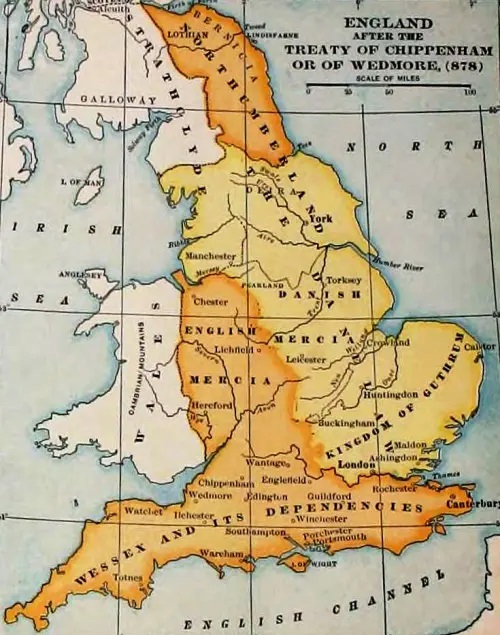
Born in 849 AD, Alfred the Great was King of the West Saxons from 871 to 886, and then King of the Anglo-Saxons from 886 to 899. He lived in a time when Viking invasions and warring tribes were common. Both of his parents died when he was young, and his three older brothers reigned before he eventually came to the throne. The battles, invasions and wars are too numerous to mention; to be a king meant to be at war. At the age of 21, he was already the King of the Wessex and a battle veteran. In early 878, the Danes struck like lightening, taking Chippenham (on the map below, you’ll see that it was in the heart of Alfred’s territories); inhabitants surrendered or fled, and it reduced Alfred and his men to hit and run means of getting provisions; they withdrew into the tidal marshes of Somerset (the area on the other side of the River Severn, just below Wales on the map below). Alfred reevaluated his strategy and learned from his enemy: He and his men began a guerilla war against the Danes, and by May, he’d defeated them in the Battle of Edington. Knowing that he would never be able to drive out such a powerful enemy, he made a treaty with them, establishing borders and what became known as the Danelaw territory; King Guthrum of the Danes converted to Christianity, with Alfred as his godfather and soon son-in-law as he sealed the treaty by marrying one of Guthrum’s daughters, Aethelflaed.
The Great comes from the fact that he united many of the disparate tribes; he recognized the deterioration in learning caused by years of disrupting wars and the Viking’s destruction of the monasteries, which were centres of learning and literacy. He recognized the fact that without widespread literacy, a king cannot rule – a people who were not united by a written language would be more vulnerable; but united through a common tongue, they would have a sense of loyalty and continuity in turbulent times. They would be able to adhere to laws, reach legal decisions, and be called to arms more readily if they could read a common language. He set out to make the English proud of being English and thus be prepared to fight for it.
By stopping the Viking advance against all odds, and consolidating his territories, he set the stage for future kings. His accomplishments in Wessex became the seed that eventually gave fruition to a united Anglo-Saxon England, which is why he alone among all kings or queens of England bears the sobriquet Great.
King Alfred’s Folly:
King Alfred’s Folly – Credit, Flickr, Andrew Bone
King Alfred’s Tower was built between 1769 and 1772. To put those dates into perspective, here are a few events from the year that construction began: 13-year-old Mozart, under his father’s control, was just finishing his third concert tour of Italy; James Watt improved his design for a steam engine that would spark the Industrial Revolution; King Charles III of Spain sent missionaries to California, founding San Diego, Santa Barbara, San Francisco and Monterey; Daniel Boone set out to explore what would become Kentucky; and finally, in August of that year, Napoleon Bonapart was born in Corsica.
The tower itself was built near the site of Egbert’s Stone, which is said to mark the mustering site for the troops of the Battle of Edington; the tower was intended to commemorate the end of the Seven Years’ War and the ascension of King George III to the throne of England. It was designed in the Palladian style (a European architectural style) by the architect Henry Flitcroft, at the commission of Banker Henry Hoare. While the reasons for commissioning the tower might be altruistic of Hoare, its site and magnificence might have had something to do with the fact that the tower was an eye-catcher for those touring the parks at his private estate, Stourhead.
Standing at over 40 metres high (131 feet) and a circumference of 51 metres (167 feet), it is completely hollow; it is a triangular structure with a round “tower” at each corner, though only one of them has a use – a spiral staircase of 205 steps, with no landing places along the dizzying ascent or descent. The only safety is a rope “railing” anchored occasionally along the central pillar of the staircase; passing others up or down can be a tight squeeze, and it is not a climb for the faint-hearted. Once reaching the top, you’ll find a crenelated parapet that surrounds a viewing platform offering a great view of the surrounding region; the centre of the platform is surrounded by a guard rail as it is a gaping hole straight down to the ground level; it’s covered with a mesh netting to prevent birds from using the tower as a dovecote.
In 1944, the tower was damaged when a Canadian single-engine plane crashed into it in the fog, killing all five aboard. In the 1980s, it finally underwent repairs and restoration; the statue of King Alfred above the main entrance was also repaired at that time, restoring a missing right forearm. A stone tablet (also in need of restoration) between the door and statue reads:
ALFRED THE GREAT AD 879 on this Summit Erected his Standard Against Danish Invaders To him We owe The Origin of Juries The Establishment of a Militia The Creation of a Naval Force ALFRED The Light of a Benighted Age Was a Philosopher and a Christian The Father of his People The Founder of the English MONARCHY and LIBERTY
Maybe this is something you’ve never stopped to think about, but everything we use on a daily basis was, at some point, invented, discovered or developed by someone. Before shoes, people walked barefoot, or wrapped leather around their feet in colder climates; before plastic, well, the world was far better off. But no matter where they lived in the world, or what their climate was like, people found ways to entertain themselves, or to have fun social interaction with board games, or with simple stones, sticks and rocks.
Even prehistoric people developed games to pass the time: The Mesopotamians had the Royal Game of Ur; in Egypt and across the Middle East, they played a game referred to as Fifty-eight Holes. A game that goes back thousands of years, with many different simultaneous versions across the world, is Mancala / Sungka / Congkak, played with hollowed dips (which could be made in dirt, wood, or stone) which players fill sequentially with stones or shells or nuts (whatever was readily available in their region of the world). As reading and writing became more widespread, word games and written riddles became popular.
In 1913, the journalist Arthur Wynne, working for the New York World newspaper, submitted the world’s first Crossword Puzzle (image below), which appeared in the Sunday paper on 21 December. An immigrant from England, Wynne based his idea on the magic square (in recreational mathematics, this is a square arrangement of numbers in which the sum of numbers in each row, column and both main diagonals is the same). In this concept, a given set of words would need to be arranged so that they form a square; but in Wynne’s version, the words had to be discovered first. The first puzzle contained 31 terms, with the word “fun” already filled in as an example.
In the beginning, crosswords (originally called Word-Cross Puzzles) were in a diamond shape; within a few years, the crossword craze had taken off, and eventually, the shape morphed into a square grid with blank or black cells where voids occur.
Today, crosswords have more competition: word search puzzles, scrabble, anagrams, ciphers, and various forms of Sudoku are the strongest contenders for puzzlers’ free time.
What is your favourite word puzzle type? Please comment below!