Tag Archives: Archaeology

History Undusted: Canning Jars

My quirky brain went down a rabbit hole last week; as I was putting away groceries into glass jars (for that explanation, please click here), I wondered who had been the genius behind the thread around canning jar lids, or, as most of my jars use, the bail closure.

Just to clarify terminology: Here is a threaded jar, a type of screw-on lid that is either one part or two:

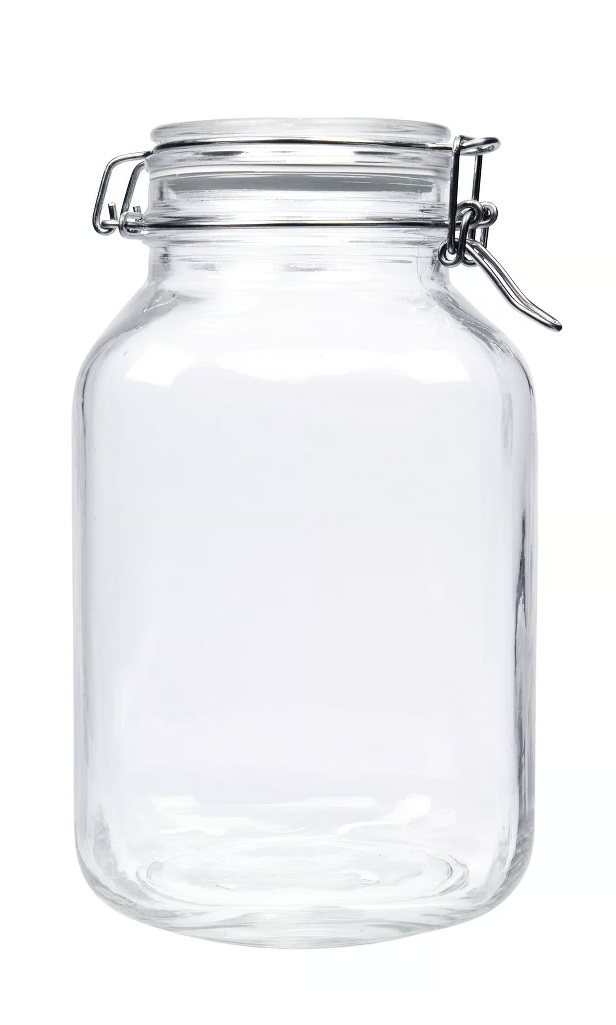
Here is a jar with a bail closure, aka flip-tops, lightning jars, known also by their various brand names, e.g. Fido, Le Parfait, Kilner:

A third type of jar, German-made, is the Weck jar, with metal clips and a glass lid. I don’t like using these, so you won’t find them in our house.

5000-Year-Old Pharaonic wine jars found intact at Abydos – Egypt Museum

Closures have been an issue for thousands of years; ancient amphoras, which were used to transport wines and oils, were sealed with wood, cork, or a ceramic or pottery lid sealed with a type of mortar. Archaeology has many examples of clay or pottery pots with lids, Norse ornate metal containers with lids, and even ancient Egypt’s canopic jars, with their ornate lids. Another variety of closure is found on wooden barrels, which have side holes called bungholes, plugged with a cork or other wood.

The threaded jar lid was invented by the tinsmith John Landis Mason in 1858. Prior to his invention, a glass lid was laid atop an un-threaded canning jar and sealed with hot wax. It was messy, and if it wasn’t done right every time, it could allow dangerous bacteria into foods. Before refrigeration, the only way to preserve garden produce was basically to can with a wax seal and take your life into your hands. There were other preservation methods, such as drying, salting, smoking or pickling, but the new way of preserving offered a convenient, faster alternative; Mason’s threaded lids, combined with a rubber ring and a threaded glass jar, revolutionised canning. Unfortunately, he was not a savvy businessman, and though he filed a patent for the threaded screw-top jars, he failed to patent the rest of the invention, such as the rubber gaskets. He let the patent expire in 1879, and manufacturers took the idea and ran with it. Mason never made a fortune; in fact, he died in poverty in 1902. But his name lives on in the common term, “Mason Jars”. The concept is now used with countless products, from drinks to shampoos to household cleaners.

The invention of the bail closure design is a bit murkier: In the early 1840s, the Yorkshireman John Kilner invented the Kilner jar, using the rubber seal and wire bail closure.

In 1893, beverage bottles began using the Hutter stopper – a porcelain plug with a rubber gasket held in place with a metal strap.

In the 1930s, the La Parfait jars began production in Reims, France, by Verreries Mécaniques Champenoises, a historic French glassmaker.

The Bormioli family is an Italian name associated with glass-blowing since the Middle Ages; among their many brands is the Fido airtight jar, using the bail closure, which began production in 1968.

I personally have Kilner, La Parfait and Fido bail-closure jars, as well as many screw-top jars similar to Mason from these companies.

Do you use any such jars for storage in your home? Do you use them for canning or storing dried goods, or both? Please comment below!

5 Comments

Filed under Articles, Food History, History Undusted, Links to External Articles, Science & Technology

Geology Undusted: Rock vs Stone

Today’s topic is the kind of thing that flashes through my brain at 4 a.m. when I’m dropping off to sleep.

Sometimes rock and stone can be used interchangeably, depending on the context of science, society or conversation; but some phrases are intuitively either stone- or rock-rooted: We say rock road, rockslide and rock salt, but stonemason, stone wall and Stonehenge.

In geological terms, a rock is a naturally occurring mass of minerals, particularly those with a distinctive composition (e.g. granite, bedrock, igneous, or features such as Ayers Rock). Other geological terms range from clay, silt, sand, pebble, gravel, cobble, boulder or glacial erratic (material moved by geological forces from one location to another) to mountain in size.

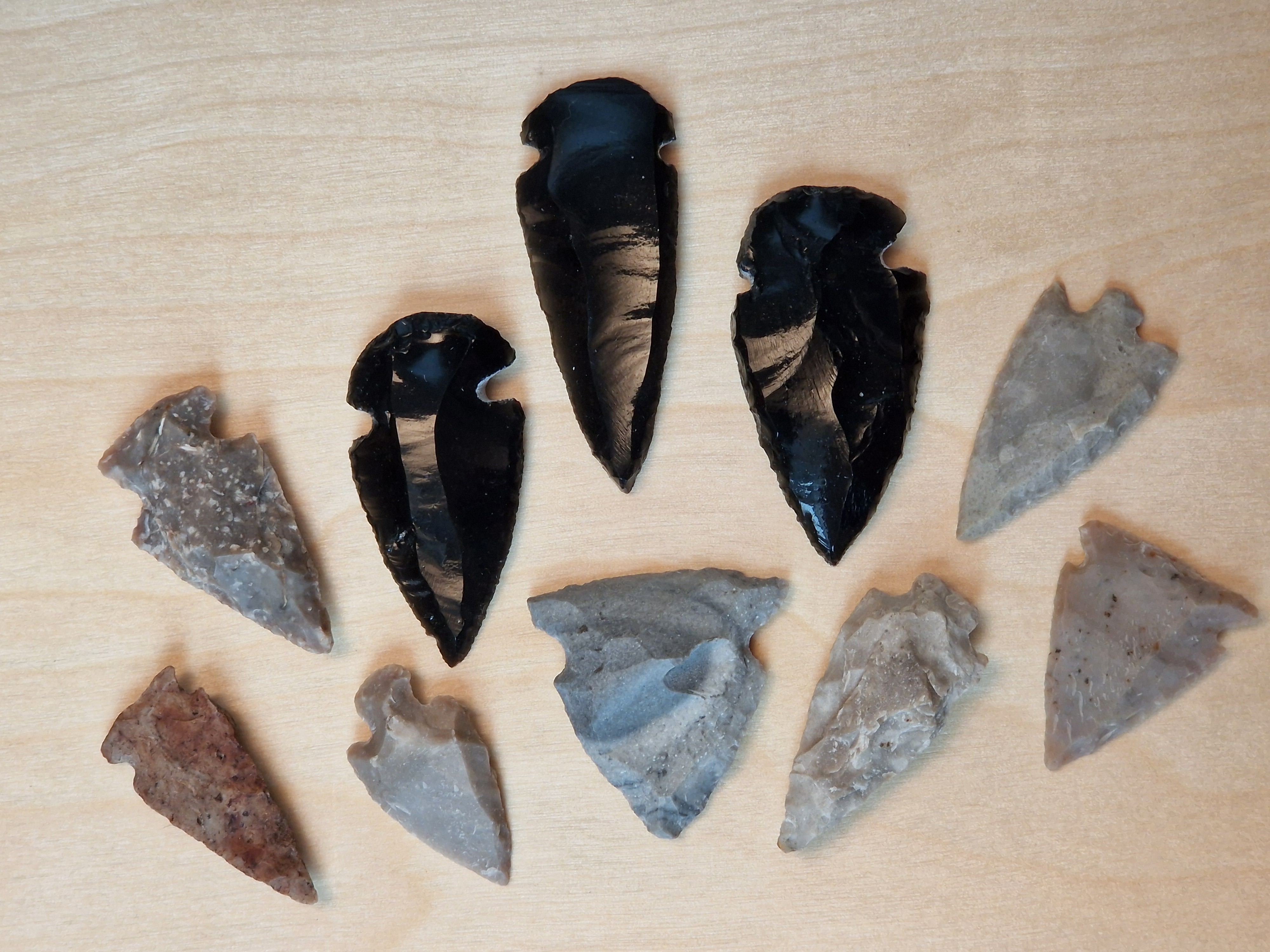
In Archaeological terms, rock refers to a geological formation, while stone refers to any rock that has been placed or modified into a tool by humans (ergo, Stonehenge, not Rockhenge). When an archaeological dig is underway and they pull out a rock, trained eyes can spot signs of scarring, or scoring, such as on a core, which is a piece of rock that has been worked by a stone tool referred to as a hammerstone (for obvious reasons), used to shape another rock into a tool, such as in the process of flint knapping (the more refined the knapping process, the more refined the tools become, such as using antler or copper nubs to chip away finer areas of an arrowhead or hunting barb). In Kansas, where I grew up, arrowheads are still discovered occasionally; I have a small collection, along with a few obsidian arrowheads.

In archaeological excavations, what might appear to be a natural rock formation may turn out to be an ancient boundary wall, with stones intentionally stacked for a specific purpose. In that sense, though a rock road has intentionally been placed, it is not stone – it is placed for a purpose, yes, but its arrangement is left as it falls, so it is referred to as a rock road.

Years ago, when my husband and I were walking along a rocky riverbank in Ticino (in the Italian-speaking part of Switzerland), I picked up a stone; it had obvious signs of human activity, with smoothed sides where hands held it, and scrapes along the top and bottom, such as might be caused by sharpening a tool – whether antler or arrowhead. As it was washed down from its resting place in the rapids, it was no longer in situ and therefore would have no archaeological significance.

So which is it, stone or rock? For me, the answer is this: When it has been modified or intentionally placed or ordered by humans, it’s stone; when it’s naturally occurring, it’s rock.

I’ll leave you with a few idioms carved in stone or rock:

Set /carved in stone

Living under a rock

Leave no stone unturned

On the rocks

Heart of stone

Kill two birds with one stone

Have rocks in one’s head

Cast the first stone

As solid as a rock / As solid as the Rock of Gibraltar

Written in stone

Like getting blood from a rock

Between a rock and a hard place

A stone’s throw

Leave a comment

Filed under Etymology, History Undusted, Images, Liguistics, Linguistics, Nature, Science & Technology

History Undusted – The Tactile Language of the Quipu

Throughout history, languages have come and gone; an estimated 30,000 have existed at some point in time, though currently, there are roughly 6,000 to 7,000 languages in use – and most are threatened with extinction. Think about that. The impact on the loss of cultural history, connection to ways of thinking, ways of communicating, and ways of processing information; senses of humour, and national heritages will be lost.

An example of a language nearly lost, but which is now familiar to most of us by sight, is the logogram language of Egyptian hieroglyphs. The knowledge of how to interpret the symbols had been lost for centuries, until 1799, when a stone was found near Rosetta, along the Nile Delta in Egypt; the stone was a stele with a decree issued in 196 BC; the texts carved into the stone were Ancient Egyptian (“demotic” text), hieroglyphs, and Ancient Greek. Because Greek was a known language, they could use the Rosetta stone to decipher the forgotten languages.

When we think of writing, we may think of various alphabets: Greek, Roman (of which English makes use), Norse Runes, or the logographic or ideographic languages of Asia, such as Chinese or Japanese, or the cuneiform writing of the Ancient Near East. But did you know that there have been languages based on string?

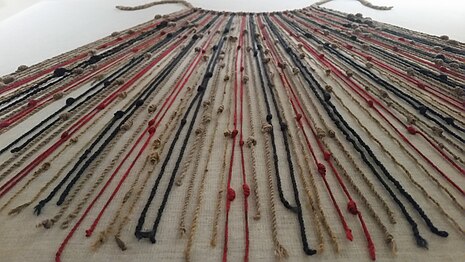
Quipu in the Museo Machu Picchu, Casa Concha, Cusco. Source: Wikipedia

The Inca people, in the region of modern Peru and Chile, used knots on an elaborate system of connected strings or cords for collecting data, keeping records, recording taxes or census records, making calendars, or for military organisation. When the Spanish Conquistadors swept through, they found numerous bundles of strings, but had no idea of their significance; they destroyed many of the quipu*, not realizing that they might have held in their hands a record of an individual’s wealth in animals or crops. [*Quipu is the Spanish spelling used in English; it is also spelled khipu or kipu.] Other cultures have also used similar concepts with knotted strings to record information, unrelated to South America; these include China, Japan, Taiwan New Zealand, Hawaii, and other parts of Polynesia.

As with most textiles, they unfortunately didn’t stand the test of time very well, and only a fraction remains today. The ancient world may have taken the concept of the quipu one step further in creating the more flexible abacus, though the latter was (and is still) used for temporary calculations, while the former was rather for recording information. Whether or not there is a historical link, both are visual tools that can be used for similar functions to a certain extent.

Even with such widespread use of these knotting records, their meaning was nearly lost, until a Harvard student, Manny Madrano, had time on his hands one summer and solved a centuries-old mystery!

For an interesting video on this topic, please click here. I hope you’ve learned something! Keep being curious about our fascinating world!

6 Comments

Filed under Etymology, History, History Undusted, Liguistics, Science & Technology, YouTube Link

Wordless Wednesday #50: Parking

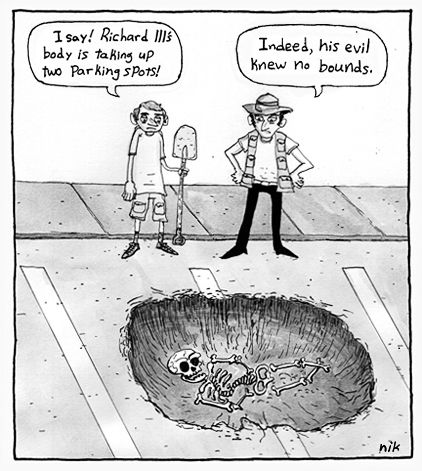
King Richard, Parking, Grave, Archeaology

4 Comments

July 4, 2018 · 12:23 AM

History Undusted: Avaldsnes, Norway: A Hidden Gem

In the summer of 2013, I went to Norway on a holiday/research trip for “The Cardinal,” a 2-part fantasy-science fiction novel set in ancient Scotland, ancient Norway, and modern Scotland.  Norway, however, seems to carry its dislike of small-talk into the area of promotion and marketing, and as a result, its museums and attractions are not as well advertised, marketed or signposted as they could be; we only found out about this little gem of a site because we happened to run into a Swiss friend in Haugesund, and he knew of the place!  I promised the curators to get the word out, so here’ goes, and with pleasure:

On the island of Karmøy, along the western coast of Norway, sits Avaldsnes.  With over 50,000 islands in Norway, it wouldn’t seem to our modern minds (as dominated by cars and roads as we are) to be a significant location, but Avaldsnes is rewriting Norse history.  It has long been a place from which to control shipping passages through the narrow neck of the Karmunsundet, also called the Seaway to the North, or in Norwegian Nordvegen, and it is the maritime route that eventually gave its name to the country.

The kings of sagas and lays have become real at Avaldsnes, the rich archaeological finds there making it one of the most important locations in Europe for the study of Viking and Norse history.  Avaldsnes was a royal seat, so it’s not surprising that some of the most important burials in Norway have been found here:  One of its ship burials was dated to the 8th century (making it much older than any other such burials known of thus far).  It was clearly a king’s burial, and the findings there have proven its political importance several hundred years before King Harald Fairhair unified Norway.

This slideshow requires JavaScript.

Today there are three main points of interest at Avaldsnes, all within walking distance from each other:  St. Olav’s church, built on the site of the oldest church in Norway, was commissioned by King Håkon Håkonson around 1250 AD as part of the royal manor complex.  On the north side of the church stands the Virgin Mary’s Sewing Needle, one of Norway’s tallest standing stones, measuring in at 7.2 metres today (though it was originally much taller; it can be seen in the picture above):  Local legend says that when the obelisk touches the wall of the church, Doomsday will come; over the years, priests have climbed the stone in the dead of night to chip away any threatening pieces from the top, thus saving the world from annihilation.  This church was an important site for pilgrims on their way to Nidaros (the medieval name for Trondheim, the capital of the land’s first Christian kings and the centre of Norwegian spiritual life up until the Protestant Reformation); on the north side of the church is a sealed door which was originally the entrance for those pilgrims, as it is said that they had to enter any church with their backs to the north.

The next site is the Nordvegen Historic Centre; at first glance, it’s merely a circular stone monument, but it is actually a stairway leading down into the underground museum, built so as to not interfere with the landscape.  The exhibitions guide you (with a bit of modern technology) through 3,500 years of history through Avaldsnes, focusing on daily life, international contacts and cultural influences from those contacts.  Foreign trade and communication were major factors at Avaldsnes, and archaeological evidence shows it to be a barometer to the prosperity and decline of European commerce as a whole.  The museum has a hands-on section, as well as a gift shop that’s well-stocked with books covering various aspects of Viking history.

The third site is a hidden gem, located about 20 minutes’ walk from St. Olav’s:  The Viking farm.  The gravel path takes you along the shore, over two bridges and through a forest to a small island.  It’s well worth the hike, as you come through the forest to find a Viking village tucked behind a typical Telemark-style fence (pictured above).  A 25-metre longhouse is the centrepiece, a reconstruction of a 950 AD house, and built of pine and oak, with windows of mica sheets.  The aroma of tar wafts from the house as you approach, as it is painted with pitch to weatherproof it; the smell reminds me of a dark peat-whiskey, and also of Stave churches, which are also painted with the tar.  [The photo of the longhouse has one element missing to the trained eye:  The low stone wall which should surround the house, as insulation, is missing at the moment while boards are being repaired.]  Other buildings on the farm include pit houses (both woven twig walls as well as wattle and daub) used for activities such as weaving, cooking or food preparation, and other crafts necessary to daily life; a round house, a reconstruction of archaeological finds in Stavanger (which may be a missing link between temples and stave churches in their construction); various buildings of a smaller size; and at the shore is a 32-metre leidang boat house, representing a part of the naval defence system developed in the Viking Age:  A settlement with a leidang was expected to man the ship with warriors and weapons when the king called upon them for aid.  When the boat house was vacant of its ship it was used as a feasting hall, and the modern replica follows that example as it is often hired out for celebrations or festivals.

Both the museum and the Viking farm have friendly and knowledgeable staff; the farm staff are all in hand-made period clothing and shoes; as a matter of fact, one of the women was working on her dress while we were there, and she said it was linen; the total hours to make such a dress from start to finish would be around 600 hours (including shearing, spinning, weaving, then cutting and sewing).  Had it been made of or included leather, it would have taken much, much longer.  That is why clothing was very valuable, and most people only had the clothes on their back; you were considered fortunate, and even wealthy, if you had a change of clothing – even into the mid-eighteenth century in countries such as England.

If you are interested in Viking history, Avaldsnes is well worth the journey.  Take your time; we stayed overnight in the area to spread the visit out over two days, and we could have spent much more time there.  If you’re a natural introvert like me, you’ll need time to process the multitude of impressions, but that’s what we like – quality time, and quality input.  And then get the word out about these points of interest!


Originally posted on History Undusted, 14 September 2013

Leave a comment

Filed under Articles, Etymology, History, History Undusted, Military History, Nuts & Bolts, Research

History Undusted: Skara Brae, Orkney

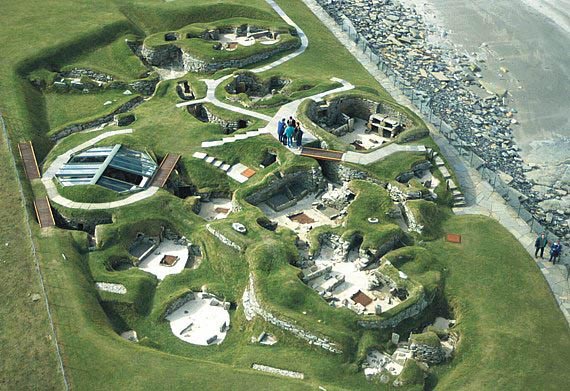
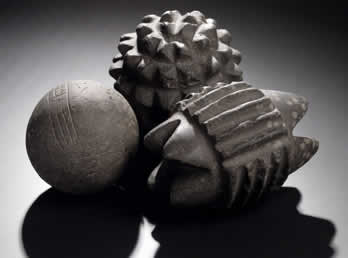
Skara BraeSkara Brae is probably the single most famous Neolithic settlement uncovered in the world.  It gives us the most complete picture of everyday life in that period of time, and has quite a few surprises:  Indoor running water?  Dressers and beds?  Yep.  They had storage rooms, and even toys for the kids.  There are some objects that they can’t figure out, but that just makes it all the more tantalizing.

Originally much farther from the shoreline, over the centuries erosion has eaten away at the land; Skara Brae will itself eventually succumb to the pounding Atlantic waves.

I was there in 1989 for the first time, and again in 2002; the first time I was there, I was with a group of friends, and we were given a private tour by a friend’s uncle who worked there.  It was an amazing way to see this prehistoric site, tourist-free and (back then) largely untainted by tourism.  In 2002 it was a different matter altogether:  A tourist shop had sprung up, and we had to time our viewing between bus-loads of day-tourists from “doon sooth” (down south = Scotland).  Also on that second visit, the Atlantic winds were so strong that we were literally leaning into the wind at a 45° angle; if it had had a sudden lull, we would have been flung into the sunken dwellings; it was an adventure.

Skara Brae stone objectsIf you get a chance to go, do so; take at least a fortnight on Mainland Orkney.  It’s known as the Archaeologist’s treasure trove, and for good reason – just about any stone you turn over has some kind of historical significance, and there are many sites to take in:  Maeshowe, Ness of Brodgar and the Ring of Brodgar, and chambered cairns to name a few, and even more modern sites such as Churchill Barrier, and sunken World War 2 vessels (some portions are visible in low tide).

The stretch of water between Scotland and Orkney, the Pentland Firth, is known as “The Sailor’s Nightmare”; there are several currents that flow and mix into this bottleneck, not only making for treacherous sailing, but it can also make even the hardiest sailor lose his lunch.  Word to the wise:  When heading out of Thurso with the ferry to the Mainland (the largest island in the Orkney group), a) don’t eat yet (it usually leaves around lunch time, and believe me, you won’t keep it long…), and b) as soon as you get on the ferry, head to the dining room and get a window-side table; this is because they will not only fill up fast, but once you’re out of the relatively calm / wind-sheltered bay into the open strait, you’ll be glad for a ring-side view from a wind-sheltered, spray-sheltered spot; keeping your eye on the horizon helps the brain deal with the swells, and keeps seasickness at bay…

Originally posted on History Undusted,

2 Comments

Filed under Articles, History, History Undusted, Nuts & Bolts, Research, Science & Technology

New Book Release: The Cardinal

Facebook Announcement with Website

Hi everyone!  I’m excited to announce the release of my latest books:  The Cardinal, Parts One and Two!  The Cardinal is an epic fantasy, spanning from the pre-Viking Age of Scotland and Norway to modern-day Scotland.

The Cardinal

790 A.D.

In the far northern reaches of the Highlands of Scotland a Pictish tribe, with their language of peat and stone, ally together with a strange kingdom of mist and whispers.  As a foe descends upon them in longships from the north with axe and smoke and they are scattered in defeat, will those left behind ever find those wrenched from their arms?  Will those slaves taken by the Vikings ever find their way to freedom and home or not?  Either way life will never be the same again.

Now

More than a thousand years later their lives, deaths and fates are brought to light by an archaeological team who uncovers the find of a lifetime… of a thousand lifetimes.  The more they discover the more perplexing it becomes; their finds challenge our very understanding of what it means to be human, and the assumption that myths are groundless and history is fact.  That we are not alone in the universe is one thing; that we are not alone on this earth is another thing entirely.

 “Legends come about when truth is considered too implausible.”—G.K. Chesterton

For further information, images and characters, please check out the page here.

If you enjoy the novels, please do leave feedback!  Both here and on Amazon would be excellent!  Every feedback is greatly appreciated, and the more the better!

5 Comments

Filed under Publications

Airchaeology – If you Speak Scots

The internet is amazing.  You can find everything useful, useless, educational and brain-cell poisoning, all just a click away.  Just for the fun of it, when you really want to find out something about another culture’s mentality and way of looking at things, try Wikipedia in another language!  Click on the photo below to try it out in modern Scots.  And if you’re having trouble reading it, trying reading it aloud.

archaeology_header_img

Leave a comment

Filed under History, Nuts & Bolts, Research