Tag Archives: society

Accidental Discoveries in History: HEALTH / MEDICINE

Pill bottle spilledThose individuals who have “Eureka” moments are those who are prepared for that moment of discovery:  They begin with an inquisitive mind, which nurtures creative thinking, which is supported by collecting background information, educating themselves; to that they add the right tools, and an open mind that looks at the possibilities in what others might see as “mistakes.”  Most inventions are the results of exploration, experimentation, blood, sweat and tears, and lots of sleepless nights.  But there are some moments of serendipity, those “Hmm.  That’s strange…” discoveries that are not lightly tossed aside but seen for their potential.  It’s taking the lemons life has thrown their way, tossing in a wet rag and a few copper and zinc coins, and coming up with a battery.

Here’s a line-up of a few of those wet rag-tossers of health and medical discoveries, with others to follow over the next few posts:

 “Our greatest weakness lies in giving up. The most certain way to succeed is always to try just one more time.”

Thomas A. Edison

Penicillin

Who:  Alexander Fleming, Scottish scientist and Nobel laureate.

When: 1928

Why: He didn’t clean up his work station before leaving one day in 1928.  When he returned he noticed a strange fungus on some of his cultures, but it wasn’t growing near certain cultures.  His “bad science” mistake led to the discovery of the first, most important, and still-widely used antibiotic.

Pacemaker

Who:  Wilson Greatbatch, American Engineer and absent-minded professor.

When: 1960

Why:  In 1958 he was trying to make a circuit to help record heartbeat sounds.  When he reached into a box of resistors he accidentally pulled out a 1-megaohm resistor instead of a 10,000 ohm resistor.  It pulsed to a familiar rhythm – a perfect heartbeat.  Actually, the first pacemakers go back as far as 1899; but Greatbatch’s invention was the first successfully implanted cardiac pacemaker.

Mauve

Who: William Perkin, 18-year-old English chemist, eventually Sir William Perkin.

When: 1856

Why: He was trying to cure malaria, attempting to produce artificial quinine; his experiment produced a murky blob; but the more he looked at it, he realised the beautiful possibilities… he’d instead made the first-ever synthetic dye.  He’d inadvertently become the poster boy for money-generating science, making it interesting for the curious-minded; he’s known as the founder of science-based industry.  One of those curious minds just happened to be a German bacteriologist named Paul Ehrlich, who used that murky blog, now known as mauveine, to pioneer chemotherapy and immunology.

Viagra

Who: Nicholas Terrett and Peter Ellis (the names on the patent); more generally, a group of pharmaceutical chemists working at Pfizer’s Sandwich, Kent, research facility in England.

When: 1996

Why: Originally attempting to develop a drug to treat Angina Pectoris – chest pains – they failed in their primary aim, but its side effects were startling, and now famous.

Anesthesia

Who: Good question.  It seems to have developed independently on several occasions, from the 12th century onwards.  Laughing gas was discovered in 1772 by Joseph Priestly, English scientist.

When: Good Question.

Why: In the 1800s, inhaling either nitrous oxide (laughing gas) or ether was considered a form of recreation; “ether frolics”, or “laughing parties” were popular, and several scientists, doctors and dentists noticed that people in such an affected state didn’t feel any pain, even when they injured themselves in the process.  Crawford Long, William Morton, Charles Jackson and Horace Wells observed such events (and probably took part in them too), and they began using the compounds during their dental and medical procedures.

X-Rays

Who: Wilhelm Röntgen, German physicist

When: 1895

Why: In a series of coincidental observations while experimenting with what Röntgen temporarily called “X-rays”, using the mathematical designation for an unknown factor, he began to discover materials that both stopped, and allowed penetration of, these rays.  At one point the material was a piece of lead, and the first radiographic image was made; but at that point he decided to continue his experiments in secret in case he was wrong; he didn’t want to risk his professional reputation on reports of skeleton photography.  Even though the term X-ray is used in English, in German they are called “Röntgenbilder”, or Röntgen-images.

LSD

Who: Dr. Albert Hofmann, Swiss Chemist, at the Sandoz Laboratories in Basel, Switzerland

When: 1938 (first synthesized); 1943 (discovered for its hallucination-inducing properties)

Why: As part of a large research project for finding useful ergot alkaloid derivatives.  Hofmann was re-synthesizing LSD-25 for a study, and took 0.25 milligrams, but became dizzy and had to stop working.  He asked his lab assistant to escort him home; they had to go by bike, and when he got home he lay down, sinking into a pleasant “intoxicated like condition” with an extremely vivid dreamlike stream of images (after an attack of paranoid anxiety that left him thinking he was going insane).  It lasted about 2 hours, and then faded. 19 April, 1943, is now known as Bicycle Day, celebrated as the birthday of LSD.

Botox

Who: Dr. Alan Scott, and Edward Schantz

When: late 1960s

Why:  Using small doses of the most acutely toxic substance known, Botulinum toxin (as one does), they applied it to treat “crossed eyes” eyelid spasms and other eye-muscle disorders; a noticeable side-effect was that wrinkles disappeared, as the muscles beneath the skin were paralyzed.  Canadian husband and wife ophthalmologist and dermatologist physicians, JD and JA Carruthers, were the first to publish a study on BTX-A for the treatment of frown lines in 1992.  The result?  Expressionless faces that become distorted and deformed with time, thanks to Botox addiction. I think the inventors of this “treatment” should be locked away in padded cells, personally.

Smallpox Vaccination

Who: Edward Jenner, a British scientist and surgeon

When: 1796

Why:  Jenner had a brainstorm that ultimately led to the development of the first vaccine: A young milkmaid had told him how people who contracted cowpox, a harmless disease easily picked up during contact with cows, never got smallpox, a deadly scourge.  With this in mind Jenner took samples from the open cowpox sores on the hands of a young dairymaid named Sarah Nelmes and inoculated eight-year-old James Phipps with the secretion he had extracted from Nelmes’ sores.  The boy developed a slight fever and a few sores but remained for the most part unscathed. A few months later Jenner gave the boy another injection, this one containing smallpox. James failed to develop the disease and the idea behind the modern vaccine was born.

Insulin

Who: Canadian doctor Frederick Banting and Professor John MacLeod of the University of Toronto; Nobel Prize winners of 1923.

When: 1923

Why: In 1889 two German
physicians, Joseph von Mering and Oscar Minkowski, removed the pancreas from a healthy dog in order to study the role of the pancreas in digestion. Several days after the dog’s pancreas was removed, the doctors happened to notice a swarm of flies feeding on a puddle of the dog’s urine. On testing the urine, the doctors realized that the dog was secreting sugar in its urine, a sign of diabetes. Because the dog had been healthy prior to the surgery, the doctors knew that they had created its diabetic condition by removing its pancreas and thus understood for the first time the relationship between the pancreas and diabetes.  After further testing they concluded that a healthy pancreas must secrete a substance that controls the metabolism of sugar in the body. Though other scientists attempted to identify the substance released by the pancreas, it was Banting and MacLeod who discovered that the mysterious substance was insulin.

Pap smear

Who: Dr. George Nicholas Papanicolaou

When: 1923

Why: In 1923 he was studying the vaginal fluid in women to observe cellular changes over the course of a menstrual cycle; one of his subjects just happened to have uterine cancer, and when he discovered the abnormal cells, plainly seen under the microscope, he quickly realized that doctors could administer a simple test to gather a sample of vaginal fluid and test it for early signs of uterine and other cancers.

 

3 Comments

Filed under Articles, History, Lists, Quotes, Research

On being powerful

“When I dare to be powerful – to use my strength in the service of my vision – it becomes less & less important whether I am afraid.”

Audre-Lorde-620x480Audre Lorde, 20th C. Caribbean-American writer

Leave a comment

August 18, 2013 · 10:00 PM

A Postcard from Lugano

Gandria, Switzerland

Gandria, Switzerland

Just put your feet up on the edge of the glass balcony, lean back and enjoy the breathtaking view:  straight ahead is San Salvatore – the signature mountain of Lugano, Switzerland (also known as the Rio De Janeiro of Europe) – rising out of Lake Lugano.  A sunny day will see the vast body of water dotted and streaked with lazy boats, speed boats, water skiers, and the occasional swimmer who ventures far away from the shores to swim long distance.  A sunny, windy day will see the lake bloom like a field of wildflowers with sails unfurled.  If you look straight down from the balcony, you’ll see six stories of uninterrupted view and a private swimming pool shimmering Caribbean blue in the garden below – all yours whenever you feel the urge.  Sitting there gently beckons you to breathe deep, slow down, forget time, and be as lazy as you want.  Being is the thing here, not doing, unless that doing brings pleasure.

Overhead, hawks circle, coming so close to the balcony that you can watch them turn their heads to look you in the eye.  I’ve been fortunate enough to see them swoop at the lake and come up with fish, but more commonly you’ll simply see the results dangling from their talons as they fly nestward.  Birds of all shapes and sizes are there for the viewing:  Ducks that fly past squawking as they flap furiously determined to reach their destination, always in a hurry; swans that pass each morning toward the town, and each evening toward their roost; silver-backed crows that fight for the highest treetop, chasing each other from tree to fence to roof to tree to lamppost to tree; sparrows that have learned the advantages of sharing their domain with humans; seagulls that pester hawks for their fish, pester each other for their prizes, and pester simply because they enjoy pestering.

To the right in the distance is the eponymous town, the shoreline rimmed by a walkway, boating and ferry docks, a giant fountain spraying five stories straight up – when the wind doesn’t use it to spray onlookers – and swans, coots and ducks competing with sparrows, pigeons and silver-backed crows for the breadcrumbs of passersby.  Every little corner café and ristorante has a place in the sun, with tables and chairs moved out onto the sidewalk, the giant umbrellas providing welcomed shade.  Gelaterie dot the shoreline, offering relief from the summer heat with generous portions of creamy Italian ice cream.

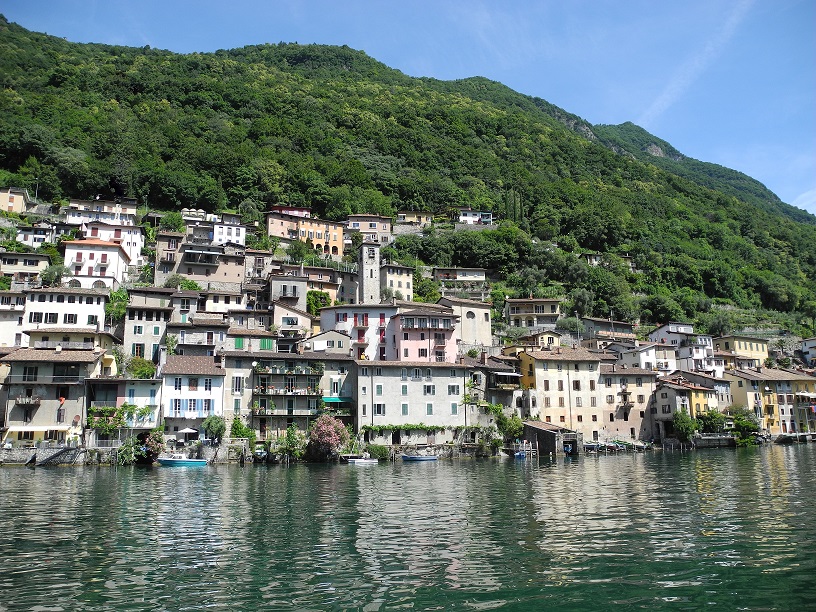
Gandria, as seen from the lake

Gandria, as seen from the lake

This first evening, let’s head down to Gandria:  A small, steep town tucked around the lakeshore hidden from Lugano, it’s accessible only to those who can walk.  There is one parking lot high above the town, but I prefer the walk high above the lakeshore.  For the first few minutes, we walk past luxury mansions, usually veiled in the silence of loneliness as the occupants are rarely in residence.  We pass a parking area and enter a narrow stone pathway that takes us past the back door of a few stucco homes, eventually giving way to steep cliffs to our left and a steep drop to the lake below on our right.  The forest grows thick here despite the rocky cliff, but if we take this walk early enough in the evening, we’ll see countless lizards sunning themselves along the stone path or cliff face; we may even glimpse a sunning snake, though they are usually quick to disappear into the underbrush.  We come at last to the village of Gandria, a labyrinth of stone houses and arched passageways, where swallows can be found nesting, and a postcard in the making at every turn with a picture perfect atmosphere.  The restaurant we choose engulfs the stone path, with the building on one side and the covered terrace on the edge of the lake (or out over the lake) on the other.  We order our meal (Italian, of course), complete with a bottle of local wine, and watch the shadows of the mountain grow steeper, swallowing the glittering lake as it climbs the forested Italian mountains across the invisible, watery border between the two countries.

Happily satisfied with a good meal and a good year, we begin the walk home.  By now, the dense forest is darker still, and conceals a deep ravine in the rising cliffs; at dusk, out of that ravine dart tiny bats by the hundreds.  Contrasted against the sky, we watch them deftly echolocate their meal of insects that have thrived on the lakeshore all day and have risen to soak up the last rays of the setting sun.  If you hear well, you’ll be able to hear their small shrieks as they swoop past – unaware that humans are there except as obstacles to be avoided in their flight path.

At last, we return home.  The view from the glass balcony has now changed: The lake is a blanket of darkness surrounded by the glittering lights of the towns splashed along the winding coast.  Sometimes a bright light suddenly flashes across the lake, where a car has turned directly toward us briefly on the winding roads and streets, but it is only the size of a firefly at this distance.  The peace that settles over the lake calms any thoughts of home, responsibilities, appointments, work and schedule.  Sitting in the dark and watching the stars come out as dusk fades to a black curtain, we whisper as our tangled thoughts unravel, our minds drawn to the deeper things of life than mere living.

Another place I’d take you is to the top of our mountain, Monte Brè, to the village of Brè Paese.  It seems to be a magnet for artistic abdicators of the outside world, with every corner, door, window frame, stair, archway, path, woodpile and every other possible canvas artistically arranged, painted, sculptured, framed and ready to grace a postcard.  My favourite and eponymous restaurant has a garden that reflects the philosophy of the town, being a dessert for the eyes and soul.  There is a large chess board in the garden with potted plants as the pieces; a wooden bench made of barked branches winds its way around one of the large shade trees, and a swinging bench ready to receive visitors at a moment’s notice sways in the warm breeze beneath another tree.  Our table is shaded by a kiwi fruit vine laden with fruit, winding its way up the trellis and taking its sweet time to reach a nearby balcony.  Sparrows flit between the terrace tables in search of morsels and are friendly and bold enough to even land on our table occasionally.

As night falls in Lugano, the city sparkles to rival the stars.  On a clear moonless night, the mountains surrounding the lake are etched black against the sky, contrasted by the city lights reflecting along the shore.  Some of the brighter stars even cast their reflections onto the water below.  A swan drifts past, asleep with its beak nuzzled under a wing, not caring where the gentle currents carry it by morning.

3 Comments

Filed under Articles

All About Perspective

So much is exhibited to the eye that nothing is left to the imagination.  It sometimes seems almost possible that the modern world might be choked by its own riches, and human faculty dwindle away amid the million inventions that have been introduced to render its exercise unnecessary.  The articles in the quarterlies extend to thirty or more pages, but thirty pages is now too much. So we witness a further condensing process and, we have the fortnightly and the Contemporary which reduce thirty pages to fifteen pages so that you may read a larger number of articles in a shorter time and in a shorter form.  As if this last condensing process were not enough the condensed articles of these periodicals are further condensed by the daily papers, which will give you a summary of the summary of all that has been written about everything.  Those who are dipping into so many subjects and gathering information in a summary and superficial form lose the habit of settling down to great works.  Ephemeral literature is driving out the great classics of the present and the past… hurried reading can never be good reading.” – G.J. Goschen, First Annual Address to the Students, Toynbee Hall, London, 1894

1894.  We tend to think of such times as “the good old days,” when life was slow and time was taken to read, contemplate, and discuss topics at great length.  Compared to now of course, they did; but the time in which we live now will look slow to future generations.  We tend to think that women today tend to be more scantily dressed than 50 years ago, and it’s true; but 100 years ago they thought exactly the same thing of their own time.

Future generations will think it quaint that we had things called “CDs” or “DVDs” (that looked exactly the same but the playing devices were incompatible with one another!) that were physical discs you actually have to put into a machine to hear music or watch a film; or telephones that actually needed electricity, or computers that needed an internet cable, or batteries that needed changing.  Our miniscule cell phones will look as bulky and clumsy to them as ‘80s films’ cell phones do to us now.  Magazine ads from the late ‘60s were more wordy than some full-length newspaper articles today.  Ads today don’t even use words – they have to grab you with an image because you’ve just sped past in your car, on your bike, or in a tram or bus or train.

First passenger railway 1830, Liverpool & Manchester Railway.  Source - Wikipedia

First passenger railway 1830, Liverpool & Manchester Railway

Literature is changing too.  When was the last time you read a tome?  Do you like to enjoy slow reading, like fine cuisine, or do you prefer to read a book in a weekend, and if it will take much longer you’re not as interested?

“With the advent of cheap newspapers and superior means of locomotion… the dreamy quiet old days are over… for men now live and think and work at express speed.  They have their Mercury or Post laid on their breakfast table in the early morning, and if they are too hurried to snatch from it the news during that meal, they carry it off, to be sulkily read as they travel… leaving them no time to talk with the friend who may share the compartment with them… the hurry and bustle of modern life… lacks the quiet and repose of the period when our forefathers, they day’s work done, took their ease…” – William Smith, Morley:  Ancient and Modern, 1886

It’s all about perspective.  So the next time you get impatient, stop and think about those past generations who felt intimidated by the speed of a steam locomotive, and instead be grateful you’re stuck in traffic.

Leave a comment

Filed under Articles, Quotes, Research

When Insults Had Class

Before the diluting of the language through modern acronyms and text messages, insulting one’s foes was an art form in itself.  Here are a few well-know gems:

Old Letter & Quill

“He uses statistics as a drunken man uses lamp-posts… for support rather than illumination.” – Andrew Lang (1844-1912)

“He has Van Gogh’s ear for music.” – Billy Wilder

“In order to avoid being called a flirt, she always yielded easily.” – Charles, Count Talleyrand

“I have never killed a man, but I have read many an obituary with a great deal of satisfaction.” Clarence Darrow

A member of Parliament to Disraeli: “Sir, you will either die on the gallows or of some unspeakable disease.”
“That depends, Sir,” said Disraeli, “whether I embrace your policies or your mistress.”

“He was distinguished for ignorance; for he had only one idea, and that was wrong.” – Benjamin Disraeli

“She runs the gamut of emotions from A to B.” – Dorothy Parker

“He loves nature in spite of what it did to him.” – Forrest Tucker

“What’s on your mind? If you’ll forgive the overstatement.” – Fred Allen

“I’ve had a perfectly wonderful evening.  But this wasn’t it.” – Groucho Marx

“I’ve just learned about his illness. Let’s hope it’s nothing trivial.” – Irvin S. Cobb

“He is a self-made man and worships his creator.” – John Bright

“His mother should have thrown him away and kept the stork.” – Mae West

“Why do you sit there looking like an envelope without any address on it?” – Mark Twain

“I did not attend his funeral, but I sent a nice letter saying I approved of it.” – Mark Twain

“Thank you for sending me a copy of your book; I’ll waste no time reading it.” – Moses Hadas

“He has no enemies, but is intensely disliked by his friends..” – Oscar Wilde

“Some cause happiness wherever they go; others, whenever they go..” – Oscar Wilde

“He is simply a shiver looking for a spine to run up.” – Paul Keating

“He is not only dull himself; he is the cause of dullness in others.” – Samuel Johnson

“I feel so miserable without you; it’s almost like having you here.” – Stephen Bishop

“He had delusions of adequacy.” – Walter Kerr

“He has never been known to use a word that might send a reader to the dictionary.” – William Faulkner (about Ernest Hemingway).

An exchange between Churchill & Lady Astor:
She said, “If you were my husband I’d poison your tea.”
He said, “Madam, If you were my wife I’d drink it.”

“He has all the virtues I dislike and none of the vices I admire.” – Winston Churchill

“I am enclosing two tickets to the first night of my new play; bring a friend…. if you have one.” – George Bernard Shaw to Winston Churchill
“Cannot possibly attend first night, will attend second…. if there is one.” – Winston Churchill, in response.

“Yes, madam, I am drunk. But in the morning I will be sober and you will still be ugly.” –  Winston Churchill

“He had just about enough intelligence to open his mouth when he wanted to eat, but certainly no more.”  – P.G. Wodehouse


5 Comments

Filed under Quotes

Musings on the Unsexy Side of Writing

WordItOut-Word-cloud-223251When someone discovers the avenue of writing as a way of expressing their creativity, I can guarantee you they don’t think, “Gee, I can’t wait to get to all those technical details it will take to launch a book!”  That technical nitty-gritty is what the Swiss would call the “unsexy” side of writing.  If you’re a writer, and you’re anything like me, it’s the last thing you want to spend your time doing – I’d much rather be working on the next manuscript than tackling things like blurbs, bios, and summaries, all in various lengths.  I’d rather not have to tackle the issues of pricing, cover art decisions, marketing (most writers enjoy the isolation it takes to be a good writer and concentrate on their craft – we are not born me-salesmen!), networking and promotion.  But that’s the phase I find myself in right now.  And perhaps my situation is a bit more challenging because I am an English-language writer living in an area of a country that speaks an unwritten language:  I live in the Swiss-German speaking area of Switzerland.  There are a variety of dialects here, none of which have an official written structure or spelling (it is usually spelled phonetically, which varies according to the dialect).  High-German is the language of the newspapers and magazines and television (for the most part), but it’s not the language you hear on the streets.  And I certainly don’t have a local writer’s group from which to draw inspiration or encouragement.  I can’t just zip down to the local bookshop and see which publishers are interested in which topics.  It’s just me, myself and moi when it comes to getting it done.

And if you’re anything like me, you’ve got several irons in the fire at any given time:  At the moment I have no less than six novels at various stages of completion.  The second novel of a trilogy is on next, but will soon get put on hold as I travel to Norway for historical research this summer, for another novel in the making.  Focusing on one project at a time is the most efficient way to work; but sometimes it’s not possible.  I actually like the variety, from 18th century fiction, to 8th and 21st century fantasy fiction, contemporary fiction, science fiction… I’ve got my fingers in a lot of pies.  For me the key is self-discipline; setting goals, priorities, and daily schedules so that I can reach those goals one step at a time, all the while not letting any of that quench my creativity.  It would be great to have a support network of writers with whom I could bounce ideas around, or glean encouragment from, or be inspired by.  But life is where it is, so I’ll take the encouragement in any form it comes.  And I’ll slog my way through the unsexy side of the craft, and maybe even learn to enjoy it along the way!


10 Comments

Filed under Nuts & Bolts

Regarding Netiquette

netiquetteThe internet is the collective human expression of Self, in all its facets:  You can find ANYTHING on here, literally.  I for one am very grateful; historical, scientific, archaeological, medical, and general research available online enables writers such as myself to stand on the shoulders of generations gone before and view the wider world from that enriched perspective.   You can also find anything for sale or free, an endless knowledge base, or entertainment, or simply a trivial waste of time, available to the entire wireless planet 24/7.  It’s a place to express opinions (informed or not), ideas (thought-through or not), philosophies (ditto), creations from songs to videos, crafts, discoveries and more.  Wonders to behold, as well as just plain wondering what the heck someone was thinking when they uploaded that.

But with the good come the bad.  I’ve gotten spam sidelined; it’s obviously spam when the text is something like, “I think you people just need to lighten up.  The writer of this article is just trying to…  (blah, blah, blah)”; there are no comments on that particular article yet, which tells me the spam’s originator is just out to stir up dissention if it happens to land on a live and already-active blog.  Why?  Are people so directionless in their lives that they have nothing better to do than stir up trouble?  Apparently.

The anonymity of the internet often brings out the worst side of people; they seem to think that, because they don’t know the person they are responding / reacting to and will probably never meet, that somehow gives them the license to be rude, belligerent, aggressive, offensive, and sloppy with everything from spelling to sentence structure.  Whatever happened to Netiquette?  Remember that quaint word (I was about to say old, but wait – internet has only been on the scene since 1993) that was an updated version of its predecessor, etiquette?  The definition (according to Wikipedia) of netiquette is, “Conduct while online that is appropriate and courteous to other Internet users.”  Ironically, the word is exactly as old as the internet itself; the need was quickly seen of reminding people to be courteous within such an anonymous setting.  In that most famous of books, the Bible, one guideline is found in Colossians 4:6:  “Let your conversation be always full of grace, seasoned with salt, so that you may know how to answer everyone.”  That’s what’s missing in a lot of the communication online:  Graciousness.  Salt is mentioned because it is a preservative, and something that adds flavour.  Graciousness not only preserves your own dignity, but guards the dignity of the person being responded to, and those that will end up reading it.  The danger in unguarded remarks is that they will bite back; it’s all too easy to wear blinders, thinking everyone will agree with our viewpoint while forgetting that we live on a planet of diversity.  Rudeness isolates; graciousness invites.  It’s the old adage about honey drawing more bees than vinegar.

There seem to be a lot of people out there who have either never learned, or have forgotten the basic rules of Netiquette.  On one hand it’s easiest and most comfortable to say that it’s not our place to educate them; after all, they’re strangers, and to each his own, right?  I say wrong:  Why do I write, if not to communicate what’s important to me?  Why do I interact with others online if not to learn something new, or be encouraged by a great story or news item or event in the life of a friend on Facebook?  And if I interact, that means addressing issues, comfortable or not.  If someone is rude, the challenge is to point it out with graciousness, not reacting to fire with fire, but with water – putting out the brush fires that have potential to do damage… taking the wind out of their sails in a gentle way.  And try to use the sandwich technique:  A compliment first, the meat of the matter (graciously put, the correction, or rebuke, or however you want to label it), and then ending on another positive note.  If they continue a barrage of crudeness, there’s always that “delete” or “block” possibility.  Peer pressure is the most effective way of making changes, for good and bad.  Let’s become peers for good in this vast cyberworld, one step at a time.   And the next time you’re tempted to fight fire with fire, remember the salt of Grace.

Leave a comment

Filed under Articles