
There’s just something about abandoned places that speaks to me; each one has a unique history, and an ending that seems somehow premature. Whether it be a shopping mall in Thailand now occupied by goldfish; cities within range of the radioactivity of Chernobyl; an island that was once inhabited but now forlorn; an underground station or even an entire train station in the middle of an inhabited city, or an abandoned house, they each have a story to tell. If their walls could speak, what would they say? What have they seen? What would they have liked to see but were prematurely cut off from the habitation or transient experiences of humanity?

Overtoun House. Image Credit: Stephanie Huesler
I once lived in a manor house in Scotland, called Overtoun House; it was often my home over the years that I lived in the UK; once we moved away it fell into disrepair, ransacked by vandals and left to rot by the town council that was charged with its maintenance. Several years ago I went back to visit and actually cried at the state it had fallen into – it was literally like finding a good friend face down in the gutter. Finally, a few years ago an organisation moved in to restore the building to its former glory, and it will be used to house women in distressed circumstances. My husband and I met there in 1991, and this past summer we went back for a visit; it was comforting to see her in good hands once more.
If you google “abandoned places”, you’ll find thousands of photos and stories just begging to be told: Salton City, former Olympic venues, World War Two installations, train stations, castles, theme parks, homes, libraries (abandoning books is just wrong), subway / underground stations, shipwrecks, asylums, private homes, and even (most tragic of all) the abandoned dead in the “death zone” of Mount Everest. Each one with a history and a reason they were abandoned, yet also an inspiration for writers to dig below the superficial surface to create an untold tale.
If those walls could speak to your inner writer, what would you hear? Write it!




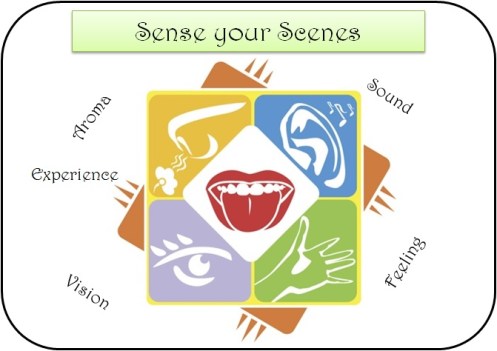 This image is one I have printed out on a card and hung near my desk when writing; it reminds me to apply all of my senses to a scene, to enrich the imagery and draw the reader in. Describe the sights, smells, sounds, feelings and taste of a scene; make it a sensory experience and it will be far more memorable; this is done through sentence structure and the pacing of those elements, but sometimes also through “camera angle” – looking at the scene from a particular perspective. How does your character feel in the moment? What are their perceptions? Does a smell remind them of something or someone? Here are a few tips to achieving these goals:





 Stephanie Huesler