This word is doubly obscure, at least for me: Whilom (c. 1200), means having once been; former; once upon a time, erewhile, or at times past. It comes from the Old English hwilum, meaning at times, and is related to today’s while. It is doubly obscure for me because it has a similar formation to an equally obscure German word, weiland, meaning formerly, of yore. This German word is related to the modern weil, which is a false friend to the English word; the German word means because. The relation between the two is not a far stretch, as because implies that something happened in times past, once upon a time.
What do you think? Should we bring back whilom? I think, at any rate, we should start using of yore every chance we get!
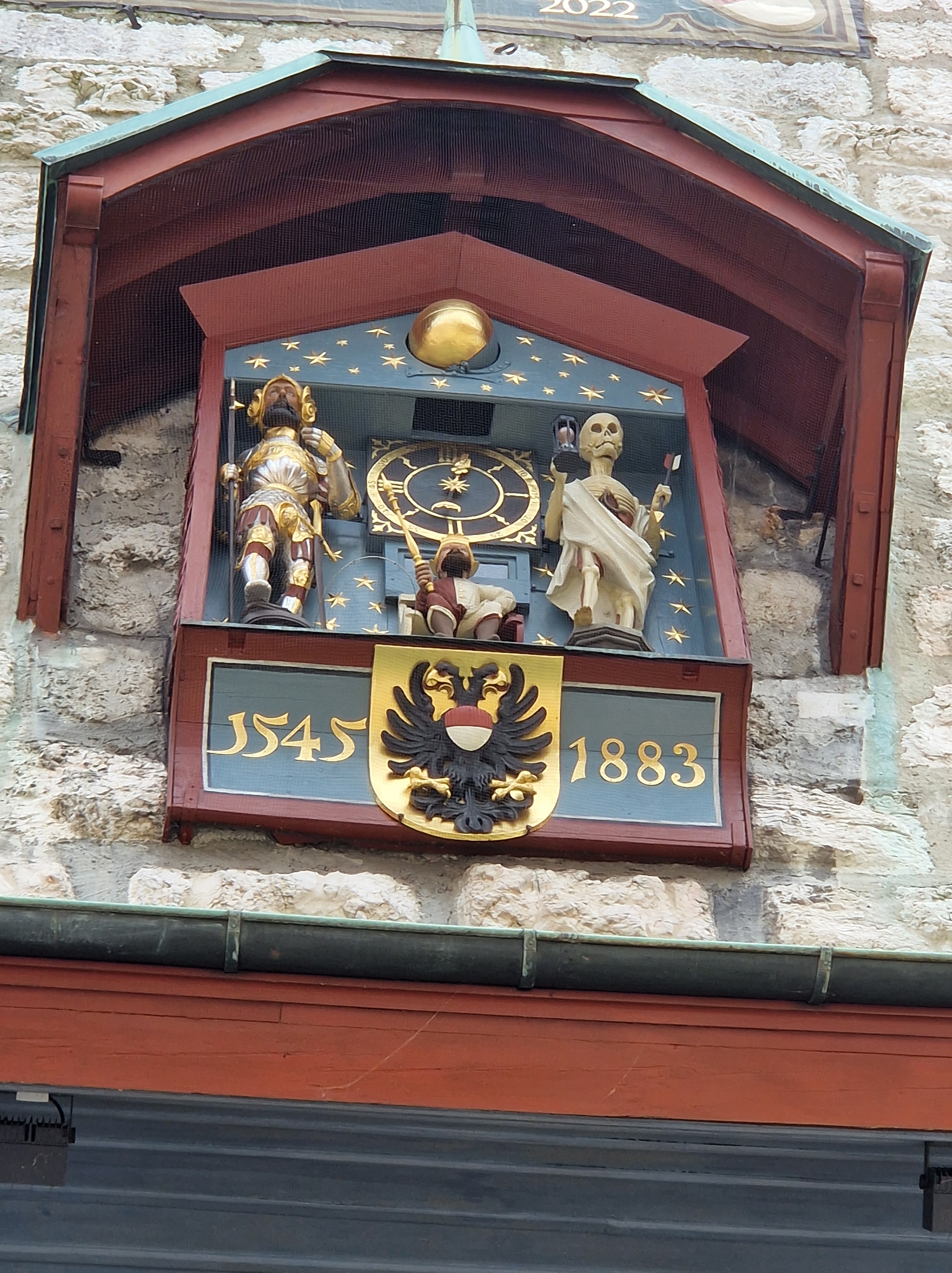
The baroque town of Solothurn, though only an hour away from our home, was unfamiliar to us until my husband and I took a day trip this week. It has a beautiful historical centre and is known as the “city of elevens”: It was the 11th canton to join the Swiss Confederation; there are 11 towers in the fortification walls of the city; there are 11 churches and chapels, and 11 historical fountains throughout the city; the stairs leading up to the St. Ursus Cathedral have landings every 11 steps; the cathedral itself has 11 altars and 11 bells; the local brewery, producing an eponymous beer, is even called Oeufi – which is a Swiss dialectical word for eleven. 11:00 is the most “auspicious” time to set appointments in the town, and there is even a clock, hanging on the wall of a local bank, which is segmented into 11 hours; it has 11 cogs and 11 bells, which are chimed by a metalwork sculpture of a harlequin on the hours of 11:00, 12:00, 17:00 and 18:00. The bells chime to the tune of the city’s unofficial anthem, the Solothurner Lied.
Solothurn’s history dates back to the palaeolithic era, and its Roman era is dated to around AD 15-25; it was first mentioned in AD 219 as vico saloduro, and may have referred to a Celtic settlement, possibly meaning “Salo’s fort/stronghold”. In the Battle of Sempach, July 1386, the Habsburgs attacked Solothurn; it was a decisive Swiss victory, and even more importantly, it helped to solidify the loosely allied Swiss Confederation cantons into a more unified nation and is seen as a turning point in the growing strength of Switzerland as a nation. Today, it is largely bypassed by tourists due to its proximity to Bern, the Swiss capital, so it remains a hidden gem.
Another interesting clock is the clock tower, the “Zeitglockenturm”, a tower built in 1152 and first mentioned as a “clock tower” in 1406. If you look closely, you’ll see typical rain spouts coming off of the corners of the tower’s spire and roof, shaped like dragon’s heads. The 24-hour astronomical clock was built by Lorenz Liechti and Joachim Habrecht in 1545. The sun and moon hands both run counterclockwise; the moon makes one complete rotation every 27 days, while the sun makes one complete rotation every 365 days.
According to the Roter Turm website, there’s a humorous story connected to the upper, 12-hour clock: By 1753 the hour hand and the bells were no longer in sync; a commission contacted the watchmaker Niklaus Pfluger, reminding him of his gild’s oath, i.e. his responsibility to correct the clock. He suggested to the local government council that they add a minute hand; but minutes were not so important in the 18th century, apparently – they told him to leave it as it had always been. He took matters into his own hands (I guess it was easier to ask for forgiveness than permission…) and in 1756, he added a minute hand. He justified it as the “warning hand of God” – but he made it smaller, less noticeable than the hour hand, so on this clock, the small hand shows the minutes, not the hours.
Because the clock tower was built and added to over time, you’ll see four dates on the full image of the tower: 1411 and 2022 on the highest, 12-hour clock; and 1545 and 1883 on the central tableau; the latter dates usually refer to restorations.
The three figures in the central tableau above the clock are a knight, king, and skeleton (Death), which perform every hour: The knight holds a battleaxe in his right hand, and a sword in his left; every quarter-hour, he turns his head toward Death and strikes his breast, signifying his loyalty to the central figure, the king. On the right stands Death; in its right hand is a hourglass, which is turned on the hour, symbolizing the contradictions of life – good, bad, life, death. In the other hand is an arrow, showing that one could be struck down at any moment. On the hour, its head turns toward the knight.
On the throne between these two figures is the king: In his right hand is a sceptre, which he lifts on the hour. His jaw moves in rhythm with the hour hand, and his beard represents wisdom. However, notice that he’s wearing red and white fool’s garb: If the king does not rule with wisdom and the humour of a fool, his reign will become a tyranny. It tells us that life should have moments of both wisdom and a jester’s humour.
While Death announces the hours, the king swings his sceptre. At the same time, Death nods with each stroke and confirms the relentless passing of the hours. The king with his fool’s garb reminds us of the memento mori. When death or illness reigns, even the power of a wise king can do little (Solothurn was hit by the plague, e.g. in 1348). Though the Freudian era banished death from contact with the living in many Western cultures, death personified as a skeleton is still a symbol seen in many countries around the world. Having death constantly before your eyes encourages you to savour each moment of life.
I hope you’ve enjoyed this brief glimpse into a beautiful city with an ancient history!
Today, I went with a friend to a large second-hand warehouse; it’s an organized treasure hunt of sorts. Every section is well-defined, so you know where to look if you’re looking for something specific, and don’t need to waste time scanning isles of glass dishes when you’re looking for office supplies. But it got me thinking about the whole topic and the cultural differences around the world.
When I first came to Switzerland, “Brockenhäuser” (or Brocki, as they’re called here) were few and far between; Swiss people weren’t usually found in such shops. I think Swiss people (and I can only really compare this to the Zürich area – perhaps in other areas of Switzerland the sentiments were different) used to have a sense of embarrassment, as if one wasn’t successful enough to buy new. But nowadays the importance of recycling has grown, and people have discovered the fun of treasure hunting.
I grew up in a region of America where garage sales were every Thursday through Sunday during summer months; my father and I were the most frequent hunters in our family, searching for treasures amongst the junk. I once found a 1920s white gold, 24-diamond dinner ring for 10¢! Someone had cleaned out grandma’s house and had no idea what they had; I took it to a jeweller to have it examined, so I knew that what I’d found was the real deal. I once took my Swiss husband along on the cultural experience when we were in the States on holiday, and he found a stack of pristine Life magazines of the first moon landing. They now grace our library shelves among the astronomy books.
In Britain, I know of some roads where nearly every other shop is a charity shop; one had a sign in the window asking for books, because they were selling nearly a thousand a week. Whenever I’m in Britain, I fly with as empty a bag as I can manage to leave room for charity shop treasures.
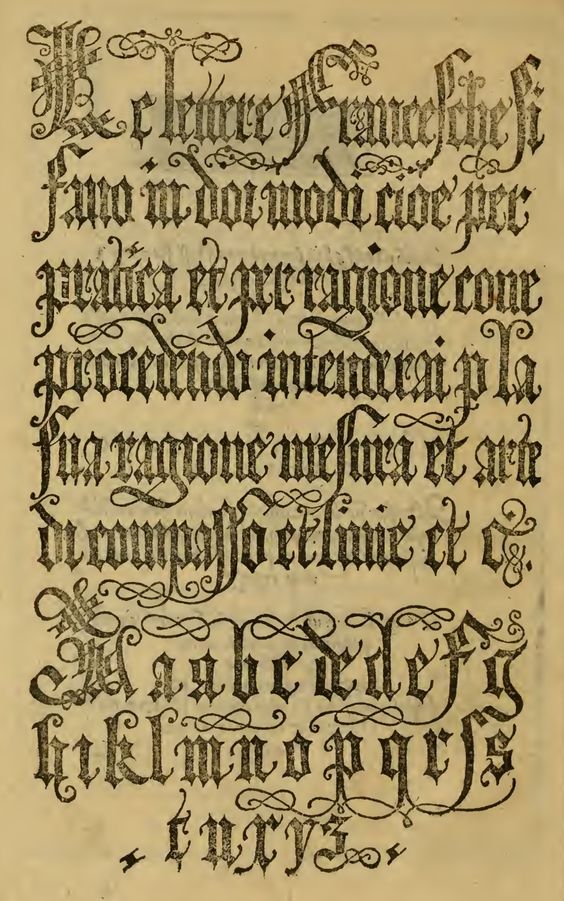
Fraktur Script
Today when I was at the shop, I was looking for specific things, mostly to do with crafts; I got a few antique German books (with the Fraktur script, often generically referred to as “Gothic text”); I’m fluent in German, but even I have to really concentrate to decipher the old type-text, especially as spelling has shifted or become more standardised. So honestly, I’m fine with using them in crafts, though the antique book lover in me fights to preserve them! I also bought sheet music for the same purpose. I kept an eye out for things I could use to make gigantic flowers with – that’s the next prop I’ll be making for our church stage area for the spring/summer season. In this particular shop, by the way, there are very few items with prices; once you get to the register, they assess what you’ve got, and calculate the set prices (such as the antique books, which ran from 3.- to 8.-); usually the end price for everything is quite reasonable – after all, they need to make room for the new inventory being restocked every 30 minutes!
What is the culture of second-hand shops in your region? Even within a country, it can vary wildly. Do you have boot sales, garage sales, thrift stores, charity shops, meet & swaps, buy-sell-trade shops, street markets, or another variety? I’d love to hear about your experiences! And if you’ve done any of the above, what was your best treasure find? Please comment below!
Recently, my mother sent me a link on Facebook and asked me to write an article about it; it’s definitely an interesting topic – so thanks, Mom!
First of all, for those of you who don’t know what a folly is:
In architectural terms, a folly is a building that is either constructed as decoration which suggests another purpose or is a practical garden building that transcends its purpose with extravagant features. An example of the former term would be buildings that were designed from the outset to look like ancient ruins, such as Wimpole’s Folly in Cambridgeshire, England; an example of the latter would be buildings like the Dunmore Pineapple in Stirlingshire, Scotland (I’ve been to this site a few times and was once able to go inside the pineapple). Designed to look like a giant pineapple, it was actually a working hothouse; that’s perhaps another story to tell. As for today’s topic, the folly of King Alfred would fall into the former definition.
Second of all, who was King Alfred, and why does he bear the sobriquet Great?
Statue of Alfred the Great at Wantage, Oxfordshire
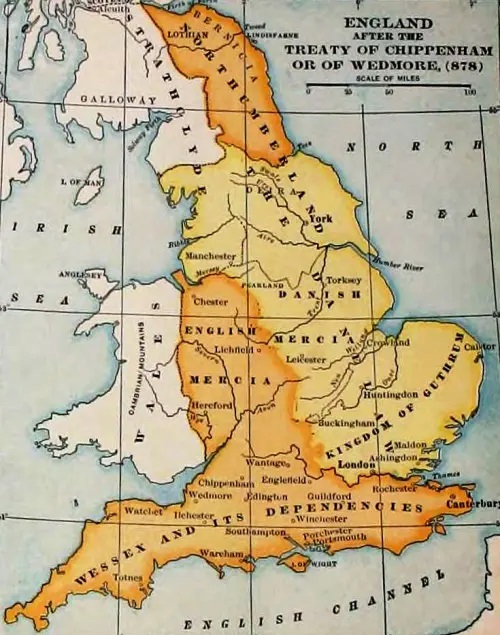
Born in 849 AD, Alfred the Great was King of the West Saxons from 871 to 886, and then King of the Anglo-Saxons from 886 to 899. He lived in a time when Viking invasions and warring tribes were common. Both of his parents died when he was young, and his three older brothers reigned before he eventually came to the throne. The battles, invasions and wars are too numerous to mention; to be a king meant to be at war. At the age of 21, he was already the King of the Wessex and a battle veteran. In early 878, the Danes struck like lightening, taking Chippenham (on the map below, you’ll see that it was in the heart of Alfred’s territories); inhabitants surrendered or fled, and it reduced Alfred and his men to hit and run means of getting provisions; they withdrew into the tidal marshes of Somerset (the area on the other side of the River Severn, just below Wales on the map below). Alfred reevaluated his strategy and learned from his enemy: He and his men began a guerilla war against the Danes, and by May, he’d defeated them in the Battle of Edington. Knowing that he would never be able to drive out such a powerful enemy, he made a treaty with them, establishing borders and what became known as the Danelaw territory; King Guthrum of the Danes converted to Christianity, with Alfred as his godfather and soon son-in-law as he sealed the treaty by marrying one of Guthrum’s daughters, Aethelflaed.
The Great comes from the fact that he united many of the disparate tribes; he recognized the deterioration in learning caused by years of disrupting wars and the Viking’s destruction of the monasteries, which were centres of learning and literacy. He recognized the fact that without widespread literacy, a king cannot rule – a people who were not united by a written language would be more vulnerable; but united through a common tongue, they would have a sense of loyalty and continuity in turbulent times. They would be able to adhere to laws, reach legal decisions, and be called to arms more readily if they could read a common language. He set out to make the English proud of being English and thus be prepared to fight for it.
By stopping the Viking advance against all odds, and consolidating his territories, he set the stage for future kings. His accomplishments in Wessex became the seed that eventually gave fruition to a united Anglo-Saxon England, which is why he alone among all kings or queens of England bears the sobriquet Great.
King Alfred’s Folly:
King Alfred’s Folly – Credit, Flickr, Andrew Bone
King Alfred’s Tower was built between 1769 and 1772. To put those dates into perspective, here are a few events from the year that construction began: 13-year-old Mozart, under his father’s control, was just finishing his third concert tour of Italy; James Watt improved his design for a steam engine that would spark the Industrial Revolution; King Charles III of Spain sent missionaries to California, founding San Diego, Santa Barbara, San Francisco and Monterey; Daniel Boone set out to explore what would become Kentucky; and finally, in August of that year, Napoleon Bonapart was born in Corsica.
The tower itself was built near the site of Egbert’s Stone, which is said to mark the mustering site for the troops of the Battle of Edington; the tower was intended to commemorate the end of the Seven Years’ War and the ascension of King George III to the throne of England. It was designed in the Palladian style (a European architectural style) by the architect Henry Flitcroft, at the commission of Banker Henry Hoare. While the reasons for commissioning the tower might be altruistic of Hoare, its site and magnificence might have had something to do with the fact that the tower was an eye-catcher for those touring the parks at his private estate, Stourhead.
Standing at over 40 metres high (131 feet) and a circumference of 51 metres (167 feet), it is completely hollow; it is a triangular structure with a round “tower” at each corner, though only one of them has a use – a spiral staircase of 205 steps, with no landing places along the dizzying ascent or descent. The only safety is a rope “railing” anchored occasionally along the central pillar of the staircase; passing others up or down can be a tight squeeze, and it is not a climb for the faint-hearted. Once reaching the top, you’ll find a crenelated parapet that surrounds a viewing platform offering a great view of the surrounding region; the centre of the platform is surrounded by a guard rail as it is a gaping hole straight down to the ground level; it’s covered with a mesh netting to prevent birds from using the tower as a dovecote.
In 1944, the tower was damaged when a Canadian single-engine plane crashed into it in the fog, killing all five aboard. In the 1980s, it finally underwent repairs and restoration; the statue of King Alfred above the main entrance was also repaired at that time, restoring a missing right forearm. A stone tablet (also in need of restoration) between the door and statue reads:
ALFRED THE GREAT AD 879 on this Summit Erected his Standard Against Danish Invaders To him We owe The Origin of Juries The Establishment of a Militia The Creation of a Naval Force ALFRED The Light of a Benighted Age Was a Philosopher and a Christian The Father of his People The Founder of the English MONARCHY and LIBERTY
Maybe this is something you’ve never stopped to think about, but everything we use on a daily basis was, at some point, invented, discovered or developed by someone. Before shoes, people walked barefoot, or wrapped leather around their feet in colder climates; before plastic, well, the world was far better off. But no matter where they lived in the world, or what their climate was like, people found ways to entertain themselves, or to have fun social interaction with board games, or with simple stones, sticks and rocks.
Even prehistoric people developed games to pass the time: The Mesopotamians had the Royal Game of Ur; in Egypt and across the Middle East, they played a game referred to as Fifty-eight Holes. A game that goes back thousands of years, with many different simultaneous versions across the world, is Mancala / Sungka / Congkak, played with hollowed dips (which could be made in dirt, wood, or stone) which players fill sequentially with stones or shells or nuts (whatever was readily available in their region of the world). As reading and writing became more widespread, word games and written riddles became popular.
In 1913, the journalist Arthur Wynne, working for the New York World newspaper, submitted the world’s first Crossword Puzzle (image below), which appeared in the Sunday paper on 21 December. An immigrant from England, Wynne based his idea on the magic square (in recreational mathematics, this is a square arrangement of numbers in which the sum of numbers in each row, column and both main diagonals is the same). In this concept, a given set of words would need to be arranged so that they form a square; but in Wynne’s version, the words had to be discovered first. The first puzzle contained 31 terms, with the word “fun” already filled in as an example.
In the beginning, crosswords (originally called Word-Cross Puzzles) were in a diamond shape; within a few years, the crossword craze had taken off, and eventually, the shape morphed into a square grid with blank or black cells where voids occur.
Today, crosswords have more competition: word search puzzles, scrabble, anagrams, ciphers, and various forms of Sudoku are the strongest contenders for puzzlers’ free time.
What is your favourite word puzzle type? Please comment below!
Picking up from where I left off in February, here are a few more everyday phrases that have been gleaned from the times when ships at sail were the most influential source of importing new ideas, foreign words and catchy tunes (such as shanties). The first of these phrases might be recognized by Star Trek fans, as the captain usually used this term or something similar to hand over the authority of the ship whenever he left the bridge.
Take the Conn: A term used to take over navigational duties on the bridge of a ship (this comes from the mid-1800s, during the age of iron-clad warships). Idiomatically, it means to take control of a situation. The word conn is either a noun or a verb and comes from conning tower – a raised platform from which the entire deck and surrounding environment can be observed.
Sailing Close to the Wind: Strong winds can be just as problematic at sea as no wind; strong winds can unexpectedly shift and take control of a boat’s direction, and many sailors will lower their sails until more favourable conditions exist. To use strong winds for sailing is risky and unpredictable but sometimes necessary; the modern term refers to taking risks that may be unreasonable, being close to breaking the law or going too far.
All Hands on Deck: A call to action – everyone must assist in resolving a problem or addressing a situation. During inspection or trouble, all hands were called to the deck; everyone needed to be present or accounted for, and working as directed.
On the Right Tack/Track: The correct course while sailing requires you to tack or move the sail to catch the wind to keep you on course. To take the wrong tack means to be off course, heading in the wrong direction. Tack has changed to track in a more modern language. Today it refers to Taking the line/course of action that leads to the correct conclusion.
Overboard: If cargo or people went overboard when sailing, the call “overboard” would be yelled out to draw attention to the event. With luck, the items or people could be recovered, but unfortunately, this was not often the case.
Abandon Ship: When a ship was sinking or being overrun by an enemy ship, sailors would need to abandon their posts and escape. The call to abandon the ship was considered a last resort.
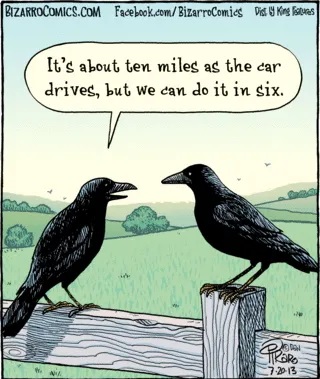
As the Crow Flies: After crossing the oceans, sailors would watch for birds to detect nearby land. Following the direction of birds, such as a crow or seagulls, got them closer to shore to follow it to a port. Crows fly straight, and so it refers to the shortest distance between two points.
Tide Over: When a ship could not get under sail due to poor winds, they would ride the tide until the winds returned. If something tides one over, it will last until new provisions can be obtained or until conditions change.
High and Dry: If a ship was caught in low tide or ran up on the shoals, it might end up being stranded with no hope of recovery. The term was to be caught high and dry, as in up out of the water. It’s used today to describe the feeling of being abandoned, stranded, or helpless.
Sink or Swim: Tossing a person overboard resulted either in them sinking or swimming. The term was made popular in swashbuckling movies featuring pirates deciding on whether they should spare their captives or not. Today, it refers to either failing (sinking) or succeeding (swimming) in a task or an endeavour.
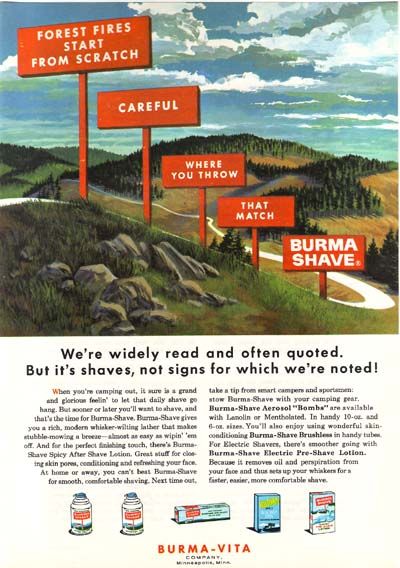
For those outside of the US and/or Millennials, the term “Burma-Shave” might be new to you – which is why I’d like to “undust” this fascinating little piece of history.
The 1920s was a time of change; World War 1 was over, and the following Spanish flu had wiped out more people than the war itself; the survivors just wanted to celebrate life. Out went the starchy mentality of Victorian dresses and in came the flappers; innovations and scientific breakthroughs fed the hunger for the new and anything that made life easier.
At the time, men shaved themselves with shaving cream applied to the face with a brush and a straight razor blade (still common into the 1950s, when the double-edged safety razor began to gradually take over).
Enter, the Burma-shave brushless shaving cream: Introduced in 1925 by the Burma-Vita Company in Minneapolis, Minnesota, it was purported to have come from “the Malay Peninsula and Burma.” It was, in fact, a result of chemical experiments by chemist Carl Noren. The monicker was a marketing gimmick, much like products touting to be “Swiss” that are unknown here (even “Swiss cheese” – which one of the hundreds is meant?). The cream didn’t really take off, and while other similar products were coming out of larger companies such as Barbasol and Gilette, Burma-Shave managed to beat the odds when their clever advertising campaign was hit upon.
Around this time, the Ford Model T had become a huge success, with millions of new automobiles on ever-expanding road systems. Roadside signage was taking off, and the advertising gimmick was destined to go down in history as one of the quirkiest success stories.
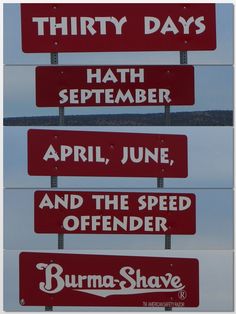
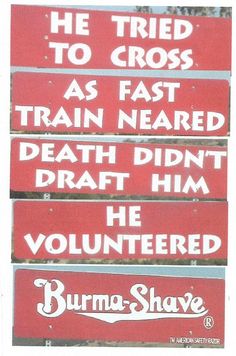
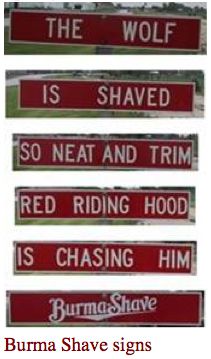
Burma-Shave ads were a series of signs along the road that concluded in the sign saying “Burma-Shave”. The first couple of years, the signs were rather prosaic ads for the company; but as they began bringing in repeat customers, the signs became bolder and more experimental. They became more humorous rhymes – usually five signs, with a sixth ending the series as “Burma-Shave”.
Here are a few examples:
Shaving brushes / you’ll soon see ’em / on the shelf / in some / museum / Burma-Shave (1943)
Uncle Rube / buys tube / one week / looks sleek / like sheik / Burma-Shave (1930)
A shave / that’s real / no cuts to heal / a soothing / velvet after-feel / Burma-Shave (1932)
Shaving brush / and soapy smear / went out of / style with / hoops my dear / Burma-Shave (1936)
The Burma girls / in Mandalay / dunk bearded lovers / in the bay / who don’t use / Burma-Shave (1937)
As cars began to speed up, safety messages increased around 1939:
Hardly a driver / Is now alive / Who passed / On hills / At 75 / Burma-Shave (1939)
If you dislike / big traffic fines / slow down / ‘till you / can read these signs / Burma-Shave (1939)
At crossroads / don’t just / trust to luck / the other car / may be a truck / Burma-Shave (1939)
Don’t pass cars / on curve or hill / if the cops / don’t get you / morticians will / Burma-Shave (1940)
At intersections / look each way / a harp sounds nice / but it’s / hard to play / Burma-Shave (1941)
When World War 2 came around, the signs reflected the social conscience:
Maybe you can’t / shoulder a gun / but you can shoulder / the cost of one / buy defence bonds / Burma-Shave (1942)
Shaving brush / in army pack / was straw that broke / the rookie’s back / use brushless / Burma-Shave (1942)
Slap / the Jap / with / iron / scrap / Burma-Shave (1943)
Tho tough / and rough / from wind and wave / your cheek grows sleek / with / Burma-Shave (1943)
A few humorous signs:
She kissed / the hairbrush / by mistake / she thought it was / her husband Jake / Burma-Shave (1941)
We know / how much / you love that gal / but use both hands / for driving pal / Burma-Shave (1947)
I use it too / the bald man said / it keeps my chin / just like / my head / Burma-Shave (1947)
Road was slippery / curve was sharp / white robe, halo / wings and harp / Burma-Shave (1948)
If you think / she likes / your bristles / walk bare-footed / through some thistles / Burma-Shave (1948)
A man / a miss / a car – a curve / he kissed the miss / and missed the curve / Burma-Shave (1948)
Our fortune / is your / shaven face / it’s our best / advertising space / Burma-Shave (1963)
Toward the latter part of the signage, they began recycling earlier messages. Road signs and maintenance became increasingly expensive, and cars sped by faster than ever. The signs disappeared from the roads in 1963 when the company was sold to Phillip Morris and they discontinued the marketing campaign, which turned out to be a mistake; sold once again, the product eventually disappeared, but the term “Burma-Shave” can still be heard, referring to short, quirky rhymes.
I hate to end / this fun article / but time is short / so here’s what’s possible / Burma-Shave examples from Pinterest:
This illustration is from “A History of the Burma-Vita Company”, written by Frank Rowsome Jr. and illustrated by Carl Rose (published by the Stephen Greene Press in 1963).
The topic of this article has been on my mind for the past two weeks; last week flew by so fast I barely had time to blink, let alone order my thoughts into coherent sentences. The topic was sparked by coming across an article online about what is known as the “Milan Conference” or “The Second International Congress on Education of the Deaf” (though it was, in fact, the first), held in Milan, Italy in 1880.
To give you a bit of my personal background, I learned BSL (The Glaswegian dialect) and translated for the deaf when I lived in Scotland. Being as close to that community as I was, I’d shockingly never heard about the Milan Conference until a fortnight ago.
When I first moved to Switzerland, I wanted to continue working with the deaf and began taking Swiss German sign classes. I immediately began hitting brick walls: The crux of the matter was spelled out – they didn’t want hearing people in their world. It made little sense to me back then, and it was frustrating. Also at that time, my husband wasn’t yet hearing impaired – which would have made a difference in their attitude toward me, as people with family members affected by hearing loss were more acceptable to them. In light of the Milan Conference, their reticence makes perfect sense. I never was able to break that barrier, and I’ve lost much of the sign language I once used fluently.
The conference was an international gathering of (hearing – with only ONE exception) educators of the deaf and mute. The imperialist arrogance of the discriminating resolutions passed profoundly wounded and damaged the deaf community for nearly 100 years.
To sum up the conference’s resolutions briefly, the majority decided that sign language was disadvantageous to integrating the deaf into the hearing world, and they banned – yes, banned – sign language from the education of the deaf in favour of “oralism” – forcing the deaf to read lips to make them assimilate to the hearing world’s culture. Deaf teachers lost their jobs, and an overall decline of deaf professionals resulted – they were no longer allowed the tools to communicate in their own language, and communication professions such as artists, lawyers and writers fell silent. Here in Switzerland, there was a two-fold impact: Deaf children were forced to sit on their hands and learn to lip-read from High German-speaking teachers; but when they went home on holidays, they couldn’t lip-read their own family’s dialects of Swiss German, and so they were isolated from society both in school and at home. The anger and resentment to the hearing world still runs deep.
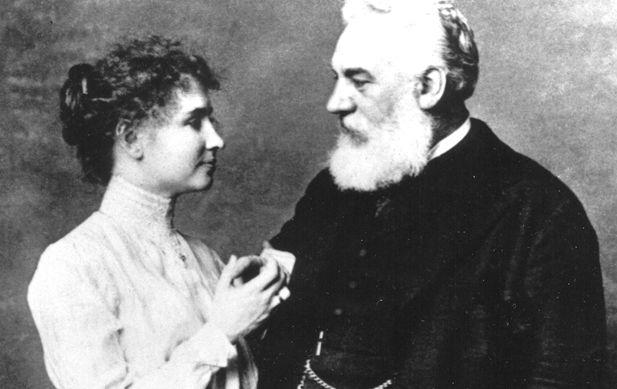
Most disturbing for me is the fact that Alexander Graham Bell, whose own mother and wife were deaf and who worked with the deaf throughout his life – including helping bring Helen Keller out of her silent world as a blind and deaf girl – was one of the strongest proponents for oralism at the conference. The most famous picture of Bell and Keller is one in which Keller is finger-spelling on Bell’s hand. It is a form of sign language. Yet he advocated to eradicate it.
The resolutions of 1880 held their ground until they were overturned in 2013 when an official apology was issued to the deaf community. Eleven years ago. Let that sink in. Inroads were made to teach sign in pockets here and there; in America, most schools for the deaf only began teaching sign language again in the 1960s; in the UK it was around a decade later. Generations suffered under the restriction. [For those who have been deaf their whole lives – what’s known as pre-lingually deaf – it means that sign language is their first language, while spoken English is their second; this can lead to difficulties in understanding complex or abstract messages in English. Imagine being denied your own native language…] Only in 2003, the British government recognised BSL as a minority language – but so far, Scotland is the only country in the UK that has given BSL legal recognition. The shift in understanding and recognition had already been set in motion by the time I’d moved to the UK, which is perhaps why the Milan Conference was no longer a topic when I was involved in the deaf community.
The ban is the main reason there are so many regional dialects today: Even though sign language was officially banned, the deaf still needed to communicate among themselves, and so signs evolved “under the table” within each pocket of deaf students. There was no exchange of information; for example, “bread” took on the shape of the local speciality, so in the French part it looks like a long baguette, while in the Zurich region, it looks more like a half-sphere. There are 5 major Swiss-German dialects; in Scotland, there were at least 7.
Please click here to watch a ~13-minute video by Storied about the history of sign language and the Milan Conference. If you’d like to learn more about the timeline of sign language in Britain, please click here to visit University College London’s website, and to learn more about BSL in Scotland, click hereto read the Scottish Parliament’s article.
ASL, American Sign Language, also has a forgotten predecessor that was largely written out of history: The Plains Indian Sign Language, also known as “hand talk”. For an interesting video about that history, click here.
I hope you’ve enjoyed this brief insight into a long and tangled topic, and that it encourages you to look into it more.
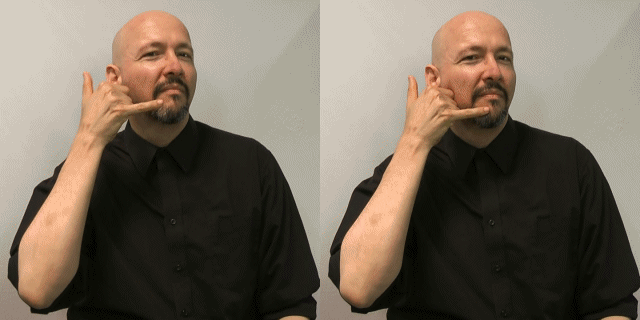
Just as a parting trivia: Everyone recognizes the sign for phone; but did you know that it became a euphemism in some deaf communities for the restroom/loo? Back when restaurants had their public phones near the “small closets”, the Deaf would sign “phone” as a polite, covert way of saying they were going to the restroom/loo.
Below are the British Sign Language and the American Sign Language alphabets; I’d encourage you to learn one or the other and stretch those grey cells a wee bit!
Some of today’s nautical idioms are well known, such as to be on board with a proposal or suggestion or learning the ropes in a new job or position, while others, such as three sheets to the wind are less common (unless you happen to work in a bar – then it may come in quite handy). Either way, enjoy these, matey!
Be On Board: As part of a crew, a sailor bore their part of the responsibilities. In today’s terms, it means to accept or agree with a proposal or a way of doing something and go along with it.
Rats Deserting a Sinking Ship: Rats and mice were common aboard ships, often in the bulkhead (lowest section of a ship, where the grains were stored (the weightier things being stored low and balanced to keep the ship sturdy in rough seas). If the ship began to take on water, the rats would go up the deck ladders to stay away from the water; if they started jumping overboard, sailors wouldn’t stand much better of a chance (most sailors could not swim). It’s a vividly grim picture of life aboard. Now, it’s an idiom describing people abandoning a failing activity or situation.
Close/Tight Quarters: Tightly packed (e.g. people in a small space). Space was at a premium, especially on the lower decks of a ship of sail. Men slept in hammocks close together and shared the space with stowed ship equipment and their own storage chests. Even today on submarines, bunks are shared by those who are off-duty and those on-duty to save sleeping quarter space.
Run a Tight Ship: Manage and organization strictly, efficiently, and effectively. A ship, especially in times of war, was run tightly to avoid unnecessary dangers and/or deaths, and to maintain discipline that would be needed to succeed in crucial moments.
Learn the Ropes: Sails were raised and lowered with ropes, and knowing how to control the sails allowed a ship to take full advantage of the wind and sail safely. There were miles of ropes on a ship, each with an important and specific function. Learning the ropes was essential for everyone aboard – it would keep others out of danger and oneself alive! Today, one learns the way things are done in a given setting or situation.
Broadside: The broadside was the side of the ship which sat above the waterline; cannons were arranged on several decks, and when ships sat broadsides facing, firing simultaneously, it was known as broadsiding. Today, it refers to being taken off guard or being surprised by something unpleasant.
Broad in the Beam: Describes the width of the beam or mast on a larger ship. It denotes a person who’s wide across the hips and buttocks.
Keel Over: To collapse, to die. If the keel of a boat were to rise out of the water, the ship would be in danger of capsizing; this might happen due to a storm or damage by an enemy attack.
To Keelhaul: To rebuke harshly. It was a punishment meted out in extreme cases by dragging someone, ankles weighted, by ropes beneath the ship along or over the keel (the backbone of wood along the bottom of the ship). As these were usually covered with barnacles, clothes and skin would be shredded by the barnacle shells, and if the salt water of the ocean didn’t disinfect the wounds on the way up, it could be a death sentence. How much it was actually practised is difficult to say, as written records are sparse (perhaps a cruel captain didn’t want it on record, or perhaps it was not as widely practised as we think); the most concrete records of the punishment come from the Dutch. It was banned by the British Royal Navy around 1720, and by the Dutch around 1750. That bans were necessary tells its own tale…
Three Sheets to the Wind: Implies an unsteady, drunk person. The sheet referred to the ropes (lines) used to control the trim (the advantageous angle of the sails in relation to the wind) of the sail. If the sheets are loose, the sails will flap in the wind which causes the ship to lurch about like a drunken sailor. There are variations of the number of sheets in the idiom: 1 would be tipsy, 3 would be staggering drunk!
My past two articles have been about everyday phrases with maritime roots; not only is a language affected by sailors, but sometimes entire populations.
Around the British Isles, there have been countless shipwrecks. The waters can be treacherous, with islets and rocky outcrops just under the waves – splinters of divided continents worn down by the power of the sea until they become hidden snares. My husband and I were once on holiday on St Mary’s, Scilly Islands; with every tide, flotsam fragments of shipwrecks (nearly 1,000 known so far) from the 16th through the 19th centuries wash ashore, and I gathered a handful of beach pottery and glass, not knowing at the time that the worn but still decorated pieces could be centuries old. Buried beneath the sand, they’d retained their colourful glazing until washed ashore.
That’s the goods and plates aboard; but what of the people? Many sailors of past centuries couldn’t swim; if their ships foundered too far from shore, they sank to Davy Jones’s Locker. Those who were fortunate enough to make it ashore were not guaranteed a safe sojourn; if the island had scant supplies, it could get ugly – as it did for Spanish sailors on Fair Isle (more on that in a moment). But first, a brief background on the situation that led to the Spanish Armada being in British waters, and their shipwrecks:
The reasons the Armada moved to attack England are complex; let’s just say that Philip II, heir apparent to the Spanish throne, had married (in a political manoeuvre) Bloody Mary, the Catholic queen of England, who’d had her Protestant half-sister, Elizabeth, placed under house arrest to prevent any political ambitions from growing in the Protestant faction. When Mary died childless, Philip (King of Spain and Portugal, as well as of Ireland and England through marriage and until Mary’s death in 1558) returned to his own kingdom in Spain, and Queen Elizabeth I ascended to the throne of England. But being the daughter of King Henry VIII and his second wife, Anne Boleyn (whom he’d had executed when Elizabeth was two years old), Elizabeth was illegitimate in the eyes of many Catholics, as her parents’ marriage had been annulled two days before her mother’s execution. Ironically, confinement hadn’t taught Elizabeth any compassion; she had her Catholic cousin, Mary, Queen of Scots, imprisoned for nineteen years, and eventually executed in February of 1587. Mary had been Spain’s Catholic ally, and her death was the final straw for Philip II of Spain, as the religious tensions had been mounting between England and Spain. Philip prepared his Armada, sailing out of Lisbon in 1588.
If you look at a map of Europe, you will see that Spain is southwest of the British Isles; they had to sail through the Bay of Biscay, and then either west of England through the waters between England and Ireland, or east through the English Channel and French waters (and the French were usually at war with everyone) to reach the east coast of England.
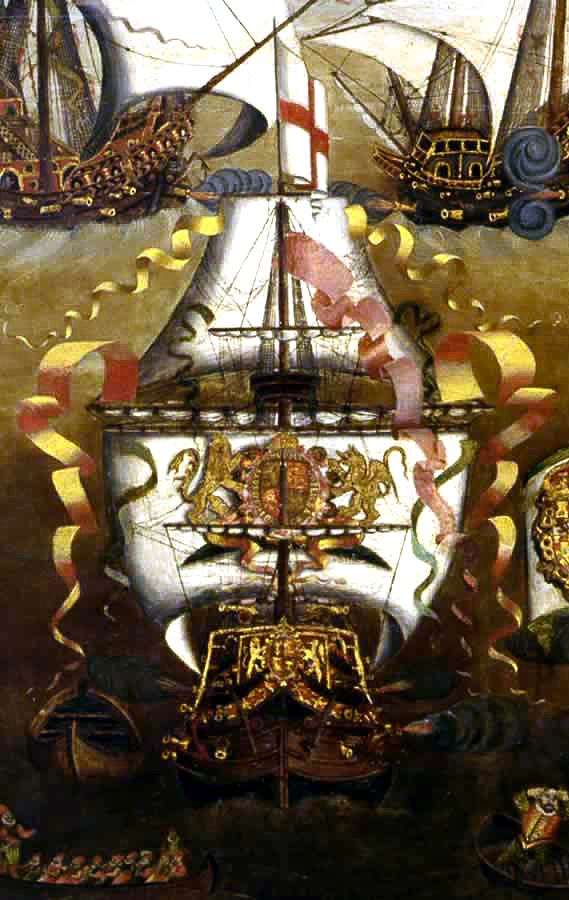
Sir Francis Drake’s Revenge, with Armada ships in the background. Credit, Wikipedia
The battle ensued; the English ships had superior long-range cannon, with which they harried the Spanish fleet. Weather and prevailing winds interfered; battle lines were redrawn, only to be scuppered again. In August 1588, the Spanish fleet had been defeated by Sir Francis Drake’s command of the English ships, and the remnants of the fleet retreated into the North Sea. By early September, seventeen ships had been lost to storms. Many of the ships not sunk by the British navy or taken out by the sea were blown onto the rocky shores of Ireland and Scotland; of the 150 ships that set out from Lisbon, only 65 returned.
Replica of the 16th century Spanish Galeón Andalucía. Photo credit, Fundacion Nao Victoria. Click on the image to see details about the ship.
Three of the ships were separated in the storm from the rest of the fleet: The Barca de Amburgo foundered off of Fair Isle, but the crew was rescued by the El Gran Grifón and the Trinidad Valencera. With the extra crew aboard, the El Gran Grifón tried to anchor to make repairs but was wrecked on the rocks of Stroms Hellier, Fair Isles (a steep, rocky outcrop of land halfway between Shetland to the north and Orkney to the south). According to historian Sir Robert Sibbald (1641-1722), the crew was on the island for two months (~August-September 1588); though they paid for their supplies, tensions were high with locals as food stores were meagre and “Spanish money doesn’t fill hungry bellies”. The island itself has never supported more than 400 inhabitants (today’s population is 65); the Spanish shipwreck brought 300 to shore. 50 of the crew either starved to death or were killed when the locals turned on them: Any Spaniard found alone was tossed over a cliff; when that wasn’t efficient enough, the islanders deliberately collapsed a flagstone roof over the sleeping crew.
The survivors fled; some to Shetland, and some to Orkney. Enter that dusty bit of history, the Westray Dons.
Westray is the northernmost island of the Orkney archipelago, a group of 70 islands*, 16 of which are inhabited (*or more, depending on who you ask – skerries or uninhabited islets may or may not count). They not only welcomed the Spaniards but intermarried with them. The men remained on the island, and their descendants became known as the Westry Dons. Spanish heritage is still seen in the Orcadian population today, though the Dons are no longer a separate community; Orkney has a higher percentage of dark-haired, dark-eyed inhabitants than any other Scandinavian-heritage region. Orcadian oral tradition, according to the Sanday folklorist Walter Traill Dennison, says that the Dons were exceptional seamen, many of whose descendants went on to become sailors and sea captains. The Dons largely adopted Orcadian surnames, the most common (but not exclusively) being Petrie, Hewison, and Reid.
I hope you enjoyed this quick dive; if you’d like to read and hear a Scottish song about the Dons, just click here (warning: It’s in thick Scottish brogue!).
To see a timeline of the Spanish Armada battle, just click on the image below.














 Stephanie Huesler