Category Archives: Military History

History Undusted: The CB Radio

You know how your brain fires off random thoughts as you fall to sleep, or combines odds-bods into dreams forgotten as soon as you wake up? For some reason, 10-4 popped into my head in those moments last night. It sent me down the rabbit hole I now present: The history of the CB radio.

The often-forgotten or overlooked inventor of the Citizen’s Band (CB) radio system, along with inventions such as a patented version of the walkie-talkie (originally invented by the Englishman Donald Hings), the telephone pager, and the cordless telephone – all precursors to today’s cell phones, was Al Gross (1918-2000): Born in Toronto, Canada, he grew up in Cleveland, Ohio. The son of Romanian-Jewish immigrants, his love for electronics was sparked when, at the age of nine, he was travelling by steamboat on Lake Erie; he explored the ship and ended up in the radio transmissions room, where the operator let him listen in. Eventually, he turned the family’s basement into a radio station built from scraps. During his higher studies, he experimented with ways to use radio frequencies.

During World War 2, he had some involvement with developing a two-way VHF air-to-ground communications system for the U.S. Office of Strategic Services, known as the Joan-Eleanor system, and after the war, the Federal Communications Commission (FCC) allocated a few frequencies for the Citizens’ Radio Service Frequency Band, in 1946. Gross saw the potential and founded the Gross Electronics Co. to produce two-way communications systems to make use of these frequencies; his firm was the first to receive FCC approval in 1948. For more about his other inventions, just follow the link on his name above. For now, let’s focus on the CB:

The CB radio became an international hit back before cell phones and computers became a thing (despite the prevalence of cell phones, CBs are still around; truckers still communicate about road conditions, etc. Its usage was also revived by the Covid lockdown, when people began reaching out to meet and talk to others outside of their own four walls). It was, and is, a way to communicate with others long-distance from home or on the go.

My dad was always interested in the latest technological gadgets; in the mid-70s, we got a laserdisc player, the precursor of CDs, and DVD/Blu-Ray players. I remember watching films like Logan’s Run and Heaven Can Wait on that format. Laserdiscs never really took off, and only about 2% of US households had one (it became more popular in Japan at the time). Around that time, we also got a CB radio in our VW van. My dad had a chart with all of the CB slang words and codes, and I memorised it, fascinated by the lingo. On long road trips, I would get on the CB and chat with truck drivers. My handle (nickname) was Spider-Fingers, as I liked spiders and had long fingers (long fingers has the connotation of thief, so I didn’t want to use that!). Here is just the tip of the iceberg, a smattering of the codes and slangs used by CB radio enthusiasts, truckers and handymen:

There were dozens of slang terms for law enforcement officers: Bear (police officer); bear trap (speed trap, radar trap) taking pictures, also called a Kojak With A Kodak; bear bait (an erratic or speeding driver); bear with ears (listening to CB traffic); bear in the air/flying doughnut/Spy in the sky (helicopter radar traps), baby bear (rookie), fox in the henhouse/Smokey in a plain wrapper (policemen in unmarked vehicles); honey bear, mamma bear or Miss Piggy (slangs for female police officers); Brush Your Teeth And Comb Your Hair (a law enforcement vehicle is radaring vehicles – as if preparing for an official photo). A Driving Award was a speeding ticket. To wish someone Shiny side up meant that you wished them safe travels (keeping the vehicle upright).

There were slang terms for objects or events, such as Bambi, meaning that there was wildlife near the road and to take precautions; a crotch rocket was a fast motorcycle; double-nickels was a 55-mph speed limit area; a fighter pilot was an erratic driver who switched lanes frequently, while a gear jammer was someone who sped up and slowed down frequently; Alabama chrome was duct tape; an alligator/gator was a piece of blown tire on the highway, as it looked in the distance like a gator sunbathing. Convoys had front doors and back doors – the front or back truck in the group that would keep an eye open for bear traps. Motion lotion was fuel; the hammer lane was the fast lane (hammer was the gas pedal, and to hammer down was to drive full-speed). Break/breaker: Informing other CB users that one wanted to start transmission on a channel; a handle might be introduced, or requested if someone was looking for a CB friend. “Breaker, this is Spider-Fingers, over.” Asking for a comeback meant that you couldn’t hear the last transmission or wanted the other driver to talk. Break check meant traffic congestion ahead, slow down. A Bumper Sticker/hitchhiker is a vehicle that is tailgating another vehicle.

Aside from hundreds of slang terms, there was a whole list of codes (I guess you could say that the codes were the precursors of emojis!):

10-4: Agreed, understood, acknowledged

4-10: The opposite – asking for agreement or if a transmission was received.

10-6: Busy, stand by

10-7: Signing off

10-10: Transmission completed, standing by (you’ll be listening)

10-20: Location – What’s your (10-)20? Home-20 was asking for a driver’s home location/base.

10-33: Emergency traffic, clear the channel. CB code for Mayday for trucks and police cars.

10-42: Accident on the road

3s and 8s: Well wishes to a fellow driver. Borrowed from amateur ham radio codes “73” (best regards) and “88” (hugs and kisses).

The lists go on and on! I love the dry sense of humour reflected in the slang, and I think our everyday language could be a bit livelier if we included a few phrases that looked at things from a different perspective. Everyone could do with more 3s and 8s, 4-10?
1 Comment

Filed under Articles, Etymology, Family History, History, History Undusted, Humanity Highlights, Humor, Liguistics, Linguistics, Links to External Articles, Military History, Science & Technology

History Undusted: MacGyver and Blue Peter

This week’s topic arose from a conversation with my husband; we were discussing a temporary fix we had made at his mother’s home to make something usable until we could find a permanent solution. I said that we had “MacGyvered” it, and he had never heard the word before. That led me down a rabbit hole to naval flags, a card game, and British tele.

First, MacGyver: Though I knew the term, I had no idea what its origin was. The name comes from the eponymous character in a US television series that ran from 1985 to 1992; Angus MacGyver was a non-violent, resourceful genius, and his favourite tool was, of course, a Swiss Army knife. Though I was living in the States at that time, its running years explain why I didn’t know of the origin: In 1985, I was in college, having finished high school a year early (I took my final two years in one); I was too busy to watch television. In 1986, I moved to Hawaii to do a Discipleship Training School (DTS) with Youth With A Mission (YWAM), and went from there to the Philippines, where we worked in the red-light district of Olongapo. 1987 was a year of multiple jobs, earning money and hanging out with college friends – again, TV was not a priority. In 1988, I emigrated to Scotland.

The traits mentioned above made MacGyver a verb; when something is “MacGyvered“, a simple yet elegant solution to a problem is employed by using existing resources. At my mother-in-law’s home, we needed to level a new microwave that was sitting tilted atop the welded inserts that fit the original one. Our solution was to use an actual leveller, removing the end caps to make it fit inside the metal frame.

Now, down the rabbit hole: In the time of British ships of sail, when a blue flag with a white square or rectangle in the centre flew alone, it served as the sign for imminent departure (signifying P, leaving port); any passengers and crew in port would then return to the ship. The flag came into use in 1777, and by the turn of the century had become known as the blue peter. I have my suspicions that the term may have come from the card game of whist, in which a strategic manoeuvre known as the “blue peter” calls for trumps by throwing away a higher card of a suit while holding a lower one. No one can say for sure which came first, the ship or the card, so to speak, but the connection is likely.

The British children’s television programme, Blue Peter, first aired on 16 October 1958; the name was inspired when Owen Reed, the producer, was inspired by a radio programme for children (produced by Trevor Hill) that began airing on television once a month; it was launched aboard the MV Royal Iris ferry on the River Mersey, Liverpool, with presenter Judith Chalmers standing at the bottom of the gangplank to welcome everyone aboard. Reed was so captivated by the idea, and with the blue peter flag, that he asked to rename the programme (then called the Children’s Television Club) and take it to London.

Blue Peter, catering to younger children, is the longest-running children’s TV programme in the world; over the years it has changed with the times, and its content is wide-ranging, but they still give a nod and a wink to that original blue peter flag by giving out badges in the shape of a shield with a blue ship of sail on a wave. It is awarded to viewers for achievements, efforts, or creative work. There are different levels of badges, with the gold badge being the most prestigious; this is usually given to presenters upon their retirement or to people who have accomplished something extraordinary.

Among other things, the show is famous for its segments of “makes” – demonstrations of how to make useful objects, or how to make something to eat. This is the element that linked the term Blue Peter to MacGyver in my mind, so now ya know!

What is something that you have MacGyvered? And do any of my British followers know if “Blue Peter” is used as a verb in a similar fashion? Please comment below!
Blue Peter Badge

1 Comment

Filed under Etymology, Family History, History, History Undusted, How It's Made, Liguistics, Military History

History Undusted: Code Talkers

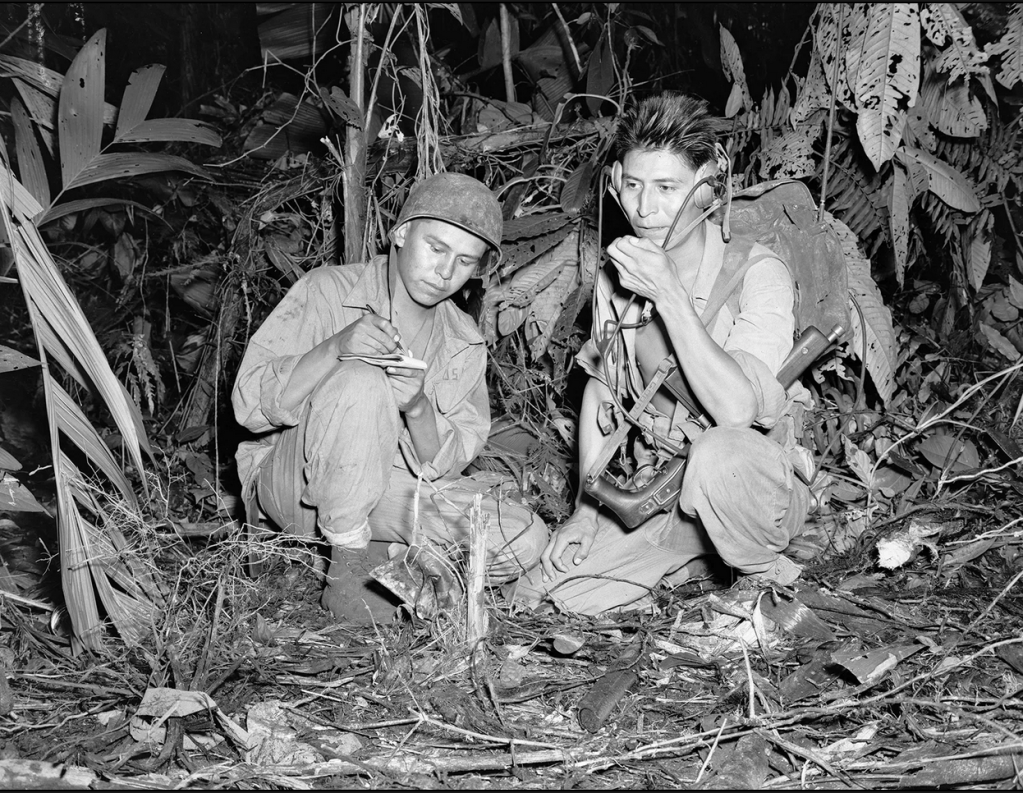
Navajo code talkers, Cpl. Henry Blake Jr. and PFC George H Kirk, who served with the Marine Signal Unit.
Source: Public Domain

Code talkers were Native Americans from various tribes who were employed by the US military during World War 2 as radio operators; their native tongues were indecipherable to anyone listening in, and as a result, their transmissions of sensitive messages were invaluable in allied victories on every Pacific island, including Iwo Jima, as well as in Europe in decisive battles.

Codes were developed based on the languages of the Assiniboin, Cherokee, Cheyenne, Choctaw, Comanche, Cree, Crow, Fox, Hopi, Kiowa, Menominee, Navajo, Ojibwa, Oneida, Osage, Pawnee, Sauk, Seminole, and Sioux peoples. These men could transmit over open radio channels, knowing that the enemy would be unable to break their code. If a military term did not exist in their languages, a phrase was used in its place: A submarine became an iron fish; a fighter plane became a hummingbird; a squad became a black street. In all, throughout WW2, over 400 terms were developed and needed to be memorised by each code talker.

The code talkers continued to be used after the end of the war, which delayed their recognition by the wider public – until documentaries about their service finally began to emerge in the 1990s. In 2002, the U.S. Congress passed the Code Talkers Recognition Act, followed by a similar act in 2008 to honour the tribes who used their languages in the wartime service of the United States.

The use of code talkers was a socially complex one: The languages that were so invaluable to the US military were the very tools that the US government had been trying to eradicate in the name of cultural assimilation. Between 1880 and 1905, boarding schools were established, in which Native American children were taken from their families and educated; they were taught to reject their Native values, languages, traditions and anything to do with their native culture. They were punished, sometimes severely, for using their native tongues; they were forced to dress like the “white man”, and were not allowed to wear their native garments or have any vestiges of their tribes. Some 100,000 Native Americans were forced to attend such schools. Parents who resisted the kidnapping of their children were imprisoned; several from the Hopi tribe were even imprisoned on Alcatraz Island. Though most of these schools had been closed by the 1930s, the cultural and psychological damage had taken its toll on many native people groups, many of whom still struggle with their cultural identities today. At the time these young warriors were called into military service or chose to join after the bombing of Pearl Harbor, many were not even legal American citizens, yet they fought for their land and their families.

With that background in mind, the dedication and ingenuity of the code talkers are all the more astounding. They were often in the first wave of soldiers deployed as they were needed to pass on messages for the strategic planning and execution of driving back the Japanese from the Pacific islands. In addition to the Pacific arena, the European front also benefited from the code talkers’ ability to communicate directly with each other: Comanche code talkers were assigned to the 4th Infantry Division when it landed at Normandy in June 1944. In this context, some of the Comanche substitutes were turtle for tank, a pregnant bird for bomber, and crazy white man was their term for Adolf Hitler – a more insightful term has never been more aptly applied.

For a fascinating look into a history largely forgotten, please click on the following video recounting code talkers telling their stories firsthand as they return to the Pacific Islands with their families and find peace after decades of PTSD. The video is 1:10, but well worth the time when you can take it: Navajo Code Talkers of World War II (2018) | Documentary

Other sources:

https://eji.org/news/history-racial-injustice-cultural-genocide/

https://www.britannica.com/topic/code-talker

8 Comments

Filed under History, History Undusted, Humanity Highlights, Liguistics, Linguistics, Links to External Articles, Military History, Psychology Undusted, Snapshots in History, YouTube Link

History Undusted: Engadin Sgraffito

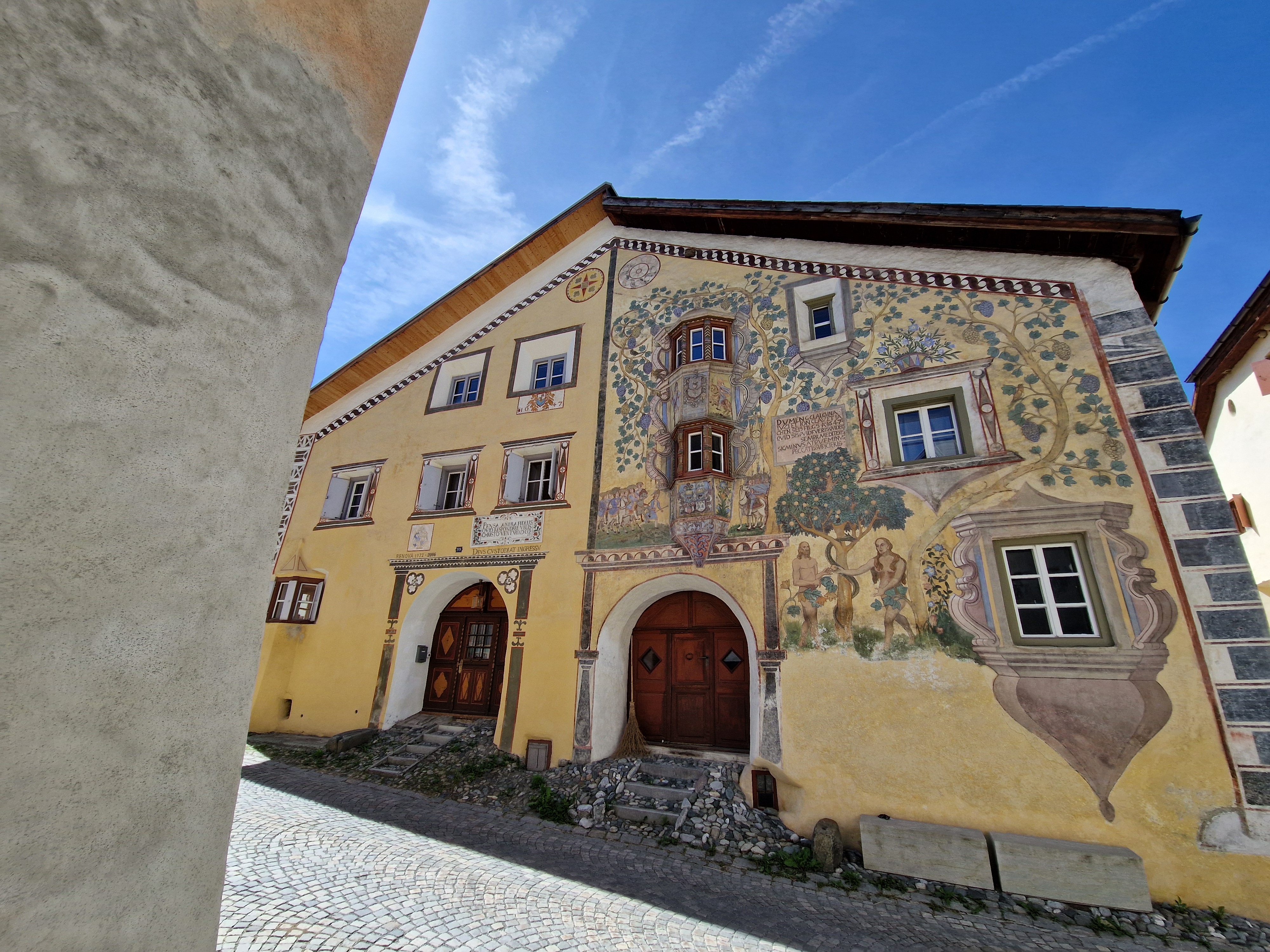
I know that, for most of you, neither Engadin nor Sgraffito have made you any wiser as to what this blog is about, so first, I’ll start off by explaining where and what they are, respectively.

Engadin (pronounced En-Ga-Deen) is a long, towering Alpine valley in the Romansh-speaking canton of Graubünden in southeast Switzerland. The first mention of this valley was in Latin as vallis Eniatina in AD 930; in the Romansh language (one of the four national languages of Switzerland), it is Engiadina. The river running through the valley is called the En or Inn, and it is the only river in Switzerland that runs (via Austria) into the Black Sea. The region is usually divided into lower and upper Engadin, and it is connected to the surrounding regions by several mountain passes.

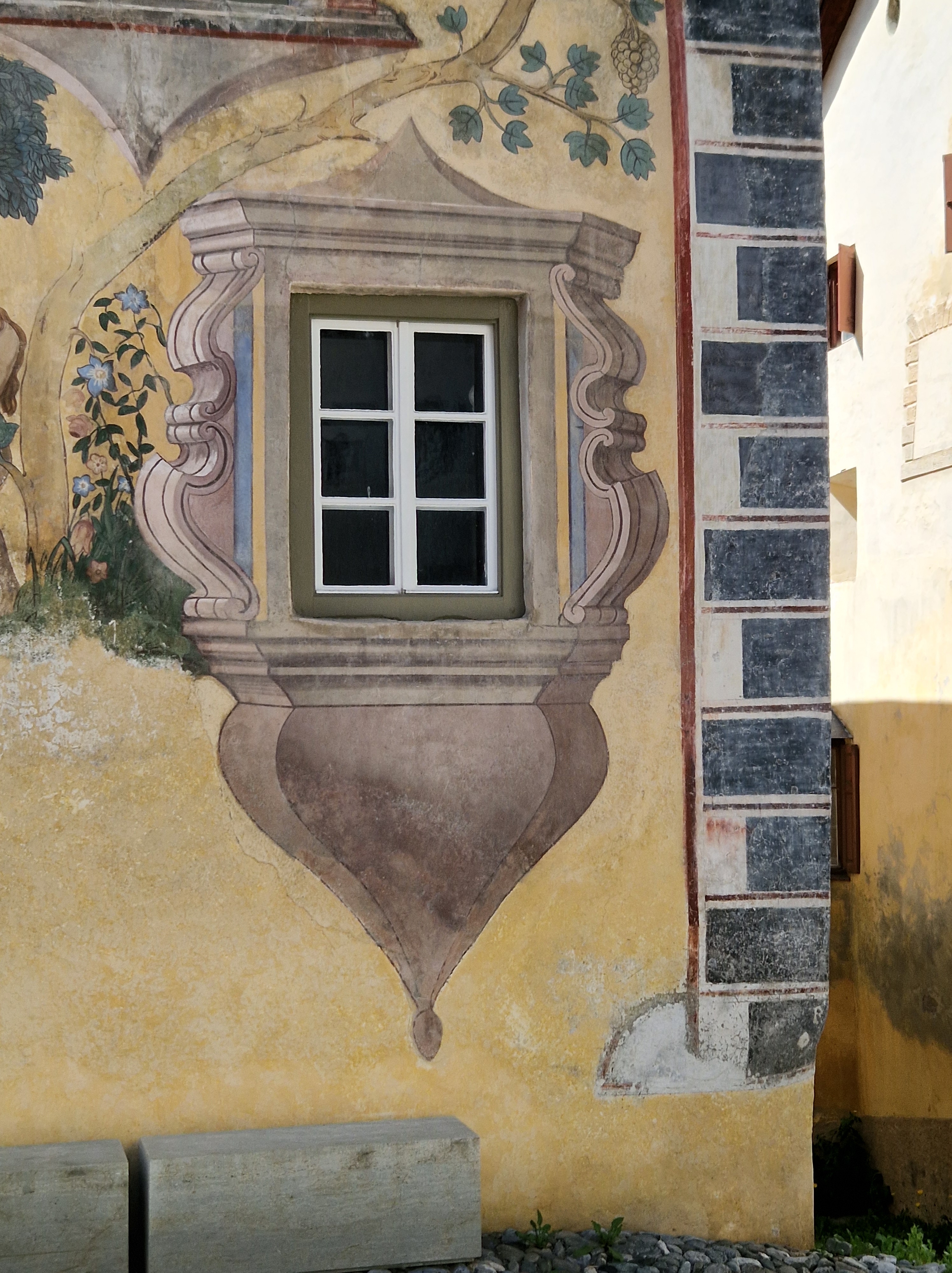
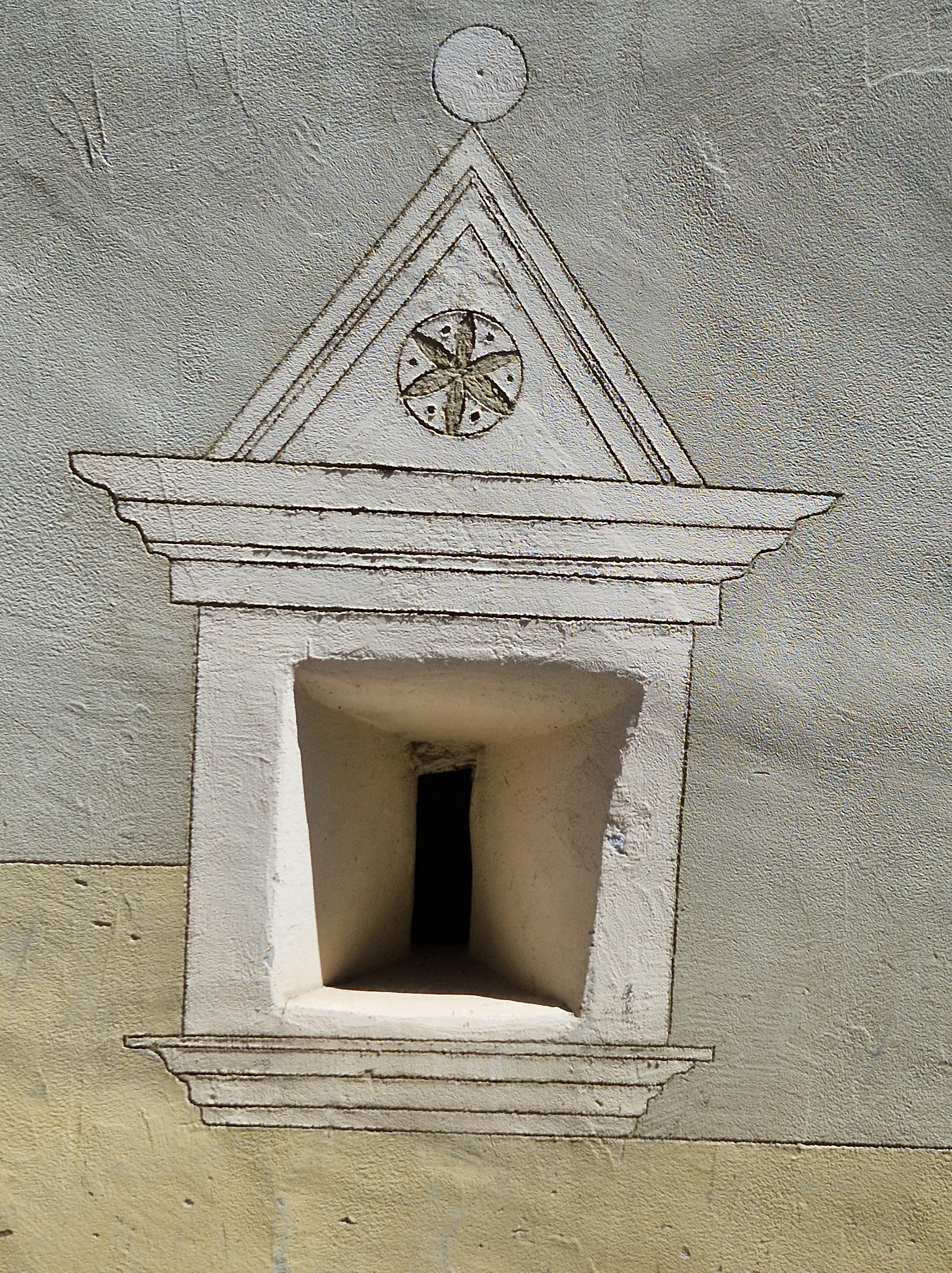
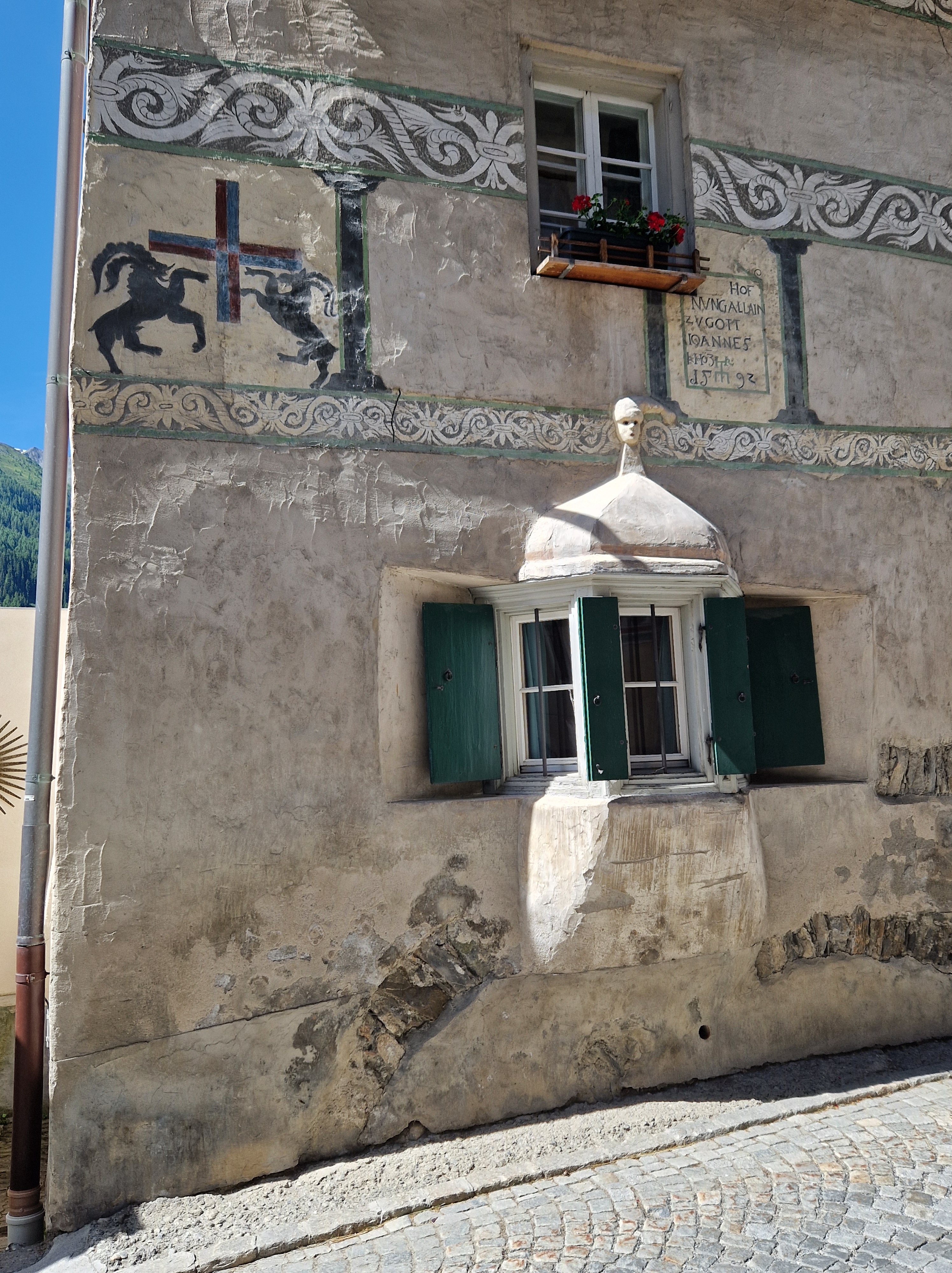
The second word, Sgraffito, describes a plaster technique that is traditional throughout Engadin: Layers of plaster of contrasting colours are scratched through, creating intricate designs on the facades of buildings (many of the buildings in Engadin towns were built (or rebuilt) in the late 1500s to early 1600s). The word comes from the Italian graffiare, which means to scratch; it can be traced back to the Greek word graphein, meaning to write (from which we also get any words containing the prefix, suffix, or derivative of graph (graphite, typography, graptolite, parallelogram, holograph, etc.). Sgraffito is not only used on buildings to make them look decorative, but it also serves the purpose of making a small feature look larger; on one building, the same floor had different-sized windows, likely installed over generations; the sgraffito was used to give a more uniform look to the façade. The decorations also make a plain building look grander, giving a more opulent impression. One building, pictured below, obviously had two occupants with very different characters back when they were originally decorated…

The basic technique for architectural features is to plaster the façade with the base colour; once that has set, it is then plastered with a contrasting colour; once that has set just enough, the scratching, or carving, begins. This is also a technique used in pottery and in creating stained glass effects (just click on the links if you’d like to see how these crafts are made).

One thing to note is that many old buildings here in Switzerland have dates listed on them: Of when they were originally built, and when they’ve been renovated. Part of the history of such renovations may include fires that swept through villages, or avalanches that buried a layer, or wars, such as the Swabian War and war against the Habsburgs, and the subsequent renovation or rebuilding of the towns or individual homes. Sometimes, along with the dates, a list of past and present occupants will also be displayed, preserving their names and memories within the history and changes of the building itself.

Below are a few pictures taken in Engadin during our recent summer holidays. Enjoy! Feel free to zoom in on the pictures to see the details.

5 Comments

Filed under Articles, Etymology, History, History Undusted, How It's Made, Liguistics, Links to External Articles, Military History, Snapshots in History, YouTube Link

Who’s Who in Quotes: John Bertram Phillips

Deciding who to highlight here in this space sometimes comes down to a moral choice; some of the people I’ve investigated as a result of a quote from my collection have turned out to have lived lives that are, frankly, not worthy of my spending time and effort to share their history. One was a multi-billionaire who was a womanizer and a miser who loved tormenting people under his control. He lived a miserable life and died a lonely death. As Jesus said, “What good is it for someone to gain the whole world, yet forfeit their soul?” (Mark 8:36). Others, while they may have lived lives worth remembering, made strings of unwise choices that led to scandals and/or dodgy associations with corrupt foreign powers. While a quote or two from such a person might hold a grain of truth or wit, I personally find it difficult to un-see the stains behind the curtain, as it were, and so I choose to highlight lives that have something worth learning from or from those people who’ve done something worthy of our respect.

The person I’d like to highlight today is John Bertram Philips (1906-1982), best known for his translation of the New Testament and part of the Old Testament into modern English. This work wasn’t done in a stuffy theologian’s office, but in the bomb shelters of the London Blitz of World War 2. During that war, he was the Anglican vicar of the Church of the Good Shepherd in Lee, London, and he realized that the young people in his church had difficulty relating to, or understanding, the Authorized Version of the Bible, aka the King James Bible, which was first published in 1611*. By the mid-1940s, English had changed fundamentally, and it has continued to grow and adapt; the older version of the biblical translation was and is (for most people) stuffy and unrelatable. [For those of you wondering which version of the Bible is most accurately translated from the original Greek, Hebrew and Aramaic texts, the NIV Bible adheres most closely to them; 2011 saw a major revision to the NIV translation, based on recently published critical editions from biblical scholars.]

[*The history of how The King James Bible came to be the king’s Bible is long and sordid, littered with spies, political intrigue and betrayal, ending in the gruesome martyrdom of William Tyndale, whose translation was basically appropriated after his death, which is ironic, as he was tried because his translation was illegal…”unauthorized” by the Holy Roman Empire political elite… but that’s another story.]

Encouraged by his friend, C.S. Lewis, Philips published the first section of the New Testament, starting with Paul’s letters to the churches, in 1947, with the Gospels following in 1952. The final compilation of the New Testament was published in 1958. In the 1960s, he translated and published parts of the Old Testament, though this was never finished within his lifetime.

As a minister and translator, a communicator at heart, it’s no wonder that there are numerous quotes taken from his writings, sermons, and letters written during his lifetime; in some ways, like Tyndale, he was ahead of his time in his understanding of God and our relationship with Him. As the saying goes, we today see further because we stand on the shoulders of giants. Whether or not you believe in God, if you live in any nation with Judeo-Christian foundations, you benefit from those shoulders in more ways than you know.

If you’d like to read more about the life of this complex man, who struggled with clinical depression most of his life and yet remained firm in his faith, please click on the link to an article titled, A Bruised Reed Firmly Planted.

Without further ado, here is a selection of quotes from John Bertram Phillips:

  • The refusal to be committed and the attitude of indifference can, in fact, never be neutral.
  • Christianity is not a religion at all but a way of life, a falling in love with God, and through him a falling in love with our fellows (fellow man).”
  • Christ is the aperture through which the immensity and magnificence of God can be seen.
  • God is not discoverable or demonstrable by purely scientific means, unfortunately for the scientifically minded. But that really proves nothing. It simply means that the wrong instruments are being used for the job.
  • All poetry and music, and art of every true sort, bears witness to man’s continual falling in love with beauty and his desperate attempt to induce beauty to live with him and enrich his common life.”
  • It is refreshing and salutary to study the poise and quietness of Christ. His task and responsibility might well have driven a man out of his mind. But He was never in a hurry, never impressed by numbers, never a slave of the clock.”
  • You can throw the whole weight of your anxieties upon him, for you are his personal concern.” (from his NT translation)
  • There is… no easy answer to the evil and suffering problem and no easy road to its solution. But Christ tackled the matter radically and realistically by winning the allegiance of a few men and women to a new way of living…They were to be the spearhead of good against evil.”
  • Love knows no limit to its endurance, no end to its trust, no fading of its hope; it can outlast anything. It is, in fact, the one thing that still stands when all else has fallen.” (from his NT translation)

3 Comments

Filed under History, History Undusted, Links to External Articles, Military History, Quotes, Research, Snapshots in History

Idioms Undusted: When Too Many is Too Much

I know that most of you can relate to the occasional feeling of having too many things going on at once; juggling jobs, family, civic responsibilities and household management can bring on the feeling of a hamster in a wheel, moving, moving, but not really getting anywhere!

That feeling began creeping up again for me last week, and a few idioms came to mind related to that feeling – which tells me that the condition of being overwhelmed or over-busy is an age-old challenge.

You can’t dance at two weddings

This idiom means that you can’t do two things simultaneously – you have to decide for one or the other. Sometimes that’s a tough choice – both things would be great to be involved in but, unless you’ve learned how to clone yourself, a choice must be made.

The phrase’s etymology leads us to the Yiddish language: Historically Judeo-German, Yiddish is a West Germanic language historically spoken by Ashkenazi Jews and originated in the 9th century. What I find interesting is that, about 25 years ago, when I was still learning High German alongside Swiss German (Zurich dialect), my husband was invited to perform some of his troubadour songs in a concert with several other artists; one of the groups performed in Yiddish. I could understand and follow the story of their song, while my husband and other Swiss around me couldn’t. I think it was a combination of me being a fresh learner of the two languages simultaneously, having a musical ear and, perhaps more importantly, having a Scottish accent still in my ear and a bit in my Swiss German – for me, it sounded a bit like a combination of the two! My brain combined it all, and I could follow the story – my explanation to my husband was then confirmed by their translation given after the song was over.

The idiom is likely derived from the Hebrew translation of the story in 1 Kings 18:21; the English NIV says “How long will you waver between two opinions?” but the Tanach could be read as, “How long will you hop between two platforms?”

Spread butter too thin (over too much toast)

This idiom, with a similar connotation, implies that one overcommits to too many things, leading to unsuccessful results, or leading to exhaustion or poor performance.

A good example of this idiom is happening right now in our flat: Of all the companies we’ve had to work with on the various issues of resolving water damage (the entire process began in April 2024, and no, it’s not over yet!), one company has teams in several functions – floor renovation, plastering, painting… and probably others, of which I hope I never have experience. Every single repair they’ve undertaken has been shoddy, and they’ve had to repeat the exercise – meaning we have had to move half of our flat away from floors, walls and pathways several times already as they have to re-do badly-done work! I’ve put my foot down and insisted that project managers show up and check the work before the workers are done, from now until I never have to see the company again!

The companies that concentrate their expertise on one area, such as plumbing, balcony renovation, façade renovation, or electrical repairs, have all done great work, done and dusted.

Have one’s fingers in too many pies

This idiom is similar to the butter metaphor, and it means to be involved in many different activities or projects at once, often to the point of being overstretched; It suggests a lack of focus or a tendency to dabble in various things without fully committing to any. 

Shakespeare used this imagery in Henry VIII, in which the Duke of Buckingham refers to Cardinal Wolsey: “The devil speed him! no man’s pie is freed from this ambitious finger“.

In Italian, the phrase “avere le mani in pasta” means to have one’s hand in the pies, or pasta, or simply being hands-on.

This idiom is so visual that it is difficult to trace its origins, as it likely had many concurrent origins throughout history. Shakespeare most likely wasn’t the first to use it, though he no doubt popularized it, like so many things he’s “credited” with.

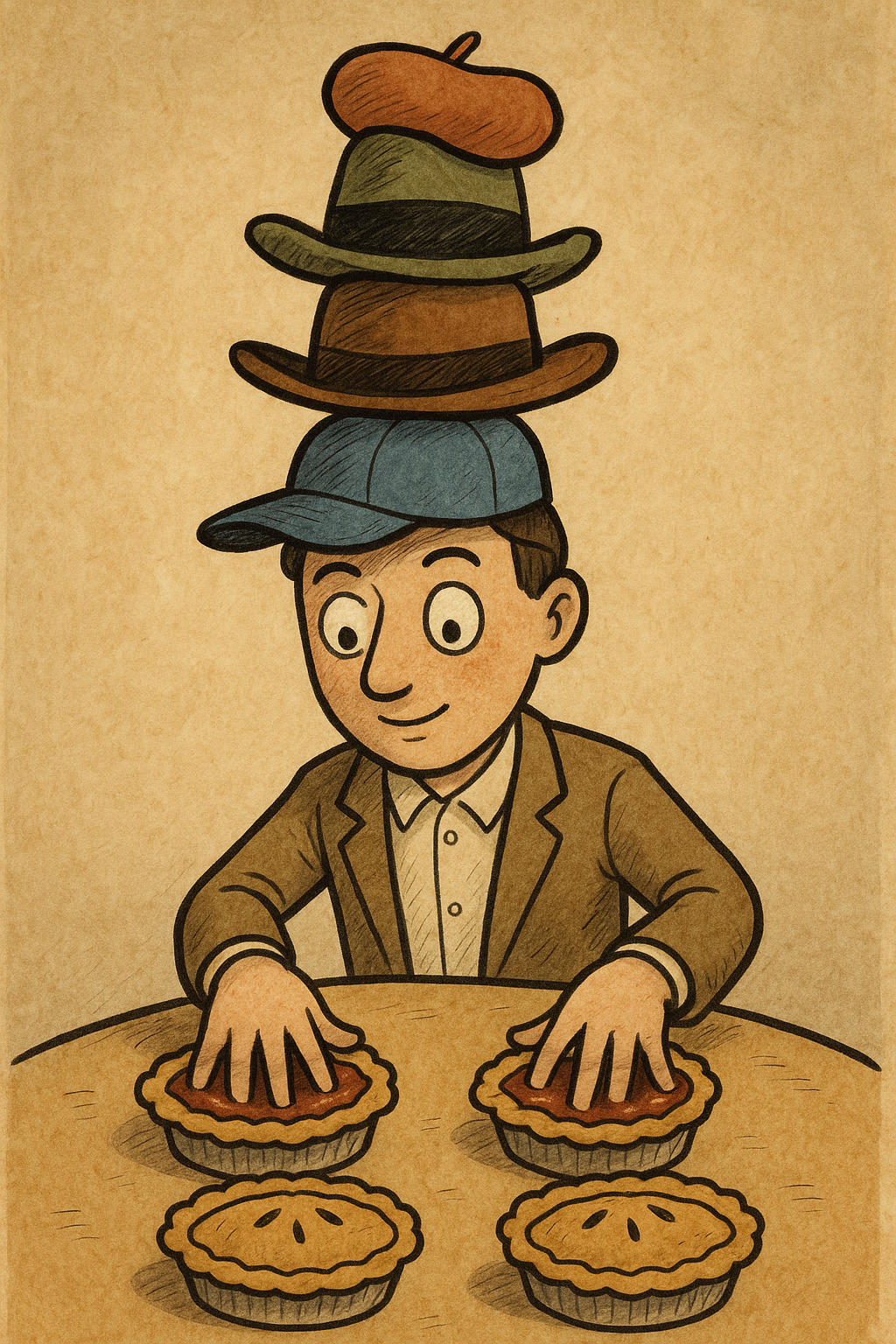
Wearing too many hats

This idiom, also as “man of many hats” stems from a recent past when people wore hats on a daily basis.

Men had hats, usually bowlers, to wear in the city during the day, while they wore a different hat on the hunting field, another when riding horses, and another for evening parties. Cricketers, cowboys, players of various sports (baseball, American football, etc.), military ranks with casual uniforms or dress uniforms or combat uniforms all wear different hats.

To wear too many hats implies that a person is trying to perform too many different roles or jobs than is realistically feasible, implying that they may struggle to fulfil responsibilities effectively.

Have you had times in your lives when too many is too much? If so, let’s all learn to slow dance, eat less butter, bake fewer pies, and choose one hat at a time!

1 Comment

Filed under Etymology, History, History Undusted, Linguistics, Military History

The Fascinating History Behind the Fraktur Typeface

Last Sunday at church, a friend filled an entire room with her late father’s books, setting up an impromptu book shop. I chose several books, most of which are in Fraktur typeface, known to some people as “Gothic” or “Old German”. I enjoy reading such books because they offer a snapshot of a cultural way of thinking. The books I chose were printed between 1877 and 1940. The latter date is significant, as you’ll soon see.

First of all, let’s clarify a few terms: Though many people think of font and typeface as interchangeable, in fact, they refer to two different aspects of a writing style. Typeface refers to a particular style of lettering (e.g. Times New Roman), while font refers to the variations within that style, such as size and weight (CAPS, bold, italic, etc.). Another term we know but may not fully understand is Serif: This refers to the small stroke or line attached to the larger stroke of a letter; an example would be an A with “feet” at the bottom of each down-stroke. Sans Serif simply means “without Serif”.

The first moveable-type printing press, designed by Johannes Gutenberg in Germany around 1440, was based on the ancient Roman design of a screw press used to press wine or oil, which in turn went on to be used to press designs into cloths. He was likely familiar with intaglio printing and may have done some work himself in copper engraving.  These designs and uses likely fermented in his inventor’s mind into what became the revolutionary turning point of literacy. Gutenberg’s original typeface was called Donatus-Kalender; the metal type design was itself a form of Textura (more on that in a moment).

Donatus Kalender
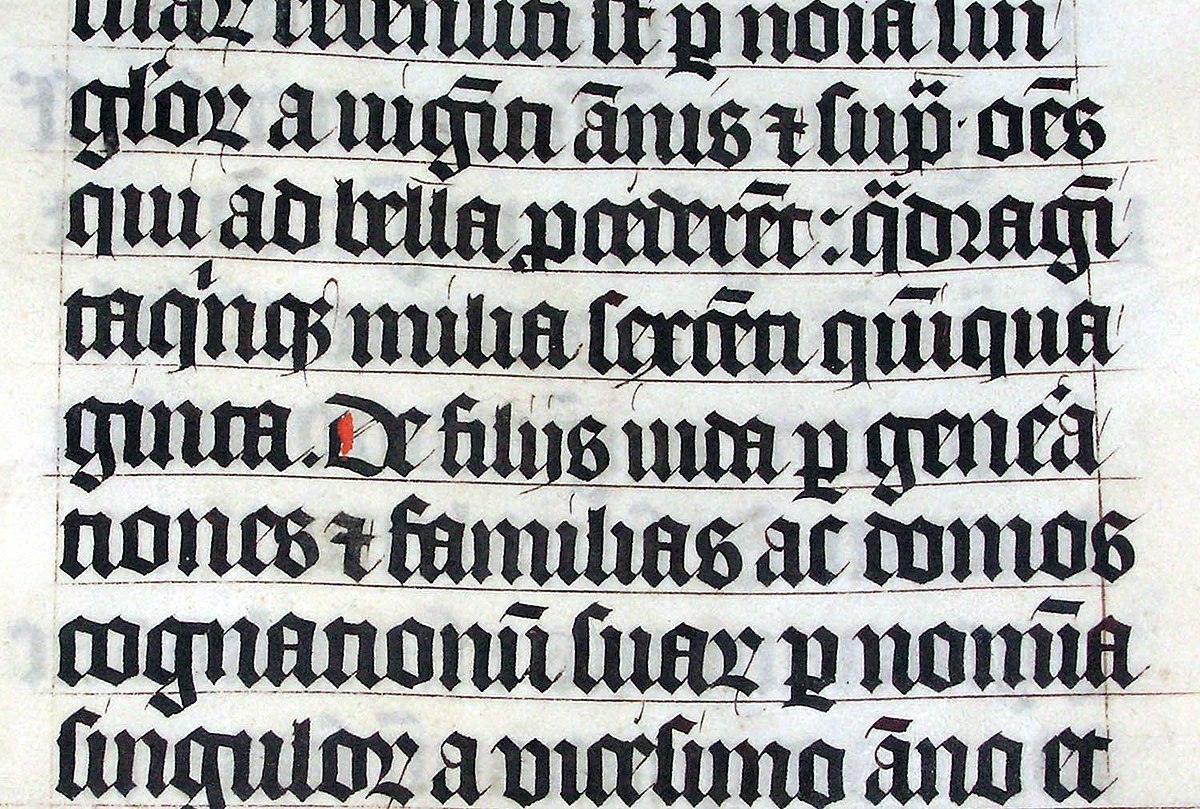
Example of Blackletter (Source: Wikipedia)

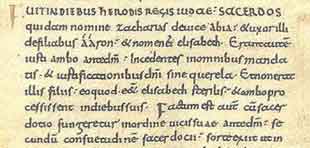
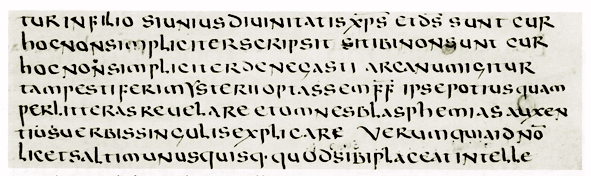
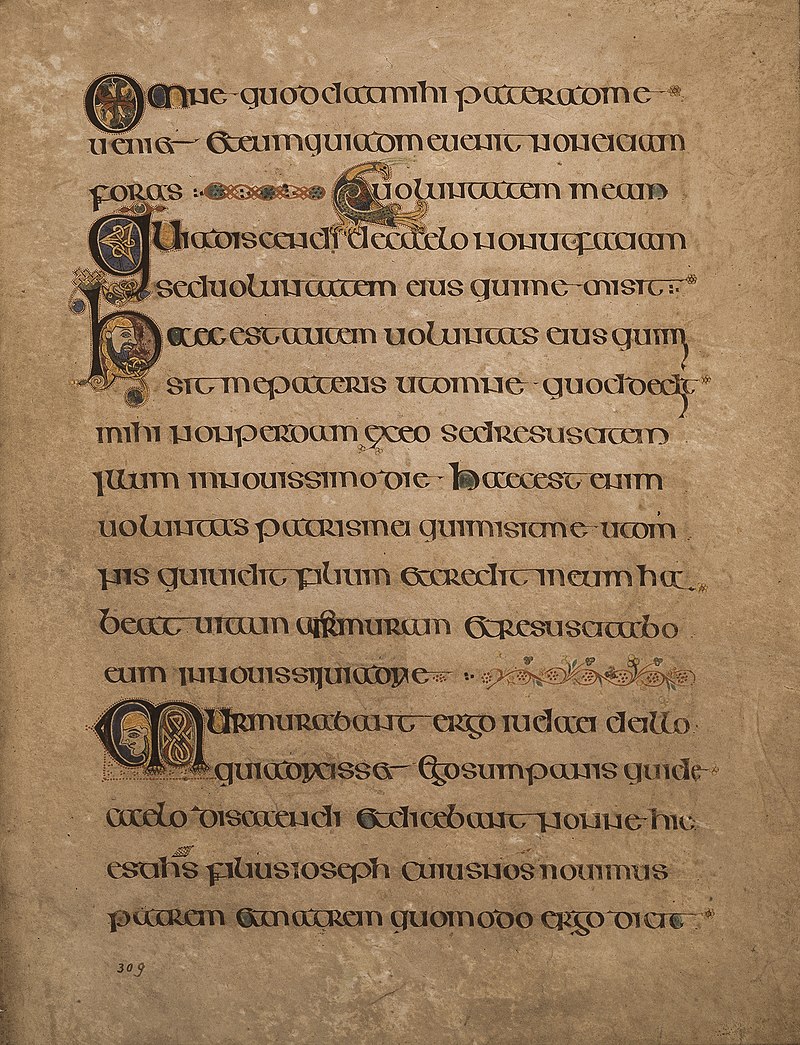
This original family of typefaces was known as “Blackletter”, aka “Gothic scripts”, with the height of popularity peaking around the 14th to 15th centuries. The ancestor of the Blackletter was called the Carolingian minuscule, a calligraphic standard of handwriting widely used in the medieval period, when literacy began increasing and a need for books in a wide range of subjects began to be in demand. It is thought to have been developed in the mid-770s by Benedictine monks north of Paris in the Corbie Abbey, famous for its scriptorium and library. The minuscule itself was derived from Roman Uncial as well as Irish Insular script, which was developed in Irish monasteries and spread throughout Europe.

Carolingian Minuscule
Roman Uncial
From the Book of Kells, an example of the Irish Insular script

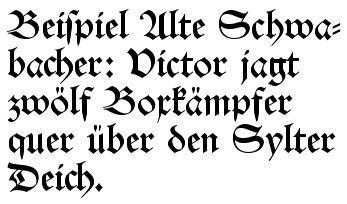
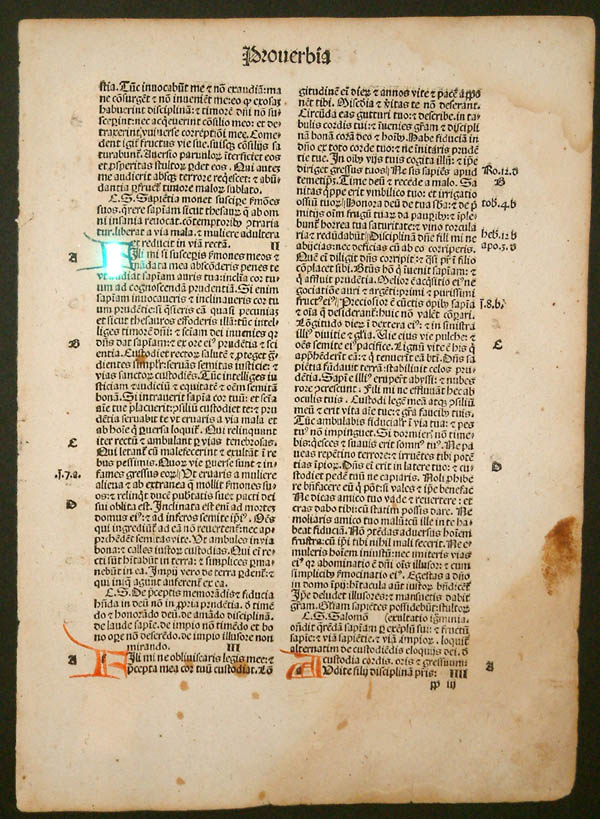
The family of Blackletter typefaces included Early Gothic, which was a transitional script between the Carolingian miniscule and Textura (the most calligraphic form of Blackletter); Schwabacher was a form popular in early German print typefaces (it became widely known with the spread of Luther Bibles from 1522), in use from the 15th century until it was eventually replaced by Fraktur around 1530, though it was still used alongside Fraktur for emphasis, much like we use bold or italic today.

Schwabacher Typeface
Textura Typeface

Another blackletter typeface developed between 1470 and 1600: Antiqua. This typeface’s letters were designed to look like the handwriting of ancient Roman documents, with the letters flowing together, strokes connecting them in a continuous line, whereas Fraktur was distinguished by having letters “fractured” – separate from one another. The Antiqua-Fraktur Dispute deserves its own article, so stay tuned!

Antiqua Typeface (Source: Wikipedia)
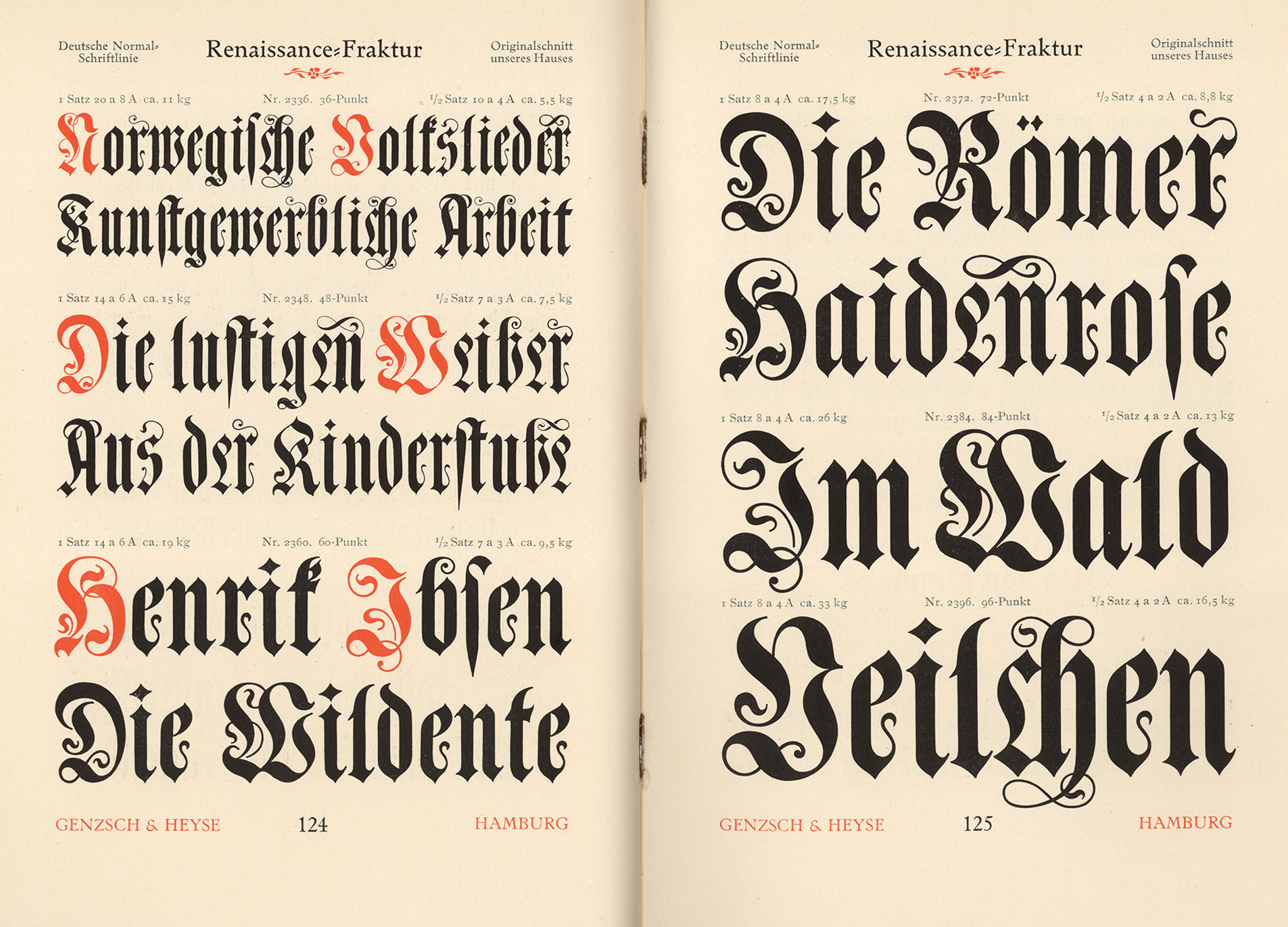
Fraktur Typeface (Source: Fonts in Use)

The Habsburg Emperor Maximillian I (1459-1519) was King of the Romans* from 1486 to 1519 [the title of king was used by the kings of East Francia, the territory later referred to as the Kingdom of Germany, from the time of Henry II (1002) to Joseph II (1764)]. The king commissioned the artist Albrecht Dürer to create a series of woodcut engravings of the Triumphal Arch [Though many are familiar with the Arc de Triomphe in Paris, it is only one example of this ancient Roman architectural feature used as a free-standing structure (rather than the Greek version, which was used within a structure such as a temple).]. These engravings would be used to create what we would recognize today as essentially wallpaper, though its purpose was more of a statement of power or propaganda (read personal marketing) commemorating his nobility, generosity, and military conquests – an incongruous combination, if you ask those conquered… The final composite of printed papers stood nearly 3 metres (12 feet) high and was only one part of a series of three enormous prints commissioned by the king.

Albrecht Dürer’s The Triumphal Arch, for Maximilian I

 The Fraktur typeface was designed in the 1530s by Hieronymus Andreae, a German woodblock cutter, printer, publisher, and typographer closely connected to Albrecht Dürer. The typeface was made to decorate the arch, telling the stories of the figures depicted throughout. The typeface became popular in Europe and was in use in the German-speaking world, as well as areas under its influence (Scandinavia, Central Europe, and some eastern European regions), into the 20th century. Specifically, Fraktur was in use in German until 1941, when it was actually banned (which places one of the books I purchased on Sunday within one year of the end of the era of Fraktur!). The atmosphere that led to that ban arose from the dispute mentioned above. Once the Nazis were defeated, the ban was lifted, but Fraktur never regained its widespread popularity after that, though you can still see it occasionally in pub signs or various forms of ads, like beer brands.

I just pulled two books from my library shelves: One is an English book originally printed in 1895, with my book being printed in 1915; the other is a German book printed in 1892. The typefaces are widely different: The English text likely used the French Oldstyle, while the German book uses Renaissance Fraktur for the text body, while the end pages act as indexes and use a variety of blackletter typefaces, such as Muenchner Fraktur, Antike Kanzlei, and Enge verzierte Altdeutsch. To see examples of the typefaces mentioned here, please click on the link for Fonts In Use.

I hope you enjoyed this jaunt through history! Nearly every name mentioned, every typeface, and every event deserves its own undusting. Next time, we’ll deep-dive into the dispute that lasted well over a century!

3 Comments

Filed under Articles, Etymology, History, History Undusted, Humanity Highlights, Images, Liguistics, Linguistics, Links to External Articles, Military History, Signs, Snapshots in History

Etymology Undusted: Murphy’s Law

The adage “Murphy’s Law” refers to the idea that anything that can go wrong will go wrong. You forget your umbrella and it will be sure to rain; your computer crashes at the worst possible moment; your worst itch is always where you can least reach it, and so on.

Similar sentiments are centuries old: E.g. Augustus D. Morgan, a British mathematician, wrote in 1866: “Whatever can happen, will happen”; Alfred Holt, an engineer, wrote in 1877: “It is found that anything that can go wrong at sea generally does go wrong sooner or later.” British stage magician Nevil Maskelyne wrote in 1908, “Everything that can go wrong will go wrong.”

But who was Murphy? And why is it his law? I’d always assumed that Murphy was either a fictional black sheep created to blame everything on, or someone from a century or more ago, much like Hobson of the “Hobson’s Choice” idiom; but Murphy’s Law comes from the 1940s aerospace era.

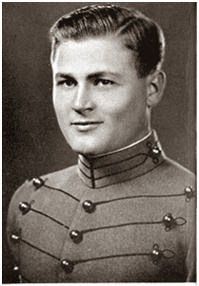
The “law” was coined by and named after Edward A. Murphy Jr. (b.11 January 1918; d.17 July 1990):  Born in the Panama Canal Zone in 1918, he finished high school in New Jersey and eventually graduated from West Point in 1940, joining the Army Air Corps, serving in the Pacific Theatre of World War 2, and in the Korean War, reaching the rank of major. According to his obituary on findagrave.com, he is credited with design work on crew escape systems for some of the most famous experimental aircraft of the 20th century, including the F-4 Phantom, the SR-71 Blackbird, the X-15 rocket plane, and later the Apache helicopter. He also worked on safety and life support systems for NASA’s Apollo space missions. Although he was apparently chagrined by the namesake, he believed in the concept as a key to good defensive design – that one must always assume worst-case scenarios and work to counter them in thorough planning, engineering and execution of mechanical designs.

Around 1948, Murphy and his team were testing rocket sleds, which were used to test the acceleration of equipment deemed too hazardous to test in a piloted aircraft and also to test missile components without risking actual (more expensive) missiles in the testing. The saying arose when training his engineers to avoid designing missile components that could be confused one for another; he said, “If a part can be installed in more than one position, it will be incorrectly installed in the field.” Perhaps Murphy was familiar with the sentiment of those past engineers, given his background in engineering, but wherever it came from, his name was attached and, as they say, the rest is history.

Edward Aloysius Murphy Jr, in his West Point uniform

5 Comments

Filed under Etymology, History, History Undusted, Humanity Highlights, Military History, Science & Technology, Space, Astronomy

History Undusted: Shop Signage

I’m fascinated by a few aspects of architecture in particular, such as doorways, knockers, unusual features such as sundials on the sides of buildings, mural paintings (here in Switzerland, these are sometimes hundreds of years old), and shop signage – you’ll see the latter even in the smallest town here.

This past summer, my husband and I rented a motorhome and travelled mostly in eastern Switzerland. I would say that 90% of my photos were of shop signs! I find that if you focus in on one topic, you’ll begin to see that thing everywhere.

Known as commercial signage or trade signs, such symbols of a shop’s products have been used as far back as ancient Egypt. As many people were illiterate, the pictorial shop sign not only advertised what was for sale in a shop but also distinguished the shops with similar items. By the mid-15th century, English laws even required shops that sold ale to hang a shop sign out; it made inspections of the quality of the ale easier. Some signs were temporary; for instance, if a woman made more ale or bread than her family could consume, she would put out a sign to sell the surplus and thus earn a bit of money. In the narrow streets of medieval towns, signs might be so large as to nearly touch the building on the other side of the lane, and they could become a hazard to passing horsemen or coachmen. By the mid-16th century, regulations were passed to limit the size of signage, and the securing of the sign to the building to avoid it endangering passersby. In Britain, hanging signs were eventually phased out in favour of what were are most familiar with – a flat sign denoting the store along the space above the front windows. But here in Switzerland, shop signage is everywhere – not just old, but also newer additions.

The development of the signs, including elements of guilds or heraldry symbols, led to competition between blacksmiths to create the most elaborate ironwork. The signs evolved from simple displays of ware to symbolic representations of a shop owner’s name or a heraldic connection or patronage of royalty (e.g. a crown). Examples might include shoemakers displaying a shoe or gilt boot, bakeries displaying bread, and haberdasheries displaying a needle and thread or a coat.

Here is just a fraction of the signs I photographed during our holidays, with brief explanations:

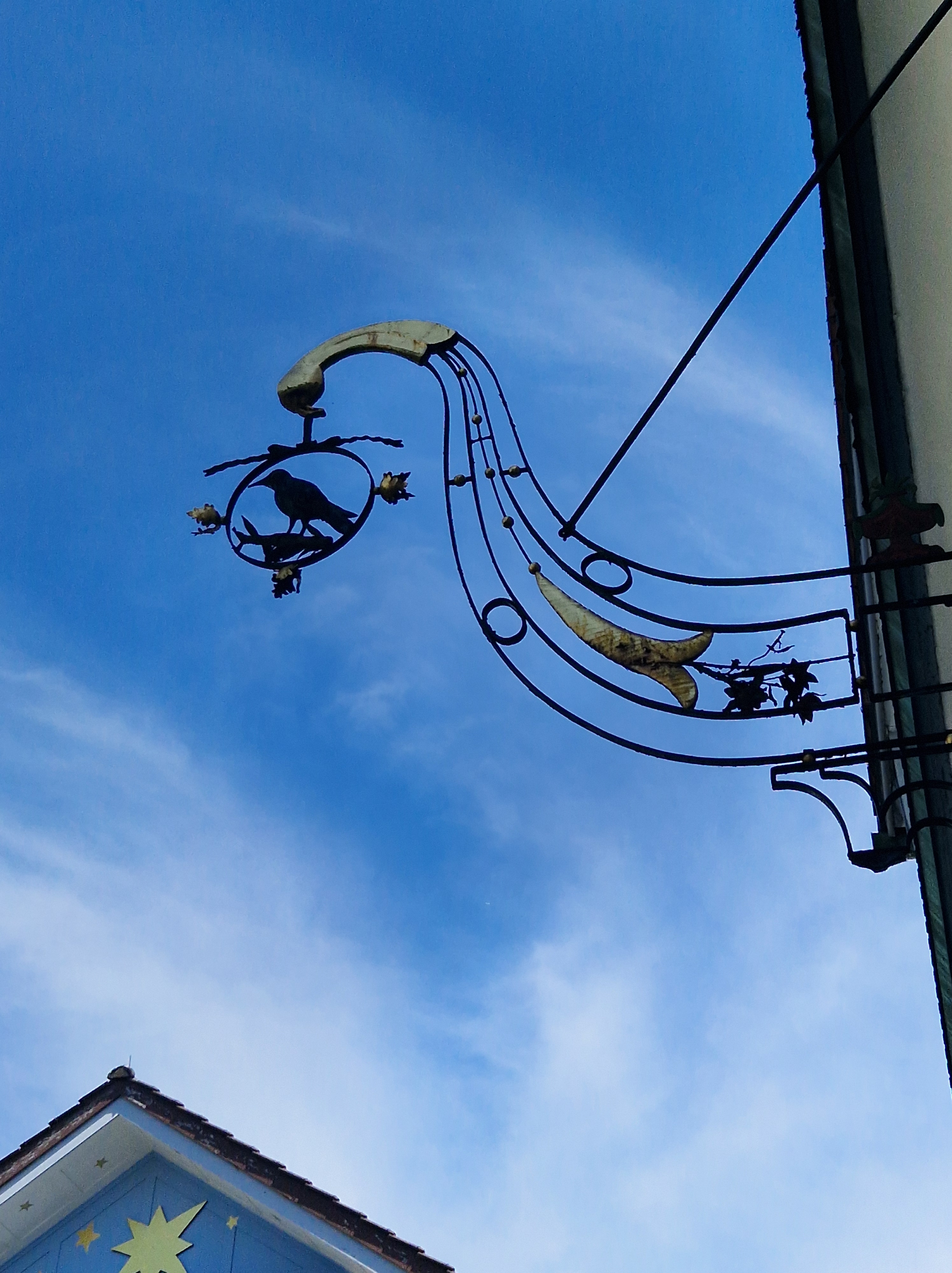
The building from which this sign hangs was built originally in 1664, and renovated to the current form in 1830. It was originally an inn/tavern on one side, and a forge (blacksmith) on the other. The Raven, as a tavern, took its symbol from the legend of St. Meinrad (797-861 AD); he was a hermit who rescued two young ravens from a sparrowhawk and raised them in his hut in the Finstern Wald (dark forest). In 861, he was murdered by two robbers; when they realized what they’d done, they fled to Zürich, but the crows followed them into a tavern and attacked them; the others present thought it unusual, so they took the men captive; they confessed, and were executed. The raven became a symbol of inns along a pilgrimage road; it was sometimes combined with a wine jug and bread.

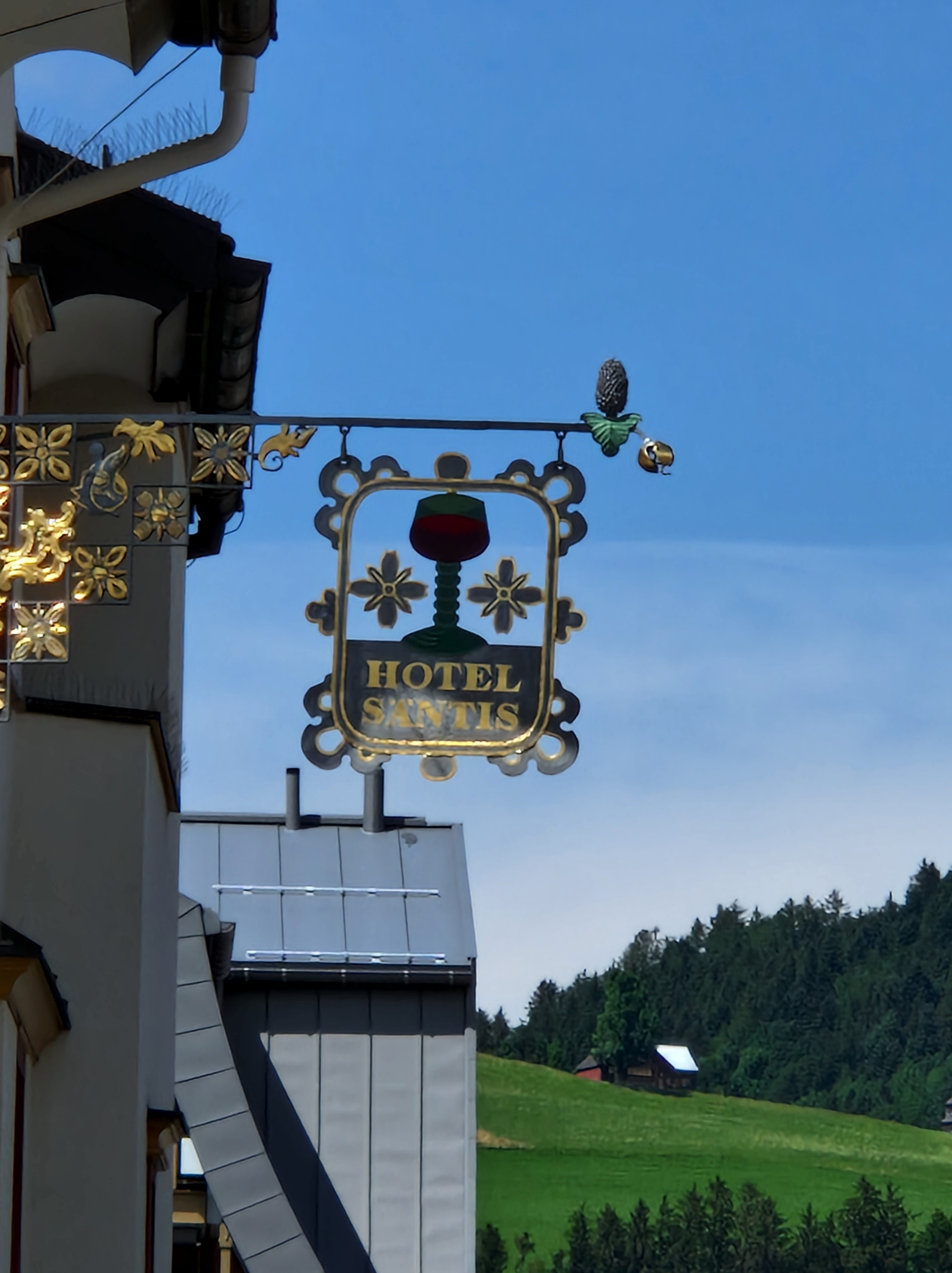
The Hotel Santis sign has a few symbols: The wine is an obvious reference to a tavern, pub or inn; the pine cone is an interesting addition: It was the symbol of the field sign of the Roman legion stationed in Rhaetia in 15 BC, and hence it is used as a heraldic charge (an emblem on a shield). It may have been included in this sign to proclaim a good place for soldiers to eat or sleep, or as an advertisement that it was protected under a legion or unit of the military at a time when such protection would have been welcome. The bell symbolized a pilgrimage or an invocation of guardian angels over a premises.

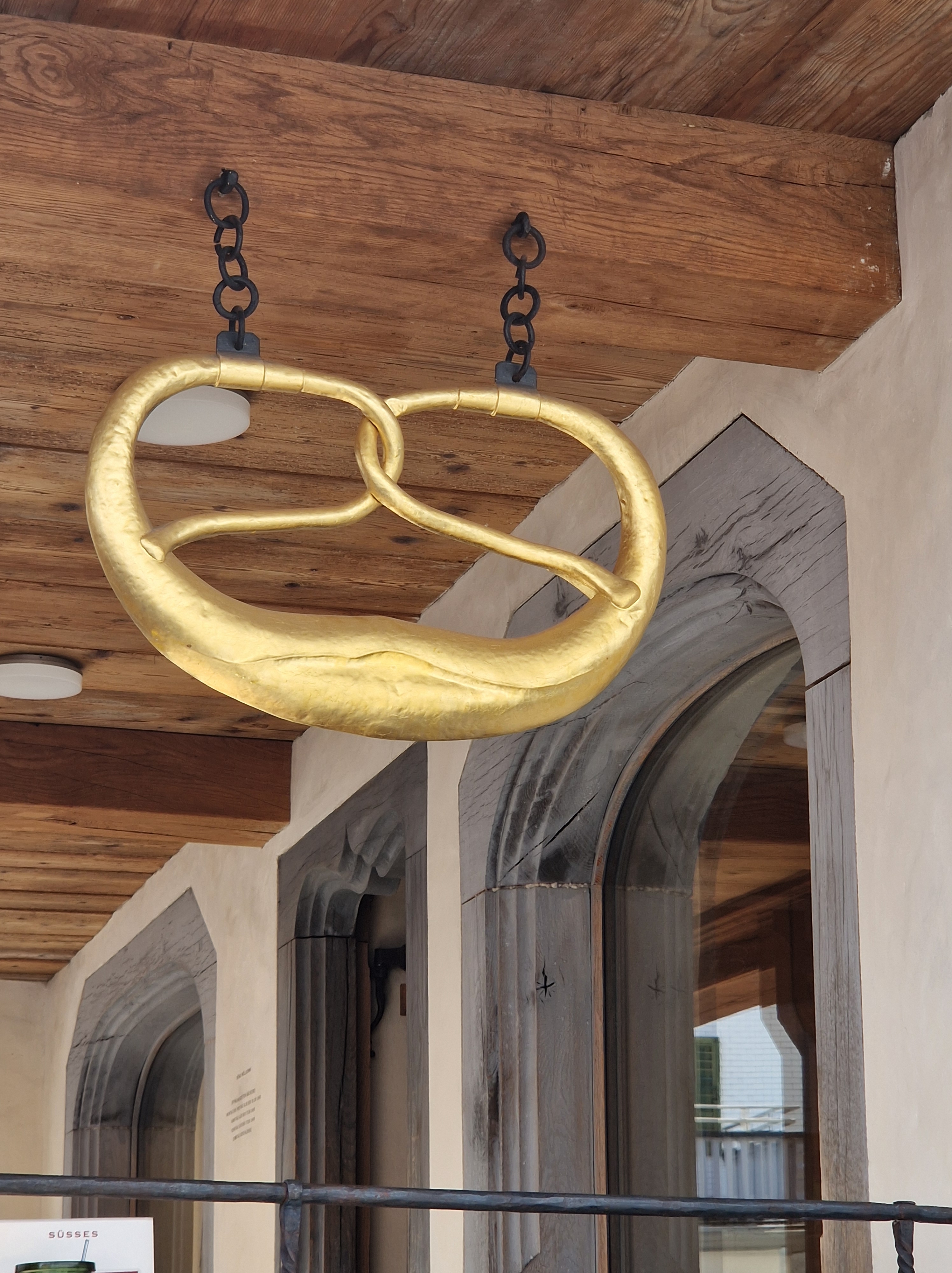
I think this is fairly clear – it’s a bakery!

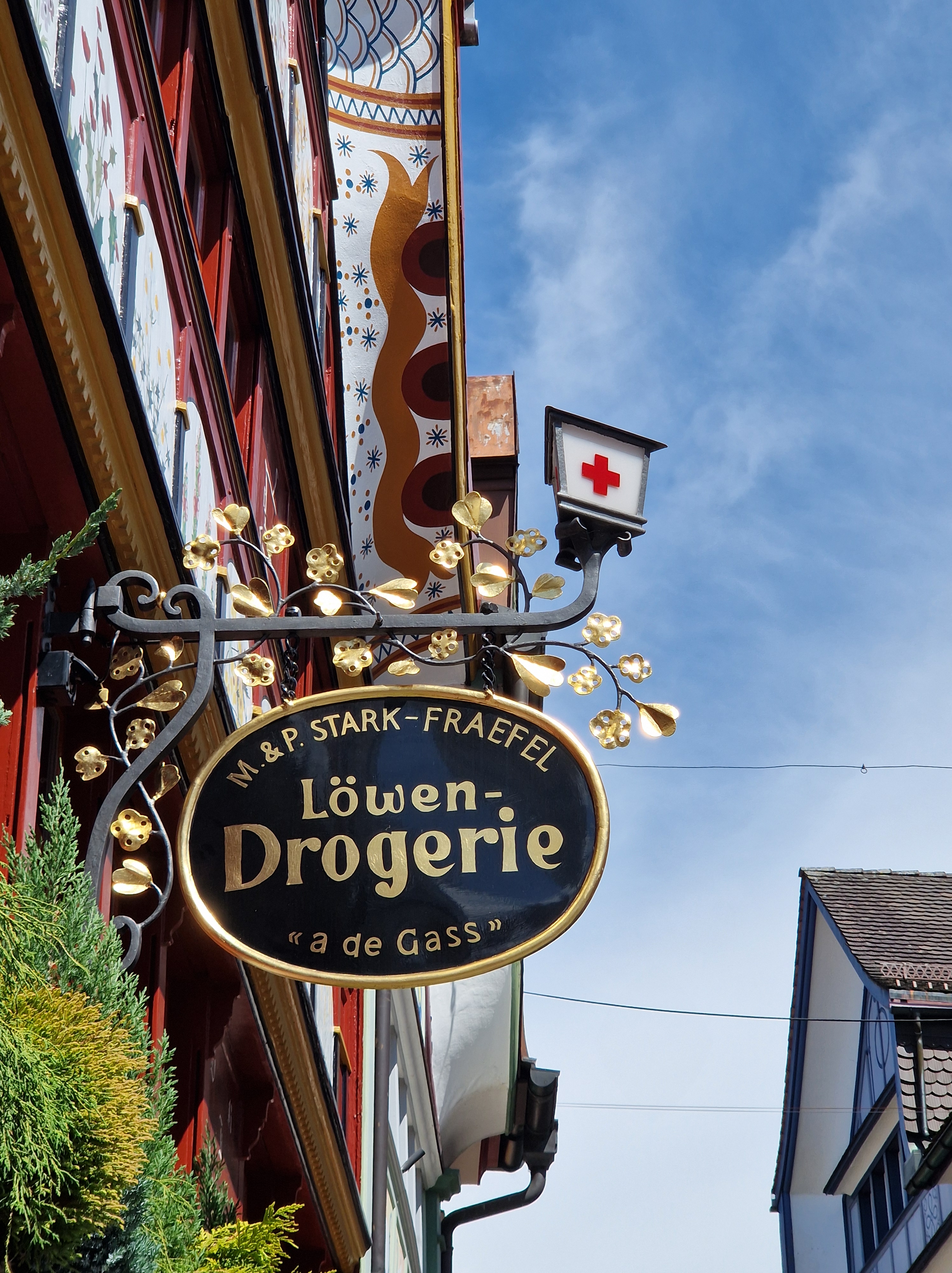
This building is a pharmacy; the front of the building is a beautiful example of the mural painting I mentioned earlier; these panels represent the herbs and flowers used medicinally. The saying painted toward the right side reads: Vielerlei Kraut gegen Leibesnot, aber kein einzigs wider den Tod (Many herbs against bodily pain, but none against death).

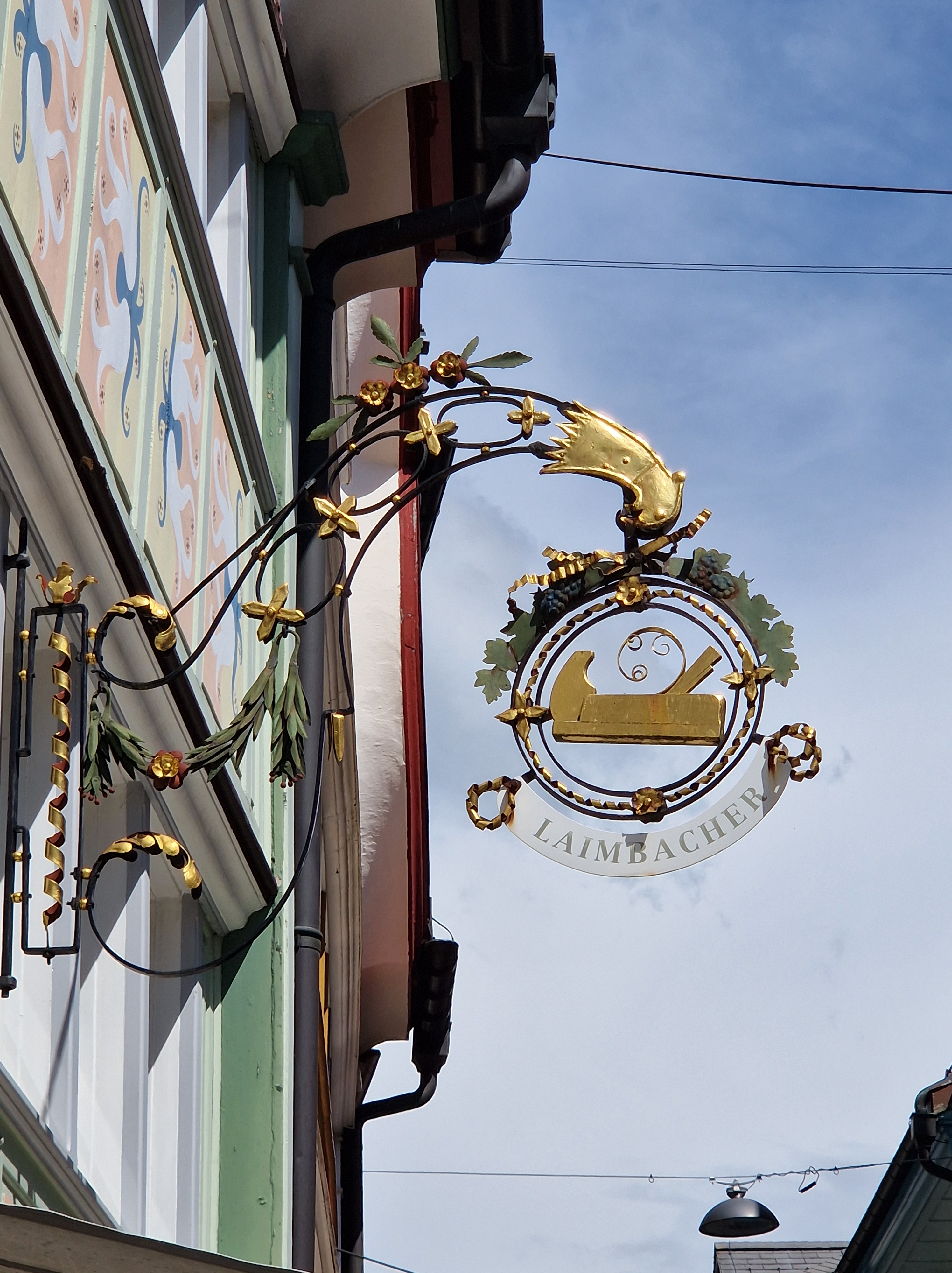
This symbol denotes a carpenter’s shop.

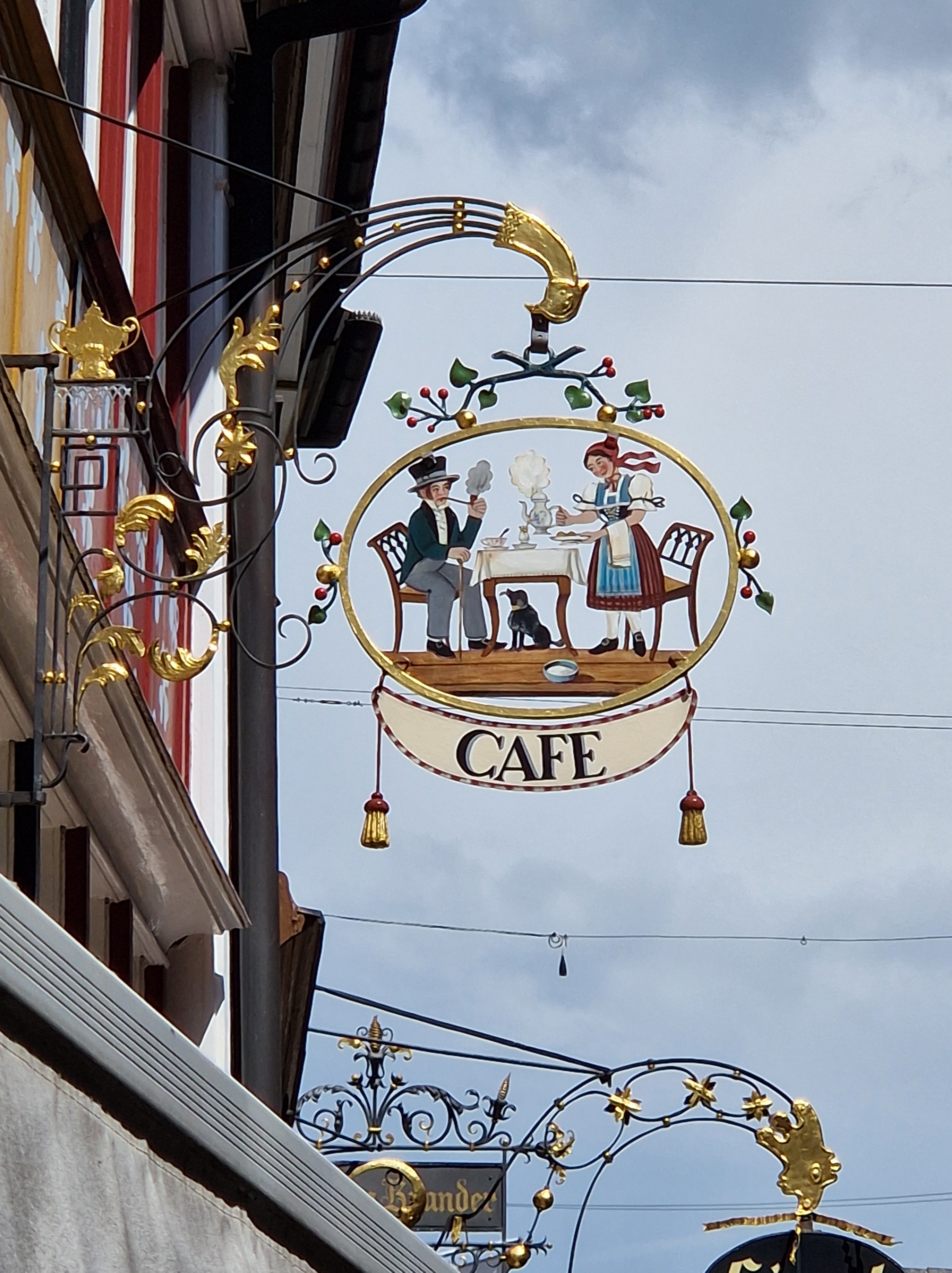
This café sign would be clear from any stagecoach stopping for a break and horse change what could be expected inside. The figures are dressed in traditional Appenzeller clothing.

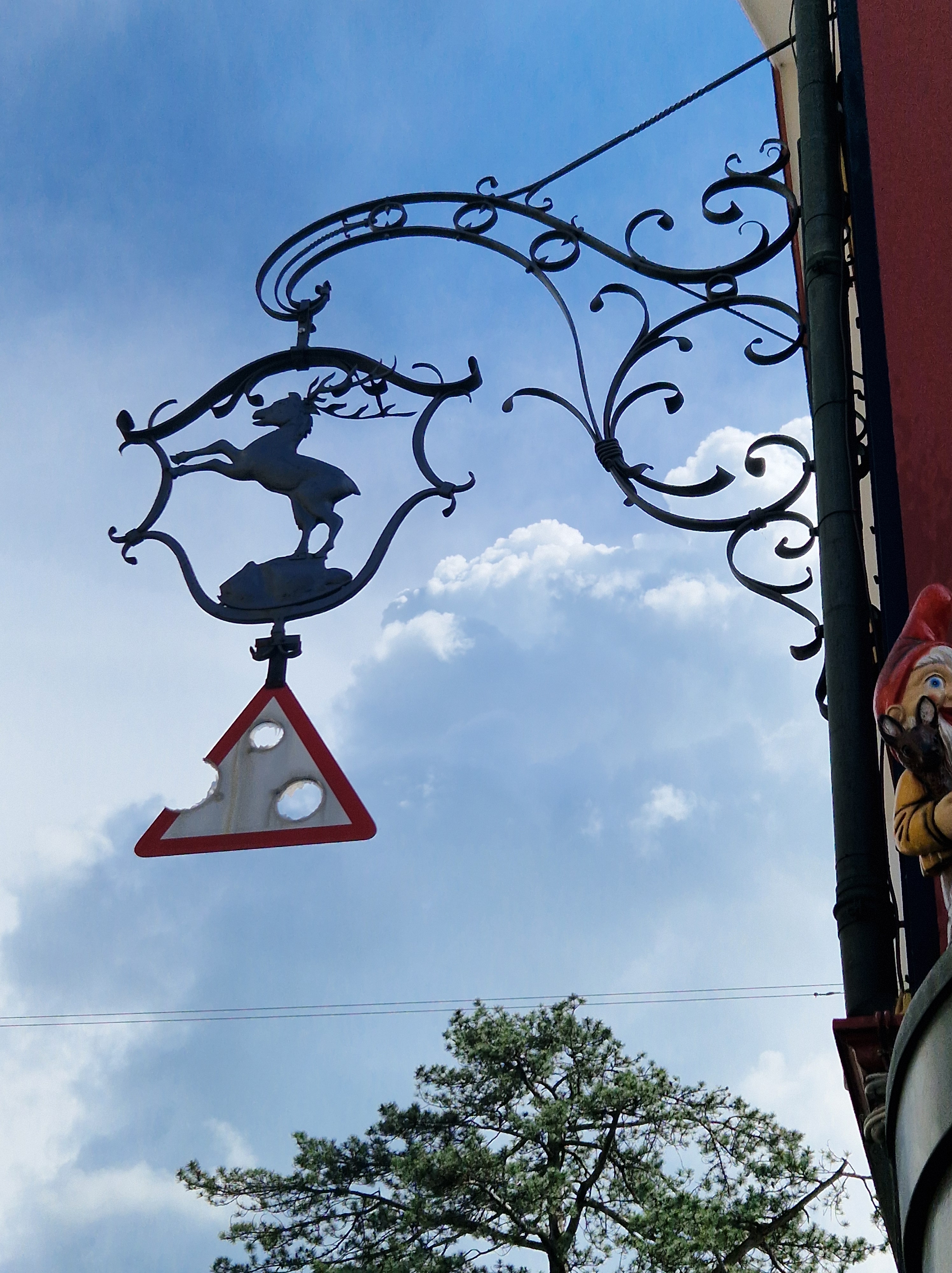
And lastly, here’s a traditional sign with a modern addition: It’s a hunting lodge, or inn that serves wild game meat. Next to it, peeking around the corner, is a figure from a toy shop.

 I hope you enjoyed this little excursion!

10 Comments

Filed under Articles, Etymology, History, History Undusted, Linguistics, Military History, Signs, Snapshots in History, Translations, Virtual Tours

History Undusted: 15 January

Unless you’ve been busier than I‘ve been, you’ll have realized that half of January 2025 is already gone. The end of 2024 was crazy busy, and after the dust of the Christmas holidays settled, life was about getting caught up with all of those little things that had been neglected for a couple of months.

I’ve thought about how I want to go forward with this blog in the coming year; I enjoy having this platform to dive into topics I might not otherwise encounter in my day-to-day life, but life in the real world has many facets that keep me busy, too. I’ve decided to post roughly once per fortnight, giving me time to live, write/edit/publish, and research topics of interest. I’ve always tried to write quality above quantity, and I want to share things that interest me, grab my imagination, or give me a good laugh. If you feel the same, sit back and enjoy the ride!

Since this is mid-January, let’s take a look at some of the highlights of history on this day, the 15th of January:

1541: A commission to settle New France (Canada) was granted by King Francis I of France.

1559: Queen Elizabeth I was crowned Queen of England in Westminster Abbey, London.

1759: The British Museum opened to the public for the first time.

1777: In the American Revolutionary War, New Connecticut (Vermont) declares its independence.

1782 – The U.S. Congress was petitioned to establish a national mint and decimal coinage.

1870 – For the first time, a political cartoon symbolizes the Democratic Party with a donkey (“A Live Jackass Kicking a Dead Lion” by Thomas Nast for Harper’s Weekly).

1889 – The Pemberton Medicine Company (later to become known as the Coca-Cola Company) is incorporated in Atlanta.

1908 – The Alpha Kappa Alpha sorority becomes the first Greek-letter organization founded and established by African American college women.

1919 – Great Molasses Flood (a wave of molasses ejected from an exploding storage tank) sweeps through Boston, Massachusetts.

1943 – The Pentagon is dedicated in Arlington County, Virginia.

2001 – Wikipedia, a free Wiki content encyclopedia, is launched (Wikipedia Day).

2009 – US Airways Flight 1549 ditches safely in the Hudson River after the plane collides with birds less than two minutes after take-off. This became known as “The Miracle on the Hudson” as all 155 people on board were rescued. This story was adapted for the “Sully” film in 2016.

2015 – The Swiss National Bank abandons the cap on the Swiss franc’s value relative to the euro, causing turmoil in international financial markets.

2022 – The Hunga Tonga-Hunga Haʻapai volcano erupts, cutting off communications with Tonga and causing a tsunami across the Pacific. It was the largest volcanic eruption since the 1991 eruption of Mt. Pinatubo (Philippines).

Which of these events do you find most interesting? Please comment below and let us know! For me personally, it’s the opening of the British Museum. What was it like back in 1759, and how has it evolved into the massive collection it is today? I’ve been there a few times, but I have yet to see it all!

This is AI’s interpretation of “ancient scroll rolled up”. No idea where the man came into that result, but his longsuffering expression is apt!

3 Comments

Filed under Articles, History, History Undusted, Lists, Military History, Snapshots in History