Category Archives: Military History

Idioms Undusted: When Too Many is Too Much

I know that most of you can relate to the occasional feeling of having too many things going on at once; juggling jobs, family, civic responsibilities and household management can bring on the feeling of a hamster in a wheel, moving, moving, but not really getting anywhere!

That feeling began creeping up again for me last week, and a few idioms came to mind related to that feeling – which tells me that the condition of being overwhelmed or over-busy is an age-old challenge.

You can’t dance at two weddings

This idiom means that you can’t do two things simultaneously – you have to decide for one or the other. Sometimes that’s a tough choice – both things would be great to be involved in but, unless you’ve learned how to clone yourself, a choice must be made.

The phrase’s etymology leads us to the Yiddish language: Historically Judeo-German, Yiddish is a West Germanic language historically spoken by Ashkenazi Jews and originated in the 9th century. What I find interesting is that, about 25 years ago, when I was still learning High German alongside Swiss German (Zurich dialect), my husband was invited to perform some of his troubadour songs in a concert with several other artists; one of the groups performed in Yiddish. I could understand and follow the story of their song, while my husband and other Swiss around me couldn’t. I think it was a combination of me being a fresh learner of the two languages simultaneously, having a musical ear and, perhaps more importantly, having a Scottish accent still in my ear and a bit in my Swiss German – for me, it sounded a bit like a combination of the two! My brain combined it all, and I could follow the story – my explanation to my husband was then confirmed by their translation given after the song was over.

The idiom is likely derived from the Hebrew translation of the story in 1 Kings 18:21; the English NIV says “How long will you waver between two opinions?” but the Tanach could be read as, “How long will you hop between two platforms?”

Spread butter too thin (over too much toast)

This idiom, with a similar connotation, implies that one overcommits to too many things, leading to unsuccessful results, or leading to exhaustion or poor performance.

A good example of this idiom is happening right now in our flat: Of all the companies we’ve had to work with on the various issues of resolving water damage (the entire process began in April 2024, and no, it’s not over yet!), one company has teams in several functions – floor renovation, plastering, painting… and probably others, of which I hope I never have experience. Every single repair they’ve undertaken has been shoddy, and they’ve had to repeat the exercise – meaning we have had to move half of our flat away from floors, walls and pathways several times already as they have to re-do badly-done work! I’ve put my foot down and insisted that project managers show up and check the work before the workers are done, from now until I never have to see the company again!

The companies that concentrate their expertise on one area, such as plumbing, balcony renovation, façade renovation, or electrical repairs, have all done great work, done and dusted.
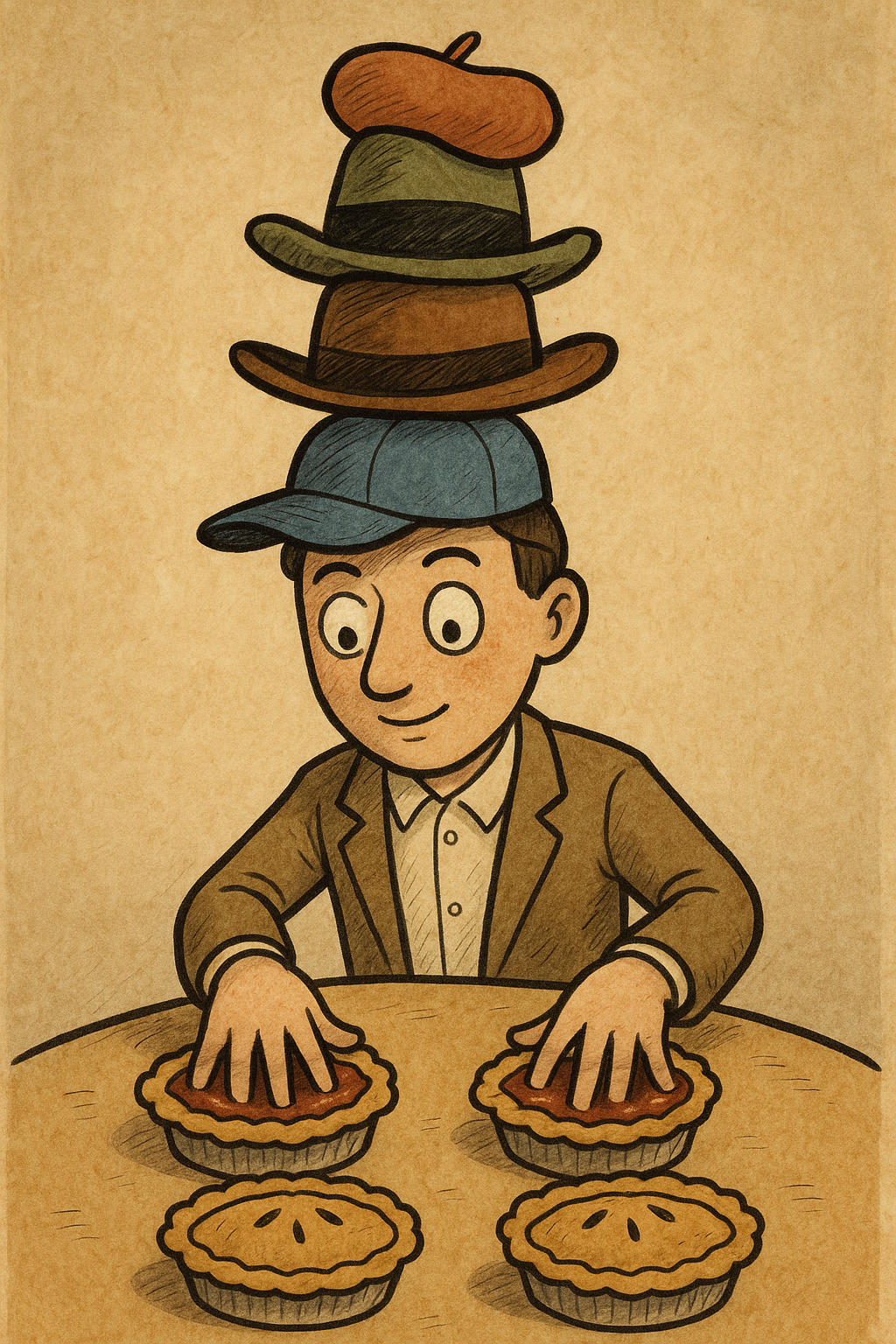
Have one’s fingers in too many pies

This idiom is similar to the butter metaphor, and it means to be involved in many different activities or projects at once, often to the point of being overstretched; It suggests a lack of focus or a tendency to dabble in various things without fully committing to any. 

Shakespeare used this imagery in Henry VIII, in which the Duke of Buckingham refers to Cardinal Wolsey: “The devil speed him! no man’s pie is freed from this ambitious finger“.

In Italian, the phrase “avere le mani in pasta” means to have one’s hand in the pies, or pasta, or simply being hands-on.

This idiom is so visual that it is difficult to trace its origins, as it likely had many concurrent origins throughout history. Shakespeare most likely wasn’t the first to use it, though he no doubt popularized it, like so many things he’s “credited” with.

Wearing too many hats

This idiom, also as “man of many hats” stems from a recent past when people wore hats on a daily basis.

Men had hats, usually bowlers, to wear in the city during the day, while they wore a different hat on the hunting field, another when riding horses, and another for evening parties. Cricketers, cowboys, players of various sports (baseball, American football, etc.), military ranks with casual uniforms or dress uniforms or combat uniforms all wear different hats.

To wear too many hats implies that a person is trying to perform too many different roles or jobs than is realistically feasible, implying that they may struggle to fulfil responsibilities effectively.

Have you had times in your lives when too many is too much? If so, let’s all learn to slow dance, eat less butter, bake fewer pies, and choose one hat at a time!

1 Comment

Filed under Etymology, History, History Undusted, Linguistics, Military History

The Fascinating History Behind the Fraktur Typeface

Last Sunday at church, a friend filled an entire room with her late father’s books, setting up an impromptu book shop. I chose several books, most of which are in Fraktur typeface, known to some people as “Gothic” or “Old German”. I enjoy reading such books because they offer a snapshot of a cultural way of thinking. The books I chose were printed between 1877 and 1940. The latter date is significant, as you’ll soon see.

First of all, let’s clarify a few terms: Though many people think of font and typeface as interchangeable, in fact, they refer to two different aspects of a writing style. Typeface refers to a particular style of lettering (e.g. Times New Roman), while font refers to the variations within that style, such as size and weight (CAPS, bold, italic, etc.). Another term we know but may not fully understand is Serif: This refers to the small stroke or line attached to the larger stroke of a letter; an example would be an A with “feet” at the bottom of each down-stroke. Sans Serif simply means “without Serif”.

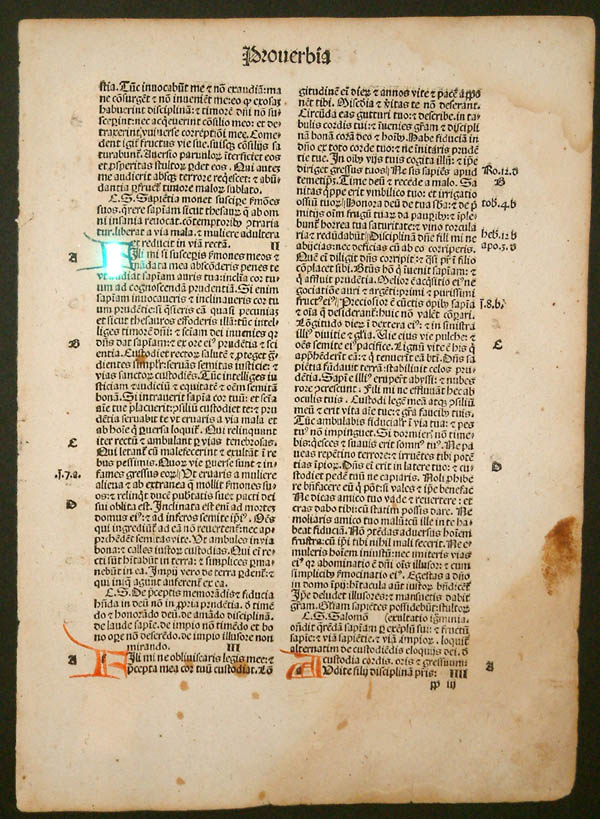
The first moveable-type printing press, designed by Johannes Gutenberg in Germany around 1440, was based on the ancient Roman design of a screw press used to press wine or oil, which in turn went on to be used to press designs into cloths. He was likely familiar with intaglio printing and may have done some work himself in copper engraving.  These designs and uses likely fermented in his inventor’s mind into what became the revolutionary turning point of literacy. Gutenberg’s original typeface was called Donatus-Kalender; the metal type design was itself a form of Textura (more on that in a moment).

Donatus Kalender
Example of Blackletter (Source: Wikipedia)

This original family of typefaces was known as “Blackletter”, aka “Gothic scripts”, with the height of popularity peaking around the 14th to 15th centuries. The ancestor of the Blackletter was called the Carolingian minuscule, a calligraphic standard of handwriting widely used in the medieval period, when literacy began increasing and a need for books in a wide range of subjects began to be in demand. It is thought to have been developed in the mid-770s by Benedictine monks north of Paris in the Corbie Abbey, famous for its scriptorium and library. The minuscule itself was derived from Roman Uncial as well as Irish Insular script, which was developed in Irish monasteries and spread throughout Europe.

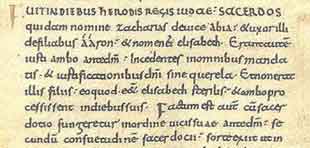
Carolingian Minuscule
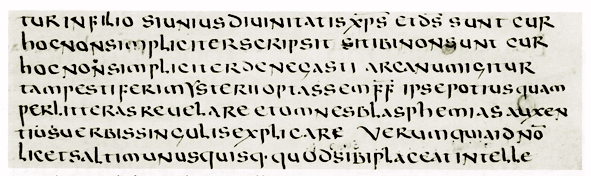
Roman Uncial
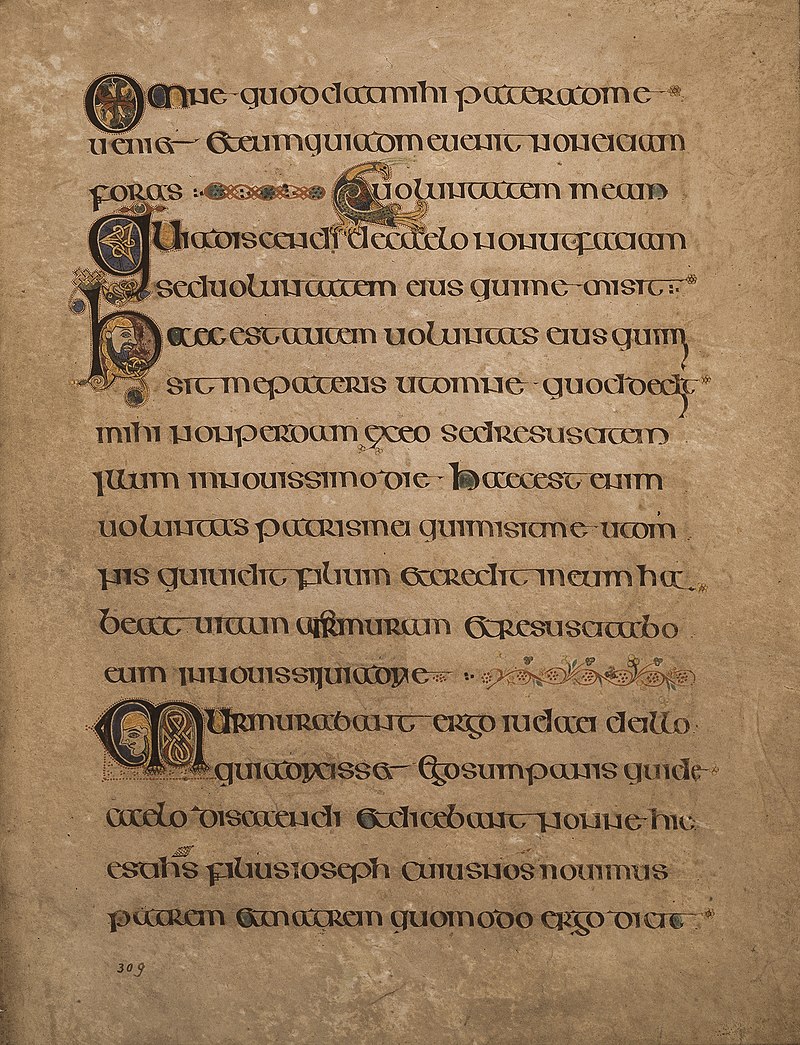
From the Book of Kells, an example of the Irish Insular script

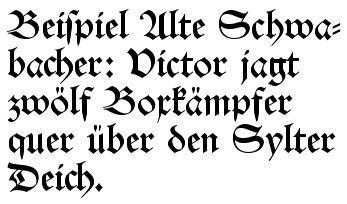
The family of Blackletter typefaces included Early Gothic, which was a transitional script between the Carolingian miniscule and Textura (the most calligraphic form of Blackletter); Schwabacher was a form popular in early German print typefaces (it became widely known with the spread of Luther Bibles from 1522), in use from the 15th century until it was eventually replaced by Fraktur around 1530, though it was still used alongside Fraktur for emphasis, much like we use bold or italic today.

Schwabacher Typeface
Textura Typeface

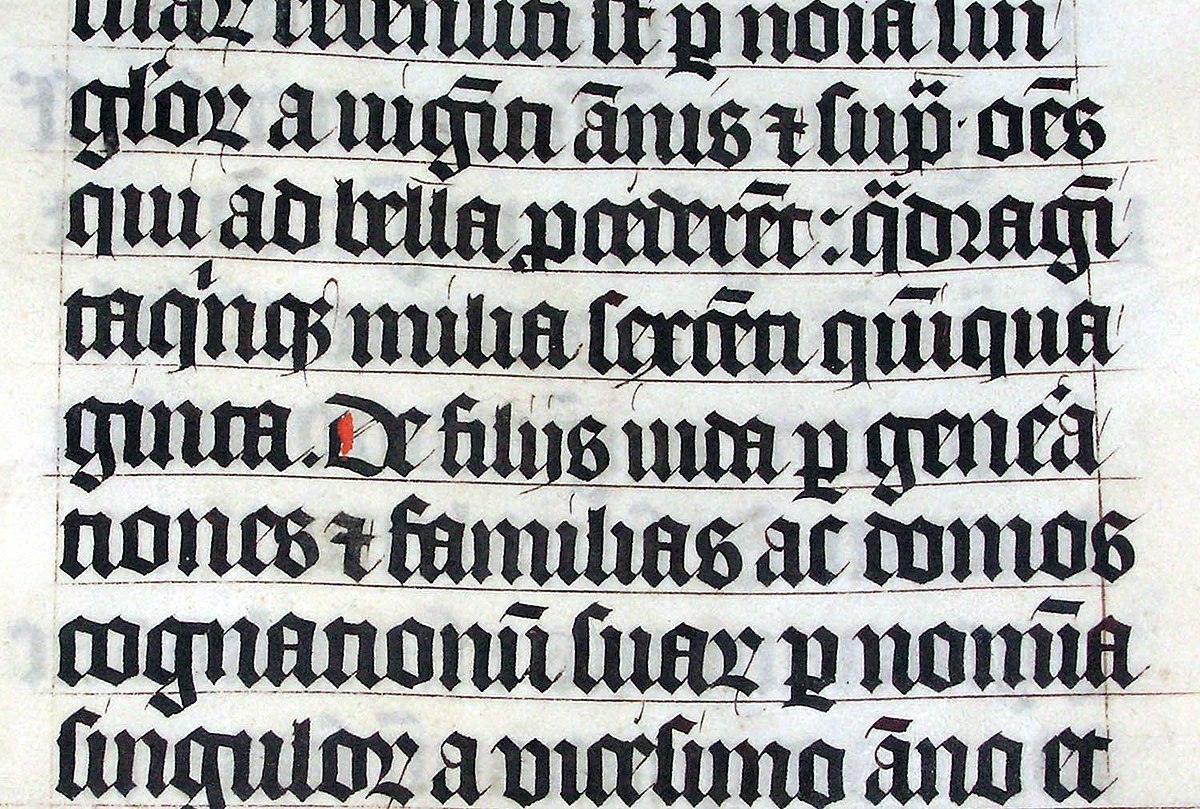
Another blackletter typeface developed between 1470 and 1600: Antiqua. This typeface’s letters were designed to look like the handwriting of ancient Roman documents, with the letters flowing together, strokes connecting them in a continuous line, whereas Fraktur was distinguished by having letters “fractured” – separate from one another. The Antiqua-Fraktur Dispute deserves its own article, so stay tuned!

Antiqua Typeface (Source: Wikipedia)
Fraktur Typeface (Source: Fonts in Use)

The Habsburg Emperor Maximillian I (1459-1519) was King of the Romans* from 1486 to 1519 [the title of king was used by the kings of East Francia, the territory later referred to as the Kingdom of Germany, from the time of Henry II (1002) to Joseph II (1764)]. The king commissioned the artist Albrecht Dürer to create a series of woodcut engravings of the Triumphal Arch [Though many are familiar with the Arc de Triomphe in Paris, it is only one example of this ancient Roman architectural feature used as a free-standing structure (rather than the Greek version, which was used within a structure such as a temple).]. These engravings would be used to create what we would recognize today as essentially wallpaper, though its purpose was more of a statement of power or propaganda (read personal marketing) commemorating his nobility, generosity, and military conquests – an incongruous combination, if you ask those conquered… The final composite of printed papers stood nearly 3 metres (12 feet) high and was only one part of a series of three enormous prints commissioned by the king.

Albrecht Dürer’s The Triumphal Arch, for Maximilian I

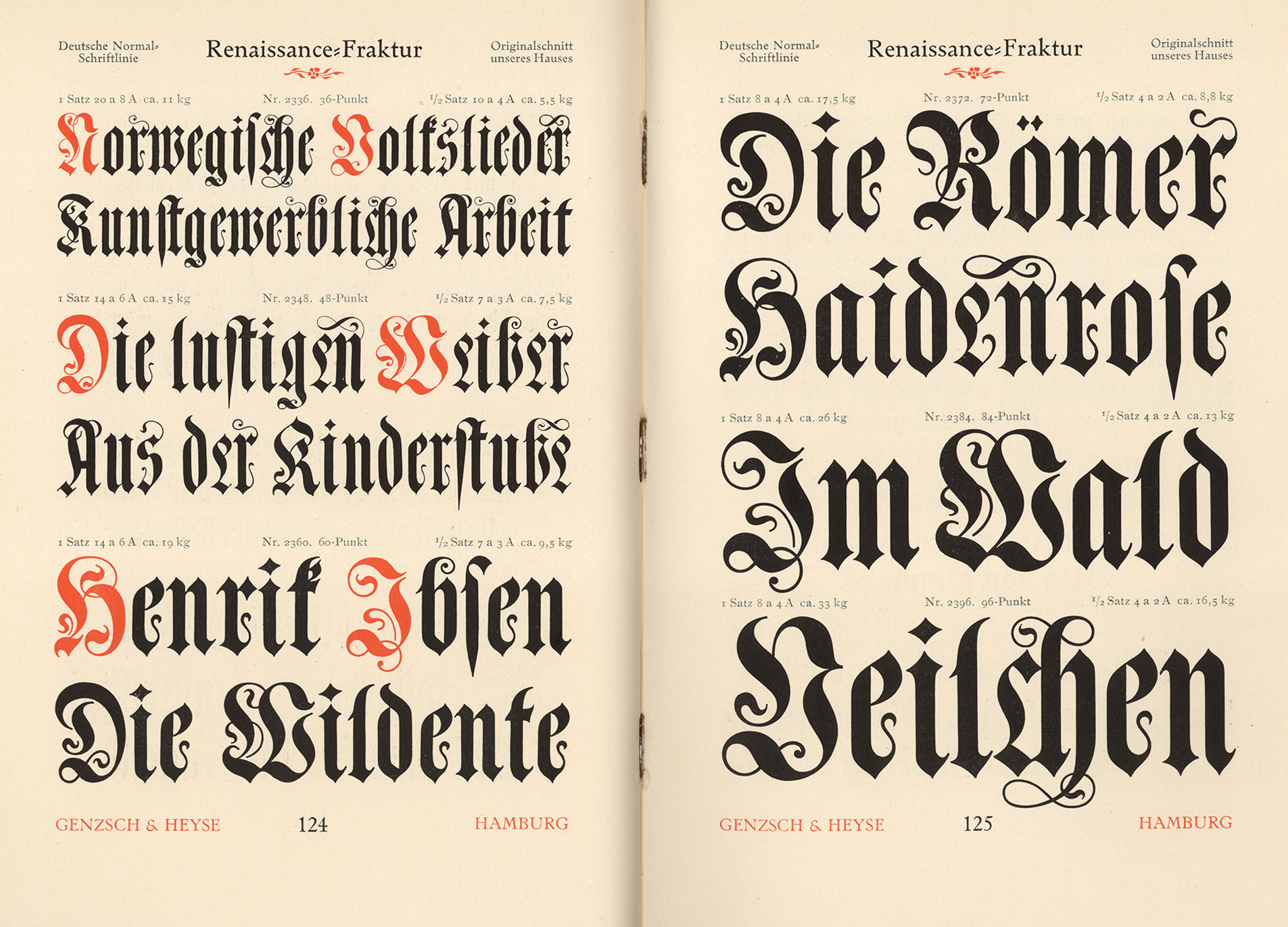
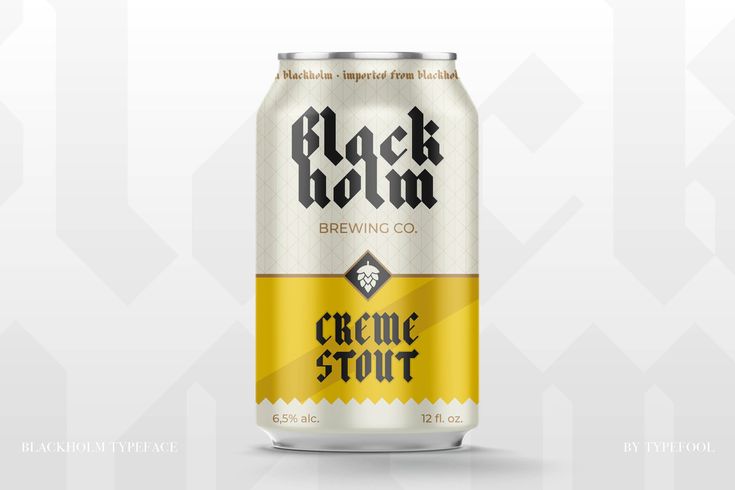
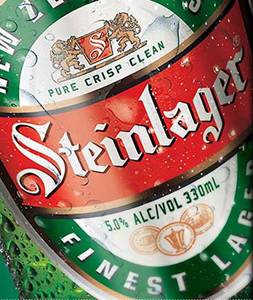
 The Fraktur typeface was designed in the 1530s by Hieronymus Andreae, a German woodblock cutter, printer, publisher, and typographer closely connected to Albrecht Dürer. The typeface was made to decorate the arch, telling the stories of the figures depicted throughout. The typeface became popular in Europe and was in use in the German-speaking world, as well as areas under its influence (Scandinavia, Central Europe, and some eastern European regions), into the 20th century. Specifically, Fraktur was in use in German until 1941, when it was actually banned (which places one of the books I purchased on Sunday within one year of the end of the era of Fraktur!). The atmosphere that led to that ban arose from the dispute mentioned above. Once the Nazis were defeated, the ban was lifted, but Fraktur never regained its widespread popularity after that, though you can still see it occasionally in pub signs or various forms of ads, like beer brands.

I just pulled two books from my library shelves: One is an English book originally printed in 1895, with my book being printed in 1915; the other is a German book printed in 1892. The typefaces are widely different: The English text likely used the French Oldstyle, while the German book uses Renaissance Fraktur for the text body, while the end pages act as indexes and use a variety of blackletter typefaces, such as Muenchner Fraktur, Antike Kanzlei, and Enge verzierte Altdeutsch. To see examples of the typefaces mentioned here, please click on the link for Fonts In Use.

I hope you enjoyed this jaunt through history! Nearly every name mentioned, every typeface, and every event deserves its own undusting. Next time, we’ll deep-dive into the dispute that lasted well over a century!

4 Comments

Filed under Articles, Etymology, History, History Undusted, Humanity Highlights, Images, Liguistics, Linguistics, Links to External Articles, Military History, Signs, Snapshots in History

Etymology Undusted: Murphy’s Law

The adage “Murphy’s Law” refers to the idea that anything that can go wrong will go wrong. You forget your umbrella and it will be sure to rain; your computer crashes at the worst possible moment; your worst itch is always where you can least reach it, and so on.

Similar sentiments are centuries old: E.g. Augustus D. Morgan, a British mathematician, wrote in 1866: “Whatever can happen, will happen”; Alfred Holt, an engineer, wrote in 1877: “It is found that anything that can go wrong at sea generally does go wrong sooner or later.” British stage magician Nevil Maskelyne wrote in 1908, “Everything that can go wrong will go wrong.”

But who was Murphy? And why is it his law? I’d always assumed that Murphy was either a fictional black sheep created to blame everything on, or someone from a century or more ago, much like Hobson of the “Hobson’s Choice” idiom; but Murphy’s Law comes from the 1940s aerospace era.

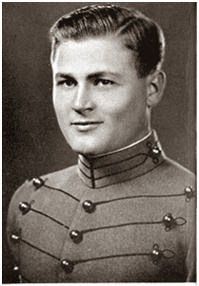
The “law” was coined by and named after Edward A. Murphy Jr. (b.11 January 1918; d.17 July 1990):  Born in the Panama Canal Zone in 1918, he finished high school in New Jersey and eventually graduated from West Point in 1940, joining the Army Air Corps, serving in the Pacific Theatre of World War 2, and in the Korean War, reaching the rank of major. According to his obituary on findagrave.com, he is credited with design work on crew escape systems for some of the most famous experimental aircraft of the 20th century, including the F-4 Phantom, the SR-71 Blackbird, the X-15 rocket plane, and later the Apache helicopter. He also worked on safety and life support systems for NASA’s Apollo space missions. Although he was apparently chagrined by the namesake, he believed in the concept as a key to good defensive design – that one must always assume worst-case scenarios and work to counter them in thorough planning, engineering and execution of mechanical designs.

Around 1948, Murphy and his team were testing rocket sleds, which were used to test the acceleration of equipment deemed too hazardous to test in a piloted aircraft and also to test missile components without risking actual (more expensive) missiles in the testing. The saying arose when training his engineers to avoid designing missile components that could be confused one for another; he said, “If a part can be installed in more than one position, it will be incorrectly installed in the field.” Perhaps Murphy was familiar with the sentiment of those past engineers, given his background in engineering, but wherever it came from, his name was attached and, as they say, the rest is history.

Edward Aloysius Murphy Jr, in his West Point uniform

5 Comments

Filed under Etymology, History, History Undusted, Humanity Highlights, Military History, Science & Technology, Space, Astronomy

History Undusted: Shop Signage

I’m fascinated by a few aspects of architecture in particular, such as doorways, knockers, unusual features such as sundials on the sides of buildings, mural paintings (here in Switzerland, these are sometimes hundreds of years old), and shop signage – you’ll see the latter even in the smallest town here.

This past summer, my husband and I rented a motorhome and travelled mostly in eastern Switzerland. I would say that 90% of my photos were of shop signs! I find that if you focus in on one topic, you’ll begin to see that thing everywhere.

Known as commercial signage or trade signs, such symbols of a shop’s products have been used as far back as ancient Egypt. As many people were illiterate, the pictorial shop sign not only advertised what was for sale in a shop but also distinguished the shops with similar items. By the mid-15th century, English laws even required shops that sold ale to hang a shop sign out; it made inspections of the quality of the ale easier. Some signs were temporary; for instance, if a woman made more ale or bread than her family could consume, she would put out a sign to sell the surplus and thus earn a bit of money. In the narrow streets of medieval towns, signs might be so large as to nearly touch the building on the other side of the lane, and they could become a hazard to passing horsemen or coachmen. By the mid-16th century, regulations were passed to limit the size of signage, and the securing of the sign to the building to avoid it endangering passersby. In Britain, hanging signs were eventually phased out in favour of what were are most familiar with – a flat sign denoting the store along the space above the front windows. But here in Switzerland, shop signage is everywhere – not just old, but also newer additions.

The development of the signs, including elements of guilds or heraldry symbols, led to competition between blacksmiths to create the most elaborate ironwork. The signs evolved from simple displays of ware to symbolic representations of a shop owner’s name or a heraldic connection or patronage of royalty (e.g. a crown). Examples might include shoemakers displaying a shoe or gilt boot, bakeries displaying bread, and haberdasheries displaying a needle and thread or a coat.

Here is just a fraction of the signs I photographed during our holidays, with brief explanations:

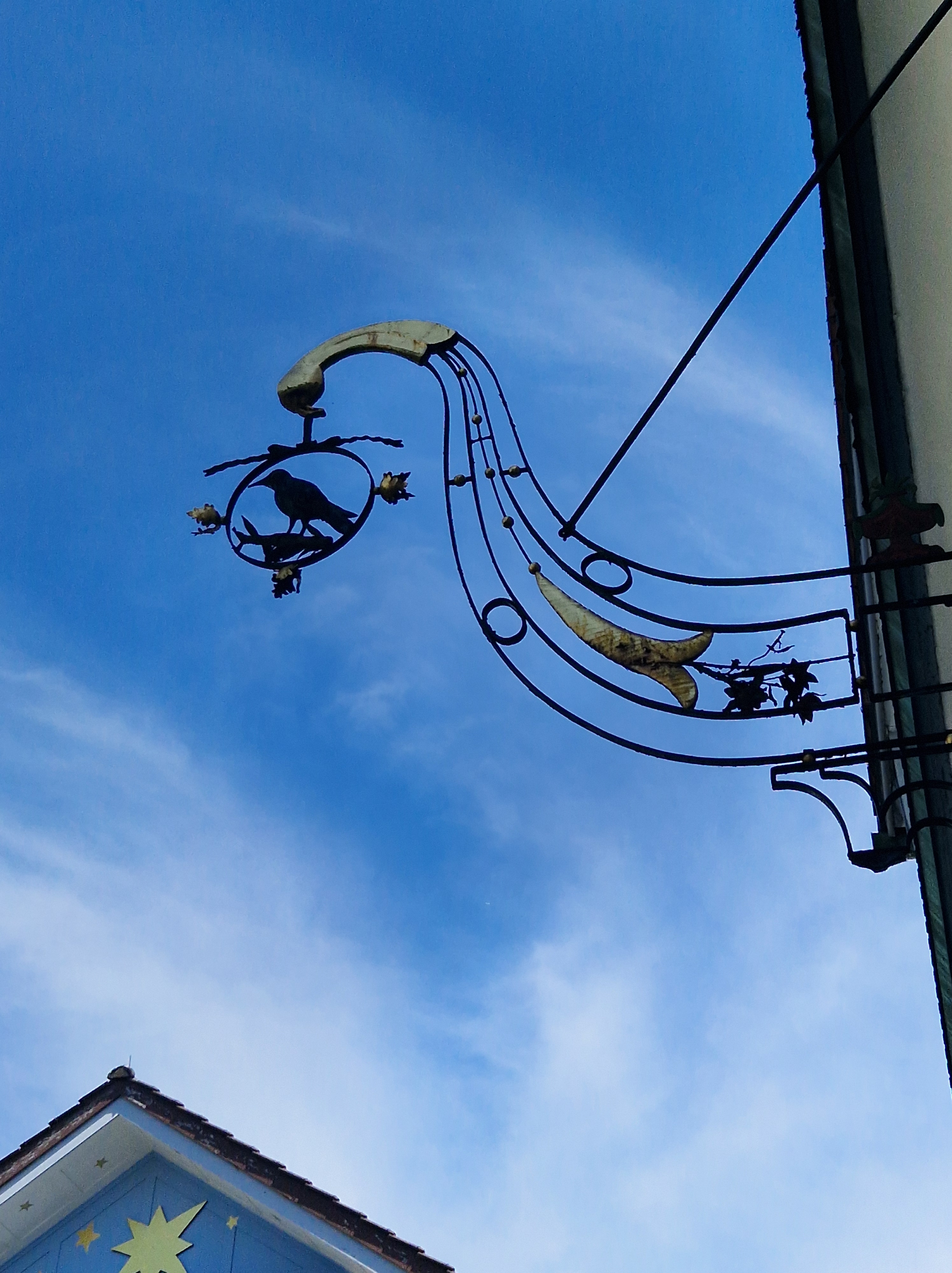
The building from which this sign hangs was built originally in 1664, and renovated to the current form in 1830. It was originally an inn/tavern on one side, and a forge (blacksmith) on the other. The Raven, as a tavern, took its symbol from the legend of St. Meinrad (797-861 AD); he was a hermit who rescued two young ravens from a sparrowhawk and raised them in his hut in the Finstern Wald (dark forest). In 861, he was murdered by two robbers; when they realized what they’d done, they fled to Zürich, but the crows followed them into a tavern and attacked them; the others present thought it unusual, so they took the men captive; they confessed, and were executed. The raven became a symbol of inns along a pilgrimage road; it was sometimes combined with a wine jug and bread.

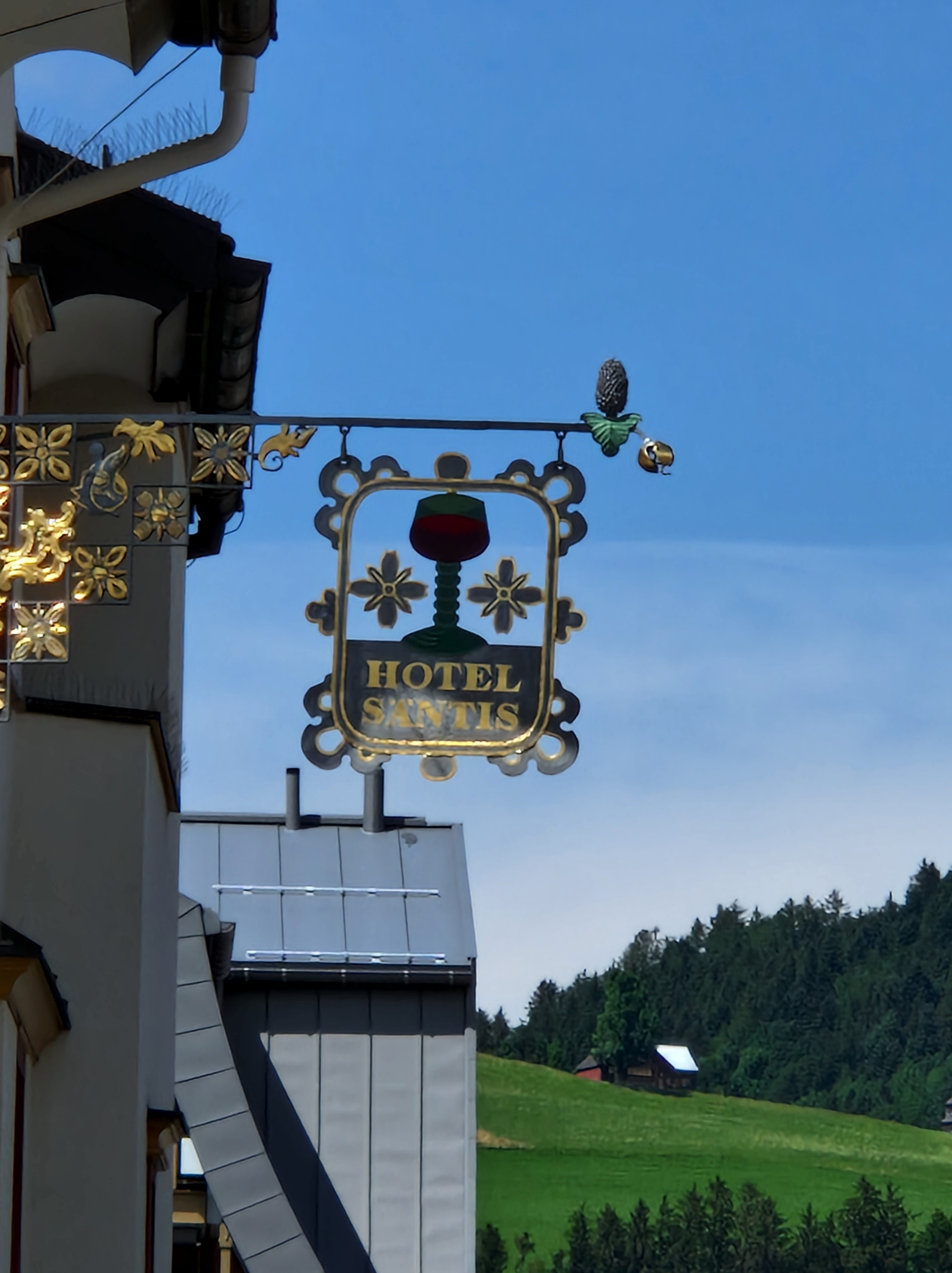
The Hotel Santis sign has a few symbols: The wine is an obvious reference to a tavern, pub or inn; the pine cone is an interesting addition: It was the symbol of the field sign of the Roman legion stationed in Rhaetia in 15 BC, and hence it is used as a heraldic charge (an emblem on a shield). It may have been included in this sign to proclaim a good place for soldiers to eat or sleep, or as an advertisement that it was protected under a legion or unit of the military at a time when such protection would have been welcome. The bell symbolized a pilgrimage or an invocation of guardian angels over a premises.

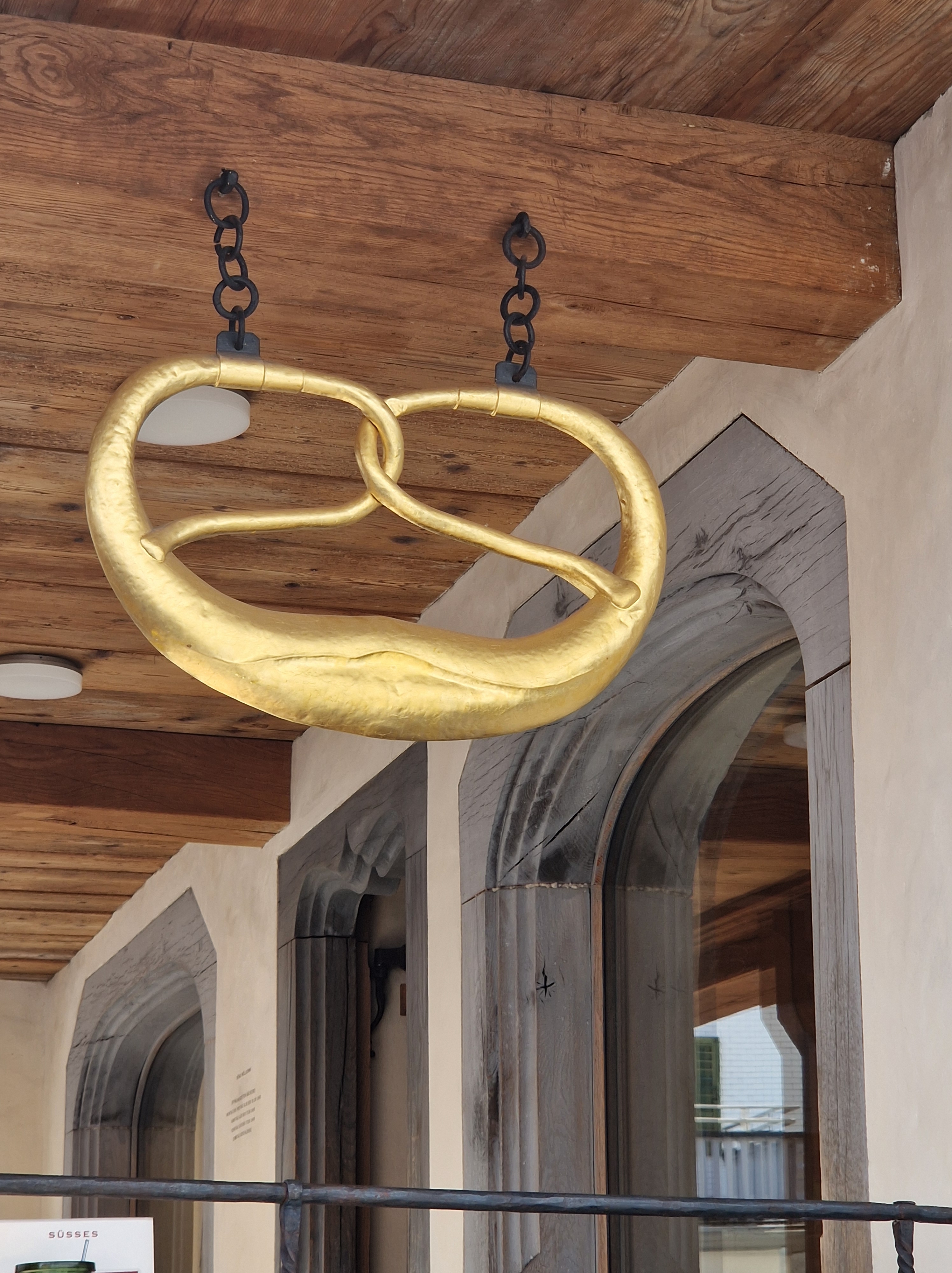
I think this is fairly clear – it’s a bakery!

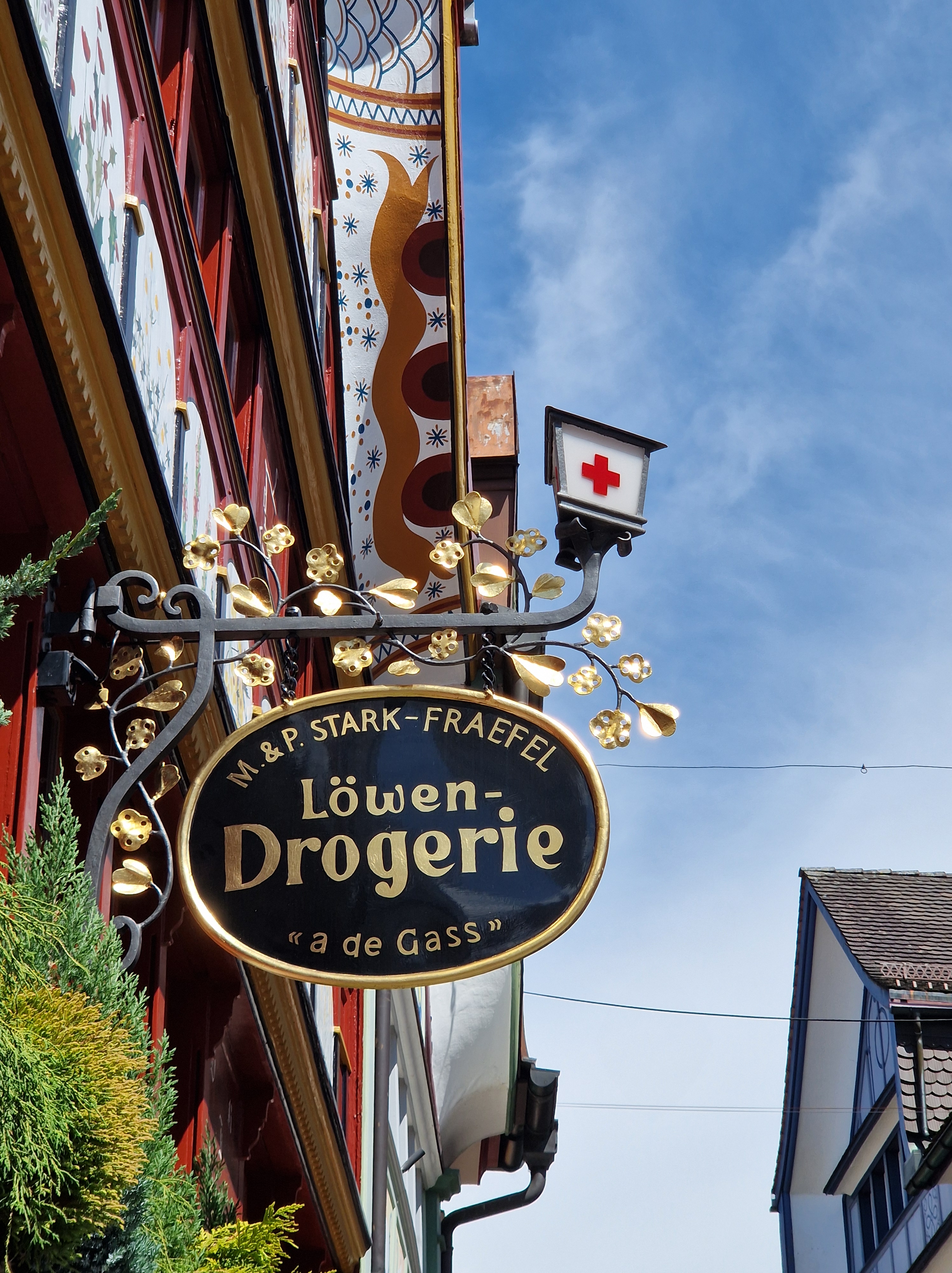
This building is a pharmacy; the front of the building is a beautiful example of the mural painting I mentioned earlier; these panels represent the herbs and flowers used medicinally. The saying painted toward the right side reads: Vielerlei Kraut gegen Leibesnot, aber kein einzigs wider den Tod (Many herbs against bodily pain, but none against death).

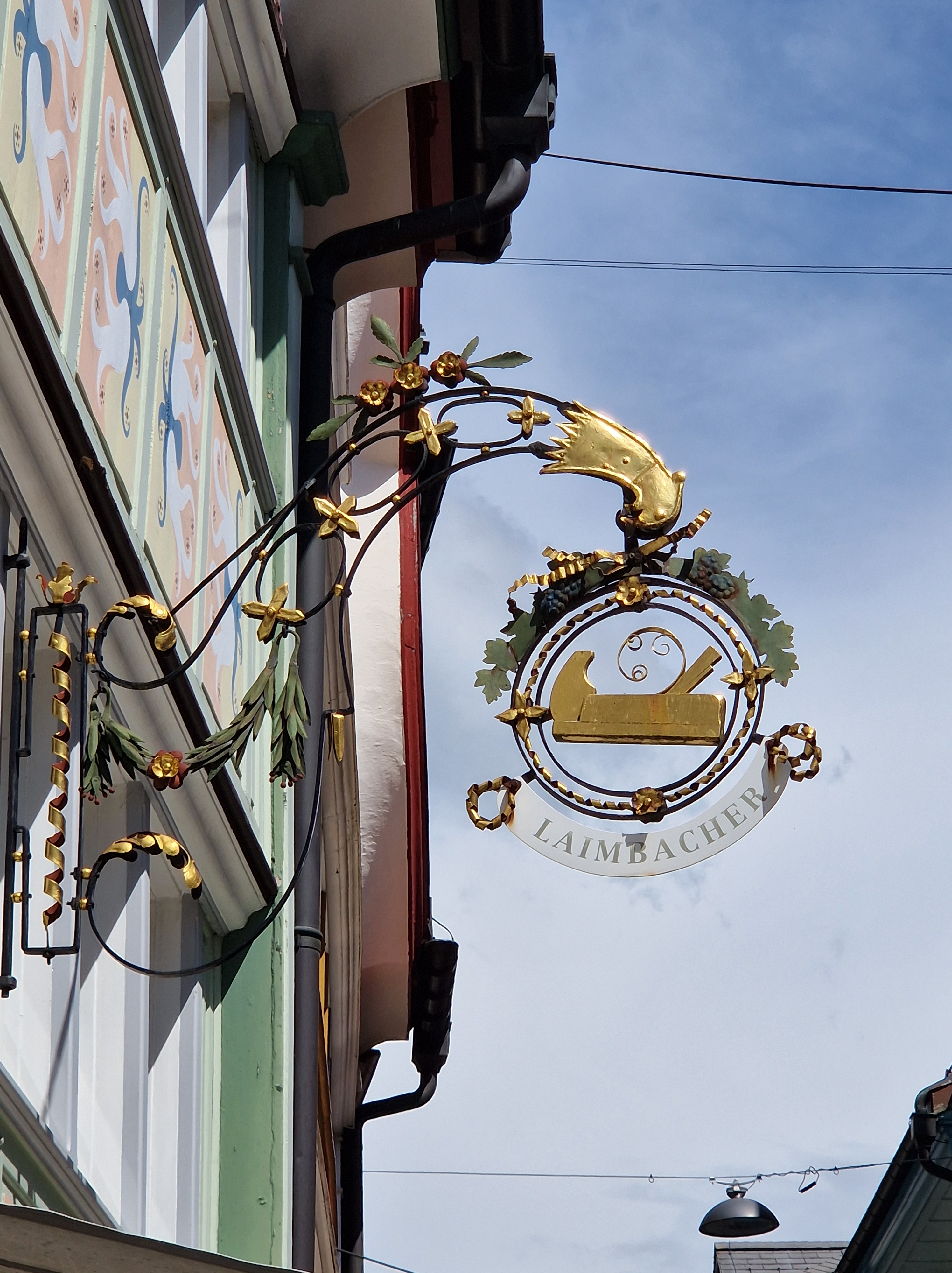
This symbol denotes a carpenter’s shop.

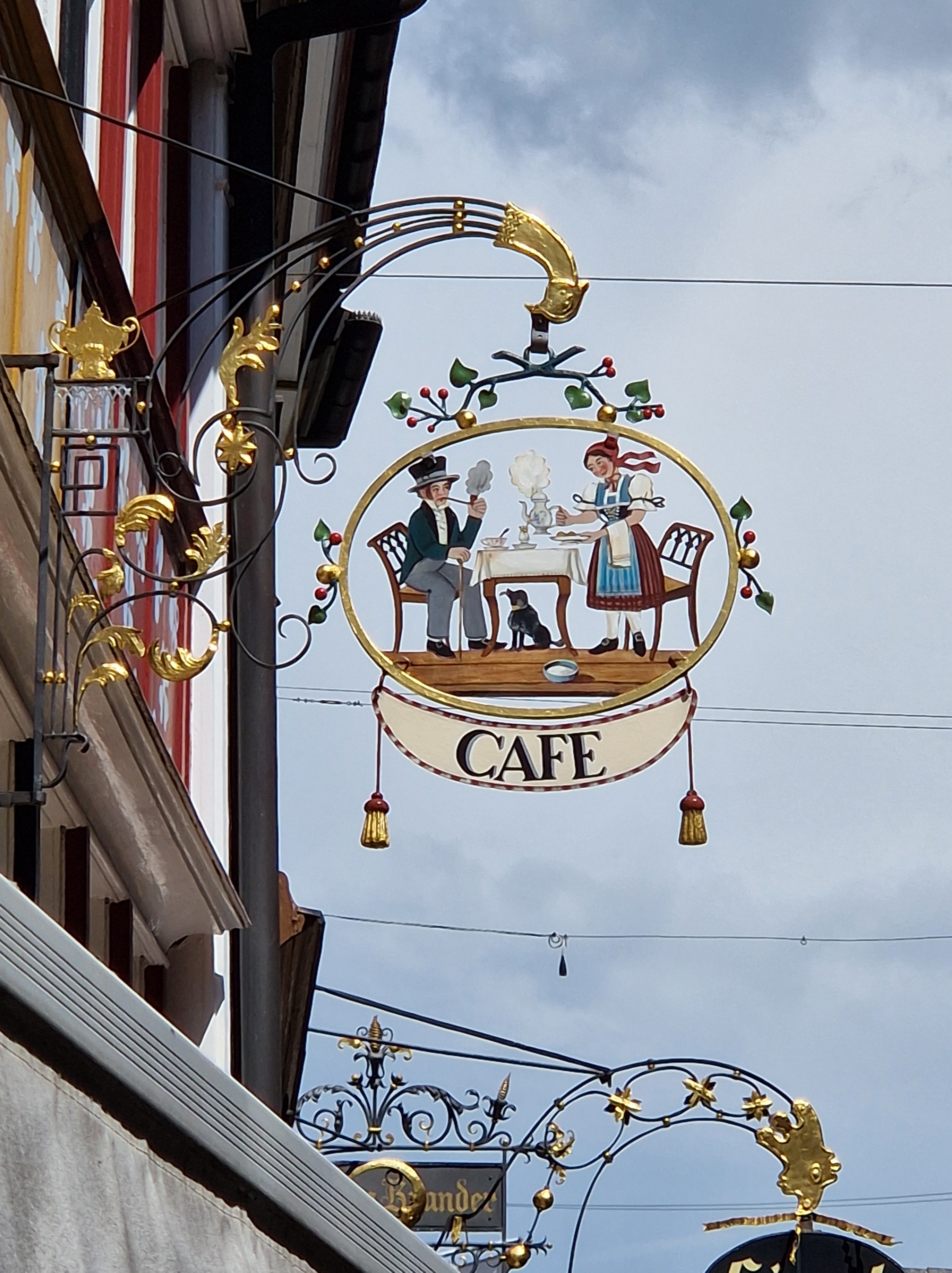
This café sign would be clear from any stagecoach stopping for a break and horse change what could be expected inside. The figures are dressed in traditional Appenzeller clothing.

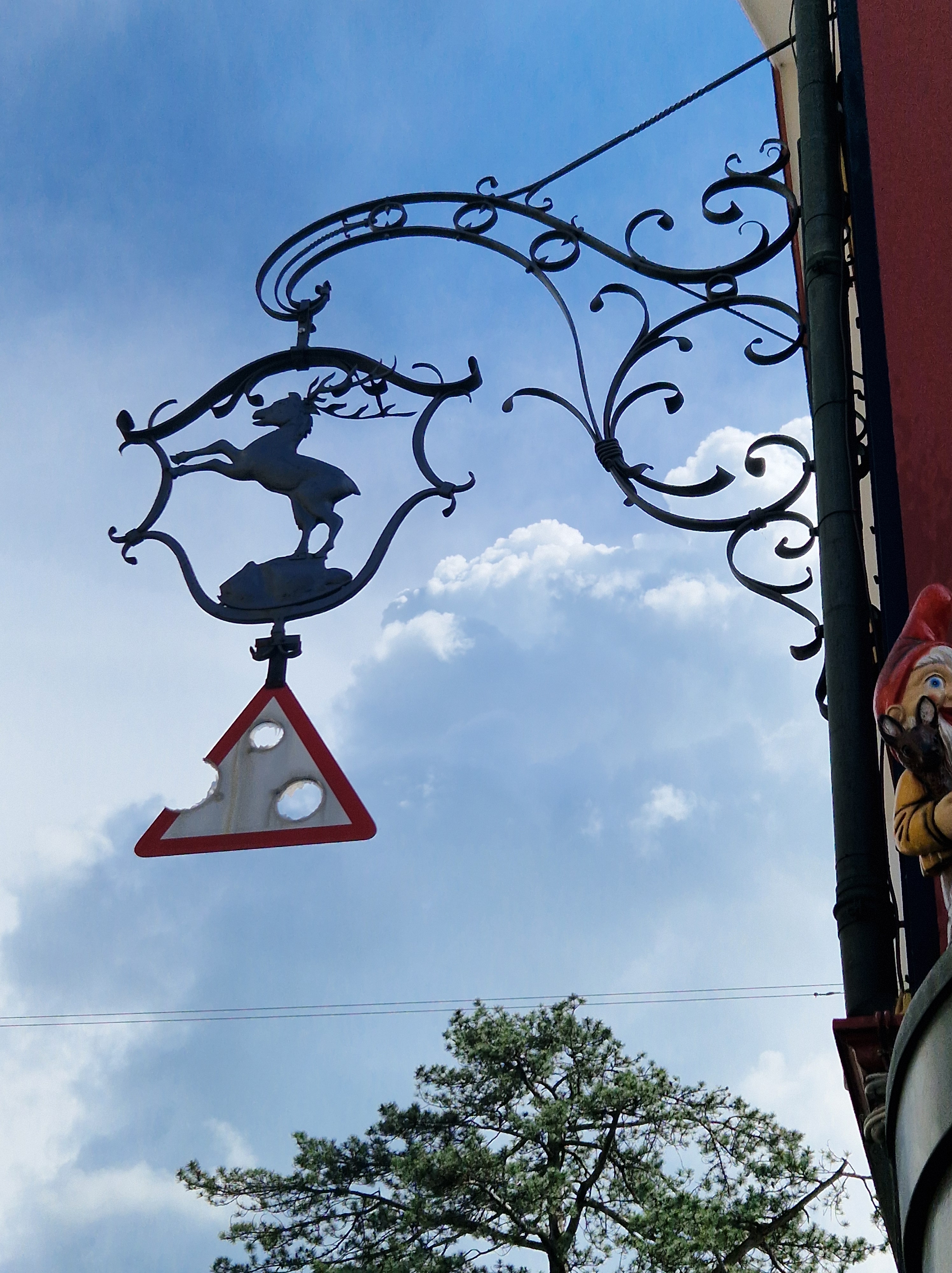
And lastly, here’s a traditional sign with a modern addition: It’s a hunting lodge, or inn that serves wild game meat. Next to it, peeking around the corner, is a figure from a toy shop.

 I hope you enjoyed this little excursion!

12 Comments

Filed under Articles, Etymology, History, History Undusted, Linguistics, Military History, Signs, Snapshots in History, Translations, Virtual Tours

History Undusted: 15 January

Unless you’ve been busier than I‘ve been, you’ll have realized that half of January 2025 is already gone. The end of 2024 was crazy busy, and after the dust of the Christmas holidays settled, life was about getting caught up with all of those little things that had been neglected for a couple of months.

I’ve thought about how I want to go forward with this blog in the coming year; I enjoy having this platform to dive into topics I might not otherwise encounter in my day-to-day life, but life in the real world has many facets that keep me busy, too. I’ve decided to post roughly once per fortnight, giving me time to live, write/edit/publish, and research topics of interest. I’ve always tried to write quality above quantity, and I want to share things that interest me, grab my imagination, or give me a good laugh. If you feel the same, sit back and enjoy the ride!

Since this is mid-January, let’s take a look at some of the highlights of history on this day, the 15th of January:

1541: A commission to settle New France (Canada) was granted by King Francis I of France.

1559: Queen Elizabeth I was crowned Queen of England in Westminster Abbey, London.

1759: The British Museum opened to the public for the first time.

1777: In the American Revolutionary War, New Connecticut (Vermont) declares its independence.

1782 – The U.S. Congress was petitioned to establish a national mint and decimal coinage.

1870 – For the first time, a political cartoon symbolizes the Democratic Party with a donkey (“A Live Jackass Kicking a Dead Lion” by Thomas Nast for Harper’s Weekly).

1889 – The Pemberton Medicine Company (later to become known as the Coca-Cola Company) is incorporated in Atlanta.

1908 – The Alpha Kappa Alpha sorority becomes the first Greek-letter organization founded and established by African American college women.

1919 – Great Molasses Flood (a wave of molasses ejected from an exploding storage tank) sweeps through Boston, Massachusetts.

1943 – The Pentagon is dedicated in Arlington County, Virginia.

2001 – Wikipedia, a free Wiki content encyclopedia, is launched (Wikipedia Day).

2009 – US Airways Flight 1549 ditches safely in the Hudson River after the plane collides with birds less than two minutes after take-off. This became known as “The Miracle on the Hudson” as all 155 people on board were rescued. This story was adapted for the “Sully” film in 2016.

2015 – The Swiss National Bank abandons the cap on the Swiss franc’s value relative to the euro, causing turmoil in international financial markets.

2022 – The Hunga Tonga-Hunga Haʻapai volcano erupts, cutting off communications with Tonga and causing a tsunami across the Pacific. It was the largest volcanic eruption since the 1991 eruption of Mt. Pinatubo (Philippines).

Which of these events do you find most interesting? Please comment below and let us know! For me personally, it’s the opening of the British Museum. What was it like back in 1759, and how has it evolved into the massive collection it is today? I’ve been there a few times, but I have yet to see it all!

This is AI’s interpretation of “ancient scroll rolled up”. No idea where the man came into that result, but his longsuffering expression is apt!

3 Comments

Filed under Articles, History, History Undusted, Lists, Military History, Snapshots in History

Humanity Undusted: Paris Catacombs and the Les Ux Secret Society

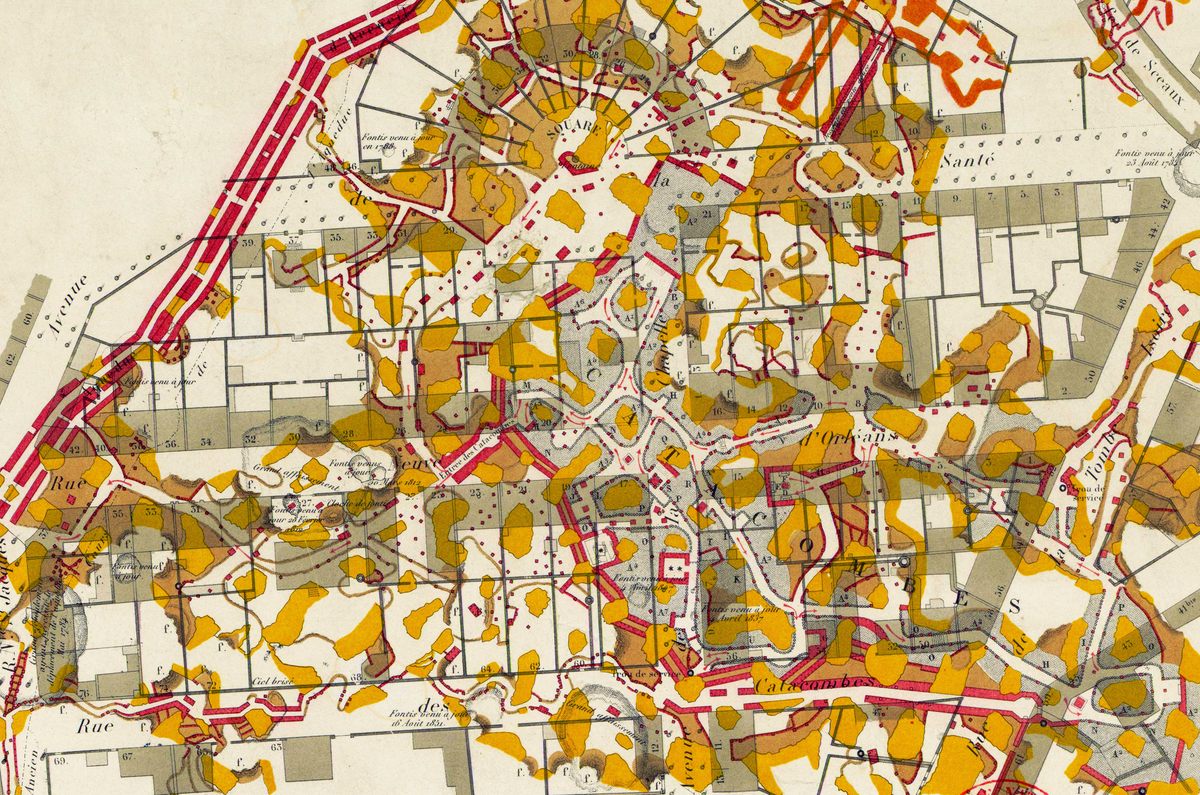
This week’s adventurous tale is a proverbial rabbit hole; diving into it takes us past the problem of Paris’ 18th century dilemma of dealing with the “explosive” issue of overfilled cemeteries, which forced King Louis XVI to take action: Bury them deeper. Following this problem and its solution into the ground, so to speak, leads us into the massive (1.5 km long) ossuary (bone depository) of Paris. Once you reach the ossuary, which contains the artfully arranged skulls and bones of some six million residents (around three times more than the actual population of central Paris, which as of 2023 was 2.1 million…), you aren’t officially allowed to go any further – because above your head is the bustling city of street cafés, boutiques, and historical buildings. And when someone buys a house up there, they are actually also buying the land on which it stands – which includes their section of the underground maze of mining tunnels and caverns; venturing beyond the official section makes you an intruder on private property or breaking and entering an actual shop – but more on that in a moment. The message above the entrance to the ossuary reads, Arrête! C’est ici l’empire de la Mort. (“Halt! This is the Empire of Death.”). That warning doesn’t stop it from being one of Paris’ most popular tourist attractions.

The tunnels, now known as The Catacombs, were originally dug far outside of the small 13th-century city when Lutetian limestone was mined as a local building material (any town or city with a distinctive architecture owes its appearance to whatever was available locally when it was founded – whether wood, stone, thatch or brick). Though no one knows with certainty, as the mining resources were eventually exhausted and the mines abandoned, an estimated 350 kilometres of tunnels undermined the city, which covers some 32 square kilometres beneath Paris… a city beneath a city, as it were.

And yes, buildings have occasionally been swallowed; in 1774, about 30 metres of a street disappeared into a cavern below. This led to the formation of the Générale des Carrières (IGC), an office created in 1777 by King Louis XVI to oversee the mapping and maintenance of the catacombs. During the French Revolution, many things got lost and fell out of collective memory, including the underground map.

Paris Catacombs Map – Inspection Générale des Carrières, 1857, Pulbic Domain

Throughout the years, the tunnels have been put to various purposes, aside from the macabre: Mushrooms were cultivated there; beer was brewed, wine aged, and Chartreuse liquors were distilled down there by monks in the 17th century. The city beneath the city had no prime real estate overhead for businesses, and many took advantage of the free space, making access for their customers through the various access points throughout Paris. It also served the French Resistance during world war 2, even though the Nazis also used a section of the tunnels. Now, let’s go back up out of the rabbit hole for a brief moment.

Remember that I wrote officially allowed? Well, a secret maze of tunnels is too much to resist for the adventurous, called cataphiles. But there is a secret society at large down there, too.

When you think of a secret society, you might think of the Luminati or something else sinister; but the Les Ux would be more akin to Robin Hood. The story goes that in 1981, a group of kids were talking after school, and one of them mentioned that he could break into any building in Paris; in fact, his next target was the Pantheon. They didn’t believe him, and so they all went down together – and found out just how easy it was to go wherever they wanted. The Pantheon, which was the tallest structure in Paris until the Eifel Tower was constructed, vacillated between being a church and a secular building several times over its history, depending on the political regime, and it finally became a secular structure in 1885 under the Third Republic. It now is a mausoleum, with famous residents like Marie Curie, Victor Hugo, Alexandre Dumas and Voltaire; but it is also a museum, an art exhibition hall, hosts school events and lectures, and is linked to a section of the catacombs – which is where the group of school friends began their adventures.

During one of their nocturnal outings, the group stumbled upon a narrow passage full of electrical cables; following those, they found themselves in the basement of the Ministry of Communications. No security stopped them and they were able to explore at their leisure. In a drawer, they found the motherlode: A map of the entire catacomb structure. That changed the course of their lives, and they eventually became known as the Les Ux, short for “urban experiment”. These individuals, unknown to anyone but themselves, specialize in safeguarding Paris cultural goods – stepping in when the government can either not afford to or doesn’t care enough to preserve something of cultural or historical value. They seem to think that, unless it’s a big-ticket attraction like the Mona Lisa, things get neglected. For instance, the mission statement of one branch of Les Ux is to reclaim and transform disused city spaces for the creation of zones of expression for free and independent art.

The group, now a full-fledged underground movement, is divided up into teams with seemingly nonsensical names: The Mouse House (an all-female team of infiltrators), La Mexicaine De Perforation (in charge of clandestine artistic events and underground shows), and the Untergunther (specializing in restorations); they also have teams that specialize in things like running internal messaging systems and coded radio networks, a database team, and a team of photographers.

Some of their exploits include restoring a forgotten metro station, a 12th-century crypt, an old French bunker, and a World War 2 air raid shelter.  One member, likely from the Mouse House, wrote a detailed report about a particular museum’s security, telling them how many ways she could have broken in and stolen had she been so inclined. She then infiltrated the museum and left the report on the desk of the museum’s head of security. He went straight to the police to press charges. They refused to pursue the matter.

They built an entire cinema complex in the catacombs, complete with a bar and restaurant, where they are thought to have held film festivals for several months or even years before being discovered by the police in a random training exercise. When the police returned to remove the cinema, everything was gone except a note which read, “Don’t try to find us.”

Les Ux has held many events within the Pantheon over the years, including parties and art exhibitions – all vanishing, and leaving the place cleaner when they left, before the museum opened the next day. One night, a team member (from Untergunther) decided to take a closer look at the broken Wagner clock, which hangs over a prominent entrance within the building. Their most public restoration (that we know of so far) was, of course, an embarrassment to the management of the Pantheon: One of the members, Jean-Baptiste Viot, was a professional clockmaker; the team snuck in for nearly a year to restore the clock. They built a secret workshop (complete with armchairs, bookcase, and bar, which they nicknamed the Unter and Gunther Winter Kneipe – German for winter boozer!) high up in the dome of the pantheon, and carried out the clock work by night. Once it was done, they knew that the clock would need to be wound regularly to continue working – so they broke protocol and met with the museum director to tell him the good news. He promptly pressed charges… but there are no laws in France about repairing an expensive clock at their own expense, and the case was dismissed with the comment, “This was stupid!” The museum director hired someone to break the clock, presumably to avoid the hassle of winding it up regularly, and also out of spite for losing his case and his face; the person refused to damage the clock, simply deactivating the mechanism. Les Ux snuck back in to let the clock chime over the days around Christmas, then went back in and removed a component to prevent any further damage the next time spite struck. I’ve read that since that time, the clockmaker of Untergunther has actually been hired by the Pantheon to maintain the clocks.

We only know of a fraction of their activities, of course, because they don’t publicise their accomplishments or events. Below are a few links if you’d like to read more on this fascinating topic! I hope you enjoyed this little exploration as much as I did!

Here are a few links to articles, if you’re interested in learning more:

Meet Paris’ Secret Underground Society (Youtube video)

The Fight Between Cataphiles and Underground Police in the Paris Catacombs

Paris’s new slant on underground movies (with a member interview, explaining how they pulled off the cinema complex)

3 Comments

Filed under Articles, History Undusted, How It's Made, Humanity Highlights, Links to External Articles, Military History, YouTube Link

Just for Fun: Maintenance Complaints & Replies

Here’s another gem from my recently re-discovered “bits & bobs”: These are actual maintenance complaints submitted by USAF pilots and replies from maintenance crews:

Problem: Left inside main tire almost needs replacement.

Solution: Almost replaced left inside main tire.

Problem: Test flight OK, except autoland very rough.

Solution: Autoland not installed on this aircraft.

Problem: Something loose in cockpit.

Solution: Something tightened in cockpit.

Problem: Evidence of hydraulic leak on right main landing gear.

Solution: Evidence removed.

Problem: Friction locks cause throttle levers to stick.

Solution: That’s what they’re there for.

Problem: Number three engine missing.

Solution: Engine found on right wing after brief search.

3 Comments

Filed under Cartoon, History Undusted, Humor, Just for Fun, Military History

History Undusted: The Folly of King Alfred the Great

Recently, my mother sent me a link on Facebook and asked me to write an article about it; it’s definitely an interesting topic – so thanks, Mom!

First of all, for those of you who don’t know what a folly is:

In architectural terms, a folly is a building that is either constructed as decoration which suggests another purpose or is a practical garden building that transcends its purpose with extravagant features. An example of the former term would be buildings that were designed from the outset to look like ancient ruins, such as Wimpole’s Folly in Cambridgeshire, England; an example of the latter would be buildings like the Dunmore Pineapple in Stirlingshire, Scotland (I’ve been to this site a few times and was once able to go inside the pineapple). Designed to look like a giant pineapple, it was actually a working hothouse; that’s perhaps another story to tell. As for today’s topic, the folly of King Alfred would fall into the former definition.

Second of all, who was King Alfred, and why does he bear the sobriquet Great?

Statue of Alfred the Great at Wantage, Oxfordshire

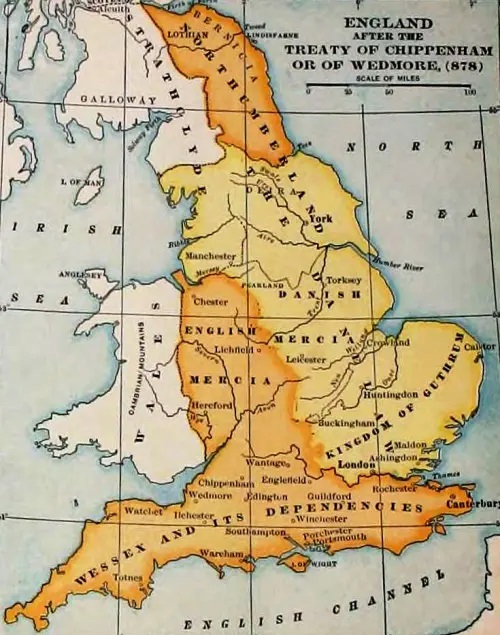
Born in 849 AD, Alfred the Great was King of the West Saxons from 871 to 886, and then King of the Anglo-Saxons from 886 to 899. He lived in a time when Viking invasions and warring tribes were common. Both of his parents died when he was young, and his three older brothers reigned before he eventually came to the throne. The battles, invasions and wars are too numerous to mention; to be a king meant to be at war. At the age of 21, he was already the King of the Wessex and a battle veteran. In early 878, the Danes struck like lightening, taking Chippenham (on the map below, you’ll see that it was in the heart of Alfred’s territories); inhabitants surrendered or fled, and it reduced Alfred and his men to hit and run means of getting provisions; they withdrew into the tidal marshes of Somerset (the area on the other side of the River Severn, just below Wales on the map below). Alfred reevaluated his strategy and learned from his enemy: He and his men began a guerilla war against the Danes, and by May, he’d defeated them in the Battle of Edington. Knowing that he would never be able to drive out such a powerful enemy, he made a treaty with them, establishing borders and what became known as the Danelaw territory; King Guthrum of the Danes converted to Christianity, with Alfred as his godfather and soon son-in-law as he sealed the treaty by marrying one of Guthrum’s daughters, Aethelflaed.

The Great comes from the fact that he united many of the disparate tribes; he recognized the deterioration in learning caused by years of disrupting wars and the Viking’s destruction of the monasteries, which were centres of learning and literacy. He recognized the fact that without widespread literacy, a king cannot rule – a people who were not united by a written language would be more vulnerable; but united through a common tongue, they would have a sense of loyalty and continuity in turbulent times. They would be able to adhere to laws, reach legal decisions, and be called to arms more readily if they could read a common language. He set out to make the English proud of being English and thus be prepared to fight for it.

By stopping the Viking advance against all odds, and consolidating his territories, he set the stage for future kings. His accomplishments in Wessex became the seed that eventually gave fruition to a united Anglo-Saxon England, which is why he alone among all kings or queens of England bears the sobriquet Great.

King Alfred’s Folly:

King Alfred’s Folly – Credit, Flickr, Andrew Bone

King Alfred’s Tower was built between 1769 and 1772. To put those dates into perspective, here are a few events from the year that construction began: 13-year-old Mozart, under his father’s control, was just finishing his third concert tour of Italy; James Watt improved his design for a steam engine that would spark the Industrial Revolution; King Charles III of Spain sent missionaries to California, founding San Diego, Santa Barbara, San Francisco and Monterey; Daniel Boone set out to explore what would become Kentucky; and finally, in August of that year, Napoleon Bonapart was born in Corsica.

The tower itself was built near the site of Egbert’s Stone, which is said to mark the mustering site for the troops of the Battle of Edington; the tower was intended to commemorate the end of the Seven Years’ War and the ascension of King George III to the throne of England. It was designed in the Palladian style (a European architectural style) by the architect Henry Flitcroft, at the commission of Banker Henry Hoare. While the reasons for commissioning the tower might be altruistic of Hoare, its site and magnificence might have had something to do with the fact that the tower was an eye-catcher for those touring the parks at his private estate, Stourhead.

Standing at over 40 metres high (131 feet) and a circumference of 51 metres (167 feet), it is completely hollow; it is a triangular structure with a round “tower” at each corner, though only one of them has a use – a spiral staircase of 205 steps, with no landing places along the dizzying ascent or descent. The only safety is a rope “railing” anchored occasionally along the central pillar of the staircase; passing others up or down can be a tight squeeze, and it is not a climb for the faint-hearted. Once reaching the top, you’ll find a crenelated parapet that surrounds a viewing platform offering a great view of the surrounding region; the centre of the platform is surrounded by a guard rail as it is a gaping hole straight down to the ground level; it’s covered with a mesh netting to prevent birds from using the tower as a dovecote.

In 1944, the tower was damaged when a Canadian single-engine plane crashed into it in the fog, killing all five aboard. In the 1980s, it finally underwent repairs and restoration; the statue of King Alfred above the main entrance was also repaired at that time, restoring a missing right forearm. A stone tablet (also in need of restoration) between the door and statue reads:

ALFRED THE GREAT
AD 879 on this Summit
Erected his Standard
Against Danish Invaders
To him We owe The Origin of Juries
The Establishment of a Militia
The Creation of a Naval Force
ALFRED The Light of a Benighted Age
Was a Philosopher and a Christian
The Father of his People
The Founder of the English
MONARCHY and LIBERTY

Leave a comment

Filed under Etymology, History, History Undusted, Humanity Highlights, Links to External Articles, Military History

10 Everyday Phrases with Nautical Origins #4

Picking up from where I left off in February, here are a few more everyday phrases that have been gleaned from the times when ships at sail were the most influential source of importing new ideas, foreign words and catchy tunes (such as shanties). The first of these phrases might be recognized by Star Trek fans, as the captain usually used this term or something similar to hand over the authority of the ship whenever he left the bridge.

Take the Conn: A term used to take over navigational duties on the bridge of a ship (this comes from the mid-1800s, during the age of iron-clad warships). Idiomatically, it means to take control of a situation. The word conn is either a noun or a verb and comes from conning tower – a raised platform from which the entire deck and surrounding environment can be observed.

Sailing Close to the Wind: Strong winds can be just as problematic at sea as no wind; strong winds can unexpectedly shift and take control of a boat’s direction, and many sailors will lower their sails until more favourable conditions exist. To use strong winds for sailing is risky and unpredictable but sometimes necessary; the modern term refers to taking risks that may be unreasonable, being close to breaking the law or going too far.

All Hands on Deck: A call to action – everyone must assist in resolving a problem or addressing a situation. During inspection or trouble, all hands were called to the deck; everyone needed to be present or accounted for, and working as directed.

On the Right Tack/Track: The correct course while sailing requires you to tack or move the sail to catch the wind to keep you on course. To take the wrong tack means to be off course, heading in the wrong direction. Tack has changed to track in a more modern language. Today it refers to Taking the line/course of action that leads to the correct conclusion.

Overboard: If cargo or people went overboard when sailing, the call “overboard” would be yelled out to draw attention to the event. With luck, the items or people could be recovered, but unfortunately, this was not often the case.

Abandon Ship: When a ship was sinking or being overrun by an enemy ship, sailors would need to abandon their posts and escape. The call to abandon the ship was considered a last resort.

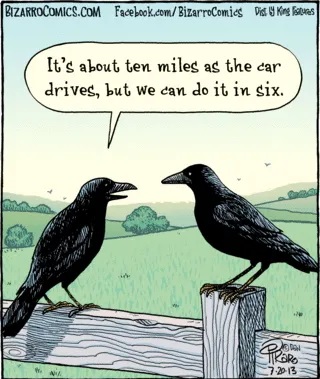
As the Crow Flies: After crossing the oceans, sailors would watch for birds to detect nearby land. Following the direction of birds, such as a crow or seagulls, got them closer to shore to follow it to a port. Crows fly straight, and so it refers to the shortest distance between two points.

Tide Over: When a ship could not get under sail due to poor winds, they would ride the tide until the winds returned. If something tides one over, it will last until new provisions can be obtained or until conditions change.

High and Dry: If a ship was caught in low tide or ran up on the shoals, it might end up being stranded with no hope of recovery. The term was to be caught high and dry, as in up out of the water. It’s used today to describe the feeling of being abandoned, stranded, or helpless.

Sink or Swim: Tossing a person overboard resulted either in them sinking or swimming. The term was made popular in swashbuckling movies featuring pirates deciding on whether they should spare their captives or not. Today, it refers to either failing (sinking) or succeeding (swimming) in a task or an endeavour.

2 Comments

Filed under Articles, Cartoon, Etymology, Grammar, History, Images, Lists, Military History

History Undusted: Burma-Shave

For those outside of the US and/or Millennials, the term “Burma-Shave” might be new to you – which is why I’d like to “undust” this fascinating little piece of history.

The 1920s was a time of change; World War 1 was over, and the following Spanish flu had wiped out more people than the war itself; the survivors just wanted to celebrate life. Out went the starchy mentality of Victorian dresses and in came the flappers; innovations and scientific breakthroughs fed the hunger for the new and anything that made life easier.

At the time, men shaved themselves with shaving cream applied to the face with a brush and a straight razor blade (still common into the 1950s, when the double-edged safety razor began to gradually take over).

Enter, the Burma-shave brushless shaving cream: Introduced in 1925 by the Burma-Vita Company in Minneapolis, Minnesota, it was purported to have come from “the Malay Peninsula and Burma.” It was, in fact, a result of chemical experiments by chemist Carl Noren. The monicker was a marketing gimmick, much like products touting to be “Swiss” that are unknown here (even “Swiss cheese” – which one of the hundreds is meant?). The cream didn’t really take off, and while other similar products were coming out of larger companies such as Barbasol and Gilette, Burma-Shave managed to beat the odds when their clever advertising campaign was hit upon.

Around this time, the Ford Model T had become a huge success, with millions of new automobiles on ever-expanding road systems. Roadside signage was taking off, and the advertising gimmick was destined to go down in history as one of the quirkiest success stories.

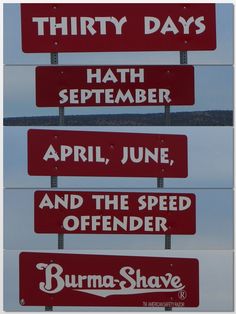
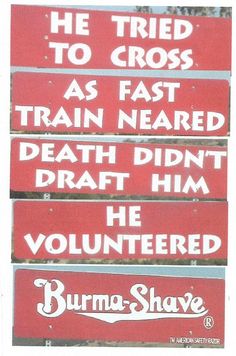
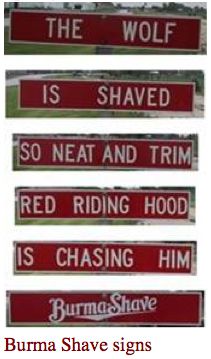
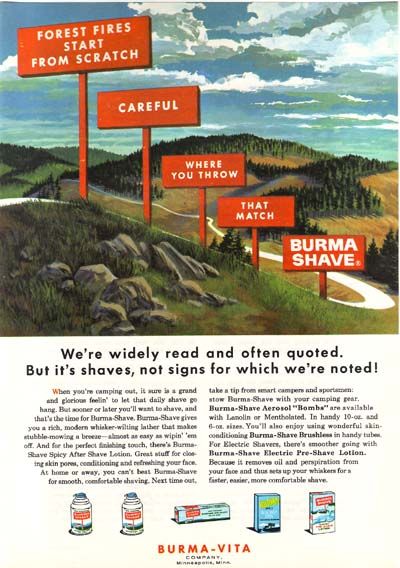
Burma-Shave ads were a series of signs along the road that concluded in the sign saying “Burma-Shave”. The first couple of years, the signs were rather prosaic ads for the company; but as they began bringing in repeat customers, the signs became bolder and more experimental. They became more humorous rhymes – usually five signs, with a sixth ending the series as “Burma-Shave”.

Here are a few examples:

  • Shaving brushes / you’ll soon see ’em / on the shelf / in some / museum / Burma-Shave (1943)
  • Uncle Rube / buys tube / one week / looks sleek / like sheik / Burma-Shave (1930)
  • A shave / that’s real / no cuts to heal / a soothing / velvet after-feel / Burma-Shave (1932)
  • Shaving brush / and soapy smear / went out of / style with / hoops my dear / Burma-Shave (1936)
  • The Burma girls / in Mandalay / dunk bearded lovers / in the bay / who don’t use / Burma-Shave (1937)

As cars began to speed up, safety messages increased around 1939:

  • Hardly a driver / Is now alive / Who passed / On hills / At 75 / Burma-Shave (1939)
  • If you dislike / big traffic fines / slow down / ‘till you / can read these signs / Burma-Shave (1939)
  • At crossroads / don’t just / trust to luck / the other car / may be a truck / Burma-Shave (1939)
  • Don’t pass cars / on curve or hill / if the cops / don’t get you / morticians will / Burma-Shave (1940)
  • At intersections / look each way / a harp sounds nice / but it’s / hard to play / Burma-Shave (1941)

When World War 2 came around, the signs reflected the social conscience:

  • Maybe you can’t / shoulder a gun / but you can shoulder / the cost of one / buy defence bonds / Burma-Shave (1942)
  • Shaving brush / in army pack / was straw that broke / the rookie’s back / use brushless / Burma-Shave (1942)
  • Slap / the Jap / with / iron / scrap / Burma-Shave (1943)
  • Tho tough / and rough / from wind and wave / your cheek grows sleek / with / Burma-Shave (1943)

A few humorous signs:

  • She kissed / the hairbrush / by mistake / she thought it was / her husband Jake / Burma-Shave (1941)
  • We know / how much / you love that gal / but use both hands / for driving pal / Burma-Shave (1947)
  • I use it too / the bald man said / it keeps my chin / just like / my head / Burma-Shave (1947)
  • Road was slippery / curve was sharp / white robe, halo / wings and harp / Burma-Shave (1948)
  • If you think / she likes / your bristles / walk bare-footed / through some thistles / Burma-Shave (1948)
  • A man / a miss / a car – a curve / he kissed the miss / and missed the curve / Burma-Shave (1948)
  • Our fortune / is your / shaven face / it’s our best / advertising space / Burma-Shave (1963)

Toward the latter part of the signage, they began recycling earlier messages. Road signs and maintenance became increasingly expensive, and cars sped by faster than ever. The signs disappeared from the roads in 1963 when the company was sold to Phillip Morris and they discontinued the marketing campaign, which turned out to be a mistake; sold once again, the product eventually disappeared, but the term “Burma-Shave” can still be heard, referring to short, quirky rhymes.

To read more about this topic:

Route Magazine: Defining the American Dream, One Sign at a Time

I hate to end / this fun article / but time is short / so here’s what’s possible / Burma-Shave examples from Pinterest:

This illustration is from “A History of the Burma-Vita Company”, written by Frank Rowsome Jr. and illustrated by Carl Rose (published by the Stephen Greene Press in 1963).

12 Comments

Filed under Articles, History, History Undusted, Links to External Articles, Lists, Military History, Quotes, Signs, Snapshots in History