Category Archives: Nuts & Bolts

Imagination vs Knowledge

Some say that imagination is more important than knowledge; to a certain extent, that may be true because imagination leads to new discoveries, inventions, and revelations.  But knowledge is often the basis for such discoveries; that which has been passed down by others who’ve researched, discovered, identified and recorded are the foundational stones upon which things are often built, whether in science, technology, or life in general.
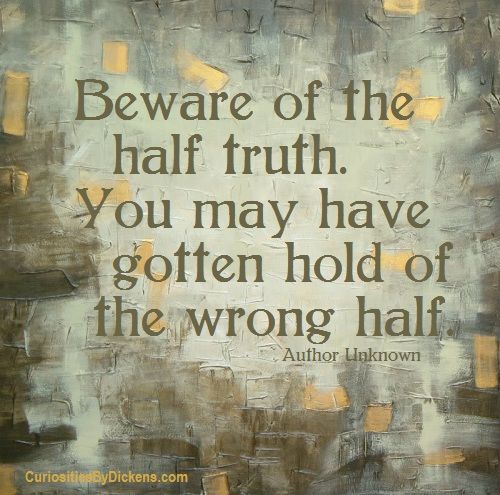
beware-of-the-half-truth-wrong-halfIn this day and age, however, sometimes imagination overtakes knowledge (or simply ignores it).  An informed mind is a powerful tool; an uninformed mind can be a dangerous weapon.  This is true whether writing non-fiction, fiction, or passing on something on social media.  We should beware of the half truths – we may have gotten hold of the wrong half.

It’s now more important than ever to test the veracity of reports and even images; anyone can make an ass out of an angel, so to speak, with photoshop, et al.  How much misinformation is spread by simple carelessness or wilful misdirection (that includes, unfortunately, mainstream news media)?  Or by assuming that since something is from a trusted friend it must be true?  How often have you gotten upset by an article you’ve seen and commented on it, or passed it on, allowing it to form an opinion in your subconscious at the very least, and in your active thoughts at worst, only to find out later that it was a false report, a hoax, or sloppy journalism?

abraham-lincoln-internet-quote

As you probably know, I love to learn; I have a steel trap of a mind for little bits of trivia, like the fact that certain microbes concentrate and disperse (read “poop”) gold, or that all living creatures, including you and I, emit visible light (probably a byproduct of biochemical reactions).  As a writer of fiction that comes in handy; I can extrapolate knowledge and use it as a plot detail or a character quirk; but when I’m writing a blog, e.g. about a historical detail, I want to make sure I get it right.  A case in point was an article I wrote in 2014 about post-mortem photography in the Victorian period; it was by far the most popular post to date on that blog and continues to generate interest.  In particular, two points from the article were addressed, researched, and edited/corrected either in the article itself or in the comments and discussion that ensued.  Mistakes happen, but when I catch them, I will do my best to correct them!

For writers, it is important to cross-reference anything you find online, especially if you’re basing something significant on it such as character development, location, or plot.  Assumptions can also get you into trouble; I know that Geneva is part of Switzerland, but in writing 18th-century fiction, I need to be aware of the fact that it was merely an ally of the Swiss Confederacy from the 16th century, but only became part of Switzerland in 1814.  Any reference I have to it in my trilogy needs to reflect that fact.

I recently read a collection of short stories on Kindle, and on nearly every single Kindle page there were mistakes (that adds up to a lot of mistakes per manuscript page!):  Missing words that the authors assumed were there, typos, commas 2 or 3 words off-position, stray quotation marks, and countless words they assumed were the correct ones but obviously were not (e.g. catwalk instead of rampart for a castle).  This is where imagination overtook the writer, and knowledge gave way to ignorance…  I have understanding for one or two such errors in a manuscript of that length, but none whatsoever for several per page; that simply smacks of laziness and poor-to-no editing, and it boils down to an unintentional slap in the face to any reader who’s taken the time to read their story.

Knowledge without imagination is like a rusted hinge; imagination is the oil that makes the knowledge come to life, and the writer is the door handle that opens the door to new worlds, new ideas, new discoveries, and inventions. It sounds noble, doesn’t it?  But did you realize that many of the electronic gadgets we take for granted today were at one time birthed in the imaginations of men like Gene Roddenberry, creator of Star Trek?  It inspired countless children who went on to become astronauts, scientists, and engineers, who made those science-fiction inventions become reality and discovered distant worlds (now known as exoplanets).  I’m waiting with bated breath for the transporter to replace airline security queues…

Those hinges are necessary, as is the oil, so that the door handle can do its job and get out of the way, allowing the world beyond to unfold.

Save

Save

2 Comments

Filed under Articles, History, History Undusted, Musings, Nuts & Bolts, Plot Thots & Profiles, Research, Science & Technology, Space, Astronomy

Buying Credit

No, the title is not referring to money or cash cards, but writing.  Stick with me.  If you’ve made yourself at home here and nosed through my cupboards, you’ll know that I do a LOT of research.  I love it.  It adds spice to my character’s meals, salty spray that blackens the redcoats of marines aboard a royal navy ship, tells me that heated arsenic smells like garlic, and makes the ship creak so loudly you’ll swear you’re going down to Davy Jones’ locker.  But there are times when, as an author, I’m required to blur the lines between fact and fiction.

There are certain things that people erroneously assume (such as Viking helmets) that I may need to adapt in order not to lose a reader’s trust (though trust me, I will never add horns!):  The sentence structures of bygone days were far more complex, with vestiges of Germanic linguistic influences – for my current manuscript (set in 18th century England and mostly aboard a Royal Navy ship of the line) I need to modernize the syntax without losing the High English flavour, and without compromising on the linguistic purity of my story’s time-setting; modern sensibilities (in social ladders, issues such as slavery, war, etc.); laxer standards (in, say, relationships or politics or social ranks), and so on.  A modern reader will most likely not appreciate the complex social mores of a time when men and women were never alone in a room – even when the man wanted to propose to the woman, and the parents wanted it to take place; and so, such things need to be adapted at times, to a certain extent, to reach a modern audience without alienating the audience that revels in bygone literature.

If I, as an author, want my reader (who is perhaps a stickler for all things historical) to give me the permission to bend a few social rules of the 18th century, I must first buy credit with them – prove to them that I’ve done my homework – so that they won’t get ripped out of the story in disbelief when I contrive to leave a man and a woman alone in the same room without a chaperone.  In my current manuscript, the husband and wife come from opposite ends of the social ladder, and the husband becomes a captain in the royal navy at the tender age of 20 or 21.  Both of these situations have many historical precedents; I know that from countless hours of research.  But most people who read historical novels might think, “But Viking helmets always have horns” – or something to that effect.  If written well, these disparities in understanding can be smoothed over, so that when I really DO break historical moulds, I am allowed to do so without offending the reader “in the know”.

1761-joshua-reynolds-lady-elizabeth-keppel

1761, Lady Elizabeth Keppel, by Sir Joshua Reynolds

This portrait illustrates an important point:  Many people, when thinking of the British rule of India, perceive it through postmodern lenses; we see it from the hindsight of Gandhi and the independence of the country from the imperialistic rule of British paramountcy.  But the other aspects were the children and wives of British soldiers, diplomats, and tradesmen, and the loneliness faced, the friendships struck with Indian men and women… these are important aspects to weave into a story, too, and thus require research.  Notice the pearls adorning the Indian woman below?  The researcher in me wants to know her story far more than the story of Lady Keppel (who died of a broken heart at the age of 29, just months after her husband had died of injuries from a riding accident).  Some readers may get jolted out of the world you create by the pearls, though it is historically accurate – so you’d still need to buy credit by setting up that aspect well.

These same credit-buying rules apply to any genre, even science fiction:  If you create a world set on another planet, that world will have laws – physics laws, indigenous social mores, etc. – and you as a writer must know what they are, and if or how they can be broken if need be.  You can’t claim that all liquid on the planet is frozen, and then have your character drinking from a fountain or stream, unless you explain how that’s possible.  If you do, you’ve taxed your believability credits and pulled the reader out of the world they’ve agreed to follow you into.  The manuscript that I’ll work on next (after the current one is published!) is science fiction; the air of the planet is toxic to humans, so I need to create a way for facial expressions, dialogue, etc. to come through even when the characters are outside in their suits.  I have done a lot of preliminary research into geology (that told me about heated arsenic, among other things); I also need to explain how a planet with multiple suns can have a stable enough orbit not to be drawn into one of the stars and burn up – i.e. I need to follow known physics laws, or explain how they are suspended for my planet.  I think you get the idea!

So if, as a writer, you want readers to believe what you write about a fictional character set in British India, you first need to buy credit with your readers by doing your historical homework and sculpting the landscape and characters in the rich tapestry they deserve.  If you are writing science fiction, establish your world and stick to your rules so that, if you need to bend them for a plot development, the readers will be willing to follow you on the adventure.  Whatever you do, keep writing!

Save

Save

Save

8 Comments

Filed under Articles, History, Military History, Nuts & Bolts, Plot Thots & Profiles, Research, Science & Technology, Writing Exercise

A Little Light Reading… Not

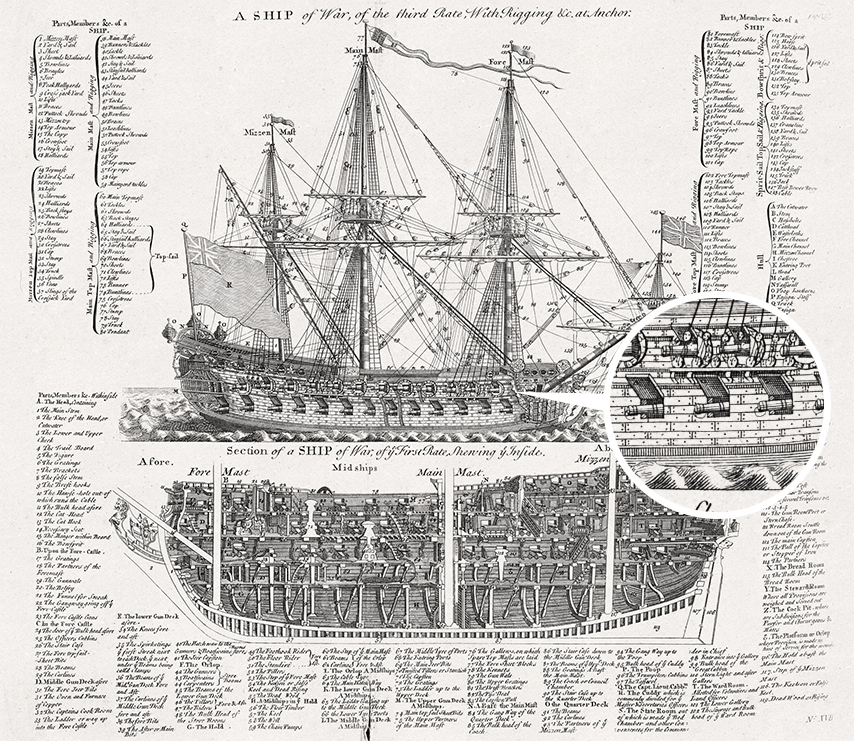
I will admit that I have quite odd tastes in reading, especially for a woman; I tend toward history, nautical, and obscure or long-forgotten books.  In writing my current manuscript, which is Asunder, the third book in the Northing Trilogy, I’ve read more than a fair share of military history books, specifically covering the 18th century of the Royal Navy.  Once, on a research trip to London, I searched out a bookstore that specializes in military and transport books, even reputed to have remainders; I don’t think they’d seen a woman in the shop in years (who’d entered intentionally) by the looks I got; one of the men even said, “The beauty shop’s two doors down, love.”  When I asked if they had the out-of-print autobiography by William Spavens, a unique lower deck view of the 18th century navy, they froze as if they hadn’t heard me correctly.  The question must have been laced with catnip, because after that I had the entire shop of men eating out of my hand, and I spent nearly two hours in there being helped to the finest pick of naval history books (including the autobiography I was after!).  Sadly, the last time I was there the shop was gone, but I’ve since found the largest used book shop in London, Skoob, which is highly dangerous for a bibliophile with a private library…!

A few of the books I’ve read in the course of research for Asunder are fairly gory, like Medicine Under Sail (I’d bet my bottom dollar that the screen writers for “Master and Commander“, with Russell Crowe, read that book as they wrote the script) and “Poxed & Scurvied” – the story of sickness and health at sea, while others have been like reading a thriller, such as “The Seven Years War” by Rupert Furneaux  or “A Sailor of King George” by Captain Frederick Hoffman.

I devour history books like other people devour pulp fiction; but especially during the first draft of the book, I had to continually keep in mind that I was writing historical fiction, not a history book; the details that I included had to serve the plot and character development, and not visa versa.  Only a fraction of what I learned has gone into the book; but those rich details give salt to the waves, creaks to the ship, and whip to the rope (I’ve also spent hours aboard the Cutty Sark “filling in the blanks” of a docked ship, so to speak, but that’s another story).  I could have peppered the dialogue with so much naval slang you wouldn’t have been able to swing a cat (naval slang, by the way), but if readers were to get ripped out of the story trying to figure things out, then I would have missed the mark.

So, the next time you sit down for a little light reading, you might want to consider one of the books linked above; then again, if you don’t want gory dreams, rather go with “The Price of Freedom“, or “Redemption“, or “The Cardinal, Part One or Part Two“…  and enjoy!

third-rate-ship-of-the-line-diagram

One of my library posters

8 Comments

Filed under Articles, History, Military History, Musings, Nuts & Bolts, Research

Rules of Writing: Elmore Leonard

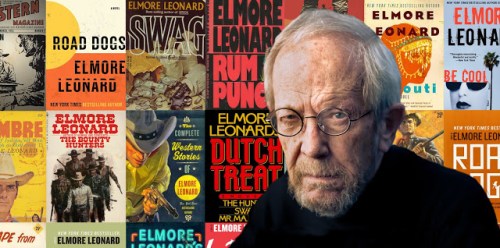
elmore-leonard-authorElmore Leonard, best known for countless novels and their film adaptations, such as Get Shorty, Jackie Brown and Out of Sight, was known for this gritty writing style and strong dialogues.
Here are a few of his gems of advice for writers (with my comments in parentheses):

  • “If it sounds like writing, I rewrite it.”
  • “Try to leave out the parts that readers tend to skip.” (Think: thick paragraphs of prose; boring lists; role calls that seem to be there more to remind the writer who’s in the scene than to entertain the reader.)
  • “If proper (grammar) usage gets in the way, it may have to go.  I can’t allow what we learned  in English composition to disrupt the sound and rhythm of the narrative.” (This advice should follow the adage, however:  First learn the rules; then you’ll know how and when you can break them.)
  • “Never open a book with weather.  There are exceptions.  If you happen to be Barry Lopez, who has more ways to describe snow and ice  than an Eskimo, you can do all the weather reporting you want.”
  • “I never see my bad guys as simply bad.  They want pretty much what you and I want:  They want to be happy.”
  • “At the time I begin writing a novel, the last thing I want to do is follow a plot outline.  To know too much at the start takes the pleasure out of discovering what the book is about.”
  • “It doesn’t have to make sense, it just has to sound like it does.”

19 Comments

Filed under Lists, Nuts & Bolts, Plot Thots & Profiles, Quotes

On Perceptions and Perspectives

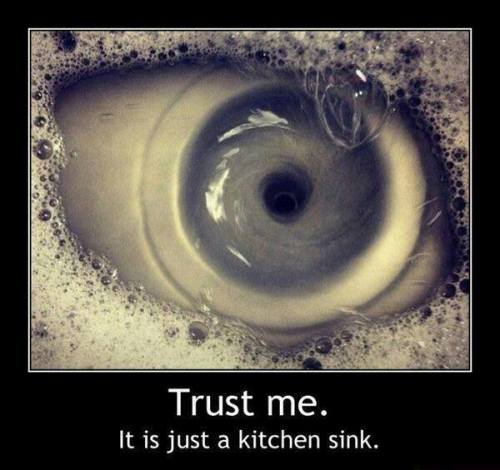
I saw this image a few weeks ago on Pinterest, and found it fascinatingly creepy.  It’s a great example of perspective, thwarting assumptions, and the fact that the image automatically raises certain expectations – until you see the caption.  What our minds initially perceive may or may not be accurate; only when we see the bigger picture, or have more pieces to the puzzle, does that perception or perspective change, or get adjusted to a more accurate overall understanding.  Doing this with words is an art form:  It’s about building expectations and thwarting them without making the reader feel like you’ve drawn them in under false pretences.  If they can look back through what they’ve already read and realize that only their assumptions were wrong – that the writer never misled them, but they misled themselves – then you’ve managed to find that fine line!


kitchen-sink

3 Comments

Filed under Images, Musings, Nuts & Bolts, Plot Thots & Profiles, Writing Exercise

Rock, Snake or Spock?

Almost everyone in the world has at one time or other played “Rock, Paper, Scissors”, or a variation of the game.  My husband and I use it to decide who goes first whenever we play a dice or card game together, which is nearly every evening.  If you scratch beneath the surface, you’ll find that there are a lot of variations; some make sense intuitively, some need to be explained to make sense, and others, you just need to accept as the way the game works.  In looking into this topic online, I came across several forums that discussed in length whether the rock sharpened the scissors, thus making them allies against paper, or why the paper wouldn’t be defeated by the rock because it holds it down; but the fact is that in this widespread variation, the rock is wrapped (defeated) by the paper, the scissors cut the paper, and the rock smashes (or dulls) the scissors.  Sometimes the game is accompanied by a preparatory chant, such as, “eeny, meeny, miny, moe”, “one, two, three” (in whichever language it’s being played in), or something like “ickety, ackerty, ock”.

Other Variations of the Game:

Rock, Scissors, Paper, Dynamite:  Dynamite (palm out, fingers spread wide like an explosion) blows up the rock and paper, but the scissors can cut the fuse.

Rock, Scissors, Paper, Fire,Water:  Fire (waving fingers, pointing upward) destroys paper and scissors but is put out by the rock and water; the water (hand held horizontally, palm down) drowns the scissors and puts out the fire but is moved by the rock and floated on by the paper.

Earwig, Elephant, Man:  The elephant is tamed by man; the man is bitten by the earwig; the earwig is stepped on by the elephant.

Hoof, Bandage, Knife:  The bandage wraps the hoof, the knife cuts the bandage, and the hoof breaks the knife (presumably by stepping on it).

In the Idaho panhandle:  Hunter, Bear, Woman:  Players stand with their backs to each other to prepare, jump and turn, landing in the stance of their choice. The hunter mimes a rifle, the bear displays claws, and the woman symbolizes breasts with cupped hands.  The hunter defeats the bear, the bear defeats the woman (unarmed), the woman defeats the hunter (putty in her hands).

rock-paper-scissor-lizard-spockRock, Paper, Scissors, Lizard, Spock:  Scissors (first and second fingers extended) cut paper (open palm) and decapitate lizard (hand held with thumb against fingers, as for finger puppet); paper covers rock (fist) and disproves Spock (Spock’s gesture of peace – palm out, fingers divided into V between middle and ring fingers); rock crushes lizard and scissors; lizard poisons Spock and eats paper; Spock smashes scissors and vaporizes rock.
Variations Around the World

Whether you call it “rock, paper, scissors”, Janken (the Japanese word for the original game), Kai bai bo (Korean), or Janjii (Thailand), the goals are the same – to win over an opponent, or to make an arbitrary decision, such as who goes first in a game.  Here are a few variations from around the world:

KoreaKai bai boKai is scissors, Bai is rock, and Bo is cloth or paper.  China has a similar version, except that it is sometimes hammer (guu) and bomb (paa).

Malaysia and parts of ThailandWan Shi Zan –Pistol, Water, Bird, Stone, Plank:  The pistol defeats everything except water, and the bird loses to everything except water. The stone defeats the bird and the plank, but loses to the pistol and the water. The plank defeats the bird and the water, but loses to the stone and the pistol. The water defeats the stone and the pistol. The bird loses to the plank.

India and Indonesia, and on Bali:  Elephant, Human Ant:  The elephant beats the human, the human beats the ant, and the ant beats (scares) the elephant.

Myanmar:  General, Soldier, Tiger:  The general defeats the soldier, the soldier (with a gun) defeats the tiger, and the tiger kills the general (unarmed).

Vietnam:  Hammer, Paper, Scissors:  The same hierarchy as Stone, Paper, Scissors.

Laos:  Hammer, Nail, Cloth:  The hammer defeats the nail; the nail pierces the cloth; the cloth wraps the hammer.

Russia:  Rock, Scissors, Paper, Well:  The rock smashes the scissors; the scissors cut the paper; the paper floats on the well and wraps the rock; the well swallows the rock and scissors.

France:  Rock, Scissors, Leaf, Well:  Same principle as the Russian variation.

ChinaGosukumi [i.e., 5 choices instead of 3]:  Idol, Chicken, Gun, Fox, Termite:  The idol is the thumb, chicken the index finger, gun the middle finger, fox the ring finger, and termite the little finger. The chicken is sacrificed to the idol; the gun introduces people to the idol (the idol wins); the termite eats the idol; both the gun and the fox defeat the chicken; the chicken defeats the termite; the gun defeats the fox. The idol and the fox are good friends, as are the gun and termite, and the fox and termite ignore each other, so these symbols tie with each other. According to these rules, the god and gun are strongest, and the chicken weakest.

Japan:  There are many variations of the game throughout Japan, where it is very popular; one is called “Mushiken” with a snake, slug and frog:  The snake (thumb) fears the slug (ring finger); the slug is eaten by the frog (index finger); the frog is eaten by the snake.

Shouyaken” is played by gestures made with the whole body. The symbols were the village-headman, musket, and fox. The village-headman sits in a dignified manner, as if in the seat of honour. The musket was mimed as if carrying a gun in both hands. The fox was indicated by holding up both fists at an angle.  The rules were that the headman beat the gun, the gun beat the fox, and the fox beat the headman.

Do you know of any other variations?  Please put it in the comments below, explaining how your version is played!

Some information gleaned from the following sites:
http://www.democraticunderground.com
https://en.wikipedia.org/wiki/Rock%E2%80%93paper%E2%80%93scissors
http://archive.ec/Rjp5v

Save

8 Comments

Filed under Articles, History, Nuts & Bolts, Research

Novels Worth Reading

As a novel writer, I’m first and foremost a reader; I love to read, I love to buy books, smell them, feel them, upload them… any form is fine by me.  I want the books I read to be witty, intelligent, and well developed in terms of plots, characters and environments.

Kitchen Sink Realism

Everyone has different tastes – that’s why there are so many different genres; but for me personally, there’s also a list of things I don’t want in a novel:  I don’t want to be confronted with messy lives dealing with self-inflicted problem after problem; I don’t want tragic or sad or bitter endings; I don’t want to be confronted with the grit, grime, blood and gore of dysfunctional lives that end up learning nothing, making no character arcs, and end up in the mud by the end of the tale.   This genre description actually has a name:  Kitchen Sink Realism.  It was a cultural movement in Britain back in the ‘50s and ‘60s that was portrayed in films, books, plays, and art – the grit, grime, anger, disillusionment and harsh realities of realistic social scenarios.  It’s what might also be referred to as postmodernism.  My personal response to this kind of novel is, “If I wanted that kind of realistic tension, I could just go hang out at the nearest bar.”

A Tough Nut

I once had an English student, and our focus was medical English in preparation for their upcoming medical exams (two nurses came together for semi-private tutoring).  As part of the lesson we needed to work on basic conversational skills and sentence structures, and I find that the best way to bring in a wide variety of scenarios is usually to do a type of role play – nothing embarrassing, but each person is given a character to put themselves into a situation that they might not normally deal with:  They may be a chef, or a secretary, or a customer in a hardware store.  This particular student, when asked what kinds of books she read, said, “history and autobiographies or biographies”.  When asked what novels she read, she said she found such things ridiculous and a complete waste of time (this was back before I became an author!); she categorically refused to even try to put herself into someone else’s shoes for the scenarios.  My impression of her as a person was that she was narrow-minded, knew it, and was proud of that fact.  She was a hard character, and all the time I knew her or met her afterwards, I never saw a soft side emerge, either toward herself or toward others; I often found myself wondering why she’d gotten into the nursing profession in the first place – as a patient, I wouldn’t necessarily want her working on my ward…  A line from the novel I’m currently writing (Asunder, the third book in the Northing Trilogy) would have fit her life too:  “he has never had the propensity for engendering compassion; I pray he never needs it, as he never gives it.”  An epic love story might do her a world of good.

What’s Worth Reading

What I want when I read a book is to be transported into another life, whether that’s in the past, present or future, on this earth, or on another planet, or in another dimension; I want to be entertained, made thoughtful, learn something about the world around me, and learn something about myself.  Ideally, I will come away from the experience having been changed, in even a small way.  I want to feel connected; somewhere out there is a person I can relate to – whether it be the author, or the character, or other readers that appreciate the same books.

Aside from places and times that are genre-specific, such as science fiction and alien planets in the future, or London in the 18th century, all of the elements of what I like in novels are universal.  Humans the world over, in every century, want to feel connected; to feel that they can relate to something someone else is going through; even to have parts of their own life’s experiences explained through someone else’s perspectives in similar circumstances.  Above all else, at the heart of every good novel – regardless of the genre – is a story of love; that is the ultimate connection between characters.  It may be a child finding the love of a family after being shoved through the knocks of life too much for their age; it may be the hero or heroine finding love; it may be a widow or widower finding love again, or reuniting with true loves; it may be someone coming to the point in their life that they accept and love themselves just the way they are.

On to You!

When you read novels, what is it you’re looking for?  I would love to hear about it – please comment below, even if it’s just a few key words!

novel-colin-firth

Save

28 Comments

Filed under Articles, Musings, Nuts & Bolts, Plot Thots & Profiles, Quotes, Writing Exercise

Just Smile

smileHave you ever stared at a word for days on end?  I have, and coming to the end of the tunnel is bliss.  When writing, I tend to use “place-markers” – anywhere from a single word to a rough-sketch of a scene that I know will need to be fleshed out, moved, replaced or “cannibalized” for a concept.  Some people like to use special writing programs, and I’ve tried a few over the years, but I tend to do all of my writing in Word; it’s got review “post-its” I can type into the side margins, and I’m usually more organized than programs like Scrivener anyway.  When I go back over such sections, I take off my writer’s hat and put on my editor’s cap, and dive in.
I’ve been editing a manuscript, and at the moment I’m focusing on repetitions; the most recent word was smile.  Each time I came across the word, I needed to read the context, think about whether it should be removed, replaced, the sentence reworded, or left as-is.  I’ve discovered that there are not actually that many synonyms for “smile” in the English language; smirk, sneer, grimace, simper, scowl, grin… they each have their own connotations, and are not simply interchangeable – each choice will effect the overall meaning in distinct ways.   as William Blake once said, “There is a smile of Love, And there is a smile of Deceit, And there is a smile of smiles In which these two smiles meet.”  Sometimes it can simply be left out – the context informs the reader about which emotions are being displayed by the characters.  Characters in love have a different smile for each other than for frenemies, or antagonists, or superiors, or subordinates, and each situation in which various characters are combined might result in a different word for smile.  And does one smile warmly, or coldly?  Broadly or tight-lipped?

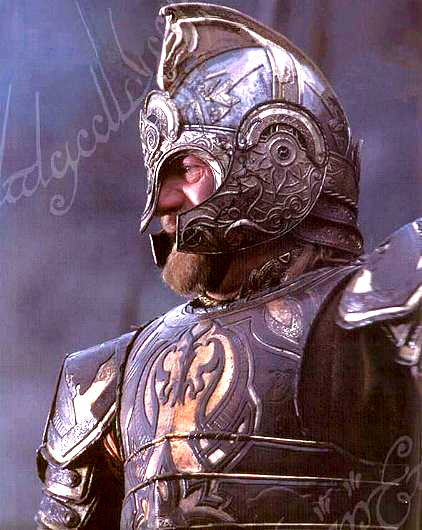
theoden-king-of-rohan-lord-of-the-ringsSometimes I wonder if I think far too much about such details; but I’d rather think about it once too often and get it right than not.  It might have seemed a tad extravagant for Weta Workshop to emboss the inside of King Théoden’s breastplate armour for the Lord of the Rings: The Two Towers, and Return of the King (in which the character appears), knowing it would never actually be seen in the films; but Bernard Hill, who played the king, said that such details helped him easily slip into the role, even feeling the nobility of a king, and it thus enhanced and influenced his performance.  As visuals matter in epic films such as LoR, words matter in writing a novel, drawing the reader into the imaginary landscape of the world the author creates. ever-after

They also matter in script-writing:  In Ever After, starring Drew Barrymore and Dougray Scott, some of the dialogue lines are just downright embarrassing – especially those of Anjelica Huston:  They go to the trouble of being opulent and period-accurate in costumes, locations and scene dressings, and then throw in lines like Relax, child and I’m management!  The editor in me cringes.

One man’s smile is another man’s smirk; one woman’s grin is another woman’s sneer.  Now, on to the next item on my list of editing revisions!

Save

Save

18 Comments

Filed under Articles, Images, Musings, Nuts & Bolts, Research, Writing Exercise

Wordless Wednesday no. 4


5 Comments

Filed under History, Images, Nuts & Bolts, Research, Wordless Wednesday

Say It Well

Let’s face it:  When writing dialogues between characters, repetition can tend to sneak up on us:  He said, she said, he whispered, she whispered, and so on.  There are a few tricks I’d like to share with you that I’ve learned along the way; one is regarding grammar, and the other is my own twist on dealing with the issue.

Regarding grammar, action verbs can often take the place of the more passive verbs (such as said):  “He said, ‘I’d like that.’” can be spiced up by giving him an action to do (“He picked up the travel brochure and flipped through it:  ‘I’d like that.’”)  The second sentence gives more context, and is more visually engaging for the reader.  Keep in mind that every word should count; don’t pad out the sentence just for word count, or make each exchange in the conversation a prop advertisement; but punctuating a dialogue with such moments can bring it to life.

My own twist is a literal one – a CD:  I took an old one, covered both sides with blank CD labels, and wrote all of the synonyms (listed below) for say and said in a spiral, starting in the centre, changing colours for each new letter of the alphabet.  To use it, I just put it on my finger and spin it around as I read through the spiral until I find the word that best fits my sentence.  I have several such CDs within reach of my computer (another CD, for instance, is for walk synonyms, and another for lie/lay); if you make enough of them, you could keep them in a CD pouch.  Here’s my list of the words around Say (click on the image to enlarge):

say-list

A word of advice to those of you for whom English is not mother-tongue:  Depending on the word, the sentence structure may need to be adapted.  If you’re unsure how to use a word, I would recommend looking it up on Wordnik, and reading the examples on the right-hand side of the page; then choose the sentence structure, prepositions, etc. that are more frequent than not.

I hope that this list helps you say what you want with the variety and precision you’re aiming for!  Feel free to reblog!  Feel free to print this list out and use it; if you pass it on online please put a hyperlink back to this blog, or recommend my blog if you pass it on by word of mouth… thank you!

If you can think of any words or phrases to replace say or said that I missed in the list above, please put them in the comments below!  Keep writing!

Save

Save

Save

4 Comments

Filed under Articles, Lists, Nuts & Bolts, Research, Writing Exercise