Category Archives: Nuts & Bolts

The nitty gritty of the English language and then some.

The Thorny Issue of Horns

As an author and writer, I do a LOT of research.  I love history particularly, but then I could say the same thing about the topics of geology, astronomy, archaeology, science and technology, crafting, drawing, botany, and a dozen others.  As I apply my studies to my work, I am sometimes faced with the issue of horns – Viking helmet horns.
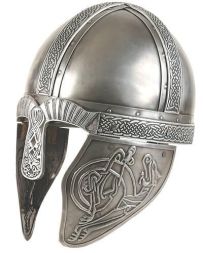
Real Viking Helmet


Accurate Viking helmet, reproduction.  Photo credit, Pinterest, unknown


While everyone seems to accept as a historically proven fact that Viking helmets had horns, the actual fact of the matter is that they didn’t.  While there were many horned helmets dating to before the rise of the Norse powers of Sweden, Norway and Denmark, most, if not all, were for religious or ceremonial purposes.  However, if I write a description of a Norse helmet and leave off the horns, someone will inevitably point it out.

Recently I spent a couple hours on Skype with one of my Beta readers for my current project, the third book in the Northing Trilogy (set in 18th century England).  Several of her comments were based on her knowledge of the 19th century as portrayed by Georgette Heyer, while others were based on her lack of historical knowledge that I, as the author, have amassed over time.  While some of that knowledge needs to seep into my writing to help the reader along, I have to continually remind myself (especially with this particular book in the trilogy, as it is centred around the Royal Navy) that I am not writing a history book but a novel, and anything I include needs to support the plot – the plot should never be forced to support a history lesson.  So it is that questions arose as to the behaviour and manners of the children of the time.

In any time period up until the mid-20th century, children in western societies matured far sooner than their modern counterparts, both out of necessity and out of cultural understanding of their roles in society.  Many families were dependent on the contribution made by the children in their household, whether it was housework, factory work, or working on the streets as beggars, shoe shiners, chimney sweeps, street sweepers, selling newspapers, or any other job they could earn money with (this is still true in many poorer countries of the world today).

If they came from a wealthy family, children were educated, but as to what extent and to which form it took very much depended on their particular circumstances:  They were educated either at home by tutors, or sent away to a boarding school.  Leaving school might be anywhere between ten and twenty; Jane Austen finished her formal education at the age of 10 or 11, whereas Charlotte Brontë’s character Jane Eyre left school at 18.  Boys who were second sons were often educated (after their basic education in either a college or at home) toward the military or toward a life as a minister (if their families held a high status in society, they might be trained toward politics; first-born sons, heirs, were rarely sent to the military due to the inherent dangers).
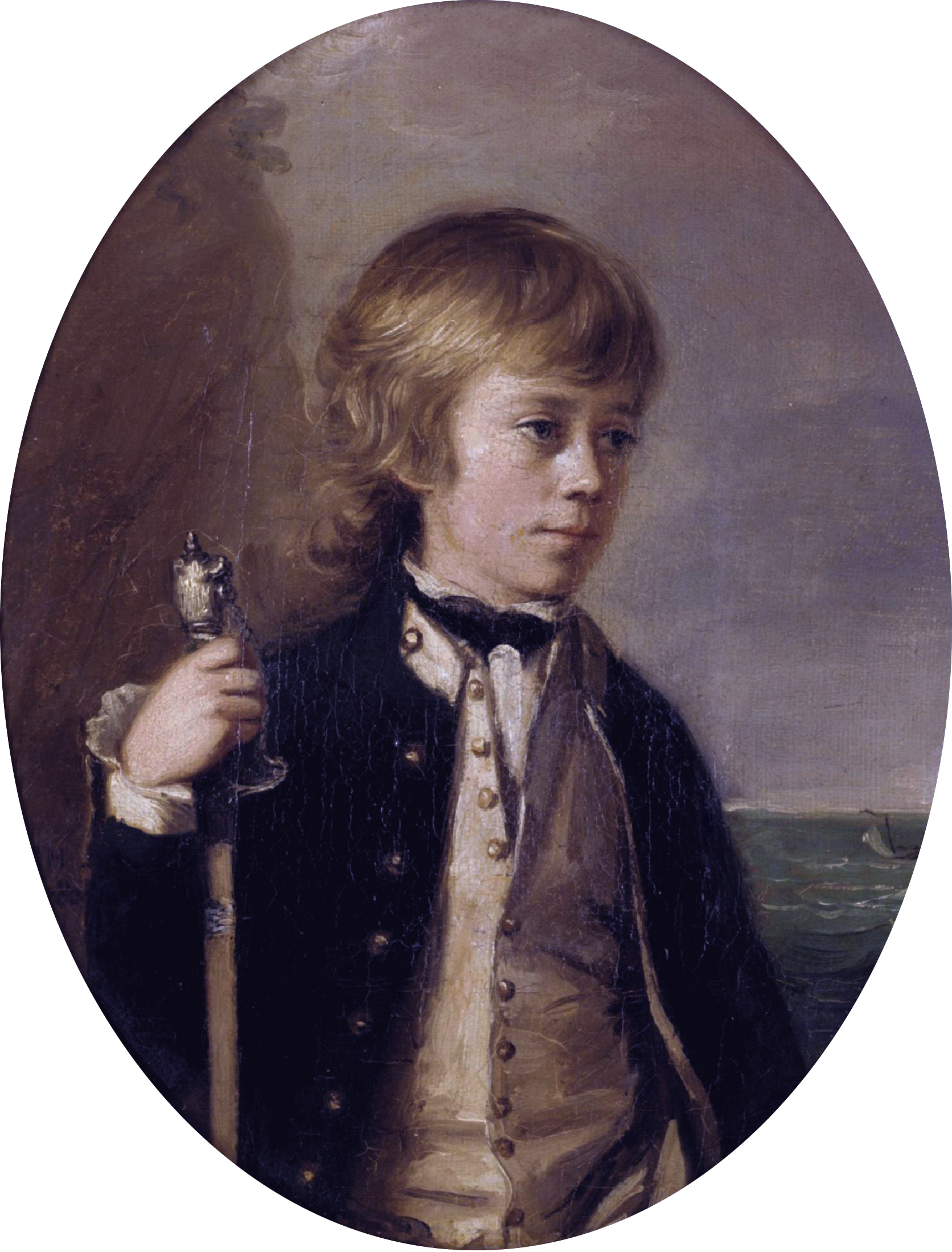
Midshipman Henry William Baynton, aged 13 -1780 - Wikipedia.jpg

Henry William Baynton, aged 13 years, 6 months, midshipman on the Cleopatra.  Photo Credit, Wikipedia.

If their fathers could afford to do so, these younger sons were often bought commissions in the military so that they would start off their career with some smidgen of position, such as a midshipman in the Royal Navy; the younger they entered, the sooner they could rise through the ranks, and thus it was not uncommon for lads of 7 or 8 to enter the navy.  Aboard ship they were trained in various skills, which included not only practical skills to do with the day-to-day running of the ship, but how to read navigational charts and how to use instruments such as sextants. How fast or slow they rose to higher ranks thereafter depended on their skills, intelligence, connections, and luck.

If poor children were either abandoned or given to workhouse orphanages because their families could not afford to keep them alive, they were also trained:  The girls were trained toward becoming servants (paying back society for the privilege of being alive), and the boys were trained for a life in the military (ditto).  They were taught to read using the Bible, and were expected to live by its principles.  Unfortunately, religion was often used as a guise for abuse and heavy-handed tyranny, but as the characters in Jane Eyre portrayed, some were true Christians in their behaviour toward her, such as her friend Helen, or the kind apothecary.  If the girls were going to become governesses, they would also be trained in more refined accomplishments such as French, drawing, needlework, history, etc.

All of this is to say that, were I to include all of this kind of information in a novel (and believe me, there’s a lot more where that came from!), it would get boring rather quickly.  And so I need to pick and choose what is used in the organic flow of the plot and character development that both serves those elements and also helps inform the reader; sometimes it’s a tricky balance.  So when the 11-year-old boy acts far more mature than a modern boy, unless the reader is aware of the historical context, I will inevitably get feedback to that effect.  Sometimes I can help their understanding by including e.g. the subjects he might be learning with his tutor, such as French, sciences, or elocution, but more than that might drag the story into the realm of a history lesson.

There are many modern myths, like the Viking horns, that people have accepted as historically accurate, when in fact they’re not.  One of my pet peeves is Christmas films that inevitably portray three kings showing up at the manger along with the shepherds in Bethlehem.  I won’t go into that here – if you’re interested in the historical details, read my article on History Undusted, here.  Other urban legends include:  We only use 10% of our brains; the full moon affects our behaviour; lightning never strikes the same place twice; cracking your knuckles gives you arthritis, and antibiotics kill viruses.  If I rankled any feathers there, or you said to yourself, “But that one is actually true,” then I would suggest you do your own research on the issue… I’ve got my plate full at the moment with the 18th century.
Save

7 Comments

Filed under Articles, History, Musings, Nuts & Bolts, Plot Thots & Profiles, Research

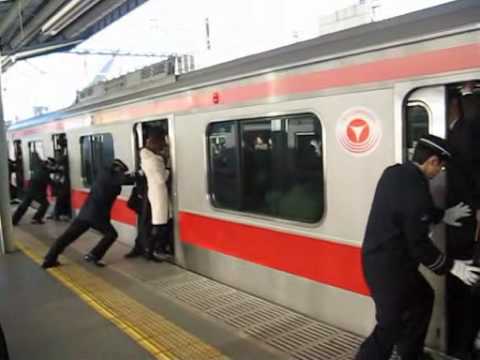
Odd Jobs #9: Lego Model-Maker to Oshiya (passenger shovers)

Once again, this odd job lineup has some gems!  Would you rather be paid to stand perfectly still for hours on end, or literally shove other people around all day, every day?  Some of these might not be so bad, such as a master distiller, or someone paid to come up with catchy nail polish names, while other jobs might have a certain prejudice or stigma attached to them – after all, how many of us haven’t had luggage damaged in transit at airports, and chosen a few special words, at least in our minds, for the people paid good money to do so?  I was once treated like a piece of luggage, and I wouldn’t wish it on my favourite enemy; however, it did give me a personal taste of just how luggage frequently comes out missing wheels, handles, or zippers.


Odd Job - Oshiya - Train Passenger Stuffers

Credit:  YouTube


  • Lego Model-Maker
  • Live Mannequin / Human Statue
  • London Dungeon Actor
  • Luggage Handler
  • Mascot
  • Master Distiller (This link also includes the job descriptions of several other jobs involved in the distilling process.)
  • Nail Polish Namer: Sometimes it’s a person, such as Essie Weingarten, and other times it’s a marketing department, or a freelance writer.
  • Nude Model
  • Ocularist: In short, they paint artificial eyes. It sounds easier than it is, since as with real eyes, no two are exactly the same.
  • Oil & Gas Diver
  • Online Book Seller
  • Online Reviewer: Often hired by a company to review a product; but, I then wonder how they could be unbiased in that review.  Such services are also offered for sale on sites such as Fiver.com.  Finding an actual, legitimate, detailed job description for this one is nigh on impossible, as most jobs are offered online now, and the term “review” can be used by anyone with an opinion…
  • Orchestra Manager: While this link is for an orchestra managing director’s job description, an even more specialized niche within the “genre” is that of the orchestra event manager:  They are responsible for booking airline tickets, arranging luggage transport for all shapes and sizes of instruments, booking hotel rooms, organizing and the overseeing of the setting up of venues, and making certain that the even runs smoothly from venue to venue.  That may also include hiring the local sound, light, and stage hands, though these tasks may be handed on to someone else in the managing office.  A friend recently flew in the seat next to such a manager, and passed on the details to me for this odd list… it just proves that you never know where you’ll meet interesting people!
  • Oshiya (Japan): Paid to push people onto trains.

5 Comments

Filed under Articles, Lists, Nuts & Bolts, Research

Musings A to Z Challenge: W

Challenge:  Write a short paragraph (100 words or less) daily on a topic beginning with the sequential letter of the alphabet.

Wiring

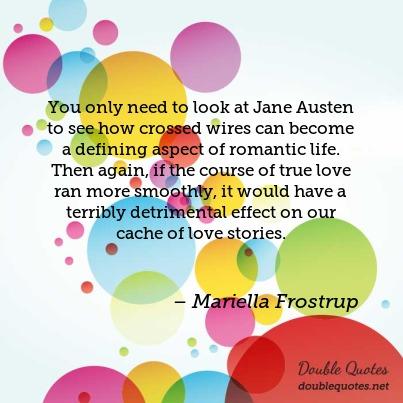
Mark Twain once said, “Truth is stranger than fiction, but it is because fiction is obliged to stick to possibilities; truth isn’t.”  Life is usually smoother than its fictional counterpart; true stories made into film, such as It Could Happen to You (Nicholas Cage, 1994) would be “too boring” if they only told the truth.  But wires need to be crossed… relationships gone stale must be electrocuted back to life, communication hampered by misunderstandings, and obstacles placed in the path of the hero/heroine to make it more interesting.  Crossed wires are the bedrock of most tales, no matter the genre.

Wiring

Leave a comment

Filed under A-Z Writing Challenges, Images, Nuts & Bolts, Plot Thots & Profiles, Quotes, Writing Exercise

Musings A to Z Challenge: V

Challenge:  Write a short paragraph (100 words or less) daily on a topic beginning with the sequential letter of the alphabet.

Vulnerability

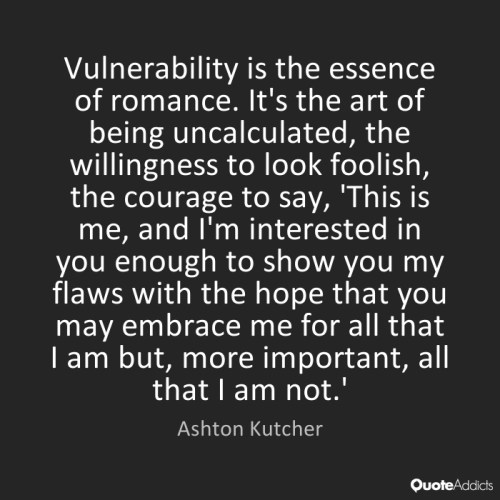
Ashton Kutcher hits the nail on the head:  Vulnerability is the essence of romance.  No one wants a perfect, untouchable hero, heroine, or partner:  Iron Man has his shrapnel; Superman has his kryptonite; Bella Swan has her clumsiness; Peter Parker has a past that haunts him; Darcy and Lizzie have their pride and prejudice.  How the character deals with that vulnerability is what makes them relatable, and even what makes them the hero/heroine or the villain – for even villains have their flaws; it’s vulnerability in some shape that gives them enough depth to be loathed or sympathised with.

Vulnerability

Leave a comment

Filed under A-Z Writing Challenges, Images, Nuts & Bolts, Quotes, Writing Exercise

Writing Trivia: Earthen Floors

I do a lot of research online; sometimes it leads down the oddest of trails, and those are always the fun ones to follow – the road less travelled, and all that.  I keep a storehouse of “odds and ends” information, the trivial bits and bobs that might come in handy as I create a new world for a story.

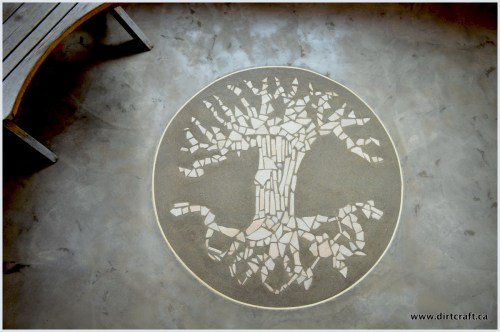
I was recently writing an article for one of my other blogs (click here to read it), and came across an interesting article on the topic of earthen flooring; such an element could be used in historical fiction, science fiction, or modern eco-escapism fiction.

What I found fascinating is the way the writer describes her first experience of walking on such a floor:  The leathery softness, the warmth, the texture, and the creative possibilities this type of flooring allows.

Such things stir my creative juices, and I have to remind myself to finish my current manuscript before moving on!  But such an element will come in very handy for my next book, which is a science fiction story… and now, because I’ve shared it with you, I’ll know where to find it when I need it!

Click on the image below to read the article, and be inspired.  Keep writing!

Earthen Flooring


5 Comments

Filed under Articles, Nuts & Bolts, Plot Thots & Profiles, Research

5 Life Hacks for Productivity

Let’s face it… humans are creatures of habit.  That phrase often has a negative connotation; in a conference that lasts several days, people will tend to sit within a few chairs of the seats they sat in on the first day, whether they like the location or not; once a person starts hanging the loo roll on the dispenser either top or bottom, the other way is just wrong.  But habits can also work to our advantage, if we form good ones:  Cleaning up after ourselves should have been a habit formed in our childhoods; brushing our teeth, pushing a chair in after we leave the table, and dozens of other little habits are hygienic, energy-saving, and contribute to more harmonious relationships within our social and environmental landscapes.

Those of us who express ourselves through creative media (such as writing, arts or crafts) might tend to see ourselves or the expression of our craft as outsiders, or at least mavericks, when it comes to business practices.  However, there are many tools (such as the SWOT) and principles for increasing productivity in the business sector that we can and should apply to our creative streaks (if the intention is to take them beyond the level of hobby to a more serious endeavour).  One of those principles involves forming good habits.  Below, I’ve listed five things that I do to keep my creativity fresh, and thus keep the time that I spend writing more productive than it would otherwise be (I know from experience).  For practical purposes I’ll refer to the expressions from the perspective of a writer, but these hacks apply to any creative discipline.

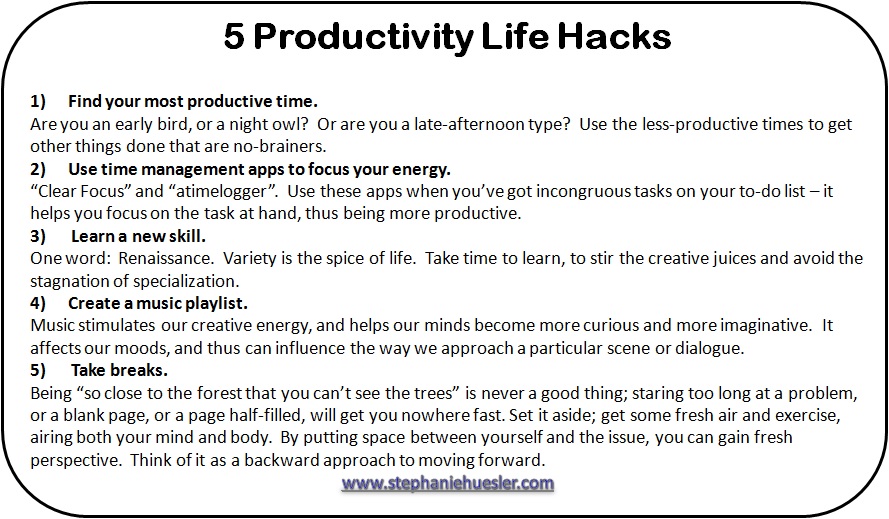
5 Productivity Life Hacks

I’ve taken the liberty of making a “cheat sheet” as a reminder of these principles; if it’s helpful for you, feel free to print it out and hang it up where you work or write.

1)   Find your most productive time.

Are you an early bird, or a night owl?  Or are you a late-afternoon type?  Most people have 9-to-5 jobs that dictate when they have free time; but when you are looking for time to write, try to schedule it in your most productive time of the day.  I am an extreme night owl; I need very little sleep and work at home, so my time is flexible; yet my most productive time of the day is between 01:00 and 04:00, with the second-most productive period being late-afternoons. I know this about myself, so I use the less-productive times to get other things done that are no-brainers (housework, shopping, etc.).

2)  Use time management apps to focus your energy.

I have two (android) apps that I use:  “Clear Focus” and “aTimeLogger”.  The first app counts down from the time I set, with a five-minute break following; every three sessions, it encourages me to take a longer break of fifteen minutes.  The second app allows me to log how much time I spend in a particular activity; I have added customized activities such as editing and blogging.  I use these apps especially when I’ve got a dozen incongruous tasks on my to-do list – it helps me focus on the task at hand, thus being more productive.

3)  Learn a new skill.

That may sound a bit odd; after all, it takes time to learn a new skill, right?  But bear with me a moment:  The current thinking of today is that one should become a specialist; the thinking goes that if you focus your energy into learning one skill to a high degree, you will be successful in it.  But I have one word in answer to that:  Renaissance.  During the Renaissance it was considered ideal for one to pursue multiple disciplines; a gentleman of the time was expected to speak several languages, be well-versed in various scientific disciplines such as astronomy, botany, or medicine, and be eloquent with words through writing poetry, play a musical instrument, study philosophy, theology, and so on.  The standard was set, and met – think of all that was accomplished, discovered, and invented during that age!  Variety is the spice of life, and I find that iron sharpens iron – that one skill hones another.  So take some time to learn something new; it will stir the creative juices and get them flowing much more productively than if you stagnate in specialization.  And in gathering new skills, you will add to your arsenal of personal experience from which to draw on when fleshing out characters, worlds, scenes and dialogues.

4)  Create a music playlist.

Spotify is a great invention!  I have dozens of playlists, and depending on what I’m working on, I’ll turn on music to set the mood for a scene I’m writing (for me, it has to be just right or it can be counter-productive), or to speed me up or slow me down.  Music stimulates our creative energy, and helps our minds become more curious and more imaginative.  It affects our moods, and thus can influence the way we approach a particular scene or dialogue.  Just for the record, as I write this, I’m listening to the album Grace by Steven Sharp Nelson (of the Piano Guys).

5) Take breaks.

This is another habit that runs counterintuitively to conventional wisdom, but being “so close to the forest that you can’t see the trees” is never a good thing; staring too long at a problem, or a blank page, will get you nowhere fast.  Frustration builds, making any mental block that much thicker.  Set it aside; get some fresh air and exercise, airing both your mind and body.  By putting space between ourselves and the issue, we often gain fresh perspective.  Think of it as a backward approach to moving forward.  As Steven Spielberg advises, contemplation time is essential in the creative process – don’t fill it with brain work that distracts.  Take a bath.  Do the laundry.  Draw; doodle; do a craft.  Some of my best solutions or plot twists have come while doing a craft.  By the way, crafts encourage abstract thinking, problem solving, and creative perspectives.  To apply this, take a 20-30 minute break after you complete a particular element; sometimes it actually helps me to start that new element before taking a break – it gives my mind time to percolate away from the computer, yet gives me a starting point when I return to work.

I hope these hacks encourage you in developing and honing your craft.  Keep writing!

14 Comments

Filed under Articles, Lists, Nuts & Bolts, Plot Thots & Profiles, Writing Exercise

SWOT Analysis in Fiction

Writing fiction often brings the writer to a crossroads:  Should I take my character(s) down this road or that?  Will they decide this or that, and what will the consequences of either choice or decision be?  Which would fit best into my plot?  All of these questions can be answered by applying a corporate business tool called the SWOT analysis chart.  I have this baby hung on a magnet strip near my desk, along with other prompts such as the sensory image, and I apply it frequently.  Just last week I faced a crossroads:  Would A) my character run away, or would B) another character (or C) take her away?  On the latter question, I had another two options (thus, B & C); I needed the SWOT.

SWOT Analysis Chart, Watermark

This image shows you the variables of each option; internal vs. external influences or attributes of a situation or choice; helpful vs. harmful in reaching the character’s goals, or the consequences of the choices laid before you.  What are the Strengths, Weaknesses, Opportunities and Threats of each path at your character’s feet?

I’ll give you the example of my thought process as I applied it to my historical novel’s fictional situation:  If my character ran away (A) , the strength would be that she would be taking her destiny into her own hands – it’s what you want your main character to do; the threat would be that such an action might raise assumptions that would damage her reputation (was she pregnant?).  The opportunity of doing things in her own timing was overshadowed by the weakness of practicalities:  How would she, without support, get from her family’s estate to Portsmouth, at least a good half-day’s journey by carriage?  If the “B” character (her mother) took her to Portsmouth, the main character would be passive in the decision – the action would happen to her rather than her controlling or causing it.  The opportunity of solving the weakness of “A” by giving her a ride to Portsmouth was a strong incentive, but would raise a bigger threat in that it might seem like the mother was being just as manipulative as the father, forcing the main character into making a choice to suit the mother, which wasn’t the case.  If “C”, her future husband, came to sweep her away from the problems at home, again it would seem that the main female character wasn’t strong on her own two feet, or was too pliable and passive.

I took each scenario through the SWOT rigorously, and in the end I decided – well, when the book comes out next year, you can find out for yourself!

Applying such tools helps you focus your energies on finding solutions, rather than finding yourself stuck in writer’s block.

6 Comments

Filed under Articles, Images, Nuts & Bolts, Plot Thots & Profiles, Research, Writing Exercise

Two Essentials on Every Blog in WordPress Land

I love looking at other blogs – it gives me a window into another culture, another mind, another lifestyle and another perspective.  I also like to click on the Gravatars of others who’ve “liked” the same article, to see what like-minds have to offer.  In doing so, I’ve repeatedly come across Gravatars & blogs that have two essentials missing:  Blog links, and “Like” buttons.

Everyone who’s got a WordPress site has a Gravatar; on the Gravatar you’ve got the opportunity to put a link to your blog(s), your Twitter account, Facebook, Pinterest, or any other link you’d like to connect to one face, one place.  Think of it as a virtual pin board, or bulletin board.  If you’ve got a blog, that’s the place to have a link!

To the right of this blog page, you see the example of my own Gravatar:  A photo of moi, my Gravatar’s name and a brief description, followed by a list of my personal links – some are to my other three blogs, and my Amazon Author’s Page, as well as my Pinterest board.  I’ve never twittered, and maintaining a public Facebook page on top of four blogs plus a writer’s forum on another website was too much of a time-eating monster… I’d rather be working on my next novel’s manuscript!

I’ll explain how to get what you need, as sometimes it’s helpful – I’m sure a lot of you know more about finding your way around cyberspace than I do, but sharing knowledge is what makes connecting with others enjoyable!

gravatar-logo-512To add a link to your Gravatar:

On your blog, click on your Gravatar’s name (just under the Gravatar photo on your blog, if you’ve got that set up; if not, click on your chosen image at the top right of your screen’s bar – that will take you to the reader, where you should see the name in blue).  Once you’re signed in through WordPress, below the Gravatar’s name you should see the options “Edit My Profile” and “Hide My Profile”.  Click on Edit; on the new screen to the right you will see a list; chose “Websites”.  On the new screen, you can add a new website by copying and pasting the URL after clicking either of the “Add Website” options.  Be sure to title it too.

One more thought:  Don’t leave a generic image as your Gravatar’s face; put something that represents you, whether a photo of you or your cat or a flower – it’s a lot more attractive, individualized, and says something about the person behind the words.

Web

To add a Like button:

Go to your blog’s main page, and hover over “My Sites” in the top left corner; one from the bottom you should see “Settings”; click on that.  From this new screen, in the last section on the left you should see “sharing”.  Here you should be able to add a like option.

I’m not certain this is correct, as I’ve already got the option on all four of my blogs; but it may also depend on which theme you choose for your blog.  If anyone knows how to get the like button up front, please let me know!  If you can’t add like in the way described, you may want to consider changing your blog’s visual theme (different themes offer different options).  Your content matters, and people want to let you know!

Also, when adding a new post, make certain that you’ve ticked on the “Likes and Shares” (in the left-hand side bar).

Just one more thought:  Be aware of how colour schemes affect the reader:  If you’ve got a bright background and clashing font colours, it’s just plain irritating, and will likely drive more people from than to your blog.  Choose colour combinations that are easy on the eye, which makes them much more attractive to read.

Please tell me in the comments below how you’ve experienced these points, and if you have any tips on improving the layouts and function of blogs!

16 Comments

Filed under Articles, Nuts & Bolts

The Pitfalls of Analogies

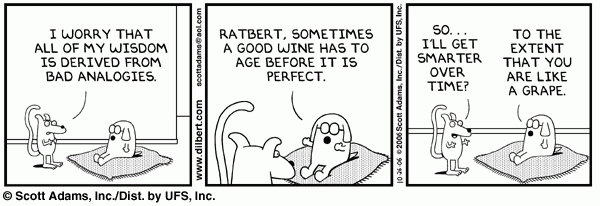
These are priceless examples of creativity gone awry.  I don’t know who originally wrote these gems or compiled them; if you know, please tell me so that I can give credit where credit is due!

21 Analogies Used by High School Students in English Essays

  1. “When she tried to sing, it sounded like a walrus giving birth to farm equipment.”
  2. “Her eyes twinkled, like the moustache of a man with a cold.”
  3. “She was like a magnet: Attractive from the back, repulsive from the front.”
  4. “The ballerina rose gracefully en pointe and extended one long slender leg behind her, like at dog at a fire hydrant.”
  5. “She grew on him like she was a colony of E. Coli and he was a room temperature Canadian beef.”
  6. “She had him like a toenail stuck in a shag carpet.”
  7. “The lamp just sat there, like an inanimate object.”
  8. “Her face was a perfect oval, like a circle that had two sides gently compressed by a Thigh Master.”
  9. “Her eyes were like the stars, not because they twinkle, but because they were so far apart.”
  10. “His career was blowing up like a man with a broken metal detector walking through an active minefield.”
  11. “The sun was below the watery horizon, like a diabetic grandma easing into a warm salt bath.”
  12. “From the attic came an unearthly howl. The whole scene had an eerie, surreal quality, like when you’re on vacation in another city and Jeopardy comes at 7:00 p.m. instead of 7:30.”
  13. “It was as easy as taking candy from a diabetic man who no longer wishes to eat candy.”
  14. “She had a deep, throaty, genuine laugh, like that sound a dog makes before it throws up.”
  15. “Their love burned with the fiery intensity of a urinary tract infection.”
  16. “It’s basically an illusion and no different than if I were to imagine something else, like Batman riding a flying toaster.”
  17. “If it was any colder, it would be like being in a place that’s a little colder than it is here.”
  18. “Joy fills her heart like a silent but deadly fart fills a room with no windows.”
  19. “The bird flew gracefully into the air like a man stepping on a landmine in zero gravity.”
  20. “He felt confused. As confused as a homeless man on house arrest.”
  21. “The revelation that his marriage of 30 years had disintegrated because of his wife’s infidelity came as a rude shock, like a surcharge at a formerly surcharge-free ATM.”

dilbert-bad-analogies

4 Comments

Filed under Cartoon, Grammar, Humor, Lists, Nuts & Bolts, Writing Exercise, Writing Prompt

Truth into Fiction

Sometimes truth is more fascinating, more adventurous than fiction.  Sometimes a news article becomes a spark for a fictional story.  One of the greatest films of all time, Titanic, took its cue from real life; many books and films are based on real life stories, mysteries, narrow escapes, historical events and experiences.  The best kinds of story sparks are those things which capture our imagination; not only best for the reader, but also for the writer – for if you are not excited by and captivated by what you’re writing about, researching and investigating, how do you expect a reader to be excited or captivated by it?  Personally, history has always fascinated me; I wonder, “What would it be like to walk among them?” or “What would it be like to discover these events as a modern archaeologist?”  I explored such a theme in my novels, “The Cardinal“.

Here are a few historical sparks that might capture your imagination; just click on  each image to link to the article:

Artifacts from the Battle of the Egadi Islands, ca. 240 BC

Battle of the Egadi Islands, 241 BC

The City of Heracleion, Plunged into the Sea

Heracleion Artifacts

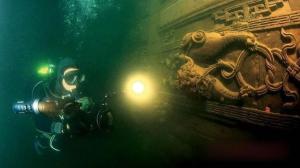
China’s Atlantis:  Shi Cheng

China's Atlantis of the East, Shi Cheng

The Skulls of  Sac Uayum

The Elongated Skulls of the Yucatan underwater cave, Sac Uayum

An Ancient Roman Shipwreck Reveals Medicinal Remedies

Roman Shipwreck with Medicinal Supplies

2 Comments

Filed under History, Images, Lists, Nuts & Bolts, Plot Thots & Profiles, Research, Writing Exercise