Category Archives: Research

The historical, geological, scientific & gadgety interests that inform and propel my writing.

A Rabble of Animals

Collective Noun - Murder of Crows

Did you know that a group of vultures has a sense of humour? Or at least the people who decided to name them did (likely back in the 16th century, when a slew of collective nouns emerged): While hanging out and doing nothing, vultures are called a committee. When feeding, they’re called a wake. There’s irony in them thar’ varmints.

Some collective nouns are common sense, and others simply common, such as packs of wolves, flocks of birds or herds of cattle; but did you know that lice flock, and sea urchins form herds, too? If I say swarm, you might think of flies or gnats or even minnows; but you could use the same word to describe a group of eels.

Worms bed, dotterels trip, cheetahs form a coalition, and Hippopotami bloat. Rhinoceroses either crash or form a stubbornness, while skunks stench and squirrels scurry. Jellyfish smack, brood or fluther, while oysters bed and goldfish glint or create a troubling. Butterflies flutter, swarm or kaleidoscope; caterpillars army, while grasshoppers cloud.

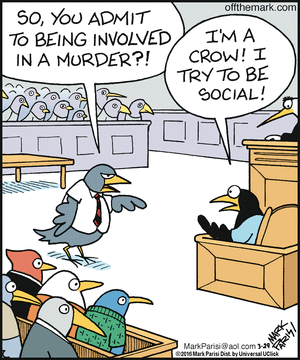
There are some fun combinations: Crows murder (they also gather as a storytelling or a parcel), Flamingos flamboyance, guillemots bazaar, gulls screech (don’t they, though?), and hawks kettle (flying in large numbers) and boil (two or more spiralling on an updraft). Hummingbirds charm, as do Magpies (unless they murder), and owls and rooks hold a parliament – I’d trust them to do so more than most politicians. Peacocks muster, ostentation and pride, while penguins tuxedo or huddle (I kid you not). Young penguins gather in a Créche, just like human toddlers, and seagulls squabble.

Starlings form beautiful murmurations and chatterings, while swifts scream and tigers ambush. I’d love to see a zeal of zebras, but not so much a prickle of porcupines. Whales pod while trout hover and stingrays fever; snails walk, frogs knot and, believe it or not, rattlesnakes rhumba! Elephants gather as a memory, while deer gang and bucks clash, and gnus form an implausibility. Running into a mob of kangaroos might be quite pleasant, but not an intrusion of cockroaches!

There are hundreds more such collective nouns; English is an ever-changing language, but some things are just too good to allow them to go the way of the Dodo, so add a few more colourful expressions to your language, and enjoy the idiosyncrasies of English!

I’ll just add that, by now, my grammar-checking program is having a nervous breakdown.

Leave a comment

Filed under Articles, Cartoon, Grammar, Humor, Lists, Nuts & Bolts, Research

History Undusted: Earrings in the 18th Century

I recently watched the film “Emma”, with Gwyneth Paltrow and Jeremy Northam; as the proposal scene was playing, I noticed her earring and wondered if that was historically accurate – did they have pierced earrings in England at that time (the early 1800s)? I’m not into fashion (that’s an understatement – I’m very pragmatic when it comes to clothes!), but the historical aspect fascinated me enough to look into the matter.

While we have probably all heard of “Girl with a Pearl Earring”, painted ~1665 by Johannes Vermeer (doubts have been raised as to whether it is actually pearl or rather polished tin or coque de perle, given the reflective qualities and size, but that’s another issue), it is a Dutch painting from the 17th century and thus doesn’t answer my question. My interest lies more in the 1700s (18th Century) of Britain, and so I began researching 18th C. English portraits.

I discovered that, while there are many portraits with earrings displayed, there are far more without. So it would have been possible, but was by no means as common as it is today. Also, sometimes the current hairstyle hid the ears, such as that of the 1770s and 1780s, or perhaps their ears were hidden by the custom of married women wearing mob caps, even beneath other “public” hats.


Mid-to-late 1780s

Typical 1780s hairstyle; such a style would have either hidden earrings or made them obsolete.


Mrs. Lewis Thomas Watson (Mary Elizabeth Milles, 1767–1818) by Sir Joshua Reynolds, 1789

A married woman wearing a mob cap under her bonnet (though from the black cape and hat combined with a white dress, she may be at the end of a period of mourning, wearing “half weeds”). Mrs Lewis Thomas Watson (Mary Elizabeth Milles, 1767–1818) by Sir Joshua Reynolds, 1789


The portraits do not reveal whether or not they were merely clip-on earrings or studs, though ear piercing has been around for centuries, varying in intensity and use from culture to culture (some for religious purposes, some for ownership such as slave earrings, and others were status symbols for royalty or nobility). I’ve found many portraits from Europe as a whole, between the 16th and 19th centuries which portray women wearing earrings; here are a few, with their details:

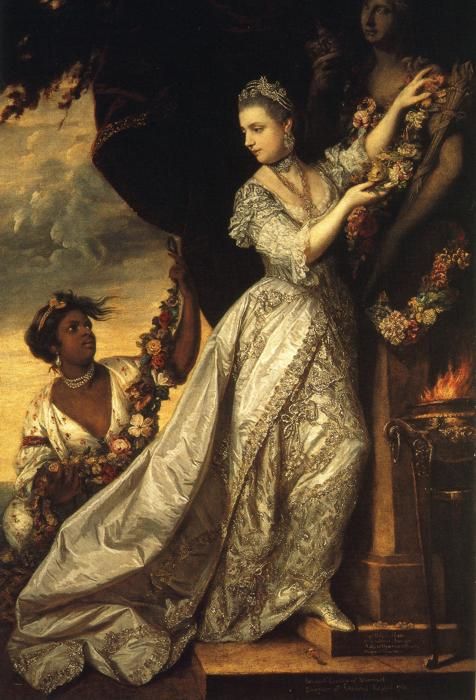
1761 Joshua Reynolds. Lady Elizabeth Keppel

1761, by Joshua Reynolds: Lady Elizabeth Keppel. Note that the Indian woman is also wearing an earring(s), and a rope of pearls; I don’t know whether she is portrayed as a servant or merely inferior in rank, due to her placement in the portrait…


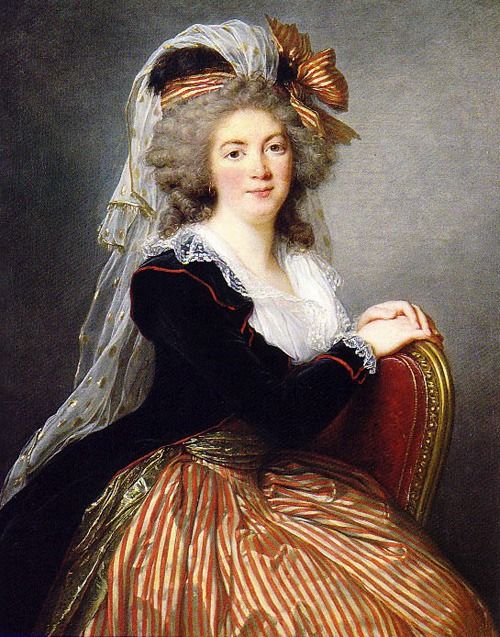
Genevieve-Sophie le Coulteux du Molay, 1788 by Elisabeth Louise Vigee Le Brun

Genevieve-Sophie le Coulteux du Molay, 1788 by Elisabeth Louise Vigee Le Brun. Though this is a French portrait by subject & painter, it is from the period in question and displays a hoop earring, as well as the hairstyle common in this period in England as well.


Turkish Dress c1776 Portrait of a Woman, possibly Miss Hill

Turkish Dress, c1776 Portrait of a Woman, possibly Miss Hill


Young Woman in Powder Blue, ca. 1777

A young woman in powder blue, ca. 1777


Thomas Gainsborough, 1727-1788 London, Portrait of Lady Anne Furye, née Greenly - born 1738

Thomas Gainsborough, 1727-1788 London, Portrait of Lady Anne Furye, née Greenly


Based on History Undusted Original Post, June 2015


4 Comments

Filed under Articles, History, History Undusted, Images, Links to External Articles, Research

History Undusted: Gibraltar

Back in 2015, my husband and I spent a few days in Gibraltar; it was the starting point for the first leg of his “south to north” European bike trips and a research trip for me; the book that resulted from such inspiration was “Asunder“.

Gibraltar is a tiny outpost of Britain at the gateway to the Mediterranean, spitting distance from Spain (as a matter of fact, I walked across the border and it took all of 2 minutes).  Its history is disproportionately immense, spanning thousands of years, as it has always been a strategic nautical or military location.  You can’t walk down a single street or lane without being reminded in some way of its military history:  There are cannons everywhere, street names and square names reflect either military leaders or garrison locations, and even the town’s parks are walled in by fortress walls.  The first known name of Gibraltar was “Calpe”, likely the Phoenician verb “kalph”, to hollow out, perhaps in reference to what is now known as St. Michael’s Cave.  There was a Roman occupation, and in 400 AD, eastern barbarians invaded; Vandals, then the Goths, and then Berber Muslims followed.  In 711 AD Tarik ibn Zeyad landed, leaving behind his name:  The Arabic phrase “Jebel Tarik” (Tarik’s Mountain) has been corrupted into the modern name of Gibraltar.  For over six centuries, with the exception of 1309 to 1333, the Rock was under Moorish occupation, though no town existed until 1160 (there were only fortifications).

In 1462 Gibraltar was retaken from the Moors by the Spanish; from there it was quibbled over between Spanish dukes, kings and queens until the Treaty of Utrecht in which Gibraltar was yielded to the Crown of Great Britain “forever”.  The Great Siege, 1779 to 1783, was Spain’s last great attempt to reclaim the Rock, and it led to the vast destruction of the town and fortifications. Spain has never forgotten the sting of losing Gibraltar, and Brexit is likely a daily topic of discussion; Gibraltar is not part of the UK but is a British Overseas Territory, and voted strongly to remain in the EU; what they will be after Brexit finally comes about is uncertain. Chances are, it will become Spanish once again, or come under co-sovereignty with Spain and Britain.

In the 19th century the phrase “As safe as the Rock of Gibraltar” entered the English language, as Gibraltar became renowned for its impregnability.  A civilian community began to grow up within the safety of the fortified walls, earning their living from commercial trade.  Today, there is still a British and American military presence, and the local language is a mixture of Spanish and English.

The Rock is dominated by the presence of the only wild monkey population in Europe, of the Barbary macaques breed; they were most likely brought as pets during the Moorish occupation.  Tourists are lower in the pecking order than the monkeys – because, in their social hierarchy, the lower in rank give their food to the higher in rank… just remember that the next time you want to feed monkeys. They usually stay up on the Rock, though we were warned not to leave our hotel window open, just in case. If they get half a chance, they’ll steal your picnic. When we first went up to the Rock, we were dismayed by the amount of rubbish everywhere, assuming it was discarded by careless humans; but it was, in fact, thieving monkies who don’t throw rubbish into the bins! And monkies were everywhere; walking toward St. Michael’s cave, we passed baby monkies playing, completely oblivious to humans; they know they’re celebrities up there, and they use it to their advantage every chance they get!

If you ever get the chance to go to Gibraltar, it’s well worth the experience. A week will give you ample time to enjoy everything it has to offer. If you like history and military history, you’ll love every nook and cranny of Gibraltar!


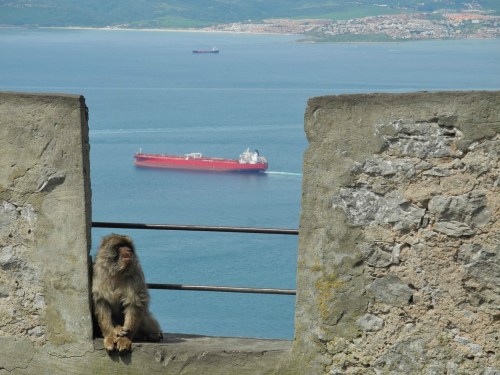
Gibraltar - Barbary macaque 2

A Barbary macaque; Spain in the distance.


Gibraltar - Reminders of Military Past, Russian Cannon

The Promenade, showing the City War Memorial honouring Gibraltarians who gave their lives in World War One. In the foreground is one of four Russian cannons (24-pounders) that arrived in GBZ in 1858 from England, having been captured in the Crimean War.

Gibraltar Rock

The Rock of Gibraltar, with Spain in the distance just beyond the airport’s single runway.

Originally posted on History Undusted 18 May 2015

3 Comments

Filed under Etymology, History, History Undusted, Military History, Research

Pareidolia

You’ve probably all heard of the “freeze, flight or fright” instinct (also known as the acute stress response, or hyperarousal) we all react with when facing a danger; it’s what our bodies automatically do to protect us. Pareidolia is related to that; it’s the name for something every human on the planet has probably experienced at some point in their lives: The tendency to interpret a shape or combination of objects as a recognizable entity or face. if we can recognize something as a friend or foe, our bodies can respond appropriately.

If we are walking in a dark forest at night and hear a twig snap, our heart races and adrenaline pumps through our veins; if we then recognize a shadowy silhouette as a bunny rather than a wolf, our body relaxes and we’ll laugh to ourselves for being silly (until we realize that bunnies should be asleep at night, and so this one must either be a were-rabbit or a zombie, but I digress). However, if the shadowy shape turns out to be a wolf, we’ll run. This is an example of the acute stress response; but Pareidolia is when we make wolves out of shoes and trousers hanging over a chair in a dark bedroom. The monsters in the closet that turn out to be a woollen jumper. The house that always seems to be smiling because of the arrangement of windows and doors.

Pareidolia is the rife playground in the imagination of many creative occupations such as cartoonists and CGI designers, and like anything else, if you focus on something, you’ll begin to see it everywhere. Once you’ve seen a smiling face in the headlights and bumper of a particular car model, it’s hard to unsee it.

So, just to put a smile on your face and on the face of an electric plug, here are a few pictures of pareidolia, gathered from Google (if you recognize one as yours, just let me know and I’ll give you the credit due!!). Some are a bit more challenging to see, like the yoda on the pig’s forehead or the downward-looking profile in the elephant’s ear, but once you’ve seen them, you’ll know! If you’ve got any examples of pareidolia, please share them in the comments below! 🙂

This slideshow requires JavaScript.

6 Comments

Filed under Articles, Etymology, Images, Musings, Research

The Long and Short of it

If you’ve been hanging around here for a while, you know I’ve written a few novels; the recent sale was a great success!

I’ve been working on something that will not only help me market those novels to a wider audience, but it’s also giving me good experience in another genre: Short stories. Just like a novel, a short has a setting, a character, character arc, conflict and resolution – just in a much more compact and simpler landscape, so to speak. You can’t afford to flesh out an ensemble of characters or have a slow-burn leading up to the time-bomb or ticking clock of conflict. I’ve been trying my hand at various lengths, from flash fiction of 6 words, or exactly 53 words long, to short stories up to 7,500 words. They all have their own challenges.

Until recently, I’d been taking a distance-learning course on the topic of short fiction, but I quickly realized that it wasn’t worth the money – and was refunded; I’ve taken a course through the same institute before, so I’ll be glad to continue looking at their options since they were helpful in resolving the issue. While the premise of the course was a good one, I am a quick and independent learner, and I’d learned enough through online research to have all the principles – it’s just about putting them into practice.

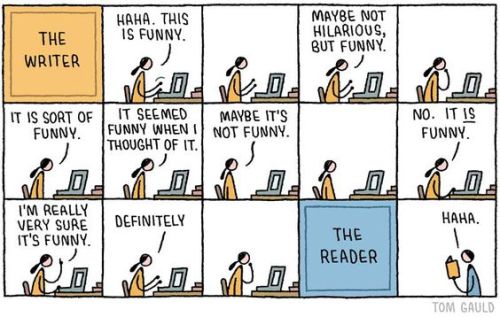
I won’t be sharing any of the stories here, because I’ll be using them to enter writing competitions, and one of the frequent prerequisites is that a story has never been released online or elsewhere. But I’ll share a cartoon with you that kind of reflects the life of a writer: Writing, re-drafting, hoping others will appreciate it, and eventually releasing the story into the wider world…

Writer vs Reader

If you’re a writer, keep at it! Hopefully you live in an area where you can join a writers’ group, or at least find other writers that can encourage you and give you feedback; if, like me, you’re on your own and living in a country that speaks another language than the one you write in, then keep at it – find your encouragers online, or within your family or circle of local friends.

If you’re interested in finding out how to write short stories, here are a few recommendations:

James Scott Bell’s “How to Write Short Stories

How to Analyze Short Stories

Short Story Tips: 10 Ways to Improve Your Creative Writing

Keep writing!

7 Comments

Filed under Articles, Links to External Articles, Publications, Research, Writing Exercise

Columbus’s Egg

1200px-columbus_breaking_the_egg'_(christopher_columbus)_by_william_hogarth

Columbus Breaking the Egg, by William Hogarth, 1752

At the end of December, I began a new training course in crafting short stories; this has renewed my interest in finding good writing prompts. By focusing on something, you usually begin to see things related to it everywhere you go. For instance, if you’re doing a puzzle and focus on the edges, you’ll begin to see them right under your nose where they’d been all along – you just hadn’t seen them before because you’d been focused on a specific colour or a particular section.

My brain is usually on rapid-fire mode; in any given second, dozens of topics flash through my thoughts. Reaching into this stream and pulling out one particular topic to focus on can lead to interesting, related issues, and Columbus’s Egg is one of the results.

The original thought that I plucked from the stream this morning was, “How do you actually spell Kobayashi Maru?” (I know, right? I’m sure you had exactly that thought as soon as your feet hit the ground this morning; it’s just that my “morning” began this afternoon as I wrote through the night and got to bed at 9:30 this morning…) By looking it up, I came across the apocryphal story about Columbus:

The story goes that Christopher Columbus, while attending a dinner, was confronted with Spanish scoffers who said that, had he not been the first to discover the Americas, someone else would have done so. He made no answer but asked a servant to bring him an egg (presumably a boiled one). He then challenged everyone present: They must try to get an egg to stand on its end, with nothing to support it in that position. Everyone tried and failed; when it was Columbus’s turn, he tapped the tip of the egg on the table, and the crushed, flat end made the egg remain upright. the moral was that a solution is obvious to everyone, but only once it has been found by someone else.

brunelleschi's dome, duomo of florence

the dome of the Santa Maria del Fiore cathedral

The story is recorded in Girolamo Benzoni’s History of the New World, published in 1565, as he related it to Columbus, but it is likely apocryphal as the same anecdote was circulating 15 years previously about the architect of the dome of the Santa Maria del Fiore cathedral in Florence, Italy.

My original thought’s term, Kobayashi Maru, is a term that any Trekkie will be familiar with: It was a no-win scenario designed to test Star Fleet cadets’ characters in the face of certain defeat. The term has gone beyond Star Trek and is used in business to illustrate the importance of changing the rules of the game in order to win, i.e. re-evaluating the foundation of a particular business scenario.

There are other such related terms, such as the Gordian KnotCatch-22, and the Archimedean point. All of these concepts are about thinking outside the box, which is exactly what I try to do as a writer.  If you’re also a writer, catch those thoughts – write them down, and let them foment into something interesting! Keep writing!

6 Comments

Filed under Articles, Etymology, History, History Undusted, Links to External Articles, Musings, Nuts & Bolts, Research, Writing Prompt

History Undusted: The Shilling

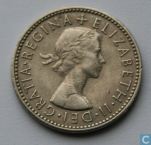
1 Shilling front

Numismatics is an interesting field, and in doing research for the Northing Trilogy, I wanted to know just what currencies would have been used at the time (1750s, England), and what the value of the currencies were:  How much could be purchased or earned?  Would a Stirling pound have made a pauper a land owner or not?  That brought me to the current book I’m reading, called “The Splendid Shilling” by James O’Donald Mays.  Here are a few bits and bobs:

The Shilling was a form of currency used in Britain up until the 1970s; even after that, the coins continued in circulation as smaller denominations (1 shilling was 5 p, and 2 shilling was 10p) until 1990, when it was demonetized.  I remember using them until they were phased out and replaced by the smaller coins of 5p and 10p values, and I kept a few for my coin collection.  One shilling coins were called “bobs”, and that led to programs such as “bob-a-job” fund raisers by the boyscouts, starting in 1914.  Two shillings were known as Florins, or “two-bob bits”.

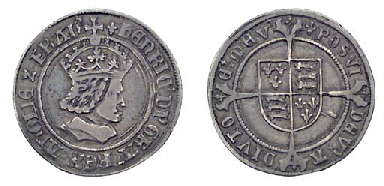
1 Shillings reverseThe word shilling most likely comes from a Teutonic word, skel, to resound or ring, or from skel (also skil), meaning to divide.  The Anglo-Saxon poem “Widsith” tells us …”þær me Gotena cyninggodedohte; se me beag forgeaf, burgwarenafruma, on þam siexhund wæs smætes goldes, gescyred sceatta scillingrime...”  “There the king of the Goths granted me treasure: the king of the city gave me a torc made from pure gold coins, worth six hundred pence.”  Another translation says that the gold was an armlet, “scored” and reckoned in shilling.  The “scoring” may refer to an ancient payment method also known as “hack” – they would literally hack off a chunk of silver or gold jewellery to purchase goods, services and land, and the scoring may have been pre-scored gold to make it easier to break in even increments, or “divisions”.  From at least the times of the Saxons, shilling was an accounting term, a “benchmark” value to calculate the values of goods, livestock and property, but did not actually become a coin until the reign of Henry VII in the 1500s, then known as a testoon.  The testoon’s name and design were most likely inspired by the Duke of Milan’s testone.
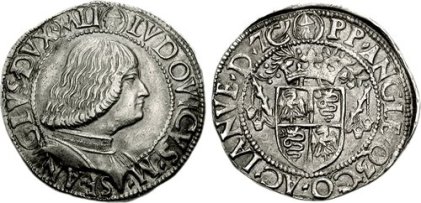
 

Duke of Milan's Testone

Duke of Milan’s Testone


Henry VII Testoon

Henry VII Testoon


Originally posted on History Undusted, 15

9 Comments

Filed under Articles, Etymology, History, History Undusted, Research

The Art of Diatom Microscopy


John Quekett.jpg

John Quekett

Recently, I came across an interesting piece of history:  During the Victorian Age, people were fascinated with nature, excursions, and technology.  Microscopes were becoming accessible to the rising middle classes of England, and one man, John Quekett, was fascinated by both microscopes and phytoplankton. He wrote a book called Practical Treastise on the Use of the Microscope, which was a hit among the Victorians, and they began discovering a hidden world of tiny creatures known as plankton and diatoms.


Plankton is what makes the ocean waters green, or aqua-blue – the differences are not only the sand or rock colour of a particular region, but also the density of microscopic life in the water. The denser the population, the lower the visibility. A teaspoon of seawater can contain a million living creatures. Regardless of their size, they underpin the marine foodchain, and indeed, all life on earth: Diatoms, which is the most common type of plankton, number in the trillions (there are over 100,000 known species to date), produce more than 20% of all oxygen on earth, and contribute nearly half of the organic life in the oceans. The shells of dead diatoms can cover the ocean bed as deep as half a mile in places, and they fertilize the Amazon basin to a tune of 27 million tons annually.

The Victorians knew very little of all that; they were at the dawn of discovery, and modern sciences owe a lot to those early intrepid explorers – women and men who braved the weather, cliffs and oceans in (heavy skirts and) leather shoes to discover, explore, and appreciate nature.  Not only did they discover it, but they began making beautiful arrangements from the various shapes – they would display their microscopic artwork to friends, much like we might look through someone’s holiday photos today.  These were known as Rosette Slides, and there is still one famous artist keeping this art form alive today: Klaus Kemp, known as the Diatomist. Here are just a few of his masterpieces; to see more, just google his name. The two links in this article will take you to two short videos on the topic.  Enjoy!

This slideshow requires JavaScript.

5 Comments

Filed under Articles, History, History Undusted, Images, Research, Science & Technology

Postcard from Lugano IV

Greetings from Lugano!  Between my last postcard to you and this one, we’ve managed to emerge from the Dark Ages here and get internet in the flat.  We’re here for another week, and are being spoilt with perfect skies, crystal blue waters on the lake, and sunshine.

Before I let photos speak for themselves, I’d like to share an interesting story that happened today: My husband and I took a ferry to a small town on the lake, called Morcote, and we happened to sit next to an older couple the same ages as my in-laws. I find people fascinating, and so we started talking; before long, I learned the origins of their family names, about accidents when the husband was a small boy, their children and grandchildren, their careers, and a lot more. When they told me their first names, I mentioned that my husband had an older cousin with the same name, whose father was killed in a train accident in 1948 in Einsiedeln. It turned out that the woman’s cousin and uncle were on that same train, one car back from my husband’s uncle; they were severely injured, but both survived.  What are the odds of someone else from Zurich being on the same boat on Lake Lugano today, sitting next to us, whose family had also been affected by the same accident 70 years ago? It just goes to prove how small the world is, and that we just might have something (or a lot) in common with the person sitting next to us on a ship, or in a train, or on a subway, or in a concert, or in a classroom – we just have to break out of our own little bubbles and reach out. And it also reminded me that sometimes the smallest actions can change lives forever: Joseph Hüsler had wanted to bring his children (2 and 4 at the time) candy after visiting his aunts in Einsiedeln; he forgot, got off the first train he’d been on, and spent more time with the aunts after he’d purchased the candy, until the next train departed. That was the train that crashed. Curious, I found a couple archive photos from the time of the accident; here they are (both images, credit – http://www.waedenswil.ch):

1948 Zugunglück Wädenswil-Einsiedeln - 22 Februar 1948, 22 Starb - waedenswil.ch1948 Zugunglück - Wädenswil-Einsiedeln - 22 Starb - waedenswil.ch

We had a wonderful visit with the couple, and then waved goodbye as we went our separate ways. So, as promised, here are a few images of Lugano, Morcote, and surrounding towns:

This slideshow requires JavaScript.


2 Comments

Filed under Articles, History, Images, Links to External Articles, Research

History Undusted: Hnefatafl (Viking Chess)

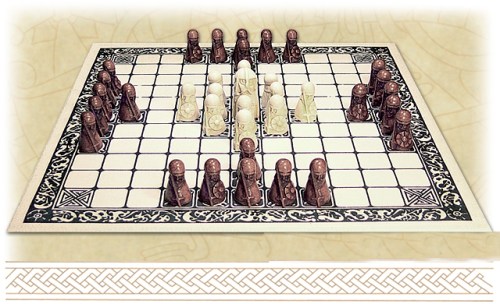
hnefatafl

Hnefatafl (meaning King’s Table, aka “Viking Chess”) is a board game that originated in Northern Europe; the oldest board found to date was located in Denmark, dated to ~ 400 BC. Because no written history of that period for northern Europe exists, apart from runic inscriptions on stone, wood, and bone, the rules of this game had to be recreated, so there are no hard and fast rules agreed upon by those who play it.  It is far older than chess, which originated in northern India in the 6th century AD and spread to the rest of the world through Persia.

In Hnefatafl, the game is played on a square board (as pictured). There are five spaces on the board that are considered special: The space in the centre of the board is the ‘Throne’ space, and the four corner spaces are the escape points for the King.

Unlike most modern board games, Hnefatafl does not start with even-strength sides (as in chess). The two sides are divided into attackers and defenders; in the illustration, the pieces along the edges of the board are the attackers, and those in the centre are the defenders. The objective of the attacker is to capture the king (centre). The objective of the defenders is to protect the king long enough for him to escape.

The board shown above is a modern version; but online, I’ve seen a wide variety of boards, from draw-bags of leather with stone pieces to wooden blocks on a large outdoor board.  I’m certain that the travelling Norse, who loved board games, word games and competitions of any sort, would have made do with whatever was at hand and would have also had travel versions of their favourite games, just like we do today.

For further information, check out the Wikipedia article, or see the rules and how to play the game here.

Originally posted on History Undusted,

15 Comments

Filed under History, History Undusted, Links to External Articles, Military History, Research