I do a lot of crafts. I mean, a lot variety-wise, and a lot quantity-wise. When I’m not writing, managing our household, planning meetings or teaching students (I’m a vocal coach and an English teacher for adults), I’m usually doing some kind of craft, and it more often than not involves some form of upcycling – turning “trash” into “treasures”. Recently, I’ve been making sheets of plastic-confetti-filled bubble wrap, ironed into what’s known as “ploth” (plastic cloth). These can then be sewn into bags, etc. It got me to thinking about just how bubble wrap came to be. I have tons of the stuff, stashed here and there in the craft room, for such projects – and I’m constantly on the lookout for creative uses for that poppable fun.
Did you know that originally it wasn’t intended as packing material but as wallpaper? In 1957, Swiss chemist Marc Chavannes and his business partner, Alfred Fielding, wanted to make a wallpaper that would appeal to the emerging Beat culture [for those of you unfamiliar with that term, it was a generation of post-war, anti-establishment rebels who were more or less the precursor to the 60’s hippie and counterculture movements]. What the partners did was simple enough: They put two layers of a plastic shower curtain through a heat-sealing machine. But it came out in what they first saw as a failure, with air bubbles trapped between the two layers. They figured they were onto something, failure or not, and so they got a patent and then began experimenting to find other uses. Wallpaper wasn’t popular; neither was their suggestion to use it as insulation for greenhouses (perhaps that was simply a matter of marketing to the wrong demographic). Then, around 1960, IBM began shipping their newly-designed 1410 computers and needed a way to protect the delicate dinosaurs – eh, I mean, computing mammoths. That’s a LOT of bubble wrap. The rest is, as they say, history. And in case you’re wondering, yes, people have been popping the bubbles from the beginning, just for fun. So much fun, in fact, that the last Monday of every January is officially “Bubble Wrap Appreciation Day”.
Click on the image below to watch an IBM recruiting film (1 minute), from 1960. You can also see one of IBM’s massive scientific mainframes being used by the original “computers” of NASA in the film “Hidden Figures“.
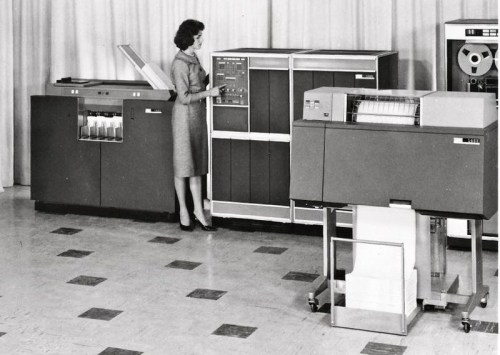
IBM’s 1410 computer promotional photo, 1959. Credit, Computer History Museum archives



 My husband and I once discussed mustard (as one does). Specifically, he had been on Google Earth and mentioned that he saw rapeseed fields near Dijon; I replied that they were more likely to be mustard fields. He was under the impression that mustard was a bush, or a tree, and we wondered if there might be varieties of the plant that ranged in size, especially if left to grow wild. And thus, a bit of research into the mustard plant ensued (naturally).
 mustards; when travelling through a few years ago, we picked up jars of orange mustard, fig mustard, lavender mustard and tomato mustard. They often come in hand-painted pots, though plain glass jars are common as well. The word mustard itself comes from Old French mostarde, which comes from Latin mustum, meaning “new wine”. This may also be related to a Swiss-German term Most, meaning apple juice that’s nearly fermented; it’s often sold in the autumn from farmer’s shops, if they have an apple orchard from which to produce it.